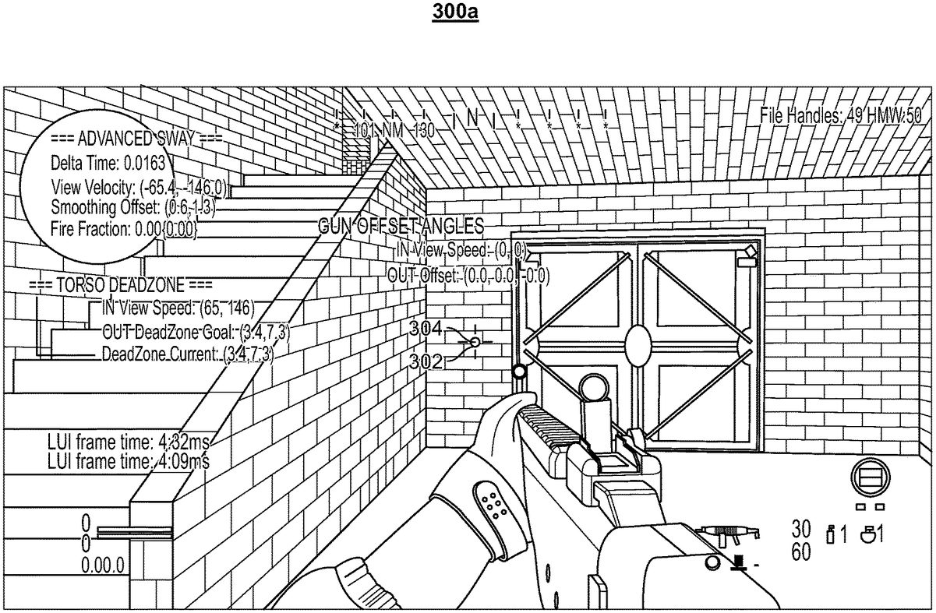
On October 23, 2023, the U.S. Patent Office issued U.S. Pat. No. 12,172,075, which was assigned to Activision Publishing, Inc. The patent concerns “systems and methods for programming movements of player-controlled avatars in video games. The following figure shows a more specific focus for the patent: improving the realism and game feel of Activision’s famous Call of Duty first-person shooter franchise.
One of the patent’s purposes seems to be to impart “dynamic, non-linear and realistic movement and look and feel to a player’s/virtual character’s first-person limbs and hand-held object model” while “procedurally animating a first-person virtual camera such that it simulates the movement of a camera handheld by the player/virtual character.” In layman’s terms, this seems to mean that one goal is to make first-person shooters feel as good as possible to play.
With over 100 million global monthly players, it’s no wonder why Activision continues to invest in their flagship franchise.
Illustrative Claim:
1. A method of programming a virtual character in a video game, wherein the virtual character is characterized by a torso having a torso mass and a torso anchor, the method being implemented by at least one server executing a plurality of programmatic instructions and comprising: generating, in at least one graphical user interface, one or more first parameter inputs for customizing an orientation of the torso;
receiving responses to said one or more first parameter inputs;
generating, in the at least one graphical user interface, one or more second parameter inputs for customizing characteristics of a first two-dimensional mass-spring-damper system, wherein the first two-dimensional mass-spring-damper system connects the torso orientation to an orientation of the torso anchor;
receiving responses to said one or more second parameter inputs;
and rendering the virtual character in accordance with the first parameter inputs and the second parameter inputs.