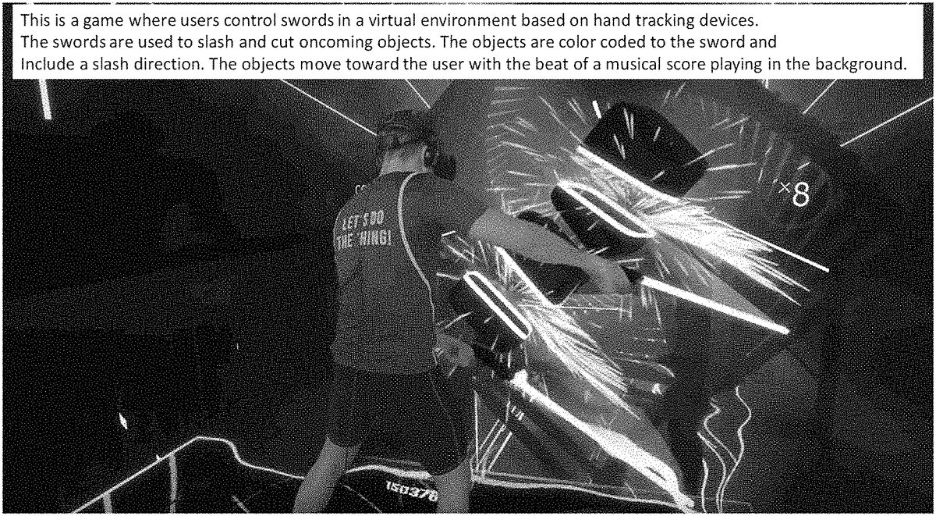
Beat Saber became a virtual reality mega-hit upon its full release in 2019. For Facebook, this meant an opportunity to patent what was under the hood of the game. Meta, the Facebook parent company, acquired Beat Saber’s developer, Beat Games, in November 2019. Two years later, the U.S. Patent Office issued U.S. Pat. No. 11,361,517 to Facebook Technologies, LLC. The patent relates to a rhythm-based video game in which “a player slashes blocks representing musical beats using a pair of energy blades resembling a lightsaber.” In other words, this seems to be the Beat Saber patent.
The game became big enough so quickly that Facebook jumped at its chance to stave off copycats. The implementation of the patent so soon after the game came out is evidenced by the fact that the patent’s figure features a photo of someone actually playing the game rather than a stylized graphic. Such direct, 1-to-1 portrayals of real-world products is a relative rarity in video game patents.
Illustrative Claim:
1. A method comprising: rendering a 3D virtual space that includes a digital position of a user and multiple object traversal paths;
defining a center position of the 3D virtual space, wherein the multiple object traversal paths are at different angles relative of the center position and each object traversal path intersects the center position, and the digital position of the user is associated with the center position;
instantiating, in the 3D virtual space, a first digital element, wherein a set of coordinates and orientation of the first digital element correspond to an orientation and position of a first real hand of the user;
graphically representing a plurality of digital objects in the 3D virtual space that each approach the center position from a distance along one of the multiple object traversal paths;
and causing a game action to occur in response to a digital collision in the 3D virtual space between a first digital object of the plurality of digital objects and the first digital element.