Since Japan Studios’ PaRappa the Rapper came out for the original PlayStation in 1997, rhythm-based video games have become fan favorites around the world for their striking combination of music, groove, and tight gameplay. In this piece, we’ll consider active U.S. patents attributed to games in this genre.
Starting out with a patent that helped cement Rock Band and its group of plastic instruments in the video gaming zeitgeist, this patent concerns the rendering of the bass drum foot pedal cue on Rock Band’s scrolling, color-coordinated beat boxes as a line that spans all four input lanes. The patent helped distinguish this unique function of the game’s drum kit while also containing language that connected this “additional cue” to alternative functions on other instruments like “an open strum” on a “simulated guitar.
In the following figure, you can see the patent’s authors making a reference to the famous Rolling Stones song “Gimme Shelter,” a memorable track from Rock Band’s campaign.
Illustrative Claim:
1. A method executed by a game platform for rendering, on a screen display, a foot-pedal cue in a rhythm-action video game, the method comprising:
a. displaying via the screen display, to a player of the rhythm-action video game, a lane divided into at least two sub-lanes, each sub-lane containing cues indicating a drum input element;
b. displaying via the screen display, to the player, an additional cue spanning a plurality of the sub-lanes and not confined to a distinct sub-lane, the additional cue indicating a foot pedal action; and
c. displaying via the screen display, to the player, a cue contained within a sub-lane and overlaid over the additional cue spanning a plurality of the sub-lanes.
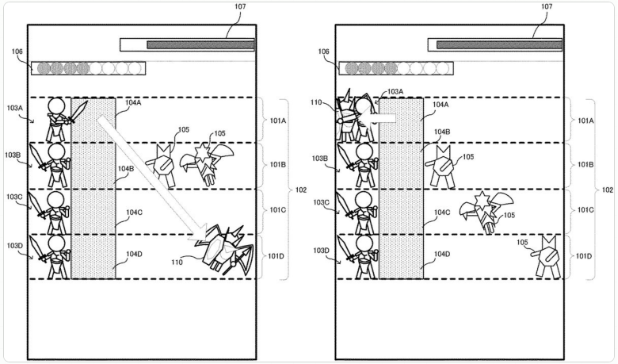
This patent refers to the interaction between what the authors of this patent call a “present embodiment,” such as a smart device like a phone or tablet, and a “game apparatus,” like a video game console or personal computer. Essentially, the patent relates to the input operations on the present embodiment and how they are rendered by the game apparatus that is tracking said input. Such interaction is especially important in the context of a rhythm video game, since any lag in the interplay between such devices could cause the experience to feel off-beat.
The following figure shows enemies moving in relation to the player character being controlled by a smart device and subsequently rendered by a game console.
Illustrative Claim:
21. A game system comprising:
a display screen; and
at least one processor configured to execute a rhythm game by performing functionality comprising:
moving an enemy element displayed on the display screen such that the enemy element reaches the first area at a predetermined timing related to rhythm provided in the rhythm game;
changing a parameter related to the enemy element when an operation input to an input section is performed at the predetermined timing;
and after the enemy element reaches the first area, when an operation input to the input section is performed at the predetermined timing, and provided that the parameter does not satisfy a predetermined condition, moving the enemy element to a second area different from the first area and then repeating the movement of the enemy element displayed on the display screen towards the first area from the second area, and when an operation input to the input section is not performed at the predetermined timing, moving the enemy element past the first area to a third area different from the first and second areas, and then having the enemy element appear on the display screen in the second area and move from the second area towards the first area.
This patent concerns the creation and customization of “interactive components” based on a multimedia file, like an mp3, to “generate and play” games associated with said multimedia file. The holder of this patent could design code meant to configure “a plurality of interactive components corresponding to the plurality of rhythmic points based on one or more predetermined rules monitoring a progress of playing the multimedia file.” This boils down to having the ability to create a rhythm game by intaking an mp3 file and rendering graphical interactions at key points in its melody. An example of such a technique could be thought of as similar to the Rock Band-style inputs we discussed in the first patent in this article.
Illustrative Claim:
1. A method of generating and playing games based on a multimedia file, comprising:
obtaining a target audio signal from the multimedia file;
determining a plurality of rhythmic points in the target audio signal;
configuring a plurality of interactive components corresponding to the plurality of rhythmic points based on one or more predetermined rules;
monitoring a progress of playing the multimedia file; and
displaying a target interactive component on an interface of playing the multimedia file in response to determining that the progress of playing the multimedia file reaches a time point corresponding to one of the plurality of rhythmic points, wherein the target interactive component is an interactive component among the plurality of interactive components corresponding to the one of the plurality of rhythmic points.
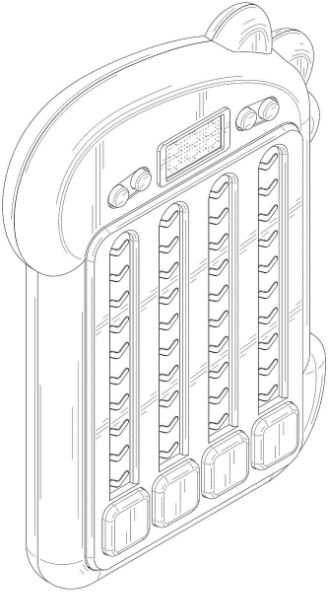
U.S. Design Pat. No. D1,057,020– The Rhythm Master Game Console –Issued on Sept. 23, 2024
Short and sweet, this patent concerns the design of the Rhythm Master Game Console, a futuristic-looking contraption that has yet to see a commercial application.
And there you have it–a run down of active rhythm video game patents. Head on over to our Video Game Patent Database for more information.