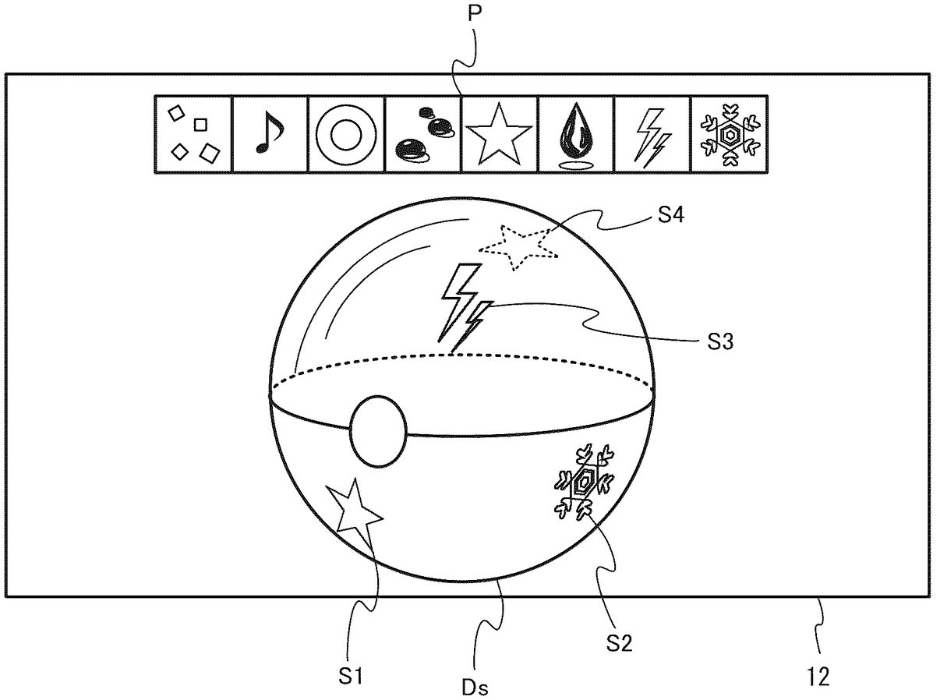
U.S. Pat. No. 12,151,165 relates to Nintendo and The Pokémon Company’s ongoing innovations on the Pokéball, the catching apparatus used in their famous Pokémon media franchise. The patent concerns itself with the “types and arrangement of … decorative items on [a] two-dimensional object [that are then] are stored into a storage medium according to a determination instruction based on an operation input.” In plain language, this means that the Pokéball might change its appearance based on the virtual creature contained within it. This innovation is made apparent in the following figure.
Although this patent is narrowly focused on “a decoration arrangement” of the Pokéball, it demonstrates Nintendo and The Pokémon Company’s ongoing interest in making sure that their highest grossing franchise continues to stand apart from competitors.
Illustrative Claim:
1. A non-transitory computer-readable storage medium having stored therein a game program that when executed by a computer of an information processing apparatus, causes the computer to perform operations comprising:
in a decoration arrangement situation where a plurality of decorative items to be added to a first item are disposed in a game:
selectively switching a user interface between a first user interface and a second user interface according to a choice instruction based on an operation input, in association with the first user interface being chosen, displaying a two-dimensional user interface object indicating an arrangement range of the decorative items to be added to the first item within the first user interface, and disposing the decorative items at locations in the range on the two-dimensional user interface object designated according to an operation input, in association with the second user interface being chosen, displaying a three-dimensional user interface object indicating an arrangement range of the decorative items to be added to the first item within the second user interface, and disposing the decorative items at locations in the range on the three-dimensional user interface object designated according to an operation input, and storing, into a storage medium, types and arrangement of the decorative items on the two-dimensional object, or types and arrangement of the decorative items on the three-dimensional object, according to a determination instruction based on an operation input;
and in an item use situation where the first item is used in a game: displaying the first item;
and displaying a scene based on the types and arrangement of the decorative items associated with the first item.