DETAILED DESCRIPTION OF ILLUSTRATIVE EMBODIMENTS
In order to make the purpose, technical solutions, and advantages of the present application clearer, the following further describes the present application in detail with reference to the accompanying drawings and embodiments. It should be understood that the specific embodiments described here are only used to explain the present application, and not used to limit the present application. Based on the embodiments in the present application, all other embodiments obtained by those of ordinary skills in the art without creative work are falling within the protection scope of the present application.
It should be noted that the descriptions related to “first”, “second” and so on in the embodiments of the present application are only for descriptive purposes, and cannot be understood as indicating or implying their relative importance or implicitly specifying the indicated technical features quantity. Therefore, the features defined with “first” and “second” may explicitly or implicitly include at least one of the features. In addition, the technical solutions between the various embodiments can be combined with each other, but they must be based on what can be achieved by those of ordinary skill in the art. When the combination of technical solutions is contradictory or cannot be achieved, it should be considered that such a combination of technical solutions does not exist, and is not within the scope of protection required by the present application.
In the description of the present application, it should be understood that the numerical label before the steps does not identify the sequence of execution of the steps, and is only used to facilitate the description of the present application and distinguish each step, and therefore cannot be understood as a limitation of the present application.
The computer device2may be configured to provide multimedia playing services. The multimedia play services may be configured to receive content via various transmission technologies and play the received content. The content may include content streams (for example, video streams, audio streams), content files (for example, a video file, an audio file), and/or other data.
The computer device2may be configured to access the content and services of a provider network4. The computer device2may be a mobile device such as a smart phone, a tablet device, an augmented reality/virtual reality device. The computer device2may be associated with one or more users. A single user can use the computer device2to access the provider network4. The computer device2can travel to various locations and use different networks to access the provider network4.
The computer device2may include an application2A and other applications. The application2A outputs (such as displays, renders, and presents) the content to the user. The application2A may be a multimedia player (such as a bilibili client), a browser client, and so on. As an example,FIG. 1displays a video screen when the application2A plays a cartoon video.
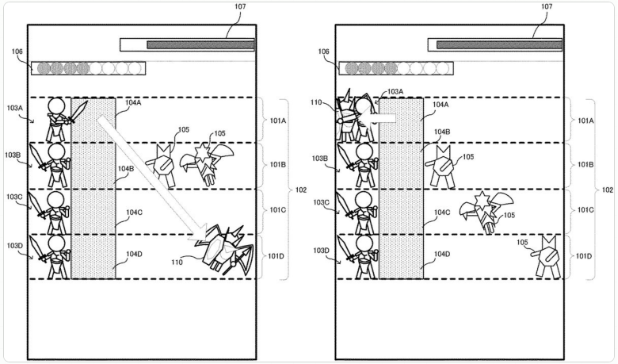
As shown inFIG. 1, under an audio game mode, the computer device2can perform the following operations: generating different interactive components (such as Z1) in real-time according to the video file, and using the video screen of the video file as a game background of the interactive component (such as Z1), which enables users to experience audio games while watching the video screen of the video file, so as to achieve a multi-faceted experience of vision, hearing and human-computer interaction, and increase user's interest. It should be understood that a video scene shown inFIG. 1is exemplary and is not used to limit the scope of protection of the present application.
A First Embodiment
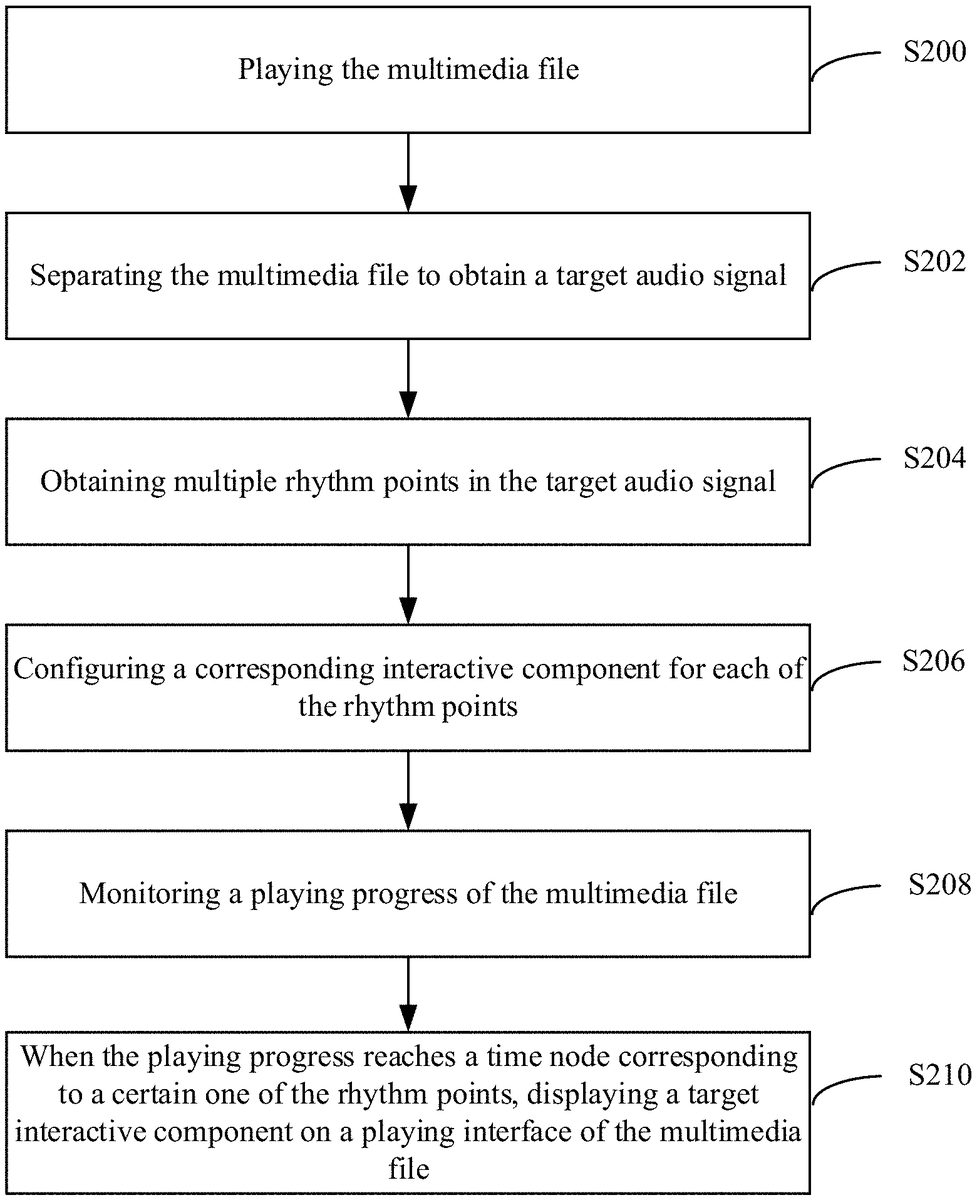
FIG. 2schematically shows a flowchart of a game playing method based on a multimedia file according to a first embodiment of the present application. The following is an exemplary description using a computing device2as an executive body. As shown inFIG. 2, the game playing method based on a multimedia file may include steps S200to S210, wherein:
Step S200, Playing the Multimedia File.
The multimedia file may include various types of audio and video content, such as music, cross-talk, or other types of content. For music type, pure music content without lyrics can be included, or music content with lyrics can be included.
The multimedia file may be a local file in the computer device2or an online file obtained through the Internet.
Step S202, Separating the Multimedia File to Obtain a Target Audio Signal.
In order to improve the accuracy of detecting rhythmic points in the multimedia file, the target audio signal is an audio signal without noise signal interference or the noise signal interference being controlled within a preset range, or an audio signal after removing noise signals.
Which signals in the multimedia file can be considered as noise signals is determined according to a source of rhythmic points. For different types of content, users focus on a different sense of rhythm, and sources of the rhythmic points may also be different. In an exemplary embodiment, a source of the rhythmic points may be determined according to classification, introduction, and comment keywords of the multimedia file. For example, music-type audio and video content often has a sense of rhythm from music beats and so on, so the rhythmic points can be music drums or sounding points of lyrics. The rhythm of cross-talk-type audio and video content often comes from word rhythms of cross-talk performers, so the rhythmic points may be sounding points of each word or the sounding points with an accent.
As an example, the multimedia file is a music-type audio and video content, and the computer device2can search for rhythmic points from a music audio signal in the multimedia file. That is, the computer device2may use the music audio signal as the target audio signal and a non-music audio signal as a noise signal. In subsequent operations, an interactive component that interacts with a user is generated based on these rhythmic points, so that the user can interact with audio beats. As shown inFIG. 3, step S202may include steps S300to S304, wherein: step S300, extracting initial audio signals of the multimedia file; step S302, determining the music audio signal and the non-music audio signal in the initial audio signals; and step S304, separating the initial audio signals to obtain the target audio signal corresponding to the music audio signal. In some embodiments, the computer device2can separate the music audio signal and the non-music audio signal in the initial audio signals through a trained deep neural network model or the like. Of course, the computer device2may also implement the separation operation in step S402in other ways, such as time domain or frequency domain analysis.
Step S204, Obtaining Multiple Rhythmic Points in the Target Audio Signal.
The multiple rhythmic points may be music drums, sounding points of lyrics, sounding points of each word in the process of performing a cross-talk program, and the like.
First, the multiple rhythmic points are the music drums.
In order to detect the multiple rhythmic points effectively and quickly, as shown inFIG. 4, step S204may include steps S400to S402, wherein: step S400, detecting the target audio signal to obtain multiple music drums from the target audio signal according to a detection result; and step S402, determining each of the music drums as one corresponding rhythmic point.
The music drums may be strong drums and/or weak drums, and maybe audio segments or audio points whose energy change range exceeds a first threshold, pitch change range exceeds a second threshold, or timbre change range exceeds a third threshold.
The computer device2can implement the detection operation in step S400through the trained deep neural network model, time-domain analysis, or frequency domain analysis. Wherein, the deep neural network model is to identify the multiple music drums through audio features in the target audio signal. The time-domain analysis is to find the multiple music drums by calculating an energy accumulation of the waveform file. The frequency-domain analysis is to find the multiple music drums by calculating spectral energy changes.
Second, the multiple rhythmic points are the sounding points of lyrics.
In order to detect the multiple rhythmic points effectively and quickly, as shown inFIG. 5, step S204may include steps S500to S502, wherein: step S500, obtaining a lyric text of the target audio signal; and step S502, predicting a sounding point of each lyric in the lyric text to determine the sounding point of each lyric as one corresponding rhythmic point.
The sounding point of each lyric corresponds to a moment when each word or accented word in the lyrics begins to sound.
The computer device2can predict a probability of whether each word belongs to the accent, a long tone, and the like through the lyrics when singing. Take the lyric “” as an example, when it is predicted that the probability of “” being an accent when singing is 99%, then the sounding of “” when being sung is regarded as one sounding point, and a time node of the sounding point of “” can be the moment when “” begins to sound.
The computer device2can predict the sounding points of each lyric through various models such as the trained deep neural network model, a long short-term memory network, and so on.
Third, the multiple rhythmic points are the sounding points of each word in the process of performing the cross-talk program.
As mentioned above, if the multimedia file is cross-talk-type audio and video content, the user pays more attention to rhythm of the language.
Therefore, when the multimedia file is cross-talk-type audio and video content, the target audio signal is a human voice signal. That is, the computer device2may use the sounding points of each word as the rhythmic points, or the accented sounding points as the rhythmic points.
The above only provides methods for obtaining rhythmic points in several situations, which are not used to limit the scope of protection of the present application.
In order to effectively find the rhythmic points that conform to the artistic conception, when the multimedia file is music-type audio and video content, the computer device2can search for the rhythmic points based on a music style. As shown inFIG. 6, step S204may include steps S600to S602, wherein: step S600, identifying the music style of the target audio signal; and step S602, finding the multiple rhythmic points from the target audio signal by a preset rule adapted to the music style. It should be noted that the preset rule corresponding to a different music style may be pre-defined, or may be obtained through training on massive audio data sets of the same style.
Step S206, Configuring a Corresponding Interactive Component for Each of the Rhythmic Points.
The interactive component may be various types of touch-sensitive interactive components, such as a point-touch interactive component, a long-press interactive component, and a sliding interactive component. Each type of interactive component can include a variety of components with different shapes and colors.
Each of the rhythmic points corresponds to at least one interactive component. The type and spatial location of the interactive component corresponding to each of the rhythmic points can be determined in the following ways:
In the exemplary embodiment, as shown inFIG. 7, step S206may include step S700, wherein: step S700, determining an interaction type of an interactive component of an i-th rhythmic point according to a time interval between the i-th rhythmic point and a preset number of adjacent rhythmic points; wherein i is a positive integer and i≤N, and the N is a number of the multiple rhythmic points. As the example, for rhythmic points with sparse rhythms, touch-sensitive interactive components may be configured; long-press interactive components are used for parts with dense rhythmic points and singers with drag, and variety and fun interaction is achieved through different forms of strategy combinations based on music styles.
In the exemplary embodiment, as shown inFIG. 8, step S206may include step S800, wherein: step S800, determining a spatial position of an interactive component of an i-th rhythmic point according to a time node of the i-th rhythmic point and an interaction type of the corresponding interactive component; where i is the positive integer and i≤N, and the N is the number of the multiple rhythmic points. As the example, the computer device2can generate the spatial position of each interactive component according to different preset curve fitting distributions. The spatial position may be a relative position of the corresponding interactive component in a playing interface. The spatial positions of all interactive components can be saved in an audio game map, the audio game map can include various related information such as the relative position of each interactive component on the playing interface, a longest continuous display time, and so on. It should be understood that the preset curve fitting distribution is obtained by fitting according to time intervals of the rhythmic points, type of the rhythmic points, and/or setting rules.
Of course, the spatial position of the interactive component of the i-th rhythmic point can also be determined based on a playing screen.
Step S208, Monitoring a Playing Progress of the Multimedia File.
The playing progress is a current playing time point corresponding to the multimedia content (video frame) currently being played. The current playing time point is a relative position point or a progress percentage in a total playing time interval.
Step S210, when the playing progress reaches the time node corresponding to a certain one of the rhythmic points, displaying a target interactive component on the playing interface of the multimedia file; wherein, the target interactive component is an interactive component corresponding to the certain one of the rhythmic points.
The target interactive component can generate a corresponding response according to user's touch operations in a touch area, thereby realizing human-computer interaction.
In the case that the spatial position of the target interactive component has been determined, the computer device2can perform the following operations: first, displaying the target interactive component on the playing interface of the multimedia file according to the determined spatial position; second, monitoring the user's touch operations on the target interactive component; third, generating a corresponding response according to an interactive logic of the target interactive component. Wherein, the corresponding response may include: dynamic changes, disappearance, and other state changes of the target interactive component on the playing interface.
As shown inFIG. 9, in the case that the spatial position of the target interactive component is not determined, the computer device2may perform step S900: popping up the target interactive component in a target area, wherein the target area is a background area of a video screen of a video file. As the example, the multimedia file is the video file, and a pop-up time of the target interactive component is 52 minutes and 18 seconds, and the longest duration is 0.5 seconds, which means that: when the video file is played from 52 minutes 18 seconds to 52 minutes 18.5 seconds, the target interactive component may be displayed on the video screen. In this case, if the target interactive component covers a main screen (such as human faces, animals, and so on), the video's viewing experience will be affected. Therefore, the computer device2can detect all video frames or several front-row video frames from 52 minutes 18 seconds to 52 minutes 18.5 seconds in the video file, find a part of common background areas of these video frames as much as possible, and display the target interactive component in this part of the background areas. The advantage is that a visual viewing experience of the user is ensured as much as possible, and at the same time, audio interactive games can be performed, which greatly improves the user's experience.
The game playing method based on a multimedia file provided in the embodiments of the present application enables the computer device to automatically detect each of the rhythmic points in the multimedia file during the process of playing the multimedia file, temporarily configure corresponding interactive components for each of the rhythmic points, and pop up and display the corresponding interactive component on the playing interface for interactive operation with the user when the multimedia file is played to the time node corresponding to each rhythmic point. That is to say, in the embodiment, on the premise that the multimedia file itself does not provide interaction, different interactive components can be temporarily configured according to the content of the multimedia, which makes it possible to dynamically pop up temporarily displayed interactive components at different time nodes while outputting visual information and auditory information, thereby interacting with the user on the playing interface of the multimedia file by the interactive components that pop up in real time, the user's experience is improved, and the scope of application is wide.
In the embodiment, the computer device2can generate interactive components in real time according to the current playing content, which effectively increases the interactive modes of the audio game, thereby realizing visual, auditory, and human-machine interaction, and improving the user's experience.
A Second Embodiment
FIG. 10schematically shows a block diagram of a game playing system based on a multimedia file according to a second embodiment of the present application, the game playing system based on a multimedia file may be divided into one or more program modules, and the one or more program modules are stored in a storage medium and executed by one or more processors to complete the embodiment of the present application. The program modules referred to in the embodiment of the present application refer to a series of computer program instruction segments capable of completing specific functions. The following description will specifically introduce the function of each program module in the embodiment.
As shown inFIG. 10, the game playing system based a multimedia file1000may include a playing module1010, a separating module1020, an obtaining module1030, a configuring module1040, a monitoring module1050, and an interactive module1060, wherein:
The playing module1010, playing the multimedia file.
The separating module1020, separating the multimedia file to obtain a target audio signal.
The obtaining module1030, obtaining multiple rhythmic points in the target audio signal.
The configuring module1040, configuring a corresponding interactive component for each of the rhythmic points.
The monitoring module1050, monitoring a playing progress of the multimedia file.
The interactive module1060, when the playing progress reaches a time node corresponding to a certain one of the rhythmic points, displaying a target interactive component on a playing interface of the multimedia file; wherein, the target interactive component is an interactive component corresponding to the certain one of the rhythmic points.
In an exemplary embodiment, the separating module1020, is further for extracting initial audio signals of the multimedia file; determining a music audio signal and a non-music audio signal in the initial audio signals; and separating the initial audio signals to obtain the target audio signal corresponding to the music audio signal.
In the exemplary embodiment, the obtaining module1030, is further for detecting the target audio signal to obtain multiple music drums from the target audio signal according to a detection result; and determining each of the music drums as one corresponding rhythmic point.
In the exemplary embodiment, the obtaining module1030, is further for: obtaining a lyric text of the target audio signal; and predicting a sounding point of each lyric in the lyric text to determine the sounding point of each lyric as one corresponding rhythmic point.
In the exemplary embodiment, the obtaining module1030, is further for identifying a music style of the target audio signal; and finding the multiple rhythmic points from the target audio signal by a preset rule adapted to the music style.
In the exemplary embodiment, the configuring module1040, is further for: determining an interaction type of an interactive component of an i-th rhythmic point according to a time interval between the i-th rhythmic point and a preset number of adjacent rhythmic points; wherein i is a positive integer and i≤N, and the N is a number of the multiple rhythmic points.
In the exemplary embodiment, the configuring module1040, is further for determining a spatial position of an interactive component of an i-th rhythmic point according to a time node of the i-th rhythmic point and an interaction type of the corresponding interactive component; where i is the positive integer and i≤N, and the N is the number of the multiple rhythmic points.
In the exemplary embodiment, the multimedia file is a video file; and the interactive module1060, is further for popping up the target interactive component in a target area, wherein the target area is a background area of a video screen of the video file.
A Third Embodiment
FIG. 11schematically shows a schematic diagram of a hardware architecture of a computer device2suitable for implementing a game playing method based on a multimedia file according to a third embodiment of the present application. In the embodiment, the computer device2is a device capable of automatically performing numerical calculations and/or information processing according to predefined or stored instructions, such as can be a smartphone, a tablet, a laptop, a desktop computer, a rack server, a blade server, a tower server or a rack server (including independent servers, or server clusters composed of multiple servers), etc. As shown inFIG. 11, the computer device2includes, but is not limited to, a memory1110, a processor1120, a network interface1130, and a vibration element1140that can be communicated with each other through a system bus. Wherein:
The memory1110includes at least one type of computer-readable storage medium. The readable storage medium includes flash memory, hard disk, multimedia card, card type memory (such as SD or DX memory, etc.), random access memory (RAM), static random access memory (SRAM), read-only memory (ROM), electrically erasable programmable read-only memory (EEPROM), programmable read-only memory (PROM), magnetic memory, magnetic disk, optical dis and so on. In some embodiments, the memory1110may be an internal storage module of the computer device2such as a hard disk or memory of the computer device2. In other embodiments, the memory1110may also be an external storage device of the computer device2, such as a plugged hard disk provided in the computer device2, a smart media card (SMC), secure digital (SD) card, a flash memory card, and so on. Of course, the memory1110may also include both an internal storage module and an external storage device of the computer device2. In the embodiment, the memory1110is generally used to store an operating system and various types of application software installed in the computer device2such as program codes of the game playing method based on a multimedia file and the like. In addition, the memory1110may also be used to temporarily store various types of data that have been or will be outputted.
The processor1120, in some embodiments, may be a central processing unit (CPU), a controller, a microprocessor, or other data processing chip. The processor1120is generally used to control the overall operation of the computer device2such as performing control and processing related to data interaction or communication with the computer device2. In the embodiment, the processor1120is used to run program code stored in the memory1110or process data.
The network interface1130may include a wireless network interface or a wired network interface which is generally used to establish a communication connection between the computer device2and other computer devices. For example, the network interface1130is used for connecting the computer device2to an external terminal via a network and establishing a data transmission channel and a communication connection between the computer device2and the external terminal. The network can be a wireless or wired network such as an enterprise intranet, an Internet, a Global System of Mobile communication (GSM), a Wideband Code Division Multiple Access (WCDMA), a 4G network, a 5G network, a Bluetooth, Wi-Fi, and so on.
It is to be noted thatFIG. 11shows only the computer device2having components1110-1130, but it is understood that it is not required to implement all of the shown components and that more or fewer parts can be implemented in lieu thereof.
In the embodiment, the game playing method based on a multimedia file stored in the memory1110may be divided into one or more program modules and executed by one or more processors (processor1120in the embodiment) to complete the embodiment of the present application.
A Fourth Embodiment
The present application further provides a computer-readable storage medium, which stores computer programs, and when the computer programs are executed by a processor to realize the steps of a game playing method based on a multimedia file in the embodiment.
In the embodiment, the computer-readable storage medium includes flash memory, hard disk, multimedia card, card type memory (such as SD or DX memory, etc.), random access memory (RAM), static random access memory (SRAM), read-only memory (ROM), electrically erasable programmable read-only memory (EEPROM), programmable read-only memory (PROM), magnetic memory, magnetic disk, optical disk and so on. In some embodiments, the computer-readable storage medium may be an internal storage module of the computing device such as a hard disk or memory of the computing device. In other embodiments, the memory may also be an external storage device of the computing device, such as a plugged hard disk provided in the computer device, a smart media card (SMC), a secure digital (SD) card, a flash memory card, and so on. Of course, the computer-readable storage medium may also include both an internal storage module and an external storage device of the computing device. In the embodiment, the computer-readable storage medium is generally used to store an operating system and various types of application software installed in the computing device such as program codes of the game playing method based on a multimedia file and the like. In addition, the memory may also be used to temporarily store various types of data that have been or will be outputted.
Apparently, it should be appreciated by those skilled in the art that each module or step described in the embodiment of the present application can be realized by a general-purpose and that the modules or steps may be integrated on a single computer device or distributed on a network consisting of a plurality of computing devices, optionally, the modules or steps may be realized by executable program codes so that the modules or steps can be stored in a storage device to be executed by a computer device, and in some cases, the steps shown or described herein can be executed in a sequence different from this presented herein, or the modules or steps are formed into integrated circuit modules, or several of the modules or steps are formed into integrated circuit modules. Therefore, the embodiment of the present application is not limited to the combination of specific hardware and software.
The embodiments described above are just preferred embodiments of the present application and thus do not limit the patent scope of the present application. Any equivalent structure, or equivalent process transformation made according to the content of the description and the drawings of the present application or any direct or indirect application to other related arts shall be also included in the patent protection scope of the present application.