U.S. Pat. No. 10,737,181
COMPUTER-READABLE NON-TRANSITORY STORAGE MEDIUM HAVING GAME PROGRAM STORED THEREIN, RHYTHM GAME PROCESSING METHOD, RHYTHM GAME SYSTEM, AND RHYTHM GAME APPARATUS
AssigneeNintendo Co., Ltd.
Issue DateAugust 10, 2018
Since Japan Studios’ PaRappa the Rapper came out for the original PlayStation in 1997, rhythm-based video games have become fan favorites around the world for their striking combination of music, groove, and tight gameplay. In this piece, we’ll consider active U.S. patents attributed to games in this genre.
Starting out with a patent that helped cement Rock Band and its group of plastic instruments in the video gaming zeitgeist, this patent concerns the rendering of the bass drum foot pedal cue on Rock Band’s scrolling, color-coordinated beat boxes as a line that spans all four input lanes. The patent helped distinguish this unique function of the game’s drum kit while also containing language that connected this “additional cue” to alternative functions on other instruments like “an open strum” on a “simulated guitar.
In the following figure, you can see the patent’s authors making a reference to the famous Rolling Stones song “Gimme Shelter,” a memorable track from Rock Band’s campaign.

Illustrative Claim:
1. A method executed by a game platform for rendering, on a screen display, a foot-pedal cue in a rhythm-action video game, the method comprising:
a. displaying via the screen display, to a player of the rhythm-action video game, a lane divided into at least two sub-lanes, each sub-lane containing cues indicating a drum input element;
b. displaying via the screen display, to the player, an additional cue spanning a plurality of the sub-lanes and not confined to a distinct sub-lane, the additional cue indicating a foot pedal action; and
c. displaying via the screen display, to the player, a cue contained within a sub-lane and overlaid over the additional cue spanning a plurality of the sub-lanes.
This patent refers to the interaction between what the authors of this patent call a “present embodiment,” such as a smart device like a phone or tablet, and a “game apparatus,” like a video game console or personal computer. Essentially, the patent relates to the input operations on the present embodiment and how they are rendered by the game apparatus that is tracking said input. Such interaction is especially important in the context of a rhythm video game, since any lag in the interplay between such devices could cause the experience to feel off-beat.
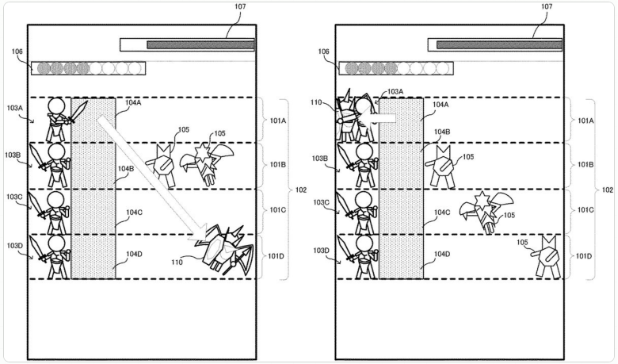
The following figure shows enemies moving in relation to the player character being controlled by a smart device and subsequently rendered by a game console.
Illustrative Claim:
21. A game system comprising:
a display screen; and
at least one processor configured to execute a rhythm game by performing functionality comprising:
moving an enemy element displayed on the display screen such that the enemy element reaches the first area at a predetermined timing related to rhythm provided in the rhythm game;
changing a parameter related to the enemy element when an operation input to an input section is performed at the predetermined timing;
and after the enemy element reaches the first area, when an operation input to the input section is performed at the predetermined timing, and provided that the parameter does not satisfy a predetermined condition, moving the enemy element to a second area different from the first area and then repeating the movement of the enemy element displayed on the display screen towards the first area from the second area, and when an operation input to the input section is not performed at the predetermined timing, moving the enemy element past the first area to a third area different from the first and second areas, and then having the enemy element appear on the display screen in the second area and move from the second area towards the first area.
This patent concerns the creation and customization of “interactive components” based on a multimedia file, like an mp3, to “generate and play” games associated with said multimedia file. The holder of this patent could design code meant to configure “a plurality of interactive components corresponding to the plurality of rhythmic points based on one or more predetermined rules monitoring a progress of playing the multimedia file.” This boils down to having the ability to create a rhythm game by intaking an mp3 file and rendering graphical interactions at key points in its melody. An example of such a technique could be thought of as similar to the Rock Band-style inputs we discussed in the first patent in this article.
Illustrative Claim:
1. A method of generating and playing games based on a multimedia file, comprising:
obtaining a target audio signal from the multimedia file;
determining a plurality of rhythmic points in the target audio signal;
configuring a plurality of interactive components corresponding to the plurality of rhythmic points based on one or more predetermined rules;
monitoring a progress of playing the multimedia file; and
displaying a target interactive component on an interface of playing the multimedia file in response to determining that the progress of playing the multimedia file reaches a time point corresponding to one of the plurality of rhythmic points, wherein the target interactive component is an interactive component among the plurality of interactive components corresponding to the one of the plurality of rhythmic points.
U.S. Design Pat. No. D1,057,020– The Rhythm Master Game Console –Issued on Sept. 23, 2024
Short and sweet, this patent concerns the design of the Rhythm Master Game Console, a futuristic-looking contraption that has yet to see a commercial application.
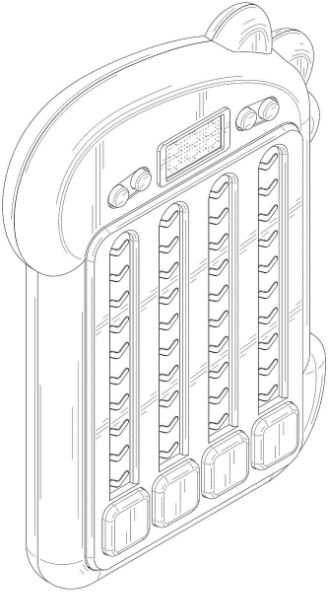
And there you have it–a run down of active rhythm video game patents. Head on over to our Video Game Patent Database for more information.
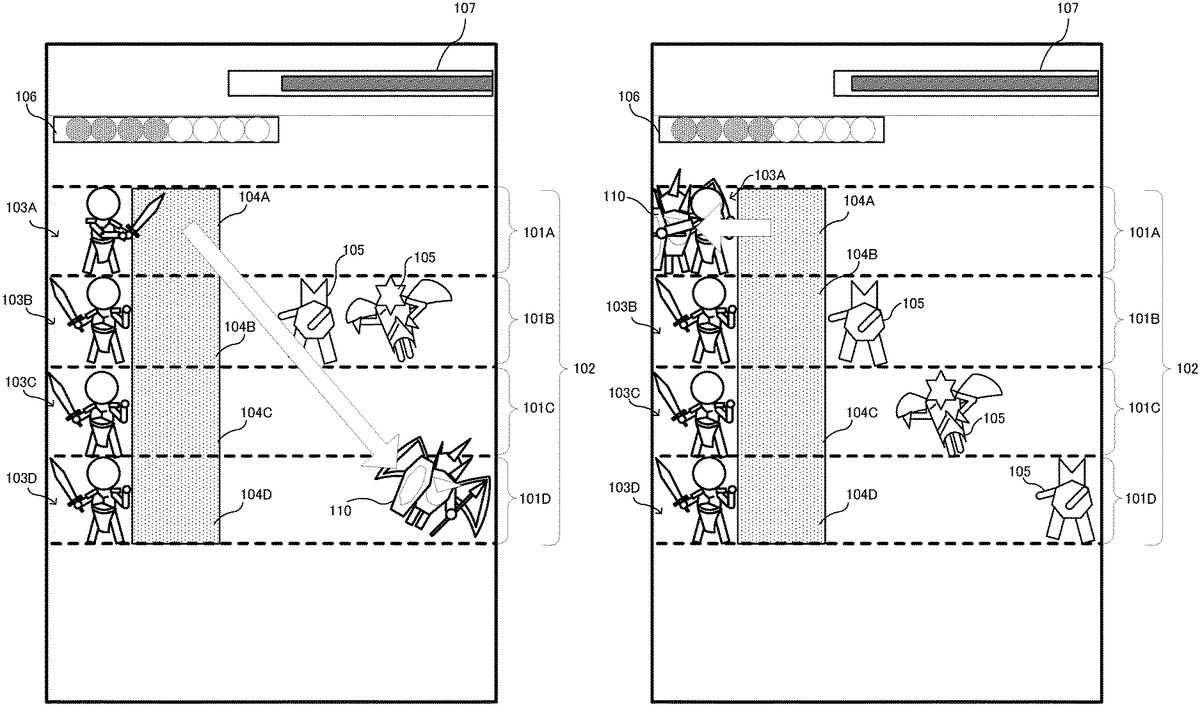
Illustrative Figure
Abstract
First, an indication sign displayed on a display screen is moved so as to reach a first position at a predetermined timing. Next, when an operation input to an input section is performed at the predetermined timing, a parameter related to the indication sign is changed. Furthermore, when the parameter related to the indication sign does not satisfy a first condition after the parameter is changed, the indication sign is moved to a position different from the first position, and then is moved toward the first position again.
Description
DETAILED DESCRIPTION OF NON-LIMITING EXAMPLE EMBODIMENTS Hereinafter, an exemplary embodiment will be described.FIG. 1is a diagram showing the hardware configuration of an information processing apparatus10which executes a rhythm game process according to the present embodiment. Here, in the present embodiment, for example, a smart device such as a smartphone and a tablet, a game apparatus such as a stationary game apparatus and a hand-held game apparatus, a personal computer, or the like is assumed as the information processing apparatus10. In the description of the present embodiment, an information processing apparatus (for example, a smartphone) including a display screen and a touch panel that are integrated with each other will be described as an example. Therefore, input operations are mainly inputs to the touch panel. InFIG. 1, the information processing apparatus10includes a processor section11, a memory13, an operation section15, a display section16, and a sound output section17. The processor section11executes a later-described rhythm game process or executes a system program (not shown) for controlling overall operation of the information processing apparatus10, thereby controlling operation of the information processing apparatus10. The processor section11may include a single processor or a plurality of processors. In the memory13, various programs to be executed by the processor section11and various kinds of data to be used in the programs are stored. The memory13is, for example, a flash EEPROM or a hard disk device. The operation section15is an input device for receiving an operation from a user, and a touch panel is mainly assumed as the operation section15in the present embodiment. In another embodiment, the operation section15may be various pointing devices, various press-type buttons, an analog stick, and the like. The display section16is typically a liquid crystal display device. The sound output section17is, for example, a speaker. [Outline of Rhythm Game Process of Present Embodiment] Next, an outline ...
DETAILED DESCRIPTION OF NON-LIMITING EXAMPLE EMBODIMENTS
Hereinafter, an exemplary embodiment will be described.FIG. 1is a diagram showing the hardware configuration of an information processing apparatus10which executes a rhythm game process according to the present embodiment. Here, in the present embodiment, for example, a smart device such as a smartphone and a tablet, a game apparatus such as a stationary game apparatus and a hand-held game apparatus, a personal computer, or the like is assumed as the information processing apparatus10. In the description of the present embodiment, an information processing apparatus (for example, a smartphone) including a display screen and a touch panel that are integrated with each other will be described as an example. Therefore, input operations are mainly inputs to the touch panel.
InFIG. 1, the information processing apparatus10includes a processor section11, a memory13, an operation section15, a display section16, and a sound output section17. The processor section11executes a later-described rhythm game process or executes a system program (not shown) for controlling overall operation of the information processing apparatus10, thereby controlling operation of the information processing apparatus10. The processor section11may include a single processor or a plurality of processors. In the memory13, various programs to be executed by the processor section11and various kinds of data to be used in the programs are stored. The memory13is, for example, a flash EEPROM or a hard disk device. The operation section15is an input device for receiving an operation from a user, and a touch panel is mainly assumed as the operation section15in the present embodiment. In another embodiment, the operation section15may be various pointing devices, various press-type buttons, an analog stick, and the like. The display section16is typically a liquid crystal display device. The sound output section17is, for example, a speaker.
[Outline of Rhythm Game Process of Present Embodiment]
Next, an outline of a game process executed in the present embodiment will be described. In the present embodiment, a rhythm game process is assumed in which musical piece data is reproduced and a player performs a predetermined operation in synchronization with a timing at which an indication sign (sometimes called “note” depending on the game) reaches a specific position, whereby the game proceeds. In addition, this rhythm game employs a stage system. That is, one musical piece is reproduced in one stage, the stage is cleared if the reproduction is successfully performed to the end, and then the next stage is opened and can be played. In other words, this rhythm game is a game in which stages are cleared one by one, so that the game proceeds.
[Configuration of Rhythm Game Screen]
FIG. 2shows an example of a screen by the rhythm game process according to the present embodiment. InFIG. 2, a field area102including four lanes101A to101D (hereinafter, sometimes collectively referred to as lanes101) extending horizontally when being viewed by the user, is displayed on the game screen. Four user characters103A to103D (hereinafter, sometimes collectively referred to as user characters103) are located in the respective lanes and at the left edge of the field area102. In addition, timing presentation areas104A to104D (hereinafter, sometimes collectively referred to as timing presentation areas104) are set so as to be located adjacently at the right side of the positions at which the respective user characters103are located. Moreover, a plurality of enemy characters105are also displayed. Each enemy character105serves as the above indication sign in the rhythm game. Furthermore, each lane101also serves as a movement path for the enemy character, and the enemy characters other than some enemy characters move along the lanes101from right to left. In addition, the enemy characters move in accordance with a predetermined rhythm (defined by later-described musical score data).
Moreover, a user-side HP (hit point) meter106is displayed at an upper left position in the field area102. In the example ofFIG. 2, eight round marks are displayed in the user-side HP meter106and indicate that the maximum value of a user-side HP is 8. In addition, in the example ofFIG. 2, the four marks at the left side are in a colored state, and the four marks at the right side are in a white state. This indicates that the current HP is 4. Furthermore, in the present embodiment, the four user characters103are displayed, and the HP indicated by the user-side HP meter106is a value shared by these four characters. That is, when any one of the four user characters suffers damage, the HP is decreased by one.
Furthermore, a boss-side HP meter107is displayed at an upper right position with respect to the user-side HP meter106. The boss-side HP meter107is shown as a bar-graph-like meter in which a bar extends horizontally. By attacking a later-described boss character, the boss-side HP meter107becomes shortened stepwise.
[Operation in Rhythm Game]
In the screen configuration described above, the enemy characters105appear as the indication signs in the rhythm game from the right side of the screen and move in the leftward direction in the screen. That is, the enemy characters105move toward the user characters103. By performing a tap operation at a predetermined timing, the user can attack and eliminate an enemy character105to delete the enemy character105from the screen. More specifically, the user can attack the enemy character105by performing a tap operation in synchronization with a “reference timing” (described in detail later) indicating a timing at which the user should input an attack operation. In the present embodiment, the reference timing is set as a timing at which the central point of the enemy character105coincides with the central point of the timing presentation area104. Furthermore, in the present embodiment, a time width centered at the reference timing is preset, and an input made within the time width is permitted as an effective attack operation. Thus, on the screen display, the timing of the tap operation is seen by the user as follows. Specifically, the user performs a tap operation on the inside of the field area102at the timing at which the enemy character105enters the timing presentation area104, whereby the user character103is seen to be able to be caused to attack and eliminate the enemy character105, thereby deleting the enemy character105from the screen. Furthermore, depending on the timing at which a tap operation is performed in a state where the enemy character105is present within the timing presentation area104, evaluation of the tap operation is also changed. For example, two-level evaluation is made such that: a tap operation performed at a timing that exactly coincides with the reference timing (on the screen, for example, a timing at which the central point of the enemy character105coincides with the central point of the timing presentation area104) is evaluated as “Great” that is a maximum evaluation; and a tap operation performed at a timing that slightly deviates from the reference timing but is within the above time width is evaluated as “Good” (on the screen, for example, a state where the central point of the timing presentation area104and the central point of the enemy character105do not coincide with each other but the central point of the enemy character105is within the timing presentation area104). As a matter of course, it is needless to say that evaluation may be made at more levels in another embodiment.
In the present embodiment, regarding a position of a tap operation for an attack, a tap operation at any position within the lane101to which the timing presentation area104that the enemy character105has entered belongs is required. For example, as shown inFIG. 3, when the enemy character105has entered the timing presentation area104C, it is possible to attack the enemy character105by performing a tap operation at any position within the lane101C. On the other hand, in this case, when a tap operation is performed on the inside of the lane other than the lane101C, an attack is not made against the enemy character105that has entered the timing presentation area104C.
Here, for convenience of explanation, in the rhythm game in the present embodiment, so-called “simultaneous pressing” is not required. That is, a state where two or more enemy characters105are present within two or more different timing presentation areas104at the exactly same timing is not caused in the four timing presentation areas104. For example, a simultaneous input operation on the lane101A and the lane101C in a state where the enemy characters105are present in the timing presentation areas104A and104C at the exactly same timing is not required. That is, on all occasions, an input on only one of the lanes is merely required at a certain timing. In another embodiment, simultaneous pressing as described above may be possible.
As an example of the attack operation, a tap operation is taken in this embodiment, but an operation method other than a tap operation may be used in another embodiment. The attack operation is, for example, a double tap operation, a slide operation in a predetermined direction, a flick operation in a predetermined direction, or a long pressing operation. In addition, an input device other than the touch panel may be usable. For example, press-type buttons may be used. In this case, for example, the above four lanes may be set so as to correspond to so-called A, B, X, and Y buttons, respectively. The user can make an attack as described above, by pressing any of the buttons corresponding to the respective lanes. Other than the A, B, X, and Y buttons, the above four lanes may be set so as to correspond to four directions of a so-called cross key/cross button.
When a tap operation is performed on the inside of the field area102, an attack motion of the user character103that belongs to the lane101on which the tap operation has been performed is displayed. Regardless of whether the enemy character105is present within the timing presentation area104, an attack motion is displayed when a tap operation is performed. Regarding each enemy character105, display of an attack motion against the user character is started at a timing previous to the later-described reference timing by a one-beat period. As described above, each enemy character105moves in accordance with a predetermined rhythm. Then, by starting the attack motion at the timing previous to the reference timing by a one-beat period as described above, it is possible to more clearly present when the reference timing comes, to the user. Furthermore, it is also possible to enhance a feeling of presence and atmosphere in which the user character103is fighting with an enemy.
When an attack has been successfully made against the enemy character105that has entered the timing presentation area104as described above, a representation that the enemy character105is flown toward the upper right of the screen as shown inFIG. 4, is performed, and then the enemy character105is deleted from the screen. That is, each of these enemy characters105can be considered to be able to be eliminated by a single attack operation if the condition of coinciding with an appropriate timing is satisfied.
Meanwhile, when an attack against the enemy character105has failed, for example, since the timing of the tap operation has not coincided, the user character103is determined to be attacked and suffer damage, and the indication of the user-side HP meter106is decreased by 1. In the present embodiment, specifically, the colored mark is changed into a white state, thereby indicating that the indication is decreased by 1. Then, when the indication of the user-side HP meter106becomes 0, that is, when the user character103is attacked eight times and all the marks are changed into a white state, the game is ended.
When the user character103has suffered damage as described above, the enemy character105that has attacked the user character103moves to the left edge of the screen as is, and is deleted from the screen.
In the game process of the present embodiment, regarding the enemy characters105, two enemy types, “ground unit” and “flight unit”, are set. The ground unit linearly moves along each lane from right to left as shown inFIG. 3described above. That is, the ground unit moves on a ground in the field area102which is a virtual game space. Meanwhile, the flight unit can move across the lane as shown inFIG. 5. In the example ofFIG. 5, a flight unit type enemy character105appearing at an upper right position is shown to move toward a lower left position. That is, the flight unit moves in air in the virtual game field.
[Outline of Motion of Boss Character]
Meanwhile, in the rhythm game of the present embodiment, in addition to the enemy characters105that can be eliminated by a single attack operation as described above, an enemy character called “boss character” is also present. The boss character is an indication sign having a “HP” as indicated by the boss-side HP meter107and cannot be eliminated only by a single attack. That is, the boss character can be considered as an indication sign, in the rhythm game, having durability typified by HP or the like. In the following description, the enemy characters105other than the boss character are referred to as “normal enemy characters”. In addition, in the following description, when the “enemy character” is merely described, the “enemy character” is used as a concept including both the “boss character” and the “normal enemy characters”. In the present embodiment, the boss character is the above “flight unit”.
In the present embodiment, the boss character appears only in a “boss stage” which is a stage dedicated for the boss character. As described above, this rhythm game is a game employing a stage system, and the “boss stage” is provided every four stages in the present embodiment. For example, only the normal enemy characters105appear in the first to third stages, and the normal enemy characters105and the boss character appear in the fourth stage.
Next, an example of a motion of the boss character in the boss stage will be described.FIG. 6shows a screen example showing a state immediately after start of the boss stage. InFIG. 6, a boss character110is displayed at an upper right position in the field area102, that is, at a position at the right end of the lane101. From this state, the boss character110moves along the lane101toward the timing presentation area104, as shown inFIG. 7, with progress of the game, that is, with reproduction of a musical piece. InFIG. 7, in addition to the boss character110, a normal enemy character105appears in the screen. When the reproduction of the musical piece further proceeds, the boss character110moves closer to the timing presentation area104A as shown inFIG. 8. Moreover, another normal enemy character105appears at the right end of the lane101A.
Thereafter, when the reproduction of the musical piece further proceeds, display of an attack motion of the boss character110is started at a one-beat period before a reference timing corresponding to the boss character110. Accordingly, similar to the case of the normal enemy character105, it is possible to more clearly present when the reference timing comes, to the user. By performing a tap operation at any position within the lane101A in synchronization with the timing at which the boss character110enters the timing presentation area104, the user can attack and damage the boss character110as shown inFIG. 9.FIG. 9shows a state where an attack of the user has been successfully made. InFIG. 9, a state where attack motions of both the boss character110and the user character103A are displayed is shown, but is a state where the user character103A has successfully made an attack against the boss character110before being attacked by the boss character110. Thus, the user-side HP meter106does not change, but, in the boss-side HP meter107, the HP of the boss character110is decreased by a value corresponding to the suffered damage. However, the state inFIG. 9is a state where the boss character110has not been eliminated.
If the HP of the boss character110still remains even when the attack has been successfully made as described above, a motion of the boss character110after the attack is as follows. First, as shown inFIG. 10, the position of the boss character110is moved in the rightward direction in the field area102. This movement is a so-called “knock-back” motion. Hereinafter, a motion of the boss character110in which the boss character110moves back in a direction including a component in the direction opposite to the direction of movement so far (in a direction including a component in the rightward direction in the present embodiment) upon being attacked by the user character103as described above, is referred to as a “knock-back motion”. In addition, a position that is a destination of the knock-back motion at this time is an “action start position” (hereinafter, referred to as “next action start position”) corresponding to the timing for the next action, among “action start positions” defined in advance by later-described boss musical score data214.
In the present embodiment, the boss character110attacked by the user character103makes a “knock-back” motion as described above, but may be caused to make another motion different from such a “knock-back” motion, in another embodiment. For example, the attacked boss character110may be caused to make a motion in which the boss character110moves to the “next action start position” so as to draw a parabola as if being hit away.
Here, the musical score data will be briefly described (the details thereof will be described later). The musical score data is data that defines in advance a timing at which each enemy character comes to the timing presentation area104. In addition, the musical score data is also data that defines in advance a timing at which and a position from which each enemy character starts moving. In the present embodiment, two types of musical score data, that is, musical score data for a normal enemy character (later-described normal enemy musical score data213) and musical score data for a boss character (later-described boss musical score data214), are prepared. Hereinafter, these two data are sometimes collectively referred to as “musical score data”.
The position that is the destination of the knock-back motion of the boss character110is determined as appropriate on the basis of the boss character musical score data. The example ofFIG. 10described above is an example in which the position at the right end of the lane101D is defined in advance as the “next action start position”. Thus, a state where the boss character110moves from the timing presentation area104A to the position at the right end of the lane101D as if being pushed away as the knock-back motion is shown. In addition, the movement in the knock-back motion is made so as to correspond to a next “action start timing” (described later). For example, when a tap operation is performed 0.5 seconds later than the reference timing and thus the boss character110makes a knock-back motion and then starts moving again as described later, the boss character110starts moving with a delay of 0.5 seconds from the reference timing being maintained. That is, when an input timing of the user deviates from the predetermined timing, if the movement speed of the boss character110in the knock-back motion is not adjusted at all, the next action start timing also deviates due to the above deviation. Thus, by adjusting the movement speed in the knock-back motion in accordance with the next action start timing, the deviation of the movement timing of the indication sign can be corrected. In other words, when an input timing of the user deviates from the predetermined timing, the movement speed during the knock-back motion can be considered to be adjusted in order to correct this deviation.
Thereafter, as shown inFIG. 11, the boss character110starts moving toward the timing presentation area104.FIG. 11shows a state where the boss character110moves toward the left on the lane101D. That is, the boss character110repeats an attack motion against the user character103until the HP of the boss character110reaches 0. In addition, the timing of the motion is a motion timing based on musical score data that is defined in advance according to the musical piece.
In other words, the indication sign in the rhythm game is set such that the indication sign has durability and cannot be deleted (eliminated) by a single tap operation. Then, when a tap operation has been successfully performed in synchronization with the timing, the indication sign is not deleted from the screen, and is continuously displayed so as to make the above knock-back motion or the like. In addition, while there is HP remaining, the indication sign continuously and repeatedly moves toward the timing presentation area in accordance with reproduction of the musical piece (musical score data).
In the present embodiment, the boss character110is the “flight unit”. As a matter of course, the boss character110may be the “ground unit”. In this case, in the case where the boss character110moves toward the timing presentation area104, the boss character110may move along the lane101, and in the case where the boss character110makes a knock-back motion, the boss character110may move across the lane101.
Next, a motion of the boss character110in the case where an attack of the user has failed will be described. For example, this case is a case where a tap operation has not been performed even when the boss character110is present in the timing presentation area104. In this case, a representation indicating that the user character103A is attacked by the boss character110is displayed as shown inFIG. 12. Along with this, the indication of the user-side HP meter106is decreased by 1. In addition, at this time point, the reproduction of the musical score data is stopped once. That is, appearance of normal enemy characters105other than any other normal enemy characters105present in the screen when the user character103A is attacked by the boss character110is inhibited once.
Thereafter, the boss character110moves to the left edge of the field area102as shown inFIG. 13, and the display of the boss character110is deleted from the screen once as shown inFIG. 14such that the boss character110further moves out of the screen. During such a motion of the boss character110, movements and attacks of the other normal enemy characters105are continued. Thereafter, when a predetermined time has elapsed from the reference timings for all the normal enemy characters105, the boss character110appears from the right end of any of the lanes101as shown inFIGS. 15 and 16. Thereafter, reproduction of the musical score data is restarted, and a movement and an attack motion of each enemy character based on the musical score data are made.
When the user character103is attacked by the normal enemy character105, the reproduction of the musical score data is continued unless the HP of the user reaches 0.
When the user finally makes the HP of the boss character110into 0 as a result of repetition of the above process, the boss stage is cleared. In the present embodiment, reproduction of the same musical piece is repeated until the HP of the boss reaches 0. In another embodiment, when the HP of the boss character110is not made into 0 before reproduction of the musical piece (reproduction for one loop) ends, the game may be ended due to running out of time.
In the present embodiment, subtractions are performed on the HP of the boss character110, and the boss character110is eliminated when the HP of the boss character110reaches 0. Alternatively, values of damage suffered by the boss character110may be accumulated, and the boss character110may be determined to be eliminated when the accumulated value exceeds a predetermined value. Still alternatively, when the number of successful attacks against the boss character110reaches a predetermined number, the boss character110may be determined to be eliminated.
In the present embodiment, the boss character110acts according to a predefined action pattern. Here, the musical score data defines a timing at which the boss character110reaches the timing presentation area, and the action start position for the boss character110, but does not define a specific motion pattern for the boss character110. Thus, data that defines a specific action pattern for the boss character110is additionally prepared as described later. Regarding the action pattern, for example, a pattern in which “a normal attack is repeated three times and then a special attack is used once” is predefined as a “pattern A”, or a pattern in which “a normal attack is repeated four times and then a special attack is continuously used twice” is predefined as a “pattern B”. Then, unless the user character103has been attacked by the boss character110(unless the boss character110disappears from the screen) as described above, the action pattern used at this time is repeated. On the other hand, when the user character103has been attacked by the boss character110, a motion is made in which the action pattern used at this time is stopped, a new action pattern is selected, and the boss character110starts acting according to the new action pattern after reappearance. As the action pattern for the boss character110, a movement path and a movement speed may be defined. Furthermore, in addition to the pattern in which the boss character110constantly moves, an action pattern in which the boss character110stops moving midway and then starts moving again may be defined.
As described above, in the present embodiment, the entertainment characteristics of the rhythm game are enhanced by making the indication sign in the rhythm game have durability such as a HP.
[Details of Game Process of Present Embodiment]
Next, the rhythm game process in the present embodiment will be described in more detail with reference toFIGS. 17 to 24.
[Data to be Used]
First, various kinds of data to be used in this game process will be described.FIG. 17shows an example of a program and data stored in the memory13of the information processing apparatus10. In the memory13, a rhythm game processing program211and data, such as musical piece data212, the normal enemy musical score data213, the boss musical score data214, a boss character HP215, a user HP216, action pattern definition data217, current action pattern data218, image data219, and operation data220, are stored.
The rhythm game processing program211is a program for causing the processor section11to execute the rhythm game process according to the present embodiment.
The musical piece data212is one of a plurality of musical piece data, and is, for example, digital data coded by a pulse code modulation (PCM) method or the like.
The normal enemy musical score data213is musical score data corresponding to predetermined musical piece data to be reproduced in a predetermined stage, and is data for controlling a normal enemy character.FIG. 18shows an example of the data configuration of the normal enemy musical score data213. InFIG. 18, the normal enemy musical score data213includes items such as a reference timing231, identification information232, a reached lane233, an action start lane234, and an action start timing235. The reference timing231indicates a reference timing that is preset in accordance with the musical piece data, and indicates a timing at which the user should perform an attack operation. In addition, in the normal enemy musical score data213, the reference timing231is defined as an elapsed time from the time of start of reproduction of the musical piece data (for example, a frame number based on a frame rate of rendering in the case where the frame number at the musical piece data reproduction start time is set to 0). The identification information232is information indicating a normal enemy character (indication sign) corresponding to each reference timing231. For example, the identification information232is information indicating a “normal enemy character A” which is a ground unit, a “normal enemy character B” which is a flight unit, etc. The reached lane233indicates a lane101in which the normal enemy character105should be present at the corresponding reference timing231. The action start lane234and the action start timing235are defined as the lane101in which the normal enemy character105for the reference timing231starts acting, and as a timing of the start. In other words, the action start lane234and the action start timing235are defined as a lane in which and a timing at which the enemy character appears in the field area102. For each normal enemy character105, since the normal enemy character105initially appears without fail at the right edge of the field area102, only the lane101in which the normal enemy character105is to appear may be defined.
Referring back toFIG. 17, the boss musical score data214is musical score data corresponding to the above predetermined musical piece data, and is data for controlling the boss character110.FIG. 19shows an example of the data configuration of the boss musical score data214. InFIG. 19, the boss musical score data214includes items such as a reference timing241, a reached lane242, an action start position243, and an action start timing244. Among these items, the reference timing241, the reached lane242, and the action start timing244have the same meanings as those of the items in the normal enemy musical score data213, except that the target is the boss character110, and thus the description thereof is omitted. Meanwhile, the action start position243basically indicates the position at which the boss character110is to be present at the action start timing244. However, the above “knock-back motion” is also assumed, and the action start position243has the contents in which positions in the respective lanes are defined in more detail. Specifically, for example, as shown inFIG. 20, regarding the action start position, two areas, a position A and a position B, are defined. As the action start position243, either the position A or the position B in each lane101is defined in consideration of a position that is the knock-back destination in the above knock-back motion. In addition, the action start position243indicates the above-described “next action start position”. The number of action start positions is an example, and it is needless to say that any number of action start positions may be defined in another embodiment.
In the present embodiment, the musical score data for a normal enemy character and the musical score data for a boss character are configured as separate data, but may be combined into integrated data in another embodiment.
Referring back toFIG. 17, the boss character HP215is data indicating the current HP of the boss character110in a boss stage. In other words, the boss character HP215is a parameter indicating the durability of the boss character110, and is data on which the indication of the boss-side HP meter107is based. That is, the boss character HP215can be considered as a parameter indicating the “endurance” of the boss character110. In addition, the user HP216is data indicating the current HP of the user side, and is a parameter indicating the durability of the user side. The user HP216is data on which the indication of the user-side HP meter106is based.
The action pattern definition data217is data that defines a plurality of action patterns for the boss character110as described above.
In the present embodiment, since each normal enemy character105can be basically eliminated by a single attack and linearly moves on the action start lane from the position where the normal enemy character105appears, an action pattern is not particularly defined for the normal enemy character105. However, in another embodiment, for each normal enemy character105, data that defines a movement path for the normal enemy character105may be prepared. In particular, such data is useful in the case of moving the flight unit in a curved manner.
The current action pattern data218is data for indicating the currently used action pattern among the plurality of action patterns defined by the action pattern definition data217.
The image data219is various kinds of image data of the user character103, various enemy characters, background images, etc.
The operation data220is data indicating the contents of various operations performed on the operation section15. In the present embodiment, the operation data220includes presence/absence of an input to the touch panel as the operation section15, data indicating a touch coordinate or the like of the input, data indicating pressed states of various buttons that are not shown, and the like.
In addition, in the memory13, various kinds of data required for the rhythm game process, such as sound effect data and various kinds of working data to be temporarily used are stored as appropriate.
[Details of Process Performed by Processor Section11]
Next, the rhythm game process according to the present embodiment will be described in detail with reference to flowcharts ofFIGS. 21 to 24. Here, a process for the above boss stage (hereinafter, a boss stage process) will be described, and the description of the other game processes is omitted.
A process loop of steps S2to S20inFIGS. 21 to 23is repeated at a predetermined time interval, for example, every 1/60 seconds (one frame), except for a process in step S19.
First, in step S1, the processor section11performs a preparation process for stating the process related to the boss stage. That is, the processor section11reads the musical piece data212, and the normal enemy musical score data213and the boss musical score data214corresponding to the musical piece data212, from a predetermined storage medium, and stores the read data in the memory13. In addition, the processor section11initializes various kinds of data to be used in the process for the boss stage, and locates the user characters103in the field area102as appropriate. Furthermore, the processor section11locates the boss character110at an initial position on the basis of the boss musical score data214. In addition, the processor section11also performs a process of determining an action pattern for the boss character110and setting the current action pattern data218. Then, the processor section11generates a game screen at the time of start of the boss stage and displays the game screen on the display section16.
Next, in step S2, the processor section11performs control of movement of various enemy characters and control of new location of various enemy characters in the field area102on the basis of the normal enemy musical score data213and the boss musical score data214. That is, the processor section11performs a process of reproducing the normal enemy musical score data213and the boss musical score data214. For example, regarding each normal enemy character105, control is performed such that the normal enemy character105indicated by the identification information232is located at the position indicated by the action start lane234at the timing indicated by the action start timing235. Then, control is performed such that the normal enemy character105is moved so as to reach the timing presentation area104of the lane indicated by the reached lane233at the timing indicated by the reference timing231. In addition, regarding the boss character110, movement thereof is controlled also with reference to the action pattern indicated by the current action pattern data218. When the boss character110is during the above “knock-back motion”, the processor section11also performs control of movement related to the knock-back motion. For example, when a flag (not shown) that is set in a process in step S10described later and indicates that the boss character110is in a knock-back state is ON, the processor section11performs this control of movement. When the knock-back motion is ended, the processor section11also performs a process of setting the flag to be OFF. In addition, regarding various enemy characters that have entered the timing presentation areas, control is also performed such that the enemy character is caused to make an attack motion of attacking the user character103. Through such processes, control of movement of various enemy characters and the like are performed.
Next, in step S3, the processor section11refers to the operation data220and determines whether a tap operation has been performed on the field area102. As a result, when the tap operation has not been performed (NO in step S3), the processor section11advances the processing to step S12described later. On the other hand, when the tap operation has been performed (YES in step S3), the processor section11determines in subsequent step S4whether the tap operation satisfies an attack condition. Specifically, the processor section11determines whether, in a state where the enemy character has entered any of the above timing presentation areas104, the tap operation has been performed in the lane101belonging to this timing presentation area104. More precisely, the processor section11determines whether the tap operation has been performed within a time width that is centered at the reference timing231(in the case of the normal enemy character105) or at the reference timing241(in the case of the boss character110) and in which a tap operation is permitted as an effective attack operation. That is, the processor section11determines whether an effective attack operation has been performed. As a result of the determination, when the effective attack operation has not been performed (NO in step S4), the processor section11advances the processing to step S12described later. At this time, an attack motion of the user character103belonging to the lane in which the tap operation has been performed may be displayed. In this case, the displayed attack motion is invalid as an attack, but it is possible for the user to confirm only the attack motion of the user character103.
On the other hand, when the effective attack operation has been performed (YES in step S4), the processor section11displays, in step S5, the attack motion of the user character103belonging to the lane101in which the tap operation has been performed. Furthermore, the processor section11performs a process of evaluating the input timing of the tap operation. That is, the processor section11determines whether the input timing is evaluated, for example, as “Great” or “Good” as described above. Then, the processor section11temporarily stores the result of the evaluation in the memory13.
Next, in step S6, the processor section11determines whether the attack made at this time is an attack against the boss character110. That is, the processor section11determines whether the enemy character attacked by the user character103is the boss character110. As a result of the determination, when the attack made at this time is not an attack against the boss character110, that is, is an attack against the normal enemy character105(NO in step S6), the processor section11performs, in step S7, a process for defeating the normal enemy character. That is, for the normal enemy character105attacked by the user character, the processor section11performs a representation that the normal enemy character105is flown toward the outside of the screen as shown inFIG. 4described above. In addition, the processor section11adds point(s) corresponding to the result of the evaluation, to score data that is not shown. At this time, when the result of the evaluation is high (“Great” in this embodiment), a value of a so-called “combo” may be added. Thereafter, the processor section11advances the processing to step S12described later.
Meanwhile, as a result of the determination in step S6described above, when the attack made at this time is an attack against the boss character110(YES in step S6), the processor section11subtracts 1 from the value of the boss character HP215in step S8shown inFIG. 22. In addition, the processor section11also performs a process for updating the indication of the boss-side HP meter107.
Next, in step S9, the processor section11determines whether the value of the boss character HP215is 0. As a result, when the value of the boss character HP215is 0, the processor section11determines that the boss is defeated, and performs a process for clearing the boss stage in step S11. For example, the processor section11performs a process of deleting the display of the boss character110from the screen and further performs a process of displaying a representation for clearing the stage, and the like. Thereafter, the processor section11ends the process related to the boss stage.
On the other hand, when the value of the boss character HP215is yet to be 0 (NO in step S9), the processor section11performs, in step S10, a setting process for causing the boss character110to make the above knock-back motion. That is, the processor section11specifies the above “next action start position” by referring to the boss musical score data214, and calculates a movement speed in a knock-back motion to this position. Although not shown, the processor section11sets the flag, which indicates that the boss character110is in a knock-back state, to be ON, for example. Thereafter, the processor section11advances the processing to step S12.
Next, in step S12inFIG. 23, the processor section11performs a process of determining whether the user character103has been attacked by any enemy character, that is, determining presence/absence of damage. Specifically, the processor section11determines whether, without an attack being made by a tap operation against the enemy character that has entered any timing presentation area104, or in a state where a tap operation has been performed but has not been determined as an effective attack since the timing does not coincide, the enemy character has advanced to the position of the user character103. That is, the processor section11determines whether the user has failed to eliminate the enemy character that has entered any timing presentation area104. Then, when the user fails, it is determined that damage has occurred.
As a result of the determination, when damage has not occurred (NO in step S12), the processor section11advances the processing to step S16described later. On the other hand, when damage has occurred (YES in step S12), the processor section11performs a damage process in step S13. Specifically, the processor section11performs a process of subtracting 1 from the value of the user HP216and updating the indication of the user-side HP meter106.
Next, in step S16, the processor section11determines whether the value of the user HP216has reached 0. As a result, when the value of the user HP216has reached 0 (YES in step S16), the processor section11performs a process for ending the game in step S17. That is, the processor section11performs a process for the case of a failure to clear the stage. For example, the processor section11performs display of a representation indicating a failure to clear the stage, and the like. Then the processor section11ends the boss stage process.
On the other hand, when the value of the user HP216has not reached 0 (NO in step S16), the processor section11next determines in step S18whether the boss character110has reached the left edge of the field area102. That is, the processor section11determines whether the boss character110that has successfully attacked the user character103has moved to the left edge of the field area102as shown inFIG. 13described above. As a result, when the boss character110has not reached the left edge of the field area102(NO in step S18), the processor section11advances the processing to step S20described later. On the other hand, when the boss character110has reached the left edge of the field area102(YES in step S18), the processor section11performs a boss reappearance process in step S19. The boss reappearance process is a process for performing reappearance of the boss character110as described with reference toFIGS. 12 to 16described above.
FIG. 24is a flowchart showing the details of the boss reappearance process. InFIG. 24, in step S31, the processor section11performs a process of pausing the reproduction of the musical score data. That is, the processor section11performs a process for preventing the normal enemy characters105other than the already deployed normal enemy characters105from appearing. At this time, the processor section11may pause the reproduction of the musical piece data, or may continue the reproduction of the musical piece.
Next, in step S32, the processor section11performs control of movement of the boss character110. Specifically, the processor section11performs a movement process such that the boss character110moves out of the screen. In addition, after the boss character110moves out of the screen, the processor section11performs a process for specifying a “next action start position” on the basis of the boss musical score data214and causing the boss character110to appear from the right end of any of the lanes101on the basis of the next action start position. Moreover, at this time, the processor section11refers to the action pattern definition data217and selects an action pattern to be used as the next action of the boss character110. Then, the processor section11sets a value indicating the selected action pattern, in the current action pattern data218.
Next, in step S33, the processor section11performs a process regarding each normal enemy character105remaining in the screen. That is, a process of moving each normal enemy character105, various determination processes regarding an attack, and the like are performed. Although not shown in the flowchart, when the HP of the user reaches 0 as a result of the user character103being attacked by the normal enemy character105in this process, the boss reappearance process is paused and a process for ending the game is performed.
Next, in step S34, the processor section11performs a process of generating a game screen reflecting the control of movement and the like in steps S32and S33described above, and displaying the game screen on the display section16.
Next, in step S35, the processor section11determines whether a condition for restarting reproduction of the musical score data has been satisfied. The condition is a condition for putting an interval in order to provide matching of attack timing between the boss character110and each normal enemy character105. For example, it is determined that the condition for restart has been satisfied when all of the following three conditions are satisfied: (1) reappearance of the boss character110is completed and there is a sufficient temporal margin until the next reference timing for the boss character110, (2) a predetermined time has elapsed from the reference timings for all the normal enemy characters105, and (3) the timing of restart is a timing at which the elapsed time is a multiple of a one-beat period. This condition for restart is an example. Regarding reappearance of the boss character110, a condition different from this condition may be used as long as the condition is a condition under which adjustment is possible such that collapse of the contents of the rhythm game is prevented.
As a result of the determination in step S35, when the condition for restart has not been satisfied (NO in step S35), the processor section11returns to step S32described above, and the process is repeated. On the other hand, when the condition for restart has been satisfied (YES in step S35), the processor section11performs a process for restarting reproduction of the musical score data in step S37. This is the end of the boss reappearance process.
Referring back toFIG. 23, next, in step S20, the processor section11performs a process of generating a game screen reflecting the results of the above game process and displaying the game screen on the display section16. In addition, the processor section11also performs a process of outputting various kinds of sound data based on the musical piece data212and the like to the sound output section17. Thereafter, the processor section11returns to step S2described above, and the process is repeated.
This is the end of the description of the boss stage process.
As described above, in the present embodiment, the indication sign in the rhythm game has durability typified by HP or the like, and the indication sign that does not disappear from the screen due to a single tap operation or the like is controlled. Accordingly, the entertainment characteristics of the rhythm game can be further enhanced.
[Modifications]
In the above embodiment, regarding the position at which a tap operation for an attack is to be performed, tap operations at positions corresponding to the four lanes, respectively, are required. Other than this, for decreasing the level of difficulty in operation, an attack operation position may be made uniform while the presence of the four lanes and control of movement of the enemy characters are unchanged. That is, this can be considered as a mode in which only the method for an attack operation is changed.FIG. 25shows an example of a screen using such a configuration. InFIG. 25, the screen has the same configuration as shown inFIG. 2described above, except that an attack operation area120is displayed at a lower portion of the screen. In this case, an operation of the user is as follows. Specifically, by performing a tap operation on the attack operation area120in synchronization with a timing at which any enemy character has entered any timing presentation area104, the user can attack the enemy character. In this case, it does not matter in which lane the enemy character is present. That is, regardless of the lane in which the enemy character has entered the timing presentation area104, the user can attack the enemy character merely by performing a tap operation on the attack operation area120as long as the timing coincides.
Regarding the attack operation area120, a partial area in the screen as described above may not be set as the attack operation area120, and, for example, the entire screen may be set as the attack operation area120and display as shown inFIG. 25described above may not be performed. That is, it may be possible to make an attack against the enemy character merely by performing a tap operation at any position on the screen as long as the timing coincides.
In addition, the user may be allowed to switch between a game mode in which tap operations corresponding to four lanes are required as in the above embodiment and a game mode in which only a tap operation on the single attack operation area120as shown inFIG. 25described above is required, or to select any of these two game modes. For example, the former may be referred to “expert mode”, the latter may be referred to as “casual mode”, and these modes may be presented to the user before start of a stage such that the user can select any of the two modes.
Furthermore, in still another embodiment, a game mode obtained by combining (integrating) the above “expert mode” and the above “casual mode” may be provided. That is, basically, a game mode may be provided in which the enemy character can be eliminated by performing a tap operation at any position on the screen as long as the timing coincides (corresponding to the casual mode), but a higher score is obtained by performing a tap operation corresponding to the lane (corresponding to the expert mode). More specifically, for example, this game mode is configured such that a high score can be obtained by performing a tap operation at any position in the lane101A at the timing at which the enemy character reaches the timing presentation area104A; and when a tap operation is performed on any area other than the timing presentation area104A, the enemy character can be eliminated but an obtained score is reduced. With such a configuration, basically, while providing simple operability in which it is not necessary to change a position for a tap operation in accordance with the position of the enemy character, higher-level operability in which it is necessary to change a position (lane) for a tap operation in accordance with the position of the enemy character can be required for a user who aims at a highest score. In other words, the user is allowed to select, at any timing, any of a play style in which a high score is given up but a simple operation is performed and a play style in which a high-level operation aimed at a high score is required. For example, for each normal enemy character105, play can be performed in a play style corresponding to the expert mode, and, for the boss character110, play can be performed in a play style corresponding to the casual mode. Alternatively, for example, it is possible to perform play in a play style corresponding to the expert mode in the first half of a stage and perform play in a play style corresponding to the casual mode in the second half of the stage.
As an example of the indication signs, the “boss character” and the “normal enemy characters” are exemplified in the above embodiment. Other than this, for example, objects emitted from the boss character110, such as arrows or bullets emitted from the boss character110, may be indication signs. In this case, the objects such as arrows or bullets may be handled as the normal enemy characters105. In addition, for example, movement of the boss character110may be stopped when the boss character110reaches the position on the right of the timing presentation area104, and the boss character110may be caused to make a motion of “emitting flames” toward the user character103. The “flames” emitted from the boss character110at this time may be handled as the normal enemy characters105. In this case, while the “flames” are emitted, the user may be allowed to prevent attacks with the “flames” by repeatedly performing a tap operation or performing a long pressing operation. Moreover, as an example of the indication signs, obstacle objects such as rocks or iron balls rolling toward the timing presentation area104may be used as the normal enemy characters105.
In the above embodiment, each normal enemy character105does not have a HP. However, in another embodiment, each normal enemy character105may have a HP, and the value of the HP may be set to “1”. That is, each normal enemy character105may be eliminated by a single attack.
In the above embodiment, only the single boss character110appears at one time. In another embodiment, a plurality of boss characters110may be caused to appear at the same time. In this case, regarding the boss-side HP, the HP indicated by the boss-side HP meter107may be shared by the plurality of boss characters110. For example, three boss characters110may be caused to appear at the same time, and may disappear when the sum of values of damage to the three boss characters110reaches a predetermined value.
In the above embodiment, the stage is cleared when the boss character110is eliminated. However, in another embodiment, play in the stage may be continued until the musical piece ends. In addition, another boss character110may be subsequently caused to appear.
The timing presentation area104is an area having a width to some extent in the above embodiment. That is, a timing for a tap operation permitted as a successful attack has a margin to some extent. In another embodiment, a timing for such a tap operation may not have this width, and a pinpoint coordinate corresponding to the reference timing may be used as the timing. That is, the timing may be displayed not as a timing presentation “area” but as a timing presentation “point”.
Regarding the position at which the user character103is displayed, in the above embodiment, the user character103is displayed at a position on the left of the timing presentation area104. However, the position at which the user character103is displayed is not limited thereto, and the user character103may be displayed in the timing presentation area104, for example.
Regarding the direction in which each indication sign moves, in the above embodiment, the indication sign (enemy character) basically moves from right to left in the screen. However, the indication sign may move from left to right, from up to down, or from down to up. In addition, for example, the one user character may be located at substantially the center of the screen, circular timing presentation areas may be located so as to surround the user character, and the indication signs may move from all directions at 360 degrees toward the center of the screen.
In the above embodiment, when the boss character110is attacked by the user character103(a tap operation is performed at the reference timing), control of a knock-back motion as described above is performed. In another embodiment, the boss character110may be caused to make a motion in which the boss character110continues to advance in the leftward direction even when being attacked, not such a motion in which the boss character110makes a knock-back motion upon being attacked.
In the above embodiment, the single information processing apparatus10performs a series of processes related to the rhythm game. However, there is no limitation thereto, and in another embodiment, the series of processes described above may be performed in an information processing system that includes a plurality of information processing apparatuses. For example, in an information processing system that includes a terminal side apparatus and a server side apparatus capable of communicating with the terminal side apparatus via a network, a part of the series of processes may be performed by the server side apparatus. Alternatively, in an information processing system that includes a terminal side apparatus and a server side apparatus capable of communicating with the terminal side apparatus via a network, a main process of the series of the processes may be performed by the server side apparatus, and a part of the series of the processes may be performed by the terminal side apparatus. Still alternatively, in the information processing system, a server side system may include a plurality of information processing apparatuses, and a process to be performed in the server side system may be divided and performed by the plurality of information processing apparatuses.
Claims
- A computer-readable non-transitory storage medium having stored therein a game program for causing a computer to execute a rhythm game, the game program causing the computer to execute functionality comprising: moving an enemy element displayed on a display screen towards a first area such that the enemy element reaches the first area at a predetermined timing related to rhythm provided in the rhythm game;changing a parameter related to the enemy element when an operation input to an input section is performed at the predetermined timing;and after the enemy element reaches the first area, when an operation input to the input section is performed at the predetermined timing, and provided that the parameter does not satisfy a predetermined condition, moving the enemy element to a second area different from the first area and then repeating the movement of the enemy element displayed on the display screen towards the first area from the second area, and when an operation input to the input section is not performed at the predetermined timing, moving the enemy element past the first area to a third area different from the first and second areas, and then having the enemy element appear on the display screen in the second area and move from the second area towards the first area.
- The computer-readable non-transitory storage medium according to claim 1 , wherein the game program further causes the computer to execute functionality comprising repeating the movement of the enemy element displayed on the display screen towards the first area until the parameter satisfies the predetermined condition.
- The computer-readable non-transitory storage medium according to claim 1 , wherein the enemy element is moved towards the first area in accordance with the rhythm provided in the rhythm game.
- The computer-readable non-transitory storage medium according to claim 3 , wherein the game program further causes the computer to execute functionality comprising waiting until a movement start timing related to the rhythm provided in the rhythm game before again moving the enemy element displayed on the display screen towards the first area, the enemy element being displayed on the display screen during the waiting.
- The computer-readable non-transitory storage medium according to claim 1 , wherein the enemy element is movable to the second area via a first behavior and is movable to the third area via a second behavior.
- The computer-readable non-transitory storage medium according to claim 1 , wherein: the enemy element is movable to the second area by moving the enemy element in a direction including at least a component in a direction opposite to a direction of movement to the first area in the first movement, and the enemy element is movable to the third area by moving the enemy element in a direction including at least a component in the same direction as the direction of movement to the first area.
- The computer-readable non-transitory storage medium according to claim 1 , wherein: the enemy element is initially moved towards the first area in accordance with one of a plurality of paths, and after the enemy element reaches the first area and when the parameter does not satisfy the predetermined condition, the enemy element is moved to a position that is located on one of the plurality of paths and is not in the first area.
- The computer-readable non-transitory storage medium according to claim 7 , wherein: the first area includes a plurality of first positions therein, the enemy element displayed on the display screen is moved such that the enemy element reaches one of the plurality of the first positions at the predetermined timing, and the parameter is changed in the parameter change when an input operation associated with the first position that the enemy element reaches is performed at the predetermined timing.
- The computer-readable non-transitory storage medium according to claim 8 , wherein: the game program further causes the computer to execute functionality comprising: executing a first rhythm game mode;and executing a second rhythm game mode, the parameter change is controlled in the first rhythm game mode execution such that the parameter is changed when a first command input, which is a command input to a single defined area in the display screen, is performed at the predetermined timing, and the parameter change is controlled in the second rhythm game mode execution such that the parameter is changed when a second command input, which is a command input associated with the first position that the enemy element reaches, is performed at the predetermined timing.
- The computer-readable non-transitory storage medium according to claim 1 , wherein: another enemy element is moved towards the first area such that the other enemy element reaches the first area at a timing associated with the other enemy element, and the game program further causes the computer to execute functionality comprising deleting the other enemy element from the display screen when an input to the input section is performed at the timing associated with the other enemy element.
- The computer-readable non-transitory storage medium according to claim 1 , wherein the game program further causes the computer to execute functionality comprising: changing a user parameter associated with a user when an input to the input section is not performed at the predetermined timing;and determining that the game being played has failed, and executing a process regarding the failure of the game, when the user parameter satisfies a predetermined condition related to the user parameter.
- The computer-readable non-transitory storage medium according to claim 1 , wherein the game program further causes the computer to execute functionality comprising ending movement of the enemy element towards the first area when the parameter satisfies the predetermined condition after the parameter is changed.
- The computer-readable non-transitory storage medium according to claim 12 , wherein the game program further causes the computer to execute functionality comprising determining that a success condition for the game is achieved, and executing a process regarding achievement of the success condition, when the parameter satisfies the predetermined condition after the parameter is changed.
- The computer-readable non-transitory storage medium according to claim 12 , wherein the game program further causes the computer to execute functionality comprising deleting the enemy element from the display screen when the parameter satisfies the predetermined condition after the parameter is changed.
- The computer-readable non-transitory storage medium according to claim 1 , wherein: the parameter indicates a durability value of the enemy element, and the parameter is decreased in the parameter change when an input to the input section is performed at the predetermined timing.
- The computer-readable non-transitory storage medium according to claim 1 , wherein: the enemy element is an enemy character, and the game program further causes the computer to execute functionality comprising: displaying a user character in or adjacent to the first area;causing the user character to make a first motion when it is determined that an input to the input section is performed;and causing the enemy character to make a second motion when the enemy element reaches the first area.
- The computer-readable non-transitory storage medium according to claim 1 , wherein the enemy element is movable to a position in the second area which is located in a direction including at least a component in a direction opposite to a direction of movement to the first area in the first movement.
- The computer-readable non-transitory storage medium according to claim 1 , wherein the enemy element, after moving to the third area, moves off of the display screen, and then appears on the display screen at the second area prior to moving from the third area towards the first area.
- The computer-readable non-transitory storage medium according to claim 1 , wherein after the enemy element reaches the first area: when the operation input to the input section is performed at the predetermined timing, and provided that the parameter does not satisfy the predetermined condition, the enemy element is moved to a first location in the second area;and when the operation input to the input section is not performed at the predetermined timing, the enemy element is moved to a second location in the second area, the first and second locations being different from one another.
- A game processing method executed by a computer which controls a rhythm game, the game processing method comprising: moving an enemy element displayed on a display screen towards a first area such that the enemy element reaches the first area at a predetermined timing related to rhythm provided in the rhythm game;changing a parameter related to the enemy element when an operation input to an input section is performed at the predetermined timing;and after the enemy element reaches the first area, when an operation input to the input section is performed at the predetermined timing, and provided that the parameter does not satisfy a predetermined condition, moving the enemy element to a second area different from the first area and then repeating the movement of the enemy element displayed on the display screen towards the first area from the second area, and when an operation input to the input section is not performed at the predetermined timing, moving the enemy element past the first area to a third area different from the first and second areas, and then having the enemy element appear on the display screen in the second area and move from the second area towards the first area.
- A game system comprising: a display screen;and at least one processor configured to execute a rhythm game by performing functionality comprising: moving an enemy element displayed on the display screen such that the enemy element reaches the first area at a predetermined timing related to rhythm provided in the rhythm game;changing a parameter related to the enemy element when an operation input to an input section is performed at the predetermined timing;and after the enemy element reaches the first area, when an operation input to the input section is performed at the predetermined timing, and provided that the parameter does not satisfy a predetermined condition, moving the enemy element to a second area different from the first area and then repeating the movement of the enemy element displayed on the display screen towards the first area from the second area, and when an operation input to the input section is not performed at the predetermined timing, moving the enemy element past the first area to a third area different from the first and second areas, and then having the enemy element appear on the display screen in the second area and move from the second area towards the first area.
- A game apparatus comprising at least one processor, the game apparatus being configured to execute a rhythm comprising: moving an enemy element displayed on a display screen towards a first area such that the enemy element reaches the first area at a predetermined timing related to rhythm provided in the rhythm game;changing a parameter related to the enemy element when an operation input to an input section is performed at the predetermined timing;and after the enemy element reaches the first area, when an operation input to the input section is performed at the predetermined timing, and provided that the parameter does not satisfy a predetermined condition, moving the enemy element to a second area different from the first area and then repeating the movement of the enemy element displayed on the display screen towards the first area from the second area, and when an operation input to the input section is not performed at the predetermined timing, moving the enemy element past the first area to a third area different from the first and second areas, and then having the enemy element appear on the display screen in the second area and move from the second area towards the first area.
Disclaimer: Data collected from the USPTO and may be malformed, incomplete, and/or otherwise inaccurate.