On November 2, 2006, the U.S. Patent Office issued U.S. Pat. No. 7,493,558 to Worlds Inc. The patent concerns methods for allowing users of early metaverse-style technology to interact in virtual spaces. According to the patent itself, the technology at hand relates to a “scalable architecture for a three-dimensional graphical, multi-user, interactive virtual world system.”
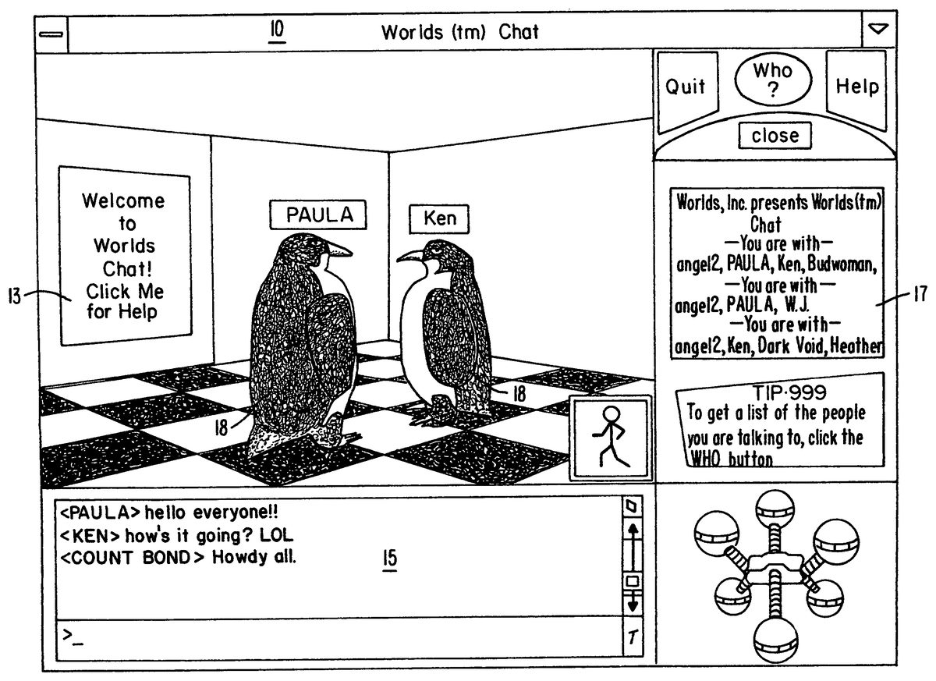
While we’ve seen countless iterations upon similar ideas in 2026, concepts like these were quite innovative when they were filed. Still, the patent remains remarkable for World Inc’s patent creators’ choice of figure.
They chose to represent their forward-looking technology by depicting two penguins–one named “PAULA” and the other named “KEN”–apparently socializing on a black and white tiled floor. The moral of this particular story? Old patents certainly can be fun.
Illustrative Claim:
1. An apparatus for interaction between a plurality of users in a three-dimensional, computer-generated graphical space, comprising: a plurality of client processes, wherein each client process is executed on a digital computer distinct from the digital computers executing others of the plurality of client processes;
a central server process, executed by a server computer;
a network coupling the server computer to the digital computers which execute the plurality of client processes, thereby coupling the plurality of client processes with the central server process;
a plurality of user objects, executed as subprocesses of the central server process, wherein each of the plurality of user objects is associated with a different user in the plurality of users;
an environment database, accessible by each client process;
means for communicating a position of a particular user object corresponding to a particular user in the three-dimensional, computer-generated graphical space from the particular user’s client process to the other client processes via the central server process, the means for communicating programmed according to a protocol;
means, on a digital computer executing the particular user’s client process, for receiving positions of the user objects of the other client processes according to the protocol via the central server process;
and means, on the digital computer executing the particular user’s client process, for rendering a three-dimensional view from a viewpoint of the location of the particular user object, the rendered view including at least one object from the environment database and, when other user objects are at locations viewable from the rendered viewpoint, including those other viewable user objects.