On March 23, 2021, the U.S. Patent Office granted U.S. Pat. No. 11,654,356 to Blizzard Entertainment, Inc. The patent relates to “methods … for restoring gameplay by replaying past inputs.”
In complex video games, players often make decisions that they’d like to re-do. In a lot of games, this requires players to create multiple save states manually. Then, once they have a desire to return to a specific point in a game, they can access one of their saves to zip them right back to the spot they were. However, historically, if a player forgot to create a save at a vital time in the game and then made a decision they wanted back, the would be out of luck. They would be faced with pressing forward under un-ideal circumstances or starting over.
In an attempt to address this dilemma, Blizzard’s system “captures participant inputs that were received to change states of game objects” and then uses what the patent writers call “replay logic” in order to access “saved state information [from] the captured participant inputs” to take players back to their desired spot in their games.
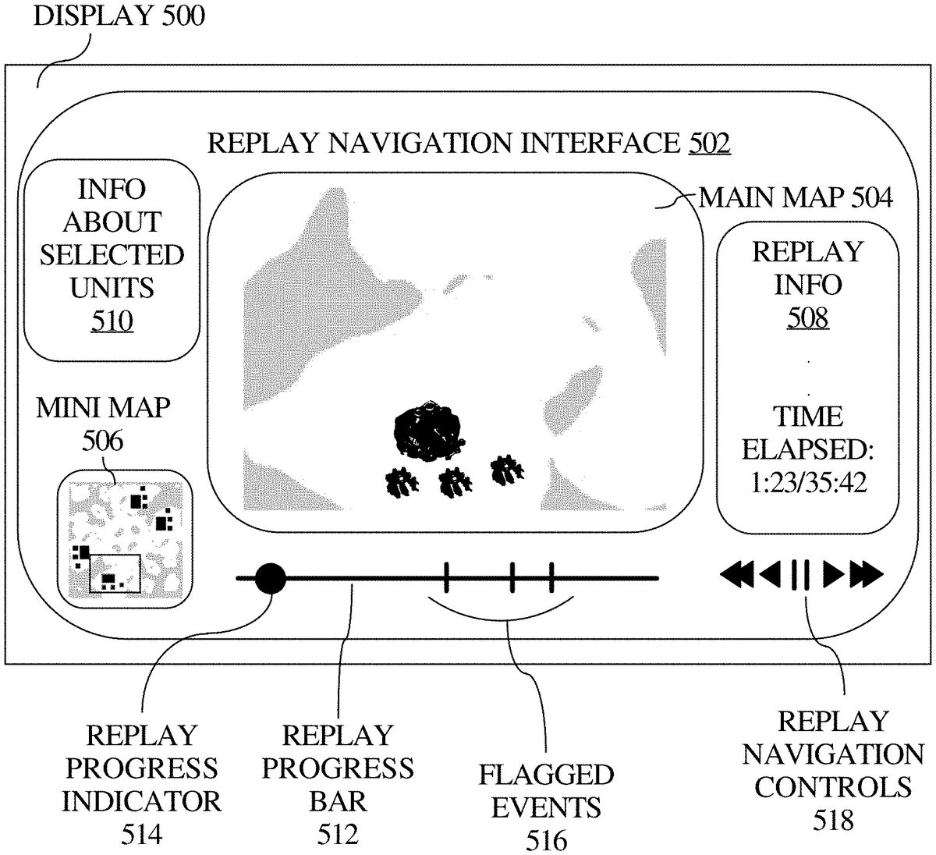
The figure shows how this technology might be implemented in a typical video game UI system with a mini map.
Illustrative Claim:
1. A method for enabling resumption of gameplay at a prior state of a gaming environment, where the prior state does not correspond to any checkpoint at which states of game objects were saved, comprising: storing one or more electronic records of at least a period of past gameplay, the one or more electronic records comprising: particular saved states of game objects at a particular checkpoint in time during the period of past gameplay, and captured participant inputs that affected one or more states of one or more of the game objects during the period of past gameplay, wherein the captured participant inputs comprise: a first subset of inputs that occurred at times before the particular checkpoint, a second subset of inputs that occurred at times after the particular checkpoint but before a second point in time during the period of past gameplay, and a third subset of inputs that occurred at times after the second point in time;
receiving a request to initiate subsequent gameplay beginning from the second point in time;
and causing the subsequent gameplay to begin from the second point at least in part by loading the particular saved states to cause game objects in the gaming environment to be in the saved states and replaying the second subset of inputs in the gaming environment based at least in part on the times of the second subset of inputs;
after replaying the second subset of inputs, beginning the subsequent gameplay in the gaming environment;
wherein the method is performed by one or more computing devices.