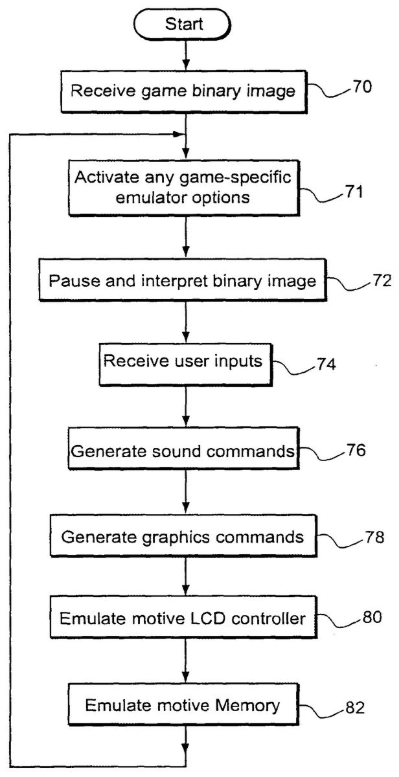
On June 23, 2014, the U.S. Patent Office issued U.S. Pat. No. 9,839,849 to Nintendo Co., Ltd. This patent relates to the emulation of Nintendo’s handheld video game platforms in the GameBoy family on “low-capability target platform[s].” The authors of the patent list “seat-back display[s] for airline or train use, personal digital assistant[s], [and] cell phone[s]” as examples of such target platforms. The technology created using the innovations in this patent might accomplish GameBoy emulation through the use of “bit BLITing, graphics character reformatting, modeling of a native platform liquid crystal display controller using a sequential state machine, and selective skipping of frame display updates.”
This patent is noteworthy because Nintendo has historically taken a hardline stance against emulating its games on third-party devices. For this reason, it’s interesting to think of the possibility space presented by Nintendo-sanctioned emulation of GameBoy games on seat-back displays in transportation settings and the other low-capability target platforms the authors of the patent mention.
In the twelve years since this patent was issued, Nintendo has doubled down on first-party hardware, blunting the strategy suggested by emulating their games more widely with the company’s blessing. That said, analyzing patents like these has the capability to present us with insight into potential roads that video game giants like Nintendo might have been considering. They are, in this way, a window into the past as a way to better understand the present and future of video games.
For more patent analysis, head on over to our video game patent database, the only one of its kind.
Illustrative Claim:
1. A method of adapting operation of an emulator, the method comprising: executing, on a processor, an emulator capable of running a plurality of different binary applications, each of said plurality of different binary applications having an associated identity;
recognizing, by the processor, an associated identity of a binary application for running by the emulator;
the processor accessing a stored data structure that specifies a function(s) and/or feature(s) for selective activation depending upon the recognized identity of the binary application;
automatically adapting, by the processor, a behavior of the emulator to the binary application based on the specification of the function(s) and/or feature(s) depending on the recognized identity of the binary application; and
generating, by the processor, an audio visual presentation using the adapted behavior of the emulator running the binary application.