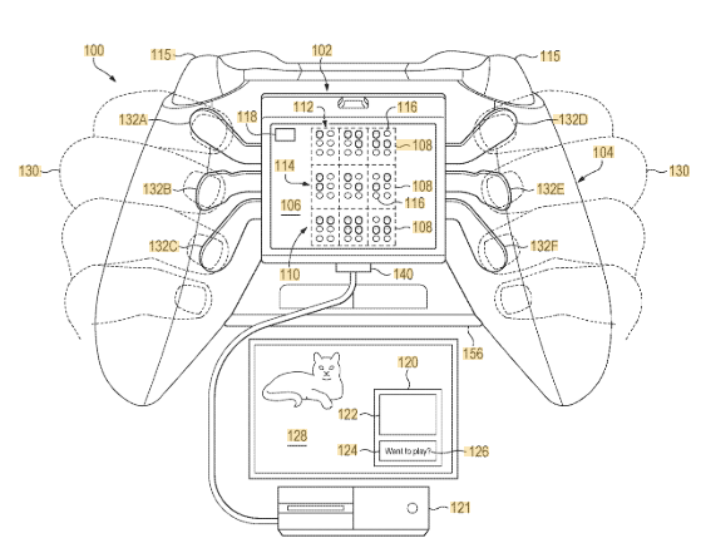
In 2019, the United States Patent Office granted U.S. Pat. No. 10,463,978 to Microsoft Technology Licensing LLC. The patent relates to “a refreshable braille display accessory for a game controller” that would allow blind video game players to read on-screen text by accessing “a plurality of pins arranged in a plurality of braille cells.” The program attached to the display would translate a video game’s text into braille and manipulate the pins in the cells to render readable text for players who would otherwise be unable to read what was on screen.
While many AAA and larger-budget video games feature voice actors that might make the feature included in this patent at least partially obsolete, the proliferation of indie video games and lower-budget productions in recent years would greatly benefit from the implementation of such technology. That’s not even mentioning the diegetic directions, subtle visual cues, and other unvoiced text that defines even the largest-budget video games on the market today.
While the technology in the issued patent might have its limits–the text itself qualifying that a device implementing this technology would be able to render “at least a portion of the plurality of pins based at least in part on a translation of game text or game audio”–it may ultimately be better than nothing for blind video game players. That said, Microsoft has yet to create a product that puts the technology described in the patent into circulation.
Illustrative Claim:
1. A braille display, comprising:
a housing sized to be received by a handheld game controller;
a plurality of pins arranged as a plurality of braille cells, each of the plurality of braille cells including six pins arranged in two columns and three rows; and
a control circuit to control refreshable actuation of the plurality of pins to provide tactile feedback to a finger based at least in part on a translation of game text or game audio to individual braille characters represented on each of the plurality of braille cells.