There have been many successful (and, unfortunately, unsuccessful) examples of games using two different screens for gameplay. As one example, the Sega Dreamcast Visual Memory Unit (VMU) is iconic for being both a memory card and a game display that plugged right into the 1999 console’s controller. As another example, Nintendo’s WiiU console famously included a controller that contained a touchscreen enabling users to provide a wider variety of gameplay input, whether or not the console was also displaying gameplay on another screen (like a television). A look into the past at U.S. Pat. No. 9,675,881, issued to MGA Entertainment Inc in 2015, shows just how much the VMU impacted hardware design long after its heyday had passed.
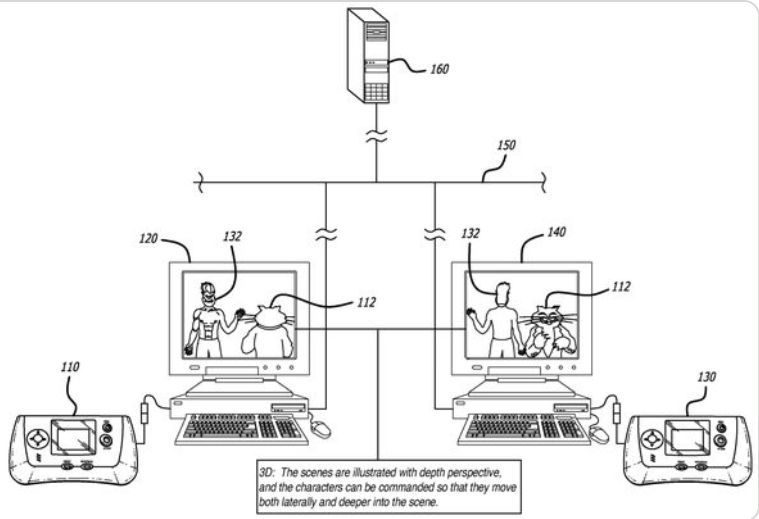
The patent concerns a “virtual world electronic game,” in which players connect a proprietary handheld device to their desktop. While in handheld mode, players can interact with a 2D version of their characters and gain upgrades. Then, when in desktop mode, players can use their characters in a 3D game world. The language in the patent is geared toward distinguishing, “game play…that can translate from a two dimensional visual presentation on a game unit to a higher order visual presentation in an interactive multi-player virtual world on-line and back while retaining any customization or upgrades.”
While the language in the patent relates to a similarly cool idea to that of the VMU, modern two-screen gaming consoles (such as Nintendo’s WiiU) have suggested that two-screen gameplay systems can be a mixed bag. That said, taking a look back at patents issued years ago has value; doing so allows us to contextualize and anticipate innovation in video gaming based on the lineage of the industry’s commercial hardware ideas through the years.
Illustrative Claim:
1. A game system comprising: a portable game playing unit for playing an electronic game, the portable game playing unit having a display, a computing mechanism for generating a first virtual character on the display, and a communications port for operatively connecting the portable game playing unit to a first computer, the first computer having an associated computer screen;
software programming the portable game playing unit computing mechanism and the first computer such that: the first virtual character translates from the portable game playing unit display to the computer screen and back to the portable game playing unit display in response to commands input to the game system by a first player;
when the first virtual character is on the portable game playing unit display, the first virtual character engages in a fight with a first opponent, the first opponent not being controlled by another player, the first virtual character obtaining increased fighting skills as a result of said fight with the first opponent;
the first virtual character, after having engaged in said fight, then translates to said computer screen;
when the first virtual character translates to said computer screen, the portable game playing unit is automatically updated so that the first virtual character is no longer available for play on the portable game playing unit;
when the first virtual character is on the computer screen, the first virtual character acts within a multi-player virtual world according to commands input by the first player, the multi-player virtual world including at least a second virtual character controlled by a second player, the first virtual character’s increased fighting skills having persisted from the portable game playing unit to the multi-player virtual world;
in the multi-player virtual world, the first virtual character engages in a fight with the second virtual character, the first virtual character’s fighting actions being controlled by the first player and the second virtual character’s fighting actions being controlled by the second player;
and when the first virtual character fights with the second virtual character in the multi-player virtual world, the first virtual character has the increased fighting skills that the first virtual character obtained while on the portable game playing unit display, those increased fighting skills having persisted across environments from the portable game playing unit to a multi-player fighting environment in the multi-player virtual world, such that the first virtual character’s fighting skills when in the multi-player fighting environment is enhanced by the first virtual character’s experiences fighting on the portable game playing unit display without a virtual character controlled by a second player.