This post is part 3 of our three-part series exploring patents on game mechanics through the lens of Wizard101. In Part 1, we looked at a patent related to pure gameplay mechanics. In Part 2, we explored a patent with claims that start to go beyond the rules of the game itself and recites how the player interacts with the game, as well as how visualizations are handled for card. That second patent is likely to fare a bit better than the patent from Part 1 under modern day abstract idea analysis.
Looking at the two together, they certainly look like two sides of the same idea. The ‘085 patent from part 1 seemed abstract because it was directed to receiving a selection of a card and then determining the result of a battle based on the card effects. The ‘320 patent from part 2 seems to be more about the computer parts, as it is more overt in talking about the virtual world, three-dimensional figures, and visualizations. But are the visualizations really the novel part of the technology being claimed? Wizard101 certainly wouldn’t claim to have invented 3D virtual worlds, and spell effects within them, in 2009. So if the novel aspects of both claims are similar, how can straightforward steps that may largely amount to “apply it” in a game user interface be enough to save the more detailed claims? The USPTO looks to whether the claims recite “significantly more” than an abstract idea, which might be shown when the claims recite a “practical application” of the abstract idea. This test is applied pretty inconsistently, with different examiners varying widely in approach.
In this final part of Marguerite’s study of three patents from her favorite game, we’ll look at a patent with claims that seem much more grounded in the nature of the technology itself, rather than veering into pure gameplay mechanics. This is where the law of abstract ideas is today. The best arguments under Sec. 101 these days arise when the solution can be tied to something about the way technology works or technical limitations, rather than describing a solution that would be done the same whether a computer or a human is trying to overcome the problem. There’s an argument that these claims still are about managing the content rather than a technical problem, but at least text chat distribution and client-side presentation is a technical context without a human analogue (or is there one?). – Ed., Scott Kelly
By Marguerite Smith, Patent Agent at Banner Witcoff. Electrical Engineering, from Miami University of Ohio.
U.S. Patent No. 8,118,673 describes a computer-implemented method for managing in-game chat in an online multiplayer environment by implementing multiple chat levels with distinct filtering rules. The system assigns each character a specific chat level, which dictates how received dialogue is processed and filtered for other players. This approach allows for customized communication experiences, allowing players with different chat permissions or safety settings to receive appropriately filtered messages. By dynamically applying chat rules based on a player’s assigned chat level, this patent enhances moderation, safety, and accessibility in online gaming communities.
Chat Filtering System
The game associates different chat levels with each player or group of players. Each chat level has specific rules about what can and cannot be said. For instance, a beginner-level chat might restrict profane language, while an advanced chat may allow more mature dialogue. When a player sends a chat message, the system evaluates the content based on the chat level and associated rules.
If the message contains prohibited words (e.g., profanity or offensive language), those words are automatically filtered or replaced before being presented to other players. The system dynamically modifies inappropriate dialogue in real-time. For example, if a player types an unacceptable word, the system might automatically replace it with ellipses (…) or a more appropriate alternative before displaying the message to others. The system allows for customizable filtering based on the chat level, ensuring that the same message can be presented differently to various groups. For instance, a word filtered for a younger audience may still be visible to players at a more mature chat level. The system can also include visual cues, such as colored text or icons, to indicate the player’s chat level. This helps other players recognize the rules that apply to specific chat interactions.
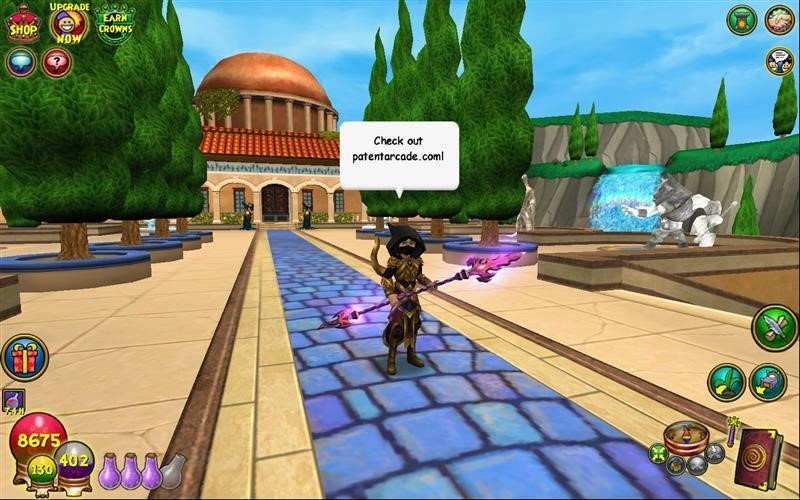
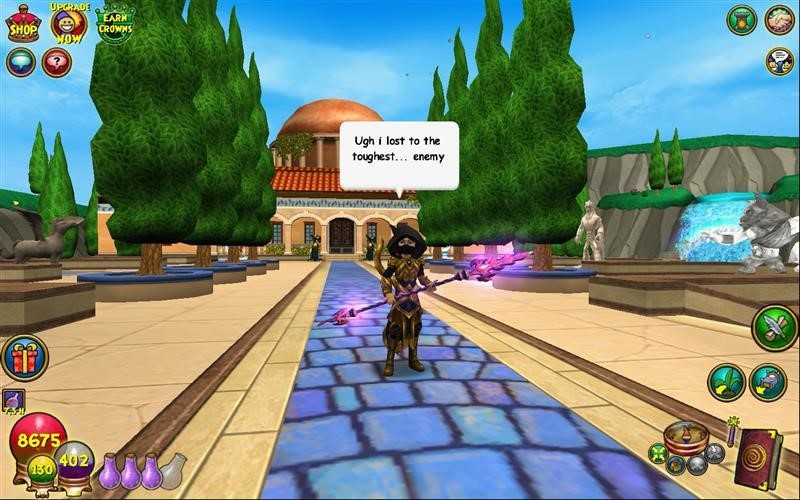
Here, you can see my wizard testing the text-to-chat feature. Since I created my account under parental controls over 15 years ago, my chat is still filtered to block profanity, numbers, and other restricted text. Verified adult players have access to open chat, which has minimal restrictions. However, if someone uses a restricted word in open chat, only other open chat users can see it. For me, those words remain blocked and appear as ellipses (…).
Alternatively, for players or parents who prefer not to use text-based chat, the game offers menu chat. This feature provides a predefined set of phrases that players can select and display. Menu chat allows anyone to communicate easily by asking for help on a quest, expressing gratitude, greeting others, or using simple responses like “yes,” “no,” and “goodbye.”
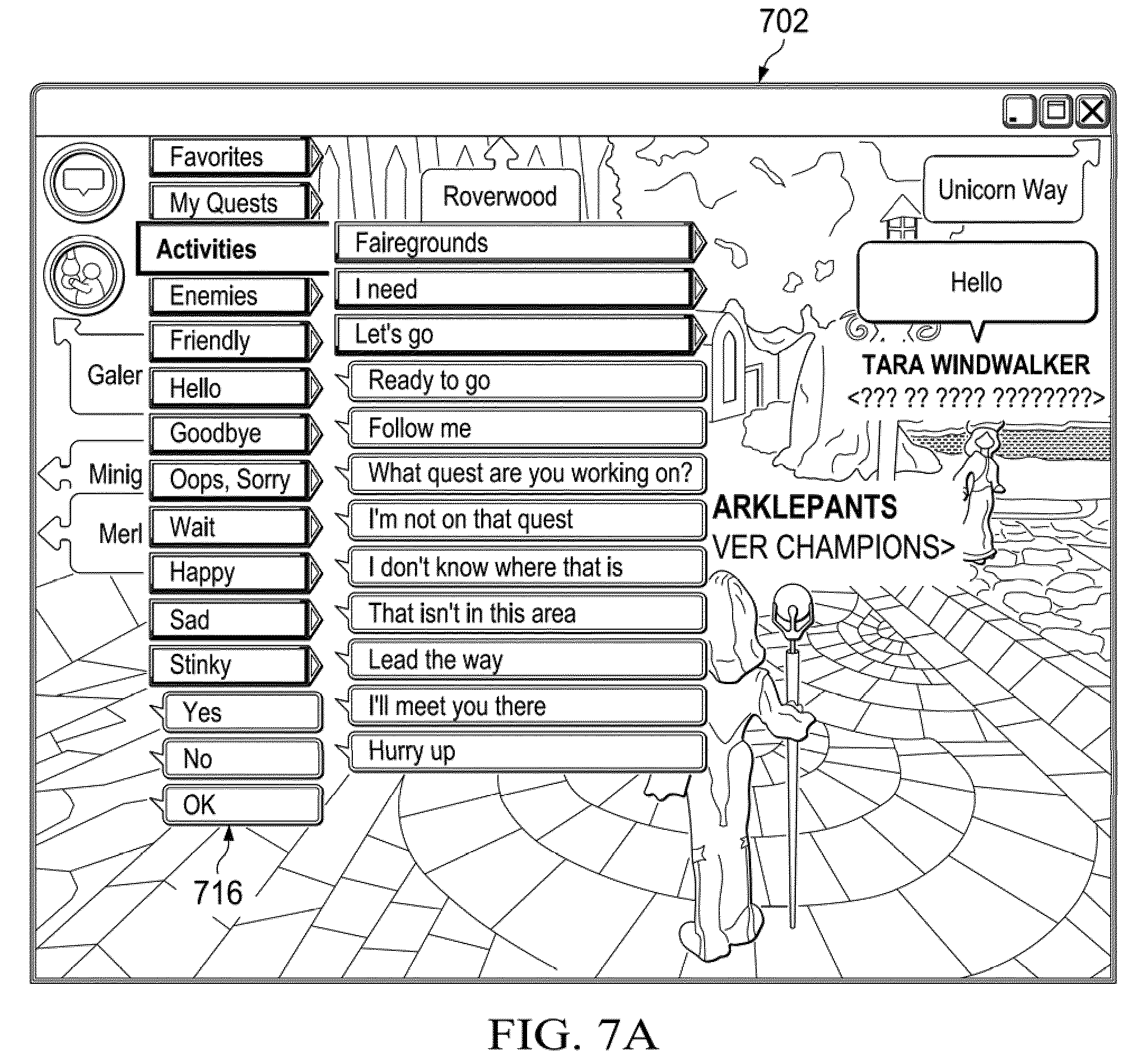
The evolution of in-game communication, as seen in Wizard101’s patented chat system, shows the value KingsIsle placed on balancing player interaction with safety and moderation. The ‘673 patent shows how filtering technology can create a more inclusive gaming environment, accommodating players of different ages and preferences. By implementing multiple chat levels, dynamic filtering, and alternative communication methods like menu chat, Wizard101 makes sure that players can engage in a way that suits their needs (or their parents).
Abstract:
A massively multiplayer online role playing game (MMORPG) or, more specifically, a card-based MMORPG enables characters in a virtual world to collect cards representing specified actions or powers and presents three-dimensional (3D) elements to players representing one or more aspects associated with the characters and environment. This 3D display can, in some implementations, offer a real-time combat engine that processes the card-based events. The 3D display may also offer hanging effects that dynamically present state information associated with the respective character. Further, the MMORPG may offer a real-time responsive and flexible chat management system.
Illustrative Claim:
1. A computer implemented method for chatting in an online game using computer-readable instructions, comprising:
identifying each of a plurality of characters in the online game and an associate chat level from a plurality of different chat levels, wherein each chat level is assigned at least one rule different from rules assigned to other chat levels;
receiving dialogue from a player controlling one of the plurality of characters, wherein players different from the player are each associated with a chat level from the plurality of different chat levels;
identifying, for each of the players different from the player, one or more rules assigned to the associate chat level; and
filtering, for each of the players different from the player, the received dialogue based, at least in part, on the one or more rules assigned to the associate chat level, wherein different chat layers filter the received dialogue differently.