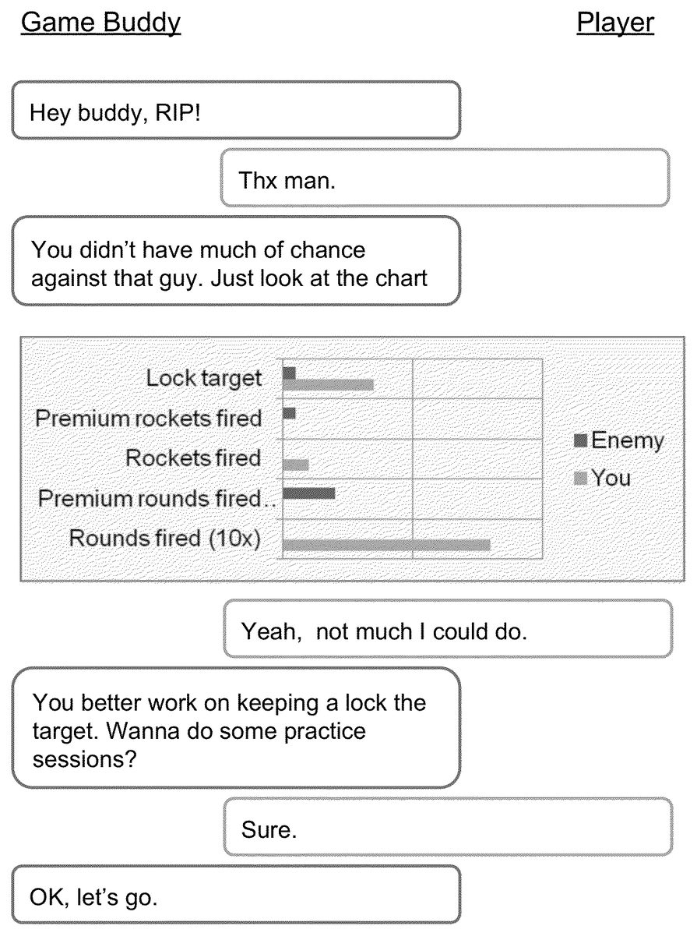
On October 24, 2012, the U.S. Patent Office issued U.S. Pat. No. 8,814,701 to SAP SE. The patent concerns a video game integration to keep players company by reacting to in-game events. The system starts by identifying a player as a “target for engagement” before conducting “a discussion with the player relating to [in-game] events.” The following figure demonstrates how these discussions might be punctuated with “game analysis,” including “recommendations or suggestions for improving the player’s performance.”
While such technology might seem rudimentary to our perspective here in 2026, it was quite forward-thinking for its time in the early 2010s. Patents like this one give consumers a lens into just how early companies begin to lean into emerging technologies in order to bring them to market. The “game buddy” in particular functions a lot like modern chat-based LLMs, and such a parallel provides fascinating context into how future innovations in video games will be based on a long history of iteration.
Illustrative Claim:
1. A method in a gaming system comprising operating a computer system in the gaming system to perform steps of: receiving from a game server event information relating to game events occurring during game play among a plurality of players conducted by the game server;
detecting an occurrence of one or more predetermined game events involving a first player;
in response to the occurrence of the one or more predetermined game events, engaging the first player in a dialogue with the gaming system by sending an initial message to the first player relating to the occurrence of the one or more predetermined game events;
and receiving a response message from the first player subsequent to sending the initial message to the first player thereby creating a dialogue between the gaming system and the first player, wherein the dialogue between the gaming system and the first player comprises an exchange of messages between the first player and the gaming system, wherein the dialogue includes presenting a comparative analysis of performance of the first player and performance of a second player, wherein the dialogue further includes offering for sale one or more virtual game items for use by the first player during game play.