Mobile devices can be handy, but their small screens can make certain kinds of games difficult to play. Recognizing this issue, U.S. Pat. No. 10,646,773, assigned to KingsIsle Entertainment (known for Wizard101 and Pirate101), breaks puzzles into “chunks” (subsets of interconnected pieces) to optimize gameplay on smaller screens.
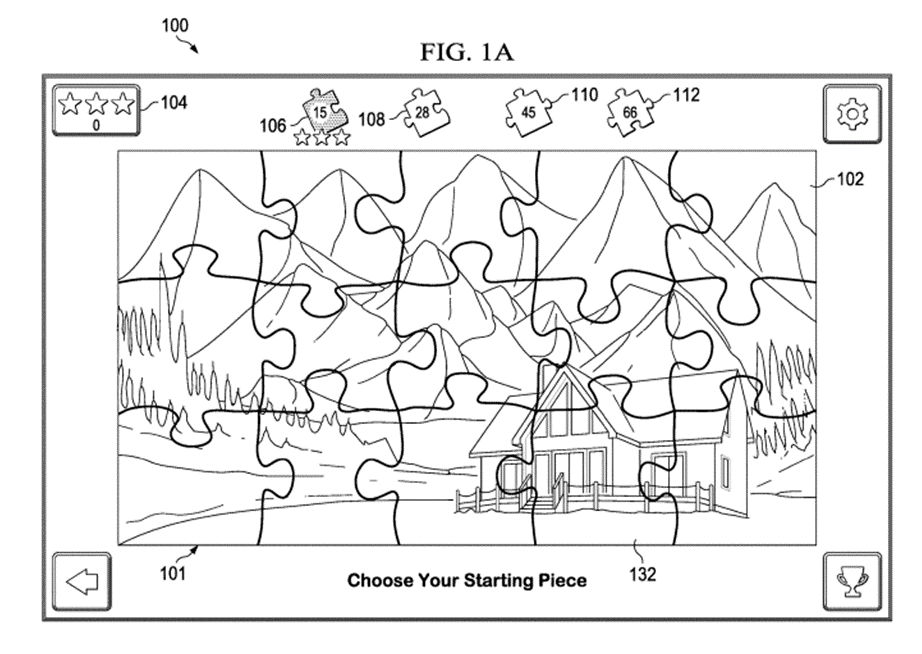
Players select a starting piece, and the game identifies a corresponding chunk of pieces. Only this chunk is actively presented for solving, making large puzzles manageable on devices from smartphones to tablets.
Pieces for the chunk appear in a “hand” area. Some pieces are deliberately duds (pieces that don’t fit), challenging players to identify and discard them. This adds a layer of strategy and skill to what could otherwise be a purely visual task.
The patent assigns points not only for correct placement but also based on accuracy and the path taken to place pieces. Even the act of discarding duds can earn points, rewarding thoughtful play.
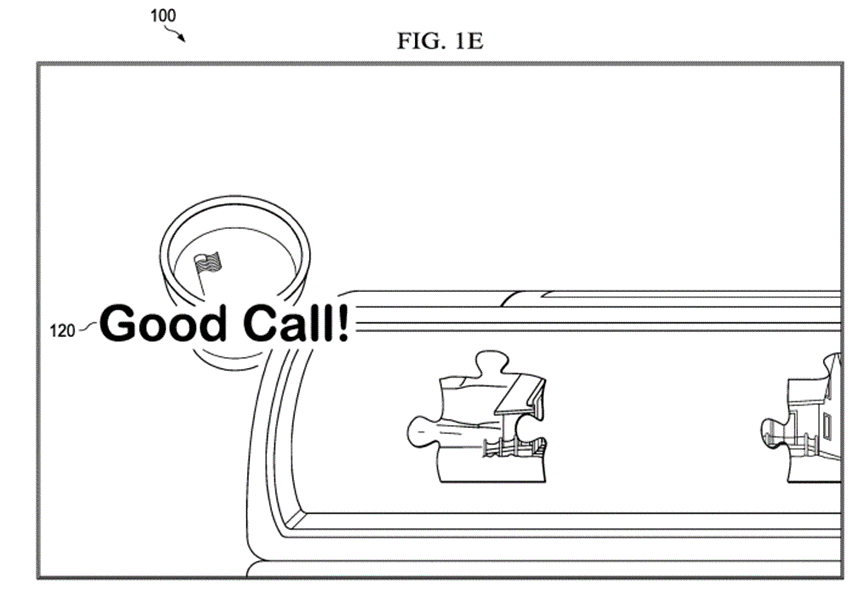
Completed chunks are placed into a puzzle frame, and the process repeats until the puzzle is finished. Optional power-ups, including slot machine-style bonuses, enhance the game and reward speed and accuracy.
Illustrative Claim:
1. A computerized method executed by one or more processors for providing a puzzle game, the method comprising:
identifying a puzzle for use in a jigsaw puzzle application, the puzzle comprising a set of puzzle pieces which combine to form a complete puzzle image, each of the puzzle pieces illustrating a portion of the complete puzzle image;
dividing the identified puzzle into a plurality of chunks, each chunk of the plurality of chunks associated with a particular subset set of pieces from the set of puzzle pieces, where the particular subset of pieces associated with a particular chunk are mutually exclusive from other subsets of pieces associated with each of the other chunks, where the particular subset of pieces of each chunk are interconnected, and wherein the plurality of chunks combine to form the complete puzzle image;
presenting the identified puzzle to a player via a user interface, the presented puzzle illustrating the set of puzzle pieces, where presenting includes prompting, via the user interface, the player to select a particular piece from the set of puzzle pieces as a starting piece;
in response to receiving selection of a particular piece by the player via the user interface, identifying a chunk from the subset of chunks associated with and including the particular piece;
presenting, via the user interface, a chunk interface area for solving the identified chunk associated with and including the particular piece, where the chunk interface area includes a solution area for solving the identified chunk and a player hand area for providing potential pieces for solving the identified chunk, wherein presenting the chunk interface area includes replacing the presentation of the identified puzzle with the chunk interface area in the user interface, and wherein upon initial presentation of the chunk interface, the solution area includes the selected piece and the player hand area includes the remaining pieces associated with and used to complete the chunk;
identifying, via the user interface, a user input selection of a particular one of the potential pieces from the player hand area; and
monitoring a user input-based placement of the particular potential piece at a location within the chunk interface area.