U.S. Pat. No. 9,504,916
ONLINE GAME ANTI-CHEATING METHOD AND SERVER
AssigneeTENCENT TECHNOLOGY (SHENZHEN) COMPANY LIMITED
Issue DateMarch 9, 2014
Illustrative Figure
Abstract
An online game anti-cheating method is provided. The method includes sending cheating program characteristics to a client and receiving characteristics matching with cheating program characteristics reported by the client. The method also includes matching the reported characteristics with characteristics in at least one stored characteristic list and obtaining a determination result based on a matching result. Further, the method includes returning the determination result to the client and to cause the client to react to the determination result.
Description
DETAILED DESCRIPTION Reference will now be made in detail to exemplary embodiments of the disclosure, which are illustrated in the accompanying drawings. FIG. 8shows an environment incorporating certain aspects of the present invention. As shown inFIG. 8, environment800may include a terminal804, a server806, and the Internet802. The terminal804may access the server806through the Internet802for certain personalized services provided by the server806. Although only one server806and one terminal804is shown in the environment800, any number of terminals804or servers806may be included, and other devices may also be included. The Internet802may include any appropriate type of communication network for providing network connections to the terminal804and server806or among multiple terminals804and servers806. For example, Internet802may include the Internet or other types of computer networks or telecommunication networks, either wired or wireless. A terminal, as used herein, may refer to any appropriate user terminal with certain computing capabilities, such as a personal computer (PC), a work station computer, a server computer, a hand-held computing device (tablet), a smart phone or mobile phone, or any other user-side computing device. In certain embodiments, terminal804may be a wireless terminal, such as a smart phone, a tablet computer, or a mobile phone, etc. Terminal804may be implemented on any appropriate computing platform. A server, as used herein, may refer one or more server computers configured to provide certain web server functionalities to provide certain online gaming services, which may match characteristics reported by the client with characteristics in a stored characteristic list and obtain a determination result based on a matching result. A server may also include one or more processors to execute computer programs in parallel. FIG. 1illustrates an overall flow chart of an exemplary anti-cheating method consistent with the disclosed embodiments. A user can install game software on a mobile terminal. When the user wants to play the game, the user ...
DETAILED DESCRIPTION
Reference will now be made in detail to exemplary embodiments of the disclosure, which are illustrated in the accompanying drawings.
FIG. 8shows an environment incorporating certain aspects of the present invention. As shown inFIG. 8, environment800may include a terminal804, a server806, and the Internet802. The terminal804may access the server806through the Internet802for certain personalized services provided by the server806. Although only one server806and one terminal804is shown in the environment800, any number of terminals804or servers806may be included, and other devices may also be included.
The Internet802may include any appropriate type of communication network for providing network connections to the terminal804and server806or among multiple terminals804and servers806. For example, Internet802may include the Internet or other types of computer networks or telecommunication networks, either wired or wireless.
A terminal, as used herein, may refer to any appropriate user terminal with certain computing capabilities, such as a personal computer (PC), a work station computer, a server computer, a hand-held computing device (tablet), a smart phone or mobile phone, or any other user-side computing device. In certain embodiments, terminal804may be a wireless terminal, such as a smart phone, a tablet computer, or a mobile phone, etc. Terminal804may be implemented on any appropriate computing platform.
A server, as used herein, may refer one or more server computers configured to provide certain web server functionalities to provide certain online gaming services, which may match characteristics reported by the client with characteristics in a stored characteristic list and obtain a determination result based on a matching result. A server may also include one or more processors to execute computer programs in parallel.
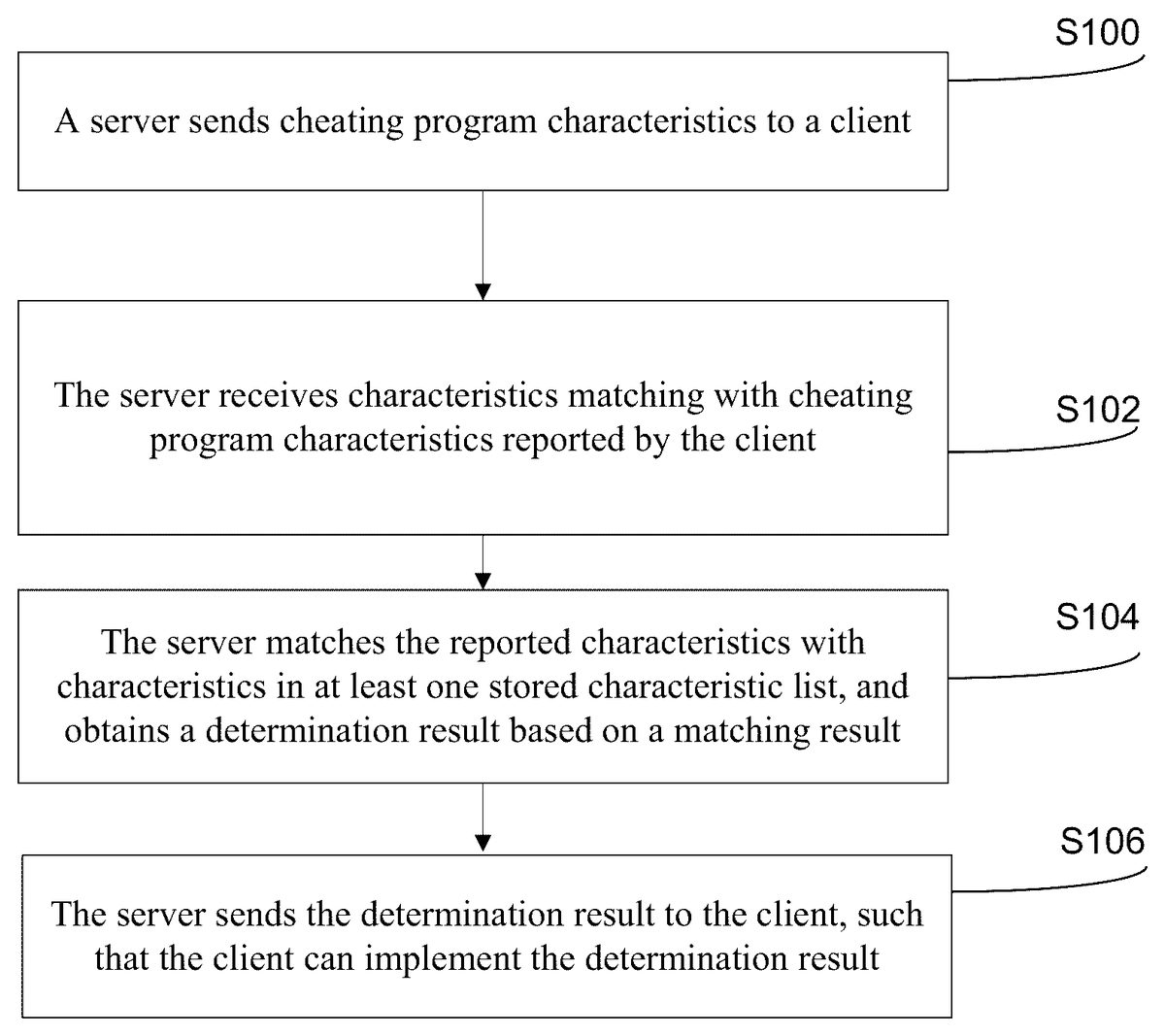
FIG. 1illustrates an overall flow chart of an exemplary anti-cheating method consistent with the disclosed embodiments. A user can install game software on a mobile terminal. When the user wants to play the game, the user logins into a server that has the game installed on and plays the game with other players. As used herein, the mobile terminal that has game software installed on can be called a client, or the client may also refer to the game software. The mobile terminal may be a mobile phone, a personal computer, and a tablet. For ease of understanding, a server may be the main execution component in certain embodiments. As shown inFIG. 1, the online game control process may include the following steps.
S100: a server sends cheating program characteristics to a client. The server may in real-time update cheating program characteristics and sends updated cheating program characteristics to the client. The client may then match the cheating program characteristics with programs running on the client.
S102: the server receives characteristics matching with cheating program characteristics reported by the client. After the client receives the cheating program characteristics from the server, the client in real-time scans and detects the current game environment. The client detects whether there is a cheating program running on the client, that is, the client detects whether there are characteristics matching between any program and the cheating program characteristics sent from the server. If there are characteristics matching with the cheating program characteristics, the client reports the matched characteristics to the server. Then, the server determines the reported characteristics.
S104: the server matches the reported characteristics with characteristics in at least one stored characteristic list, and obtains a determination result based on a matching result.
The server stores a real-time updated characteristic list. The characteristic list includes an abnormal characteristic list and a safe characteristic list. The abnormal characteristic list refers to a list containing characteristics that have been mistakenly considered as the cheating program characteristics. That is, the characteristics in the abnormal characteristic list can be mistakenly considered as the cheating program characteristics by the client. The corresponding punishment operations are not needed if the abnormal characteristics are detected. The safe characteristic list refers to a list containing the cheating program characteristics. The corresponding punishment operations need to be performed if the safe characteristics are detected.
Further, if the reported characteristics match with the characteristics in the abnormal characteristic list, that is, the reported characteristics are included in the abnormal characteristic list, the server determines not to punish the player.
If the reported characteristics do not match with the characteristics in the abnormal characteristic list, but the reported characteristics match with the characteristics in the safe characteristic list. That is, the reported characteristics are included in the safe characteristic list, the server determines to punish the player. That is, the client needs to kick the current player out the game, or terminate the current player's game playing.
If the reported characteristics do not match with either the characteristics in the abnormal characteristic list or the characteristics in the safe characteristic list, the server may determine to delay the determination. The characteristic list is updated within a predetermined counting time period based on the number of times that the characteristics are reported. The server then matches the reported characteristics with the updated characteristic list, and obtains the determination result.
S106: the server sends the determination result to the client, such that the client can implement the determination result.
In certain embodiments, when the determination result is not to punish the current player, the client may keep the current player's game playing. On the other hand, when the determination result is to punish the current player, the client kicks the current player out of the game (i.e., force the current player being logged out of the game), or terminates the current player's game playing. Further, when the determination result is to delay the determination, the client reports the characteristics to the server again in the predetermined waiting time period, and the server can re-determine the result.
Therefore, an anti-cheating method is provided in the present disclosure. A server receives characteristics matching with cheating program characteristics reported by a client. The server matches the reported characteristics with characteristics in at least one stored characteristic list. Based on a matching result, the server obtains a determination result. The corresponding punishment operation is not performed just because the client detects that the characteristics that match the cheating program characteristics are detected. Instead, the server can further determine the characteristics matching with cheating program characteristics reported by the client, thereby improving the security of cheating program detection. In addition, the determination result is obtained by the server, reducing the number of wrong determinations caused by no real-time updated cheating program characteristics on the client. The method further enhances security and reduces risk, ultimately improving the user's experience.
FIG. 2illustrates a detailed flow chart of an exemplary anti-cheating method consistent with the disclosed embodiments. As shown inFIG. 2, the online game control process may include the following steps.
S200: a server sends cheating program characteristics to a client. The server may in real-time update the cheating program characteristics and send the updated cheating program characteristics to the client. The client may then match the cheating program characteristics with programs running on the client.
S201: the server receives characteristics matching with cheating program characteristics reported by the client. After the client receives the cheating program characteristics from the server, the client real-time scans and detects the current game environment. The client detects whether there is a cheating program running on the client. That is, the client detects whether there are characteristics matching between any program and the cheating program characteristics sent from the server. If there are characteristics matching with the cheating program characteristics, the client reports the matched characteristics to the server. Then the server determines the reported characteristics.
S202: the server determines whether the reported characteristics are included in an abnormal characteristic list.
The abnormal characteristic list refers to a list containing characteristics that have been mistakenly considered as the cheating program characteristics. That is, the characteristics in the abnormal characteristic list can be mistakenly considered as the cheating program characteristics by the client. The corresponding punishment operations are not needed if the abnormal characteristics are detected. A safe characteristic list refers to a list containing the cheating program characteristics. The corresponding punishment operations need to be performed when the safe characteristics are detected.
If the reported characteristics match with characteristics in the abnormal characteristic list, that is, the reported characteristics are included in the abnormal characteristic list, the determination result is not to punish the current player (“no punishment”). The process goes to S203.
If the reported characteristics do not match with characteristics in the abnormal characteristic list, the process goes to S204.
S203: the server returns the determination result “no punishment” to the client.
S204: the server determines whether the reported characteristics are included in the safe characteristic list.
If the reported characteristics match with characteristics in the safe characteristic list, that is, the reported characteristics are included in the safe characteristic list, the server determines to punish the player (“punishment”). That is, the client needs to kick the current player out of the game (i.e., force the current player being logged out of the game), or terminate the current player's game playing. The process goes to S205.
If the reported characteristics do not match with characteristics in the safe characteristic list, that is, the reported characteristics are not included in the safe characteristic list, the process goes to S206.
S205: the server returns the determination result “punishment” to the client.
S206: the server updates the stored characteristic list based on the number of times that the characteristics are reported in a predetermined counting time period.
In certain embodiments, in the predetermined counting time period, the server counts the number of times that the same characteristics are reported from multiple clients. That is, the server counts the number of times that the characteristics are reported in S204. When the number of times that the characteristics are reported is greater than a preset threshold value, the server determines that the reported characteristics are abnormal characteristics and adds the reported characteristics into the abnormal characteristic list. When the number of times that the characteristics are reported is not greater than the preset threshold value, the server determines that the reported characteristics are safe characteristics and adds the reported characteristics into the safe characteristic list.
S207: the server receives the characteristics that are re-reported by the client, and matches the re-reported characteristics with the updated characteristic list. The server then determines whether to punish the player based on the matching result.
Further, if the characteristics re-reported by the client match with characteristics in the abnormal characteristic list, that is, the characteristics re-reported by the client are included in the abnormal characteristic list, the server determines not to punish the player.
If the characteristics re-reported by the client do not match with characteristics in the abnormal characteristic list, but match with characteristics in the safe characteristic list, that is, the characteristics re-reported by the client are included in the safe characteristic list, the server determines to punish the current player. The client needs to kick the current player out of the game (i.e., force the current player being logged out of the game), or terminate the current game playing.
The characteristics are determined by the server for multiple times. Therefore, the server can further determine whether the characteristics are cheating program characteristics.
S208: the server returns the determination result to the client, such that the client can implement the determination result.
An anti-cheating method is provided in the present disclosure. A server receives characteristics matching with cheating program characteristics reported by a client. The server matches the reported characteristics with characteristics in at least one stored characteristic list. Based on a matching result, the server obtains a determination result. The corresponding punishment operation is not performed just because the characteristics that match the cheating program characteristics are detected. Instead, the server can further determine the characteristics matching with cheating program characteristics reported by the client, thereby improving the security of cheating program detection. In addition, the determination result is obtained by the server, reducing the number of wrong determinations caused by no real-time updated cheating program characteristics on the client. The method further enhances security and reduces risk, ultimately improving the user's experience.
FIG. 3illustrates a detailed flow chart of another exemplary anti-cheating method consistent with the disclosed embodiments. As shown inFIG. 3, the online game control process may include the following steps.
S300: a server sends cheating program characteristics to a client, and starts timing for counting reported characteristics, where the time period for counting the reported characteristics is predetermined by the system and can be modified based on actual needs.
S301: the client in real-time scans and detects current game environment, and reports the characteristics that match with cheating program characteristics to the server.
S302: the server determines whether the reported characteristics are included in an abnormal characteristic list.
The abnormal characteristic list refers to a list containing characteristics that have been mistakenly considered as the cheating program characteristics. That is, the characteristics in the abnormal characteristic list can be mistakenly considered as the cheating program characteristics by the client. The corresponding punishment operations are not needed if abnormal characteristics are detected. A safe characteristic list refers to a list containing the cheating program characteristics. The corresponding punishment operations need to be performed when safe characteristics are detected.
If the reported characteristics match with characteristics in the abnormal characteristic list, that is, the reported characteristics are included in the abnormal characteristic list, the server determines not to punish the current player. The process goes to S303. If the reported characteristics do not match with characteristics in the abnormal characteristic list, the process goes to S304.
S303: the server returns the determination result “no punishment” to the client.
S304: the server determines whether the reported characteristics are included in the safe characteristic list.
If the reported characteristics match with characteristics in the safe characteristic list, that is, the reported characteristics are included in the safe characteristic list, the server determines to punish the current player. The client needs to kick the current player out of the game (i.e., force the current player being logged out of the game), or terminate the current player's game playing. The process then goes to S305.
On the other hand, if the reported characteristics do not match with characteristics in the safe characteristic list, that is, the reported characteristics are not included in the safe characteristic list, the process goes to S306.
S305: the server returns the determination result “punishment” to the client.
S306: the server returns a determination result “delay the determination” to the client, labels the client's status as a delay determination status, and counts the number of times that the characteristics are reported. In certain embodiments, the determination result “delay the determination” also includes the time period that the client needs to wait for delaying reporting. Further, the client can report the characteristics again after the waiting time period is ended.
S307: the server determines whether the time period for counting the number of times that the characteristics are reported is ended. If the time period for counting the number of times that the characteristics are reported is ended, the process goes to S308; otherwise, the process goes to S306.
S308: the server determines whether the number of times that the characteristics are reported is greater than a preset threshold value.
When the number of times that the characteristics are reported is greater than the preset threshold value, the process goes to S310. When the number of times that the characteristics are reported is not greater than the preset threshold value, the process goes to S309. The process then goes to S310.
S309: the server determines that the reported characteristics are safe characteristics and adds the reported characteristics into the safe characteristic list, thereby updating the safe characteristic list.
S310: the server determines that the reported characteristics are abnormal characteristics and adds the reported characteristics into the abnormal characteristic list, thereby updating the abnormal characteristic list.
S311: the server receives the characteristics re-reported by the client after the waiting time period is ended.
S312: The server determines whether the characteristics re-reported by the client are included in the abnormal characteristic list.
The abnormal characteristic list refers to a list containing characteristics that have been mistakenly considered as the cheating program characteristics. That is, the characteristics in the abnormal characteristic list can be mistakenly considered as the cheating program characteristics by the client. The corresponding punishment operations are not needed if abnormal characteristics are detected. A safe characteristic list refers to a list containing the cheating program characteristics. The corresponding punishment operations need to be performed when safe characteristics are detected.
If the characteristics re-reported by the client match with characteristics in the abnormal characteristic list, that is, the characteristics re-reported by the client are included in the abnormal characteristic list, the server determines not to punish the current player. The process goes to S313.
If the characteristics re-reported by the client do not match with characteristics in the abnormal characteristic list, the process goes to S314.
S313: the server returns the determination result “no punishment” to the client.
S314: the server determines whether the characteristics re-reported by the client are included in the safe characteristic list.
If the characteristics re-reported by the client match with characteristics in the safe characteristic list, that is, the characteristics re-reported by the client are included in the safe characteristic list, the server determines to punish the current player. The client needs to kick the current player out of the game (i.e., force the current player being logged out of the game), or terminate the current player's game playing. The process goes to S315.
If the characteristics re-reported by the client do not match with characteristics in the safe characteristic list, that is, the characteristics re-reported by the client are not included in the safe characteristic list, the process goes to S316.
S315: the server returns the determination result “punishment” to the client.
S316: the server returns the determination result “punishment” to the client, and adds the characteristics re-reported by the client into the safe characteristic list, thereby updating the safe characteristic list.
When the characteristics re-reported by the client are not included either in the safe characteristic list or in the abnormal characteristic list, the server determines that the characteristics re-reported by the client are safe characteristics, and adds those characteristics into the safe characteristic list.
Optionally, the process may also include the following steps.
The server detects whether there is a delay determination label on the client. If there is a delay determination label, according to S312and S314, the server determines the client with a delay determination status. The server determines to punish or not to punish the player based on the final judgment result.
Therefore, an online game anti-cheating method is provided in the present disclosure. A server receives characteristics matching with cheating program characteristics reported by a client. The server matches the reported characteristics with characteristics in at least one stored characteristic list. Based on a matching result, the server obtains a determination result. The corresponding punishment operation is not performed just because the client detects that the characteristics that match the cheating program characteristics are detected. Instead, the server can further determine the characteristics matching with cheating program characteristics reported by the client, thereby improving the security of cheating program detection. In addition, the determination result is obtained by the server, reducing the number of wrong determinations caused by no real-time updated cheating program characteristics on the client. The method further enhances security and reduces risk, ultimately improving the user's experience.
FIG. 4illustrates an overall structure diagram of an exemplary anti-cheating server consistent with the disclosed embodiments. As shown inFIG. 4, the server includes a sending unit40, a receiving unit41, a determination unit42and a storage unit43.
The server can establish communication connections with multiple clients. The server may in real-time update cheating program characteristics and send updated cheating program characteristics to multiple clients.
The sending unit40is configured to send cheating program characteristics to a client. The receiving unit41is configured to receive characteristics matching with cheating program characteristics reported by the client. After the client receives the cheating program characteristics from the server, the client in real-time scans and detects current game environment. The client detects whether there is a cheating program running on the client, that is, the client detects whether there are characteristics matching between any program and cheating program characteristics sent from the server. If there are characteristics matching with cheating program characteristics, the client reports the matched characteristics to the server. Then, the server determines the reported characteristics.
The determination unit42is configured to match the characteristics received by the receiving unit41with the characteristics stored in the storage unit43, and to obtain a determination result based on a matching result.
The storage unit43is configured to store a real-time updated characteristic list. The characteristic list includes an abnormal characteristic list and a safe characteristic list. The abnormal characteristic list refers to a list containing characteristics that have been mistakenly considered as the cheating program characteristics. That is, the characteristics in the abnormal characteristic list can be mistakenly considered as the cheating program characteristics by the client. The corresponding punishment operations are not needed if abnormal characteristics are detected. The safe characteristic list refers to a list containing the cheating program characteristics. The corresponding punishment operations need to be performed when safe characteristics are detected.
If the reported characteristics match with characteristics in the abnormal characteristic list, that is, the reported characteristics are included in the abnormal characteristic list, the determination unit42determines not to punish the current player.
If the reported characteristics match with characteristics in the safe characteristic list, that is, the reported characteristics are included in the safe characteristic list, the determination unit42determines to punish the current player. That is, the client needs to kick the current player out of the game (i.e., force the current player being logged out of the game), or terminate the current player's game playing.
If the reported characteristics do not match with either characteristics in the abnormal characteristic list or characteristics in the safe characteristic list, the determination unit42may determine to delay the determining result. In a predetermined counting time period, the characteristic list is updated based on the number of times that the characteristics are reported. The server then matches the re-reported characteristics with the updated characteristic list, and obtains the determination result. The determination unit42determines the re-reported characteristics based on the updated characteristic list.
The sending unit is further configured to send the determination result determined by the determination unit42to the client, such that the client can implement the determination result. When the determination result is not to punish the current player, the client may keep the current player's game playing. On the other hand, when the determination result is to punish the current player, the client kicks the current player out of the game (i.e., force the current player being logged out of the game), or terminates the current player's game playing. Further, when the determination result is to delay the determination result, the client reports the characteristics to the server again in the predetermined waiting time period, and the server can re-determine the result.
An online game anti-cheating method is provided in the present disclosure. A server receives characteristics matching with cheating program characteristics reported by a client. The server matches the reported characteristics with characteristics in at least one stored characteristic list. Based on a matching result, the server obtains a determination result. The corresponding punishment operation is not performed just because the client detects that the characteristics that match the cheating program characteristics are detected. Instead, the server can further determine the characteristics matching with cheating program characteristics reported by the client, thereby improving the security of cheating program detection. In addition, the determination result is obtained by the server, reducing the number of wrong determinations caused by no real-time updated cheating program characteristics on the client. The method further enhances security and reduces risk, ultimately improving the user's experience.
FIG. 5illustrates a detailed structure diagram of an exemplary anti-cheating server consistent with the disclosed embodiments. As shown inFIG. 5, the server includes a sending unit40, a receiving unit41, a determination unit42, a storage unit43, and an updating unit44. In addition, the determination unit42includes a first determination module420and a second determination module421.
The sending unit40is configured to send cheating program characteristics to a client. The receiving unit41is configured to receive characteristics matching with cheating program characteristics reported by the client. The storage unit43is configured to store a real-time updated characteristic list. The characteristic list includes an abnormal characteristic list and a safe characteristic list.
The first determination module420is configured to determine whether the characteristics received by the receiving unit41are included in the abnormal characteristic list stored in the storage unit43. The first determination module420matches the reported characteristics with the characteristics in the abnormal characteristic list. If the reported characteristics match with characteristics in the abnormal characteristic list, it indicates that the reported characteristics are included in the abnormal characteristic list. Then, a determination result ‘no punishment’ is made.
The second determination module421is configured to, when the first determination module determines that the reported characteristics are not included in the abnormal characteristic list, determine whether the reported characteristics are included in the safe characteristic list. The second determination module421matches the reported characteristics with the characteristics in the safe characteristic list. If the reported characteristics match the characteristics in the safe characteristic list, it indicates that the reported characteristics are included in the safe characteristic list. A determination result “punishment” is made.
The updating unit42is configured to, when the second determination module determines that the reported characteristics are not included in the safe characteristic list, update the stored characteristic list based on the number of times that the characteristics are reported in a predetermined counting time period. In the predetermined counting time period, the updating unit44may count the number of times that the same characteristics are reported by multiple clients. If the updating unit44determines that the number of times that the characteristics are reported is greater than a preset threshold value, the reported characteristics are considered as abnormal characteristics, and added into the abnormal characteristic list stored in the storage unit43. On the other hand, if the updating unit44determines that the number of times that the characteristics are reported is not greater than the preset threshold value, the reported characteristics are considered as safe characteristics, and added into in the safe characteristic list stored in the storage unit43.
The receiving unit41is further configured to receive characteristics re-reported by the client. The determination unit42is further configured to match the re-reported characteristics with characteristics in the updated characteristic list, and obtain a determination result based on the match result. Wherein, the first determination module420is further configured to determine whether the characteristics re-reported by the client are included in the abnormal characteristic list. If the characteristics re-reported by the client are included in the abnormal characteristic list, the determination result “no punishment” is made. The second determination module421is further configured to, when the first determination module420determines that the characteristics re-reported by the client are not included in the abnormal characteristic list, determine whether the characteristics re-reported by the client are included in the safe characteristic list. If the characteristics re-reported by the client are included in the safe characteristic list, the determination result “punishment” is made.
The sending unit40is further configured to send the determination result to the client, such that the client can implement the determination result.
An anti-cheating method is provided in the present disclosure. A server receives characteristics matching with cheating program characteristics reported by a client. The server matches the reported characteristics with characteristics in at least one stored characteristic list. Based on a matching result, the server obtains a determination result. The corresponding punishment operation is not performed just because the client detects that the characteristics that match the cheating program characteristics are detected. Instead, the server can further determine the characteristics matching with cheating program characteristics reported by the client, thereby improving the security of cheating program detection. In addition, the determination result is obtained by the server, reducing the number of wrong determinations caused by no real-time updated cheating program characteristics on the client. The method further enhances security and reduces risk, ultimately improving the user's experience.
FIG. 6illustrates a detailed structure diagram of another exemplary anti-cheating server consistent with the disclosed embodiments. As shown inFIG. 6, the server includes a sending unit40, a receiving unit41, a determination unit42, a storage unit43, and an updating unit44. In addition, the determination unit42includes a first determination module420and a second determination module421. The updating unit44includes a timekeeping module440, a counting module441, and a third determination module442.
The sending unit40is configured to send cheating program characteristics to a client. The timekeeping module440is configured to, when the sending unit40sends the cheating program characteristics to the client, start timing for counting the number of times that the characteristics are reported.
The receiving unit41is configured to receive the characteristics matching with cheating program characteristics reported by the client. The counting module441is configured to count the number of times that the matched characteristics are reported by the client. The storage unit43is configured to store a real-time updated characteristic list. The characteristic list includes an abnormal characteristic list and a safe characteristic list.
The first determination module420is configured to determine whether the characteristics received by the receiving unit41are included in the abnormal characteristic list stored in the storage unit43. The first determination module420matches the reported characteristics with the characteristics in the abnormal characteristic list. If the reported characteristics match the characteristics in the abnormal characteristic list, it indicates that the reported characteristics are included in the abnormal characteristic list. Then, a determination result “no punishment” is made.
The second determination module421is configured to, when the first determination module420determines that the reported characteristics are not included in the abnormal characteristic list, determine whether the reported characteristics are included in the safe characteristic list. The second determination module421matches the reported characteristics with the characteristics in the safe characteristic list. If the reported characteristics match the characteristics in the safe characteristic list, it indicates that the reported characteristics are included in the safe characteristic list. A determination result “punishment” is made.
The third determination module442is configured to, when the second determination module determines that the reported characteristics are not included in the safe characteristic list, after the counting time period of the timekeeping module440is ended, determine whether the number of times that the characteristics are reported is greater than a preset threshold value, and inform the updating unit43to update the characteristic list based on the judgment result.
The third determination module442is further configured to, when the number of times that the characteristics are reported is greater than the preset threshold value, determine that the reported characteristics are abnormal characteristics, and inform the storage unit43to add the reported characteristics into the abnormal characteristic list stored in the storage unit43. The third determination module442is further configured to, when the number of times that the characteristics are reported is not greater than the preset threshold value, determine that the reported characteristics are safe characteristics, and inform the storage unit43to add the reported characteristics into the safe characteristic list stored in the storage unit43.
The receiving unit41is further configured to receive the characteristics re-reported by the client. The determination unit42is further configured to match the re-reported characteristics with characteristics in the updated characteristic list, and obtain a determination result based on the matching result. Wherein, the first determination module420is further configured to determine whether the characteristics re-reported by the client are included in the abnormal characteristic list. If the characteristics re-reported by the client are included in the abnormal characteristic list, the determination result “no punishment” is made. The second determination module421is further configured to, when the first determination module420determines that the characteristics re-reported by the client are not included in the abnormal characteristic list, determine whether the characteristics re-reported by the client are included in the safe characteristic list. If the characteristics re-reported by the client are included in the safe characteristic list, the determination result “punishment” is made.
The second determination module421is further configured to, when the characteristics re-reported by the client are not included in the safe characteristic list, determine to punish the player and inform the storage unit43to add the characteristics re-reported by the client into the safe characteristic list.
The sending unit40is further configured to return the determination result to the client, such that the client can implement the determination result.
Optionally, the server also includes a labeling unit45. The labeling unit45is configured to, when the second determination module421determines that the characteristics reported by the client are not included in the safe characteristic list, label the client's status as a delay determination status.
After the counting time period of the timekeeping module440is ended, the server determines whether there is a delay determination status label in the labeling unit45. When the delay determination status label exists, the first determination module420and the second determination module421further determine whether or not to punish the client.
An online game anti-cheating method is provided in the present disclosure. A server receives characteristics matching with cheating program characteristics reported by a client. The server matches the reported characteristics with characteristics in at least one stored characteristic list. Based on a matching result, the server obtains a determination result. The corresponding punishment operation is not performed just because the clients detects that the characteristics that match the cheating program characteristics are detected. Instead, the server can further determine the characteristics matching with cheating program characteristics reported by the client, thereby improving the security of cheating program detection. In addition, the determination result is obtained by the server, reducing the number of wrong determinations caused by no real-time updated cheating program characteristics on the client. The method further enhances security and reduces risk, ultimately improving the user's experience.
FIG. 7illustrates a schematic diagram of an exemplary anti-cheating server consistent with the disclosed embodiment. As shown inFIG. 7, the server may include a storage medium120, an input unit130, an output unit140, a processor180, and a power supply190. Certain devices may be omitted and other devices may be included.
Processor180may include any appropriate processor or processors that may accept instruction and data as input, process it according to instructions stored in its memory, and provide results as output. Further, processor180can include multiple cores for multi-thread or parallel processing. Storage medium120may include any appropriate memory modules used to store programs (sequences of instructions) or data, such as ROM, RAM, flash memory modules, and erasable and rewritable memory, and mass storages, such as CD-ROM, U-disk, and hard disk, etc. Storage medium120may store computer programs or modules for implementing various processes, when executed by processor180. Storage medium120may also include storage controller used to access storage medium120for input unit130and processor180.
Further, input unit130may be any appropriate peripheral used to receive data and control signals (e.g. numbers, characters, etc.), such as keyboard, mouse, trackball, etc.
The server may include power supply190that can provide low-voltage regulated DC power for the internal components (e.g., storage medium120, processor180, etc.) of a computer. The power supply190include one or more DC or AC power, recharging system, power fail detection circuit, power supply converters or inverters, power status indicator, etc.
In the server, cheating program characteristics are sent to the client through the output unit140. The processor180receives the characteristics matching with cheating program characteristics from the client through the input unit130. The processor180matches the reported characteristics with characteristics stored in at least one characteristic list, and obtains a determination result based on a matching result. The determination result is sent to the client through the output unit140, such that the client can implement the determination result.
Optionally, the characteristic list for storing characteristics in the processor180includes an abnormal characteristic list. The process for matching the reported characteristics with characteristics stored in the characteristic list and obtaining a determination result based on a matching result further includes the followings.
The processor180determines whether the reported characteristics are included in the abnormal characteristic list. If the reported characteristics match with characteristics in the abnormal characteristic list, the processor180determines that the reported characteristics are included in the abnormal characteristic list. A determination result “no punishment” is made.
Optionally, the characteristic list for storing characteristics in the processor180includes a safe characteristic list. The process for matching the reported characteristics with characteristics stored in the characteristic list and obtaining a determination result based on a matching result further includes the followings.
If the reported characteristics do not match with characteristics in the abnormal characteristic list, the processor180determines that the reported characteristics are not included in the abnormal characteristic list. The processor180determines whether the reported characteristics are included in the safe characteristic list. If the reported characteristics match with characteristics in the safe characteristic list, the processor180determines that the reported characteristics are included in the safe characteristic list. A determination result “punishment” is made.
Optionally, the process for matching the reported characteristics with characteristics stored in the characteristic list and obtaining a determination result based on the matching result further includes the followings.
If the reported characteristics do not match with characteristics in the safe characteristic list, the processor180determines that the reported characteristics are not included in the safe characteristic list. The processor180determines to delay the determination result. In a predetermined counting time period, the processor180updates the characteristic list based on the number of times that the characteristics are reported.
Optionally, the process for updating the characteristic list based on the number of times that the characteristics are reported in the predetermined counting time period further includes the followings.
The processor180determines whether the time period for counting the number of times that the characteristics are reported is ended. If it is determined that the counting time period is ended, the processor180determines whether the number of times that the characteristics are reported is greater than a preset threshold value. If it is determined that the number of times that the characteristics are reported is greater than the preset threshold value, the processor180determines that the reported characteristics are abnormal characteristics, and adds the reported characteristics into the abnormal characteristic list.
On the other hand, if it is determined that the number of times that the characteristics are reported is not greater than the preset threshold value, the processor180determines that the reported characteristics are safe characteristics, and adds the reported characteristics into the safe characteristic list.
Optionally, the input unit130is further configured to receive the characteristics re-reported by the client. The processor180matches the characteristics re-reported by the client with characteristics in the updated characteristic list, and obtains a determination result based on the matching result.
Optionally, after the determination result “delay the determination” is made, the processor180is further configured to label the client's status as a delay determination status.
Optionally, the processor180is further configured to detect whether there is a delay determination label on the client. If there is a delay determination label on the client, the processor180determines that the characteristics re-reported by the client are safe characteristics. The processor180returns a determination result “punishment” to the client through the output unit140, and adds the characteristics re-reported by the client into the safe characteristic list.
Those skilled in the art should understand that all or part of the steps in the above method may be executed by relevant hardware instructed by a program, and the program may be stored in a computer-readable storage medium such as a read only memory, a magnetic disk, a Compact Disc (CD), and so on.
The embodiments disclosed herein are exemplary only and not limiting the scope of this disclosure. Without departing from the spirit and scope of this invention, other modifications, equivalents, or improvements to the disclosed embodiments are obvious to those skilled in the art and are intended to be encompassed within the scope of the present disclosure.
INDUSTRIAL APPLICABILITY AND ADVANTAGEOUS EFFECTS
Without limiting the scope of any claim and/or the specification, examples of industrial applicability and certain advantageous effects of the disclosed embodiments are listed for illustrative purposes. Various alternations, modifications, or equivalents to the technical solutions of the disclosed embodiments can be obvious to those skilled in the art and can be included in this disclosure.
By using the disclosed online game anti-cheating method and server, a server receives characteristics matching with cheating program characteristics reported by a client. The server matches the reported characteristics with characteristics in at least one stored characteristic list. Based on a matching result, the server obtains a determination result. The corresponding punishment operation is not performed just because implemented the clients detects that the characteristics that match the cheating program characteristics are detected. Instead, the server can further determine the characteristics matching with cheating program characteristics reported by the client, thereby improving the security of cheating program detection. In addition, the determination result is obtained by the server, reducing the number of wrong determinations caused by no real-time updated cheating program characteristics on the client. The method further enhances security and reduces risk, ultimately improving the user's experience.
Claims
- An online game anti-cheating method, comprising: sending, by a server having at least a processor, cheating program characteristics to a plurality of clients, each client being a game software installed on a user terminal having at least a processor, wherein a cheating program is an automated program executed in parallel with the game software that helps a player illicitly skip steps and gain extra points in the online game;receiving, by the server, characteristics matching with the cheating program characteristics reported by the plurality of clients in a predetermined time period;during the predetermined time period, matching, by the server, the reported characteristics from each client with characteristics in at least one stored characteristic list;when the server finds a matching result for the reported characteristics in the at least one stored characteristic list, obtaining, by the server, a determination result for the corresponding client based on the matching result;when the server does not find the matching result for the reported characteristics in the at least one stored characteristic list, determining the determination result for the corresponding client as delaying determination, and recording the characteristics not found in the at least one stored characteristic list;returning, by the server, the determination result to the corresponding client and to cause the corresponding client to react to the determination result;and when the predetermined time period is ended, updating the at least one stored characteristic list based on a total number of times that the characteristics not found in the at least one stored characteristic list are reported during the predetermined time period.
- The method according to claim 1 , when the stored characteristic list includes an abnormal characteristic list, wherein matching the reported characteristics with characteristics in a stored characteristic list and obtaining a determination result based on a matching result further includes: determining whether the reported characteristics are included in the abnormal characteristic list, wherein the abnormal characteristic list is a list containing characteristics that are reported by the client but do not considered as the cheating program characteristics;when the reported characteristics match with characteristics in the abnormal characteristic list, determining that the reported characteristics are included in the abnormal characteristic list;and determining the determination result for the corresponding client as no punishment.
- The method according to claim 2 , when the stored characteristic list includes a safe characteristic list, wherein matching the reported characteristics with characteristics in a stored characteristic list and obtaining a determination result based on a matching result further includes: determining whether the reported characteristics are included in the safe characteristic list, wherein the safe characteristic list is a list containing validated cheating program characteristics;when the reported characteristics match with characteristics in the safe characteristic list, determining that the reported characteristics are included in the safe characteristic list;and determining the determination result for the corresponding client as punishment, wherein the corresponding client reacts to the determination result by terminating the corresponding client from running the online game.
- The method according to claim 3 , wherein updating the at least one stored characteristic list based on a total number of times that the characteristics not found in the at least one stored characteristic list are reported in the predetermined time period further includes: determining whether the number of times that the characteristics not found in the at least one stored characteristic list are reported is greater than a preset threshold value;when the number of times is greater than the preset threshold value, determining that the reported characteristics are abnormal characteristics and adding the reported characteristics into the abnormal characteristic list;and when the number of times is not greater than the preset threshold value, determining that the reported characteristics are safe characteristics and adding the reported characteristics into the safe characteristic list.
- The method according to claim 1 , further including: receiving the characteristics re-reported by the client, wherein when the server returns the determination result of delaying determination to the corresponding client, the corresponding client reacts to the determination result by re-reporting the characteristics after the predetermined time period is ended;matching the re-reported characteristics with characteristics in the updated characteristic list;and obtaining a determination result based on the matching result.
- The method according to claim 2 , after determining the determination result for the corresponding client as delaying determination, further including: labeling, by the server, the client's status as a delay determination status.
- The method according to claim 6 , further including: detecting a delay determination label on the client;when there is a delay determination label on the client, determining that the characteristics re-reported by the client are safe characteristics;returning the determination result as punishment to the client;and adding the characteristics re-reported by the client into the safe characteristic list.
- An online game anti-cheating server comprising at least a processor and a plurality of program units to be executed by the processor, the plurality of program units comprising: a sending unit configured to send cheating program characteristics to a plurality of clients, each client being a game software installed on a user terminal having at least a processor, wherein a cheating program is an automated program executed in parallel with the game software that helps a player illicitly skip steps and gain extra points in the game;a receiving unit configured to receive characteristics matching with the cheating program characteristics reported by the plurality of clients in a predetermined time period;a storage unit configured to store at least one characteristic list;a determination unit configured to: match the reported characteristics from each client with the at least one characteristics in the characteristic list stored in the storage unit;when a matching result for the reported characteristics in the at least one stored characteristic list is found, obtain a determination result for the corresponding client based on the matching result;and when the matching result for the reported characteristics in the at least one stored characteristic list is not found, determine the determination result for the corresponding client as delaying determination, and record the characteristics not found in the at least one stored characteristic list;the sending unit further configured to return the determination result to the corresponding client and to cause the corresponding client to react to the determination result during the predetermined time period;and an updating unit configured to, when the predetermined time period is ended, update the at least one stored characteristic list based on a total number of times that the characteristics not found in the at least one stored characteristic list are reported during the predetermined time period.
- The server according to claim 8 , wherein: the stored characteristic list includes an abnormal characteristic list, wherein the abnormal characteristic list is a list containing characteristics that are reported by the client but do not considered as the cheating program characteristics;and the determination unit includes a first determination module configured to: determine whether the reported characteristics are included in the abnormal characteristic list;when the reported characteristics match characteristics in the abnormal characteristic list, determine that the reported characteristics are included in the abnormal characteristic list;and determine the determination result for the corresponding client as no punishment.
- The server according to claim 9 , wherein: the stored characteristic list includes a safe characteristic list, wherein the safe characteristic list is a list containing validated cheating program characteristics;and the determination unit includes a second determination module configured to: determine whether the reported characteristics are included in the safe characteristic list;when the reported characteristics match characteristics in the safe characteristic list, determine that the reported characteristics are included in the safe characteristic list;and determine the determination result for the corresponding client as executing punishment, wherein the corresponding client reacts to the determination result by terminating the corresponding client from running the online game.
- The server according to claim 8 , wherein the updating unit further includes: a counting module configured to count the number of times that the characteristics not found in the at least one stored characteristic list reported by the plurality of clients in the predetermined time period;and a third determination module configured to: when the predetermined timing period for counting the reported characteristics is ended, determine whether the number of times that the characteristics not found in the at least one stored characteristic list are reported is greater than a preset threshold value.
- The server according to claim 7 , wherein the third determination module is further configured to: when the number of times is greater than the preset threshold value, determine that the reported characteristics are abnormal characteristics and inform the storage unit to add the reported characteristics into the abnormal characteristic list stored in the storage unit;and when the number of times is not greater than the preset threshold value, determine that the reported characteristics are safe characteristics and inform the storage unit to add the reported characteristics into the safe characteristic list stored in the storage unit.
- The server according to claim 10 , further including: a labeling unit configured to, when the second determination module determines that the reported characteristics are not included in the safe characteristic list, label the client's status as a delay determination status, wherein the second determination module is further configured to: detect the delay determination label on the client;when the delay determination label on the client is detected, determine that the characteristics re-reported by the client are safe characteristics;and inform the storage unit to add the characteristics re-reported by the client into the safe characteristic list.
- The method according to claim 1 , wherein: the determination result returned by the server includes one of: punishment for clients running the cheating program, no punishment for clients not running the cheating program, and delaying determination for clients having characteristics not found in the stored the at least one stored characteristic list;and when the server returns the determination result of delaying determination to the corresponding client, the corresponding client reacts to the determination result by re-reporting the characteristics after the predetermined time period is ended.
Disclaimer: Data collected from the USPTO and may be malformed, incomplete, and/or otherwise inaccurate.