U.S. Pat. No. 9,268,673
LOAD TESTING ONLINE GAME SERVER ENVIRONMENT USING WEB-BASED INTERFACE
AssigneeSony Computer Entertainment America Inc.
Issue DateOctober 20, 2010
Illustrative Figure
Abstract
Load testing an online game server environment using a web-based interface includes: configuring a load test with configuration parameters including client behavior parameters and server parameters, wherein the client behavior parameters provide settings for various behaviors such as cheating and aggressiveness, and wherein the server parameters provide a setup for server states and messages; building and deploying simulation client and game server binaries; scheduling and running the load test; and collecting test data output from the load test. Keywords include load test automation, load test service, load test resource management.
Description
DETAILED DESCRIPTION Certain implementations as disclosed herein provide for load testing an online game server environment using a web-based interface to insure stability and/or scalability of an online game network. The online game environment includes, but not be limited to, arcade games, simulations, massively multi-player online games (MMOG), virtual reality, avatar communications, interactive television overlays, and games with motion sensing and on various devices. Further, these games, devices, and concepts are considered to be included in the online game environment whether such games, devices, and concepts provide or contribute to, in full or part, an entertainment or simulation experience. After reading this description it will become apparent how to implement the invention in various implementations and applications. However, although various implementations of the present invention will be described herein, it is understood that these implementations are presented by way of example only, and not limitation. As such, this detailed description of various implementations should not be construed to limit the scope or breadth of the present invention. In one implementation, resources are allotted to load test online game server environments. For example, the load testing can require simulation of an online game environment involving over 50,000 players as accurately as possible. The steps of a load test can be automated and configured in such a way as to provide management of load tests via a web interface which allows an end user to configure and schedule a load test to run at a specific time, have the test executed and analyzed, and then receive test reports via email and/or a mobile device. The configuration of the automatic load test includes a server framework which interacts with various server-based resources to complete the load test process. FIG. 1is a block diagram of a load testing framework100for an online game server environment ...
DETAILED DESCRIPTION
Certain implementations as disclosed herein provide for load testing an online game server environment using a web-based interface to insure stability and/or scalability of an online game network. The online game environment includes, but not be limited to, arcade games, simulations, massively multi-player online games (MMOG), virtual reality, avatar communications, interactive television overlays, and games with motion sensing and on various devices. Further, these games, devices, and concepts are considered to be included in the online game environment whether such games, devices, and concepts provide or contribute to, in full or part, an entertainment or simulation experience.
After reading this description it will become apparent how to implement the invention in various implementations and applications. However, although various implementations of the present invention will be described herein, it is understood that these implementations are presented by way of example only, and not limitation. As such, this detailed description of various implementations should not be construed to limit the scope or breadth of the present invention.
In one implementation, resources are allotted to load test online game server environments. For example, the load testing can require simulation of an online game environment involving over 50,000 players as accurately as possible. The steps of a load test can be automated and configured in such a way as to provide management of load tests via a web interface which allows an end user to configure and schedule a load test to run at a specific time, have the test executed and analyzed, and then receive test reports via email and/or a mobile device. The configuration of the automatic load test includes a server framework which interacts with various server-based resources to complete the load test process.
FIG. 1is a block diagram of a load testing framework100for an online game server environment using a web-based interface in accordance with one implementation of the present invention. In the illustrated implementation, the load testing framework100includes a load test controller110and a web-based interface112. The load test controller110can be configured as a software application that manages execution steps or a work flow required to manage a load test, which may interact with external hardware resources such as server hosts and data repositories as needed to complete its tasks. The web-based interface112can support creation and/or scheduling of load tests. In one implementation, the load test execution steps include: load test configuration130; build simulation client and game server binary150; deploy simulation client and game server binary160; schedule load test180; collect data190; and data analysis and/or report generation192.
The load test configuration step130, in one implementation, sets up major attributes of the load test. For example, the major attributes include a maximum player count to be simulated, a game title to load tested, a simulation client version, and a game server version. Further, the load test configuration step130can include a client behavior configuration step132and a server configuration step134. The client behavior configuration step132provides settings for various client behaviors such as cheating and aggressiveness. The server configuration step134provides a setup for server states and messages. The settings can be saved and/or retrieved to and from a test configuration repository140for storage and reuse.
The build simulation client and game server binary step150, in one implementation, builds source code or pre-built binaries which can be retrieved from a source code repository152(e.g., Current Version System (CVS), Perforce, and Subversion (SVN)).
The deploy simulation client and game server binary step160, in one implementation, deploys to physical hosts binaries acquired in the build simulation client and game server binary step150. The deployment is carried out according to the load test configuration performed in step130. Further, the deploy simulation client and game server binary step160includes a prepare simulation hosts step162which prepares simulation hosts and a prepare server hosts step164which prepares server hosts. The prepared hosts are then hosted on cloud or internally-hosted servers170.
The schedule load test step180, in one implementation, schedules a load test based on the load test configuration step130. Then, a run/stop load test step182is executed based on schedule preferences selected by a user. The load test is hosted on cloud or internally-hosted servers170.
After the load test is completed, the collect data step190, in one implementation, is executed to load test data collected from the simulation client and server hosts. The test data is then stored in a test result repository194for analysis.
In one implementation, the stored test data is retrieved from the test result repository194and is analyzed for a variety of purposes and reports generated by the data analysis/report generation step192. The purposes of the analysis include error conditions, server health during test, and simulation client metrics. The report is generated from the analysis and sent via the delivery methods specified by the user at the load test configuration step130.
The web-based interface112, in one implementation, is configured to receive inputs from various input devices including a cellular device114and/or a computer116. The web-based interface112performs user registration and profile management as well as load test management. The user registration and profile management function allows the user to create an account and manage a profile that includes email addresses and a list of destination devices for load test notifications. The load test management function creates, edits, and schedules load tests.
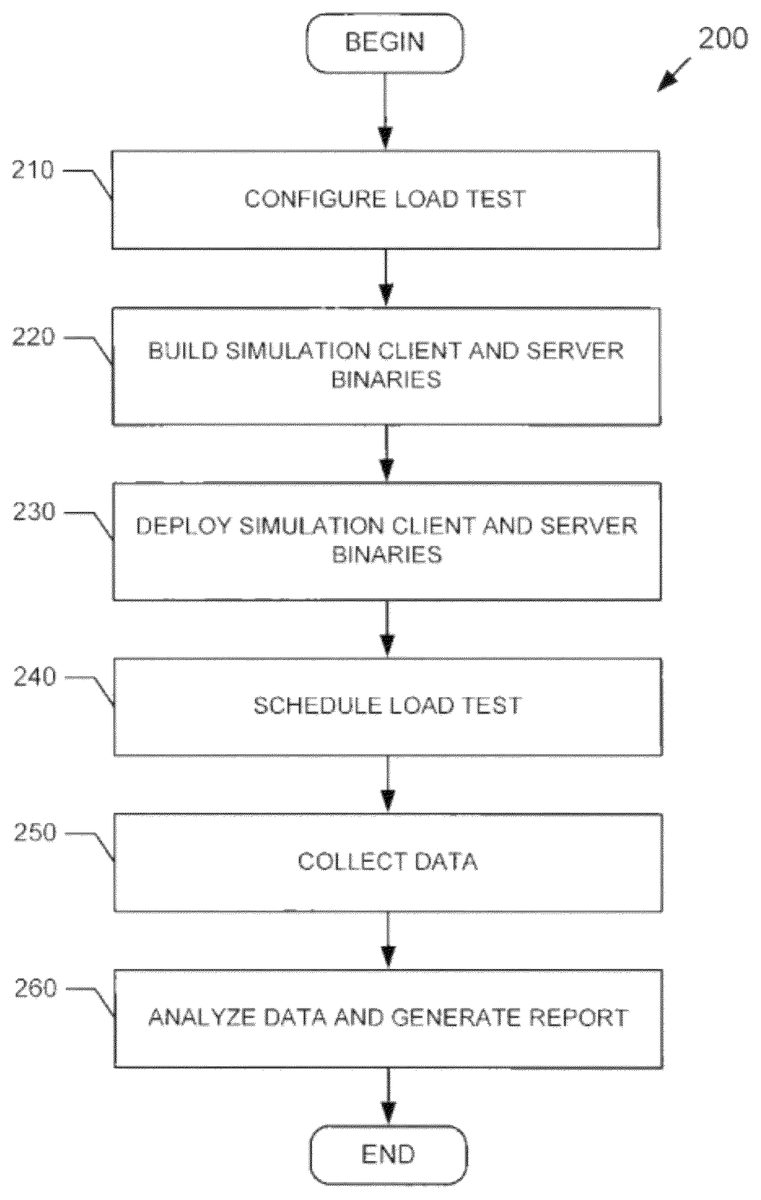
FIG. 2is a flowchart illustrating a process200for load testing an online game server environment using a web-based interface to insure stability and/or scalability of an online game network in accordance with one implementation of the present invention. In the illustrated implementation, the load testing process200is initiated with configuration of a load test, at box210, using configuration parameters. In one implementation, major attributes of the load test is set up by the load test configuration step. For example, the major attributes include a maximum player count to be simulated, a game title to load tested, a simulation client version, and a game server version.
FIG. 3Ashows further steps for the load test configuration210including configuring of a client behavior, at box310, using client behavior parameters, and configuring of a server, box312, using server parameters. The client behavior parameters provide settings for various behaviors such as cheating and aggressiveness. The server parameters provide a setup for server states and messages. The settings can be saved and/or retrieved to and from a test configuration repository140for storage and reuse.
Referring back toFIG. 2, simulation client and game server binaries are built, at box220. In this step, source codes or binaries which can be retrieved from a source code repository152are built. Then, at box230, the previously-built simulation client and game server binaries are deployed to physical hosts. The deployment is carried out according to the load test configuration performed at box210.
FIG. 3Bshows further steps for the deployment of previously-built simulation client and game server binaries (at box230) including preparing simulation hosts, at box330, which prepares simulation hosts, and preparing server hosts, at box332, which prepares server hosts. The prepared hosts are then hosted on cloud or internally-hosted servers170.
Referring back toFIG. 2, the load test is scheduled, at box240, based on the load test configuration performed at box210.FIG. 3Cshows a further step for load test scheduling (at box240) including a run/stop load test step, at box340, which is executed based on schedule preferences selected by a user. The load test is then hosted on cloud or internally-hosted servers170.
Referring back toFIG. 2again, after the load test is completed, the test data is collected, at box250, and is then stored in a test result repository194for analysis.
In one implementation, the stored test data is retrieved from the test result repository194and is analyzed for a variety of purposes, at box260. The analyzed data is then used to generate report(s). The purposes of the analysis include error conditions, server health during test, and simulation client metrics. The report is generated from the analysis and sent via the delivery methods specified by the user.
FIG. 4Aillustrates a representation of a computer system400and a user402. The user402uses the computer system400to perform a load test to insure stability and/or scalability of an online game network. The computer system400stores and executes a load test control490.
FIG. 4Bis a functional block diagram illustrating the computer system400hosting the load test control490. The controller410is a programmable processor and controls the operation of the computer system400and its components. The controller410loads instructions (e.g., in the form of a computer program) from the memory420or an embedded controller memory (not shown) and executes these instructions to control the system. In its execution, the controller410provides the load test control490as a software system. Alternatively, this service can be implemented as separate hardware components in the controller410or the computer system400.
Memory420stores data temporarily for use by the other components of the computer system400. In one implementation, memory420is implemented as RAM. In one implementation, memory420also includes long-term or permanent memory, such as flash memory and/or ROM.
Storage430stores data temporarily or long term for use by other components of the computer system400, such as for storing data used by the load test control490. In one implementation, storage430is a hard disk drive.
The media device440receives removable media and reads and/or writes data to the inserted media. In one implementation, for example, the media device440is an optical disc drive.
The user interface450includes components for accepting user input from the user of the computer system400and presenting information to the user. In one implementation, the user interface450includes a keyboard, a mouse, audio speakers, and a display. The controller410uses input from the user to adjust the operation of the computer system400.
The I/O interface460includes one or more I/O ports to connect to corresponding I/O devices, such as external storage or supplemental devices (e.g., a printer or a PDA). In one implementation, the ports of the I/O interface460include ports such as: USB ports, PCMCIA ports, serial ports, and/or parallel ports. In another implementation, the I/O interface460includes a wireless interface for communication with external devices wirelessly.
The network interface470includes a wired and/or wireless network connection, such as an RJ-45 or “Wi-Fi” interface (including, but not limited to 802.11) supporting an Ethernet connection.
The computer system400includes additional hardware and software typical of computer systems (e.g., power, cooling, operating system), though these components are not specifically shown inFIG. 4Bfor simplicity. In other implementations, different configurations of the computer system can be used (e.g., different bus or storage configurations or a multi-processor configuration).
The above description of the disclosed implementations is provided to enable any person skilled in the art to make or use the invention. Various modifications to these implementations will be readily apparent to those skilled in the art, and the generic principles described herein can be applied to other implementations without departing from the spirit or scope of the invention. Accordingly, additional implementations and variations are also within the scope of the invention. Further, it is to be understood that the description and drawings presented herein are representative of the subject matter which is broadly contemplated by the present invention. It is further understood that the scope of the present invention fully encompasses other implementations that may become obvious to those skilled in the art and that the scope of the present invention is accordingly limited by nothing other than the appended claims.
Claims
- A method of load testing an online game server environment using a web-based interface, the method comprising: configuring a load test with configuration parameters including client behavior parameters and server parameters, wherein the client behavior parameters provide settings for various behaviors including cheating and aggressiveness, wherein the server parameters provide a setup for server states and messages, and wherein the configuration parameters are selected to enable the load test to provide assurance of scalability of the online game server environment;building a software application to initiate and control the load test, wherein the software application is built in accordance with the configuration parameters for the load test, and wherein the software application is built to generate test data resulting from the load test;hosting the load test on cloud to perform the load test on cloud applications running on the online game server environment;running the software application using the web-based interface to initiate and control the load test, and to generate test data resulting from the load test;storing the test data in a test result repository;and analyzing the test data for server health during the load test and simulation client metrics.
- The method of claim 1 , wherein said configuring a load test comprises setting up attributes of the load test.
- The method of claim 2 , wherein the attributes of the load test comprise a maximum player count to be simulated.
- The method of claim 2 , wherein the attributes of the load test comprise a game title to be load tested.
- The method of claim 2 , wherein the attributes of the load test comprise a simulation client version and a game server version.
- The method of claim 1 , wherein building a software application comprises building source codes according to the configuration parameters.
- The method of claim 6 , wherein building source codes comprises deploying the source codes and preparing simulation hosts and server hosts on the cloud.
- The method of claim 1 , wherein the web-based interface is configured to receive inputs from various input devices including a cellular device and/or a computer.
- The method of claim 1 , wherein the web-based interface performs registration and profile management which allows a user to create an account and manage a profile that includes email addresses and a list of destination devices for notifications of the load test.
- The method of claim 1 , wherein the web-based interface creates, edits, and schedules the load test using the software application.
- A non-transitory tangible storage medium storing a computer program for load testing an online game server environment using a web-based interface, the computer program comprising executable instructions that cause a computer to: configure a load test with configuration parameters including client behavior parameters and server parameters, wherein the client behavior parameters provide settings for various behaviors including cheating and aggressiveness, wherein the server parameters provide a setup for server states and messages, and wherein the configuration parameters are selected to enable the load test to provide assurance of scalability of the online game server environment;build a software application to initiate and control the load test, wherein the software application is built in accordance with the configuration parameters for the load test, and wherein the software application is built to generate test data resulting from the load test;host the load test on cloud to perform the load test on cloud applications running on the online game server environment;run the software application using the web-based interface to initiate and control the load test, and to generate test data resulting from the load test;store the test data in a test result repository;and analyze the test data for server health during the load test and simulation client metrics.
- The non-transitory tangible storage medium of claim 11 , wherein executable instructions that cause a computer to configure a load test comprise executable instructions that cause a computer to set up attributes of the load test.
- The non-transitory tangible storage medium of claim 12 , wherein the attributes of the load test comprise a maximum player count to be simulated.
- The non-transitory tangible storage medium of claim 12 , wherein the attributes of the load test comprise a game title to be load tested.
- The non-transitory tangible storage medium of claim 11 , wherein executable instructions that cause a computer to build a software application comprise executable instructions that cause a computer to build source codes according to the configuration parameters.
- The non-transitory tangible storage medium of claim 15 , wherein executable instructions that cause a computer to build source codes comprise executable instructions that cause a computer to deploy the source codes and prepare simulation hosts and server hosts on the cloud.
- The non-transitory tangible storage medium of claim 11 , wherein the web-based interface is configured to receive inputs from various input devices including a cellular device and/or a computer.
- The non-transitory tangible storage medium of claim 11 , wherein the web-based interface performs registration and profile management which allows a user to create an account and manage a profile that includes email addresses and a list of destination devices for notifications of the load test.
- The non-transitory tangible storage medium of claim 11 , wherein the web-based interface creates, edits, and schedules the load test using the software application.
Disclaimer: Data collected from the USPTO and may be malformed, incomplete, and/or otherwise inaccurate.