U.S. Pat. No. 8,944,917
MULTI-TIER ONLINE GAME PLAY
AssigneeMicrosoft Corporation
Issue DateMarch 30, 2007
Illustrative Figure
Abstract
Online multiplayer games are provided in multiple tiers. A first tier offers limited features and a second tier offers first tier features plus additional features. The additional features are exclusive to the second tier. During game play in the first tier, enticements are provided to participate in the second tier. The first tier requires no subscription to participate therein. Participation in the second tier requires a subscription. In an example configuration, the first tier allows players to host a game on a dedicated server, browse a list of dedicated server games, and join a game from a list of first tier eligible games. And, the second tier offers a variety of additional features, such as the ability to invite other players to join a game session, match making services, and cross-platform game play.
Description
DETAILED DESCRIPTION OF ILLUSTRATIVE EMBODIMENTS FIG. 1is an illustration of a multi-tier online gaming system comprising a game service12coupled to the devices14,16, and18via a network20. The game service12can comprise any appropriate service capable of providing multi-tier online gaming services. The service12can comprise any appropriate combination of processors and the like to provide multi-tier online gaming services. The network20can comprise any appropriate network, such as a local area network (LAN), a wide area network, the internet, a home network, and enterprise network, or a combination thereof, for example. The devices14,16, and18, represent any number of devices, including a single device. Each device14,16, and18, can comprise any appropriate device capable of game playing, such as a dedicated console (e.g., XBOX®, XBOX® 360, a general purpose processor such as a laptop, PC, desktop, server, or the like. For example, each of the devices14,16, and18can comprise a game console, a set-top box, a portable phone, a portable entertainment device, a personal digital assistant (PDA), or the like. The service12and the devices14,16, and18, are coupled to the network20, via interfaces22,24,26, and28, respectively. The interfaces22,24,26, and28, are representative of any appropriate interface, such as a wireless interface, a wired interface, or a combination thereof. In accordance with multi-tier online game play, the service12provides to the devices14,16,18, two tiers of game play. It is to be understood that multi-tier online game play is not limited to two tiers, and that more tiers of game play are applicable. In an example embodiment, a first tier provides a first set of multiplayer online game features and a second tier provides additional, exclusive multiplayer online game features. The additional features provided in the second tier are exclusive to the second tier and are not available to players participating in the first tier. While participating in a first tier online game ...
DETAILED DESCRIPTION OF ILLUSTRATIVE EMBODIMENTS
FIG. 1is an illustration of a multi-tier online gaming system comprising a game service12coupled to the devices14,16, and18via a network20. The game service12can comprise any appropriate service capable of providing multi-tier online gaming services. The service12can comprise any appropriate combination of processors and the like to provide multi-tier online gaming services. The network20can comprise any appropriate network, such as a local area network (LAN), a wide area network, the internet, a home network, and enterprise network, or a combination thereof, for example. The devices14,16, and18, represent any number of devices, including a single device. Each device14,16, and18, can comprise any appropriate device capable of game playing, such as a dedicated console (e.g., XBOX®, XBOX® 360, a general purpose processor such as a laptop, PC, desktop, server, or the like. For example, each of the devices14,16, and18can comprise a game console, a set-top box, a portable phone, a portable entertainment device, a personal digital assistant (PDA), or the like. The service12and the devices14,16, and18, are coupled to the network20, via interfaces22,24,26, and28, respectively. The interfaces22,24,26, and28, are representative of any appropriate interface, such as a wireless interface, a wired interface, or a combination thereof.
In accordance with multi-tier online game play, the service12provides to the devices14,16,18, two tiers of game play. It is to be understood that multi-tier online game play is not limited to two tiers, and that more tiers of game play are applicable. In an example embodiment, a first tier provides a first set of multiplayer online game features and a second tier provides additional, exclusive multiplayer online game features. The additional features provided in the second tier are exclusive to the second tier and are not available to players participating in the first tier. While participating in a first tier online game session, via at least one of the devices14,16,18, a player is provided, by the service12, enticements to participate in the second tier. In an example embodiment, the first tier does not require a subscription to participate therein and the second tier does require a subscription. In yet another example embodiment, the subscription to participate in the second tier is fee based. Thus, the participation in the first tier is free and participation in the second tier requires a paid subscription.
In an example embodiment, the first tier comprises multiplayer online game features such as the ability to host dedicated server game sessions, browse a list of dedicated server game sessions, and join a game from a list of game sessions that are eligible to first tier participation. Hosting a dedicated server game session comprises executing an application on a processor that provides master game controls and communications to all players participating in the multiplayer game session. Each player, including the one who sets up the dedicated server, executes an instance of the game application, each of which connects to the dedicated server via which all in-game player to player interaction and communication occur. Dedicated servers provide a persistent game to which players can connect and participate over time.
Exclusive multiplayer online game features of the second tier can include the ability to invite other players to join a game session. In an example configuration, a first tier player (a player participating in an online game session at the first tier) can see a list of game sessions available for first tier players and second tier players (players participating in an online game session at the second tier). However, the game sessions that do not allow participation at the first tier can be emphasized, such as highlighted or grayed out, for example. A second tier player, on the other hand, is provided the same list of game sessions, but none of the game sessions are emphasized (e.g., none of the game sessions are grayed out). The emphasis of the game sessions provides an enticement to a first tier player to participate at the second tier level.
Other exclusive second tier online game play features include the ability to earn points for achievements during a game session in the second tier and receiving a Gamerscore (game score) of a game session in the second tier. First tier players do not earn points or receive a Gamerscore from an online game session. In an example embodiment, upon the conclusion of an online game session, first tier players of the game session are provided an indication of the points and Gamerscore that could have been earned if the player had participated in the online game session at the second tier. The provision of the achievement points that could have been earned and the indication of the Gamerscore that could have been achieved are enticements to participate in the second tier.
Another exclusive second tier online game play features includes earning ranking among other second tier players. Also, the second tier provides the ability to send invitations to other players to join a game session and to accept invitations to join a game session. In an example embodiment, as an enticement to participate in the second tier, first tier players can be provided invitations to join an online multiplayer game session, but be denied the ability to accept the invitation. This could be implemented for example, if a first tier player receives an invitation to join a second tier only game session, and/or if a first tier player receives an invitation to join a game session that already contains a maximum number of first tier players.
Yet another exclusive feature of the second tier is the provision of voice communications among second tier players during an online multiplayer game session. In an example configuration, first tier players can hear other players but can not be heard by other players. The ability to hear and not be heard is an enticement to participate in the second tier.
A multiplayer online game session is typically limited, by the service (e.g., the service12), to a maximum number of players, such as 8 players, for example. In an example embodiment, as an enticement to participate in the second tier, the number of first tier players allowed to join a multiplayer online game session is less than the maximum number of players. And, the number of second tier players allowed to join the multiplayer online game session is equal to the maximum number of players. For example, a multiplayer online game session could be limited to a maximum of 8 players, only 4 of which can be first tier players.
Another exclusive feature provided at the second tier is the ability to utilize matchmaking services. A matchmaking service attempts to use player specific parameters to characterize what would constitute a high quality game experience, and use weightings of these attributes to automatically link players with compatible attributes in the same game session. Example attributes used to architect high quality matches include (but are not limited to) spoken language, skill level in the game, competitive nature (fun oriented vs. competitive), family appropriateness, parental controls, or the like. In an example embodiment, indications of a matchmaking service can be rendered on a display of a first tier player's game playing device, such as devices14,16,18, but the first tier player can not access the matchmaking service. For example a tier 1 player can see a list of multiplayer game modes available, but only ListPlay would be accessible. Player Match, Ranked Match, Join a Friend, would be shown as options, but grayed out.
Cross platform online game play is another exclusive feature offered in the second tier. Cross platform online game play refers to the ability to participate in a multiplayer online game session via different types of game devices. Example game devices include a PC, a general purpose processor, a dedicated game console (e.g., XBOX®, XBOX® 360), a mobile device, a PDA, or a combination thereof, for example. Thus, as an enticement to participate in the second tier, first tier player participation can be limited to a single type of game device, or exclude a type of game device. For example, first tier participation could be limited to only dedicated game consoles and exclude PCs.
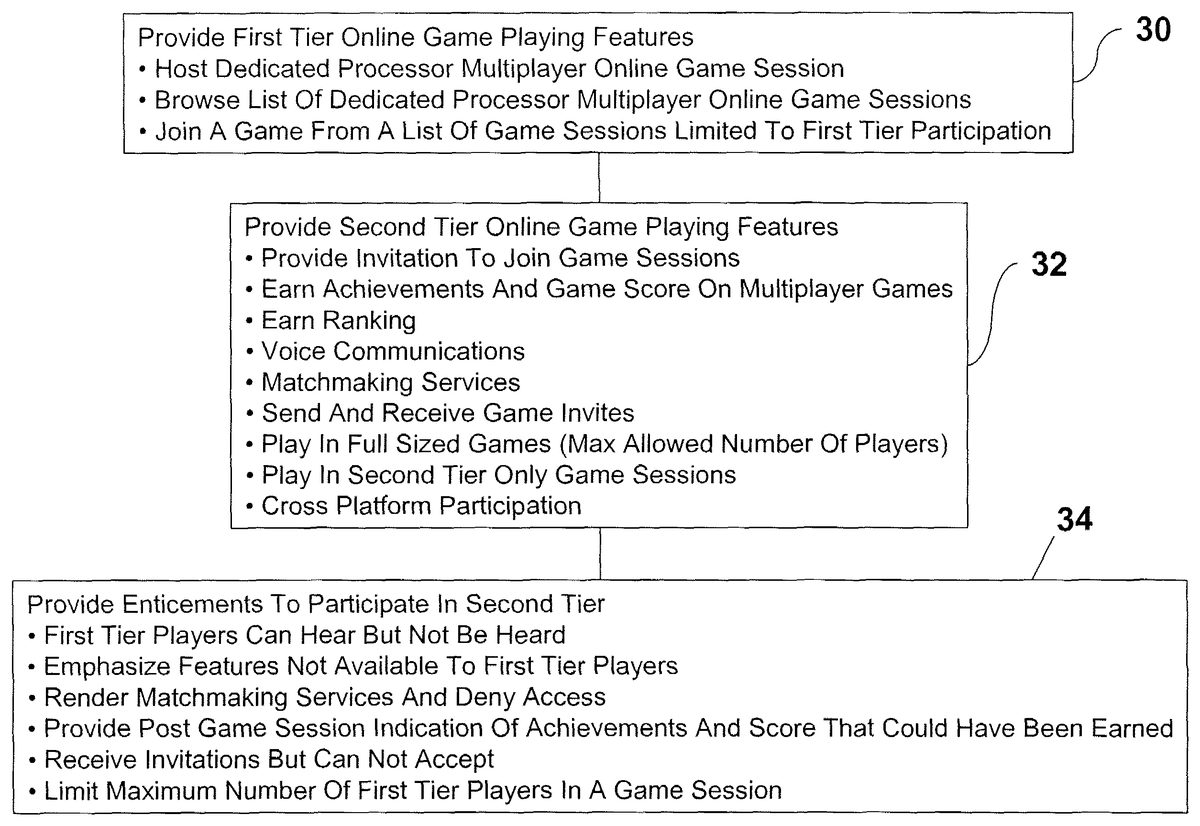
FIG. 2is a flow diagram of an example process for multi-tier online game playing. At step30, first tier online game playing features are provided. As described above, first tier online game features can include the ability to host dedicated server game sessions, browse a list of dedicated server game sessions, and join a game from a list of game sessions that are limited to first tier participation.
Second tier game features are provided at step32. Second tier game features include the first tier game features and additional features exclusive to the second tier. In an example implementation, the first tier is made available without a subscription or fee. The second tier is made available with a subscription and optionally with a fee. As described above, exclusive second tier game features include the ability to invite other players to join a game session, the ability to earn points for achievements during a game session, the ability to receive a game score of a game session, the ability to earn ranking among other second tier players, the provision of voice communications among second tier players during an online multiplayer game session, the ability to utilize matchmaking services, the ability to send invitations to join a game session and to accept invitations to join a game session, the ability to allow the maximum number of second tier players to participate in a game session, the ability for second tier players to participate in a second tier only game session, and allowing cross platform multiplayer online game play.
Enticements to participate in the second tier are provided at step34. As described above, enticements include the ability for first tier players to hear other players but not be heard by other players; emphasizing features not available to first tier players, such as matchmaking services, second tier only game sessions; rendering matchmaking services and denying access thereto; providing, at the conclusion of a game session, an indication of the achievement points that could have been earned and an indication of the game score that could have been achieved during the game session; the ability for first tier players to receive invitations to join an online multiplayer game session, but be denied the ability to accept the invitation; and limiting the number of first tier players that can join a game session to less than the maximum number of players that can join the game session.
As described above, the device (e.g., devices14,16,18, inFIG. 1) used by players to participate in an online game session can comprise a PC, a general purpose processor, a mobile device, a PDA, a dedicated game console or a combination thereof.FIG. 3is a block diagram of an example game console300in which multi-tier online game play can be accomplished. The game console300along with other devices described herein, such as a display device, are capable of performing the functions needed to accomplish multi-tier online game play, as describe above. Game console300is an example of a dedicated host system, although, as noted above, a game console is only one example of a dedicated host device. A typical game console comprises hardware and software that are specifically designed to support a core set of usage scenarios.
Game console300has a central processing unit (CPU)301having a level 1 (L1) cache302, a level 2 (L2) cache304, and a flash ROM (Read-only Memory)306. The level 1 cache302and level 2 cache304temporarily store data and hence reduce the number of memory access cycles, thereby improving processing speed and throughput. The flash ROM306can store executable code that is loaded during an initial phase of a boot process when the game console300is initially powered. Alternatively, the executable code that is loaded during the initial boot phase can be stored in a FLASH memory device (not shown). Further, ROM306can be located separate from CPU301. Game console300can, optionally, be a multi-processor system; for example game console300can have three processors301,303, and305, where processors303and305have similar or identical components to processor301.
A graphics processing unit (GPU)308and a video encoder/video codec (coder/decoder)314form a video processing pipeline for high speed and high resolution graphics processing. Data is carried from the graphics processing unit308to the video encoder/video codec314via a bus. The video processing pipeline outputs data to an A/V (audio/video) port340for transmission to a television or other display device. A memory controller310is connected to the GPU308and CPU301to facilitate processor access to various types of memory312, such as, but not limited to, a RAM (Random Access Memory).
Game console300includes an I/O controller320, a system management controller322, an audio processing unit323, a network interface controller324, a first USB host controller326, a second USB controller328and a front panel I/O subassembly330that may be implemented on a module318. The USB controllers326and328serve as hosts for peripheral controllers342(1)-342(2), a wireless adapter348, and an external memory unit346(e.g., flash memory, external CD/DVD ROM drive, removable media, etc.). The network interface324and/or wireless adapter348provide access to a network (e.g., the Internet, home network, etc.) and may be any of a wide variety of various wired or wireless interface components including an Ethernet card, a modem, a Bluetooth module, a cable modem, and the like.
System memory343is provided to store application data that is loaded during the boot process. A media drive344is provided and may comprise a DVD/CD drive, hard drive, or other removable media drive, etc. The media drive344may be internal or external to the game console300. When media drive344is a drive or reader for removable media (such as removable optical disks, or flash cartridges), then media drive344is an example of an interface onto which (or into which) media are mountable for reading. Application data may be accessed via the media drive344for execution, playback, etc. by game console300. Media drive344is connected to the I/O controller320via a bus, such as a Serial ATA bus or other high speed connection (e.g., IEEE 3394). While media drive344may generally refer to various storage embodiments (e.g., hard disk, removable optical disk drive, etc.), game console300may specifically include a hard disk352, which can be used to store game data, application data, or other types of data, and on which the file systems depicted inFIGS. 3 and 4may be implemented.
The system management controller322provides a variety of service functions related to assuring availability of the game console300. The audio processing unit323and an audio codec332form a corresponding audio processing pipeline with high fidelity, 3D, surround, and stereo audio processing according to aspects of the present subject matter described herein. Audio data is carried between the audio processing unit323and the audio codec326via a communication link. The audio processing pipeline outputs data to the A/V port340for reproduction by an external audio player or device having audio capabilities.
The front panel I/O subassembly330supports the functionality of the power button350and the eject button352, as well as any LEDs (light emitting diodes) or other indicators exposed on the outer surface of the game console300. A system power supply module336provides power to the components of the game console300. A fan338cools the circuitry within the game console300.
The CPU301, GPU308, memory controller310, and various other components within the game console300are interconnected via one or more buses, including serial and parallel buses, a memory bus, a peripheral bus, and a processor or local bus using any of a variety of bus architectures.
When the game console300is powered on or rebooted, application data can be loaded from the system memory343into memory312and/or caches302,304and executed on the CPU301. The application can present a graphical user interface that provides a consistent user experience when navigating to different media types available on the game console300. In operation, applications and/or other media contained within the media drive344may be launched or played from the media drive344to provide additional functionalities to the game console300.
The game console300may be operated as a standalone system by simply connecting the system to a television or other display. In this standalone mode, the game console300may allow one or more users to interact with the system, watch movies, listen to music, and the like. However, with the integration of broadband connectivity made available through the network interface324or the wireless adapter348, the game console300may further be operated as a participant in a larger network community.
As described above, the multi-tier online game service (e.g., service12inFIG. 1) can comprise a processor or combination of processors.FIG. 4is a diagram of an exemplary processor38for providing or participating in multi-tier online gaming services. Further, the processor38can represent a general purpose processor used by a player to participate in multi-tier online game play.
The processor38comprises a processing portion40, a memory portion42, and an input/output portion44. The processing portion40, memory portion42, and input/output portion44are coupled together (coupling not shown inFIG. 4) to allow communications therebetween. The input/output portion44is capable of providing and/or receiving components utilized to perform multi-tier online game play as described above. For example, the input/output portion44is capable of, as described above, providing first tier game features, providing second tier game features, providing enticements to participate in the second tier, and/or receiving responses thereto.
The processing portion40is capable of performing multi-tier online game play as described above. For example, the processing portion40is capable of determining first tier game features, determining second tier game features, determining enticements to participate in the second tier, or a combination thereof.
The processor38can be implemented as a client processor and/or a server processor. In a basic configuration, the processor38can include at least one processing portion40and memory portion42. The memory portion42can store any information utilized in conjunction with performing multi-tier online game play. Depending upon the exact configuration and type of processor, the memory portion42can be volatile (such as RAM)46, non-volatile (such as ROM, flash memory, etc.)48, or a combination thereof. The processor38can have additional features/functionality. For example, the processor38can include additional storage (removable storage50and/or non-removable storage52) including, but not limited to, magnetic or optical disks, tape, flash, smart cards or a combination thereof. Computer storage media, such as memory portion42,46,48,50, and52, include volatile and nonvolatile, removable and non-removable media implemented in any method or technology for storage of information such as computer readable instructions, data structures, program modules, or other data. Computer storage media include, but are not limited to, RAM, ROM, EEPROM, flash memory or other memory technology, CD-ROM, digital versatile disks (DVD) or other optical storage, magnetic cassettes, magnetic tape, magnetic disk storage or other magnetic storage devices, universal serial bus (USB) compatible memory, smart cards, or any other medium which can be used to store the desired information and which can be accessed by the processor38. Any such computer storage media can be part of the processor38.
The processor38can also contain communications connection(s)58that allow the processor38to communicate with other devices, such as other devices, for example. Communications connection(s)58is an example of communication media. Communication media typically embody computer readable instructions, data structures, program modules or other data in a modulated data signal such as a carrier wave or other transport mechanism and includes any information delivery media. The term “modulated data signal” means a signal that has one or more of its characteristics set or changed in such a manner as to encode information in the signal. By way of example, and not limitation, communication media includes wired media such as a wired network or direct-wired connection, and wireless media such as acoustic, RF, infrared and other wireless media. The term computer readable media as used herein includes both storage media and communication media. The processor38also can have input device(s)56such as keyboard, mouse, pen, voice input device, touch input device, etc. Output device(s)54such as a display, speakers, printer, etc. also can be included.
FIG. 5and the following discussion provide a brief general description of a suitable computing environment in which multi-tier online game play can be implemented. Although not required, various aspects of multi-tier online game play can be described in the general context of computer executable instructions, such as program modules, being executed by a computer, such as a client workstation or a server. Generally, program modules include routines, programs, objects, components, data structures and the like that perform particular tasks or implement particular abstract data types. Moreover, implementation of multi-tier online game play can be practiced with other computer system configurations, including hand held devices, multi processor systems, microprocessor based or programmable consumer electronics, network PCs, minicomputers, mainframe computers, and the like. Further, multi-tier online game play also can be practiced in distributed computing environments where tasks are performed by remote processing devices that are linked through a communications network. In a distributed computing environment, program modules can be located in both local and remote memory storage devices.
A computer system can be roughly divided into three component groups: the hardware component, the hardware/software interface system component, and the applications programs component (also referred to as the “user component” or “software component”). In various embodiments of a computer system the hardware component may comprise the central processing unit (CPU)521, the memory (both ROM564and RAM525), the basic input/output system (BIOS)566, and various input/output (I/O) devices such as a keyboard540, a mouse542, a monitor547, and/or a printer (not shown), among other things. The hardware component comprises the basic physical infrastructure for the computer system.
The applications programs component comprises various software programs including but not limited to compilers, database systems, word processors, business programs, videogames, and so forth. Application programs provide the means by which computer resources are utilized to solve problems, provide solutions, and process data for various users (machines, other computer systems, and/or end-users). In an example embodiment, application programs perform the functions associated with multi-tier online game play as described above.
The hardware/software interface system component comprises (and, in some embodiments, may solely consist of) an operating system that itself comprises, in most cases, a shell and a kernel. An “operating system” (OS) is a special program that acts as an intermediary between application programs and computer hardware. The hardware/software interface system component may also comprise a virtual machine manager (VMM), a Common Language Runtime (CLR) or its functional equivalent, a Java Virtual Machine (JVM) or its functional equivalent, or other such software components in the place of or in addition to the operating system in a computer system. A purpose of a hardware/software interface system is to provide an environment in which a user can execute application programs.
The hardware/software interface system is generally loaded into a computer system at startup and thereafter manages all of the application programs in the computer system. The application programs interact with the hardware/software interface system by requesting services via an application program interface (API). Some application programs enable end-users to interact with the hardware/software interface system via a user interface such as a command language or a graphical user interface (GUI).
A hardware/software interface system traditionally performs a variety of services for applications. In a multitasking hardware/software interface system where multiple programs may be running at the same time, the hardware/software interface system determines which applications should run in what order and how much time should be allowed for each application before switching to another application for a turn. The hardware/software interface system also manages the sharing of internal memory among multiple applications, and handles input and output to and from attached hardware devices such as hard disks, printers, and dial-up ports. The hardware/software interface system also sends messages to each application (and, in certain case, to the end-user) regarding the status of operations and any errors that may have occurred. The hardware/software interface system can also offload the management of batch jobs (e.g., printing) so that the initiating application is freed from this work and can resume other processing and/or operations. On computers that can provide parallel processing, a hardware/software interface system also manages dividing a program so that it runs on more than one processor at a time.
A hardware/software interface system shell (referred to as a “shell”) is an interactive end-user interface to a hardware/software interface system. (A shell may also be referred to as a “command interpreter” or, in an operating system, as an “operating system shell”). A shell is the outer layer of a hardware/software interface system that is directly accessible by application programs and/or end-users. In contrast to a shell, a kernel is a hardware/software interface system's innermost layer that interacts directly with the hardware components.
As shown inFIG. 5, an exemplary general purpose computing system includes a conventional computing device560or the like, including a processing unit521, a system memory562, and a system bus523that couples various system components including the system memory to the processing unit521. The system bus523may be any of several types of bus structures including a memory bus or memory controller, a peripheral bus, and a local bus using any of a variety of bus architectures. The system memory includes read only memory (ROM)564and random access memory (RAM)525. A basic input/output system566(BIOS), containing basic routines that help to transfer information between elements within the computing device560, such as during start up, is stored in ROM564. The computing device560may further include a hard disk drive527for reading from and writing to a hard disk (hard disk not shown), a magnetic disk drive528(e.g., floppy drive) for reading from or writing to a removable magnetic disk529(e.g., floppy disk, removal storage), and an optical disk drive530for reading from or writing to a removable optical disk531such as a CD ROM or other optical media. The hard disk drive527, magnetic disk drive528, and optical disk drive530are connected to the system bus523by a hard disk drive interface532, a magnetic disk drive interface533, and an optical drive interface534, respectively. The drives and their associated computer readable media provide non volatile storage of computer readable instructions, data structures, program modules and other data for the computing device560. Although the exemplary environment described herein employs a hard disk, a removable magnetic disk529, and a removable optical disk531, it should be appreciated by those skilled in the art that other types of computer readable media which can store data that is accessible by a computer, such as magnetic cassettes, flash memory cards, digital video disks, Bernoulli cartridges, random access memories (RAMs), read only memories (ROMs), and the like may also be used in the exemplary operating environment. Likewise, the exemplary environment may also include many types of monitoring devices such as heat sensors and security or fire alarm systems, and other sources of information.
A number of program modules can be stored on the hard disk, magnetic disk529, optical disk531, ROM564, or RAM525, including an operating system535, one or more application programs536, other program modules537, and program data538. A user may enter commands and information into the computing device560through input devices such as a keyboard540and a pointing device (e.g., mouse542). Other input devices (not shown) may include a microphone, joystick, game pad, satellite disk, scanner, or the like. These and other input devices are often connected to the processing unit521through a serial port interface546that is coupled to the system bus, but may be connected by other interfaces, such as a parallel port, game port, or universal serial bus (USB). A monitor547or other type of display device is also connected to the system bus523via an interface, such as a video adapter548. In addition to the monitor547, computing devices typically include other peripheral output devices (not shown), such as speakers and printers. The exemplary environment ofFIG. 5also includes a host adapter555, Small Computer System Interface (SCSI) bus556, and an external storage device592connected to the SCSI bus556.
The computing device560may operate in a networked environment using logical connections to one or more remote computers, such as a remote computer549. The remote computer549may be another computing device (e.g., personal computer), a server, a router, a network PC, a peer device, or other common network node, and typically includes many or all of the elements described above relative to the computing device560, although only a memory storage device550(floppy drive) has been illustrated inFIG. 5. The logical connections depicted inFIG. 5include a local area network (LAN)551and a wide area network (WAN)552. Such networking environments are commonplace in offices, enterprise wide computer networks, intranets and the Internet.
When used in a LAN networking environment, the computing device560is connected to the LAN551through a network interface or adapter553. When used in a WAN networking environment, the computing device560can include a modem554or other means for establishing communications over the wide area network552, such as the Internet. The modem554, which may be internal or external, is connected to the system bus523via the serial port interface546. In a networked environment, program modules depicted relative to the computing device560, or portions thereof, may be stored in the remote memory storage device. It will be appreciated that the network connections shown are exemplary and other means of establishing a communications link between the computers may be used.
While it is envisioned that numerous embodiments of multi-tier online game play are particularly well-suited for computerized systems, nothing in this document is intended to limit the invention to such embodiments. On the contrary, as used herein the term “computer system” is intended to encompass any and all devices capable of storing and processing information and/or capable of using the stored information to control the behavior or execution of the device itself, regardless of whether such devices are electronic, mechanical, logical, or virtual in nature.
The various techniques described herein can be implemented in connection with hardware or software or, where appropriate, with a combination of both. Thus, the methods and apparatuses for implementing multi-tier online game play, or certain aspects or portions thereof, can take the form of program code (i.e., instructions) embodied in tangible media, such as floppy diskettes, CD-ROMs, hard drives, or any other machine-readable storage medium, wherein, when the program code is loaded into and executed by a machine, such as a computer, the machine becomes an apparatus for implementing multi-tier online game play.
The program(s) can be implemented in assembly or machine language, if desired. In any case, the language can be a compiled or interpreted language, and combined with hardware implementations. The methods and apparatuses for implementing multi-tier online game play also can be practiced via communications embodied in the form of program code that is transmitted over some transmission medium, such as over electrical wiring or cabling, through fiber optics, or via any other form of transmission, wherein, when the program code is received and loaded into and executed by a machine, such as an EPROM, a gate array, a programmable logic device (PLD), a client computer, or the like. When implemented on a general-purpose processor, the program code combines with the processor to provide a unique apparatus that operates to invoke the functionality of multi-tier online game play. Additionally, any storage techniques used in connection with multi-tier online game play can invariably be a combination of hardware and software.
While multi-tier online game play has been described in connection with the example embodiments of the various figures, it is to be understood that other similar embodiments can be used or modifications and additions can be made to the described embodiments for performing the same functions of multi-tier online game play without deviating therefrom. Therefore, multi-tier online game play as described herein should not be limited to any single embodiment, but rather should be construed in breadth and scope in accordance with the appended claims.
Claims
- A method comprising: providing, via a gaming device, a first tier of game playing that includes a first set of game playing features and an enticement directed at enticing a first tier game player to participate in a second tier of game playing;visually rendering via a display of the gaming device, a first portion of the enticement comprising an invitation to the first tier game player to join a multiplayer game session, but denying the first tier game player the ability to accept an offer;visually rendering via the display of the gaming device, a second portion of the enticement comprising a list of game sessions available to first and second tier game players, with at least one game session that is unavailable to the first tier game player visually emphasized in comparison to a game session that is available to the first tier game player, wherein the visual emphasis is applied to draw attention to the at least one game session that is unavailable in the first tier of game playing but would be available upon a subscription to the second tier of game playing;and responsive to an indication that a subscription to the second tier of game playing has been activated, removing, by the gaming device, the visual emphasis and making an exclusive feature available to the first tier game player.
- A method according to claim 1 , wherein: a subscription fee is charged to participate in the second tier of game playing;and no subscription fee is charged to participate in the first tier of game playing.
- A method according to claim 1 , further comprising: imposing at least one restriction upon the first tier game player in joining a game session;and eliminating the at least one restriction upon a second tier game player joining the game session.
- A method according to claim 3 , wherein the at least one restriction comprises allowing less than a maximum number of game players to participate in a multiplayer online game session.
- A method according to claim 1 , wherein the exclusive feature comprises at least one of: an ability to participate in restricted multiplayer online game sessions restricted to only subscribers of the second tier of game playing;and an ability to participate in multiplayer online game sessions utilizing a combination of a dedicated game console, a general purpose processor, and a mobile device.
- A method according to claim 1 , wherein the exclusive feature comprises at least one of: an indication of achievements earned during a multiplayer online game session;an indication of scores earned by players during a multiplayer online game session;an indication of rank among players of a multiplayer online game session;an ability to invite players to participate in a multiplayer online game session;an ability to accept an invitation to participate in a multiplayer online game session;an indication of characteristics of multiplayer online game sessions;and an indication of characteristics of online game players.
- A method according to claim 1 , wherein the enticement further comprises at least one of: an indication of achievements that could have been earned subject to participation in the second tier of game playing;and an indication of a score that could have been earned subject to participation in the second tier of game playing.
- A gaming device comprising: a processor;and memory coupled to the processor, the memory comprising executable instructions that when executed by the processor cause the processor to effectuate operations comprising: providing a first tier of game playing comprising a first set of game playing features together with a visual enticement directed at enticing a first tier game player to subscribe to a second tier of game playing;visually rendering via a display of the gaming device, a first portion of the visual enticement comprising an invitation to the first tier game player to join a multiplayer game session, but denying the first tier game player the ability to accept an offer;and visually rendering via the display, a second portion of the visual enticement comprising an indication of achievements that could have been earned by the first tier game player if the first tier game player had participated in the second tier of game playing, thereby drawing attention to an exclusive feature that is unavailable in the first tier of game playing but would be available upon a subscription to the second tier of game playing.
- The gaming device of claim 8 , wherein: a subscription fee is charged to participate in the second tier of game playing;and no subscription fee is charged to participate in the first tier of game playing.
- The gaming device of claim 8 , wherein the exclusive feature comprises an exclusive online game playing feature.
- The gaming device of claim 8 , wherein the first set of game playing features comprises: an ability to host, on a dedicated processor, a multiplayer online game session;an ability to browse a list of dedicated processor-hosted multiplayer online game sessions;and an ability to join a multiplayer online game session, wherein: at least one restriction to joining a multiplayer online game session is imposed on game players participating in the first tier of game playing;and the at least one restriction to joining a multiplayer online game session is not imposed on game players participating in the second tier of game playing.
- The gaming device of claim 8 , wherein the exclusive feature comprises at least one of: an ability to accept an invitation to play a game;an ability to hear but not be heard in voice communications between players during a multiplayer online game session;an ability to participate in restricted multiplayer online game sessions restricted to only subscribers of the second tier of game playing;and an ability to participate in multiplayer online game sessions utilizing a combination of a dedicated game console, a general purpose processor, and a mobile device.
- The gaming device of claim 8 , wherein the exclusive feature comprises at least one of: an indication of achievements earned during a multiplayer online game session;an indication of scores earned by players during a multiplayer online game session;an indication of rank among players of a multiplayer online game session;an ability to invite players to participate in a multiplayer online game session;an ability to accept an invitation to participate in a multiplayer online game session;an indication of characteristics of multiplayer online game sessions;and an indication of characteristics of online game players.
- The gaming device of claim 8 , wherein the visual enticement further comprises at least one of: an indication that advertises the ability to hear players participating in a multiplayer online game session and while not being heard by players participating in the multiplayer online game session;and an indication of a score that could have been earned subject to participation in the second tier of game playing.
- A computer-readable memory comprising executable instruction that when executed by a processor cause the processor to effectuate operations comprising: providing a first tier of game playing that includes a first set of game playing features together with an enticement directed at enticing a first tier game player to participate in a second tier of game playing;visually rendering via a display, a first portion of the enticement comprising an invitation to the first tier game player to join a multiplayer game session, but denying the first tier game player the ability to accept an offer;and visually rendering via the display, a second portion of the enticement comprising a visual emphasis applied upon a representation of an exclusive feature in order to draw attention to the exclusive feature and for indicating that the exclusive feature is unavailable in the first tier of game playing but would be available upon a subscription to the second tier of game playing, the exclusive feature comprising an ability to hear players participating in a multiplayer online game session without being heard by the players participating in the multiplayer online game session;providing, to subscribers thereof, the second tier of game playing, wherein: an intended recipient of the provided second tier of game playing is a subscriber of the second tier of game playing;and the second tier of game playing comprises the first set of game playing features and at least one exclusive game playing feature;wherein the at least one exclusive game playing feature is not available in the first tier of game playing;and wherein the representation of the exclusive feature is provided in the first tier of game playing in the form of a visually enhanced description of the exclusive feature.
- A computer-readable memory according to claim 15 , the operations further comprising: providing an ability to host, on a dedicated processor, a multiplayer online game session;providing an ability to browse a list of dedicated processor-hosted multiplayer online game sessions;and providing an ability to join a multiplayer online game session, wherein: at least one restriction to joining a multiplayer online game session is imposed on game players participating in the first tier of game playing;and the at least one restriction to joining a multiplayer online game session is not imposed on game players participating in the second tier of game playing.
- A computer-readable memory according to claim 15 , wherein the at least one exclusive game playing feature comprises at least one of: an ability to accept an invitation to play a game;an ability to participate in restricted multiplayer online game sessions restricted to only subscribers of the second tier of game playing;and an ability to participate in multiplayer online game sessions utilizing a combination of a dedicated game console, a general purpose processor, and a mobile device;an indication of achievements earned during a multiplayer online game session;an indication of scores earned by players during a multiplayer online game session;an indication of rank among players of a multiplayer online game session;an ability to invite players to participate in a multiplayer online game session;an ability to accept an invitation to participate in a multiplayer online game session;an indication of characteristics of multiplayer online game sessions;and an indication of characteristics of online game players.
- A computer-readable memory according to claim 15 , the enticement comprises at least one of: an indication of multiplayer game sessions having less than a maximum number of players participating therein, wherein the indication of multiplayer game sessions having less than a maximum number of players participating therein is emphasized to indicate that participation by additional players is limited to subscribers of the second tier of game playing;an indication of achievements that could have been earned subject to participation in the second tier of game playing;and an indication of a score that could have been earned subject to participation in the second tier of game playing.
- A method according to claim 1 , wherein: the visual emphasis comprises highlighting;and removing the visual emphasis comprises removing the highlighting.
Disclaimer: Data collected from the USPTO and may be malformed, incomplete, and/or otherwise inaccurate.