U.S. Pat. No. 8,825,690
METHODS OF EFFICIENTLY RECORDING AND REPRODUCING ACTIVITY IN VIRTUAL WORLD
AssigneeInternational Business Machines Corporation
Issue DateAugust 27, 2012
Illustrative Figure
Abstract
An apparatus and method for recording activities of an avatar in a virtual world by means of a computer including: means for dividing the virtual world into a plurality of blocks each provided with a unique ID; means for recording a movement history in a storage area of the computer, the movement history including the ID of each block which an avatar acting in the virtual world enters and a time point at which the avatar enters the block; means for deleting the movement history between the first and the last blocks of a plurality of blocks which the avatar enters if the plurality of blocks are continuous in a straight line in one direction; and activity record DB recording means for recording, as an activity dataset in an activity record DB, an event content, the movement history and a repetition count of an event.
Description
DETAILED DESCRIPTION OF THE PREFERRED EMBODIMENTS Hereinafter, an embodiment of the present invention will be described by referring to the accompanying drawings.FIG. 1shows an example of a connection between a client computer100and a server computer120according to this embodiment. The client computer100and the server computer120are connected to each other through the Internet110. This connection can be either wired or wireless.FIG. 2shows a hardware configuration example of the client computer100. The client computer100includes: storage devices such as a main memory210and a hard disk drive240; a CPU220that performs computation processing; an IDE controller230that controls the hard disk drive240; a display controller260that controls a display270for displaying a virtual world; an I/O interface290used for input-output of a keyboard and the like; and a communication interface280such as a network interface card, all of which are connected to the system bus250. This configuration is just an example of the client computer100, and the client computer100does not always need all the hardware components described above. Any hardware device having a function as a general personal computer can be used as the client computer100without any problem. As similar to the client computer100, any hardware device having a function as a general personal computer can be used as the server computer120without any problem. The server computer120functions as a virtual world server by executing a program stored in a storage device. The storage device of the server computer120stores data indicating the three-dimensional shapes of objects existing in the virtual world, that is, data called 3D shape model data. In response to a request received from the client computer100, the server computer120transmits various kinds of information including such data to the client computer100. The server computer120communicates with multiple client computers, and hence the client computers share the virtual world. The client computer100displays the virtual world including the 3D shape model data on ...
DETAILED DESCRIPTION OF THE PREFERRED EMBODIMENTS
Hereinafter, an embodiment of the present invention will be described by referring to the accompanying drawings.FIG. 1shows an example of a connection between a client computer100and a server computer120according to this embodiment. The client computer100and the server computer120are connected to each other through the Internet110. This connection can be either wired or wireless.FIG. 2shows a hardware configuration example of the client computer100. The client computer100includes: storage devices such as a main memory210and a hard disk drive240; a CPU220that performs computation processing; an IDE controller230that controls the hard disk drive240; a display controller260that controls a display270for displaying a virtual world; an I/O interface290used for input-output of a keyboard and the like; and a communication interface280such as a network interface card, all of which are connected to the system bus250. This configuration is just an example of the client computer100, and the client computer100does not always need all the hardware components described above. Any hardware device having a function as a general personal computer can be used as the client computer100without any problem. As similar to the client computer100, any hardware device having a function as a general personal computer can be used as the server computer120without any problem.
The server computer120functions as a virtual world server by executing a program stored in a storage device. The storage device of the server computer120stores data indicating the three-dimensional shapes of objects existing in the virtual world, that is, data called 3D shape model data. In response to a request received from the client computer100, the server computer120transmits various kinds of information including such data to the client computer100. The server computer120communicates with multiple client computers, and hence the client computers share the virtual world. The client computer100displays the virtual world including the 3D shape model data on the display270by executing a program stored in the storage device. Once the client computer100receives an input from the keyboard, mouse or the like through the I/O interface290, an avatar representing a user in the virtual world moves in a three dimensional space according to the received input. Moreover, various events occur in certain circumstances such as when: the avatar acts in a certain way; the user inputs a particular command; and the avatar enters a particular environment in the virtual world. The events occurring with the activities of the avatar are displayed on the display270. The client computer100efficiently stores the information on the activities and events of the avatar in its own storage device by executing a program of an embodiment of the present invention stored in a storage device such as a hard disk, a flexible disk, or a computer readable medium such as a CD-ROM or DVD. Preferably, the information on the activities and events of the avatar is also efficiently stored in the server computer120. Thus, the stored information is searched out according to the current activity of the avatar, and then is read to display the past record on the display270.
As shown inFIG. 3, one embodiment of the present invention is mainly composed of two processing units called an activity recording unit310and a memory recall assisting unit320. The activity recording unit310efficiently records the activity history of an avatar in the virtual world in the activity record DB330. The memory recall assisting unit320reads the history of past activities from the activity record DB330, and assists a user to recall the past record.
Operation of Activity Recording Unit
FIG. 4shows a processing flow of the activity recording unit310. To begin with, the activity recording unit310initializes activity data in step410. The initializing of the activity data means to prepare a dataset used to record the activity data into the activity record DB330.FIG. 5shows this dataset. As shown inFIG. 5, the dataset is mainly composed of activity data510, an event history520and a movement history530. The data formats of these dataset components are as follows. The activity data510is composed of an event ID, a pointer to the event history520, a pointer to the movement history530, and a repetition count. As is well known in the field of information processing, the pointer is not data of the movement history itself, but information indicating a location in which the data is recorded. The event ID is an identifier of each event including movements. For example, the ID numbers are respectively defined for all the events such as a chat with another avatar, sitting, purchasing something, standing-up, making a gesture, equipping himself/herself with something, and touching something. The event history520is composed of an event occurrence time and an event content. The movement history530is composed of multiple sets of an identifier (block ID) indicating a block inside a 3D space, and a time point at which an avatar enters the block. The repetition count is a value indicating how many times an avatar repeats a certain activity. If the repetition count is 0, this means that the avatar conducts the activity for the first time. If the repetition count is 1, this means that the avatar conducted the activity once in the past. Incidentally, the activity data510, the event history520and the movement history530are recorded individually in the activity record DB330.
Subsequently, the activity recording unit310detects a block in step420. In the present embodiment of the invention, a block is defined as follows. First, a space is divided in x, y and z directions into n pieces. Then, each of the n pieces is expressed as B(xn,yn,zn). For example, assume that there is a space of 256-meter cubed, and that the space is divided into blocks each of which is 4-meter cubed. Then, 262144 (64×64×64) blocks are obtained within a range from B(0,0,0) to B(63,63,63). At this time, the blocks immediately adjacent to the block B(xn,yn,zn) on the left and right sides, on the front and back sides, and the top and bottom sides are expressed as B(xn+1,yn,zn), B(xn−1,yn,zn), B(xn,yn+1,zn), B(xn,yn−1,zn), B(xn,yn,zn+1) and B(xn,yn,zn−1).FIG. 16shows an example in which there are 2×2×2 blocks. A determination as to whether an avatar moves from one block (called a starting block) to a different block is not made simply depending on whether the avatar enters the different block. Specifically, it is determined that the avatar has moved to the different block only when the avatar is at least a certain distance away from the starting block. This certain distance is referred to as DistanceH. Once the avatar is regarded as having moved to the different block, a calculation is started to obtain a distance from the different block to the current position of the avatar. At this time, the avatar has already entered the different block and moved DistanceH inside from its boundary. For this reason, even if the avatar goes back and forth around the boundary of the different block, the avatar is less likely to be regarded as having returned to the starting block. The avatar is regarded as having returned to the starting block only if the avatar enters the starting block and moves DistanceH inside from its boundary. Thus, employing a hysteresis such as DistanceH for the determination as to whether an avatar moves to a different block prevents determination results around the boundary of the block from changing again and again. In the case of a space of 256-meter square as one specific example, an appropriate size of one block is approximately 4-meter square. In this case, the space includes 64×64×64 blocks. The block ID may be expressed directly as coordinates (x,y,z) or as a number within a range from 1 to 262145. In either case, the only necessary requirement is to clearly indicate the coordinates. Under this condition, an appropriate size of DistanceH is approximately 50 centimeters.FIG. 17shows how blocks partially overlap each other. Blocks A and B overlap each other by a predetermined distance DistanceH. The actual three dimensional virtual world is divided into blocks so that each of the blocks will overlap, by DistanceH, the blocks adjacent to the block on the right and left sides, on the front and back sides and on the top and bottom sides. Then, an avatar is determined as having entered a certain block at a time point when the avatar enters the certain block and moved DistanceH inside from its boundary.
Next, in step430, the activity recording unit310extracts the first event from an event list of all the events including movements. The events including movements are sequentially queued in the storage device. The list of all the events is called the event list. When nothing is queued, the activity recording unit310waits until the first event is queued. In step440, the activity recording unit310determines if the extracted event is a movement. If the extracted event is a movement, the processing moves to step480. Then, the activity recording unit310acquires the coordinates of a location after the movement and the time point of the movement. Specifically, the activity recording unit310additionally records the block ID and the time point on the movement history530. Then, in step490, the activity recording unit310determines whether or not the avatar has moved to a different block. As described above, the affirmative determination is made only when the avatar is the certain distance (DistanceH) away from the starting block. If the avatar is determined as having moved to the different block, the processing moves back to step420. If the avatar is determined as not having moved to the different block, the processing moves back to step430.
If the extracted event is determined as not a movement in step440, the activity recording unit310streamlines the movement history in step450. When an event other than a movement occurs, the activity recording unit310determines that one activity is completed, and starts recording the activity data. The event history is composed of an event occurrence time and event contents. The name of an event, its characteristic point, and conversation content, if the event is a conversation, and the like, are recorded as the event content. The activity data is preferably recorded in both the activity record DB330of the client computer for storing only the activity data of its own user, and the activity record DB of the server for storing the activity data of all the users. The event content can be set in advance so that the event content to be recorded may differ between the activity record DBs. For example, the conversation content may not be stored in the activity record DB of the server. Note that data is first transmitted to the server through the communication interface280, and then is written into the activity record DB of the server.
In the virtual world, an avatar may enter the same block again and again. In other words, the avatar may take an unnecessary side trip or a roundabout route. In such a case, the activity recording unit310deletes redundant data by finding the shortest route.FIG. 6shows a method of this streamlining processing. Assume that there is a movement history600before the streamlining processing. The activity recording unit310deletes a redundant route620, and records the movement history630after the streamlining processing. Although the movement history is expressed by two dimensional vectors for the convenience of the description inFIG. 6, actually the movement history is streamlined three-dimensionally. Here, the description is provided for how to delete redundant routes from the following movement history:[1,1,0]→[2,1,0]→[2,2,0]→[3,2,0]→[4,2,0]→[3,2,0]→[3,3,0]→[4,3,0][3,3,0]→[3,4,0]→[2,4,0]→[1,4,0]→[1,3,0]→[2,3,0]→[3,3,0]→[3,4,0]→[4,4,0]→[5,4,0]→ (goal).
During the course of the route, the avatar passes through the same blocks more than once. For example, the avatar enters [3,2,0] twice. In this case, [4,2,0] between the two points [3,2,0] is abandoned. Similarly, since the point [3,4,0] is also recorded twice, the movement history between the two points [3,4,0] is deleted. In other words, if the avatar enters a certain block for the second time, the movement history after the time point when the avatar entered the certain block for the first time until now is abandoned. For the purpose of implementing this processing, an algorithm is designed to first search the blocks recorded earlier than a current block to find the same block as the current block, and then to delete the route between the pair of the same blocks. Another alternatively-employable method is to search the blocks recorded later than a current block to find the same block as the current block, and then to delete the route between the pair of the same blocks. Thereafter, one of the same points is deleted. When the routes to be deleted and one of the two same points are deleted, the movement history can be streamlined as:[1,1,0]→[2,1,0]→[2,2,0]→[3,2,0]→[3,3,0]→[3,4,0]→[4,4,0]→[5,4,0]→(goal).
Some users may dislike such automatic route streamlining. Such users can cancel the automatic route streamlining through a selection. Moreover, if the avatar sequentially enters blocks located in any one of the right, left, front, back, top and bottom directions without changing the direction, the movement history between the first and last entered blocks can be omitted. Specifically, when the avatar enters multiple consecutive blocks located in a straight line in the same direction, the movement history between the first and last blocks in the straight line is deleted. In the above example of the movement history of the three-dimensional vectors, the movement [3,2,0]→[3,3,0]→[3,4,0] is linear. The movement history can be expressed as [3,2,0]→[3,4,0] by omitting [3,3,0]. The following shows the resultant movement history after all the streamlining described above.[1,1,0]→[2,1,0]→[2,2,0]→[3,2,0]→[3,4,0]→[4,4,0]→[5,4,0]→(goal)
Next, in step460, the activity recording unit310additionally records, into the activity record DB330, the activity data510including the pointers to the event history520and the movement history530. Preferably, the activity data is additionally recorded in the activity record DB of the server computer120. The activity recording unit310stores almost all the data in the activity record DB330of the client computer100. For example, if the avatar had a conversation, even the detailed content of the conversation is recorded therein. In contrast, only data permitted in consideration of the privacy and security are recorded in the activity record DB of the server computer120.FIG. 7shows a table indicating kinds of events and items to be recorded for each event in the client and server computers. The activity data510is also stored in the activity record DB330by incrementing the repetition count. When recording a new activity dataset, the activity recording unit310searches the activity datasets recorded in the past to find an activity dataset having the same content but a different time point in the movement history530and event history520, and increments only the repetition count if such same activity dataset is found. Instead, if the same activity dataset is not found, the activity recording unit310records the new activity dataset as having a repetition count of 0.
Subsequently, in step470, the activity recording unit310downsizes the activity data.FIG. 8shows more detailed steps of this processing. In step810inFIG. 8, the activity recording unit310downsizes record data when the size of the activity record DB330reaches a predetermined maximum storage size. This downsizing processing includes processing for abandoning less important recorded data (step830) and processing for merging redundantly recorded data (steps840to880). Incidentally, this downsizing processing may be started at a time triggered by any other factor. Moreover, the downsizing processing may include only any one of the above two kinds of processing. Also, it is preferable to execute this downsizing processing in the server in the same manner. The activity recording unit310obtains the size of the activity record DB330in current use in step810, and then compares the obtained size with a predetermined maximum size actDBsizeMax in step820. If the obtained size exceeds the maximum size actDBsizeMax, the processing moves to the downsizing processing in step830. If otherwise, the processing ends without downsizing the activity record DB330. In step830, the activity dataset considered to have a low importance score is deleted. The importance score is determined as a total sum of three functions, Fc(C,E), Ft(T,E) and Fr(R,E) using, as original data, a repetition count C, an event number E, a storage time period T and a movement distance R of the activity dataset. The Fc(C,E) function is for calculating an importance score from the repetition count C and the event number E. The Ft(T,E) function is for calculating an importance score from the storage time period T and the event number E. The Fr(R,E) function is for calculating an importance score from the movement distance R and the event number E. For example, the activity recording unit310calculates the importance score W for each activity dataset. By using the following Formula 1, the activity recording unit310determines an activity dataset as less important if the activity dataset has the calculated importance score W not more than a given value, and then deletes the activity dataset:
W=Fc(C,E)+Ft(T,E)+Fr(R,E) [Formula 1]
The Fc(C,E) function outputs a value more or less positively correlated with the repetition count C. The Ft(T,E) function outputs a value more or less positively correlated with the storage time period T. The Fr(R,E) function similarly outputs a value more or less positively correlated with the movement distance R. Since the event number E is assigned to each of these three functions, the importance scores for an action dataset with a certain event number are calculated with weights different from those for the other event numbers. For example, these functions are calculated as follows:
Fc(C,E)=kc(E)×Cwherekc(E) is a weight coefficient assigned to the repetition countCof the event numberE,
Ft(T,E)=kt(E)×Twherekt(E) is a weight coefficient assigned to the storage time periodTof the event numberE, and
Fr(R,E)=kr(E)×Rwherekr(E) is a weight coefficient assigned to the movement distanceRof the event numberE.
It depends on the event number which one of the repetition count, storage time period and movement distance should be considered important. Accordingly, the importance scores for these three factors are calculated separately first, and then are summed up to obtain the total importance score.
It should be noted, however, that a small number in the repetition count does not necessarily mean that the activity is less important. Some activities may be very important for a user even though the activities have been experienced only once. In addition, a long storage time period does not necessarily mean that the activity is less important. Rather, a user may require more assistance to recall memory of such an old event. From this point of view, before an activity dataset is actually deleted, a prompt may be shown to a user to confirm a deletion of the activity dataset.
Next, in step840, the activity recording unit310merges activity datasets stored in the activity record DB330. Specifically, if the activity datasets contain the same event content and event occurrence block, these activity datasets are merged on the basis of how their respective routes overlap each other. More specifically, the activity recording unit310searches the activity record DB330to find older activity datasets each having the same event content and event occurrence block as a new activity dataset recorded immediately before and having the starting point during the route of the new activity dataset. Then, the activity recording unit310generates an activity data list. In step850, one of the activity datasets is extracted from the list. If the list is empty, the processing is terminated. If the two routes of the new and extracted-old activity datasets completely overlap each other in step860, the processing moves to step870. In contrast, if these two routes overlap only partially, the processing moves to step880. In step870, the longer route of the two activity datasets is kept recorded while the shorter route is deleted. Moreover, a total sum of the repetition counts of the two activity datasets is recorded as the repetition count of the activity dataset. This processing is shown inFIG. 9. InFIG. 9, the route of an activity dataset B is completely included in the route of activity dataset A; these two activity datasets are merged into one activity dataset. In other words, the activity dataset B is abandoned. At this time, a total sum of the repetition counts of the activity datasets A and B is recorded as the repetition count of the activity data A. Incidentally, G represents a goal which is a destination of the movement. Step880is processing of merging the two activity datasets by keeping the route of the activity dataset having the greater repetition count for a part where the two routes do not overlap each other. In this case, the repetition counts of these two activity datasets are summed up. This processing is shown inFIG. 10. When the routes of the activity datasets differ from each other, the route of the activity dataset having the greater repetition count is kept.FIG. 10shows a situation in which an activity dataset B has the greater repetition count. A total sum of the repetition counts of the activity datasets A and B is recorded as the repetition count of the activity dataset A. Here, the description for the flow of all the steps inFIG. 4shall be finished.
Operation of Memory Recall Assisting Unit
FIG. 11shows a processing flow of the memory recall assisting unit320. A memory recall assistance is to help a user to recall a past experience or to motivate the user to start a next activity when the user is about to perform an activity in the virtual world. Specifically, the memory recall assistance is carried out by visually showing the user a past representative activity example on a displayed image of the virtual world. Such a past representative activity example is selected by use of the histories of the activity data of the user himself/herself and others. To begin with, in step1110, the memory recall assisting unit320detects a block where there is an avatar to be assisted to recall memory. Here, the detected block is called C. Then, in step1120, the memory recall assisting unit320lists activity datasets, each containing the block C in its route, by extracting the activity datasets from the activity record DB330. Next, if there is no activity dataset usable for the memory recall assistance in step1130, the memory recall assisting unit320moves the processing to step1150without performing the memory recall assistance and waits until the avatar moves to a next block. If there is an activity dataset usable for the memory recall assistance, the memory recall assisting unit320moves to step1140to perform the memory recall assistance. It is preferable to retrieve activity datasets for the memory recall assistance not only from the activity record DB of the client computer but also from the activity record DB of the server computer in order to make a list of the activity datasets. This is because, with such a list, the memory recall assisting unit320can perform the memory recall assistance based on the activity data of other users and therefore can provide a wider variety of memory recall assistance to the user. The more detailed processing flow in step1140will be described later. In step1150, the memory recall assisting unit320waits for an event in which the avatar moves to a next block. Thereafter, in step1160, whether to continue the memory recall assistance is determined. This determination is made mainly according to an input by the user who operates the avatar.
FIG. 12shows the more detailed processing flow of the memory recall assistance in step1140. In step1210, the memory recall assisting unit320extracts the first one of the activity datasets from the list of the client computer or the server computer. If both of the lists are already empty, the processing moves to step1240. In step1240, the memory recall assisting unit320makes the display of the memory recall assistance disappear if the avatar already reaches an event occurrence block indicated by an activity dataset used in the memory recall assistance. Alternatively, if the display of the memory recall assistance is hardly understandable due to, for example, an overlap between images displayed for the assistance, the memory recall assisting unit320adjusts the display of the memory recall assistance. If the list is not empty in step1210, the memory recall assisting unit320determines whether the activity dataset extracted in step1220is appropriate for the memory recall assistance. The importance score is calculated by use of Formula1. If the activity dataset has an importance score of a certain value or less, the memory recall assisting unit320determines the activity dataset as less important and does not carry out the memory recall assistance based on this activity dataset. In this case, the processing moves back to step1210. If the activity dataset is determined as important, the memory recall assistance is carried out in step1230.
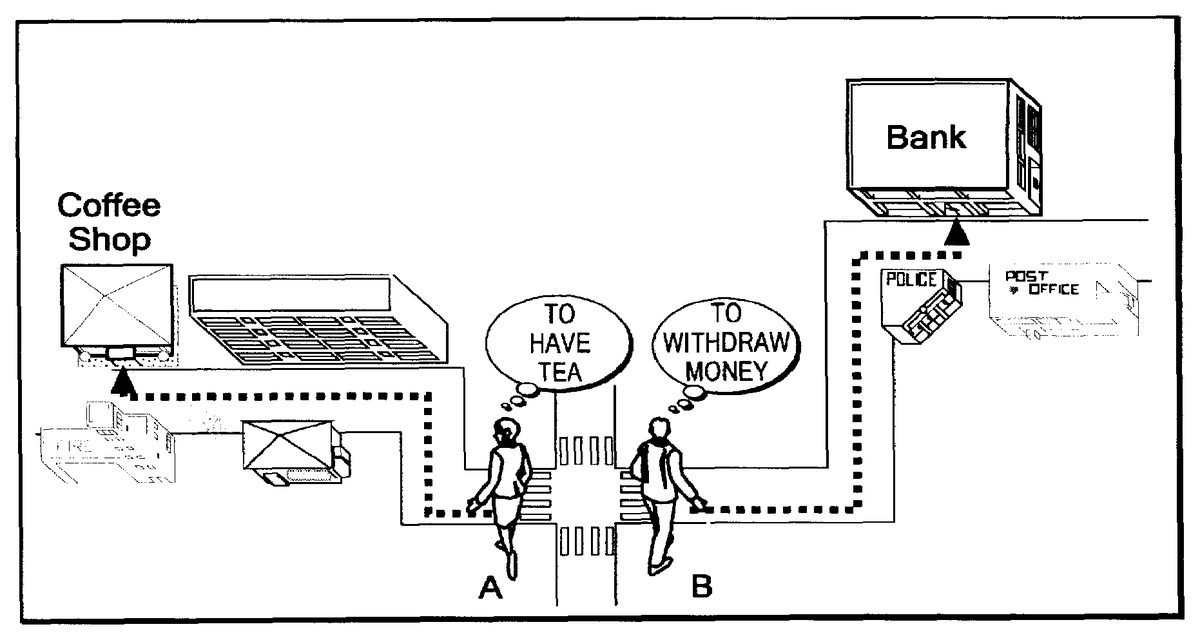
FIGS. 13 and 14show how the memory recall assistance is displayed. The memory recall assistance is displayed by a guide line having a goal indicating a location where a certain event occurred in the past. The guide line is based on the movement history indicated by an activity dataset and is displayed with a dotted line or solid line drawn in a virtual world space, or with many images of the avatar successively arranged therein. More specifically, on the display, graphic images of the avatar are successively shown between the avatar and a location (Goal) where the event occurred, and the event content is shown in text either near the avatar or near the location where the event occurred. Such graphic images should be arranged and displayed to accurately follow the movement history in the past. However, if a building and a topographic component, which did not exist before, exist on the route due to a change over time, the graphic images may be displayed to make a detour to avoid them. Alternatively, unsurprisingly, the graphic images may be displayed in a straight line to the goal with no regard to the building and topographic feature. It is preferable that the client computer display, at the goal of such a guide, texts or an icon indicating what kind of event occurred. It is more preferable that the client computer display the guide to make its own user distinguish whether the event is one experienced by its own user himself/herself, or one experience by a different user. An event experienced by its own user is one indicated by a past activity dataset obtained from the activity record DB of the client computer, while an event experienced by a different user is one indicated by a past activity dataset obtained from the activity record DB of the server computer. In this case, the guides are distinctively displayed with different display attributes so as to make it distinguishable whether each event is based on the activity dataset of the different user or the activity dataset of its own user. For example, if the event is based on the activity dataset of the different user, the guide is displayed with a color, shape, brightness, and the like, different from that in the memory recall assistance based on the activity data of the own user.
An avatar A inFIG. 13is assisted to recall memory on the basis of an activity dataset indicating that the avatar A went to have tea in the past. On the other hand, an avatar B is assisted to recall memory on the basis of an activity dataset indicating that the avatar B went to the bank to withdraw money.FIG. 14shows an example of how to display the memory recall assistance by successively arranging avatar images.FIG. 15explanatorily shows one example of a display method in the case ofFIG. 14.FIG. 15shows a display example of the memory recall assistance at a time point when the avatar B reaches a block C. In this display example, five graphic images1to5of the avatar are displayed from the block C to the event occurrence location (Goal) while being gradually reduced in size and partially overlapping one another. In addition, in this display example, the text of “money withdrawing” is displayed near the block G which is the event occurrence location. This display method is only one example, and accordingly various variations can be made for the display of the memory recall assistance. For example, the event of “money withdrawing” may be displayed with a movie icon providing an animation of an activity of withdrawing money. Moreover, if a client computer can operate at high speed, walking motions of the avatar may be stored as moving image data in advance and the guide line may be displayed with moving images of the avatar like an animation showing that the avatar walks from a place near the current position to the block G.
According to the present invention, it is possible to efficiently record activity histories and to provide memory recall assistance in a virtual world. Hence, even a user who has unclear memory or a user inexperienced in the virtual world can be assisted to act without getting lost in the virtual world.
Although the preferred embodiments of the present invention have been described in detail, it should be understood that various changes, substitutions and alternations can be made therein without departing from spirit and scope of the inventions as defined by the appended claims.
Claims
- A memory recall assistance apparatus for providing memory recall assistance to a user by a computer, the user operating an avatar in a virtual world divided into a plurality of blocks each provided with a unique identifier (ID), the apparatus comprising: search means of searching an activity record database (DB), including recorded activity datasets, to find an activity dataset containing an entered block ID of the avatar, the activity datasets each obtained by recording data on an activity of an avatar including an event content, a movement history and a repetition count of the activity;determination means for determining whether the found activity dataset is appropriate for the memory recall assistance;and display means for displaying, on a display of the computer, the activity dataset determined as appropriate for the memory recall assistance, wherein the determination means includes means for calculating an importance score of the activity dataset from the event content and the repetition count and means for determining that the activity dataset is appropriate for the memory recall assistance if the importance score is greater than a predetermined value, wherein the display means includes means for displaying the movement history of the activity dataset near the avatar and means for displaying the event content of the activity dataset near the avatar, wherein the virtual world is shared by a server computer and a plurality of client computers, the activity record DB is recorded in the server computer, and wherein a search means, a determination means, and a display means operate by using activity datasets of the activity record DB to assist the user to recall memory according to an activity dataset of another client computer, and wherein the memory recall assistance based on activity datasets of the other client computers is distinctively displayed with an attribute different from that of the memory recall assistance based on its own activity dataset.
- The apparatus according to claim 1 , wherein the means for displaying the movement history is means for successively displaying graphic images of the avatar from the avatar to a location where the event occurred.
- The apparatus according to claim 1 , wherein the means for displaying the event content is means for displaying the event content near either the avatar or the location where the event occurred.
- A memory recall assistance method for assisting a user to recall memory by a computer, the user operating an avatar in a virtual world divided into a plurality of blocks each provided with a unique identifier (ID), the method comprising: searching an activity record database (DB) including recorded activity datasets to find an activity dataset containing an entered block ID of the avatar, the activity datasets each obtained by recording data on an activity of an avatar including an event content, a movement history and a repetition count of the activity;determining whether the found activity dataset is appropriate for the memory recall assistance;and displaying, on a display of the computer, the activity dataset determined as appropriate for the memory recall assistance, wherein said determining whether the found activity dataset is appropriate for the memory recall assistance includes calculating an importance score of the activity dataset from the event content and the repetition count and determining that the activity dataset is appropriate for the memory recall assistance if the importance score is greater than a predetermined value, wherein said displaying of the activity dataset includes displaying the movement history of the activity dataset near the avatar and displaying the event content of the activity dataset near the avatar, wherein the virtual world is shared by a server computer and a plurality of client computers, the activity record DB is recorded in the server computer, and wherein a search means, a determination means, and a display means operate by using activity datasets of the activity record DB to assist the user to recall memory according to an activity dataset of another client computer, and wherein the memory recall assistance based on activity datasets of the other client computers is distinctively displayed with an attribute different from that of the memory recall assistance based on its own activity dataset.
- The method according to claim 4 , further comprising successively displaying graphic images of the avatar from the avatar to a location where the event occurred.
- The method according to claim 4 , further comprising displaying the event content near either the avatar or the location where the event occurred.
- A non-transitory computer readable article of manufacture tangibly embodying computer readable instructions comprising: searching an activity record database (DB) including recorded activity datasets to find an activity dataset containing an entered block identifier (ID) of the avatar, the activity datasets each obtained by recording data on an activity of an avatar including an event content, a movement history and a repetition count of the activity;determining whether the found activity dataset is appropriate for the memory recall assistance;and displaying, on a display of the computer, the activity dataset determined as appropriate for the memory recall assistance, wherein said determining whether the found activity dataset is appropriate for the memory recall assistance includes calculating an importance score of the activity dataset from the event content and the repetition count and determining that the activity dataset is appropriate for the memory recall assistance if the importance score is greater than a predetermined value, wherein said displaying of the activity dataset includes displaying the movement history of the activity dataset near the avatar and displaying the event content of the activity dataset near the avatar, wherein the virtual world is shared by a server computer and a plurality of client computers, the activity record DB is recorded in the server computer, and wherein a search means, a determination means, and a display means operate by using activity datasets of the activity record DB to assist the user to recall memory according to an activity dataset of another client computer, and wherein the memory recall assistance based on activity datasets of the other client computers is distinctively displayed with an attribute different from that of the memory recall assistance based on its own activity dataset.
- The non-transitory computer readable article of manufacture tangibly embodying computer readable instructions according to claim 7 , further comprising successively displaying graphic images of the avatar from the avatar to a location where the event occurred.
- The non-transitory computer readable article of manufacture tangibly embodying computer readable instructions according to claim 7 , further comprising displaying the event content near either the avatar or the location where the event occurred.
- A memory recall assistance method for assisting a user to recall memory by a computer, the user operating an avatar in a virtual world divided into a plurality of blocks each provided with a unique identifier (ID), the method comprising: searching an activity record database (DB) including recorded activity datasets to find an activity dataset containing an entered block ID of the avatar, the activity datasets each obtained by recording data on an activity of an avatar including an event content, a movement history and a repetition count of the activity;determining whether the found activity dataset is appropriate for the memory recall assistance, said determining including: calculating an importance score of the activity dataset based on the event content, the event content including at least one of communication with another avatar, a purchase, standing-up, making a, gesture, and equipping the avatar with an item, and determining that the activity dataset is appropriate for the memory recall assistance if the importance score is greater than a predetermined value;and displaying, on a display of the computer, the activity dataset determined as appropriate for the memory recall assistance, wherein the virtual world is shared by a server computer and a plurality of client computers, the activity record DB is recorded in the server computer, and wherein a search means, a determination means, and a display means operate by using activity datasets of the activity record DB to assist the user to recall memory according to an activity dataset of another client computer, and wherein the memory recall assistance based on activity datasets of the other client computers is distinctively displayed with an attribute different from that of the memory recall assistance based on its own activity dataset.
- The method according to claim 10 , further comprising successively displaying graphic images of the avatar from the avatar to a location where the event occurred.
- The method according to claim 10 , further comprising displaying the event content near either the avatar or the location where the event occurred.
Disclaimer: Data collected from the USPTO and may be malformed, incomplete, and/or otherwise inaccurate.