U.S. Pat. No. 8,764,563
VIDEO GAME SUPERIMPOSING VIRTUAL CHARACTERS ON USER SUPPLIED PHOTO USED AS GAME SCREEN BACKGROUND
AssigneeNintendo Co., Ltd.
Issue DateMarch 11, 2010
U.S. Patent No. 8,764,563: Video Game superimposing virtual characters on user supplied photo used as game screen background
U.S. Patent No. 8,764,563: Video Game superimposing virtual characters on user supplied photo used as game screen background
Issued July 1, 2014, to Bandai Namco Entertainment, Inc.
Priority Date: March 24, 2009
Summary:
The Nintendo DSi was the fourth iteration of the Nintendo DS design. Unlike, previous models, the DSi featured two VGA (0.3-megapixel) digital cameras. One camera pointed toward the user while the second camera pointed away. The cameras allowed for augmented reality games to be played on the DSi and U.S. Patent No. 8,764,563 describes one such game.
Players use the DSi’s cameras to take photographs of real objects. The picture appears on the bottom screen of the DSi while the game analyzes it for recognizable shapes or openings. If the photograph contained a house, the game would look for windows and doors. Based on the analysis, the game will cause characters to appear from those shapes or openings so that a ghost might appear from a window. The player taps on the characters to gain points.
Abstract:
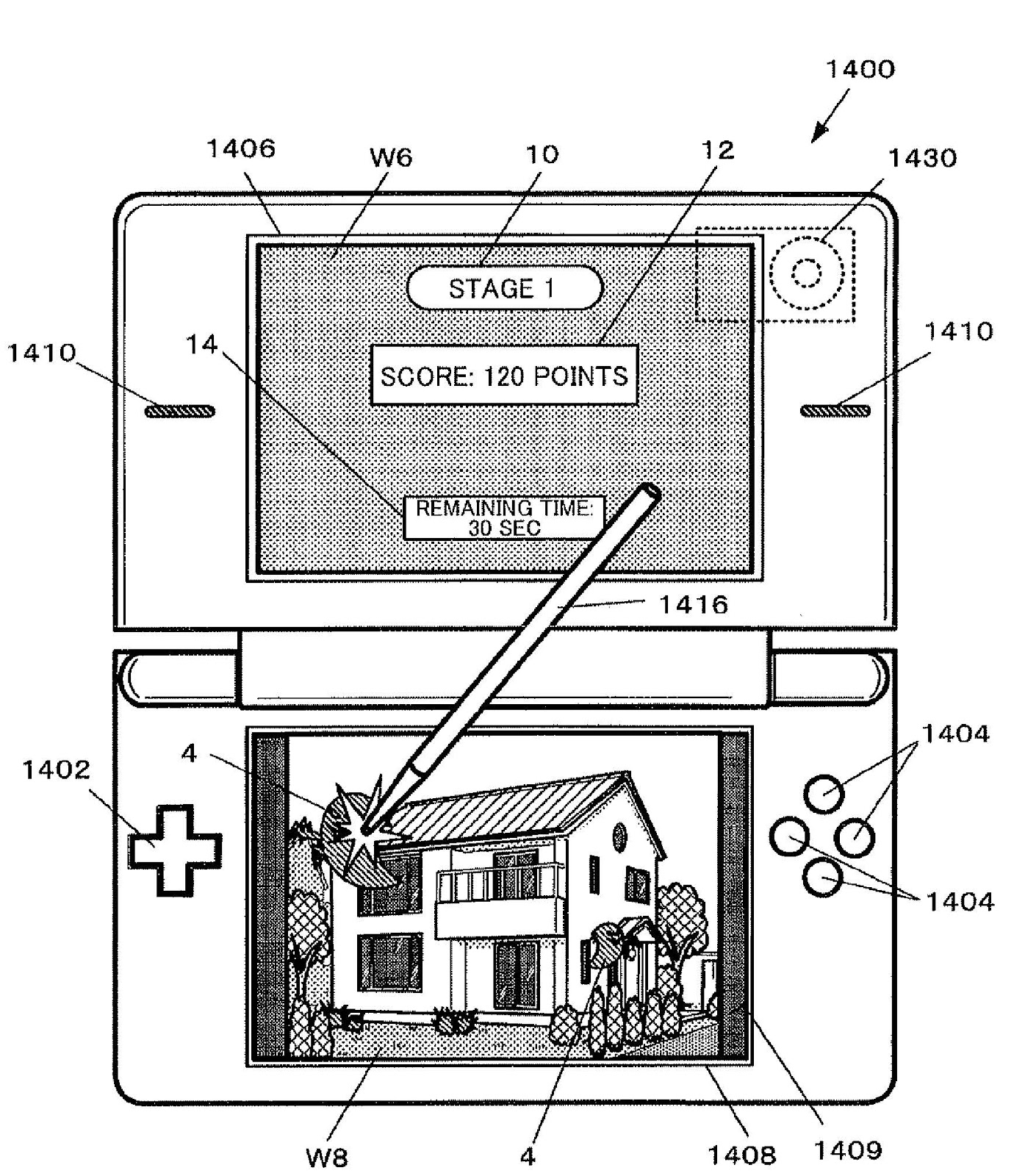
A feature image area that has a similar feature (e.g., quadrangular outline) is extracted from an original two-dimensional image photographed by a player. When a game has started, the original two-dimensional image is displayed as the background of a game stage, and a target character 4 is caused to appear or disappear from the extracted feature image area at a random appearance frequency and a random appearance speed. When the player has touched the target character 4, points are added to the score of the player.
Illustrative Claim:
1. A method comprising: detecting an image area that satisfies a feature image area condition from a photographed image, the feature image area condition being a condition to detect an image area that has an outline of a given shape and satisfies a proper size condition; displaying the photographed image on a touch panel; selecting character type based on at least one of a color of the image area and a size of the image area; displaying a character of the selected character type on the photographed image in a manner such that the character appears to emerge from the image area; and incrementing a score linked to the character that has appeared from the image area when a user inputs a touch operation on the character, wherein the detecting, the selecting, the displaying the character, and the incrementing are performed by a hardware processor.
Illustrative Figure
Abstract
A feature image area that has a similar feature (e.g., quadrangular outline) is extracted from an original two-dimensional image photographed by a player. When a game has started, the original two-dimensional image is displayed as the background of a game stage, and a target character 4 is caused to appear or disappear from the extracted feature image area at a random appearance frequency and a random appearance speed. When the player has touched the target character 4, points are added to the score of the player.
Description
DESCRIPTION OF EXEMPLARY EMBODIMENTS Several embodiments of the invention may implement a novel game in which a real world and a game world are united by advantageously incorporating the real world in the game. According to one embodiment of the invention, there is provided a method comprising: detecting an image area that satisfies a feature image area condition from a photographed image, the feature image area condition being defined as a feature condition that is used for determining an image area on which a character is superimposed; displaying the photographed image; and causing the character to appear from the image area that is included in the photographed image and satisfies the feature image area condition. According to another embodiment of the invention, there is provided a game device that controls a game process while displaying a character, the game device comprising: an image area detection section that detects an image area that satisfies a feature image area condition from a photographed image, the feature image area condition being defined as a feature condition that is used for determining an image area on which a character is superimposed; an image display control section that displays the photographed image; and a character display control section that causes the character to appear from the image area that is included in the photographed image and detected by the image area detection section. According to the above configuration, an area that has a similar feature is detected from the photographed image, and the character is caused to appear from the detected area. As the feature image area condition, various parameters can be utilized insofar as whether or not the parameters are satisfied as can be determined by image processing. Examples of the parameters include the shape of an approximate outline, a color, a contrast, a ...
DESCRIPTION OF EXEMPLARY EMBODIMENTS
Several embodiments of the invention may implement a novel game in which a real world and a game world are united by advantageously incorporating the real world in the game.
According to one embodiment of the invention, there is provided a method comprising:
detecting an image area that satisfies a feature image area condition from a photographed image, the feature image area condition being defined as a feature condition that is used for determining an image area on which a character is superimposed;
displaying the photographed image; and
causing the character to appear from the image area that is included in the photographed image and satisfies the feature image area condition.
According to another embodiment of the invention, there is provided a game device that controls a game process while displaying a character, the game device comprising:
an image area detection section that detects an image area that satisfies a feature image area condition from a photographed image, the feature image area condition being defined as a feature condition that is used for determining an image area on which a character is superimposed;
an image display control section that displays the photographed image; and
a character display control section that causes the character to appear from the image area that is included in the photographed image and detected by the image area detection section.
According to the above configuration, an area that has a similar feature is detected from the photographed image, and the character is caused to appear from the detected area. As the feature image area condition, various parameters can be utilized insofar as whether or not the parameters are satisfied as can be determined by image processing. Examples of the parameters include the shape of an approximate outline, a color, a contrast, a position within the screen, and the like.
According to the above embodiment, a novel game in which a real world and a game world are united can be implemented by utilizing an image obtained by photographing the real world as the background of the game, for example.
The method may further comprise:
calculating a score based on a given operation input performed by a user on the character that has appeared from the image area.
According to the above configuration, a game that uses the character that appears from the feature image area as the target character can be implemented.
In the method,
the causing of the character to appear from the image area may include causing the character to appear respectively from each image area that satisfies the feature image area condition at intervals of time.
According to the above configuration, it is possible to implement a game in which characters appear from image areas having a similar feature at intervals of time, for example. Examples of such a game include a whack-a-mole game.
In the method,
the causing of the character to appear from the image area may include causing the character to appear from the image area that satisfies the feature image area condition while increasing or decreasing the size of the character based on the size of the image area.
According to the above configuration, the size of the character can be changed based on the size of the image area having a similar feature. Therefore, the size of the character that appears from the feature image area can be changed based on the displayed image. For example, when the game is configured so that the player performs an operation input aimed at the character that appears from the feature image area, the difficulty level of the game can be changed based on the size of the character.
In the method,
the feature image area condition may include a plurality of conditions; and
the causing of the character to appear from the image area may include causing the character to appear from the image area while changing the type and/or the number of characters based on a condition among the plurality of conditions that has been satisfied by the image area.
This makes it possible to cause characters of the type and/or the number corresponding to the satisfied condition to appear from the image area that satisfies the feature image area condition. Specifically, a more interesting game can be implemented by causing a character relevant to the photographed image to appear in the game.
For example, it is possible to implement a collection game in which a character that corresponds to the feature area appears from the feature area of the photographed image, and the player captures and collects the character.
In the method,
the detecting of the image area may include detecting an image area that satisfies the feature image area condition based on shape and/or color information about the photographed image.
According to the above configuration, it is possible to implement a situation in which a character appears from an object that is included in the photographed image and has a similar shape or color, for example. Therefore, the player can immediately determine an area from which a character appears.
The method may further comprise:
controlling a game process by sequentially reading a photographed image among a plurality of photographed images, detecting an image area that satisfies the feature image area condition, displaying the photographed image, and causing the character to appear from the image area that satisfies the feature image area condition.
According to the above configuration, the game process can be controlled while sequentially utilizing each of a plurality of photographed images as the background of the game screen. Specifically, it is possible to sequentially utilize the photographed images in a game provided with a plurality of game stages or scenes.
The method may further comprise:
detecting an image area that satisfies the feature image area condition from each of a plurality of photographed images;
selecting an image used in a game from the plurality of photographed images based on the detection result for each of the plurality of photographed images;
displaying the selected image; and
causing the character to appear from the selected image.
According to the above configuration, an image used in the game can be automatically selected from the photographed images based on the detection result (e.g., presence or absence, number, position, and size of image areas having a similar feature). This makes it possible to exclude an image that is not appropriate from the viewpoint of game balance, or classify the images taking account of the difficulty level of the game, so that a well-balanced game can be implemented.
The method may further comprise:
determining a use order of the selected image; and
displaying the selected image and causing the character to appear from the selected image based on the use order.
According to the above configuration, the display order of the image in the game can be automatically determined based on the detection result for the image area that satisfies the feature image area condition. For example, since a character appears from the detected image area, the number of detected image areas affects the difficulty level of the game. Therefore, a standard in which the difficulty level gradually increases along with the game stage can be automatically implemented by automatically determining the display order of the image in the game based on the detection result for the image area that satisfies the feature image area condition.
According to another embodiment of the invention, there is provided a computer-readable information storage medium storing a program that causes a computer to execute the above method.
The term “information storage medium” used herein includes a magnetic disk, an optical disk, an IC memory, and the like.
Exemplary embodiments to which the invention is applied are described below. Note that embodiments to which the invention may be applied are not limited to the following exemplary embodiments.
First Embodiment
A first embodiment to which the invention is applied is described below taking an example in which a whack-a-mole game is executed by a portable game device that allows application software to call and utilize a digital camera function.
Configuration of Game Device
FIG. 1is an external view illustrative of a configuration example of a portable game device. A portable game device1400according to this embodiment includes an arrow key1402and button switches1404that allow the player to input a game operation, a first liquid crystal display1406, a second liquid crystal display1408, a speaker1410, a control unit1450, and a flip-top main body1401that can be opened and closed through a hinge1414, the arrow key1402, the button switches1404, the first liquid crystal display1406, the second liquid crystal display1408, the speaker1410, and the control unit1450being provided on or in the main body1401.
Touch panels1407and1409that allow the player to perform a touch operation by touching an arbitrary position within the display screen using a stylus pen1416or the like are provided on the display surfaces of the first liquid crystal display1406and the second liquid crystal display1408, respectively.
The main body1401includes a memory card reader1418that reads and writes data from and into a memory card1440(i.e., computer-readable information storage medium). The memory card1440stores a program and setting data necessary for the control unit1450of the portable game device1400to execute various game play calculation processes. The main body1401is also provided with a built-in battery, a power button, a volume control button, and the like (not shown).
The touch panels1407and1409respectively cover almost the entire area of the display screens of the first liquid crystal display1406and the second liquid crystal display1408so that images displayed on the first liquid crystal display1406and the second liquid crystal display1408can be observed from the outside. When the player has performed a touch operation using the stylus pen1416(or finger or the like), the coordinates of the touch position in an orthogonal Xt-Yt coordinate system (origin: upper left) can be output to the control unit1450.
The control unit1450corresponds to a game device control board, and includes a processor (e.g., central processing unit (CPU), graphics processing unit (GPU), and digital signal processor (DSP)), an application-specific integrated circuit (ASIC), and an IC memory (e.g., VRAM, RAM, and ROM).
The control unit1450also includes a wireless communication module1412, a triaxial acceleration sensor1422, a driver circuit that drives the first liquid crystal display1406and the liquid crystal display1408, a driver circuit that drives the touch panel1407and the touch panel1409, a circuit that receives signals from the arrow key1402and the button switches1404, an amplifier circuit that outputs a sound signal to the speaker1124, and an interface circuit (I/F circuit) such as a signal input-output circuit that exchanges signals with the memory card reader1418. The elements provided in the control unit1450are electrically connected through a bus circuit so that data can be read from and written into the elements, or signals can be exchanged between the elements.
The triaxial acceleration sensor1422detects accelerations in an X-axis direction, a Y-axis direction, and a Z-axis direction that perpendicularly intersect to detect a change in posture or position of the portable game device1400, and outputs detection signals to the control unit1450. Note that the portable game device1400may include a gyrosensor instead of, or in addition to, the acceleration sensor. Alternatively, the portable game device1400may further include a magnetic sensor that detects a change in position or posture of the portable game device1400based on terrestrial magnetism.
The control unit1450reads a program and data stored in the memory card1440through the memory card reader1418, and temporarily stores the program and data in the IC memory. The control unit1450performs a calculation process by executing the program read from the memory card1440, and controls each section of the portable game device1400(executes the game) based on operation inputs from the arrow key1402, the button switches1404, and the touch panels1407and1409.
Although this embodiment employs a configuration in which the portable game device1400reads a necessary program and setting data from the memory card1440, it is also possible to employ a configuration in which the portable game device1400connects to a cable/wireless communication channel1(e.g., Internet, local area network (LAN), or wide area network (WAN)) through the wireless communication module1412, and downloads a necessary program and setting data from an external device.
The portable game device1400includes an image sensor module1430(i.e., digital imaging section) that is provided on the outer surface of the main body1401. A shutter release function is assigned to a given switch among the button switches1404, and a live view image is displayed on the first liquid crystal display1406or the second liquid crystal display1408. This allows the user to photograph an arbitrary photographing target and store digital image data in the memory card1440or the like in the same manner as a live viewfinder-type digital camera. The digital camera function is incorporated in the basic system of the portable game device1400, and can be appropriately called and utilized from application software.
Outline of Game
In this embodiment, the player photographs and acquires an image used as a game stage before starting the game.
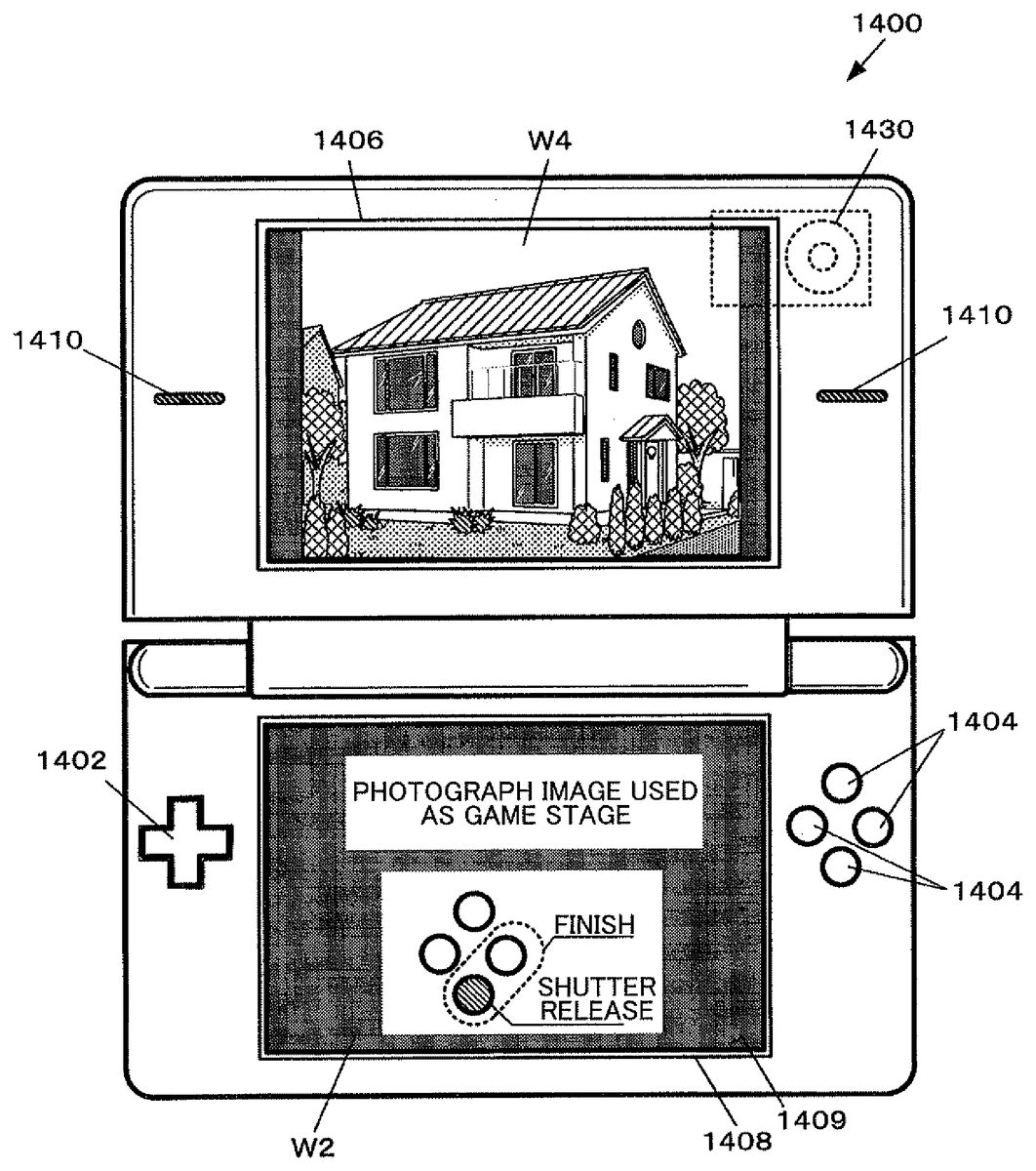
For example, the second liquid crystal display1408displays a photographing screen W2(seeFIG. 2) that includes a message that prompts the user to photograph an image, and a photographing guide that indicates a function assigned to each button switch1404, and the digital camera function of the portable game device1400is called so that an image (live view image W4) that is currently detected by the image sensor module1430is displayed on the first liquid crystal display1406in real time (i.e., the first liquid crystal display1406functions as a live viewfinder).
In the example shown inFIG. 2, a house is displayed within the live view image W4. A shutter release function is assigned to the lower switch among the button switches1404that are disposed in a diamond shape, and a photographing operation is terminated when the lower switch and the right switch are pressed simultaneously.
When the player has determined the photographing range while aiming the image sensor module1430at the desired photographing target, and performed a shutter release operation by pressing the lower button switch1404, two-dimensional image data in a given format is generated in the same manner as in a known digital camera, and stored in a given folder of the memory card1440. The player may photograph an image used as the game stage a plurality of times. The image thus photographed is referred to as “original two-dimensional image”.
Note that the original two-dimensional image may be acquired by designating data or a folder stored in the memory card1440, or downloaded from an external storage device through the wireless communication module1412.
When the original two-dimensional image has been acquired, a point where the target character (i.e., “mole”) of the whack-a-mole game appears is determined for each original two-dimensional image.
As shown inFIG. 3, a target character4is caused to appear or disappear from the image area selected from the original two-dimensional image (background), and the game process is controlled so that points are added to the score when the player has touched the target character4that has appeared in the image area using the stylus pen1416or the like.
In this embodiment, the first liquid crystal display1406displays an information display screen W6that includes a current game stage number10, a current score12, and a residual play time14in the current game stage, and the second liquid crystal display1408displays a game screen W8. The game screen W8is controlled so that the target character4appears in a feature image area (i.e., the quadrangular window of the house in the example shown inFIG. 3) of the original two-dimensional image (background) that satisfies a given feature condition.
Feature image area extraction principle
FIGS. 4 to 7are views illustrative of the feature image area extraction principle.
FIG. 4is a view showing an original two-dimensional image that has been photographed (acquired) before starting the game. The original two-dimensional image is subjected to an outline extraction process. An approximate outline of each section (e.g., roof, window, wall, and garden tree) is obtained by the outline extraction process (see solid lines inFIG. 5).
An outline that satisfies a given feature condition is extracted from the approximate outlines obtained by the outline extraction process.
Various parameters obtained by processing the original two-dimensional image may be appropriately set as the feature condition. Examples of the feature condition include (1) the shape of the approximate outline (e.g., triangle, quadrangle (whether the quadrangle is a diamond, trapezoid, rectangle, square, etc. may be determined), star, ellipse, or crisscross), (2) the statistical color of the area enclosed by the approximate outline (e.g., a color that is statistically calculated from color information about pixels included in the area enclosed by the approximate outline (e.g., an average color or a color with the highest intensity), (3) the contrast between the area enclosed by the approximate outline and an area around the area enclosed by the approximate outline, (4) the relative relationship between the color of the area enclosed by the approximate outline and the color of an area around the area enclosed by the approximate outline (e.g., similarity of statistical color or complementary color), and the like.
In this embodiment, the target character4such as a ghost or a monster appears from a foreign space or a passage to a spiritual world. Therefore, a quadrangular approximate outline is extracted. For example, the window areas are extracted (see bold solid lines shown inFIG. 6). Broken lines indicate the approximate outlines that are not extracted.
A round window6positioned in the upper area (second floor) of the original two-dimensional image (seeFIG. 4) is not extracted since the window6does not satisfy the feature condition according to this embodiment. Note that the round window6is also extracted when the feature condition is satisfied when the approximate outline is quadrangular or elliptical.
When a window includes a plurality of window panes (seeFIG. 6), each window pane is extracted as the feature image area. If the photographing target house differs in shape or color arrangement, a wall provided with a window may also be extracted.
If the feature image areas are positioned close to each other, the target characters appear adjacently so that game playability may be impaired. If the feature image area is too large with respect to the entire screen, the player can easily touch the target character so that game playability may also be impaired. If the feature image area is too small with respect to the entire screen, the player may not be able to touch the target character so that the difficulty level of the game may unnecessarily increase.
In this embodiment, feature image areas suitable for game play are appropriately selected based on the positional relationship between the pre-selected feature image areas or the size of the pre-selected feature image areas with respect to the entire screen, and may be united, if necessary.
Specifically, a feature image area20shown inFIG. 6corresponds to the window frame, and feature image areas22,24, and26shown inFIG. 6correspond to three window panes. Since the feature image area20and the feature image areas22,24, and26are determined to have a nested structure, and the feature image areas22,24, and26are determined to be adjacently situated, the feature image areas20,22,24, and26are united to form a single feature image area28(seeFIG. 7). This also applies to other feature image areas.
Specifically, when the center position of one feature image area is included within another feature image area, these feature image areas are determined to have a nested structure, for example. When the distance between the approximate outlines of feature image areas is shorter than a given adjacency determination reference value, these feature image areas are determined to be adjacently situated and need to be united.
The feature image areas having a nested structure are united so that the feature image area of which the center position is included within the other feature image area is united with the other feature image area. Note that the feature image areas having a nested structure may be united in an arbitrary manner.
The feature image areas that are adjacently situated are united to form a single feature image area that also includes an opening between the feature image areas. Note that only one of the feature image areas that are adjacently situated may be allowed to remain (i.e., other feature image areas may be excluded).
Appearance direction of target character
In this embodiment, the target character is caused to appear from the feature image area that has been thus extracted/united. In this case, an appearance direction appropriate for each feature image area is determined so that the appearance direction of the target character matches the three-dimensional relationship around the object displayed within the original two-dimensional image.
Taking the original two-dimensional image shown inFIG. 4as an example, the target character is caused to appear from the inside of the house and move to the outside.
Specifically, the structure of the three-dimensional space photographed within the original two-dimensional image is calculated based on the original two-dimensional image, and an appearance direction vector Vc (two-dimensional vector) that matches the three-dimensional relationship between each feature image area is calculated. The structure of the three-dimensional space may be calculated by utilizing known technology that generates a three-dimensional image from a single two-dimensional image, or known technology that forms a three-dimensional model from a single two-dimensional image.
For example, a three-dimensional model shown inFIG. 8is calculated from the original two-dimensional image shown inFIG. 4.FIG. 8shows a three-dimensional model27of the house (main object) disposed on an earth's surface29. InFIG. 8, the detailed structure of the three-dimensional model27of the house is omitted. A model (e.g., trees) that should be obtained (calculated) around the three-dimensional model27of the house is also omitted.
The united feature image areas28(28ato28g) are disposed on the side surface of the three-dimensional model27of the house. As shown inFIG. 9, the appearance direction vector Vc of each feature image area28is calculated as a projection vector obtained by projecting the normal vector of the side surface of the three-dimensional model27of the house onto the screen coordinates.
As shown inFIG. 10, the target character4appears from the feature image area28, expands in the direction indicated by the appearance direction vector Vc, and then disappears. The target character4basically appears from the center of the feature image area28, for example. Note that the target character4may appear from an arbitrary position within the feature image area28.
The size of the target character4is determined based on the size of the feature image area28. Specifically, the size of the target character4is determined so that the size of the target character4increases as the size of the feature image area28(window) increases, as shown inFIG. 11.
The player can more easily touch the target character4as the size of the target character4increases so that the difficulty level of the game decreases. Therefore, the difficulty level (game stage) of the game is roughly determined based on the size and the number of extracted feature image areas28.
When a plurality of original two-dimensional images are provided, the difficulty level of the game is estimated based on the size and the number of feature image areas28, and the game stage numbers are sequentially assigned to the original two-dimensional images from the original two-dimensional image for which the estimated difficulty level of the game is lowest so that the difficulty level of the game gradually increases with the progress of the game.
Functional blocks
A functional configuration example that implements the above game is described below.
FIG. 12is a functional block diagram showing an example of the functional configuration according to this embodiment. As shown inFIG. 12, the portable game device1400according to this embodiment includes an operation input section100, an imaging section110, a processing section200, a sound output section350, an image display section360, a communication section370, and a storage section500.
The operation input section100outputs an operation input signal to the processing section200based on an operation input performed by the player. In this embodiment, the operation input section100includes a touch position detection section102and an acceleration detection section104.
The operation input section100may be implemented by a button switch, a joystick, a touch pad, a trackball, a multi-axis acceleration sensor that has two or more detection axes, a single-axis acceleration sensor unit formed by combining acceleration sensors so that the detection axis direction differs, a multi-direction tilt sensor that has two or more detection directions, a single-direction tilt sensor unit formed by combining tilt sensors so that the detection direction differs, and the like. The arrow key1402and the button switches1404shown inFIG. 1correspond to the operation input section100.
The touch position detection section102is a device that detects a touch position within a display screen. The touch panels1407and1409shown inFIG. 1correspond to the touch position detection section102.
The triaxial acceleration sensor1422shown inFIG. 1corresponds to the acceleration detection section104.
The imaging section110converts light received from the photographing target into an electrical signal to generate digital image data, and outputs the digital image data to the processing section200. The imaging section110may be implemented by a lens, a mechanical shutter, a shutter driver, a photoelectric conversion element (e.g., CCD image sensor module or CMOS image sensor module), a digital signal processor (DSP) that reads the amount of charge from a photoelectric conversion element and generates image data, an IC memory, and the like. The image sensor module1430shown inFIG. 1corresponds to the imaging section110.
The processing section200is implemented by a microprocessor (e.g., CPU and GPU), an application-specific integrated circuit (ASIC), an IC memory, and the like. The processing section200exchanges data with each functional section of the portable game device1400including the operation input section100and the storage section500. The processing section200controls the operation of the portable game device1400by performing various calculations based on a given program, data, and the operation input signal from the operation input section100. The control unit1450shown inFIG. 1corresponds to the processing section200. The processing section200according to this embodiment includes a game calculation section210, a sound generation section250, an image generation section260, and a communication control section270.
The game calculation section210executes a game process. In this embodiment, the game calculation section210includes an image acquisition section212, a feature image area detection section214, a game stage image selection section216, and a character appearance display control section218.
The image acquisition section212executes a process that acquires an original two-dimensional image used as a game stage background image. In this embodiment, the image acquisition section212causes the image display section360to display the photographing screen W2(seeFIG. 2) to prompt the player to photograph an image, and assigns the shutter release operation to the operation input section100. The image acquisition section212stores image data of an image obtained by the imaging section110at the shutter release operation timing in the storage section500as the original two-dimensional image.
Although this embodiment employs a configuration in which the image acquisition section212acquires an image photographed by the imaging section110, image data may be downloaded from an external device through the communication section370. Alternatively, image data stored in advance in the storage section500may be read and selected by the player.
The feature image area detection section214detects an area (feature image area) that satisfies a given feature condition from the original two-dimensional image. The feature image area detection section214unites the feature image areas that have been detected and satisfy a given adjacency condition or nested structure condition, and calculates the character appearance direction for each united feature image area (seeFIGS. 5 to 9).
In this embodiment, the feature condition is satisfied when the approximate outline is quadrangular. Note that the feature condition may be satisfied when the approximate outline has another shape, or a condition based on the color of the area enclosed by the approximate outline may be set alternatively or additionally.
The game stage image selection section216selects an image suitable as the game stage based on the feature image areas detected by the feature image area detection section214when a plurality of original two-dimensional images have been acquired by the image acquisition section212, and assigns the game stage number to the selected image based on the feature image area detection results (e.g., number, size, location, and color).
The character appearance display control section218causes the target character4to appear or disappear from the feature image area (superimposition display control) (seeFIGS. 10 and 11). The character appearance display control section218determines the size of the target character4that appears based on the size of the feature image area, and determines the type and the number of characters based on the color (e.g., statistical color) of the area enclosed by the feature image area.
The sound generation section250is implemented by a processor (e.g., digital signal processor (DSP) or sound synthesis IC) and an audio codec that can reproduce a sound file, for example. The sound generation section250generates a sound signal of a game-related effect sound, background music (BGM), or an operation sound based on the processing results of the game calculation section210, and outputs the generated sound signal to the sound output section350.
The sound output section350is implemented by a device that outputs sound such as effect sound or BGM based on the sound signal input from the sound generation section250. The speaker1410shown inFIG. 1corresponds to the sound output section350.
The image generation section260is implemented by a processor (e.g., graphics processing unit (GPU) or a digital signal processor (DSP)), a video signal IC, a program (e.g., video codec), a drawing frame IC memory (e.g., frame buffer), and the like. The image generation section260generates a game image every frame (e.g., 1/60th of a second) based on the processing results of the game calculation section210, and outputs an image signal of the generated game image to the image display section360.
The image display section360displays a game image based on the image signal input from the image generation section260. The image display section360may be implemented by an image display device such as a flat panel display, a cathode-ray tube (CRT), a projector, or a head mount display. The first liquid crystal display1406and the second liquid crystal display1408shown inFIG. 1correspond to the image display section360.
The communication control section270performs a data communication process to implement data exchange with an external device through the communication section370.
The communication section370connects to the communication channel1to implement communication. The communication section370is implemented by a transceiver, a modem, a terminal adapter (TA), a jack for a communication cable, a control circuit, and the like. The wireless communication module1412shown inFIG. 1corresponds to the communication section370.
The storage section500stores a system program that implements a function for causing the processing section200to control the portable game device1400, a game program and data necessary for causing the processing section200to execute the game, and the like. The storage section500is used as a work area for the processing section200, and temporarily stores the results of calculations performed by the processing section200based on a program, data input from the operation section100, and the like. The function of the storage section500is implemented by an IC memory (e.g., RAM or ROM), a magnetic disk (e.g., hard disk), an optical disk (e.g., CD-ROM or DVD), or the like. The IC memory included in the control unit1450and the memory card1440shown inFIG. 1correspond to the storage section500.
In this embodiment, the storage section500stores a system program501and a game program502. The system program501implements an embedded system that implements the basic function of the portable game device1400, and includes various types of firmware that allows application software to call and utilize each functional section. For example, the system program501implements a digital camera function utilizing the imaging section110. The game program502is application software that is read and executed by the processing section200so that the processing section200implements the function of the game calculation section210.
The storage section500also stores character initial setting data504and a difficulty level point setting table (TBL)510that are provided in advance.
The storage section500also stores an original two-dimensional image folder512, feature image area setting data514, game stage image candidate data516, and a score518that are appropriately generated or rewritten during the game preparation or the game process.
The storage section500also appropriately stores data (e.g., timer value and counter value) that is required for the game process.
Initial setting information about the character that is superimposed on the feature image area is stored as the character initial setting data504. As shown inFIG. 13, a character type504a, a selection condition504b, and points504c(added to the score of the player when the player has touched the character) are linked and stored as the character initial setting data504, for example. Examples of the parameters of the selection condition504binclude the color attribute of the feature image area (i.e., the system of the representative color of the feature image area that is statistically calculated), the external shape of the feature image area, the size (%) of the feature image area with respect to the entire image, and the like. Different types of target characters CR1to CR4can be set based on the parameters of the selection condition504b.
Specifically, the target characters CR1and CR2are designed using a color similar to the color attribute of the selection condition504b. In this case, the player is given an impression that the target character is born from the feature image area. The target characters CR3and CR4are selected when the size of the feature image area is 5% or less with respect to the entire image, and designed using a color complementary to the color of the feature image area, but differ in design due to the difference in shape of the feature image area.
The number of characters of the character type594athat are caused to appear may be linked to the character type504a, or the number of characters that are caused to appear may be set instead of the character type504a. In the latter case, the number of identical characters that are caused to appear changes depending on the selection condition504b.
The character initial setting data504includes character size setting data504d. The character size setting data504ddefines the factor by which the target character is scaled with respect to the initial setting size (100%). In the example shown inFIG. 13, the size of the target character is set to 10% of the initial setting size when the size of the feature image area is less than 5% of the size of the entire original two-dimensional image. The size of the target character increases as the size of the feature image area with respect to the size of the entire original two-dimensional image increases when the size of the feature image area is 5 to 20% of the size of the entire original two-dimensional image. The size of the target character is fixed to the initial setting size when the size of the feature image area exceeds 20% of the size of the entire original two-dimensional image to prevent a situation in which the difficulty level of the game unnecessarily decreases as a result of displaying an improperly large target character.
The difficulty level point setting TBL510defines a basal value of points that indicate the difficulty level of the game that is estimated when using the original two-dimensional image as the game stage. The difficulty level points are used as a condition for excluding an image that is not appropriate as the game stage or a condition for setting the order of images used as the game stage when a plurality of images are stored in the original two-dimensional image folder512.
As shown inFIG. 14, the difficulty level point setting TBL510includes a first table that stores a feature image area number condition510aand appearance position points510b, and a second table that stores a feature image area size condition510cand appearance size points510d, for example. The first table according to this embodiment is defined so that higher points are added as the number of (united) feature image areas included in the target original two-dimensional image increases, since the difficulty level of the game increases as the number of target characters that appear within the screen increases. The second table is defined so that higher points are added as the size of the feature image area included in the target original two-dimensional image with respect to the screen size decreases since the difficulty level of the game increases as the size of the target character that appears within the screen decreases.
The feature image area setting data514is provided corresponding to each original two-dimensional image, and stores information about the feature image area included in each original two-dimensional image. As shown inFIG. 15, the feature image area setting data514includes an image data name514a, for example. A label514bthat is set corresponding to each feature image area, area identification data514c, an appearance direction vector514d, a color attribute514e, a feature image area size514f, a character type514g, and a character size514hare stored as the feature image area setting data514. Note that other parameters may also be linked to the label514b.
The label514bis information that identifies the feature image area.
The area identification data514cis information that specifies the feature image area. For example, information about the approximate outline that encloses the feature image area, the coordinates of all dots included in the feature image area, and the coordinates of a representative dot (e.g., center position) included in the feature image area may be stored as the area identification data514c.
The system of the representative color of all dots (or selected dots) included in the feature image area that is statistically calculated and determined based on a given standard is stored as the color attribute514e. For example, the system of the representative color is a rough attribute (e.g., red, blue, or yellow).
The size (%) of the feature image area with respect to the size of the entire screen (100%) is stored as the feature image area size514f.
The character type that is assigned to the feature image area based on the character initial setting data504is stored as the character type514g.
The size (initial setting size=100%) of the target character that appears from the feature image area is stored as the character size514h, the size of the target character being determined based on the character size setting data504dof the character initial setting data504.
Information about the original two-dimensional image (image used as the game stage image) that is selected by the game stage image selection section216from the images stored in the original two-dimensional image folder512is stored as the game stage image candidate data516.
As shown inFIG. 16, an image data name516a, appearance position points516band appearance size points516cdetermined based on the difficulty level point setting TBL510, difficulty level points516d(i.e., the sum of the appearance position points516band the appearance size points516c), and a game stage number516edetermined by the game stage image selection section216based on the difficulty level point516dare stored as the game stage image candidate data516.
Process Flow
The flow of a process according to this embodiment is described below. A series of processes described below is implemented by causing the processing section200to read and execute the game program502.
FIGS. 17 and 18are flowcharts illustrative of the flow of the main process. In order to acquire the original two-dimensional image, the processing section200causes the first liquid crystal display1406to display a live view image obtained by the image sensor1430, and causes the second liquid crystal display1408to display the operation guide screen W2to prompt the player to photograph an image (step S2). When the processing section200has detected that the player has performed a photographing operation according to a given photographing procedure (YES in step S4), the processing section200executes a photographing process, and stores the photographed image in the original two-dimensional image folder512(step S6). The processing section200repeats the steps S4and S6until a photographing finish operation is detected (NO in step S8).
When acquiring an image data from an external device through the communication section370, the steps S2to S6may be replaced by a step of connecting to a given external device, a step of allowing the player to select an image from image data stored in the external device, and a step of downloading the image selected by the player and storing the downloaded image in the original two-dimensional image folder512. When image data has been stored in the storage section500, the steps S2to S6may be replaced by a step of allowing the player to select an image from the image data stored in the storage section500.
When the processing section200has detected that the player has performed the photographing finish operation (YES in step S8), and a single image is stored in the original two-dimensional image folder512(NO in step S10), the processing section200executes a feature image area detection process on the image stored in the original two-dimensional image folder512(step S12).
FIG. 19is a flowchart illustrative of the flow of the feature image area detection process according to this embodiment. In the feature image area detection process, the processing section200extracts approximate outlines from the target original two-dimensional image, and labels the extracted approximate outlines (step S20).
The processing section200pre-selects an approximate outline that satisfies a given feature condition from the extracted approximate outlines (step S22). In this embodiment, the processing section200selects a quadrangular approximate outline.
The processing section200then selects an approximate outline that satisfies a given proper size condition from the pre-selected approximate outlines (step S24). The term “proper size condition” used herein refers to a condition for excluding an area (very small area) that is enclosed by the approximate outline and is determined to be too small to cause the target character to appear and allow the player to touch the target character in a whack-a-mole manner, and an area (very large area) that is enclosed by the approximate outline and is determined to occupy a large area of the game screen. The proper size condition is appropriately set taking account of the screen size and the resolution of the portable game device1400, the target age group, and the like. Specifically, the processing section200excludes the very small area and the very large area in the step S24.
When the processing section200has selected an approximate outline that satisfies the proper size condition, the processing section200extracts approximate outlines that satisfy a given adjacency condition (e.g., the feature image areas22,24, and26shown inFIG. 6) and approximate outlines that have a nested structure (e.g., the feature image areas20,22,24, and26shown inFIG. 6) from the selected approximate outlines, and unites the extracted approximate outlines (step S26). The area that is enclosed by the approximate outline and has been thus united is the final feature image area from which the target character is caused to appear. The feature image area setting data514that is linked to the target original two-dimensional image is generated, and the label514band the area identification data514care stored in the storage section500.
In order to calculate the character appearance direction corresponding to each feature image area, the processing section200acquires the three-dimensional structure of the object and the space around the object from the target original two-dimensional image (step S28). In this embodiment, the three-dimensional structure is acquired by utilizing known technology that automatically generates a three-dimensional image from a two-dimensional image.
When the processing section200has generated the three-dimensional model, the processing section200calculates the three-dimensional normal vector of each feature image area in the three-dimensional structure of the object and the space around the object based on the three-dimensional model (step S30). The processing section200calculates a two-dimensional projection vector obtained by projecting each three-dimensional normal vector onto the game screen, and determines the two-dimensional projection vector to be the character appearance direction vector Vc in each feature image area (step S32).
The processing section200then determines the color attribute of each feature image area (step S34). Specifically, the processing section200calculates the average color of the dots included in the feature image area, and determines the hue (e.g., R, G, B, C, M, Y, or K) that corresponds to the average color. The processing section200then calculates the size of each feature image area (step S36), and finishes the feature image area detection process.
Again referring to the flowchart shown inFIG. 17, when a plurality of images are stored in the original two-dimensional image folder512(YES in step S10), the processing section200executes a loop A process on each image (steps S14to S56).
In the loop A process, the processing section200executes the feature image area detection process on the target original two-dimensional image (step S16). The processing section200refers to the difficulty level point setting TBL510, and determines the appearance position points based on the number of feature image areas detected in the step S16(step S50). The processing section200determines the appearance size points of each feature image area detected in the step S16based on the size of each feature image area (step S52).
The processing section200calculates the difficulty level points of the target original two-dimensional image by adding up the appearance position points and the appearance size points (step S54), and finishes the loop A process. The points calculated by the loop A process are stored as the game stage image candidate data516that is generated in the storage section500corresponding to each original two-dimensional image.
When the processing section200has executed the loop A process on each original two-dimensional image, the processing section200excludes the original two-dimensional image for which the difficulty level points do not satisfy a proper point condition (i.e., the difficulty level is too low or too high) from the game stage image candidates (step S58). Specifically, the processing section200deletes the original two-dimensional image for which the difficulty level points do not satisfy a proper point condition from the game stage image candidate data516.
The processing section200determines the game stage numbers516eof the remaining game stage image candidate original two-dimensional images in an ascending order from the original two-dimensional image with the lowest difficulty level points (step S60). The original two-dimensional image is thus identified as the game stage image.
Again referring to the flowchart shown inFIG. 18, the processing section200executes a loop B process on each game stage image in an ascending order of the game stage number516eto implement a whack-a-mole game (steps S70to S100).
In the loop B process, the processing section200refers to the character initial setting data504, determines the type and the size of the target character that appears from each feature image area of the target game stage image, and registers the type and the size of the target character as the character type514gand the character size514hof the corresponding feature image area setting data514(seeFIG. 15) (step S72).
The processing section200then resets the score518(step S74), and executes a game start process (step S76). The original two-dimensional image (target game stage image) is displayed as the game stage background image, and the residual play time in each game stage is counted down.
When the game has started, the processing section200causes the target character to appear or disappear from each feature image area of the target game stage image at a random appearance frequency and a random appearance speed (step S78). In this case, the type and the size of the target character that appears from each feature image area are determined based on the character type514gand the character size514hof the feature image area setting data514corresponding to the target game stage image.
When the position coordinates detected by the touch position detection section102indicate the target character that appears from the feature image area (i.e., the player has touched the target character that appears from the feature image area) (YES in step S90), the processing section200executes a whack display control process (e.g., the target character that has been touched by the player disappears) (step S92), refers to the character initial setting data504(seeFIG. 13), and adds the points504clinked to the character type504aof the target character that has been touched by the player to the score of the player (step S94).
The processing section200then determines whether or not the residual play time has reached zero. When the residual play time has not reached zero (NO in step S96), the processing section200returns to the step S90(i.e., continues the game process). When the residual play time has reached zero (YES in step S96), the processing section200determines whether or not the current score518satisfies a given game clear condition (step S98).
When the current score518satisfies the game clear condition (YES in step S98), the processing section200returns to the step S70, and executes the loop B process on the next game stage image. Specifically, the processing section200similarly executes the whack-a-mole game in the next game stage. When the processing section200has executed the loop B process on all of the game stage images, the processing section200executes a given game finish process (step S102), and finishes the series of processes.
When the current score518does not satisfy the game clear condition (NO in step S98), the processing section200executes the game finish process (step S102), and finishes the series of game processes.
According to this embodiment, it is possible to implement a game in which the target character appears from (is superimposed on) each area that has a common feature (feature image area) in the actually photographed original two-dimensional image.
Since the player can photograph the original two-dimensional image, an arbitrary image (e.g., home, commuting road, school road, office, school, or personal belongings) can be used as the game stage. Therefore, the player can enjoy a novel game in which the character appears from a familiar view.
The original two-dimensional image is not directly used as the background of the game screen, but the feature image areas that have a common feature are automatically selected, and an image appropriate for the game is automatically selected based on the number and the size of feature image areas. Therefore, since it suffices that the player merely photograph a favorite object, the player can easily and fully enjoy the game.
When a plurality of original two-dimensional images are provided, the game stage numbers can be assigned to the original two-dimensional images while automatically estimating the difficulty level of the game based on the feature image area. Therefore, the total game playability whereby the difficulty level of the game gradually increases each time the game stage is cleared can be implemented in the same manner as a known action game.
In the feature image area detection process according to this embodiment, approximate outlines are pre-selected only once based on a given feature condition. Note that approximate outlines may be pre-selected a plurality of times.
For example, approximate outlines may be pre-selected based on a first feature condition “quadrangular approximate outline”. When the number of pre-selected approximate outlines is not sufficient for the game, approximate outlines may be pre-selected based on a second feature condition “elliptical approximate outline”. If the number of pre-selected elliptical approximate outlines is sufficient for the game, only the elliptical approximate outlines may be subjected to the subsequent process (i.e., two-stage configuration). Note that a three or higher-stage configuration may be employed by further providing a feature condition. Such a multi-stage configuration enables various objects to be utilized. Therefore, various game stages can be implemented even if the player merely photographs the object without taking account of the shape etc. of the object.
In this embodiment, a still image is used as the original two-dimensional image. Note that one frame of a video may also be used as the original two-dimensional image. In this case, the feature image area detection process is executed on each frame of a video corresponding to the game play time to obtain a game stage image corresponding to one frame to implement a whack-a-mole game using a video as the background.
Second Embodiment
A second embodiment to which the invention is applied is described below. This embodiment is basically the same as the first embodiment, but differs from the first embodiment in that a portable telephone that can execute application software is used as the game device, and the player performs an operation input using a dial key. The elements described in connection with the first embodiment are indicated by identical symbols. Description of these elements is omitted. The following description focuses on the differences from the first embodiment.
FIG. 20is a front external view showing a configuration example of a game device according to this embodiment. The game device according to this embodiment is a portable telephone1400B that can execute application software. The portable telephone1400B includes a speaker1410, a microphone1411, a telephone call start button1462, a telephone call finish button1464, a dial key group1466, and a wireless communication antenna1468. The portable telephone1400B functions as a wireless telephone that utilizes wireless communication. The portable telephone1400B can read application software stored in a memory card1440through a memory card reader1418, and execute the application software read from the memory card1440. The portable telephone1400B according to this embodiment executes a game program as the application software.
A game operation is input using the dial key group1466since it is difficult to quickly input a game operation using a small touch panel1407provided on a first liquid crystal display1406of the portable telephone.
As shown inFIG. 21(schematic view illustrative of an operation input method according to this embodiment), the game screen is divided into nine (3×3) areas (AR1to AR9), and these areas are respectively assigned to the keys “1” to “9” of the dial key group1466. The relative positional relationship among the areas corresponds to the relative positional relationship among the keys “1” to “9”. The player operates one of the keys “1” to “9” that corresponds to the area in which a target character4appears instead of touching the target character4. In the example shown inFIG. 21, when the player attacks the target character4that appears on the right of the screen, the player operates the dial key “6” that corresponds to the sixth area AR6.
The functional configuration and the process flow according to this embodiment are basically the same as those of the first embodiment. As shown inFIG. 22, however, an area to which each feature image area belongs is determined from the nine (3×3) areas into which the original two-dimensional image is divided, and registered as the feature image area setting data514(step S38) after the step S36of the feature image area detection process in order to implement an operation input using the dial key.
The flow of the main process according to this embodiment differs from that of the first embodiment as to the loop B process.FIG. 23is a flowchart illustrative of the flow of the loop B process according to this embodiment. In this embodiment, the processing section200executes steps S80to S86instead of the steps S76, S90, and S92according to the first embodiment.
Specifically, when the game has started, the processing section200selects one of the areas at a random appearance frequency (step S80), and causes the target character to appear or disappear from one of the feature image areas that belong to the selected area (step S82). When the processing section200has detected that the player has operated the dial key that corresponds to the area in which the target character appears (YES in step S84), the processing section200causes the target character that appears in the area that corresponds to the dial key operated by the player to disappear (step S86), and add points to the score of the player (step S94).
According to this embodiment, the same effects as those of the first embodiment can be achieved using a device having a small screen size.
Note that the application of the method according to this embodiment (i.e., the entire image is divided into areas, and the player attacks the target character by selecting the area) is not limited to a game device that includes dial keys. For example, when using a personal computer as a game device, numeric keypads may be utilized in the same manner as dial keys. When a portable telephone does not include dial keys and displays virtual dial keys on a touch panel, the virtual dial keys may be utilized in the same manner as dial keys.
Third Embodiment
A third embodiment to which the invention is applied is described below. This embodiment is basically the same as the first embodiment, but differs from the first embodiment in that a function of displaying a guide screen when the player photographs an original two-dimensional image is provided. The elements described in connection with the first embodiment are indicated by identical symbols. The following description focuses on the difference from the first embodiment.
FIG. 24is a view showing an example of a screen according to this embodiment that is displayed when the player photographs an original two-dimensional image. In an operation guide screen W3according to this embodiment, a guide display ON/OFF function is assigned to one of the button switches1404. When the player has operated one of the button switches1404that is assigned to guide display when a live view image W4is displayed on the first liquid crystal display1406, the feature image area detection process is performed on the current frame of the live view image, and the target character that appears is determined, so that markers30that indicate the detected feature image areas and information32about the target character that will appear are additionally displayed on the first liquid crystal display1406.
The functional configuration according to this embodiment is basically the same as the functional configuration according to the first embodiment, but differs from the functional configuration according to the first embodiment in that the processing section200includes a functional section that displays the markers30and the information32.
In this embodiment, the processing section200executes a guided photographing process shown inFIG. 25instead of the steps S2to S8(seeFIG. 17) according to the first embodiment.
Specifically, the processing section200starts live view display (step S130). When the processing section200has detected that the player has operated one of the button switches1404that is assigned to guide display (YES in step S132), the processing section200extracts approximate outlines from the current frame of the live view image (step S134). The processing section200pre-selects an approximate outline that satisfies a given feature condition from the extracted approximate outlines (step S136), selects an approximate outline that satisfies the proper size condition from the pre-selected approximate outlines (step S138), unites the approximate outlines that satisfy the adjacency condition or the nested structure condition, and determines the area enclosed by the united approximate outline to be a feature image area (step S140).
The processing section200then highlights the detected feature image areas (step S142). For example, the processing section200displays the outline of the feature image area in a given color, paints out the feature image area in a given color, or displays a given marker30to enclose the feature image area (seeFIG. 24).
The processing section200refers to the character initial setting data504, and determines the type of target character that appears from each feature image area (step S144). When a special target character that rarely appears is included in the determined target characters (YES in step S146), the processing section200displays the information32about the special target character near the feature image area in which the special target character appears (step S148).
When the player has not operated one of the button switches1404that is assigned to guide display (NO in step S132), the processing section200skips the steps S134to S148.
When the processing section200has detected that the player has performed a shutter release operation (step S150), the processing section200stores one frame of the live view image at the shutter release timing in the storage section500as the original two-dimensional image (step S152). When the processing section200has detected that the player has performed a given photographing finish operation, the processing section200finishes the guided photographing process, and returns to the step S10(seeFIG. 17).
According to this embodiment, the same effects as those of the first embodiment can be achieved. Moreover, the player can expect a game stage obtained when the player photographs the current object at the current angle.
Note that the guided photographing process according to this embodiment may also be applied to the second embodiment.
In this embodiment, the markers30and the information32are displayed when the player operates one of the button switches1404that is assigned to guide display. Note that guide display may be turned ON or OFF when the player has operated one of the button switches1404that is assigned to guide display.
Modifications
The first to third embodiments to which the invention is applied have been described above. Note that the invention is not limited thereto. Various modifications may be appropriately made, such as adding other elements, omitting some of the elements, or changing some of the elements.
For example, the game device is not limited to an electronic instrument that is sold as a game device. An electronic instrument (e.g., portable telephone, compact digital camera, or music player) that can execute application software and functions as a game device by executing a game program may be used as the game device according to the invention.
The game according to the invention is not limited to a whack-a-mole game, but may be a shooting game, an RPG, a virtual pet breeding game, or a collection game in which the player collects a virtual living creature.
For example, a pet breeding game may be configured so that a cake appears or disappears from a yellow and quadrangular feature image area, and an apple appears or disappears from a red and elliptical feature image area. In this case, the player acquires food by touching it, and feeds it to the pet. Note that the player may acquire an item used by the pet. A collection game may be configured so that the player touches and collects a virtual character (living creature) that appears from the photographed scene.
For example, instructions may be issued to the player when the player photographs an original two-dimensional image. For example, the player is instructed to photograph an image that contains a given number of feature image areas. In this case, it is preferable to present a clear condition (e.g., “You must photograph one hundred quadrangular objects!”) before the player photographs an image. The original two-dimensional image thus photographed may be used as the game stage image.
Although only some embodiments of the invention have been described in detail above, those skilled in the art would readily appreciate that many modifications are possible in the embodiments without materially departing from the novel teachings and advantages of the invention. Accordingly, such modifications are intended to be included within the scope of the invention.
Claims
- A method comprising: detecting an image area that satisfies a feature image area condition from a photographed image, the feature image area condition being a condition to detect an image area that has an outline of a given shape and satisfies a proper size condition;displaying the photographed image on a touch panel;selecting character type based on at least one of a color of the image area and a size of the image area;displaying a character of the selected character type on the photographed image in a manner such that the character appears to emerge from the image area;and incrementing a score linked to the character that has appeared from the image area when a user inputs a touch operation on the character, wherein the detecting, the selecting, the displaying the character, and the incrementing are performed by a hardware processor.
- The method as defined in claim 1 , the displaying the character on the photographed image includes causing the character to appear to emerge at intervals of time, from each image area that satisfies the feature image area condition, with respect to the photographed image.
- The method as defined in claim 1 , the displaying the character on the photographed image includes causing the character to appear to emerge from the image area that satisfies the feature image area condition while increasing or decreasing the size of the character based on the size of the image area.
- The method as defined in claim 1 , the detecting of the image area includes detecting an image area that satisfies the feature image area condition based on shape and color information about the photographed image.
- The method as defined in claim 1 , further comprising: controlling a game process by sequentially reading the photographed image from among a plurality of photographed images.
- The method as defined in claim 1 , further comprising: detecting the image area that satisfies the feature image area condition from each of a plurality of photographed images;selecting an image used in a game from the plurality of photographed images based on a detection result for each of the plurality of photographed images;displaying the selected image;and displaying the selected character on the selected image.
- The method as defined in claim 6 , further comprising: determining a use order of the selected based on the detected image areas;displaying the selected image;and displaying the selected character on the selected image based on the use order.
- The method as defined in claim 1 , further comprising: uniting a plurality of image areas that satisfy the feature image area condition and a nested structure condition to form a single image area;and displaying the character on the photographed image in a manner such that the character appears to emerge from within the single image area.
- The method as defined in claim 1 , further comprising: uniting a plurality of image areas that satisfy the feature image area condition and an adjacency condition to form a single image area;and displaying the character on the photographed image in a manner such that the character appears to emerge from within the single image area.
- The method as defined in claim 1 , further comprising: pre-storing a plurality of characters each associated with a relative size of the image area as a percentage of the total area of the photographed image;and selecting at least one of the plurality of characters to display on the photographed image based on the relative size.
- The method as defined in claim 1 , further comprising: changing the size of the character relative to the image area over time.
- A non-transitory computer-readable information storage medium storing a program, which when executed by a processor, causes a computer to execute a method comprising: detecting an image area that satisfies a feature image area condition from a photographed image, the feature image area condition being a condition to detect an image area that has an outline of a given shape and satisfies a proper size condition;displaying the photographed image on a touch panel;selecting a character type based on at least one of a color of the image area and a size of the image area;displaying a character of the selected character type on the photographed image in a manner such that the character appears to emerge from the image area;and incrementing a score linked to the character that has appeared from the image area when a user inputs a touch operation on the character.
- A game device that controls a game process while displaying a character on a touch panel, the game device comprising: a processor;and a memory storing a program that when executed causes the processor and memory to function as: an image area detection section that detects an image area that satisfies a feature image area condition from a photographed image, the feature image area condition being a condition to detect an image area that has an outline of a given shape and satisfies a proper size condition;an image display control section that displays the photographed image on the touch panel;a selection section that selects a character type based on at least one of a color of the image area and a size of the image area: a character display control section that causes a character of the selected character type to be displayed on the photographed image in a manner such that the character appears to emerge from the image area;and an incrementing section that increments a score linked to the character that has appeared from the image area when a user inputs a touch operation on the character.
Disclaimer: Data collected from the USPTO and may be malformed, incomplete, and/or otherwise inaccurate.