DESCRIPTION As shown inFIGS. 1 and 2, a lock-box device100for controlling access to and use of at least one video game console110(or other electronic system such as a television, a computer, a DVD player, a cable TV box, a satellite TV box, or other electronic entertainment system, for example) comprises a tamper-proof, or at least tamper-resistant, housing120that includes a lock mechanism. The device100also has at least one power outlet130disposed within the housing120. The outlet130is for receiving and electrically connecting to a power plug140at the end of a power cord150of the video game console110. The lock mechanism of the device100provides the tamper-resistance of the device100, and the lock mechanism is operable to lock the power plug140within the housing120after the power plug140is inserted into the power outlet130. The power cord150extends out of the housing120through a hole or other opening in the housing120that is sized to allow that, but the hole or other opening in the housing120is not sized to allow the power plug140to pass through it. Thus, even if someone were to pull on the power cord150after the power plug140is plugged into the power outlet130and the housing is locked to secure the power plug140therewithin, the power plug140may be pulled out of the power outlet130, but the power plug140will not be able to be pulled out of the locked housing120of the device100without somehow breaking open the locked housing120of the device100. A parent, guardian, or other supervisor of a child typically will be the one that is able to lock and unlock the lock mechanism of the device100, and that adult thus will be the one that opens the housing120by unlocking it, plugs the power plug140into the device's internal power outlet130, and then closes the housing120and locks the lock mechanism to secure the plugged-in power plug inside the housing120of the device100. The lock mechanism ...
DESCRIPTION
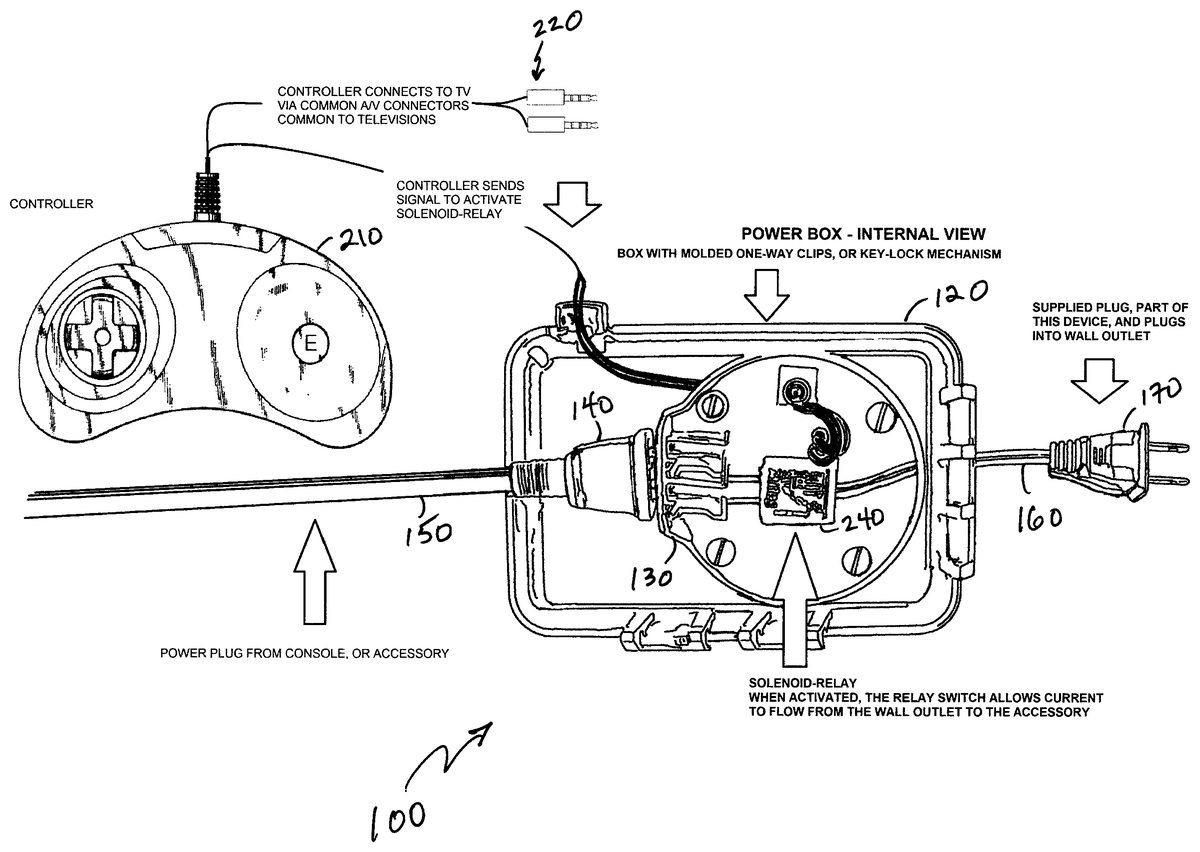
As shown inFIGS. 1 and 2, a lock-box device100for controlling access to and use of at least one video game console110(or other electronic system such as a television, a computer, a DVD player, a cable TV box, a satellite TV box, or other electronic entertainment system, for example) comprises a tamper-proof, or at least tamper-resistant, housing120that includes a lock mechanism. The device100also has at least one power outlet130disposed within the housing120. The outlet130is for receiving and electrically connecting to a power plug140at the end of a power cord150of the video game console110. The lock mechanism of the device100provides the tamper-resistance of the device100, and the lock mechanism is operable to lock the power plug140within the housing120after the power plug140is inserted into the power outlet130. The power cord150extends out of the housing120through a hole or other opening in the housing120that is sized to allow that, but the hole or other opening in the housing120is not sized to allow the power plug140to pass through it. Thus, even if someone were to pull on the power cord150after the power plug140is plugged into the power outlet130and the housing is locked to secure the power plug140therewithin, the power plug140may be pulled out of the power outlet130, but the power plug140will not be able to be pulled out of the locked housing120of the device100without somehow breaking open the locked housing120of the device100. A parent, guardian, or other supervisor of a child typically will be the one that is able to lock and unlock the lock mechanism of the device100, and that adult thus will be the one that opens the housing120by unlocking it, plugs the power plug140into the device's internal power outlet130, and then closes the housing120and locks the lock mechanism to secure the plugged-in power plug inside the housing120of the device100.
The lock mechanism can be one or more molded one-way clips that are used to hold a top of the housing120to the shown bottom of the housing120(FIG. 2), or the lock mechanism could be a mechanical key-lock that requires a physical key to be inserted and turned to lock the top of the housing120to the bottom of the housing120and also to unlock the top from the bottom. Another option is an electromechanical lock that requires a code to be entered into a keypad or screen on the top or bottom of the housing120. A numerical tumbler lock would work as well, such as the kind typically used as a bicycle lock. Other possible lock mechanisms include one-way locks such as the above-mentioned molded one-way clips, or one-way insertion tabs on one piece of the housing120(either the top or the bottom) with one-way receiving slots on the other piece of the housing120. If a one-way lock mechanism is used, then the device100may need to be broken and replaced in order to act as a control device for the same and/or other electronic entertainment systems. Various lock mechanisms are possible and are within the scope of this disclosure as long as the mechanism allows an operator (such as a parent or guardian or supervisor) to secure the top of the housing120to the bottom of the housing120(or alternatively one half or portion of the housing to the other half or portion of the housing) in a way that does not allow, or that at least does not easily allow, a child or other potential user of the video game console110to open and gain access into the locked housing120. The lock mechanism should be able to be locked and unlocked repeatedly over time, to allow the device100to be used with different electronic entertainment systems over time.
The housing120of the device100can be two separate halves—a bottom and a top—as hereinbefore described, or the housing120can be a hinged clam-shell configuration where the top and bottom are hinged together along one side. If a hinged configuration, the housing120can be made of plastic by injection molding, and the hinge can be a so-called living hinge. Various other possibilities exist for configuring and forming the housing120of the device100, as will be appreciated and understood by one of ordinary skill. For example, the housing120could be a rigid plastic or metal box with a separate or hinged (a living hinge or one or more mechanical hinges similar to hinges used on a wooden cabinet door) top or side or bottom. The active lock mechanism could be located on one part of the housing with the receiving or passive part of the lock mechanism located on the other part of the housing.
The device100also includes a device power cord160extending from and external to the housing120of the device100. The device's power cord160terminates in a device power plug170for insertion into an electrical outlet such as a typical household electrical wall socket. The device100also can include one or more connectors accessible external to the housing120to allow a display180to be connected to the device100. The display180can be a television or a video monitor. An alternative to having or using the connector(s) accessible external to the housing120to allow the display180to be connected to the device100is to have supplied with the device100a handheld input unit210that has one or more connectors220for coupling to the display180(FIG. 2). As another alternative, the device100can be supplied with such display connector(s) that extend directly from the housing120of the device10, and thus the handheld input unit210would not need to have or use the connectors220that extend from the unit210.
A logic and control system190of the device100is disposed within the housing120, and it controls the power outlet130. The logic and control system190also supplies images to be shown on the display180to a potential user of the video game console110, and these images include educational content in the form of one or more questions in one or more educational subject matter areas. The logic and control system190also allows the potential user to provide responses to the one or more questions, and it controls the supply of power to the power outlet130based on the responses to those questions. The logic and control system190will not supply power to the power outlet130unless the responses to the one or more questions are acceptable.
The device also can have one or more other connectors accessible external to the housing120to allow a handheld controller unit200of the video game console110to be plugged in to the device100and then used by the potential user to provide his or her responses to the one or more questions posed by the device100and displayed on the display180connected to the device100. Instead of or in addition to the device100having the one or more other connectors, the device100can have supplied with it the handheld input unit210(that can be hard-wired to the device100, as shown inFIG. 2, or wirelessly connected to the device100). The handheld input unit210, whether wireless or hard-wired, is for use by the potential user to provide the responses to the one or more questions, and the unit210typically will have at least an up-down button and an enter button. As shown, the unit210has an up-down-left-right button on its top left surface and an enter button on its top right surface. The handheld input unit210can be configured to be the top of the housing120that gets locked onto the bottom of the housing120, thereby eliminating the need for a separate top piece that gets locked onto the bottom piece of the housing120. The device100also can include one or more additional power outlets disposed within the housing120for allowing the device100to control the use of more than one video game console110.
The device100is shown (FIG. 1) with an internal power supply230, but it is noted that the device100does not have to have the internal supply230. The device100also has a switch or relay240. The switch240is also referred to in the drawings as a solenoid.
The logic and control system190controls the switch240to either supply power to the outlet130or else prevent power from reaching the outlet130. The logic and control system190is disposed within the housing120, and it can be programmable. That is, the logic and control system can include computer code that is updateable. The code can be updated via an Internet connection to the device100or with a portable memory stick that plugs into the device100or otherwise. The updateability allows the questions and topics presented to users by the device100to be changed over time.
The logic and control system190of the device100can be configured to supply power to the power outlet130(by operating the switch240) only if the responses include enough correct answers to the one or more questions, and that logic/control system190also can be configured to stop supplying power to the power outlet130after a predetermined amount of time from when the responses were deemed acceptable. Once the logic and control system190of the device100operates the switch240and allows power to be supplied to the outlet130, the video game console110is energized and can then be used. The video game console110may have its own display screen, or it may be connected to the display180and use the display180as its display screen.
When one or more electronic entertainment systems are connected to the device100, such as the video game console110, and when the device100is connected to the display180, and when the device100is powered on, the device100will operate as indicated inFIG. 3after the display180also is powered on (Step300). The device100first will perform an initialization process (step302) and will show on the display180an initial image such as a branded logo and/or other initial information. After initialization, the device100will need to be set up if it has not yet been previously set up. The set-up for the device100is something that will have to be done initially at least to set the age (or age range) and/or school grade (or grade range) of the expected user (step303), and this is typically done by the expected user's parent, guardian, or supervisor by that adult following some basic set-up prompts provided on the display180by the device100. The set-up mode can be entered again after the initial set-up, and entry into the set-up mode of the device100can be password or PIN protected in order to prevent the child from tampering with the difficulty level set by the child's parent, guardian, or supervisor.
If set-up has already been done previously and it does not need to be adjusted, the normal operation of the device100will involve step303being an educational topic selection step. The educational topic of interest can be selected from a screen shown on the display180such as the simplified sample screen shot400shown inFIG. 4. If the child selects math as the topic (using the controller200or the unit210) from screen400, the device100could next ask the child user select a subtopic under the math heading such as algebra, geometry, or arithmetic, as shown by simplified sample screen shot402. And, if algebra is selected by the child (again, using the controller200or the unit210) from screen402, the device100could then cause an algebra question to appear on the display180such as the one shown in the simplified sample screen shot404. This algebra question appearing on the display180also is identified as step304inFIG. 3. If the child does not select the correct answer from screen404, the program flow of the device100continues to the “incorrect” box306which will result in the device100causing the display180to show a screen that indicates to the child user that the selected answer is wrong. The device100then will cause the display180to show another (different) algebra question, or it could show the same question to give the child user another chance. It could show the same question with a hint to help the child user select the correct answer. The same question could be shown two or more times until the child user selects the correct answer. The same question could be shown no more than two or three or some other number of times before the device100causes the display180to show a different algebra question. Various question presentation arrangements are possible and within the scope of this disclosure. If the child selects the correct answer, whether it is on the first or a subsequent try, the device100will cause the display180to show an indication that the correct answer was selected such as the simplified sample screen shot406ofFIG. 4. While screen406indicates that the selection of the correct answer will result in the video game console110being energized and thus available for use by the child, it most typically will be the case that the device100will require more than just a correct answer to a single question before it energizes the video game console110.
The device100typically will present a certain number of questions in each of two or more educational subject matter areas and require a certain number of correct answers in each of the areas, such as, for example, ten correct answers in math and ten correct answers in English. As shown inFIG. 3, at least one correct answer in math is required and also required is at least one correct answer in vocabulary. The topics and subtopics within any given topic can be varied by the device100and/or can be determined by the device100as opposed to allowing the child user to select the topic and subtopic as is indicated inFIG. 4.FIGS. 3 and 4show particular illustrative embodiments of the operation of the device100, but the embodiments depicted inFIGS. 3 and 4are not the only embodiments possible with the operation of the device100. The educational topics presented can be different than shown in screen400, and again the device100can decide the topic(s) and/or subtopic(s) automatically instead of allowing the user to select the desired topic(s) and/or subtopic(s). And similarly the educational subtopics can be different than shown in screen402. The device100can cause the display180to show a variety of types of questions other than the four-option type of question shown in screen404, and the device100also can cause the display180to show a variety of types of responses if the user's selected answer is correct or incorrect other than the particular response shown in screen406.
Certain embodiments according to the invention have been disclosed. These embodiments are illustrative of, and not limiting on, the invention. Other embodiments, as well as various modifications and combinations of the disclosed embodiments, are possible and within the scope of this disclosure.