U.S. Pat. No. 8,517,834
COMPUTER VIDEOGAME SYSTEM WITH BODY POSITION DETECTOR THAT REQUIRES USER TO ASSUME VARIOUS BODY POSITIONS
AssigneeSoftkinetic Studios SA
Issue DateFebruary 17, 2009
Illustrative Figure
Abstract
A videogame may include providing body position challenges to one or more players to assume various target body positions at, or within, a predetermined time. Body position challenges may be provided to the one or more players by displaying body position challenge representations that prompt the one or more players to assume body positions and/or execute one or more body movements or gestures corresponding to the body position challenges. The time may be indicated via various mechanisms associated with the display (as detailed below). At a given time or over a given time interval, the videogame system may compare the player's detected body position(s) and/or movement(s) to the body position challenges to determine a degree of match or mismatch based on various criteria. Based on the results of the comparison, the game may generate a score or other feedback for display.
Description
DETAILED DESCRIPTION FIG. 1illustrates a videogame system10according to one or more implementations of the invention. According to one embodiment, the videogame provided by videogame system10may include providing body position challenges to one or more players to assume various target body positions at, or within, a predetermined times. Body position challenges may be provided to the one or more players by displaying body position challenge representations that prompt the one or more players to assume body positions and/or execute one or more body movements or gestures corresponding to the body position challenges. The time may be indicated via various mechanisms (as detailed below). At a given time or over a given time interval, videogame system10may compare the player's detected body position(s) and/or movement(s) to the body position challenges to determine a degree of match or mismatch based on various criteria. Based on the results of the comparison, the game may generate a score or other feedback for display (or other forms of output). In some implementations, videogame system10may include one or more of a display12, electronic storage14, a body position detector16, one or more peripherals18, a processor20, and/or other components. Display12may include one or more electronic display devices that can be controlled to present visual displays to one or more players. For example, display12may include a television, a monitor, a handheld electronic display and/or other display devices. In some instances, display12may be included in, or under the control of, a common system with one or more other devices configured to provide sensory stimulation to a player. For example, the one or more other devices may include one or more speakers, one or more lights, one or more dials, one or more haptic devices, and/or other devices that provide sensor stimulation to the player including auditory stimulation, visual stimulation, tactile stimulation, and/or ...
DETAILED DESCRIPTION
FIG. 1illustrates a videogame system10according to one or more implementations of the invention. According to one embodiment, the videogame provided by videogame system10may include providing body position challenges to one or more players to assume various target body positions at, or within, a predetermined times. Body position challenges may be provided to the one or more players by displaying body position challenge representations that prompt the one or more players to assume body positions and/or execute one or more body movements or gestures corresponding to the body position challenges. The time may be indicated via various mechanisms (as detailed below). At a given time or over a given time interval, videogame system10may compare the player's detected body position(s) and/or movement(s) to the body position challenges to determine a degree of match or mismatch based on various criteria. Based on the results of the comparison, the game may generate a score or other feedback for display (or other forms of output). In some implementations, videogame system10may include one or more of a display12, electronic storage14, a body position detector16, one or more peripherals18, a processor20, and/or other components.
Display12may include one or more electronic display devices that can be controlled to present visual displays to one or more players. For example, display12may include a television, a monitor, a handheld electronic display and/or other display devices. In some instances, display12may be included in, or under the control of, a common system with one or more other devices configured to provide sensory stimulation to a player. For example, the one or more other devices may include one or more speakers, one or more lights, one or more dials, one or more haptic devices, and/or other devices that provide sensor stimulation to the player including auditory stimulation, visual stimulation, tactile stimulation, and/or other sensory stimulation.
In some implementations, electronic storage14may comprise electronic storage media that electronically stores information. The electronically storage media of electronic storage14may include one or both of system storage that is provided integrally (i.e., substantially non-removable) with videogame system10and/or removable storage that is removably connectable to videogame system10via, for example, a port (e.g., a USB port, a firewire port, etc.) or a drive (e.g., a disk drive, etc.). Electronic storage14may include one or more of optically readable storage media (e.g., optical disks, etc.), magnetically readable storage media (e.g., magnetic tape, magnetic hard drive, floppy drive, etc.), electrical charge-based storage media (e.g., EEPROM, RAM, etc.), solid-state storage media (e.g., flash drive, etc.), and/or other electronically readable storage media. Electronic storage14may store software algorithms, information determined by processor20, and/or other information that enables videogame system10to function properly. Electronic storage14may include one or more separate components within videogame system10. Electronic storage14may include one or more components provided integrally with one or more other components of videogame system10(e.g., processor10).
Body position detector16may be configured to be operable to detect one or more parameters that define the position of the body (and/or body parts) of a player in space. By way of non-limiting example, body position detector16may be configured to capture two and/or three dimensional information defining the position of the bodies and/or body parts of a player in two dimensional or three dimensional space. The two and/or three dimensional information may include, for example, one or more images of the player captured sequentially and/or simultaneously (e.g., from different viewpoints), a map of the positions of the body and/or body parts of the player in a two dimensional space, a map of the positions of the bodies and/or body parts of the player in a three dimensional space, and/or other dimensional information. From the captured dimensional information, one or more body position parameters of the bodies of the player may be detected. The one or more body position parameters may include the relative positions of two or more of the parts of the body of the player, a profile and/or silhouette of the player, a volume of the player, and/or other body position parameters. The relative positions of two or more of the parts of the body of the player may include, for example, the positions of the two or more of the head, torso, legs (individually), arms (individually), feet (individually), and/or hands (individually) relative to each other.
From the two and/or three dimensional information captured by body position detector16, parameters other than the one or more body position parameters may be determined. The one or more other parameters may include depth information that represents the distance of the player from a real or virtual reference plane (as detailed below), information related to pose (e.g., the maintenance of the relative positions of the body parts of the player), information related to gesture (e.g., coordinated movement of one or more body portions), information related to location (e.g., within a room, with respect to the ground, and/or other location information), information related to directional orientation, information related to motion (e.g., speed, inertia, acceleration, rhythm, and/or other information), information related to size, information related to volume, and/or other information. For example, some aspects of the game may require the player to move laterally, perform one or more gestures, and/or hold one or more poses.
To enable the videogame to be played by more than one person, more than one body position detector16may be used and/or a single body position detector16may be capable of simultaneously discerning between and detecting parameters for two or more players (as detailed below).
Peripherals18may include one or more devices configured to operate in coordination with the other components of videogame system10to provide the videogame to one or more players. For example, peripherals18may include one or more of the sensory stimulation devices discussed above with respect to display12. Peripherals18may include one or more input devices configured to enable a user to input information to videogame system10. Examples of the one or more input devices may include a keypad, buttons, switches, a keyboard, knobs, levers, a touch screen, a microphone, a joystick, a direction-pad, and/or other input devices.
Processor20may be configured to provide information processing capabilities in videogame system10. As such, processor20may include one or more of a digital processor, an analog processor, a digital circuit designed to process information, an analog circuit designed to process information, a state machine, and/or other mechanisms for electronically processing information. Although processor20is shown inFIG. 1as a single entity, this is for illustrative purposes only. In some implementations, processor20may include a plurality of processing units. These processing units may be physically located within the same device, or processor20may represent processing functionality of a plurality of devices operating in coordination. For example, in some implementations, some of the functionality attributed to processor20may be provided by processing capabilities provided integrally with body position detector16, while other functionality attributed to processor20may be provided by one or more processing units physically located in a console or terminal that is separate from body position detector16.
As is shown inFIG. 1, in one embodiment, processor20executes one or more modules including a parameter module22, a challenge/sequence module24, a player representation module26, a timing module28, a comparison module30, a scoring module32, a feedback module34, a pick-up/obstacle module36, and/or other modules. Modules22,24,26,28,30,32,34, and/or36may be implemented in software; hardware; firmware; some combination of software, hardware, and/or firmware; and/or otherwise implemented. It should be appreciated that although modules22,24,26,28,30,32,34, and/or36are illustrated inFIG. 1as being co-located within a single processing unit, in implementations in which processor14includes multiple processing units, modules22,24,26,28,30,32,34, and/or36may be located remotely from the other modules. Further, the description of the functionality provided by the different modules22,24,26,28,30,32,34, and/or36described below is for illustrative purposes, and is not intended to be limiting, as any of modules22,24,26,28,30,32,34, and/or36may provide more or less functionality than is described. For example, one or more of modules22,24,26,28,30,32,34, and/or36may be eliminated, and some or all of its functionality may be provided by other ones of modules22,24,26,28,30,32,34, and/or36. As another example, processor14may include one or more additional modules that may perform some or all of the functionality attributed below to one of modules22,24,26,28,30,32,34, and/or36.
It will be appreciated from the foregoing that in some implementations videogame system10may be achieved on various videogame platforms. However, this is not intended to be limiting, as videogame system10may be implemented in a variety of different contexts.
Parameter module22may be configured to obtain player parameters body position parameters, and/or other parameters of one or more players playing the videogame. The parameters may include parameters obtained directly from body position detector16and/or parameters determined by parameter module22based on information obtained from body position detector16, information input to videogame system10by players (e.g., via peripherals18), information stored by electronic storage14, and/or other information. The player parameters obtained by parameter module22may include one or more of a number of players, identifications of individual players, identified body parts of individual players, information related to pose, and/or other player parameters. The body position parameters obtained by parameter module22for a given player may include one or more of a profile/silhouette parameter, a parameter describing the relative position of two or more body parts (e.g., head, torso, legs, arms, hands, feet, and/or other body parts), a volume or area parameter, and/or other body position parameters. Other parameters determined by parameter module22may include one or more of a depth parameter related to the distance of the player from a real or virtual reference plane, a body pose parameter (e.g., parameterizing the pose of a player), a gesture parameter, a location parameter, an orientation parameter, a motion parameter, a rhythm parameter, a timing parameter, a size parameter, and/or other parameters.
According to various implementations, one or more body position parameters determined by parameter module22may be impacted by objects that are grasped or otherwise engaged by a player and/or the representation of the player in the videogame. The objects may include virtual and/or real objects. A virtual object may include an object that is depicted in a display of the videogame to the player. A real object may include a physical object that is physically present with the player.
Virtual objects may be associated with the representation of the player in the videogame. For example, a virtual object may be grasped, carried on, and/or otherwise associated with the representation of the player in the display of the videogame. The virtual object may be an “positive” object, or a “negative” object.
If a virtual object that is a positive object is associated with the representation of the player (e.g., is grabbed by the representation of the player), body position parameters of the user, such as the area and/or volume of the user, may be determined as if the positive object were a part of the player's body. Thus, determinations by parameter module22of, for example, the area and/or volume of the player may be increased by the of the virtual object.
As will be appreciated, performing body position challenges while being associated with a positive object may increase the difficulty of the body position challenges. The association of a positive virtual object with the representation of the player may be a penalty and/or disincentive within the videogame for some behavior, may be a way of handicapping the game to enable players of different skill levels to compete with each other, and/or may enable the player to achieve higher scores for executing the same body position challenges.
If a virtual object that is a negative object is associated with the representation of the player, parameter module22may determine body position parameters of the player as if the object cancels out a portion of the volume and/or area of the player. The portion of the volume and/or area of the player that are canceled out by the negative virtual object may correspond to a portion of the representation of the player that is “covered” by the virtual object.
By way of example,FIG. 2Aillustrates a representation38of a player associated with an object40. Object40may be positioned between representation38and some reference object42.FIG. 2Billustrates representation38of the player, minus the portion of the area and/or volume of the player that has been subtracted from the player by virtue of the presence of reference object42between representation38and object40. Parameter module22may then determine one or more body position parameters based on the area and/or volume of the player depicted by representation38inFIG. 2B(minus the “covered” portion of the player). Object40may include a reference plane, axis, point, or object (e.g., an approaching wall, a different type of approaching body position challenge representation).
The subtraction of a portion of the area and/or volume of a player based on the position of a negative object may make performing a body position challenge easier for the player. As such, the association of a negative virtual object with the representation of the player may be a reward and/or incentive within the videogame for some behavior and/or may be a way of handicapping the game to enable players of different skill levels to compete with each other.
Returning toFIG. 1, real objects are physical objects that can be engaged and manipulated physically by the player. Body position detector16may provide input information to processor20that indicates information about a physical object held, carried by, and/or otherwise engaged by the player. The information may include dimensional information, a volume of the object, an area of the object, a shape of the object, and/or other aspects of the object. Similar to virtual objects, real objects may be positive objects or negative objects. Whether a real object is considered by the videogame to be a positive object or a negative object may be based on parameters of the game, a selection by the player and/or another player (e.g., an opponent, a collaborator, and/or other players), and/or otherwise determined. If a real object is considered by the videogame to be a positive object, then the volume and/or area of the real object is added to the volume and/or area of the player by parameter module22for the purposes of determining one or more body position parameters and/or other parameters. If a real object is considered by the videogame to be a negative object, then the real object can be positioned between the player and some reference plane, point, axis, or object (e.g., body position detector16, display12, and/or other objects), and the volume and/or area of the player covered by the real object is removed from the volume and/or area of the player by parameter module22for the purposes of determining one or more body position parameters.
Challenge/sequence module24may be configured to present body position challenges and/or sequences of body position challenges to a player during play of the videogame. The body position challenges may be presented by displaying body position challenge representations to one or more players via display12that prompt the one or more players to assume various target body positions corresponding to the body position challenges.
A body position challenge representation may convey the target body position of a body position challenge in a variety of ways. By way of example,FIGS. 3,4,5, and6illustrate body position challenge representations44.
The body position challenge representations44illustrated inFIGS. 3 and 4may include obstacles. In order to avoid these obstacles, a player must assume a body position (and/or make a motion) that would enable the player to avoid body position challenge representations44, if the body position challenge representations44were tangibly present with the player. As is discussed below, in some implementations, a representation of the player is displayed along with body position challenge representation44, and the body position and/or motion of the representation of the player is displayed as corresponding to the detected body position and/or motion of the player. In such implementations, the representation of the player provides feedback to the player that enables the player to determine whether his body position and/or motion is sufficient to avoid body position challenge representation44.
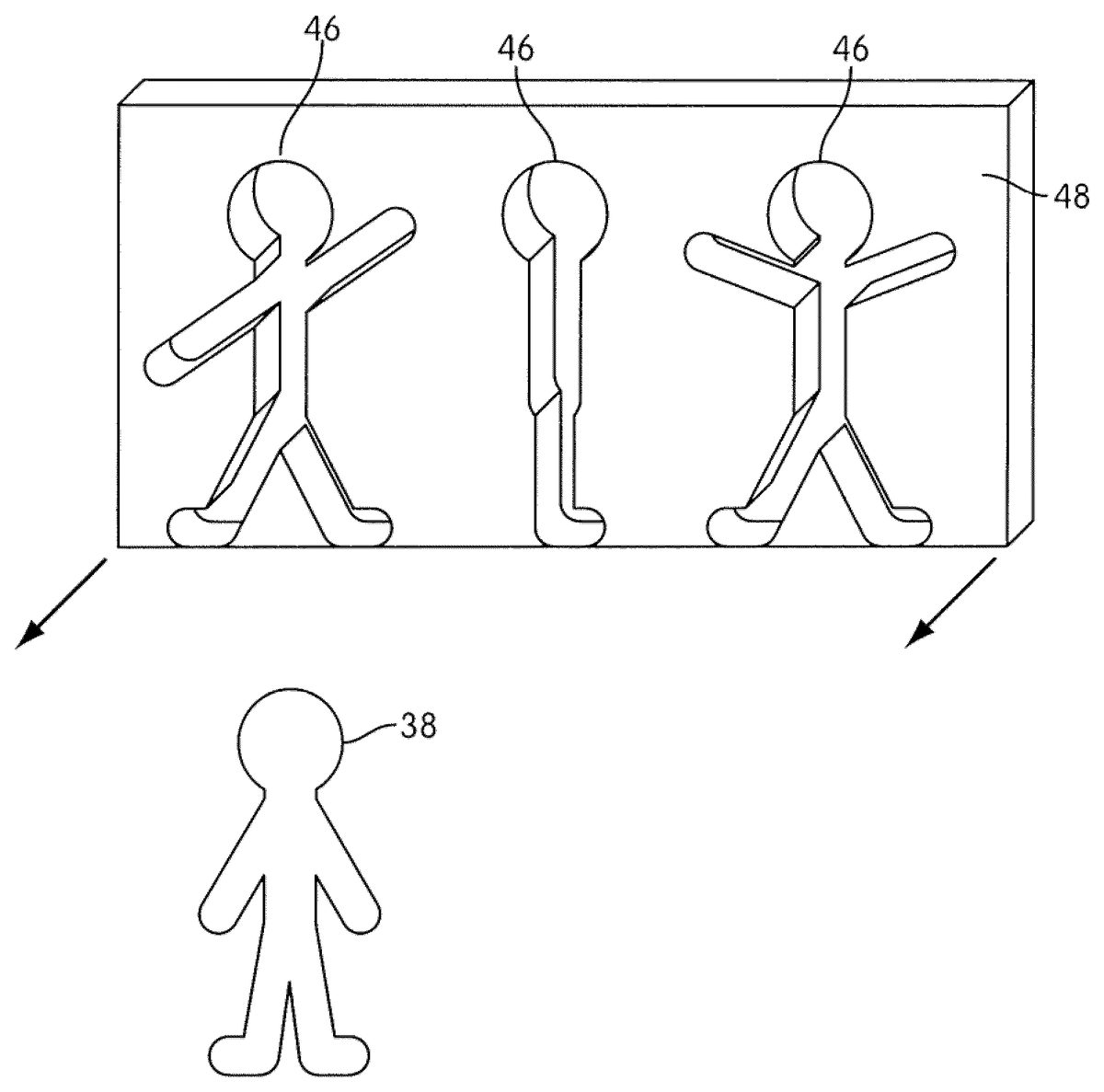
The body position challenge representations44illustrated inFIGS. 5 and 6include representations46of target body positions corresponding to body position challenges. The representations46may be depicted as silhouettes having shapes that corresponds to the target body positions. In the implementations illustrated inFIGS. 4 and 5, body position challenge representations44may include a wall48(or other structure) having at least one opening50formed therein. The opening50can take the form of various sizes and shapes corresponding to different target body positions. In some embodiments, the wall or portions of the opening of the wall may be at different heights relative to a plane such as the ground (e.g., to require the player to jump up to or duck down to the appropriate height).
Body position challenge representations44like the one ones depicted inFIGS. 5 and 6may prompt a player to assume a body that corresponds to opening50of a displayed wall48. As is discussed further below, in some implementations, a representation of the player is also displayed along with body position challenge representation44, and the player attempts to assume a body position that enables the representation of the player to pass through opening50without contacting a portion of wall48.
It should be appreciated that the illustration of body position challenge representations44inFIGS. 3-6is not intended to be limiting. Other schemes for prompting a player to assume a target body position associated with a body position challenge are contemplated for body position challenge representations. For example, a body position challenge representation may include one or more objects the player must try to contact, a graphical depiction of one or more target body positions that the player must assume, a graphical depiction of a volume that a player must fill (or confine himself to), and/or other body position challenge representations.
In some implementations, one or more body position challenge representations presented to players of the videogame may pertain to a plurality of body position challenges. For instance,FIG. 7provides an illustration of such a body position challenge representation38. Upon being presented with representation38, the player may select a single body position challenge to attempt. The player may select a body position challenge with a physical gesture (e.g., pointing to one body-position challenge representation), by simply attempting a selected body position challenge, via a selection input through peripherals, by moving laterally to the selected body position challenge, and/or through other selection mechanisms. The videogame may involve incentivizing selections of more difficult body position challenges. An incentive may be in the form of one or more of an increase in score, a score bonus, a timing bonus, an increased allowance for error in conforming to the target body positions, manna or life force awards, and/or other incentives.
Returning toFIG. 1, a player representation module26may manage information related to player representations. Player representations may be displayed on display12to represent a player playing the videogame. A player representation may include an object, or set of objects. The player representation may be depicted as having a body position that corresponds to the body position of the player associated with the player representation (e.g., based on body position detected by body position detector16).
Player representation module26may enable players to create customized representations. Customization of a player representation may include customization of a size, shape, features (e.g., hair, facial features, and/or other features), clothing, props, and/or other aspects of the representation that are customized. Player representation module26may manage associations between players that have previously established customized representations on videogame system10and their representations. In some instances, a customized player representation may be created in separate environment (e.g., another game, an avatar creation setting such as Nintendo's Mii Channel, Sony Home, and/or Xbox Live) and imported to videogame system10. Importation of previously created customized player representations may be managed by player representation module26.
In implementations where videogame system10enables players to be represented by customized player representations, the body position challenge representations displayed to a given user may be customized to correspond to the representation of the given player. For example, if the representation of the given player has large, spiky hair, the body position challenge representations (e.g., holes in a wall) displayed to the given user may reflect this distinctive feature.
In some implementations, players of the videogame may be prompted to perform body position challenges (e.g., to assume target body positions associated with the body position challenges) for or within a predetermined time. Player information, such as one or more body position parameters, may then be determined at a given time or over a given time interval the corresponds to a given body position challenge. The player information may then be compared to the body position challenge to determine a degree of match and/or mismatch between the actual body position of the one or more players and the target body positions. Based on this comparison the game may generate and output a score and/or other feedback for the one or more players. Other scoring and feedback criteria may also be used. In some implementations, the times and/or time intervals associated with body position challenges are managed by timing module28. Comparisons between body position challenges and one or more body position parameters and/or other parameters of players may be managed by comparison module30. Scoring of the players based on performance of the body position challenges may be managed by scoring module32.
In some implementations, timing module28may be configured to convey to players of the videogame the times and/or time intervals associated with body position challenges. By way of illustration,FIG. 8illustrates a presentation of a body position challenge representation44. In the implementations illustrated inFIG. 8, timing module28may manage the presentation of a timing icon52that conveys to players a time by which a target body position corresponding to body position challenge representation44should be assumed and/or a target body motion should be made, a time for which the target body position and/or motion should be maintained, and/or other times or timing intervals associated with body position challenge representation44. In some implementations, timing icon52may include a simple timer that visually indicates an amount of time.
In some implementations, timing information may be conveyed to players by timing module28by other mechanisms than timing icon52. For example, timing information may be conveyed to players by relative movement between representation38of a player and a reference plane, axis, or object. The reference plane, axis, or object may include a body position challenge representation44(or some plane, axis, or object associated therewith). InFIG. 8, timing module28may convey a time by which the player represented by representation38should perform the body position challenge associated with body position challenge representation44by controlling the display of the videogame to depict representation38and body position challenge representation44moving closer and closer as time goes on. The time at which the player should perform the body position challenge may be the time at which representation38meets body position challenge representation44in the display.
In implementations in which body position challenge representation44includes wall48with an opening50therein corresponding to the target body position, if the player has performed the body position challenge at the appropriate time, representation38will assume the body target position and pass through opening50in wall48. The length of the timing intervals associated with the body position challenges may be controlled by the distance between walls48along a path between walls48and representation38, and/or the rate at which walls48move along the path.
In some implementations, the timing between body position challenges may be fixed or variable. For example, to the extent that the game displays relative movement between representation38and body position challenge representation44, the relative time between successive body position challenge representations44may be fixed (e.g., a constant time) so that the player as the same amount of time to assume a target body position. Or, the timing may vary between being relatively longer and relatively shorter periods of time between body position challenge representations44to give the player more or less time to assume the target body position.
In some implementations, movement of the body position challenge representations44toward the player may be non-uniform. For example, as one of body position challenge representations44approaches player representation38, body position challenge representation44may accelerate/decelerate and/or move from side to side in an unpredictable and/or random manner. This may provide an enhanced sense of excitement as body position challenge representation44approaches player representation38because the player corresponding to player representation38may not know exactly when his body position parameters will be evaluated with the body position parameters of the body position challenge (e.g., for scoring purposes).
According to various implementations, as the time corresponding to a given body position challenge approaches, the body position parameters conveyed by the body position challenge44corresponding to the body position challenge may fluctuate. For example, as body position challenge44inFIG. 8approaches representation38, the shape of opening50may change. This may prompt the player to change his body position so that the position of representation38conforms to the new configuration of opening50. The amount and/or rate of change in the body parameters of the body position challenge (as represented by opening50) may be based on a past performance of the player (e.g., increased movement as a penalty for poor performance), a skill level of the player, a game setting, and/or other parameters.
As was mentioned above, the relative movement between body position challenge representation44and representation38may include relative motion along a path between body position challenge representation44and representation38. The path may be substantially linear (e.g., generally perpendicular to a plane of wall48). In some implementations, the path may be, or include segments that are, substantially straight and or curved. For example, wall48(or other structures) may rotate, relative to body position challenge representation44, about an axis of rotation that is distant from both representation38and body position challenge representation44. For example, body position challenge representation44may be depicted as sitting on a surface that rotates relative to representation38while representation38appears to remain in a relatively fixed location. In such cases, the timing of the body position challenges presented to the player may be controlled by the spacing of body position challenge representations44on the rotating surface, the radial distance from the axis of rotation to representation38, and/or the rotational velocity of the surface.
In some implementations, the path (or at least a portion thereof) of motion between representation38of the player and body position challenge representation44may not be perpendicular with a plane of wall48. For example, there may be relative lateral movement between body position challenge representation44and representation38of the player. This may require the player to both move laterally to a corresponding location and assume a target body position to perform the body position challenge. In this scenario, body position detector16(and/or other detectors) may detect the player's relative location and other parameters (e.g., silhouette or outline). In this case, even if a player assumes a body position having an outline or silhouette that corresponds to an approaching body position challenge representation44, the relative lateral position of the player may result in the detection of deficiencies in the performance of the body position challenge by the player.
In addition to depicting the time at which the target body position should be assumed, timing module28may control the display of body position challenge representation44to also convey an amount of time for which the target body position should be held. For instance, a thickness of wall48may be controlled to prompt the player to hold the target body position for a larger or smaller amount of time (a thicker wall prompts prolonged poses).
Referring back toFIG. 1, at the appropriate time, and/or over the appropriate time interval, comparison module30may be configured to compare body position parameters of the one or more players to body position parameters dictated by a body position challenge to determine a degree of match or mismatch based on various criteria. For example, if the body position challenge relates to a specific silhouette or profile, the silhouette of the player (e.g., as detected by the body position detector) may be compared with the silhouette dictated by the body position challenge. In some implementations, the body position challenge may relate to a volume with a specific three-dimensional shape and the three-dimensional shape of the players body position may be compared to this three-dimensional shape. In some implementations, the body position challenge may relate to relative positions of body parts (e.g., left foot in front of right foot). In some implementations, the body position challenge may relate to other parameters, such as body orientation, location of the body and/or specific parts thereof, and/or other parameters. In such implementations, the corresponding parameters of the player's body position may be determined (e.g., by the body position detector) and may be compared with the parameters of the body position challenge to determine the degree of match or mismatch.
By way of illustration,FIG. 9illustrates a display of the videogame at a point in time at which the player is being prompted to perform a body position challenge. In particular, a body position challenge representation44comprising wall48forming opening50has arrived at representation38of the player. As can be seen, representation38shows that for the most part the player has performed the body position challenge associated with body position challenge representation44. However, the left arm of representation38does not fit into opening50because the corresponding part of the body of the user (e.g., the left arm) is not in the position dictated by body position challenge representation44. Accordingly, a comparison between the body position parameters and/or other parameters of the player, and the parameters dictated by the body position challenge by comparison module30may reflect the mismatch illustrated inFIG. 9.
Referring back toFIG. 1, based on the results of a comparison between the body position parameters and/or other parameters of the player and the parameters of a body position challenge, and/or other criteria, scoring module32may generate a score for display or other output. For example, scoring module32may determine a score based at least on the degree of match or mismatch between the one or more body position parameters and/or other parameters of the player's detected body position and the parameters of the body position challenge, as determined by comparison module30, according to various scoring criteria. For example, if a body position challenge is presented to a user with a body position challenge representation that includes a wall with an opening, one of the scoring criteria may be whether the outline of the player's body position at a given time would avoid contact with the wall. As another example, the criteria may be the degree of contact between the player's body position and the wall. As another example, the scoring criteria may include points for not contacting the wall, but also deductions for unfilled areas and/or deductions for some areas of contact.
In the event the body position challenge is presented to a user with a body position challenge representation that includes a wall (or other structure) to maximize contact with, one scoring criteria may include whether the player's body position at a given would make contact with the surface. As another example, the criteria may be the degree of contact.
In some implementations, the scoring criteria applied by scoring module32may include how far in advance and/or for how long the player maintained a body position with body position parameters and/or other parameters that satisfy the body position challenge. Other scoring criteria and body position challenges may be used, some of which are disclosed below. In some implementations, scoring module32may further account for other criteria in determining the scores of players. For example, scoring module32may take into account an amount of time for which a player holds a target body position (e.g., prior to the appropriate time, after the appropriate time passes), interactions with obstacles and/or pick-ups (as discussed below), handicapping between players of disparate skill levels, and/or other criteria.
According to various implementations, scoring module32may manage incentives provided to players within the game. Incentives may include rewards provided to players within the game other than simply increasing the scores awarded to players. Incentives may be provided to players as a reward for quality of performance of body position challenges, for performing pick-ups and/or avoiding obstacles (as discussed below), to handicap competing players of different skill levels, and/or for other activities within the game. Incentives may include, for example, a score bonus (e.g., future scoring multiplied and/or other score bonuses), a timing bonus (e.g., the velocity of the body position challenge representations approaching a player representation is decreased, an amount of time a target body positions must be held is decreased, spacing between body position challenge representations is increased, and/or other timing bonuses), an increased allowance for error in conforming to the target body positions (e.g., larger openings in approaching walls, a decrease in player representation size, or other allowances for error), manna or life force awards, and/or other incentives. Similarly, scoring module32may manage disincentives (e.g., corresponding to the incentives outlined above) for failing to perform activities within the videogame.
Feedback module34may manage feedback provided to players regarding their performance of body position challenges. This feedback may include feedback at and/or before the time corresponding to a body position challenge. Feedback may include information other than score that indicates to a player information about his performance of a body position challenge. Feedback presented to the player prior to a time corresponding to a body position challenge may enable the player to refine his performance of the body position challenge before his body position parameters and/or other parameters are compared with the parameters of the body position challenge. Feedback presented to the player at or after the time corresponding to the body position challenge may indicate to the player how well he performed the body position challenge. Feedback may include visual feedback (e.g., provided via display12), audio feedback, haptic feedback, and/or other feedback.
By way of example, feedback module34may present a preview of the player's body position relative to a body position challenge representation (e.g., a wall) prior to the time corresponding to the body position challenge to provide guidance to the user. For example,FIG. 10illustrates one technique that may be implemented by feedback module34to provide feedback to the player.
InFIG. 10, body position challenge representation44is presented to the player sin the form of wall48having opening50opening therein. Opening50corresponds to a target body position of a body position challenge. As time progresses toward the time at which the player will perform the body position challenge, body position challenge representation44progresses along a path toward representation38. In order to provide the player with feedback prior to the time at which the player will perform the body position challenge, the display may further include a second representation54of the player. Second representation54may be superimposed on body position challenge representation44, and may represent a current body position of the player. The superposition of second representation54on body position challenge representation44may depict, based on the player's current body position, areas56where representation38of the player would contact wall48, areas58of opening50that would not be filled by representation38, and/or areas60of opening50and representation38that currently correspond.
Referring back toFIG. 1, as another example of feedback provided by feedback module34, instead of depicting a second representation of the player on or near a body position challenge representation feedback module34may determine, prior to a time associated with a given body position challenge, portions of the representation of the player and/or portions of the body position challenge representation that do not coincide, and may highlight these sections on the representation of the player (element62inFIG. 10) and/or the body position challenge representation. If there would not be any contact, the display can display a visual or other indicator for indicating that there would not be contact.
As was mentioned above, feedback module34may provide feedback to a player regarding performance of a previous body position challenge (other than score). This feedback may include, for example, audio or visual messages that convey the quality of the performance of the player. For example, if the player receives a score at or above a predetermined threshold, an audio and/or visual message may indicate such to the player. Conversely, if the player receives a score below the predetermined threshold, an audio and/or visual message may be delivered to the player that provides encouragement, derides the poor quality of performance, and/or otherwise conveys to the user that the quality of the performance was sub-par.
In some implementations, the feedback provided by feedback module34may include interactions between a representation of the player and the body position challenge representation. For example, in implementations in which the body position challenge representation includes a wall having an opening formed therein, failure of the player to conform his body position in accordance with the body position challenge may result in a collision between the wall and the representation of the player. This collision may have an adverse impact on the representation of the player (e.g., knock the representation down, reduce responsiveness of the representation for some time, move the representation backward, and/or other impacts).
Other forms of feedback can include text, audible feedback, and/or haptic feedback among other forms of feedback.
In some implementations, pick-up/obstacle module36may present challenges to players that are represented to players as obstacles and/or pick-ups. The obstacles and/or pick-ups may be displayed as moving around display12relative to the representation of the player and/or body position challenge representations. By moving his body, the player may be able to control his representation to either avoid (for obstacles) and/or make contact with (for pick-ups) the moving obstacles and/or pick-ups. The obstacles and/or pick-ups may be presented such that the player must control his representation to either avoid or make contact with them in addition to positioning the his representation in accordance with other body position challenges (e.g., walls having openings). For example, the player may have to move a hand, foot or other body part to a designated portion of the display at or near a given time to make contact with a pick-up or to avoid contact with an obstacle. A pick-up may identify a body part of the avatar that must contact the pick-up in order to gain the incentive associated with the pick-up, or to maximize the incentive associated with the pick-up.
According to various implementations, the videogame provided by videogame system10may be played as a single player game. In the single player game, the player is the sole individual playing the game. In the single player game, the player may compete (e.g., through performing body position challenges) with a previous score, to complete “levels,” to unlock new game content, and/or for other purposes.
According to various implementations, the videogame may be played as a multi-player game by two or more players. In the multi-player game, the two or more players participating in the videogame may be present in the same physical location, or in disparate physical locations (e.g., over a network). When the two or more players are present in the same physical location, parameters of their body position may be captured by the same body position detector to be processed as inputs to the videogame.
If the two or more players are participating from separate physical locations, each player may participate via a separate body position detector, display, and processor system that are linked by a network. For example,FIG. 11illustrates implementations in which separate systems similar to videogame system10(shown inFIG. 1and described above) are provided for different users. In some implementations, to enable the systems to communicate with each other, processors20may communicate with a server64that manages the transmission of game information between the systems. In some implementations, processors20may communicate in a peer-to-peer manner without an intervening server.
In the multi-player game, a plurality of players may compete against each other and/or work collaboratively in one or more multi-player modes. For instance, two or more players may compete against each other in a competitive multi-layer mode. In this mode, representations of the two or more players may be displayed simultaneously with separate sets of body position challenge representations (e.g., in the form of walls with openings) for each of the players. The timing intervals associated with the separate sets of body position challenges may be synchronized (e.g., so that the players attempt challenges at the same time) and/or the timing intervals may be offset (e.g., so that the players attempt the challenges in a staggered manner).
For example,FIG. 12illustrates implementations of the competitive multi-player mode of the videogame in which separate sets of body position challenge representations44are displayed corresponding to representations38of separate players. The body position challenge representations44illustrated inFIG. 12include a first set of challenge representations66with synchronized timing intervals, and a second set of challenge representations68with offset timing intervals.
In some implementations, each of the separate sets of body position challenges includes the same body position challenges in the same order. In such implementations, the players must attempt the same body position challenges either simultaneously, or in succession (e.g., a follow-the-leader type of timing). In some implementations, each of the separate sets of body position challenges includes different body position challenges.
In order to facilitate competition between players of disparate skill levels, the competitive multi-player mode may include one or more handicapping features. For example, different sets of body position challenges may be presented to the players, with the differences between the body position challenges being provided so that a more skilled player is presented with a harder set of body positions. Handicapping players of different skill levels may include adjusting the timing intervals (e.g., shorter timing intervals for more skilled players). In some implementations, handicapping may include requiring a more skilled player to hold body positions corresponding to the body position challenges for a more prolonged period of time to gain the same incentives as a less skilled player receives for holding body positions for a shorter period of time. Other handicapping features may be incorporated into the videogame.
In some implementations of the competitive multi-player mode, the videogame may enable one of the players to have some control over the body position challenges presented to one or more of the other players. This may enable the controlling player to control the difficulty of body position challenges presented to the other player. Control over the difficulty of the body position challenges presented to another player may include one or more of control of timing intervals associated with the body position challenges, selection of specific body position challenges, selection of parameters of body position challenges, and/or control over other aspects of the body position challenges. This may present an aspect of risk-reward to the player, as the posing player will be less likely to conform completely to body position challenges when difficulty is increased, but increased difficulty may have a higher scoring potential for the posing player. Control by a player over the difficulty experienced by a posing player within the videogame may be accomplished via a peripheral control device and/or via gestures that are detected by the body position detector and/or the processor(s).
According to various implementations, the multi-player game may include a competitive multiplayer mode in which one or more players follow the body position of a leading player (e.g., a follow-the-leader mode). In this mode, the leading player may set one or more body position parameters and/or other parameters of a body position challenge for the following player(s) by positioning himself with the desired one or more parameters at predetermined intervals. The following player(s) must then conform themselves to body position challenges having the one or more parameters dictated by the body position of the leading player.
For example,FIG. 13illustrates a body position challenge representation44that is blank (e.g., a blank wall, is not yet associated with body position parameters and/or other parameters) approaching two player representations (illustrated inFIG. 13as first representation38aand second representation38b). Turning toFIG. 14, as the blank body position challenge representation44reaches the first representation38a, the body position of the player corresponding to the first representation38asets the body position parameters and/or other parameters of the body position challenge corresponding to body position challenge representation44. This is depicted inFIG. 15, which shows body position challenge representation44now prompting the player associated with second representation38bto assume the same body position as first representation38ainFIG. 14, and a new, blank body position challenge representation44approaching first representation38a.
According to various implementations, the videogame may include a cooperative multi-player mode in which two or more players cooperate to position themselves in response to compound body position challenges. For example,FIG. 16illustrates and example of this cooperative multi-player mode. InFIG. 16, a compound body position challenge representation44of a compound body position challenge may be presented to two players corresponding to first representation38aand second representation38b. The two players then coordinate their body positions and/or motions (as depicted) to perform the compound body position challenge.
In the cooperative multi-player mode, all of the players may be considered positive objects (e.g., as displayed inFIG. 16). In some instances, one or more of the players may be considered a negative object. In such instances, a player that is a negative object may move and/or position his body such that his representation is between the representation of another player and some reference plane, axis, point, or object (e.g., an approaching body position challenge representation). Portions of the other player represented by the portions of the representation of the other player that are covered by the representation of the player that is a negative object may be removed from the volume and/or are of the other player in analysis of the conformance of the players to cooperative body position challenges.
In some implementations, the videogame provided by videogame system10may include a studio mode in which players create body position challenges and/or sequences of body position challenges for use during game play modes such as the single player mode and/or the multi-player modes described above. A player may create a body position challenge by positioning his body in a body position and capturing parameters of the body position using the body position detector, through manipulation of a peripheral controller to dictate body position parameters and/or other parameters, and/or by some combination of these two possibilities. The player may assemble a set of body position challenges into a sequence that can then be presented during game play modes such as the single player mode and/or the multi-player modes described above. In some implementations, the player may share created body position challenges and/or sequences of body position challenges with other players (e.g., over a network).
According to various implementations, the videogame provided by videogame system10may include an instructional mode. In the instructional mode, a player may be instructed on how to satisfy various body position challenges. During this mode, the timing intervals associated with individual body position challenges may be increased, or even done away with altogether. In the instructional mode, rather than merely presenting a body position representation (e.g., the form of a opening in the wall), the one or more processors executing the videogame may generate a display that includes additional information instructing the player on how to satisfy the body position challenge. For example, the display may show a picture or diagram of a person with a body position that satisfies the body position parameters and/or other parameters of the body position challenge, a written description of how body members should be positioned to satisfy the body position parameters and/or other parameters of the body position challenge, and/or other information.
In some implementations, in addition to presenting body position challenge representations to the player(s), the videogame may require or incent the performance of other actions. For example, the videogame may require the vocal performance of a piece of music, the manipulation of a musical instrument, a musical instrument-like game controller, and/or other types of controllers, the rhythmic contacting of one or more contact sensors, and/or other the performance of other actions with the conformance to body position challenges. These actions may be performed simultaneously with conformance to body position challenges and/or in separate time periods from conformance with body position challenges (e.g., first satisfy a set of body position challenges, then perform a karaoke part).
Although the invention has been described in detail for the purpose of illustration based on what is currently considered to be the most practical and preferred embodiments, it is to be understood that such detail is solely for that purpose and that the invention is not limited to the disclosed embodiments, but, on the contrary, is intended to cover modifications and equivalent arrangements that are within the spirit and scope of the appended claims. For example, it is to be understood that the present invention contemplates that, to the extent possible, one or more features of any embodiment can be combined with one or more features of any other embodiment.
Claims
- A system configured to provide a videogame to a first player and a second player, the system comprising: one or more body position detectors configured to capture dimensional information that defines the position of a first player and a second player in space;one or more electronic displays configured to display to the first player and the second player a first set of body position challenge representations and a second set of body position challenge representations, wherein a body position challenge representation represents a body position challenge associated with a corresponding point in time, and wherein the body position challenge representations are displayed to the players in advance of the associated points in time such that while a point in time associated with a given body position challenge representation is approaching, the given body position challenge representation is displayed via the electronic display, wherein the first set of body position challenges and the second set of body position challenges are different;one or more processors configured (i) to determine one or more body position parameters of the body position of the first player based on the dimensional information captured by the body position detector and to compare the one or more body position parameters of the body position of the first player with one or more body position parameters dictated by the body position challenges of the first set of body position challenges at the points in time associated with the body position challenges of the first set of body position challenges, (ii) to determine one or more body position parameters of the body position of the second player based on the dimensional information captured by the body position detector and to compare the one or more body position parameters of the body position of the second player with one or more body position parameters dictated by the body position challenges of the second set of body position challenges at the points in time associated with the body position challenges of the second set of body position challenges, and (iii) to convey an indication as to which of the first player and the second player is winning a single competitive game in which the first player and the second player are participating that incentivizes conformance with body position challenges at points in time associated with the first set of body position challenges and the second set of body position challenges, wherein the points in time associated with the body position challenges of the first set of body position challenges and the points in time associated with the body position challenges of the second set of body position challenges are the same points in time.
- The system of claim 1 , wherein the one or more body position detectors are contactless and markerless.
- The system of claim 1 , wherein one or more body position parameters comprise one or more of a body silhouette, a three-dimensional shape of one or more body parts, or a relative positioning of specific body parts.
- The system of claim 1 , wherein a relative difficulty between the first set of body position challenges and the second set of body position challenges is determined by the one or more processors based on previously demonstrated skill-levels of the first player and the second player.
- A method of providing a videogame to a first player and a second player, the method comprising: detecting one or more body position parameters of a first player;detecting one or more body position parameters of a second player;successively displaying body position challenge representations that represent a first set of body position challenges to the first player and the second player, wherein individual body position challenges in the first set of body position challenges are associated with separate points in time, and wherein the body position challenge representations are displayed in advance of the associated points in time such that while a point in time associated with a given body position challenge representation is approaching, the given body position challenge representation is displayed;successively displaying body position challenge representations that represent a second set of body position challenges to the first player and the second player, wherein individual body position challenges in the second set of body position challenges are associated with separate points in time, wherein the first set of body position challenges and the second set of body position challenges are different;comparing the one or more body position parameters of the body position of the first player with one or more body position parameters dictated by the body position challenges of the first set of body position challenges at the points in time associated with the body position challenges of the first set of body position challenges;comparing the one or more body position parameters of the body position of the second player with one or more body position parameters dictated by the body position challenges of the second set of body position challenges at the points in time associated with the body position challenges of the second set of body position challenges;conveying an indication as to which of the first player and the second player is winning a single competitive game in which the first player and the second player are participating that incentivizes conformance with body position challenges at points in time associated with the first set of body position challenges and the second set of body position challenges, wherein the points in time associated with the body position challenges of the first set of body position challenges and the points in time associated with the body position challenges of the second set of body position challenges are the same points in time.
- The method of claim 5 , wherein the detections of the one or more body position parameters are contactless and markerless.
- The method of claim 5 , wherein the one or more body position parameters comprise one or more of a body silhouette, a three-dimensional shape of one or more body parts, or a relative positioning of specific body parts.
- The method of claim 5 , wherein a relative difficulty between the first set of body position challenges and the second set of body position challenges is determined based on previously demonstrated skill-levels of the first player and the second player.
Disclaimer: Data collected from the USPTO and may be malformed, incomplete, and/or otherwise inaccurate.