U.S. Pat. No. 8,425,325
AUTOMATICALLY GENERATING A BOOK DESCRIBING A USER'S VIDEOGAME PERFORMANCE
AssigneeApple Inc.
Issue DateFebruary 6, 2009
U.S. Patent No. 8,425,325: Automatically generating a book describing a user’s videogame performance
U.S. Patent No. 8,425,325: Automatically generating a book describing a user’s videogame performance
Issued April 23, 2013, to Apple Inc.
Filing/Priority to February 6, 2009
A comic book of your video game life? A unique narrative based on your own in-game experience.
Overview:
U.S. Patent No. 8,425,325 (the ‘325 patent) relates to the automatic generation of a book, comic book, or e-book to record a user’s experience or choices in playing a video game. The ‘325 patent details generating a narrative structure by reading data from a user’s experience playing a video game. The recorded data serves as a basis to automatically select narrative text, separate from, and narrative of, the recorded data. It inserts one or more portions of the recorded data into the narrative as well as the narrative text, to implant user input into the narrative. This can generate a book, an e-book, or a combination of the two which can include gameplay screenshots. The recorded data can be gleaned from dialogue or be the results of a user’s interaction with the video game, and can include information on one or more characters from the game. The narrative can be considered to have various placeholders where recorded data is inserted to create the unique narrative.
The ‘325 patent may be familiar as implemented in Mass Effect: Genesis, or the interactive comic in the Mass Effect 3: Special Edition. These were used to allow players to have narratives generally only available to players who played previous installments in the Mass Effect series. This was important because some consoles did not have Mass Effect, but only Mass Effect 2, and the ‘325 patent prevented players from being locked into only one narrative state in the vastly branching Mass Effect universe.
Abstract:
Systems and methods are provided that record data in a videogame, such as a user’s character and performance in the videogame, and generate a book, e-book, or comic book based on the recorded data. A narrative data structure generated from the recorded data may include pregenerated text and images, and may provide for insertion of the recorded data into the narrative data structure. The recorded data may be converted into natural-language text for insertion into the narrative data structure. In some embodiments, the system may record screenshots of the videogame and insert the screenshots into the narrative data structure as illustrations. The narrative data structure may be provided to a location for printing as a book or other publication or may be electronically formatted and provided as an e-book.
Illustrative Claim:
- A method, comprising: recording data from a user’s experience of playing a video game on an electronic device; and generating a narrative data structure, further comprising: using the recorded data as a basis to automatically select narrative text that is separate from and narrative of the recorded data; and inserting one or more portions of the recorded data into the narrative data structure; and inserting one or more portions of the narrative text into the narrative data structure.
Illustrative Figure
Abstract
Systems and methods are provided that record data in a videogame, such as a user's character and performance in the videogame, and generate a book, e-book, or comic book based on the recorded data. A narrative data structure generated from the recorded data may include pregenerated text and images, and may provide for insertion of the recorded data into the narrative data structure. The recorded data may be converted into natural-language text for insertion into the narrative data structure. In some embodiments, the system may record screenshots of the videogame and insert the screenshots into the narrative data structure as illustrations. The narrative data structure may be provided to a location for printing as a book or other publication or may be electronically formatted and provided as an e-book.
Description
DETAILED DESCRIPTION OF SPECIFIC EMBODIMENTS One or more specific embodiments of the present disclosure will be described below. In an effort to provide a concise description of these embodiments, not all features of an actual implementation are described in the specification. It should be appreciated that in the development of any such actual implementation, as in any engineering or design project, numerous implementation-specific decisions must be made to achieve the developers' specific goals, such as compliance with system-related and business-related constraints, which may vary from one implementation to another. Moreover, it should be appreciated that such a development effort might be complex and time consuming, but would nevertheless be a routine undertaking of design, fabrication, and manufacture for those of ordinary skill having the benefit of this disclosure. Embodiments of the present disclosure include systems, devices, and techniques for recording data from a videogame and generating a book, e-book, or comic book from the recorded data. Embodiments may include an electronic device, such as a computer or a videogame console, which generates a narrative structure from the recorded data. The narrative structure may be converted into a book, e-book, or comic book, and the book, e-book, or comic book may be physically or electronically sent to a user. In some embodiments, the recorded data may be sent from an electronic device over a network to a server, and the server may generate a narrative structure from the recorded data. By way of example,FIGS. 1,2, and3depict systems and electronic devices that may provide for playing of a videogame, recording data from the videogame, and generation of a book, e-book, or comic book based on the recorded data. FIG. 1depicts a system that may be used when playing a videogame (also referred to as a “computer game”) and generating a book, e-book, ...
DETAILED DESCRIPTION OF SPECIFIC EMBODIMENTS
One or more specific embodiments of the present disclosure will be described below. In an effort to provide a concise description of these embodiments, not all features of an actual implementation are described in the specification. It should be appreciated that in the development of any such actual implementation, as in any engineering or design project, numerous implementation-specific decisions must be made to achieve the developers' specific goals, such as compliance with system-related and business-related constraints, which may vary from one implementation to another. Moreover, it should be appreciated that such a development effort might be complex and time consuming, but would nevertheless be a routine undertaking of design, fabrication, and manufacture for those of ordinary skill having the benefit of this disclosure.
Embodiments of the present disclosure include systems, devices, and techniques for recording data from a videogame and generating a book, e-book, or comic book from the recorded data. Embodiments may include an electronic device, such as a computer or a videogame console, which generates a narrative structure from the recorded data. The narrative structure may be converted into a book, e-book, or comic book, and the book, e-book, or comic book may be physically or electronically sent to a user. In some embodiments, the recorded data may be sent from an electronic device over a network to a server, and the server may generate a narrative structure from the recorded data. By way of example,FIGS. 1,2, and3depict systems and electronic devices that may provide for playing of a videogame, recording data from the videogame, and generation of a book, e-book, or comic book based on the recorded data.
FIG. 1depicts a system that may be used when playing a videogame (also referred to as a “computer game”) and generating a book, e-book, or comic book from the videogame in accordance with an embodiment of the present disclosure. In one embodiment, the system10may include one or more electronic devices12capable of playing videogames. For example, the electronic device12may include a computer14, such as a desktop, laptop, or server. By way of example, the computer14may be a computer manufactured by Apple Inc. The computer14may execute any operating system suitable for managing the resources of the computer14, executing applications (e.g., videogames) and providing a user interface to a user. The operating system and applications may be stored on any tangible computer-readable storage media accessible to the computer14. In some embodiments, the operating system may be OS X® manufactured by Apple Inc., Windows XP®, Windows Vista®, or Windows 7® manufactured by Microsoft, Linux, or Unix®. The computer14may integrally or separately include a display15, and may be physically or wirelessly coupled to one or more input devices17, e.g., a mouse and keyboard. The input devices17may allow interaction with the computer14, and may enable a user to play videogames on the computer14and generally interact with a user interface (e.g., as provided by an operating system) of the computer14.
In some embodiments, the electronic device12may include a console16coupled to a display18. The console16may be physically or wirelessly coupled to an input device19, e.g., a “controller,” that enables a user to control the console16and enables a user to play videogames on the console16. The input device17may include a motion-activated controller that enables a user to control the console16and play a videogame by physically moving the controller.
The console16may be a videogame console, such as a Microsoft Xbox®, Microsoft Xbox360®, Sony Playstation®, Sony Playstation 2®, Sony, Playstation 3®, Nintendo Gamecube®, Nintendo Wii®, or any suitable game console. In other embodiments, the console may be or may include a digital video recorder (DVR), a DVD player, a CD player, a digital audio player, an audio receive, a video receiver, a cable converter box, a satellite receiver, a streaming media player, and/or any combination thereof. The display15coupled to the computer14and the display18coupled to the console16may be any suitable display, such as a plasma display, LCD display, DLP display, CRT display, laser display, OLED display, laser display, etc.
The electronic device12, e.g., the computer14and console16, may be physically or wirelessly coupled to a networking interface20to enable communication to and from a network22. In some embodiments, the networking interface20may be a cable modem, DSL modem, satellite modem, router, switch, hub, and/or any combination thereof. The network22may include a local-area-network (LAN), wide-area-network (WAN), campus-area network (CAN), municipal area network (MAN) and/or the Internet. The electronic device12may communicate with other electronic devices24over the network22. For example, the electronic devices24coupled to the network22may include additional consoles26and/or computers28. In some embodiments, a videogame executed on the electronic device12may enable users of the electronic device12to interact with users of the console26and/or28over the network22, such as by playing a videogame against or with other users. Additionally, the electronic device12may communicate with a server30coupled to the network22. For example, the computer14and/or the console18may send and receive data to and from the server30, such as software updates, videogame data, etc. As described below, in some embodiments, the server30may receive recorded data of the videogame from the electronic device12.
FIG. 2depicts a system32illustrating another embodiment of an electronic device12, e.g. portable electronic device34, in accordance with an embodiment of the present disclosure. In some embodiments, the portable electronic device34may be a media player for playing music and/or video, a cellular phone, a personal data organizer, or any combination thereof. Thus, the electronic device12may be a unified device providing any one of or a combination of the functionality of a media player, a cellular phone, a personal data organizer, and so forth. In addition, the portable electronic device34may allow a user to connect to and communicate through the network22, including a cellular network, local-area-network (LAN), wide-area-network (WAN), campus-area network (CAN), municipal area network (MAN) and/or the Internet. For example, the portable electronic device34may allow a user to communicate using e-mail, text messaging, instant messaging, or using other forms of electronic communication. By way of example, the portable electronic device34may be a model of an iPod® having a display screen or an iPhone® available from Apple Inc. In some embodiments, the portable electronic device34may be a portable videogame console, such as Nintendo DS® or Game Boy® manufactured by Nintendo, Inc., PlayStation Portable® manufactured by Sony, or any suitable portable videogame console.
The portable electronic device34may include a display36and input device38. The display36may be a liquid crystal display (LCD), a light emitting diode (LED) based display, an organic light emitting diode (OLED) based display, or other suitable display. In accordance with certain embodiments of the present technique, the display36may display a user interface as well as various images, such as logos, avatars, photos, album art, and so forth. Additionally, in one embodiment the display36may be a touch screen through which a user may interact with the user interface. The display36may also display various function and/or system indicators to provide feedback to a user, such as power status, call status, memory status, etc. These indicators may be in incorporated into the user interface displayed on the display36.
In one embodiment, one or more of the user input devices38are configured to control the device34, such as by controlling a mode of operation, an output level, an output type, etc. For instance, the user input structures38may include a button to turn the device34on or off. In general, embodiments of the electronic device34may include any number of user input structures38, including buttons, switches, a control pad, keys, knobs, a scroll wheel, or any other suitable input structures. The input devices38may work with a user interface displayed on the device34to control functions of the device12or of other devices connected to or used by the device34. For example, the user input structures38may allow a user to navigate a displayed user interface or to return such a displayed user interface to a default or home screen.
Turning now toFIG. 3, a block diagram of components of an illustrative electronic device12is shown in accordance with an embodiment of the present disclosure. The block diagram includes a display40, I/O ports42, a user interface44, one or more processors46, a memory48, storage50, hardware interface(s)52, networking device54, and power source56.
As discussed herein, in certain embodiments the user interface44may be displayed on the display40, and may provide a means for a user to interact with the electronic device12. The user interface44may be a textual user interface, a graphical user interface (GUI), or any combination thereof. The user interface44may, in certain embodiments, allow a user to interface with displayed interface elements via the one or more input devices, e.g., mouse and keyboard, controller, etc., and/or via a touch sensitive implementation of the display40. In such embodiments, the user interface44provides interactive functionality, allowing a user to select, by touch screen or other input structure, from among options displayed on the display40. Thus the user can operate the device12by appropriate interaction with the user interface44. Further, as described above, the user interface44may enable the selection and control of videogames displayed on the display40, via input devices coupled to the I/O ports42.
The processor(s)42may provide the processing capability to execute the operating system, programs, videogames, user interface44, and any other functions of the device12. The processor(s)42may include one or more microprocessors, such as one or more “general-purpose” microprocessors, a combination of general and special purpose microprocessors, and/or ASICS. For example, the processor(s)42may include one or more reduced instruction set (RISC) processors, such as a RISC processor manufactured by Samsung, as well as graphics processors, video processors, and/or related chip sets.
Embodiments of the electronic device12may also include a memory48. The memory48may include a volatile memory, such as RAM, and a non-volatile memory, such as ROM. The memory48may store a variety of information and may be used for a variety of purposes. For example, the memory48may store the firmware for the device12, such as an operating system for the device12and/or any other programs or executable code necessary for the device12to function. In addition, the memory48may be used for buffering or caching during operation of the device12.
The device12inFIG. 3may also include non-volatile storage50, such as ROM, flash memory, a hard drive, any other suitable optical, magnetic, or solid-state storage medium, or a combination thereof. The storage50may store data files such as media (e.g., music and video files), software (e.g., for implementing functions on device12), preference information (e.g., media playback preferences), lifestyle information (e.g., food preferences), exercise information (e.g., information obtained by exercise monitoring equipment), transaction information (e.g., information such as credit card information), wireless connection information (e.g., information that may enable media device to establish a wireless connection such as a telephone connection), subscription information (e.g., information that maintains a record of podcasts or television shows or other media a user subscribes to), telephone information (e.g., telephone numbers), and any other suitable data. Additionally, as described in detail below, the storage50may store recorded data from a videogame executed on the device12.
The embodiment inFIG. 3also includes one or more hardware interfaces52. The hardware interfaces52may receive expansion cards that may be used to add functionality to the device12, such as additional memory, I/O functionality, or networking capability. The expansion card may connect to the device12through any type of connector and may be accessed internally or externally to the device12. For example, in one embodiment the hardware interfaces52may receive a flash memory card, such as a SecureDigital (SD) card, mini- or microSD, CompactFlash card, Multimedia card (MMC), etc. In other embodiments, the hardware interfaces52may include ISA, PCI, PCI-X, AGP, PCI-Express, etc. Additionally, in some embodiments the hardware interfaces52may receive a Subscriber Identity Module (SIM) card, for use with an embodiment of the electronic device12that provides mobile phone capability.
The device12depicted inFIG. 3also includes a network device54, such as a network controller or a network interface card (NIC). In one embodiment, the network device54may be a wireless NIC providing wireless connectivity over any 802.11 standard or any other suitable wireless networking standard. The network device54may allow the device12to communicate over the network22, such as a cellular network, LAN, WAN, CAN, MAN, or the Internet. Further, the device12may connect to and send or receive data with any device on the network, such as other portable electronic devices, personal computers, printers, etc. Alternatively, in some embodiments the electronic device may not include a network device54. In such an embodiment, a NIC may be added into the hardware interfaces52to provide similar networking capability as described above.
The device12may also include or be connected to a power source56. In one embodiment, the power source56may be a battery, such as a Li-Ion battery. In such embodiments, the battery may be rechargeable, removable, and/or attached to other components of the device12. Additionally, in certain embodiments the power source56may be an external power source, such as a connection to AC power and the device12may be connected to the power source56via one or more of the I/O ports42.
As described above, a user may use the electronic device12to play a videogame. The videogame may be stored on a tangible computer-readable medium accessible to the electronic device12. The videogame may be stored on the storage50, and/or the memory48, and may be stored on removeable optical media, such as a CD, DVD, etc. During play of a videogame, a user may make choices, resolve conflicts, solve puzzles, etc. These choices, conflicts, and puzzles, and any related data may be recorded by the electronic device12, so that the user's performance (such as results and metrics) and other data relating to the user's play may be recorded on the storage50.
FIG. 4is a flowchart100depicting a user's play of a videogame, and the various data that may be recorded at different points in the game, in accordance with an embodiment of the present disclosure. A user may play a videogame, and resume playing at a later time, such that data may be recorded throughout the play until the user completes the videogame. Further, each user's play through a videogame may result in different recorded data, resulting in a different experience for each user.
Initially, at the start of the videogame, the user may create a character (block102) having attributes (e.g., name, appearance, etc.) and other information. After character creation, the attributes and any other character information may be written (block104) as recorded data105. It should be appreciated that, in other embodiments, the videogame may not write the attributes immediately after character creation and may write the attributes at a later point in the videogame. As the user progresses in the videogame, the user may be confronted with a choice (block106), such as a choice of dialogue, choice of action, etc. For example, the user may have the choice of selecting a first dialogue response (block108), a second dialogue response (block110), or a third dialogue response (block112). In this particular embodiment, the user may select the third dialogue (as indicated by the bold line). The selection of the third dialogue (block112) may be written to the recorded data105. In some embodiments, the user's progress may be periodically recorded (block114), such as through a manual or automatic “save game” command.
As the user progresses through the videogame, the user may encounter a conflict (block116), such as combat with another player character, a non-player character, etc. Depending on the user's performance, the conflict may resolve in either a first result (block118) or second result (block120). In the illustrated embodiment, the user may reach the first result (block118) as shown by the bolded line. The first result (block118), and any other data relating to the first result may be written to the recorded data105. In some embodiments, the user's progress in the videogame may be noted as an achievement (block122), such as resolving the conflict116, reaching a specific point in the story of the videogame, reaching a specific character level, etc. This achievement, any other information relating to the achievement, may be written to the recorded data105. In some embodiments, the videogame may include a puzzle (block124). As the user attempts to solve the puzzle, any metric relating to the puzzle (e.g., time taken to solve the puzzle), may be written to the recorded data105. The user may continue to play the videogame (line128), encountering any number of choices, conflicts, achievements, puzzle, etc., any or all of which (and any related data) may be written to the recorded data105. Each choice, conflict, achievement, and/or puzzle may result in data specific to the user's results, metrics, and other performance written to the recorded data105.
FIG. 5is a block diagram illustrating the interaction between a videogame130and recorded data105in accordance with an embodiment of the present disclosure. The videogame130may be played on the electronic device12, and the recorded data105may be written to the storage50during or after playing of the videogame130. The recorded data105may be written to the storage50continuously during play of the videogame130, or the recorded data105may be written to the storage50at discrete points of the videogame130, such as at the end and/or beginning of chapters, levels, areas, etc. of the videogame130.
The videogame130may monitor the progress132of the user in the videogame130. For example, the progress132may indicate the user's current location in the videogame130, such as the location in a level, chapter, area, and/or narrative. This progress132may be written to the recorded data105, such that the recorded data105includes a recorded progress134. Thus, a user may resume the videogame130at the point indicated by the recorded progress134. Additionally, as described below, the recorded progress134may be used to cross-reference other recorded data to aid placement of the recorded data in a narrative data structure.
As mentioned above, the videogame130may write various other data to the recorded data105. In some embodiments, the videogame130may record data suitable for conversion into a narrative data structure and generation of a book, e-book, comic book, etc. from the narrative data structure. In other embodiments, the videogame130may be updated to enable recording of other data suitable for conversion into a narrative data structure, such as by a software update (e.g., a “patch”). In yet other embodiments, implementation of the recording of data for use in a narrative data structure may be performed at the design and development stage of the videogame130.
In some embodiments, data written to the recorded data105may include any data that reflect a user's progress, choices, results, metrics and other performance in a videogame130. For example, the videogame130may create and use attributes136, such as attributes of the user's character in the videogame130. Such attributes136may include the appearance of the character (e.g., apparel, color of hair, skin, eyes, age, size, etc.), statistics of the character (e.g., numerical representations of health, strength, intelligence, agility/dexterity, charisma, luck, or any other statistic), skills possessed by the character and the corresponding statistics of those skills, inventory of the character (e.g., possessions such as items, weapons, etc.). These attributes136may be written to the recorded data105as character information138. Any modified or new attributes136may replace the recorded character information138, or any modified or new attributes136may be appended to the recorded character information138. For example, modified or new attributes136may be appended to the recorded character information138in chronological order, reflecting change of the user's character as the user progresses through the videogame130. Additionally, in some embodiments, the recorded character information138may be cross-referenced with the recorded progress134, such as by mapping recorded character information138to a point in the recorded progress134.
Additionally, the user may modify and/or add user settings140of the videogame130. These user settings140may include gameplay settings (e.g., difficulty), graphical settings, audio settings, control settings, etc. The user settings140may also be written to the recorded data105as recorded user settings142.
As mentioned above, the videogame130may present to the user one or more choices144during play of the videogame130. The choices144may include any choices relating to the gameplay and/or the narrative of the videogame130. For example, such choices144may include dialogue choices, such as a dialogue branch (e.g., during interaction with player characters or non-player characters), path choices (e.g., selection of a location and/or direction within a two or three-dimensional virtual world), and/or any other choice. Each choice144and any data relating to the choice may be written to the recorded data105. For example, as shown inFIG. 5, the recorded data105may include recorded dialogue146(e.g., text and/or audio), results148(e.g., the selection made by the user), metrics150(e.g., time taken to select). The results148and metrics150may be a part of the recorded performance152of the user. The recorded performance152may include the results148, metrics150, or any other data indicative of the user's performance in the videogame. In some embodiments, the choices144and related data may be saved in a specified order, e.g., chronological order. The dialogue146, results148, metrics150, and performance152of the choices144may be cross-referenced with the recorded progress134, such as by mapping the dialogue146and/or results148made by the user to a point in the recorded progress134. Similarly, the dialogue146, results148, metrics150and any other performance152may be cross-referenced with the recorded character information138, such as by mapping the dialogue146and/or results148to character information138to indicate the impact of a choice144on the character information.
As mentioned above, the videogame130, the user may present to the user one or more conflicts154, such as combat with other player characters or non-player characters. These conflicts154may be resolved by the user in real-time, turn-based, or any other suitable gameplay type. For example, a real-time conflict may involve the user's reflexes and hand-eye-coordination (such as through the mouse and keyboard, controller, etc.) to resolve the conflict. In such embodiments, data related to the conflicts154may be written to the recorded data105. For example, the results of the conflicts154(e.g., if the user was successful or unsuccessful, the degree of success or failure, if a player character or non-player character was killed, etc.), and the user's performance and metrics of the conflicts (e.g., time to complete the conflict, points scored, points lost, and/or any other statistical data) may be written to the recorded data105. As discussed above, the results148, metrics150, and any other performance152relating to the conflicts154may be saved in chronological order or any other order in the recorded data105. Additionally, the recorded results148, metrics150and any other performance152may be cross-referenced with the recorded character information138, recorded dialogue146, and/or the recorded progress134.
The videogame130may also include puzzles156, such as hand-eye coordination puzzles, timed puzzles, logic puzzles, and/or any other type of puzzle. In some embodiments, the videogame130may exclusively include the puzzles156, and in other embodiments the puzzles156may be implemented into other gameplay types and/or a narrative of the videogame130. The puzzles156and data relating to the puzzles156may be written to the recorded data105. The results148of the puzzle156(e.g., solved, unsolved, etc.) metrics150(e.g., time elapsed, number of moves), and any other performance152may be written to the recorded data105. As mentioned above, the data relating to the puzzles156may be saved in chronological order or any other order in the recorded data105. Additionally, the recorded results148, metrics150, and any other performance152may be cross-referenced with the recorded character information138, recorded dialogue146, and/or the recorded progress134.
In yet other embodiments, screenshots158of the videogame130may be written to the recorded data105. The screenshots158may be a capture of a frame160of the displayed data of the videogame130. The screenshots158may be captured at any point during play of the videogame130. For example, the screenshots158may be taken any time that data is written to the recorded data105, upon the modification or addition of any attributes136, the selection of any of the choices144, the resolution of any of the conflicts154, the completion of any of the puzzles156, etc. Further, screenshots158may be cross-referenced to any other recorded data105, such as the recorded character information138, recorded dialogue146, recorded results148, recorded metrics150, and any other recorded performance152, and/or the recorded progress134. For example, during recording of character information138, a screenshot of the user's character may be written to the recorded data105. In another example, after a user reaches a specific progress132in the videogame130, a screenshot illustrating the progress132(e.g., a screenshot of the level, chapter, etc.) may be written to the recorded data
Additionally, the user may complete specific achievements162in the videogame130. These achievements may correlate to any specific accomplishments reached by the user in the videogame130. It should be appreciated the achievements162may include the “Achievement” points available for the Xbox 360® manufactured by Microsoft, Inc. For example, the achievements162may include solving a specific number of puzzles, resolving a specific number of conflicts (e.g., killing a threshold number of “enemies), finding a specific type or number of “items” in the videogame130, etc. These achievements162may also be written to the recorded data105, as shown by recorded achievements164. The recorded achievements164may also be cross-referenced to any other recorded data105, such as the recorded character information138, recorded dialogue146, recorded results148, recorded metrics150and any other recorded performance152, and/or the recorded progress134.
In accordance with embodiments of the disclosure, during play or after completion of the videogame130, the recorded data105may be combined with other data (such as pregenerated text) and converted into a narrative data structure. This narrative data structure may be the basis of a book, e-book, comic book, etc., which reflects the user's videogame experience. As noted above, because of the user's character and the various choices, conflicts, puzzles, etc., presented to the user, each user's videogame experience may be different, resulting in a different book, e-book, or comic book for each user.
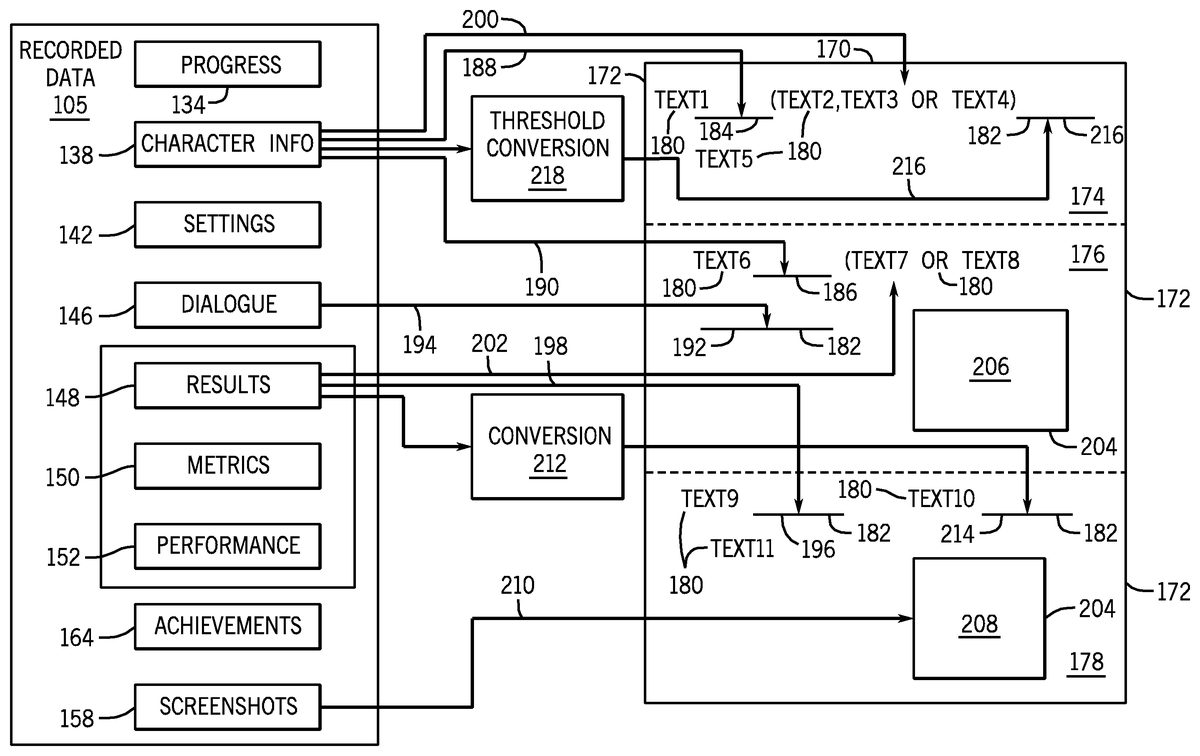
FIG. 6is a block diagram illustrating conversion of the recorded data105into a narrative data structure170. The narrative data structure170may include different sections172, (e.g., beginning174, middle176, end178, chapters, etc.). Each section172may include pregenerated text180(represented as “TEXT1,” “TEXT2,” “TEXT3,” etc.). The pregenerated text180may be natural-language text relating to the videogame130, such as describing the gameplay and/or story of the videogame130. For example, in the first section172, TEXT1may include an introduction to a narrative describing the videogame130. Similarly, in section178, TEXT11may include a conclusion to a narrative describing the videogame130. In some embodiments, the pregenerated text180may be specific to the gameplay and/or narrative of the videogame130. In other embodiments, the pregenerated text may be include or may be generic text (e.g., one or more sections172of the narrative data structure170may form a generic beginning, middle, and end useable with any recorded data105).
The recorded data105may be inserted into the narrative data structure170to complete generation of the narrative data structure170. Portions of the recorded data105may be inserted before, after, or between the pregenerated text180. In one embodiment, placeholders182or any other indicators may be used to indicate those portions of the narrative data structure170that receive portions of the recorded data105. In other embodiments, portions of the recorded data105may be inserted by reference to the pregenerated text180. For example, in the first section172of the narrative data structure170, the recorded character information138from the recorded data105may be inserted into a placeholder184, and in the second section174, the recorded character information138may be inserted into placeholder186, as shown by arrows188and190respectively. Similarly, recorded dialogue146may be inserted into a placeholder192as shown by arrow194, recorded results148, may be inserted into a placeholder196as shown by arrow198, etc. In other embodiments, the pregenerated text180may also be inserted into placeholders182. For example, a narrative data structure170may be generated by inserting both pregenerated text180and recorded data105into the narrative data structure170.
Alternatively, in some embodiments the recorded data105may be used as the basis for selecting among pregenerated text180. For example, as shown inFIG. 6, the selection between TEXT2, TEXT3, or TEXT4, may be based on the recorded character information138, as shown by arrow200. Thus, depending on the text, value, or other data of the character information138, either TEXT2, TEXT3, or TEXT4may be selected and added to the narrative data structure170. In another example, the selection between TEXT7or TEXT8may be based on recorded results148, as shown by arrow202. For example, if a recorded result148indicates “success” or “failure”, TEXT7may include text corresponding to “success” and TEXT8may include text corresponding to “failure.” In this manner, pregenerated text may be selected based on the recorded data105, creating portions of the narrative data structure that are customized based on the user's videogame experience. Any number of pregenerated text may be available and selected based on the prerecorded text105.
In some embodiments, the narrative data structure170may include illustrations204. Similar to the pregenerated text180, the illustrations204may include a pregenerated illustration206. For example, as discussed above, the pregenerated illustration206may be related to the videogame130, such as illustrating the gameplay and/or story of the videogame130. In other embodiments, the illustration204may be a generic illustration. The illustrations204may also include a screen shot generated from the recorded screenshots158. The narrative data structure170may include an illustration placeholder208, and a screenshot from the recorded data105may be inserted into the narrative data structure170at the placeholder208, as indicated by arrow210.
In some embodiments, the recorded data105may be inserted directly into the narrative data structure170. In such an embodiment, numbers, text, and images may be read from the recorded data105and placed into the placeholders182without additional processing. In other embodiments, the recorded data105may be formatted, converted, or undergo any other processing or combination thereof before or during insertion into the narrative data structure170. In one embodiment, the recorded data105may be converted into natural-language text before insertion into the placeholders182of the narrative data structure170. As shown inFIG. 6, for example, some recorded results148may undergo natural-language conversion (block212) before insertion into a placeholder214. It should be appreciated that numerical data may also be converted into natural-language text. For example, as shown by arrow216, a numerical health value of the recorded character information138may be compared to a threshold (block218) and natural-language text may be substituted for the numerical health value (e.g., a health value below a threshold may be “dying” and a health value above a threshold may be “healthy”).
Any other recorded data105may be similarly processed before insertion into the narrative data structure170. Conversion of the recorded data105into natural-language text may improve integration with the pregenerated text180and readability of the narrative data structure170. In some embodiments, recorded data105may be inserted into the narrative data structure170both directly and with some natural-language text conversion or other processing.
In some embodiments, the recorded progress132of the recorded data105may be used to aid insertion of other recorded data105into the narrative data structure170. For example, the electronic device12may read the recorded progress132and corresponding recorded character information138, recorded dialogue146, recorded results148, recorded metrics150, and any other recorded performance152cross-referenced with the progress132to determine the point or time of the videogame130at which the data was recorded. This information may be used, either alone or in combination with the placeholders182, to determine the insertion of the recorded data105into the narrative data structure170. For example, recorded progress132indicating character information138correlating to the beginning of the user's play of the videogame130(and/or the story of the videogame130) may be used to control insertion of such character information into the first section172(e.g., beginning) of the narrative data structure170. Similarly, recorded progress132indicating character information138correlating to the end of the user's play of the videogame130(and/or the story of the videogame130) may be used to control insertion of such character information into the third section176(e.g., end) of the narrative data structure170.
In some embodiments, generation of the narrative data structure170may be performed on the electronic device12, and an e-book, book, or comic book may be generated on the electronic device12. In such an embodiment, the generation of the narrative data structure170and a book, e-book, or comic book may be referred to as being provided at the “system-level.”FIG. 7depicts a process300for generating a narrative data structure from the recorded data105of the videogame130in accordance with an embodiment of the present disclosure. The process300may be implemented in hardware, software (such as instructions encoded on a computer-readable storage media) or a combination thereof. As described above, a user plays a videogame (block302), during which data is recorded (block304), such as the recorded character information138, recorded dialogue146, recorded results148, recorded metrics150and any other recorded performance152, recorded progress132, and/or recorded screenshots158discussed above. The recorded data105may be stored on the storage50of the electronic device12.
During the videogame130, or after completion of the videogame130, the user may initiate a request for a book, e-book, comic book, etc. (block306). In some embodiments, the user may initiate this request from within the videogame130. In other embodiments, the user may initiate this request from the operating system of the electronic device12or any other software. Alternatively, the electronic device12may automatically initiate the request for a book, e-book, comic book, etc. (block308), such as after completion of the videogame130or after a specific amount of progress by the user. The electronic device12may then generate the narrative data structure170from the recorded data105(block310), using the pregenerated text and placing portions of the recorded data105into sections of the narrative data structure170as described above inFIG. 6. The pregenerated text180may be stored on the electronic device12and may be installed as a part of the videogame130. Alternatively, the electronic device12may download the pregenerated text180from a server on the network22after initiation of the request.
After generation of the narrative data structure170, the electronic device12may perform one or more actions. In some embodiments, these actions may be selected and/or specified by the user, such that the action only occurs if the user has enabled that particular action after generation of the narrative data structure170. The electronic device12may send an electronic copy of the book (e.g., an e-book) to the user (block312), such as via email or other electronic communication. The electronic device12may have the capability to send email directly, or it may send the e-book to a server with email capability. Additionally, the electronic device12may send the e-book to the user's contacts (block314), such as via email or other electronic communication. For example, a user may maintain a “network” of other users who interact with the user via their own electronic devices. These users are often referred to as “friends,” “buddies,” etc., and may be maintained through the electronic device12. The electronic device12may automatically retrieve a list of the user's “friends” and send the e-book to these contacts. Additionally, the narrative data structure170may be saved to the electronic device12as an e-book (block316), such as by writing the e-book to the storage50.
In some embodiments, a book, comic book, or any other publication may be created from the generated narrative data structure170. In such an embodiment, data, such as generated narrative data structure, may be sent to a server (block318), such as over the network22. The electronic device12may also send other information about the user to the server, such as the user's identify, billing information, shipping information, etc. The server may have the capability to print the book (block320) or cause the book to be printed from a printing location. After printing, the book may be mailed to the user (block322) and/or the user's friends (block324).
In other embodiments, the generation of the narrative data structure170from recorded data may not be performed on the electronic device12. Instead, the electronic device12may send the recorded data105to a remote location for processing. In such an embodiment, the generation of the narrative data structure and book, e-book, or comic book may be referred to as being provided at the “service-level.” The service may be offered to a user of an electronic device12as a free service, a pay-as-you-go service, or as a subscription service.
FIG. 8depicts a process400for generating the narrative data structure170from the recorded data105at a remote location in accordance with an embodiment of the present disclosure. The process400may be implemented in hardware, software (such as instructions encoded on a computer-readable storage media) or a combination thereof. As described above, a user plays a videogame (block402), during which data is recorded (block404), such as the recorded character information138, recorded dialogue146, recorded results148, recorded metrics150any other recorded performance152, recorded progress132, and/or recorded screenshots158discussed above. The recorded data105may be stored on the storage50of the electronic device12.
During the game, or after completion of the videogame130, the user may initiate a request for a book, e-book, comic book, etc. from the service (block406). For example, in some embodiments, a user may initiate this request from within the videogame130. In some embodiments, the user may externally initiate the request from a web page (block408) or an application (block410). The user may request the book from same electronic device12on which the user played the videogame130or on a different electronic device.
Alternatively, the electronic device12may automatically request a book, e-book, comic book, etc. from the service (block412), such as after completion of the videogame or a specific amount of progress by the user. After the request, the electronic device12may send the recorded data105to a server (block414), such as over the network22to the server30. The server30receives the recorded data105and generates the narrative data structure170from the recorded data (block416). As described above inFIG. 6, the server30may insert portions of the recorded data105into the narrative data structure170and may convert portions of the recorded data105into natural-language text during or before insertion into the narrative data structure170. After generation of the narrative data structure170from the recorded data105, the server30may perform one or more actions with the generated narrative data structure170. In some embodiments, the server30may send an electronic copy of the book (e.g., an e-book) back to the electronic device12that sent the recorded data105(block418). After receiving the e-book, the electronic device12may then send the book to a user, save the book, etc. In other embodiments, the server30may also send an e-book to the user (block420), such as via email, instant messaging, text messaging, or other electronic communication. In yet other embodiments, the server30may also print, or initiate printing, a book or other printed publication (block422). After printing, the book may be mailed to the user (block424) and/or the user's contacts (block426).
In one embodiment, the videogame may be Mass Effect® published by Electronic Arts, Inc. The videogame Mass Effect® is an RPG that includes many dialogue choices, conflicts, and other gameplay sequences that may be recorded and used in the generation of a book, e-book, or comic book in accordance with an embodiment of the present disclosure.
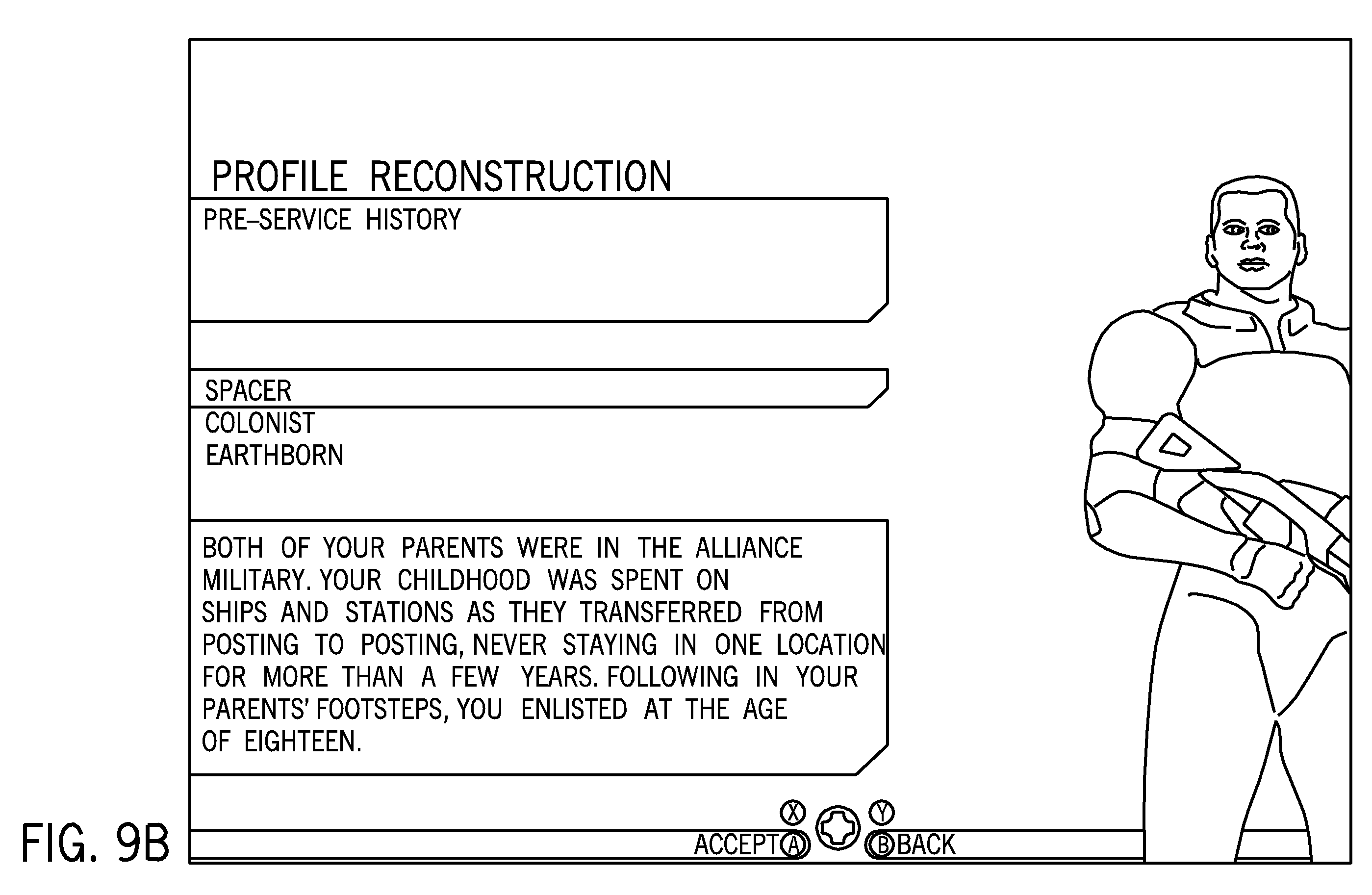
FIGS. 9A-9Gdepict screenshots of a Mass Effect® gameplay session, illustrating the data that may be recorded and inserted into the narrative data structure170for generation into a book, e-book, or comic book.FIG. 9Ais a first screenshot of Mass Effect® depicting the attributes of a user's player character. As shown inFIG. 9A, the attributes (shown as part of the character's profile) may include the Name, Origin, Reputation, and Class of the player character. Each of these attributes may be selected by a user. For example, as shown inFIG. 9B, a user may select an Origin (“Pre-Service History”) of “Spacer,” “Colonist,” or “Earthborn.” As shown inFIG. 9C, a user may select a Reputation (“Psychological Profile) as “Sole Survivor,” “War Hero,” or “Ruthless.” Similarly, as shown inFIG. 9D, a user may select from a Class (“Military Specialization”) as “Soldier,” “Engineer,” “Adept,” etc. Finally, as shown inFIG. 9E, a user may customize the appearance of the player character.
Each of these exemplary attributes (Name, Origin, Reputation, Class, and appearance of the character) may be written to the recorded data105and used in the generation of the narrative data structure170. For example, the player character's name may be inserted into the narrative data structure170during the introduction of the character in the narrative data structure170. In another example, a character's Origin may affect the selection from among multiple pregenerated text180. Each pregenerated text may convey a different background based on character's Origin as “Spacer,” “Colonist,” or “Earthborn.” It should be appreciated that in this embodiment, the videogame Mass Effect may also include pregenerated text for each Origin that may be used as (or may be the basis of) some of the pregenerated text180of the narrative data structure170.
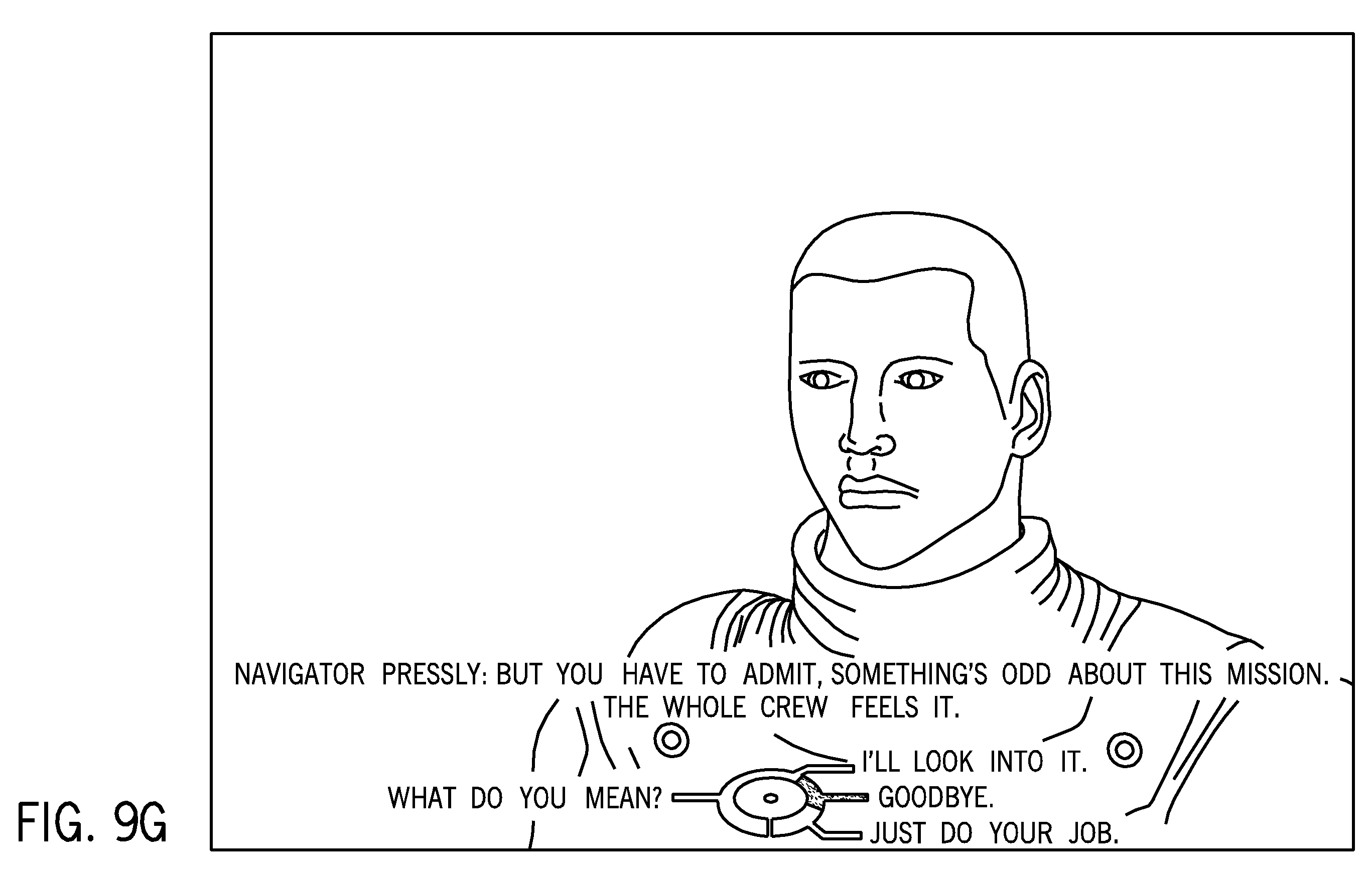
FIGS. 9F and 9Gdepict choices presented to a user playing Mass Effect that enable the selection of dialogue that may be written to the recorded data105in accordance with an embodiment of the present disclosure. As shown inFIG. 9F, a non-player character (“Navigator Pressly”) asks the user a question (“You heading down to see the captain?”). The user is provided with the dialogue responses: “I heard you arguing”; or “He wants to see me.” To respond to the non-player character, the user selects one of these dialogue responses. The selection of one of these dialogue responses may be written to the recorded data105so that the dialogue may be inserted into the narrative data structure. Additionally, in games such as Mass Effect, the selection of a dialogue response may make available additional or different dialogue responses. Thus, the entire conversation between the user's player character and the non-player character may be written to the recorded data105and may vary during each gameplay session.
FIG. 9Gillustrates a more complex choice presented to a user playing Mass Effect, allowing the selection of one or multiple dialogue responses. As shown inFIG. 9F, a non-player character (“Navigator Pressly”) is conversing with a user. The user is provided with multiple dialogue responses: “What do you mean?”; “I'll look into it.”; “Goodbye”; and “Just do your job.” Again, the selection of one (or more) of these dialogue responses may be written to the recorded data015. During generation of the narrative data structure170, any one of these dialogue responses may be inserted, and combined with pregenerated text170, to create the narrative data structure170. For example, a dialogue response may be combined with the pregenerated text as follows: “ angrily responded ” wherein the and may be inserted from the recorded character information138and recorded dialogue146of the recorded data105. In this manner, an entire conversation based on the user's choices of the dialogue responses and pregenerated text may be generated into the narrative data structure170.
Claims
- A method, comprising: recording data from a user's experience of playing a video game on an electronic device;and generating a narrative data structure, further comprising: using the recorded data as a basis to automatically select narrative text that is separate from and narrative of the recorded data;and inserting one or more portions of the recorded data into the narrative data structure;and inserting one or more portions of the narrative text into the narrative data structure.
- The method of claim 1 , comprising generating a book, an e-book, or a combination thereof from the narrative data structure.
- The method of claim 1 , wherein the recorded data comprises dialogue from the videogame.
- The method of claim 1 , wherein the recorded data comprises results of a user's interaction with the video game.
- The method of claim 1 , wherein the recorded data comprises information of one or more characters of the video game.
- The method of claim 1 , wherein the recorded data comprises screenshots of the video game.
- The method of claim 1 , wherein inserting one or more portions of the recorded data comprises converting one or more portions of the recorded data into natural-language text.
- The method of claim 1 , wherein the narrative data structure comprises a plurality of placeholders, wherein one more portions of the recorded data are inserted into one or more of the plurality of placeholders.
- A method, comprising: receiving data at a server from an electronic device over a network coupled to the electronic device, wherein the data comprises data recorded from a user's play of a video game;converting the recorded data to natural-language text;generating a narrative data structure by using the natural-language text to automatically select narrative text that is separate from and narrative of the recorded data;and inserting one or more portions of the natural-language text into the narrative data structure;and inserting one or more portions of the narrative text into the narrative data structure.
- The method of claim 9 , comprising printing a book from the narrative data structure.
- The method of claim 9 , comprising generating an e-book from the narrative data structure on the server.
- The method of claim 9 , comprising sending an e-book based on the narrative data structure to the electronic device over the network.
- The method of claim 9 , comprising sending the book to a user of the electronic device.
- A system, comprising: an electronic device configured to: record dialogue, character information, a user's performance, screenshots, or a combination thereof, from the user's play of a videogame;automatically select narrative text that is separate from and narrative of the recorded dialogue, character information, a user's performance, screenshots, or combinations thereof;and combine the recorded dialogue, character information, a user's performance, screenshots, or combinations thereof with the narrative text into a narrative data structure.
- The system of claim 14 , wherein the electronic device comprises a mobile phone, a videogame console, or a personal computer.
- The system of claim 14 , wherein the electronic device is configured to generate an e-book based on the narrative data structure.
- The system of claim 14 , wherein the electronic device is further configured to send the narrative data structure to a server over a network coupled to the electronic device.
- The system of claim 14 , comprising a server configured to print a book based on the narrative data structure.
- The system of claim 14 , comprising an e-book, book, or comic book generated from the narrative data structure.
- The system of claim 16 , wherein the electronic device is further configured to send the book to a user.
- A method, comprising: recording dialogue, character information, screenshots, and a user's performance from a videogame, wherein the dialogue, character information, screenshots, and user's performance are based on a user's interaction with the video game;automatically selecting narrative text that is separate from and narrative of the recorded dialogue, character information, a user's performance, screenshots, or combinations thereof;combining the recorded dialogue, character information, a user's performance, screenshots, or combinations thereof with the narrative text into a narrative data structure generating an e-book from the narrative data structure.
- The method of claim 21 , comprising: sending the recorded character information, screenshots, and the user's performance over a network to a server at a remote location.
- The method of claim 21 , further comprising converting the recorded dialogue, character information, and the user's performance to natural language text.
- A method, comprising: recording data pertaining to a user's interactions with a videogame, wherein the data comprises character dialogue, character information, screenshots, and user's performance;converting at least a portion of the recorded data to natural-language text;generating a narrative data structure, further comprising: using the recorded data, the natural language text as a basis to automatically select a narrative illustration that is separate from and narrative of the recorded data;and inserting the narrative illustration into the narrative data structure;and generating a book, a comic book, or an e-book from the narrative data structure.
- The method of claim 24 , comprising: sending the recorded data over a network to a server at a remote location.
Disclaimer: Data collected from the USPTO and may be malformed, incomplete, and/or otherwise inaccurate.