U.S. Pat. No. 8,414,395
STRUM PROCESSING FOR MUSIC VIDEO GAME ON HANDHELD DEVICE
AssigneeActivision Publishing, Inc.
Issue DateJune 11, 2008
Illustrative Figure
Abstract
A handheld video game system provides a music video game including a guitar simulation. Operation of the handheld video game system is designed to simulate, to a certain extent, the playing of a real guitar. The handheld video game system typically includes a touch sensitive screen, whereby certain actuation and stroke motions made along the surface of the touch sensitive screen are processed by the handheld video game system as simulated guitar strums. Sets of criteria are implemented by the handheld video game system to determine whether a particular stroke motion is processed and registered as a valid strum.
Description
DETAILED DESCRIPTION FIG. 1illustrates a handheld video game system in accordance with aspects of the invention. The handheld video game system includes a handheld gaming device101, and a peripheral device123attached to the handheld gaming device. The handheld gaming device is a standalone device, which generally is capable of being operated without being connected to other devices. InFIG. 1, the handheld gaming device incorporates a clamshell design, and includes a first portion103, a second portion105, and a hinge107which provides for closure of the handheld gaming device and protection of the device's components when the device is not in use. InFIG. 1, the first portion of the handheld gaming device includes a first display screen109and a pair of audio output devices113, which may be, for example, a pair of speakers. The second portion of the handheld gaming device includes a second display screen111, and a variety of input devices, including a plurality of input buttons115and a multi-directional control pad117. In some embodiments, either the first display screen or the second display screen, or both, may include touch screen capabilities or similar touch sensitive properties, and detects contact made about or against the screen, either from a finger of a user or a stylus or similar actuator. Some embodiments may include a single screen in lieu of the dual screen configuration presented inFIG. 1. The handheld gaming device ofFIG. 1also includes internal circuitry associated with processing video game instructions. The handheld gaming console generally includes at least one processor, memory, and various different types of interface circuitry. The interface circuitry may include a removable memory interface119for interfacing with removable memory sources, such as video game cartridges storing program instructions for specific video games, and a peripheral interface121for, for example, interfacing with different add-on accessories designed for use with specific video games. InFIG. 1, ...
DETAILED DESCRIPTION
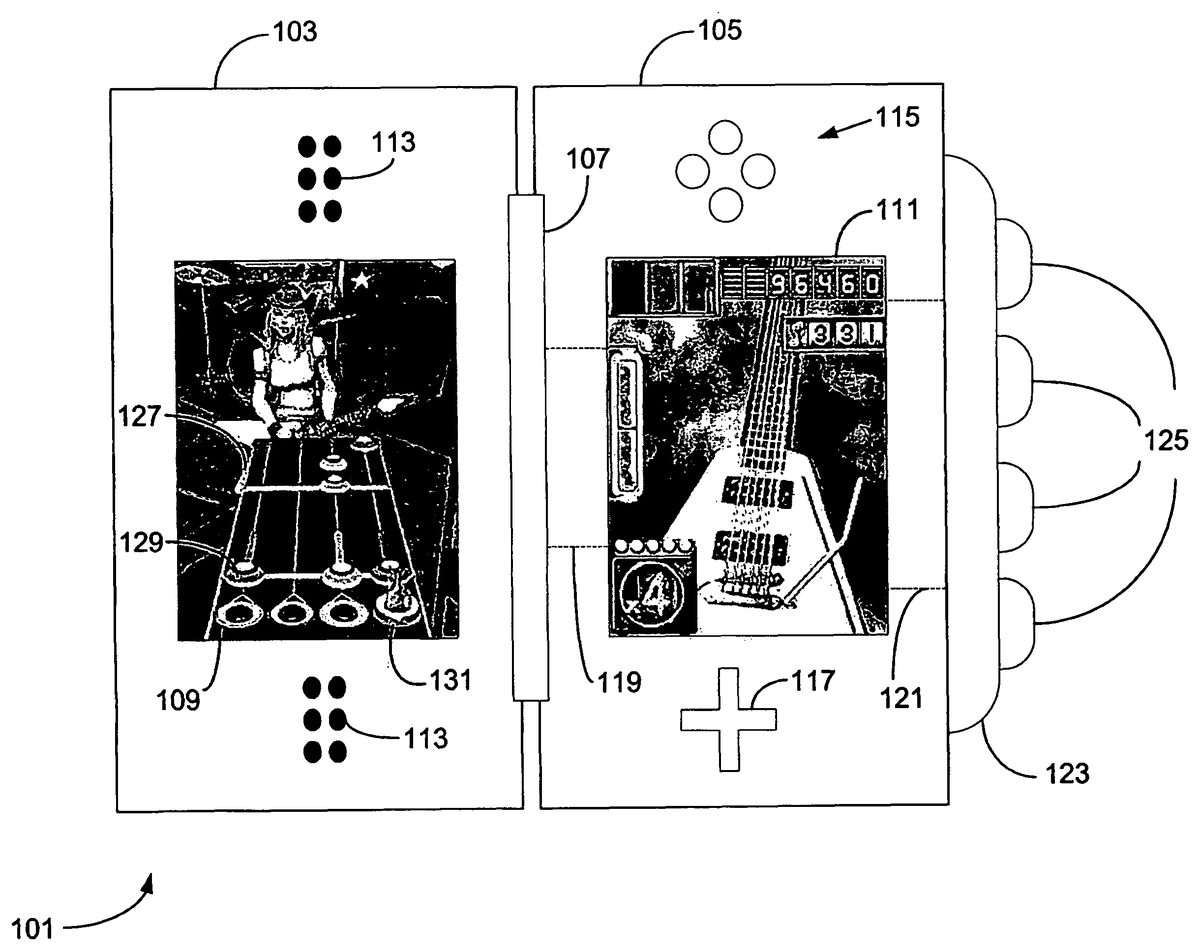
FIG. 1illustrates a handheld video game system in accordance with aspects of the invention. The handheld video game system includes a handheld gaming device101, and a peripheral device123attached to the handheld gaming device.
The handheld gaming device is a standalone device, which generally is capable of being operated without being connected to other devices. InFIG. 1, the handheld gaming device incorporates a clamshell design, and includes a first portion103, a second portion105, and a hinge107which provides for closure of the handheld gaming device and protection of the device's components when the device is not in use.
InFIG. 1, the first portion of the handheld gaming device includes a first display screen109and a pair of audio output devices113, which may be, for example, a pair of speakers. The second portion of the handheld gaming device includes a second display screen111, and a variety of input devices, including a plurality of input buttons115and a multi-directional control pad117. In some embodiments, either the first display screen or the second display screen, or both, may include touch screen capabilities or similar touch sensitive properties, and detects contact made about or against the screen, either from a finger of a user or a stylus or similar actuator. Some embodiments may include a single screen in lieu of the dual screen configuration presented inFIG. 1.
The handheld gaming device ofFIG. 1also includes internal circuitry associated with processing video game instructions. The handheld gaming console generally includes at least one processor, memory, and various different types of interface circuitry. The interface circuitry may include a removable memory interface119for interfacing with removable memory sources, such as video game cartridges storing program instructions for specific video games, and a peripheral interface121for, for example, interfacing with different add-on accessories designed for use with specific video games.
InFIG. 1, a peripheral device123has been inserted into the peripheral interface of the handheld gaming device, and includes a plurality of fret inputs125. As can be seen through the screen shots provided on the two displays, a music video game involving a guitar simulation is being processed by the handheld gaming device. The guitar simulation may be part of a music video game, for example, a rhythm based music game, and a removable memory device, such as a game cartridge which may store program instructions for the video game, may be inserted into the removable memory interface. In some embodiments involving a music video game, operation of the handheld gaming device may simulate the playing of, for example, a guitar. In these embodiments, a user of the handheld gaming device may hold the device so that the fingers of one hand rest over the fret inputs, where different combinations of the fret inputs may simulate guitar note and chord fingerings. A second free hand of the user may be used as a strumming hand, to simulate the strumming of a guitar, or other guitar techniques, for example, finger tapping or individual notes in a multi-note chord.
The screen shot on the first display shows a music track127including a plurality of gem-shaped instructive cues, for example, gem129. The instructive cues provide users with instructions as to how to operate the fret buttons on the peripheral device. As can be seen in the screen shot inFIG. 1, there are four columns on the music track and four fret inputs on the peripheral device. Therefore, in the embodiment ofFIG. 1, each column may correspond to one of the fret inputs, whereby an instructive cue located in one of the columns instructs a user to depress the corresponding fret input. The instructive cues may scroll, for example, from a top of the music track to a bottom of the music track. The screen shot further includes a timing bar131located at the bottom of the track. As each set of instructive cues scrolls past the timing bar, users are instructed to perform a strum while executing the fret combination indicated by the set of instructive cues crossing the timing bar.
The screen shot on the second display includes a visual display of a portion of a guitar133, including a guitar body, a guitar neck, and a series of guitar strings. The screen shot also includes a plurality of user game play information, such as power meters and user scores. In most embodiments of the invention, the second display is a touch screen display, which may detect contact made to the surface of the display. In some embodiments, a strum may be performed by the user by performing a stroke, that is touching and moving a stylus or similar actuator, back and forth along and/or across a portion or portions of the surface of the touch screen display. The guitar displayed on the touch screen display may encourage users to run the actuator substantially perpendicular to the direction of the guitar strings, although in many embodiments, a strum stroke may be performed in any direction and on any portion along the touch screen display.
In some embodiments, a processor of the device, configured, for example, by program instructions in memory, determines occurrence of a strum stroke if contact is made over a predefined distance of the touch screen display after a first contact, In some embodiments, occurrence of a strum stroke is determined if contact is made over a second predefined distance of the touch screen display following a first predefined distance, if an angle formed between a vector representative of the first distance and a vector representative of the second distance is within a predefined window of angles.
In operation, a user may operate the fret inputs and perform strums in compliance with instructive cues displayed on the music track. The executed fret combinations and strum strokes generate input signals, which are received by the processor of the handheld gaming device, and processed to determine a level of compliance with the presented instructive cues. User scores and other game play status indicators may be updated based on the level of compliance. In most embodiments, the operation of the handheld gaming device in such a music video game simulates the play of a guitar. Video animations and audio outputs, such as guitar-based audio samples, are generated based on user operation of the handheld gaming device.
FIG. 2is an example of a block diagram of a processing unit of the handheld gaming device in accordance with aspects of the invention. In the embodiment ofFIG. 2, the processing unit includes at least one processor connected to various other internal components via a system bus203. The other components may include, for example, a main memory205, a removable memory interface207, a peripheral interface209, an audio driver,211, a video driver213for a first display223, a video driver215for a second display225which may be a touch display, a user input/output interface217, and a wireless communication interface219. In other embodiments of the invention, the processing unit may include various different combinations of components depending on the particular application of each embodiment.
In operation, the processor of the handheld gaming device executes video game instructions to facilitate game play for a particular video game. The processor utilizes the different components of the processing unit as needed to facilitate video game play. In many embodiments, video game instructions for a specific video game are stored on a removable memory source, such as a video game cartridge, inserted into the removable memory interface. The processor may retrieve the video game information via the removable memory interface, and may process the video game instructions in accordance with general program instructions located in the main memory of the handheld gaming device. In addition, the processor may receive user generated input signals from various sources, for example, the user input/output interface, which may include input signals generated by input buttons or a touch display as was seen with respect toFIG. 1, or for example, a peripheral device communicating with the processor through the peripheral interface. The processor processes the various instructions and user input signals to generate audio and video data associated with proper execution of the video game.
The processor sends generated audio and video data, respectively, to audio and video drivers available in the processing unit of the handheld gaming device. Audio data may be directed to the audio driver, which processes the data into audio output signals, which it may then send to audio output devices, such as speakers221. Video data may be directed to one or more video drivers, depending on how many display screens are available on the handheld gaming device. For the handheld gaming device ofFIG. 1, there are two displays, and therefore two corresponding video drivers. Video data associated with the first display223are directed to display video driver213, which processes the data into video outputs displayable on the first display. Likewise, video data associated with the second display225, which in embodiments of the invention may be a touch display, are directed to display video driver215, which processes the data into video outputs displayable on the second display.
Furthermore, a wireless communication interface may be available to, for example, connect separate handheld gaming devices either in close proximity, or in remote locations through the Internet. The wireless communication interface may be utilized to facilitate multiplayer game play between users of different handheld gaming devices, whereby game play information may be communicated between two or more devices in a collaborative or competitive manner to further enhance enjoyment of particular video games.
FIG. 3is an example of a video game system executing a guitar-based music video game in accordance with aspects of the invention. The video game system includes a handheld gaming device301, an optional peripheral device305attached to the handheld gaming device, and, optionally, for ease of use, a separate stylus309for actuating a touch screen of the handheld gaming device. In the embodiment ofFIG. 3, the peripheral device includes a plurality of fret inputs designed to simulate chord fingerings on strings of a guitar. InFIG. 3, the stylus is designed to simulate a guitar pick, and a tip of the stylus is preferably designed so that it may repeatedly make contact with a touch screen of the handheld gaming device without causing damage to the handheld gaming device. Alternatively, a more conventional stylus, or even a finger of a user, may be used as an actuation device against the touch screen.
The handheld gaming device ofFIG. 3includes two screen shots of video game play of a guitar-based music video game. A first screen shot includes a music track303with instructive cues including information on how to operate the fret inputs on the peripheral device and timing of strums performed using the guitar pick stylus. A second screen shot is displayed on a touch screen and includes a portion of a guitar with strings307. In game play, users may observe the first screen for instructions on how to operate the fret inputs and the guitar pick stylus, while performing different fret combinations on the peripheral device and running the guitar pick stylus across the guitar strings displayed on the second screen, or alternatively, any area on the second screen including touch sensitive properties.
FIGS. 4a-4dare touch screen displays including examples of different stroke motions on touch screen displays in accordance with aspects of the invention. The stroke motions may be visualized as vectors. In some embodiments, the touch screen displays ofFIGS. 4a-4drepresent the touch screens as have been discussed with respect toFIG. 1andFIG. 3. In these embodiments, the stroke motion vectors presented inFIGS. 4b-4dmay be attempted strums performed on the touch screen.
FIG. 4ais a touch screen display401displaying an array of equidistant sensor points or markers, for example, sensor points403. Sensor points may be arbitrary markers defined by game programmers to track actuation along the touch screen display, and may be positioned in a variety of ways depending on the application. For example, in a music video game, sensor points may be spaced four pixels apart on the touch screen display. In some embodiments of the invention, a stroke motion across the touch screen display may only be recognized as a strum if certain stroke prerequisites involving the sensor points are met. A stroke may be defined as a touching of an actuator along the surface of the touch screen display, and a subsequent motion in one or more directions along the surface of the touch screen display. The prerequisites may include, for example, a minimum number of sensor points actuated along a path of the stroke motion, or for example, a minimum angle change along the path based on the sensor points actuated along the path. For example, a path generated by a stroke may only be processed as a strum if two or more sensor points are touched along the path of the stroke. Such a prerequisite may exclude taps on the touch screen display, whether they be intentional or involuntary, from being processed as strums. The described prerequisites and other similar preconditions may be set and adjusted at the design level by programmers of the video game, and in some embodiments may be further adjusted by users of the video game. For example, some embodiments of the invention may provide for a strum calibration option, whereby examples of a user's typical or normal strumming motion across the touch screen display is saved by the processor of the handheld gaming device for use in determining if a strum has occurred. Such a calibration option may provide for more accurate strum detection and more personalized and enjoyable video game play.
FIG. 4bis the touch screen display401including examples of stroke motion vectors in a first direction405,407, and409. As described with respect toFIG. 4a, a stroke motion in a first direction405may be processed by the processor of the handheld gaming device as a strum in the context of the music video game if certain prerequisites involving the sensor points are met. After a successful strum has been performed, users may elect to lift the actuator from the touch screen display, ceasing contact between the actuator and the surface of the touch screen display, and reinitiate contact with the touch screen display to perform a subsequent strum407similar in motion to the first stroke motion. In this manner, a further stroke motion409and still further stroke motions may be executed to perform strums in the context of video game play.
FIG. 4cis the touch screen display401including an example of a stroke motion in a first direction405and a stroke motion in a second direction411. In some instances, a user may prefer to perform strums in two directions, simulating upwards and downwards strums on a real guitar. Stroke motions in a second direction may have a separate set of prerequisites or preconditions in order to be processed as successful strums. Separate prerequisites may be set to exclude, for example, slight or minor involuntary movements in a second direction from being processed as a strum after a strum in a first direction has been properly executed. The prerequisites may include a higher sensor point actuation requirement, for example, four or five sensor points along the path of the second stroke motion, or a minimum direction change requirement, for example, at least a 145 degree, or at most a 215 degree, direction change from the direction of the first stroke motion. In most embodiments, users may elect to continue contact with the touch screen and perform additional stroke motions. In many of these embodiments, the additional stroke motions may be processed as strums if prerequisites similar to the prerequisites for the stroke motions in the second direction are satisfied. That is, there may be a first set of prerequisites for successfully performing a strum in a first direction, and a second set of prerequisites for successfully performing a strum in a second direction and for further directions thereafter.
FIG. 4dis the touch screen display401including two examples of stroke motion vectors in a second direction413and415which may not be processed as strums. Each of the stroke motions in a second direction is performed after a successful strum in a first direction405. One of the second stroke motions413comes at the tail end of a successful strum, wherein the direction of the second stroke motion deviates less than 90 degrees from the successful strum. Using the prerequisites defined with respect to the discussion inFIG. 4c, such a stroke motion may not be processed by the processor of the handheld gaming device as a strum, since it may not meet a minimum direction change prerequisite. Another of the second stroke motions415also comes at the tail end of a successful strum, wherein the second stroke motion is very short in length. Again, based on the prerequisites defined with respect toFIG. 4c, such a stroke motion may not be processed by the handheld gaming device as a strum, since it may not meet a heightened minimum sensor point actuation prerequisite for stroke motions in a second direction.
In occurrences where a first stroke motion may not have been processed as a strum, a stroke motion following the first stroke motion may nevertheless be processed as a successful strum. In some embodiments, the second stroke motion may be processed as a further stroke motion, and may be processed as a strum only if a heightened set of prerequisites of further stroke motions is met or satisfied. In other embodiments, the second stroke motion following an unsuccessful strum may be processed using the set of prerequisites for a first strum, thereby lowering the strum requirements for a second stroke motion for these limited cases.
FIG. 5is a flow diagram of the process of determining strums over the course of one instance of contact with a touch screen display in accordance with aspects of the invention. In some embodiments, the process ofFIG. 5may be performed using the touch screen displays described with respect to the handheld gaming devices inFIG. 1andFIG. 3, and may be indicative of the process involved in determining whether successful strums were executed with respect to the various stroke motions described with respect toFIGS. 4b-4d. In most embodiments, the process is performed using a processor of a handheld gaming device, with the processor configured by program instructions stored in memory.
In block511, the process detects contact with the touch screen display. In most embodiments, contact is detected when a finger, a stylus, or another comparable actuator is depressed against the surface of the touch screen display. In the context of a guitar-based music video game as has been described herein, the contact may be made against the surface of the second display screen, which may include a screen shot of a guitar with guitar strings.
In block513, the process determines whether a stroke motion, if any, made after an initial detected contact meets the criteria for a successful strum. After contact has been made to the touch screen display, a user may simply cease the contact without moving the contact point, or may continue the contact with the touch screen display and move the contact point in any direction along the surface of the touch screen display. Movements along the surface of the touch screen display may be considered strokes or stroke motions. To be processed as a strum, a stroke motion may be required to meet certain criteria or prerequisites, for example, a minimum stroke motion length, or for example, movement in one direction without excess deviation from the one direction. Such criteria may be based on programming by video game designers, and may in some embodiments be adjustable by users to suit each individual user's preferences. In various other embodiments involving other video games, the criteria may be different based on the application of each individual video game. If the criteria for executing a successful strum are met, the process proceeds to block515. If the criteria for executing a successful strum are not met, the process instead proceeds to block519.
In block515, the process processes a successful strum. In the context of the guitar-based music video game as has been described, a successful strum may include information on, for example, the time of the successfully executed strum, as well as information on a fret combination being executed on a peripheral device at the time of the successfully executed strum. The information may be compared against, for example, instructive cues presented to users, to determine a compliance level of user operation of the handheld gaming device to the instructive cues. The information may also be processed based on video game instructions to generate audio and video outputs characterizing game play of the music video game. In some embodiments, an indicator, for example, a visual strum detection indicator or auditory feedback, may be activated when a strum is performed, to indicate to a user that a strum has been performed successfully.
In block517, the process determines whether a further strum has been executed after a successful strum. In most embodiments of the invention, a further strum is defined as a strum executed after a preceding strum or stroke motion, without ending contact with the touch screen display. In other words, a further strum is a strum executed at the tail end of a first stroke motion, in a different direction than the first stroke motion. In some embodiments, the criteria for determining execution of a successful further strum may be different, often more extensive, than the criteria for determining execution of a successful first strum. A more detailed discussion of the different criteria which may be employed for determining successful execution of a further strum may be found with respect toFIG. 6below. If a further strum is successfully executed, the process returns to block515to process a successful strum. If instead a further strum is not successfully executed, the process proceeds to block519.
In block519, the process determines whether contact between the actuator and the touch screen display has ended. Generally, contact ends when a user lifts the actuator from the surface of the touch screen display, so that there is no longer a contact point between the actuator and the surface of the touch screen display. If the process determines that there is still contact between an actuator and the touch screen display, the process returns to block517to determine if a further strum is being executed. If instead the process determines that the user has lifted the actuator from the surface of the touch screen display and ended contact, the process returns.
FIG. 6is a flow diagram of a process of determining whether a further strum has been successfully executed in accordance with aspects of the invention. In most embodiments, a further strum may be executed in a second direction along a surface of a touch screen display after an initial stroke motion has been previously performed in a first direction on the touch screen display. In some embodiments, the process ofFIG. 6may be performed in block517of the process ofFIG. 5. Criteria for successfully executing a further strum may be different than the criteria for successfully executing an initial strum, and in many instances are more difficult to meet than initial strum criteria. The more stringent criteria may be implemented to prevent residual motion after an initial strum from being processed as an unwanted further strum. For example, after an initial strum, a user may unintentionally continue contact with the touch screen display and move an actuator in a second direction a short distance. Excluding such residual motion from being processed as further strums may be desirable for more accurate game processing and a more enjoyable game play experience.
In block611, the process receives a stroke motion in a first direction. In some embodiments, the stroke motion may be required to be a successful strum. In other embodiments, the stroke motion may simply be a motion in an initial direction different than the direction of a subsequent further movement, whether the motion in the initial direction resulted in a successful strum or not.
In block613, the process determines whether a further movement is detected. A further movement may be defined in the context of the invention as a movement in a direction different than the direction of an initial stroke motion as was described with respect to block611. Generally, a further movement may be considered a stroke motion in a second direction. If a further movement is detected, the process proceeds to block615. If a further movement is not detected, the process returns.
In block615, the process determines whether the further movement is of a sufficient distance to be considered a strum. In some embodiments, a distance of a stroke motion is determined by measuring the distance between a starting point of the stroke motion and a terminating point of the stroke motion. In other embodiments, a distance may be measured by the number of sensor points or markers intersected by a particular stroke motion, wherein one potential arrangement of a sensor point array was discussed with respect toFIG. 4a. In such embodiments, a distance prerequisite for an initial strum may be, for example, two or three sensor points in length, whereas a distance prerequisite for a further strum may be heightened, for example, four or five sensor points in length. If the further movement is of a sufficient distance, the process proceeds to block617. If, however, the further movement is not of a sufficient distance, the process returns.
In block617, the process determines whether the direction of the further movement deviates from a preceding stroke motion sufficiently, that is, whether there is a sufficient angle change between the direction of an initial stroke motion and the direction of the further movement. On a real guitar, if a guitar pick is not lifted and/or repositioned, a first strum is generally followed by a second strum in the opposite direction. For example, a strum in one direction across a plurality of guitar strings is generally followed by a strum in the opposite direction across the same guitar strings. A second strum in the same or similar direction as the first strum would not generate any sound, as there would be no more guitar strings to traverse. Similarly, a second strum in a direction perpendicular to the first strum would involve movement parallel to the guitar strings, and would likewise generate no sound.
To enhance accuracy of the guitar simulation in the music video game, a criteria may be established whereby a second stroke motion is recognized as a further strum only when the direction of the second stroke motion is opposite, or sufficiently opposing of, the direction of the initial stroke motion. In some embodiments, a prerequisite of a second strum may be, for example, that the direction of the second stroke motion deviate at least 145 degrees from the direction of a stroke motion immediately preceding the second stroke motion. If the further movement involves a sufficient angle change, the process proceeds to block619. If the further movement does not involve a sufficient angle change, the process instead returns.
In block619, the process processes a strum in a second direction. In the process ofFIG. 6, a successful strum is registered if the prerequisites described with respect to blocks613,615, and617are satisfied. In alternative embodiments of the invention, different sets of criteria may be implemented, based on the particular application of each alternative embodiment. After strum processing, the process returns.
The invention therefore provides for strum processing for a music video game on a handheld video game device. Although the invention has been described with respect to certain embodiments, it should be recognized that the invention may be practiced other than as specifically described, the invention comprising the claims and their insubstantial variations supported by this disclosure.
Claims
- A handheld music video game device including a face and a side wall, the side wall being in an abutting configuration relative to the face, comprising: a display, the display being disposed on the face of the device;a touch screen input;a plurality of fret input buttons, the plurality of fret input buttons being linearly arranged on the side wall of the device;and a processor, the processor including program instructions for: commanding a display of instructive cues on the display, the display of instructive cues corresponding to the linearly arranged plurality of the fret input buttons, the instructive cues indicating desired operation of the touch screen input and the plurality of fret input buttons, and further indicating a target timing of the desired operation of the touch screen input and the plurality of fret input buttons;receiving a strum along the surface of the touch screen input;receiving status information of the plurality of fret input buttons at the time of the strum;determining compliance with the instructive cues;and generating audio and video output information based on accuracy of compliance;wherein a strum is received when properties of an actuation along the surface of the touch screen input meet a set of predefined criteria.
- The handheld music video game of claim 1 , wherein determining compliance with the instructive cues includes comparing a timing of the strum and the status information of the plurality of fret input buttons with a corresponding set of instructive cues.
- The handheld music video game of claim 1 , wherein a set of predefined criteria includes a minimum distance of actuation along the surface of the touch screen input.
- The handheld music video game of claim 1 , the program instructions further including instructions for displaying an image of at least a portion of a guitar on the touch screen input.
- The handheld music video game of claim 1 , wherein the set of predefined criteria includes an actuation along the surface of the touch screen input in a first direction intersects at least a plurality of sensor points of the touch screen input.
Disclaimer: Data collected from the USPTO and may be malformed, incomplete, and/or otherwise inaccurate.