U.S. Pat. No. 8,388,441
METHOD FOR DISPLAYING INFORMATION ABOUT USE OF HACK TOOL IN ONLINE GAME
AssigneeInca Internet Co., Ltd.
Issue DateNovember 30, 2010
Illustrative Figure
Abstract
Disclosed herein is a method for displaying information about the use of a hack tool in the online game. When a game IDentification (ID) is input, a client system accesses a security server, and requests and receives the number of times that one or more hack tools have been used for the game ID. The client system provides the game ID and the number of times that hack tools have been used to a game server so that the number of times that hack tools have been used is shared by one or more gamers who participate in the game provided by the game server. When the client system detects the use of a hack tool, the client system increases the number of times that hack tools have been used for the game ID by 1, and provides the number of times that hack tools have been used to the security server.
Description
DESCRIPTION OF THE PREFERRED EMBODIMENTS Reference now should be made to the drawings, in which the same reference numerals are used throughout the different drawings to designate the same or similar components. A method for displaying information about the use of a hack tool in the online game according to an embodiment of the present invention will be described in detail with reference to the accompanying drawings below. FIG. 1is a diagram showing an online game system to which the present invention is applied. A plurality of client systems10a,10b,10c, and10daccess a game server21aor22a, and download and install a game program. Further, the client systems10a,10b,10c, and10daccess a security server30, and download and install a security program. When users execute the game program installed in each of the client systems10a,10b,10c, and10d, game processes11a,11b,11c, and11dand security processes12a,12b,12c, and12dare executed at the same time. Each of the game databases21band22bof the game servers21aand22astores a level, a class, ranking, a joined clan name, a winning average, the number of times that a corresponding user killed the enemy, and the number of times that the user died for each game Identification (ID). It is assumed that the client systems10aand10bare user computers for the game provided from the first game server21a, and that the game processes11aand11b, executed on the respective client systems10aand10b, access the first game server21a. Meanwhile, it is assumed that the client systems10cand10dare user computers for the game provided from the second game server22, and that the game processes11cand11d, executed on the respective client systems10cand10d, access the second game server22a. Each of the users accesses the corresponding game server21aor22athrough one of the corresponding game processes11a,11b,11c, and11d, and then logs in to the game server with his/her game ID. Then, the corresponding game server21aor22aprovides information stored and related to the corresponding game ID (a level, a class, ...
DESCRIPTION OF THE PREFERRED EMBODIMENTS
Reference now should be made to the drawings, in which the same reference numerals are used throughout the different drawings to designate the same or similar components.
A method for displaying information about the use of a hack tool in the online game according to an embodiment of the present invention will be described in detail with reference to the accompanying drawings below.
FIG. 1is a diagram showing an online game system to which the present invention is applied. A plurality of client systems10a,10b,10c, and10daccess a game server21aor22a, and download and install a game program. Further, the client systems10a,10b,10c, and10daccess a security server30, and download and install a security program. When users execute the game program installed in each of the client systems10a,10b,10c, and10d, game processes11a,11b,11c, and11dand security processes12a,12b,12c, and12dare executed at the same time.
Each of the game databases21band22bof the game servers21aand22astores a level, a class, ranking, a joined clan name, a winning average, the number of times that a corresponding user killed the enemy, and the number of times that the user died for each game Identification (ID).
It is assumed that the client systems10aand10bare user computers for the game provided from the first game server21a, and that the game processes11aand11b, executed on the respective client systems10aand10b, access the first game server21a. Meanwhile, it is assumed that the client systems10cand10dare user computers for the game provided from the second game server22, and that the game processes11cand11d, executed on the respective client systems10cand10d, access the second game server22a.
Each of the users accesses the corresponding game server21aor22athrough one of the corresponding game processes11a,11b,11c, and11d, and then logs in to the game server with his/her game ID. Then, the corresponding game server21aor22aprovides information stored and related to the corresponding game ID (a level, a class, ranking, a joined clan name, a winning average, the number of times that a corresponding user killed the enemy, and the number of times that the user died) to the corresponding client systems.
Meanwhile, a game server for the online game commonly includes a plurality of game divergence servers, each of the divergence servers includes a plurality of game rooms, and users who entered the same game room divide up into teams and then play of the online game moves forward. In the specification of the present invention, a plurality of game servers and a plurality of game divergence servers are called “a game server”.
When a user logs in to a game server (or logs in to the game server and then selects a specific divergence game server), the game server recognizes that the user having a corresponding game ID is in a game waiting state. In this state, if the user selects a specific game room, the game server provides information stored and related to each of the game IDs (a level, a class, ranking, a joined clan name, a winning average, the number of times that a corresponding user killed the enemy, and the number of times that the user died) of all the users who entered the corresponding game room and the current states of the users (a game playing state or a game waiting state) to the corresponding client system. Game IDs and information related to the game IDs of users who newly enter or exit are shared by all users who previously entered the corresponding game room and are waiting to play the game or are playing the game.
Meanwhile, the game processes and the security processes are executed at the same time. The security processes12a,12b,12c, and12daccess the security server30and download the latest hack tool examination engine.
When all the users, who selected and entered the corresponding game room, are divided into two teams and preparation is completed, the game can start. Here, each of the users can check information related to all the users who entered the corresponding game room, and then select or reject one or more gamers who participate in the corresponding game.
Since the actual online game is moved forward by loading a game file installed in the corresponding client system10a,10b,10c, or10d, such a user can abnormally play the game by installing a hack tool in the client system10a,10b,10c, or10dand hooking or forging a graphic-related library file, or by forging strength data value or bullet data value loaded in memory. Here, each of the security processes12a,12b,12c, and12ddetects whether a hack tool is used in the corresponding client system10a,10b,10c, or10dusing a hack tool examination engine. If the use of a hack tool is detected, the security process12a,12b,12c, or12dstops the corresponding hack tool or terminates the corresponding game process11a,11b,11c, or11dforcibly. Of course, when the game process11a,11b,11c, or11dis terminated, the corresponding security process12a,12b,12c, or12dis terminated.
Meanwhile, if the online game terminates normally, the game server21aor22aupdates information related to game IDs (a level, a class, ranking, a joined clan name, a winning average, the number of times that a corresponding user killed the enemy, and the number of times that the user died) and then stores the updated information in the game database21bor22b.
The present invention proposes a method of displaying the cumulative number of times that one or more hack tools have been used for each game ID when information related to the game ID is shared and displayed on the screens of the client systems of garners who participate in the corresponding online game in the above-described online game system.
The present invention will be described based on the client system10a.
The security server30includes a security database31for storing online games and the cumulative number of times that one or more hack tools have been used for each game ID. The security database31can distinguish the kind of a hack tool, can accumulate the number of times that each kind of the hack tool has been used, and then can store the accumulated number of times. Furthermore, the security database31stores a method of displaying the cumulative number of times that hack tools have been used for each online game. If an online game name and a game ID are input from the security process installed on the client system, the security server30provides the cumulative number of times that hack tools have been used and a display method thereof, which have been stored in the security database31, to the corresponding security process.
The security process or the game process provides the game ID, the cumulative number of times that one or more hack tools have been used and the display method thereof to the game server21a. The game server21aprovides the cumulative number of times that hack tools have been used for the game ID and the display method thereof to a plurality of client systems which accessed the corresponding game server21aso that information about the cumulative number of times that hack tools have been used for the game ID is displayed on the plurality of client systems.
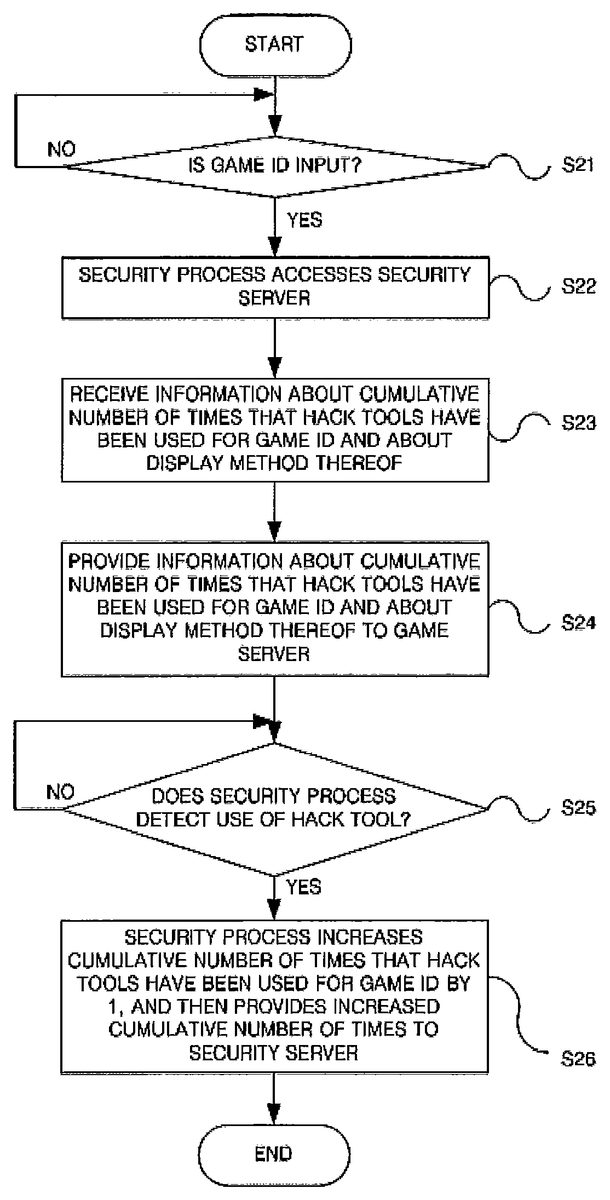
FIG. 2is a flowchart showing a method for displaying information about the use of one or more hack tools in the online game according to the present invention.
If the game process11aand security process12aof the client system10aare executed and a game user inputs a game ID to the first game server21ausing the client system10aat step S21, the security process12aaccesses the security server30at step S22, makes an inquiry about information about the cumulative number of times that hack tools have been used for the corresponding input game ID of the online game provided from the first game server21aand about a display method thereof; and receives the information at step S23.
The game process11aor the security process12aprovides information about the cumulative number of times that hack tools have been used and the display method thereof together with the game ID to the first game server21aat step S24. When a plurality of client systems accessed the first game server21ashare the information related to the game user (a level, a class, ranking, a joined clan name, a winning average, the number of times that a corresponding user killed the enemy, and the number of times that the user died), the first game server21aadditionally displays the cumulative number of times that hack tools have been used based on the display method thereof.
Meanwhile, if the game user uses a hack tool when the online game is being moved forward and the security process detects the use of the hack tool at step S25, the security process12aforcibly terminates the game process11awhile the security process12ablocks the hack tool, and, at the same time, the security process12aincreases the cumulative number of times that hack tools have been used for the corresponding game ID input from the security server30by 1, and then provides the cumulative number of times that hack tools have been used to the security server30so that the cumulative number of times that hack tools have been used is stored in the security database31at step S26.
The display method includes a game ID color conversion display method, a directly diagnosed frequency display method, and a specific mark display method. The game ID color conversion display method is a method of displaying game IDs using different colors according to levels depending on the cumulative number of times that hack tools have been used. For example, the colors of game IDs are displayed using different colors depending on the cumulative number of times that hack tools have been used in such a way that a game ID is displayed using a light orange color when the cumulative number of times that hack tools have been used falls in the range of 1 to 4, and that the corresponding game ID is displayed using a deep orange color when the cumulative number of times falls in the range of 5 to 10. The directly diagnosed frequency display method is a method of displaying game IDs and the cumulative number of times that hack tools have been used for the corresponding game IDs using figures. In this method, the game IDs and the cumulative number of times can be displayed by classifying the kind of hack tools, and classifying the cumulative number of times depending on the resulting kind of the hack tools. The specific mark display method is a method of displaying specific marks according to level, similar to the game ID color conversion display method. For example, a specific mark is displayed together with a game ID in such a way that the “H” mark is displayed when the cumulative number of times that hack tools have been used falls in the range of 1 to 4, the “D” mark is displayed when the cumulative number of times that hack tools have been used falls in the range of 5 to 10, and a skeleton mark is displayed when the cumulative number of times that hack tools have been used falls in the range of 11 to 14.
When the use of a hack tool is detected, the security process or the security server stores the date on which the use of the hack tool is detected, and decrease the cumulative number of times that hack tools have been used by 1 when a predetermined period elapses from the date on which the use of the hack tool is detected. Therefore, information about the use of the hack tool is removed if the game user does not use a hack tool for a predetermined period even though the game user used the hack tool before.
Furthermore, when the cumulative number of times that hack tools have been used for each game ID is displayed, the recent date on which the use of the hack tool is detected may be additionally displayed.
The above-described game server can display the cumulative number of times that hack tools have been used for each game ID in a waiting state as well as in a game room.
According to the above-described invention, when the online game is played, the number of times that one or more hack tools have been used for each user is shared and revealed, so that users voluntarily reject some users who have used hack tools a large number of times from the corresponding online game, with the result that there is an advantage of controlling the use of hack tools of the game users without engaging one or more online game suppliers therein.
Although the preferred embodiments of the present invention have been disclosed for illustrative purposes, those skilled in the art will appreciate that various modifications, additions and substitutions are possible, without departing from the scope and spirit of the invention as disclosed in the accompanying claims.
Claims
- A method for use in an online game system in which a plurality of client systems, a game server and a security server communicate with each other over an Internet, and in which the game server stores game-related information for a game Identification (ID) of each of a plurality of gamers and transfers the game-related information to the client systems, and the security server stores a number of times that one or more hack tools have been used for the game ID, the method for displaying information about use of one or more hack tools for each game ID on the client systems, the method comprising: a first step of each of the client systems accessing the security server, requesting a number of times that one or more hack tools have been used for each logged-in game ID, and receiving the number of times that the hack tools have been used for each logged-in game ID from the security server;a second step of each client system sending the number of times that the hack tools have been used for each logged-in game ID to the game server, so that the number of times that the hack tools have been used for each logged-in game ID can be shared amongst the gamers;a third step of each client system receiving the number of times that the hack tools have been used for each logged-in game ID from the game server and displaying the number of times that the hack tools have been used for each logged-in game ID on a screen;a fourth step of a security process installed on a client system determining whether one or more hack tools are being used on said client system;and based on the determination that one or more hack tools are being used on said client system, a fifth step of, said client system updating the number of times that the hack tools have been used for an associated logged-in game ID by increasing the number of times that the hack tools have been used for the logged-in game ID by one, and sending the updated number of times that the hack tools have been used for the logged-in game ID to the security server.
- The method set forth in claim 1 wherein the first step comprises each client system receiving the number of times that the hack tools have been used for each logged-in game ID and a display method, and the second step comprises each client system providing the number of times that the hack tools have been used for each logged-in game ID and the display method to the game server.
- The method as set forth in claim 2 , wherein the method comprises a game ID color conversion display method of displaying one or more game IDs using different colors depending on the number of times that hack tools have been used.
- The method as set forth in claim 2 , wherein the method comprises a directly diagnosed frequency display method of displaying the number of times that hack tools have been used using figures.
- The method as set forth in claim 2 , wherein the method comprises a specific mark display method of displaying one or more specific marks depending on the number of times that the hack tools have been used.
- The method as set forth in claim 1 , wherein the fourth step comprises said client system further providing a date on which the use of the hack tools was detected to the security server and the security server further storing the date on which the use of the hack tools was detected.
- The method as set forth in claim 6 , wherein the first step comprises each client system further receiving the date on which the use of the hack tools was detected from the security server;and the second step comprises each client system further providing the date on which the use of the hack tools was detected to the game server.
- The method as set forth in claim 6 , wherein the number of times that hack tools have been used decreases by 1 when a predetermined period elapses from the date on which the use of the hack tool is detected.
Disclaimer: Data collected from the USPTO and may be malformed, incomplete, and/or otherwise inaccurate.