U.S. Pat. No. 8,382,566
NETWORK GAME ANTI-CHEATING DEVICE, METHOD AND SYSTEM
AssigneeTencent Technology (Shenzhen) Company Ltd.
Issue DateFebruary 27, 2009
Illustrative Figure
Abstract
An embodiment of this invention discloses a network game anti-cheating device, method and system. The device includes: an information processing unit, adapted to modify actual game state information to dummy game state information, and send the dummy game state information to a terminal of a player; and a seat assignation unit, adapted to assign a player into an unoccupied seat of an idle table according to actual table information in a game room. The information processing unit comprises: a table information processing unit, adapted to send dummy table information in the game room to the terminal of the player; a watching information processing unit, adapted to send dummy game information of players who are playing the game on the table; and a partner-player information processing unit, adapted to send dummy information of the partner-players on the table.
Description
DETAILED DESCRIPTION OF THE INVENTION In embodiments of the present invention, an anti-cheating device is arranged between a game server and a terminal of a player. When the player selects to enter into an anti-cheating game room, the device is run, which can prevent, without affecting normal operations of the game server and normal procedure of the game, cheating practiced by some players by seeing cards in others' hands. Hereinafter, embodiments of the present invention are described in detail by referring to accompany drawings. The player needs to start game hall software first if the player wants to play a game. The player inputs his/her IM account number and password, logs in the game server, and then enters into the game hall. During the above processes, the game server has correctly obtained information of the player capable of effectively identifying the player. Such information includes an IM number, nickname, score and level of the player, etc. The game server then sends room information to the terminal of the player, and displays the room information in the game hall. The players may select and enter into a game room providing a multi-player casual game. If the player enters into a game room providing ordinary games, the game server runs a procedure identical to the existing one. If the player selects to enter into an anti-cheating game room, the anti-cheating device starts to run. As shown inFIG. 1, the anti-cheating device includes information processing unit21and seat assignation unit22. Information processing unit21is used to send dummy game state information to the terminal of a player, and seat assignation unit22is used to assign the player to an unoccupied seat of an idle table according to actual table information in the game room. In embodiments of the present invention, the game state information at least ...
DETAILED DESCRIPTION OF THE INVENTION
In embodiments of the present invention, an anti-cheating device is arranged between a game server and a terminal of a player. When the player selects to enter into an anti-cheating game room, the device is run, which can prevent, without affecting normal operations of the game server and normal procedure of the game, cheating practiced by some players by seeing cards in others' hands.
Hereinafter, embodiments of the present invention are described in detail by referring to accompany drawings.
The player needs to start game hall software first if the player wants to play a game. The player inputs his/her IM account number and password, logs in the game server, and then enters into the game hall. During the above processes, the game server has correctly obtained information of the player capable of effectively identifying the player. Such information includes an IM number, nickname, score and level of the player, etc. The game server then sends room information to the terminal of the player, and displays the room information in the game hall. The players may select and enter into a game room providing a multi-player casual game.
If the player enters into a game room providing ordinary games, the game server runs a procedure identical to the existing one. If the player selects to enter into an anti-cheating game room, the anti-cheating device starts to run.
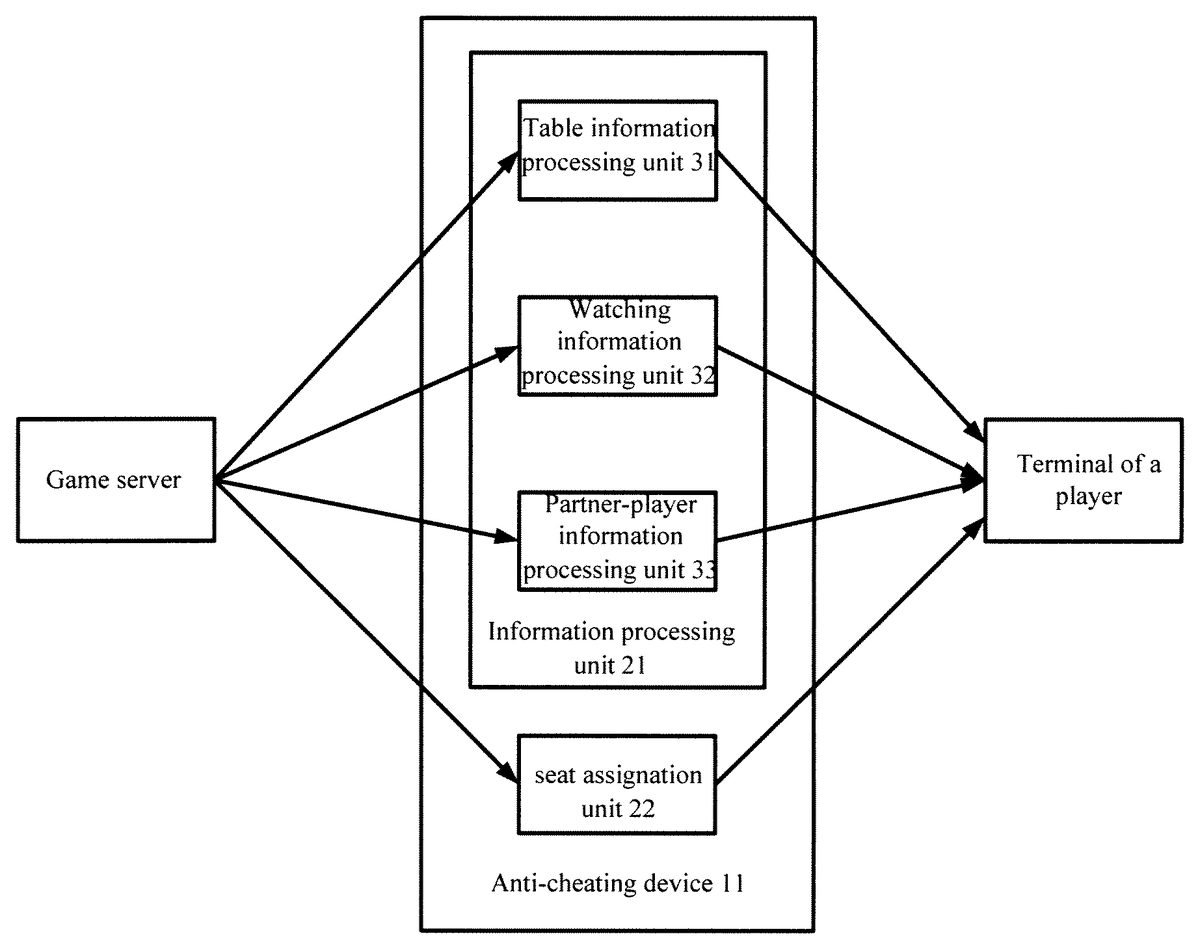
As shown inFIG. 1, the anti-cheating device includes information processing unit21and seat assignation unit22. Information processing unit21is used to send dummy game state information to the terminal of a player, and seat assignation unit22is used to assign the player to an unoccupied seat of an idle table according to actual table information in the game room.
In embodiments of the present invention, the game state information at least includes table information in the game room, and/or game information of players who are playing the game on a table, and/or information of partner-players on the table. The dummy game state information at least includes: dummy game state information formed by hiding all actual game state information, and/or dummy game state information formed by hiding a part of actual game state information, and/or dummy game state information formed by making all actual game state information invalid. In practice, the actual game state information is the game state information, and the dummy game state information is formed by hiding all or a part of the game state information, or making all the game state information invalid.
Information processing unit21further includes table information processing unit31, watching information processing unit32and partner-player information processing unit33. Table information processing unit31is used to send dummy table information in the game room to the terminal of the player. Watching information processing unit32is used to send to the terminal of the player dummy game information of players who are playing the game on the table. Partner-player information processing unit33is used to send to the terminal of the player the dummy information of partner-players who are playing the game on the same table.
In embodiments of the present invention, the table information at least includes information indicating whether the table is idle, and/or information indicating whether the idle table has an unoccupied seat.
As shown inFIG. 2, the working mode of the anti-cheating device is as follows:
The game server has correctly read the actual table information in the game room when the player enters into the anti-cheating game room, and sends the actual table information to table information processing unit31. Table information processing unit31modifies the received actual table information and sends corresponding dummy table information to the terminal of the player.
Table information processing unit31modifies the actual table information to obtain the corresponding dummy table information by the following processes:
(a) Table information processing unit31sends table information of all tables to the terminal of the player, but all the table information is invalid.
For example, when receiving information indicating whether the table is idle and information indicating whether the idle table has an unoccupied seat, table information processing unit31directly modifies this information to the dummy table information indicating that all the tables are occupied and all seats of each table are occupied, and then sends the dummy table information to the terminal of the player. Since a table is actually shown as a picture, a table with all seats occupied can be displayed by displaying a default head portrait on each seat.
(b) Table information processing unit31hides all the table information.
For example, table information processing unit31directly deletes all the received table information and does not send information to the terminal of the player.
(c) Table information processing unit31hides a part of the table information.
For example, table information processing unit31deletes information indicating whether the table is idle, and sends to the terminal of the player dummy information indicating that each seat of each table has been occupied.
When a player sends to the game server a watch game command, the game server immediately sends to the watching information processing unit32actual information of players on the table. Such actual information includes one or more pieces of the following game data information, such as information of cards in the players' hands, and information of cards distributed by the players on the table. Watching information processing unit32modifies the received actual information and sends the corresponding dummy information to the terminal of the player.
Watching information processing unit32modifies the watching information to obtain the dummy information by the following processes:
(a) Watching information processing unit32sends all the game information of the players on the table to the terminal of the player, but all the game information is invalid.
For example, when receiving the game information of the players, watching information processing unit32modifies the cards in the players' hands as default cards, and also modifies the cards distributed by the players on the table as default cards, and sends modified dummy game information of the players to the terminal of the player.
(b) Watching information processing unit32hides all the game information of the players on the table.
For example, watching information processing unit32directly deletes all the received game information of the players and does not send information to the terminal of the player.
(c) Watching information processing unit32hides a part of the game information of the players on the table.
For example, watching information processing unit32deletes information of the cards distributed by the players on the table, and modifies the cards in players' hands as default cards, and then sends such dummy information to the terminal of the player.
Since the player can not obtain the actual table information according to the information displayed on the terminal of the player, the player has to sends a join game command to the game server if the player wants to enter into the table and start a game. When the game server receives the join game command from the player, the game server immediately sends to the seat assignation unit22the actual table information in the anti-cheating game room. Seat assignation unit22assigns the player to an unoccupied seat according to information of the actual idle table and unoccupied seats thereof, sends to the terminal of the player the number of players on the table, and displays default head portraits of partner-players on the table to the player.
Seat assignation unit22assigns the player to an unoccupied seat in a random manner or by using an algorithm preset in the game server.
Assigning, by seat assignation unit22, the player to an unoccupied seat in the random manner includes randomly assigning several players, who send join game commands, to an idle table, or randomly assigning a player, who sends the join game command, to an unoccupied seat of an idle table.
Assigning, by seat assignation unit22, the player to an unoccupied seat by using the algorithm preset in the game server includes the following processes. Since different algorithms are generated according to different game properties and different algorithms are used according to different room properties, the game server can change algorithms and automatically assign several players sharing different IP addresses to one table in a game room that has a possibility that more players may cheat.
The game server has correctly read the actual information of the partner-players on the table when the player enters into the game room, and sends the actual information to partner-player information processing unit33. The actual information of the partner-players may be any information capable of identifying the partner-players, such as IM numbers, nicknames, scores and levels, etc. Partner-player information processing unit33modifies the received actual information of the partner-players, and sends obtained dummy information of the partner-players to the terminal of the player, regardless of whether the player selects to start a game, wait for playing a game or leave a game.
Partner-player information processing unit33modifies the received actual information of the partner players to obtain the dummy information of the partner players by the following processes:
(a) Partner-player information processing unit33sends all the information of the partner-players to the terminal of the player, but all the information is invalid.
For example, when receiving information such as IM numbers, nicknames, scores and levels of the partner-players, partner-player information processing unit33modifies all or a part of information of all the players to default information. For instance, partner-player information processing unit33modifies all the game accounts to a same default account, such as 12345678 or gameplayers, modifies all the nicknames to “game player”, modifies all the scores to zero, and modifies all the levels to zero. Then partner-player information processing unit33sends the obtained dummy information to the terminal of the player. As such, the player can not obtain the actual information of other players, thus can not recognize the players and contact with the players.
(b) Partner-player information processing unit33hides all the information of partner-players.
For example, partner-player information processing unit33deletes the actual information of all the partner-players, and does not send information to the terminal of the player. Then, the player only can obtain the number of the partner-players according to the number of the default head portraits.
(c) Partner-player information processing unit33hides a part of the information of the partner-players.
For example, partner-player information processing unit33deletes IM numbers of the partner-players, modifies all the nicknames of the partner-players to “game player”, modifies all the scores to zero, modifies all the levels to zero, and sends the obtained dummy information to the terminal of the player.
In such a way, although the player can not obtain the information of the partner-players, can select to start, wait for playing a game or leave a game according to the number of the partner-players on one table.
By using the anti-cheating device provided by the embodiments of the present invention, the actual information of the table is modified without affecting the normal operation of the game server and the normal procedure of the game, and a player can join in a game on a table by using the device, thereby the cheat practiced by some players by seating on one table and directly knowing one another's cards is avoided. Additionally, since the watching information is modified, the cheat practiced by obtaining cards in the partner-players' hands is avoided. Also, since the actual information of the partner-players on the same table is modified, the action of some players on the same table obtaining one another's cards by using IM software, etc. and then deceiving other players is avoided.
It is apparent that those skilled in the art can make various modifications and variations without being apart from the sprit and scope of this invention. In such a way, if such modifications and variations are covered by the claims and the equivalent articles, this invention intends to contain these modifications and variations.
Claims
- A network game anti-cheating device, comprising: an information processing unit, adapted to modify actual game state information to dummy game state information, and send the dummy game state information to a terminal of a player;and a seat assignation unit, adapted to assign a player into an unoccupied seat of an idle table according to table information in a game room in the actual game state information;wherein the dummy game state information comprises dummy table information in a game room, dummy game information of players who are playing a game on a table, and dummy information of partner-players on a table;and the dummy game state information comprises any one of;the dummy game state information formed by hiding all the actual game state information;the dummy game state information formed by hiding a part of the actual game state information;and the dummy game state information formed by making all the actual game state information invalid.
- The device of claim 1 , wherein the information processing unit comprises: a table information processing unit, adapted to send the dummy table information in the game room to the terminal of the player when the player enters into the game room;a watching information processing unit, adapted to send the dummy game information of players who are playing the game on the table when the player sends a watch game command;and a partner-player information processing unit, adapted to send the dummy information of the partner-players on the table when the player sends a join game command;wherein the dummy information of the partner-players comprises information for effectively identifying the partner-players.
- The device of claim 1 , wherein the seat assignation unit is further adapted to assign the player to the unoccupied seat of the idle table in a random manner, or assign the player to the unoccupied seat of the idle table according to a preset algorithm.
- The device of claim 1 , wherein the dummy table information comprises at least one of: information indicating whether the table is idle and information indicating whether the idle table has an unoccupied seat.
- A network game anti-cheating method, comprising: modifying, by an anti-cheating device, actual game state information to dummy game state information;sending, by the anti-cheating device, the dummy game state information to a terminal of a player;and assigning, by the anti-cheating device, a player to an unoccupied seat of an idle table according to table information in a game room comprised in the actual game state information;wherein the dummy game state information comprises dummy table information in a game room, dummy game information of players who are playing a game on a table, and dummy information of partner-players on a table;and the dummy game state information comprises any one of;the dummy game state information formed by hiding all the actual game state information;the dummy game state information formed by hiding a part of the actual game state information;and the dummy game state information formed by making all the actual game state information invalid.
- The method of claim 5 , wherein assigning by the anti-cheating device the player to the unoccupied seat of the idle table comprises: assigning, by the anti-cheating device, the player to the unoccupied seat of the idle table in a random manner;or assigning, by the anti-cheating device, the player to the unoccupied seat of the idle table according to a preset algorithm.
- The method of claim 6 , wherein assigning by the anti-cheating device the player to the unoccupied seat of the idle table in the random manner comprises: assigning, by the anti-cheating device, several players to unoccupied seats of the idle table in one time, or assigning, by the anti-cheating device, one player into the unoccupied seat of the idle table in one time.
- The method of claim 5 , wherein the dummy table information comprises at least one of: information indicating whether the table is idle and information indicating whether the idle table has an unoccupied seat.
- The method of claim 5 , wherein the dummy information of the partner-players comprises: information for effectively identifying the partner-players.
- A network game anti-cheating system, comprising: a terminal of a player, a game server and an anti-cheating device arranged between the terminal of the player and the game server, wherein the game server is adapted to provide actual game state information to the anti-cheating device;the anti-cheating device is adapted to modify the actual game state information to dummy game state information, send the dummy game state information to the terminal of the player, and assign the player to an unoccupied seat of an idle table according to table information in a game room comprised in the actual game state information;and the player terminal is adapted to receive the dummy game state information, wherein the dummy game state information comprises dummy table information in a game room, dummy game information of players who are playing a game on a table, and dummy information of partner-players on a table;and the dummy game state information comprises any one of;the dummy game state information formed by hiding all the actual game state information;the dummy game state information formed by hiding a part of the actual game state information;and the dummy game state information formed by making all the actual game state information invalid.
Disclaimer: Data collected from the USPTO and may be malformed, incomplete, and/or otherwise inaccurate.