U.S. Pat. No. 8,376,858
SYSTEM AND METHOD FOR COMMUNICATING GAME INFORMATION BETWEEN A PORTABLE GAMING DEVICE AND A GAME CONTROLLER
AssigneeSony Computer Entertainment America LLC
Issue DateFebruary 20, 2009
Illustrative Figure
Abstract
A method and system for transmitting game related information from a hand-held gaming device through a game console to a game controller and vice versa. In one aspect, the game related information comprises command information that causes the game controller to respond either by vibrating, rumbling or other action associated with a game being played. In another aspect, the game related information may include controller signals that cause an action at the hand-held device.
Description
DETAILED DESCRIPTION FIG. 1illustrates a system1in accordance with an aspect of the present invention. The system1includes a hand-held game device10, a game console16and game controller20. The device10and console16are connected via a first connection22and the console16is connected to the game controller20via a second connection26. As shown, the connection22is made between interface28on the hand-held device10and a first interface30on the game console16. Connection26is made between a second interface32on the game console16and an interface36on the game controller20. The game console16may also be optionally connected to a peripheral device38or, as is explained in further detail below, the peripheral device38may be incorporated into the game console. In the system1, commands generated at hand-held device10are processed by game console16and transmitted to game controller20using connections22and26. In a preferred embodiment, such commands may include haptic information that causes the game controller20to communicate a sense of touch to a user, such as rumbling or vibrations. Conversely, signals generated by game controller20are processed by game console16and transmitted to hand-held device10. FIG. 2illustrates a hand-held device210that may be used in the system shown inFIG. 1in accordance with an aspect of the present invention. As shown, in the preferred embodiment the device210includes at least one joystick215, a screen218and a set of control buttons220. The device210typically also includes a central processing unit226and a graphics processing unit230. In addition, the device210includes ports or interfaces234,236for connecting to other devices, such as game console16. In a preferred embodiment, these ports may comprise ports for universal serial bus (USB) or WiFi connections. The device20may also include additional ports that allow connection to a monitor or display. The device210may further include a receptacle or opening240for receiving game media such as a game card or disk (not shown). In general, the hand-held device210operates under the control of CPU226, which processes game information for display on the screen218via graphics processor230. FIG. ...
DETAILED DESCRIPTION
FIG. 1illustrates a system1in accordance with an aspect of the present invention. The system1includes a hand-held game device10, a game console16and game controller20. The device10and console16are connected via a first connection22and the console16is connected to the game controller20via a second connection26. As shown, the connection22is made between interface28on the hand-held device10and a first interface30on the game console16. Connection26is made between a second interface32on the game console16and an interface36on the game controller20. The game console16may also be optionally connected to a peripheral device38or, as is explained in further detail below, the peripheral device38may be incorporated into the game console. In the system1, commands generated at hand-held device10are processed by game console16and transmitted to game controller20using connections22and26. In a preferred embodiment, such commands may include haptic information that causes the game controller20to communicate a sense of touch to a user, such as rumbling or vibrations. Conversely, signals generated by game controller20are processed by game console16and transmitted to hand-held device10.
FIG. 2illustrates a hand-held device210that may be used in the system shown inFIG. 1in accordance with an aspect of the present invention. As shown, in the preferred embodiment the device210includes at least one joystick215, a screen218and a set of control buttons220. The device210typically also includes a central processing unit226and a graphics processing unit230. In addition, the device210includes ports or interfaces234,236for connecting to other devices, such as game console16. In a preferred embodiment, these ports may comprise ports for universal serial bus (USB) or WiFi connections. The device20may also include additional ports that allow connection to a monitor or display. The device210may further include a receptacle or opening240for receiving game media such as a game card or disk (not shown). In general, the hand-held device210operates under the control of CPU226, which processes game information for display on the screen218via graphics processor230.
FIG. 3illustrates a game console316in accordance with an aspect of the present invention. Game console316includes a central processing unit320, which controls the operations of the game console. Typically, central processing unit320comprises a processor that is capable of handling the large computational workload required of a game console. The game console also includes a video processor324that interfaces with a monitor or display (not shown). Game console316further includes a plurality of ports or interfaces328for transmitting and receiving data to or from a game controller, such as game controller20, hand-held game10,210or other electronic devices. These ports include wired and wireless connections such as those provided using a USB or WiFi interface connection. The game console316also includes a receptacle330for receiving gaming media such as a card or disk. As is explained in further detail below, in a preferred embodiment the game console includes a peripheral device336, which may be incorporated in or connected to the game console316via a cable or wirelessly.
Turning now toFIG. 4, there is illustrated a game controller420in accordance with an aspect of the present invention. In a preferred embodiment, the game controller420includes a pair of joysticks422,424, and various control buttons A through L. The controller also includes one or more ports428, such as USB and/or other wireless transceivers, for transmitting and receiving control signals or other gaming information to and from a game console, such as 16 or 316, or a hand-held game device, such 10 or 210. In the preferred embodiment, the game controller includes the capability to respond to haptic type commands including commands that cause the controller to vibrate or rumble.
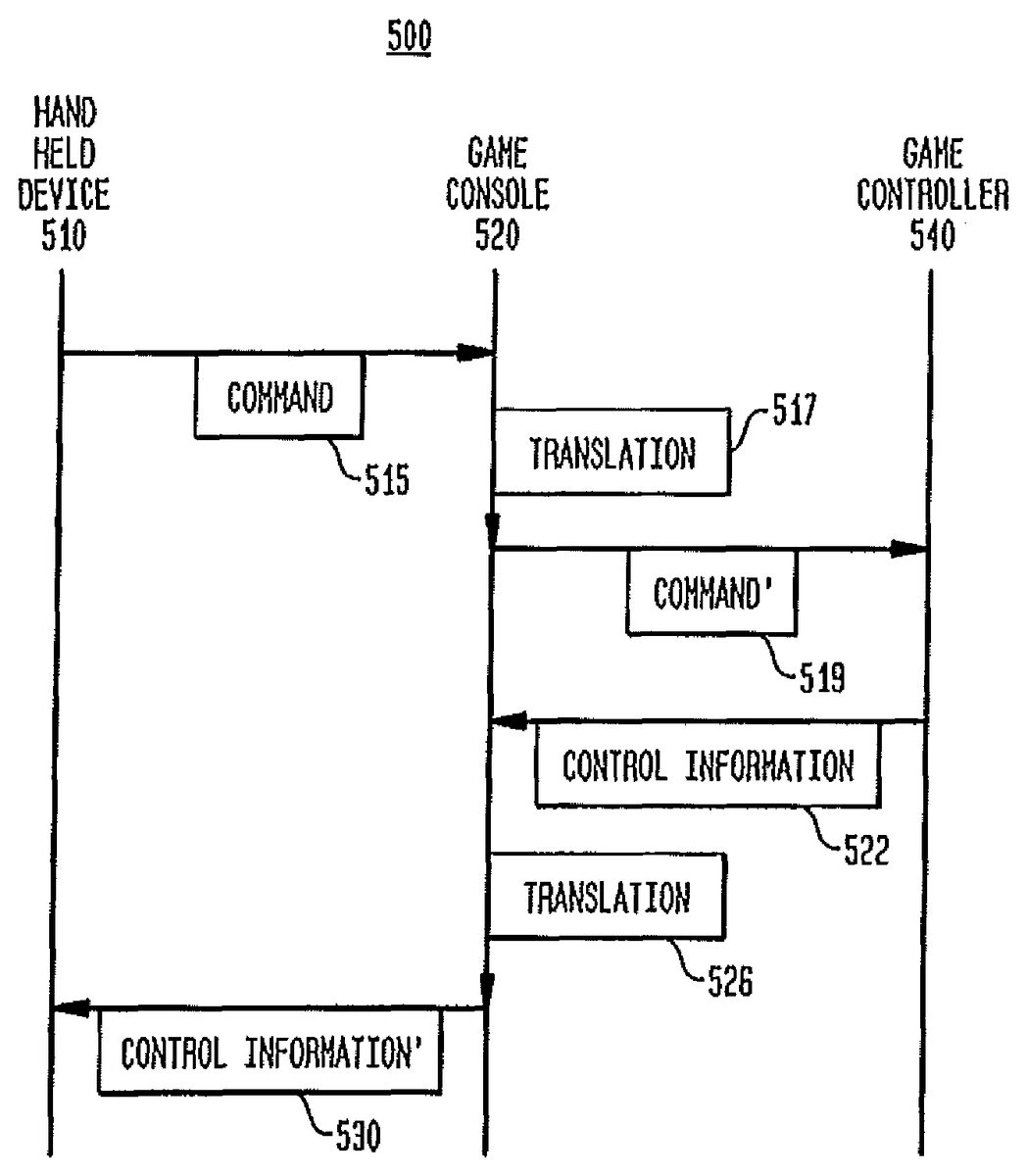
Referring toFIGS. 1 and 5, in another, aspect, the present invention includes a method for communicating messages containing gaming information from a hand-held device10to a game controller20through the game console16and/or communicating such information from the game controller20through the game console16to the hand-held device10. More specifically, in the preferred embodiment, messages from the hand-held device comprise a command that includes haptic information.
In particular, in accordance with the method500shown inFIG. 5, the hand-held device510is preferably equipped with a game that causes haptic information to be generated. As the hand-held device510is advantageously designed to be small in size, it does not usually include the capability to respond to haptic information such as by vibrating or the like. Accordingly, in order to give a user the full effect of games that generate haptic commands, an aspect of the present invention provides this capability by using a game console, such as game console316or520to translate commands from the hand-held device into commands that are compatible with a game controller that has haptic function capability such as controller540.
As indicated inFIG. 5, in this aspect of the invention, the hand-held device510generates a command515that is sent to the game console520. As the command is not in a format suitable for direct transmittal to game controller530, it undergoes translation at the game console520. In the preferred embodiment, the game console520includes a protocol that translates the command information from a first format into a second format. Preferably, the protocol operates at the application layer of the 7-layer open system interconnect (OSI) model and employs a socket type connection. In addition, as discussed below, the protocol operates bi-directionally by also translating control information sent by the game controller540into a format that is suitable for the hand-held device.
After translation of the command information at step517, the game console520transmits this information519to the game controller540, which responds to the information. As discussed above, preferably, the command information includes haptic information which when received by game controller540causes the game controller540to rumble or vibrate.
As is also shown inFIG. 5, the game controller540transmits control information522destined for the hand-held device to the game console520, where such information undergoes translation526into a format that is compatible with the hand held device510. In addition to remedying format incompatibilities; as part of its translation, the protocol also resolves differences between the functionality of controller buttons on the hand-held game device510and the game controller540. For example, in some instances, the hand-held device may include only one joystick whereas the game controller may include two joysticks. Thus, whereas the game console may receive control information from each joystick on the controller540, the hand-held device is equipped to only handle information from a single joystick. In this instant, as part of its translation processing, the game console520preferably maps the information associated with both joysticks on the game controller into control information that would be generated by the single joystick on the hand-held device.
After translating the controller information (step526), the game console520then transmits the translated control information530to the hand-held device510. Typically, control information522,530comprise information that controls the actions of the game being played using the hand held device510. For example, this information may control the actions of avatars within a game, what the user sees on screen (e.g., panning a screen across objects in the game) and any other actions associated with playing video games.
In a further aspect of the present invention, the operating system used to manage the game applications (e.g., software) may be augmented to include the translation protocol described above. In this way, the game console may then act as a translation device for the hand-held device and allow a wider variety of games to be played using the hand-held device. In particular, games that require the functionality required by game controllers20,420and540may then be played using the hand-held device. In addition, since game consoles are generally equipped with more powerful processors than hand-held devices, the game console's processor may be shared with the hand-held device. This would allow more processor hungry applications to run on the hand-held device, thereby lowering its processor design requirements. This may allow a different class of hand-held game devices, e.g., tamaguchis, access to more sophisticated or processor hungry applications.
In another aspect of the present invention, the game console may also function as a gateway between different hand-held game devices. For example, if the game console includes a WiFi or other connection, it may be used to link a local hand-held device, e.g., one proximate the game console, with a remote hand-held device that is connected using the WiFi connection. In this way, games that allow interactions among multiple users may be played through a game console although the users may be at different geographic locations, e.g., different states, countries, continents.
In a further aspect of the present invention, the hand-held game device10,210,510may control one or more peripheral devices integrated in or coupled to the game console16,316,520. For example, if the game console is equipped with a camera, the hand-held device may pass command information to the game console to operate the camera causing it to take a photograph or shoot a video. As another example, the peripheral device may comprise a microphone. In this way, the hand-held game device may be used to perform games which require the user to use a microphone without requiring a microphone jack to be built into the hand-held device.
In accordance with a most preferred embodiment, the hand-held device, game console and game controller respectively comprise a SONY PLAYSTATION PORTABLE (PSP), PLAYSTATION game console and a dual shock controller. In this regard, a user may play a game on the PSP using a dual shock controller that is linked to the PSP through the PS3. In addition to the advantages discussed above, if equipped with a video output port, the PSP on screen information may be outputted to a display so that a user would be provided with a different playing experience than that provided using only the hand-held device.
Although the invention herein has been described with reference to particular embodiments, it is to, be understood that these embodiments are merely illustrative of the principles and applications of the present invention. It is therefore to be understood that numerous modifications may be made to the illustrative embodiments and that other arrangements may be devised without departing from the spirit and scope of the present invention as defined by the appended claims.
Claims
- A system, comprising: a game console;a game controller coupled to the game console through a first interface and configured to generate and process control information, the game controller being further configured to control a gaming application;and a local hand-held game device coupled to the game console through a second interface and configured to receive, through the game console, control information transmitted by the game controller, the control information including information that controls actions of the gaming application, the control information being generated by the game controller based on user input received at the game controller;wherein the local hand-held game device is configured to execute, at least in part, the gaming application;and wherein the local hand-held game device receives from the game controller, via the game console, user input for controlling the gaming application.
- The system of claim 1 , wherein the control information comprises command information causing the game console to initiate a predetermined action.
- The system of claim 2 , wherein the predetermined action includes capturing an image using a camera coupled to the game console.
- The system of claim 3 , wherein the game console transmits the captured image to the local hand-held game device through the second interface.
- The system of claim 1 , wherein the first and second interfaces comprise interfaces selected from the group consisting of USB, WiFi and Bluetooth connection interfaces.
- The system of claim 1 , wherein the game console includes a third interface for communicating with a remotely located hand-held game device.
- The system of claim 6 , further comprising communicating gaming information between the local and remote hand-held game devices through the game console.
- The system of claim 7 , wherein the third interface comprises a WiFi interface.
- The system of claim 1 , wherein the game console includes a data processor that processes gaming information for the hand-held device.
- The system of claim 9 , wherein the gaming information comprises rendering information associated with on-screen objects for the hand-held device and the rendering information causes a change in location of an object on a screen associated with the hand-held game device.
- The system of claim 1 wherein the local hand-held game device further comprises a screen for outputting graphics produced by the gaming application when the gaming application is executed by a processor.
- A system for communicating game information, comprising: a game console capable of processing haptic information;a game controller coupled to the game console through a first interface and capable of processing haptic information received from the game console, the game controller being operable to control a gaming application;and a hand-held game device coupled to the game console through a second interface, the hand-held game device being operable to transmit to the game controller, through the game console, haptic information that is generated by a gaming application executing on the hand-held game device.
- The system of claim 12 , wherein the hand-held game device communicates with the game console using an application layer protocol that translates haptic information generated by the hand-held device into control information compatible with the game controller.
- The system of claim 12 , wherein the haptic information comprises control information that communicates a sense of touch to a user.
- The system of claim 14 , wherein the haptic information comprises information associated with forces, vibration or motion.
- The system of claim 12 wherein the hand-held game device further comprises a screen for outputting graphics produced by the gaming application when the gaming application is executed by a processor.
- A method for communicating information in a gaming system, comprising: generating a message including haptic control information at a hand held game device, the haptic control information being generated by a gaming application that is being executed by the hand-held gaming device;transmitting the message from the hand-held gaming device to a game console;and transmitting, by the game console, the message to a game controller that is responsive to haptic control information.
- The method of claim 17 , further comprising translating, at the game console, the message from a first format generated by the hand held game device into a second format that is compatible with the game controller.
- The method of claim 17 wherein the hand-held game device further comprises a screen for outputting graphics produced by the gaming application when the gaming application is executed by a processor.
Disclaimer: Data collected from the USPTO and may be malformed, incomplete, and/or otherwise inaccurate.