U.S. Pat. No. 8,376,834
ROLE ASSIGNMENT IN MULTIPLAYER GAMES
AssigneeMicrosoft Technology Licensing LLC
Issue DateMay 7, 2010
Illustrative Figure
Abstract
Dynamic role selection of players for different roles in multiplayer gaming sessions is provided. Users seeking to participate in different roles in the game may request participation in the role. Selection of players for roles is made dynamically by varying a selection component for different sessions of the game. The selection component may be a user's game score over different time periods, and can be rotated for different sessions of the game, so that various levels of players have an opportunity to fill game roles.
Description
DETAILED DESCRIPTION Technology is provided to selects one or more users for advanced roles in one or more sessions (or “episodes”) of a multiplayer game. Skill based multi-player games may provide roles both to make games interesting and as incentives to generate interest in the game amongst various levels of users. The technology provides an opportunity for long standing players as well as new players to have an opportunity to fill elevated roles in the game. Selection of players for elevated roles is made dynamically by varying a selection component over a number of sessions. In one embodiment, the selection component is a user's game score over different time periods, such as a single session, a week or the entire time a user has participated in the game. A ranking score based on the user's game score for a given period determines which users requesting elevated roles in the game will be assigned to those roles. Selection components can be rotated for different sessions of the game, so that various levels of players have an opportunity to fill game elevated roles. FIG. 1shows an exemplary gaming and media system100. The following discussion ofFIG. 1is intended to provide a brief, general description of a suitable environment in which concepts presented herein may be implemented. As shown inFIG. 1, gaming and media system100includes a game and media console (hereinafter “console”)102. In general, console102is one type of computing system, as will be further described below. Console102is configured to accommodate one or more wireless controllers, as represented by controllers104(1) and104(2). Console102is equipped with an internal hard disk drive (not shown) and a portable media drive106that support various forms of portable storage media, as represented by optical storage disc108. Examples of suitable portable storage media include DVD, CD-ROM, game discs, and so forth. Console102also includes ...
DETAILED DESCRIPTION
Technology is provided to selects one or more users for advanced roles in one or more sessions (or “episodes”) of a multiplayer game. Skill based multi-player games may provide roles both to make games interesting and as incentives to generate interest in the game amongst various levels of users. The technology provides an opportunity for long standing players as well as new players to have an opportunity to fill elevated roles in the game.
Selection of players for elevated roles is made dynamically by varying a selection component over a number of sessions. In one embodiment, the selection component is a user's game score over different time periods, such as a single session, a week or the entire time a user has participated in the game. A ranking score based on the user's game score for a given period determines which users requesting elevated roles in the game will be assigned to those roles. Selection components can be rotated for different sessions of the game, so that various levels of players have an opportunity to fill game elevated roles.
FIG. 1shows an exemplary gaming and media system100. The following discussion ofFIG. 1is intended to provide a brief, general description of a suitable environment in which concepts presented herein may be implemented. As shown inFIG. 1, gaming and media system100includes a game and media console (hereinafter “console”)102. In general, console102is one type of computing system, as will be further described below. Console102is configured to accommodate one or more wireless controllers, as represented by controllers104(1) and104(2). Console102is equipped with an internal hard disk drive (not shown) and a portable media drive106that support various forms of portable storage media, as represented by optical storage disc108. Examples of suitable portable storage media include DVD, CD-ROM, game discs, and so forth. Console102also includes two memory unit card receptacles125(1) and125(2), for receiving removable flash-type memory units140. A command button135on console102enables and disables wireless peripheral support.
As depicted inFIG. 1, console102also includes an optical port130for communicating wirelessly with one or more devices and two USB (Universal Serial Bus) ports110(1) and110(2) to support a wired connection for additional controllers, or other peripherals. In some implementations, the number and arrangement of additional ports may be modified. A power button112and an eject button114are also positioned on the front face of game console102. Power button112is selected to apply power to the game console, and can also provide access to other features and controls, and eject button114alternately opens and closes the tray of a portable media drive106to enable insertion and extraction of a storage disc108.
Console102connects to a television or other display (such as monitor150) via A/V interfacing cables120. In one implementation, console102is equipped with a dedicated A/V port (not shown) configured for content-secured digital communication using A/V cables120(e.g., A/V cables suitable for coupling to a High Definition Multimedia Interface “HDMI” port on a high definition monitor150or other display device). A power cable122provides power to the game console. Console102may be further configured with broadband capabilities, as represented by a cable or modem connector124to facilitate access to a network, such as the Internet. The broadband capabilities can also be provided wirelessly, through a broadband network such as a wireless fidelity (Wi-Fi) network.
Each controller104is coupled to console102via a wired or wireless interface. In the illustrated implementation, the controllers104are USB-compatible and are coupled to console102via a wireless or USB port110. Console102may be equipped with any of a wide variety of user interaction mechanisms. In an example illustrated inFIG. 1, each controller104is equipped with two thumbsticks132(1) and132(2), a D-pad134, buttons136, and two triggers138. These controllers are merely representative, and other known gaming controllers may be substituted for, or added to, those shown inFIG. 1.
In one implementation, a memory unit (MU)140may also be inserted into controller104to provide additional and portable storage. Portable MUs enable users to store game parameters for use when playing on other consoles. In this implementation, each controller is configured to accommodate two MUs140, although more or less than two MUs may also be employed.
Gaming and media system100is generally configured for playing games stored on a memory medium, as well as for downloading and playing games, and reproducing pre-recorded music and videos, from both electronic and hard media sources. With the different storage offerings, titles can be played from the hard disk drive, from an optical disk media (e.g.,108), from an online source, or from MU140.
During operation, console102is configured to receive input from controllers104and display information on display150. For example, console102can display a user interface on display150to allow a user to participate in a multiplayer game using controller104based on user intent, as discussed below.
FIG. 2is a functional block diagram of gaming and media system100and shows functional components of the gaming and media system100in more detail. Console102has a central processing unit (CPU)200, and a memory controller202that facilitates processor access to various types of memory, including a flash Read Only Memory (ROM)204, a Random Access Memory (RAM)206, a hard disk drive208, and portable media drive106. In one implementation, CPU200includes a level 1 cache210and a level 2 cache212, to temporarily store data and hence reduce the number of memory access cycles made to the hard drive208, thereby improving processing speed and throughput.
CPU200, memory controller202, and various memory devices are interconnected via one or more buses (not shown). The details of the bus that is used in this implementation are not particularly relevant to understanding the subject matter of interest being discussed herein. However, it will be understood that such a bus might include one or more of serial and parallel buses, a memory bus, a peripheral bus, and a processor or local bus, using any of a variety of bus architectures. By way of example, such architectures can include an Industry Standard Architecture (ISA) bus, a Micro Channel Architecture (MCA) bus, an Enhanced ISA (EISA) bus, a Video Electronics Standards Association (VESA) local bus, and a Peripheral Component Interconnects (PCI) bus also known as a Mezzanine bus.
In one implementation, CPU200, memory controller202, ROM204, and RAM206are integrated onto a common module214. In this implementation, ROM204is configured as a flash ROM that is connected to memory controller202via a PCI bus and a ROM bus (neither of which are shown). RAM206is configured as multiple Double Data Rate Synchronous Dynamic RAM (DDR SDRAM) modules that are independently controlled by memory controller202via separate buses (not shown). Hard disk drive208and portable media drive106are shown connected to the memory controller202via the PCI bus and an AT Attachment (ATA) bus216. However, in other implementations, dedicated data bus structures of different types can also be applied in the alternative.
A three-dimensional graphics processing unit220and a video encoder222form a video processing pipeline for high speed and high resolution (e.g., High Definition) graphics processing. Data are carried from graphics processing unit220to video encoder222via a digital video bus (not shown). An audio processing unit224and an audio codec (coder/decoder)226form a corresponding audio processing pipeline for multi-channel audio processing of various digital audio formats. Audio data are carried between audio processing unit224and audio codec226via a communication link (not shown). The video and audio processing pipelines output data to an A/V (audio/video) port228for transmission to a television or other display. In the illustrated implementation, video and audio processing components220-228are mounted on module214.
FIG. 2shows module214including a USB host controller230and a network interface232. USB host controller230is shown in communication with CPU200and memory controller202via a bus (e.g., PCI bus) and serves as host for peripheral controllers104(1)-104(4). Network interface232provides access to a network (e.g., Internet, home network, etc.) and may be any of a wide variety of various wire or wireless interface components including an Ethernet card, a modem, a wireless access card, a Bluetooth module, a cable modem, and the like.
In the implementation depicted inFIG. 2, console102includes a controller support subassembly240for supporting four controllers104(1)-104(4). The controller support subassembly240includes any hardware and software components needed to support wired and wireless operation with an external control device, such as for example, a media and game controller. A front panel I/O subassembly242supports the multiple functionalities of power button112, the eject button114, as well as any LEDs (light emitting diodes) or other indicators exposed on the outer surface of console102. Subassemblies240and242are in communication with module214via one or more cable assemblies244. In other implementations, console102can include additional controller subassemblies. The illustrated implementation also shows an optical I/O interface235that is configured to send and receive signals that can be communicated to module214.
MUs140(1) and140(2) are illustrated as being connectable to MU ports “A”130(1) and “B”130(2) respectively. Additional MUs (e.g., MUs140(3)-140(6)) are illustrated as being connectable to controllers104(1) and104(3), i.e., two MUs for each controller. Controllers104(2) and104(4) can also be configured to receive MUs (not shown). Each MU140offers additional storage on which games, game parameters, and other data may be stored. In some implementations, the other data can include any of a digital game component, an executable gaming application, an instruction set for expanding a gaming application, and a media file. When inserted into console102or a controller, MU140can be accessed by memory controller202. A system power supply module250provides power to the components of gaming system100. A fan252cools the circuitry within console102.
An application260comprising machine instructions is stored on hard disk drive208. When console102is powered on, various portions of application260are loaded into RAM206, and/or caches210and212, for execution on CPU200, wherein application260is one such example. Various applications can be stored on hard disk drive208for execution on CPU200.
Gaming and media system100may be operated as a standalone system by simply connecting the system to monitor150(FIG. 1), a television, a video projector, or other display device. In this standalone mode, gaming and media system100enables one or more players to play games, or enjoy digital media, e.g., by watching movies, or listening to music. However, with the integration of broadband connectivity made available through network interface232, gaming and media system100may further be operated as a participant in a larger network gaming community, as discussed in connection withFIG. 3.
FIG. 3illustrates another example embodiment of the gaming and media system shown inFIGS. 1-2.FIG. 3illustrates an example of a suitable computing system environment300such as a personal computer.
With reference toFIG. 3, an exemplary system for implementing the technology includes a general purpose computing device in the form of a computer310. Components of computer310may include, but are not limited to, a processing unit320, a system memory330, and a system bus321that couples various system components including the system memory to the processing unit320. The system bus321may be any of several types of bus structures including a memory bus or memory controller, a peripheral bus, and a local bus using any of a variety of bus architectures. By way of example, and not limitation, such architectures include Industry Standard Architecture (ISA) bus, Micro Channel Architecture (MCA) bus, Enhanced ISA (EISA) bus, Video Electronics Standards Association (VESA) local bus, and Peripheral Component Interconnect (PCI) bus also known as Mezzanine bus.
Computer310typically includes a variety of computer readable media. Computer readable media can be any available media that can be accessed by computer310and includes both volatile and nonvolatile media, removable and non-removable media. By way of example, and not limitation, computer readable media may comprise computer storage media and communication media. Computer storage media includes volatile and nonvolatile, removable and non-removable media implemented in any method or technology for storage of information such as computer readable instructions, data structures, program modules or other data. Computer storage media includes, but is not limited to, RAM, ROM, EEPROM, flash memory or other memory technology, CD-ROM, digital versatile disks (DVD) or other optical disk storage, magnetic cassettes, magnetic tape, magnetic disk storage or other magnetic storage devices, or any other medium which can be used to store the desired information and which can accessed by computer310. Communication media typically embodies computer readable instructions, data structures, program modules or other data in a modulated data signal such as a carrier wave or other transport mechanism and includes any information delivery media. The term “modulated data signal” means a signal that has one or more of its characteristics set or changed in such a manner as to encode information in the signal. By way of example, and not limitation, communication media includes wired media such as a wired network or direct-wired connection, and wireless media such as acoustic, RF, infrared and other wireless media. Combinations of the any of the above should also be included within the scope of computer readable media.
The system memory330includes computer storage media in the form of volatile and/or nonvolatile memory such as read only memory (ROM)331and random access memory (RAM)332. A basic input/output system333(BIOS), containing the basic routines that help to transfer information between elements within computer310, such as during start-up, is typically stored in ROM331. RAM332typically contains data and/or program modules that are immediately accessible to and/or presently being operated on by processing unit320. By way of example, and not limitation,FIG. 3illustrates operating system334, application programs335, other program modules336, and program data337.
The computer310may also include other removable/non-removable, volatile/nonvolatile computer storage media. By way of example only,FIG. 3illustrates a hard disk drive340that reads from or writes to non-removable, nonvolatile magnetic media, a magnetic disk drive351that reads from or writes to a removable, nonvolatile magnetic disk352, and an optical disk drive355that reads from or writes to a removable, nonvolatile optical disk356such as a CD ROM or other optical media. Other removable/non-removable, volatile/nonvolatile computer storage media that can be used in the exemplary operating environment include, but are not limited to, magnetic tape cassettes, flash memory cards, digital versatile disks, digital video tape, solid state RAM, solid state ROM, and the like. The hard disk drive341is typically connected to the system bus321through an non-removable memory interface such as interface340, and magnetic disk drive351and optical disk drive355are typically connected to the system bus321by a removable memory interface, such as interface350.
The drives and their associated computer storage media discussed above and illustrated inFIG. 3, provide storage of computer readable instructions, data structures, program modules and other data for the computer310. InFIG. 3, for example, hard disk drive341is illustrated as storing operating system344, application programs345, other program modules346, and program data347. Note that these components can either be the same as or different from operating system334, application programs335, other program modules336, and program data337. Operating system344, application programs345, other program modules346, and program data347are given different numbers here to illustrate that, at a minimum, they are different copies. A user may enter commands and information into the computer20through input devices such as a keyboard362and pointing device361, commonly referred to as a mouse, trackball or touch pad. Other input devices (not shown) may include a microphone, joystick, game pad, satellite dish, scanner, or the like. These and other input devices are often connected to the processing unit320through a user input interface360that is coupled to the system bus, but may be connected by other interface and bus structures, such as a parallel port, game port or a universal serial bus (USB). A monitor391or other type of display device is also connected to the system bus321via an interface, such as a video interface390. In addition to the monitor, computers may also include other peripheral output devices such as speakers397and printer396, which may be connected through a output peripheral interface390.
The computer310may operate in a networked environment using logical connections to one or more remote computers, such as a remote computer380. The remote computer380may be a personal computer, a server, a router, a network PC, a peer device or other common network node, and typically includes many or all of the elements described above relative to the computer310, although only a memory storage device381has been illustrated inFIG. 3. The logical connections depicted inFIG. 3include a local area network (LAN)371and a wide area network (WAN)373, but may also include other networks. Such networking environments are commonplace in offices, enterprise-wide computer networks, intranets and the Internet.
When used in a LAN networking environment, the computer310is connected to the LAN371through a network interface or adapter370. When used in a WAN networking environment, the computer310typically includes a modem372or other means for establishing communications over the WAN373, such as the Internet. The modem372, which may be internal or external, may be connected to the system bus321via the user input interface360, or other appropriate mechanism. In a networked environment, program modules depicted relative to the computer310, or portions thereof, may be stored in the remote memory storage device. By way of example, and not limitation,FIG. 3illustrates remote application programs385as residing on memory device381. It will be appreciated that the network connections shown are exemplary and other means of establishing a communications link between the computers may be used.
FIG. 4is a block diagram of an environment for implementing the disclosed technology.FIG. 4illustrates a plurality of gaming consoles400A-400X on which users may participated in online multiplayer games provided by a gaming service provider450. The multiplayer gaming service402provide authentication, management and connection services to players and the gaming service provider. The multiplayer gaming service402and the gaming service provider450may be combined and offered by a single service provider and/or on a single server. Alternatively, the service providers may be different entities. In another embodiment, the gaming service provider450may be provided as a product in the form of hardware and software included on a non-volatile storage medium.
In one example, multiple consoles400A-400X are coupled to a network406and can communicate with a multiplayer gaming service402having one or more server(s)404via network406. Also present and coupled to the network is a gaming service provider450. In one embodiment, network406comprises the Internet, though other networks such as LAN or WAN are contemplated. The server(s)404also includes a communication component capable of receiving information from and transmitting information to consoles400A-X and provides a collection of services that applications running on consoles400A-X may invoke and utilize. For example, the server(s)404in the multiplayer gaming service402may manage a plurality of multiplayer games concurrently by aggregating events from users executing one or more game applications on the consoles400A-X. The server(s)404may also provide other gameplay services such as executing game play rules and outputting results to users involved in multiplayer games.
Consoles400A-X may invoke user login service408, which is used to authenticate a user on consoles400A-X. During login, login service408obtains a gamer tag (a unique identifier associated with the user) and a password from the user as well as a console identifier that uniquely identifies the console that the user is using and a network path to the console. The gamer tag and password are authenticated by comparing them to user account records410in a database412, which may be located on the same server as user login service408or may be distributed on a different server or a collection of different servers. Once authenticated, user login service408stores the console identifier and the network path in user account records410so that messages and information may be sent to the console.
User account records410can include additional information about the user such as game records414and friends list416. Game records414include information for users identified by gamer tags and can include statistics for particular games, achievements acquired for particular games and/or other game specific information.
The friends list414includes an indication of friends of a user that are also connected to or otherwise have user account records with multiplayer gaming service402. The term “friend” as used herein can broadly refer to a relationship between a user and another gamer, where the user has requested that the other gamer consent to be added to the user's friends list and the other gamer has accepted. This may be referred to as a two-way acceptance. A two-way friend acceptance may also be created where another gamer requests the user be added to the other gamer's friends list and the user accepts. At this point, the other gamer may also be added to the user's friends list. While friends will typically result from a two-way acceptance, it is conceivable that another gamer be added to a user's friends list, and be considered a “friend,” where the user has designated another gamer as a friend regardless of whether the other gamer accepts. It is also conceivable that another gamer will be added to a user's friends list, and be considered a “friend,” where the other user has requested to be added to the user's friends list, or where the user has requested to be added to the other gamer's friends list, regardless of whether the user or other gamer accepts in either case. In an embodiment, a user's friends list416may include the user's family, the user's friends and friends of the user's friends.
User account records410also include additional information about the user including games that have been downloaded by the user and licensing packages that have been issued for those downloaded games, including the permissions associated with each licensing package. Portions of user account records410can be stored on an individual console, in database412or on both. If an individual console retains game records414and/or friends list416, this information can be provided to multiplayer gaming service402through network406. Additionally, the individual console has the ability to display information associated with game records414and/or friends list416without having a connection to multiplayer gaming service402.
The multiplayer gaming service402also includes a message service420which permits one console, such as console400A, to send a message to another console, such as console400B. The message service420is known, the ability to compose and send messages from a console of a user is known, and the ability to receive and open messages at a console of a recipient is known. Mail messages can include emails, text messages, voice messages, attachments and specialized in-text messages known as invites, in which a user playing the game on one console invites a user on another console to play in the same game while using network406to pass gaming data between the two consoles so that the two users are playing from the same session of the game. Friends list416can also be used in conjunction with message service420.
In accordance with the technology, the gaming service provider450allows a multitude of users on consoles400A-400X to participate in a group game environment. The group may be as small as two users and may include hundreds of thousands of users. The gaming service provider450obtains game data and state information from the multiplayer gaming service402, which it uses to provide information to console users. It will be understood that the gaming service provider450and the multiplayer gaming service402may be integrated into a single service and/or a single server. Alternatively, the gaming service provider450may not be managed by the same administrator of the multiplayer gaming service402or different administrators.
Also shown inFIG. 4with respect to the gaming service provider450are game status services422, game management services430and a user ranking service409.
The game status services422collect user game statistics and tracks which friends of a particular user on one of the consoles400A-300X are participating or scheduled to participate in an online program game. Game management services430provide the gaming environment while control over game play may be handled by the multiplayer gaming service402. Alternatively, control over game play may be provided by the game management services430. In addition, the game management services430may provide organization of the program game content, breaking down the games into different sections, episodes, organizing the games into different channels, and ensuring that localized content is directed to the proper console and user.
In one embodiment, the gaming service provider provides a multiplayer online game divided into sessions or episodes. The game may include any number of participants in different roles, and may be moderated or “hosted” by a live individual or a programmed controller. Scoring and game play may vary based on the rules of different games.
Also included in the gaming service provider450are a scheduling database424and a library of game applications413. The library of game applications413may comprise instructions executed on each of the consoles to allow one or more users interacting with the console to participate in a multiplayer game. The schedule database424can be used to provide status services to each console to indicate which of the user's particular friends might be participating in a programmatic game.
Console400X illustrates functional components which may be present on each of the consoles400A-400X. Each console400A-400X may be of a type such as that illustrated inFIGS. 1-3, wherein the functional components may comprise one or more sets of instructions or applications instructing the processor200to perform the functions described herein. Such functional components may be implemented in hardware, software or a combination of hardware or software. Moreover, the instructions may be embodied in a computer readable medium. A computer readable medium may include volatile and nonvolatile, removable and non-removable media implemented in any method or technology for storage of information such as computer readable instructions, data structures, program modules or other data. Computer readable media includes, but is not limited to, RAM, ROM, EEPROM, flash memory or other memory technology, CD-ROM, digital versatile disks (DVD) or other optical disk storage, magnetic cassettes, magnetic tape, magnetic disk storage or other magnetic storage devices, or any other medium which can be used to store the desired information and which can accessed by consoles400A-400X.
Console400X (as well as consoles400A-300N) may include one or more game applications460a,460b. The game applications may be delivered via a download from the game applications data store412, may be present in non-volatile memory such as Flash ROM memory204in the console, or may be provided on a computer storage medium such as a CD ROM, or other disk. Some components of each game application may be provided on the console while others remain in the gaming service or with the gaming service provider. The console400X also includes a programmatic content engine480that may include parental control functionality, game reminder functionality, and friend or game status updates. The programmatic content engine480may also provide a set of foundational components such as libraries, methods, tools and data which are re-usable by programmatic content games running on the console. When games are executed on the console, new game events455occur when a user provides input to the game, or as a result of another user's input to the game being returned to the console. Events caused by user activity on the console400X are transmitted to the multiplayer gaming service402which manages the game playing function.
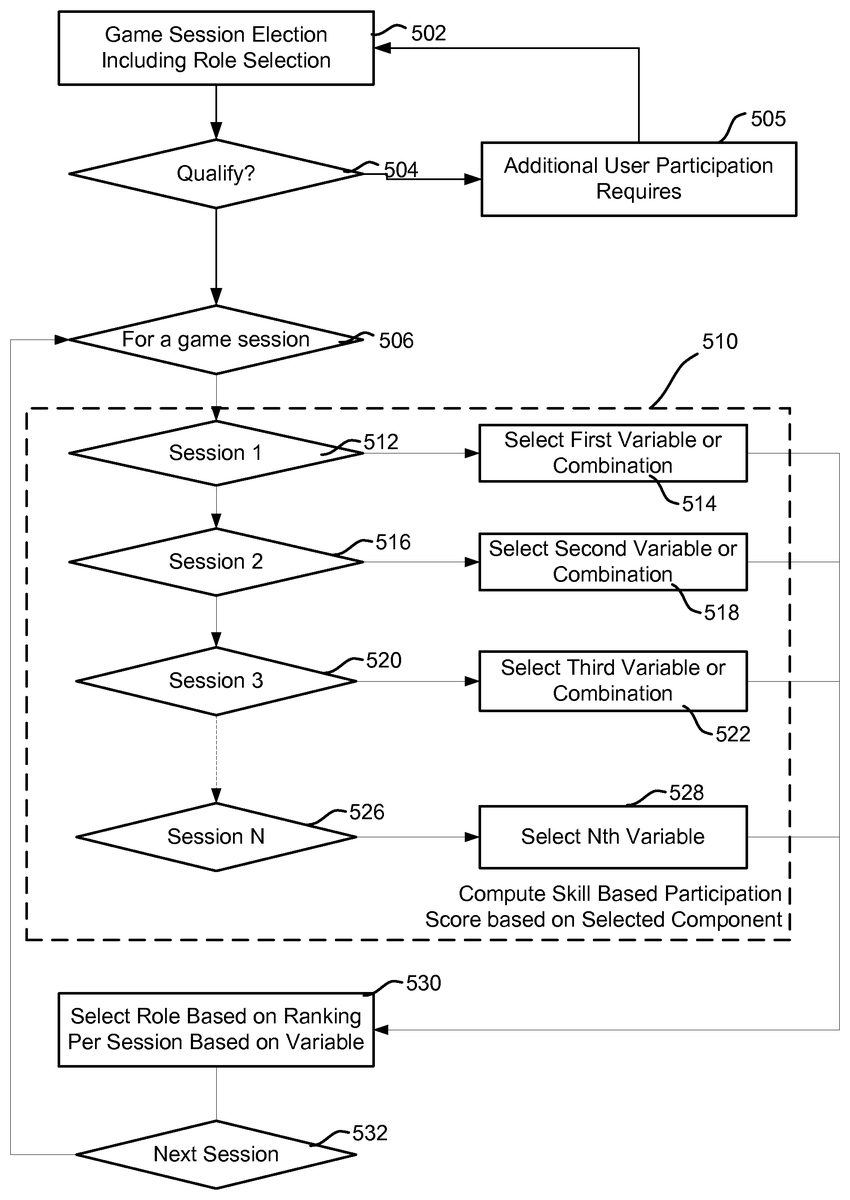
FIG. 5is a flow chart illustrating a process suitable for implementing the technology disclosed herein. The technology presented selects one or more users for elevated roles in one or more sessions (or “episodes”) of a multiplayer game. The technology is applicable to any skill based game wherein users may be provided with greater incentives based on different roles within the game. Use of different roles which provide player with an advantage during game play may be used as incentives to generate interest in the game amongst various levels of users. In order to incentivize long standing players, role selection should provide some benefits to such advanced players. Similarly, casual or relatively new participants in the game should have some chance of being selected for elevated role participation in order to generate interest from new players.
At502, a game session election is made by a user. The selection will include an elevated role selection for the game. In one embodiment, an on-line multiplayer game will include different roles for different players. One role may comprise a basic role for an unlimited or very large number of users to allow participation by anyone desiring to play some part of the game to participate. Other, higher level roles may be provided which give a player greater challenges and greater rewards. In order to qualify for elevated roles, the game administrator may require some level of participation prior to allowing a user into the elevated role.
One example of such a multiplayer game is “1 vs. 100”, where at least three roles are provided. The basic format of 1 vs. 100 includes one player selected to play the game in an elevated role of “The One” against100other people, collectively known as “The Mob.” Everyone else remains in a role of “The Crowd”. During game play, a question is posed, and the One and the Mob must select an answer from three choices. If the One gets the question wrong, the game is over and prize money is split up amongst the Mob. If the One gets the answer right, members of the Mob who got the question wrong are eliminated. The payout goes up as members of the Mob are eliminated. The One can opt to quit with their winnings at various intervals, or press their luck and continue on. To win the game outright, the One must eliminate all 100 members of the Mob by answering questions correctly.
The Crowd is a role which allows players not in the role of the Mob and the One to compete in the game. Top members of the Crowd can win prizes. Each of the elevated roles provides greater incentives for players in that role. Note that some games, including the aforementioned 1 vs. 100, may need a minimum number of users to complete a game session. In the above example, at least 102 players are required—one player in the role of the One, one hundred players in the role of the Mob, and at least one player in the role of the Crowd.
When selecting an elevated role at502, the user may or may not have some participation credit in the game which is being selected. In order to allow users to participate in elevated roles in the game, a qualification check can be made at504. Qualification can take many forms depending on the format of the game and choices by the game designer. In one embodiment, qualification is based on at least some participation in a basic role in the game by the user. In alternative embodiments, no qualification is required. In the following example, qualification is based on at least some participation in a basic role.
If the user is not qualified at504, the user may be prompted at505to participate in one or more qualifying sessions to allow the user to accumulate enough participation to attempt to qualify for higher levels in the game session at504. At506, for each game session, the steps indicated at box510may be performed to select the user role based on individual game sessions and skill-based metrics. For a first session512, a first component or combination of components may be selected at514. Likewise, for a second session516and a third session520, a second component or combination of components516or a third component or combination of components at522may be selected. Any number of sessions as indicated by session “N” at526and any number of components or combination of components at528may be used to select an elevated role at530based on the ranking of the user for a given session based on a given set of participation components. In one embodiment, the first, second, third and Nth components are different for each session. In an alternative embodiment, one or more of the components may be the same for different sessions. In general, participation components may include a user's absolute score in a game as computed by the game rules, metrics based on a particular time such as how long a user has been participating in the game, or score as a function of time so that a user efforts within a particular time window are used to compute the user's availability to participate in a particular role in a gaming session.
At steps514,518,522or528, any number of skill based components may be used in a function to compute a user assignment to a particular role in a game. In one embodiment, the components selected at steps514,518,522or528, compute a ranking score at530that is used to select the user's role. Selected users having ranking scores meeting criteria defined by a game administrator may be selected for elevated roles. In one embodiment, role selection is based on ranking the users relative to their highest to lowest ranking score, with users having a higher score selected for elevated roles.
Any number of methods for selecting the elevated role based on a ranking per user session may be provided. In one embodiment, a “session” may comprise an “episode”, where an episode is a pre-scheduled game event with a specific duration. However, sessions need not be pre-scheduled or have a specific duration. The method repeats at532for each session scheduled.
A specific example of a skill-based game utilizing the ranking system as disclosed inFIG. 5is illustrated inFIG. 6. In the example ofFIG. 6, a method for selecting users in roles for the online multiplayer game 1 vs. 100 is shown. At600inFIG. 6, a user may optionally select to participate in one or more gaming session(s) wherein the user has a base role or, in the case of 1 vs. 100, participates in the role of the Crowd. In the context of the game, the user may generate one or more metrics based on skill and participation as a result of the user's participation in the game.
InFIG. 6, at600, the user selects to participate in an online multiplayer game. In600, the user may or may not have participated in the game before. At602, a user selects to be participated in a higher role in the game—in this case the user selects to participate as the One or the Mob. A qualification check is made at604and if the user has not participated in the game, at605, the user may participate in game play and acquire a score over time. In the 1 vs. 100 example, the game includes a single player, the One, a Mob, comprised of, for example, 100 players, and a Crowd comprised of all players who wish to participate in the game but do not have specific elevated roles such as the One or the Mob. Users who have no participation basis in the game, participate in the game to acquire a score over time. Once a user has acquired some score, at605, the user may select a role in the game.
At602, the user may desire to participate as the role of the One or the Mob. In order to acquire higher prizes in the game, the user will select a role giving the user his best chance to achieve a higher score or prize. As will be understood, the role and the manner of selection of a role can vary from game to game. In one embodiment, players may simply choose to remain private or public in game play, and users choosing private will never be selected for an elevated role such as the One or the Mob. At606for every game session, the steps in box607are performed to compute a skill based participation score based on a skill component. In one embodiment, the skill component is the user's game score which reflects the user's accuracy and speed in answering questions.
At607, three components are used in a rotation over a series of sessions. The components may comprise a user's game score during a selected time period. In a first session in the rotation at608, a user's score over a first time period at610is used. Likewise, for second and third sessions in the rotation, at612and616, the user's score over a second period of time614or third period of time618are utilized. The score is the user's score as determined by the rules of the particular game. A first time period may, for example, comprise the entire time the user has participated in the game, a second time period may comprise a shorter time period, such as a week, and a third time period may comprise an even shorter time period such as, for example, a single game session. This allows the users of varying participation a chance to achieve the elevated role in game playing.
At620, the user's ranking score is computed based on the component used. A process for computing a ranking score is illustrated inFIG. 7. Once the ranking score is computed, the ranking score is sent to the gaming service at622where it will be used to assign roles by the gaming service. In one embodiment, the gaming service will return a ranked list of all users in elevated roles to the console at623and the game will be populated with the elevated users in such roles based on the user's position on the ranked list at624. It will be understood that in one embodiment, this population and ranking can occur on the console, while in other embodiments the gaming service may return a specific role assignment for the console user (and/or a list of other users in elevated roles which have been pre-assigned by the service). The console then waits for the next session at625.
FIG. 7illustrates a process for computing a ranking score. In one embodiment, the ranking score includes a skill component and a tie breaking component, and is biased against users who have participated in the elevated role previously.
At702, once a user selects a role, a determination is made as to whether or not the user has been previously selected for that role or another role which would justify a bias against selecting a user for an elevated role. Bias against users who have participated in an elevated role may be maintained for some time period and then removed. If the user has been previously selected for the elevated role, a computing using a biased ranking function is made at706. If the user has not been selected for an elevated role previously, then the standard ranking function is utilized at708.
The technology herein ensures that many people, especially mid or late season players in a particular session, have a chance to participate in different elevated roles. In the functions used in steps706and708, skill is the dominant element in determining role for a user. Skill may be determined by the game score and hence the rules of the particular game in use. In one embodiment, a ranking score computation is designed so that a single 64-bit value is created that can be sorted to determine the top players as illustrated inFIG. 8. A primary selection criterion (e.g. skill) is the most significant part of the number and tiebreakers become the least significant part. In alternative embodiments, other selection criteria can be used. Other such metrics for selection criteria may include participation, number of questions answered, speed of questions answered, accuracy of questions answered, all of which can be measured over different time periods.
In general, a ranking score function can be described as f(x1, x2, x3 . . . xn), where f is a function of n independent variables returning a score over which the users are ranked. The range of the function is some number of bits in the function should have criteria that balance various factors in the game. Certain selection criteria, such as the number of questions answered, would have a much greater chance of resulting in a tie between the numbers of different players. As such cases, a tiebreaker component is used (a secondary selection of criteria) to break any possible ties. In one embodiment, it is desirable to perform the selection in one pass of the function.
As illustrated inFIG. 7, one ranking function may comprise f(x, y)=x+1/y, where x is a value that can be any one of the three criteria described above (such as a user score over a session, week or since inception) and y is a fractional number utilized as a tiebreaker. Y may comprise a time, in milliseconds, that the user has been playing the game If the user had been in the role they were applying for previously, then f(x, y)=−1/(x+1/y). This allows for all eligible or ineligible players to be gauged on the same set of values with a single pass.
FIG. 8illustrates the process provided by the game management service to select users for an elevated role. At802, the user's role selection is received. As noted above, this may be an explicit or implicit selection, the latter based on whether the user selects to remain private in game participation. At804, the users are ordered by the ranking value of the particular gaming session. The list may include the user's ranking and/or an assignment of the user to a particular role. Where the entire users list is returned to the user game device, the game device may derive role selection by reference to each user's placement on the list. In one embodiment, the game is populated with users in particular roles on the console, while in an alternative embodiment, the role assignment is made by the service. In one embodiment, where the aforementioned 1 vs. 100 game is used, the ranking comprises of assigning the user with the highest ranking score to the role of the One, assigning the user with scores2through101to the role of the Mob, and assigning all other users to the role of the Crowd. In alternative embodiment, elevated roles may be assigned based on different rankings of users relative to their ranking score, including, for example selecting users other than the highest ranked user for the One (e.g. 10th or 20th user), or selecting a random user in a range of users ranked on the list (e.g. a random selection of those placing 1-10 on the list). At806, a determination is made as to whether a sufficient number of users have been provided for in the game, If so, the ranking list (or role assignment) is returned at812. If not, then at814the selection process returns to602and the process from602to806is repeated (at814) until a sufficient number of players (such as 102 in the 1 vs. 100 example) are in the game.
Although the subject matter has been described in language specific to structural features and/or methodological acts, it is to be understood that the subject matter defined in the appended claims is not necessarily limited to the specific features or acts described above. Rather, the specific features and acts described above are disclosed as example forms of implementing the claims.
Claims
- A computer implemented method for assigning a role to each user in a plurality of users in an online multiplayer game implemented by a processing device, the game organized into a plurality of sessions and having a plurality of gameplay roles including at least an elevated gameplay role, the plurality of gameplay roles comprising different gameplay incentives, comprising: receiving a selection of the gameplay role from two or more users of the plurality of users to participate in a session of the game;and for the session: selecting a plurality of metrics for use in determination of a gameplay role for the two or more users over a time period, computing a ranking score for each of the two or more users based on the plurality of metrics over the time period by assigning a function to each selected metric, ranking the two or more users based on the ranking scores, and assigning a role to each of the two or more users in the multiplayer game based on the ranking, including assigning at least one of the two or more users from whom a selection was received to the elevated gameplay role.
- The method of claim 1 wherein the plurality of metrics comprises a skill based metric.
- The method of claim 2 wherein the skill based metric comprises a game score and the game score is determined based on rules of the game.
- The method of claim 2 wherein the time period comprises an alternating one of a session, an hour, a day, a week, and a total time a user has participated in the game.
- The method of claim 2 wherein the step of computing comprises using a skill component and a tie breaking component.
- The method of claim 1 wherein the step of computing includes computing the ranking score based on a first function if the user has not participated in the role and based on a second function biased against the user if the user has participated in the role.
- The method of claim 1 wherein the time periods comprises one of three time periods used in a rotation over the plurality of sessions such that in a first session in the rotation, a first time period is used, over a second session in the rotation, a second time period is used and in a third session, a third time period is used, each of the first, second and third time periods being different.
- The method of claim 1 further including receiving user participation in the game prior to receiving the request.
- The method of claim 1 wherein the plurality of metrics comprises one of a user participation in the game, speed, accuracy, and/or number of questions answered.
- A computer implemented method for determining a role for each of a plurality of users in an online multiple game operated by a processing device, comprising: providing the online multiple game organized into a plurality of sessions, each session having a time period and a plurality of gameplay roles, including at least two different gameplay roles with different game incentives in the session;receiving a gameplay role request from a plurality of users to participate in the session in the different gameplay roles;determining a ranking for each of the plurality of users, the ranking being determined based on a plurality of skill based parameters derived from user participation in the online multiplayer game;and outputting the ranking of users, the ranking determining one or more users in the plurality of users filling each different gameplay role, and the ranking being determined by assigning a function to each of the plurality of skill based parameters.
- The method of claim 10 wherein the at least two different gameplay roles include a first role having a higher chance of success in succeeding in the game than a second role.
- The method of claim 10 wherein said step of determining comprises, for each session, selecting at least two skill based parameters over a time period, computing a ranking score for each of the plurality of users based on the at least two skill based parameters over the time period, and ranking the users based on the ranking score.
- The method of claim 12 wherein said step of determining uses a different time period for each session and the time period comprises one of a session, an hour, a day, a week, or a total time a user has participated in the game.
- The method of claim 13 wherein the at least two skill based parameters comprise one skill based parameter and a tie breaking component.
- The method of claim 14 wherein the step of computing comprises summing the one skill based parameter and an inverse of a total time a user has participated in the online multiplayer game.
- The method of claim 12 wherein the step of computing includes computing the ranking score for each of the plurality of users based on a first function if a user has not participated in the role and based on a second function biased against the user if the user has participated in the role.
- A computer implemented process providing an interactive networked multiplayer game operated by a processing device having a plurality of users in a plurality of game roles in one or more sessions of the multiplayer game, comprising: providing a general user role allowing a user to participate in one or more sessions of the multiplayer game to generate a skill based score in the one or more sessions of the multiplayer game;providing an elevated role subject to different gameplay incentives than the general user role;receiving a request from the user to participate in the elevated role in a session of the one or more sessions of the multiplayer game;for each user whom a request to participate in the elevated role has been received, determining a user ranking score based on participation by the user in one or more previous sessions in which the user has generated a skill based score based on a plurality of metrics, the ranking score being based in part on the skill based score during the one or more previous sessions over a time period, and a tie breaking score;comparing the user ranking scores from plurality of users from whom a request to participate in the elevated role has been received;assigning users to the elevated role and to the general user role based on each user's ranking score;and starting a game session with users in the assigned roles.
- The computer implemented process of claim 17 wherein the step of determining includes computing the ranking score for each of the plurality of users based on a first function if a user has not participated in the role and based on a second function biased against the user if the user has participated in the role.
- The computer implemented process of claim 17 wherein the receiving, determining, comparing and assigning steps are repeated if an insufficient number of requests from users to fill all roles required for the game are received.
Disclaimer: Data collected from the USPTO and may be malformed, incomplete, and/or otherwise inaccurate.