U.S. Pat. No. 8,317,605
METHOD OF GAMING, A GAMING SYSTEM AND A GAME CONTROLLER
AssigneeAristocrat Technologies Australia Pty Limited
Issue DateMarch 27, 2009
Illustrative Figure
Abstract
A method of gaming comprising conducting one or more paid game rounds initiated in response to the payment of a wager by a player and a series of one or more free game rounds initiated in response to a free game series trigger event, the method comprising: in each paid game round, selecting a set of paid game round symbols for display to the player, determining a paid game round outcome based on the selected symbols, and incrementing a jackpot by a paid game jackpot increment; in each free game round, selecting a set of free game round symbols for display to the player, determining a free game round outcome based on the selected symbols, and incrementing the jackpot by a free game jackpot increment; and awarding the jackpot on the occurrence of a jackpot award event.
Description
DETAILED DESCRIPTION OF THE INVENTION Referring to the drawings, there is shown a gaming system having a game controller arranged to implement a game wherein a progressive jackpot is incremented during each free game of a free game series when a free game series is awarded. The gaming system may take a number of different forms. In a first form, a stand alone gaming machine is provided wherein all or most components required for implementing the game are present in a player operable gaming machine. In a second form, a distributed architecture is provided wherein some of the components required for implementing the game are present in a player operable gaming machine and some of the components required for implementing the game are located remotely relative to the gaming machine. For example, a “thick client” architecture may be used wherein part of the game is executed on a player operable gaming machine and part of the game is executed remotely, such as by a gaming server; or a “thin client”architecture may be used wherein most of the game is executed remotely such as by a gaming server and a player operable gaming machine is used only to display audible and/or visible gaming information to the player and receive gaming inputs from the player. However, it will be understood that other arrangements are envisaged. For example, an architecture may be provided wherein a gaming machine is networked to a gaming server and the respective functions of the gaming machine and the gaming server are selectively modifiable. For example, the gaming system may operate in stand alone gaming machine mode, “thick client” mode or “thin client” mode depending on the game being played, operating conditions, and so on. Other variations will be apparent to persons skilled in the art. Irrespective of the ...
DETAILED DESCRIPTION OF THE INVENTION
Referring to the drawings, there is shown a gaming system having a game controller arranged to implement a game wherein a progressive jackpot is incremented during each free game of a free game series when a free game series is awarded.
The gaming system may take a number of different forms. In a first form, a stand alone gaming machine is provided wherein all or most components required for implementing the game are present in a player operable gaming machine.
In a second form, a distributed architecture is provided wherein some of the components required for implementing the game are present in a player operable gaming machine and some of the components required for implementing the game are located remotely relative to the gaming machine. For example, a “thick client” architecture may be used wherein part of the game is executed on a player operable gaming machine and part of the game is executed remotely, such as by a gaming server; or a “thin client”architecture may be used wherein most of the game is executed remotely such as by a gaming server and a player operable gaming machine is used only to display audible and/or visible gaming information to the player and receive gaming inputs from the player.
However, it will be understood that other arrangements are envisaged. For example, an architecture may be provided wherein a gaming machine is networked to a gaming server and the respective functions of the gaming machine and the gaming server are selectively modifiable. For example, the gaming system may operate in stand alone gaming machine mode, “thick client” mode or “thin client” mode depending on the game being played, operating conditions, and so on. Other variations will be apparent to persons skilled in the art.
Irrespective of the form, the gaming system comprises several core components. At the broadest level, the core components are a player interface50and a game controller60as illustrated inFIG. 1. The player interface is arranged to enable manual interaction between a player and the gaming system and for this purpose includes the input/output components required for the player to enter instructions and play the game.
Components of the player interface may vary from embodiment to embodiment but will typically include a credit mechanism52to enable a player to input credits and receive payouts, one or more displays54, a game play mechanism56comprising one or more input devices that enable a player to input game play instructions (e.g. to place bets), and one or more speakers58.
The game controller60is in data communication with the player interface and typically includes a processor62that processes the game play instructions in accordance with game play rules and outputs game play outcomes to the display. Typically, the game play instructions are stored as program code in a memory64but can also be hardwired. Herein the term “processor” is used to refer generically to any device that can process game play instructions in accordance with game play rules and may include: a microprocessor, microcontroller, programmable logic device or other computational device, a general purpose computer (e.g. a PC) or a server.
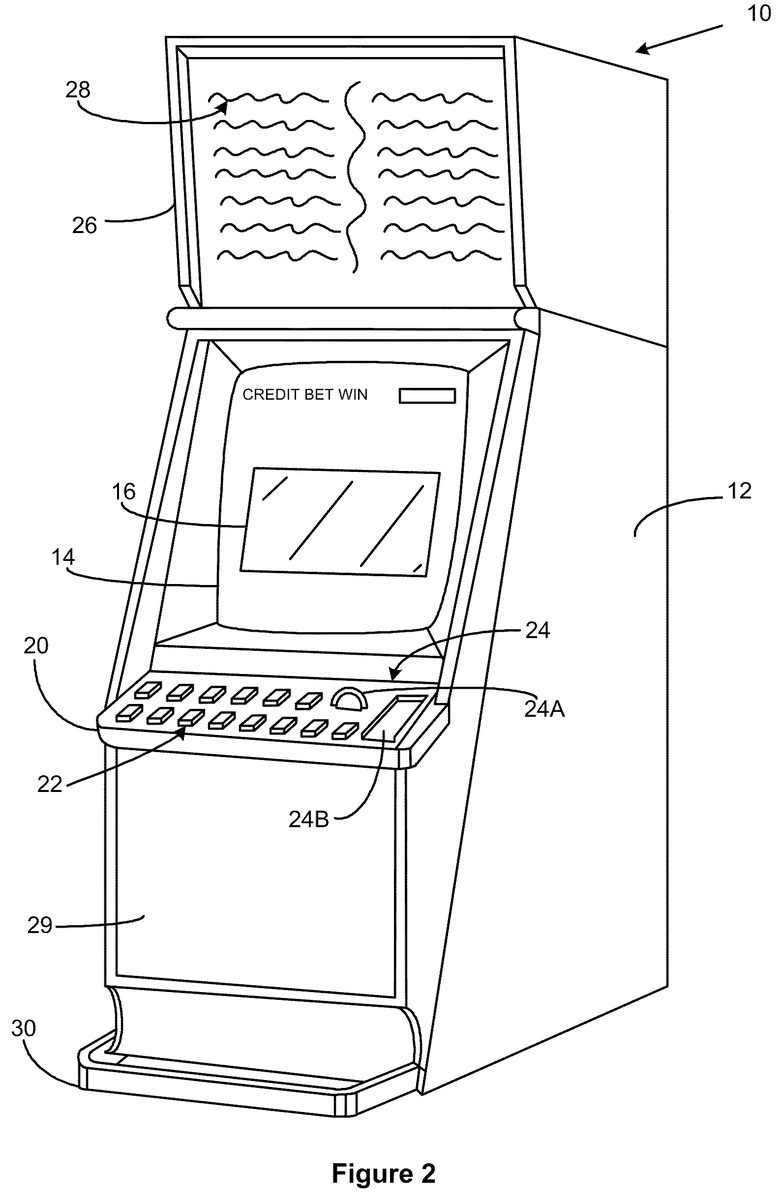
A gaming system in the form of a stand alone gaming machine10is illustrated inFIG. 2. The gaming machine10includes a console12having a display14on which are displayed representations of a game16that can be played by a player. A mid-trim20of the gaming machine10houses a bank of buttons22providing input devices for enabling a player to interact with the gaming machine, in particular during game play. The mid-trim20also houses a credit input mechanism24which in this example includes a coin input chute24A and a bill collector24B. Other credit input mechanisms may also be employed, for example, a card reader for reading a smart card, debit card or credit card. A player marketing module (not shown) having a reading device may also be provided for the purpose of reading a player tracking device, for example as part of a loyalty program. The player tracking device may be in the form of a card, flash drive or any other portable storage medium capable of being read by the reading device.
A top box26may carry artwork28, including for example pay tables and details of bonus awards and other information or images relating to the game. Further artwork and/or information may be provided on a front panel29of the console12. A coin tray30is mounted beneath the front panel29for dispensing cash payouts from the gaming machine10.
The display14shown inFIG. 2is in the form of a video display unit, particularly a cathode ray tube screen device. Alternatively, the display14may be a liquid crystal display, plasma screen, any other suitable video display unit, or the visible portion of an electromechanical device. The top box26may also include a display, for example a video display unit, which may be of the same type as the display14, or of a different type.
FIG. 3shows a block diagram of operative components of a typical gaming machine which may be the same as or different to the gaming machine ofFIG. 2.
The gaming machine100includes a game controller101having a processor102. Instructions and data to control operation of the processor102are stored in a memory103, which is in data communication with the processor102. Typically, the gaming machine100will include both volatile and non-volatile memory and more than one of each type of memory, with such memories being collectively represented by the memory103.
The gaming machine has hardware meters104for purposes including ensuring regulatory compliance and monitoring player credit, an input/output (I/O) interface105for communicating with peripheral devices of the gaming machine100. The input/output interface105and/or the peripheral devices may be intelligent devices with their own memory for storing associated instructions and data for use with the input/output interface or the peripheral devices. A random number generator module113generates random numbers for use by the processor102. Persons skilled in the art will appreciate that the reference to random numbers includes pseudo-random numbers.
In the example shown inFIG. 3, a player interface120includes peripheral devices that communicate with the game controller101and comprise one or more displays106, a touch screen and/or buttons107, a card and/or ticket reader108, a printer109, a bill acceptor and/or coin input mechanism110and a coin output mechanism111. Additional hardware may be included as part of the gaming machine100, or hardware may be omitted as required for the specific implementation. For example, while input devices in the form of a touch screen or buttons are commonly used in gaming machines, other input devices could be used to form a game play mechanism. For example, in some gaming machines a handle is uses to initiate a play of the game.
In addition, the gaming machine100may include a communications interface, for example a network card112. The network card may, for example, send status information, accounting information or other information to a central controller, server or database and receive data or commands from the central controller, server or database.
FIG. 4shows a block diagram of the main components of an exemplary memory103. The memory103includes RAM103A, EPROM103B and a mass storage device103C. The RAM103A typically temporarily holds program files for execution by the processor102and related data. The EPROM103B may be a boot ROM device and/or may contain some system or game related code. The mass storage device103C is typically used to store game programs, the integrity of which may be verified and/or authenticated by the processor102using protected code from the EPROM103B or elsewhere.
It is also possible for the operative components of the gaming machine100to be distributed, for example input/output devices106,107,108,109,110,111to be provided remotely from the game controller101.
FIG. 5shows a gaming system200in accordance with an alternative embodiment. The gaming system200includes a network201, which for example may be an Ethernet network. Gaming machines202, shown arranged in three banks203of two gaming machines202inFIG. 5, are connected to the network201. The gaming machines202provide a player operable interface and may be the same as the gaming machines10,100shown inFIGS. 2 and 3, or may have simplified functionality depending on the requirements for implementing game play. While banks203of two gaming machines are illustrated inFIG. 5, banks of one, three or more gaming machines are also envisaged.
One or more displays204may also be connected to the network201. For example, the displays204may be associated with one or more banks203of gaming machines. The displays204may be used to display representations associated with game play on the gaming machines202, and/or used to display other representations, for example promotional or informational material.
In a thick client embodiment, game server205implements part of the game played by a player using a gaming machine202and the gaming machine202implements part of the game. With this embodiment, as both the game server and the gaming device implement part of the game, they collectively provide a game controller. A database management server206may manage storage of game programs and associated data for downloading or access by the gaming devices202in a database206A. Typically, if the gaming system enables players to participate in a Jackpot game, a Jackpot server207will be provided to perform accounting functions for the Jackpot game. A loyalty program server212may also be provided.
In a thin client embodiment, game server205implements most or all of the game played by a player using a gaming machine202and the gaming machine202essentially provides only the player interface. With this embodiment, the game server205provides the game controller. The gaming machine will receive player instructions, pass these to the game server which will process them and return game play outcomes to the gaming machine for display. In a thin client embodiment, the gaming machines could be computer terminals, e.g. PCs running software that provides a player interface operable using standard computer input and output components.
Servers are also typically provided to assist in the administration of the gaming network200, including for example a gaming floor management server208, and a licensing server209to monitor the use of licenses relating to particular games. An administrator terminal210is provided to allow an administrator to run the network201and the devices connected to the network.
The gaming system200may communicate with other gaming systems, other local networks, for example a corporate network, and/or a wide area network such as the Internet, for example through a firewall211.
Persons skilled in the art will appreciate that in accordance with known techniques, functionality at the server side of the network may be distributed over a plurality of different computers. For example, elements may be run as a single “engine” on one server or a separate server may be provided. For example, the game server205could run a random generator engine. Alternatively, a separate random number generator server could be provided. Further, persons skilled in the art will appreciate that a plurality of games servers could be provided to run different games or a single game server may run a plurality of different games as required by the terminals.
This invention can apply to all forms of games such as card games, keno, bingo, pin and ball games or any other game which has an incrementing jackpot.
Embodiments of the invention relate to gaming systems for implementing games that involve a display of spinning reels as part of the display of the outcome of the game.
The game controllers of such gaming systems have a stop determining function that determines the stop position for each reel. For example, if there are five reels, each having twenty symbols, the stop determining function might determine that the stop positions are positions:3,13,7,9and17. The spinning of the reels is then controlled so that each symbol comes to a stop in the same row, typically a predetermined row in a “window” corresponding to a “single win line” game. When a reel stops, the symbols will be in one of a plurality of possible symbol positions for that reel relative to the stop position.
Exemplary embodiments of the present invention relate to gaming systems that allow a player to select, in non-feature games, how many win lines of a plurality of win lines they will play in each game—i.e. a minimum of one win line up to the maximum number of win lines allowed by the game. Each win line is formed by a set of symbol positions consisting of one symbol position from each reel. That is, a predetermined symbol position of each reel is assigned to a win line. The symbol positions that constitute each of the win lines are usually advertised to the player by markings on the display or diagrams showing the symbol positions that correspond to each win line.
The game controller of one embodiment is shown in more detail inFIG. 6. The game controller60incorporates a processor62which implements in software paid game round controller610and free game round controller611, operably interconnected with random number generator650, free game series trigger controller670and jackpot awarder660. Paid game round controller610further comprises paid game round symbol selector620, paid game round outcome determiner630and paid game round jackpot incrementer640. Similarly, free game round controller611further comprises free game round symbol selector621, free game round outcome determiner631and free game round jackpot incrementer641. Connected to the processor62is a memory64incorporating game instructions644, symbol lists643, symbol set data642, prize data645, meter data646and jackpot data647.
Persons skilled in the art will appreciate that one or more of these components could be provided in other ways, for example by a dedicated circuit.
In an example of a game to which the invention is applied, in a paid game round controlled by paid game round controller610, paid game round symbol selector620selects symbols for display from symbol lists643, updates symbol set data642with the selected set of symbols and displays the set of symbols in their assigned display positions on the display54. Paid game round outcome determiner630determines a paid game round outcome based on the win lines defining one symbol on each reel, using prize data645and then updates meter data646. Paid game round jackpot incrementer640then increments the jackpot in jackpot data647by the paid game round jackpot increment. In a free game round, part of a series of one or more free game rounds triggered under the control of free game series trigger controller670by a random free game trigger event, free game round symbol selector621selects symbols for display from symbol lists643, updates symbol set data642with the selected set of symbols and displays the set of symbols in their assigned display positions on the display54. Free game round outcome determiner631determines a free game round outcome based on the win lines defining one symbol on each reel, using prize data645and then updates meter data646. Free game round jackpot incrementer641then increments the jackpot in jackpot data647by the free game round jackpot increment. After the game round, either free or paid, jackpot awarder660determines whether to award the jackpot or allow it to increment further in the next game. Thus according to the invention both the free game rounds and the paid game rounds cause the jackpot to increment.
Now referring toFIG. 7, a flow diagram for an embodiment of the invention is shown. At the beginning of each game round, game controller60in step1201determines whether the game round is to be free or paid and passes control to either the free game round controller611or paid game round controller610respectively. A free game is either part of a new series as specified by free game series trigger controller670or one of an unfinished series of free game rounds previously started by free game series trigger controller670. A paid game begins by the acceptance of a wager from the player in step1202. Typically the acceptance of the wager will be an automatic step consisting of the decrement by a predetermined wager amount of a credit balance previously paid by the player. In step1203paid game round symbols are selected and a paid game round outcome is determined. Then in step1204the jackpot in jackpot data647is incremented by the paid game round jackpot increment. A free game round skips the wager step and in step1205, free game round symbols are selected and a free game round outcome is determined. In simple embodiments the free and paid game round symbols are selected from the same set of symbols and the outcomes are determined from the same set of rules. In accordance with the invention, in step1206the jackpot in jackpot data647is incremented by a free game round jackpot increment. In simple embodiments, the paid and free game round jackpot increments are an equal fixed amount. In step1207, jackpot awarder660determines whether the jackpot should be awarded. If so, the jackpot is awarded, updating meter data646and jackpot data647is reset to zero. Control then returns to step1201for the next game round.
EXAMPLE 1
A specific example of a game according to the invention is now described, with particular reference to a computation method for determining the jackpot increment i in order not to modify expected total winnings per wager. In this example where the free game and paid game round jackpot increments are the same.
There is a desired amount of the average jackpot increment per wager d which is simply set as the increment after each wager in the prior art systems where the free game jackpot increment is zero. In order to maintain the average jackpot increment per wager at d when the paid game and free game jackpot increments are both the same, the jackpot increment must be reduced by a factor equal to the expected average total number of games as a ratio of the total number of wager games.
In this example, free game trigger events can only occur in paid game rounds and cannot be awarded inside a free game round. In this circumstance, the ratio of total games to wager games is (1+n/t) where n is the average number of free game rounds in each series of free game rounds, and t is the average number of game rounds between free game series trigger events. The actual number of free game rounds and the actual number of game rounds between free game series trigger events in general belongs to a probability distribution with mean n and t respectively to maintain player anticipation as to the number which might be awarded after each free game series trigger event and when they might occur.
Consequently d is maintained as the average amount of the jackpot increment per unit wager if the jackpot increment i is chosen so that i=w*d/(1+n/t), where w is the wager in each of the paid games.
Consider for the sake of clarity some particular numbers applied to this example. The wager is $2 and the desired average increment per unit wager is d=0.01. The average number of free games awarded in a free game series is n=10, and the average number of game rounds between free game trigger events is t=100. Using the formula, i=$2*0.01/(1+0.1)=$0.018181818 . . . =1.8181818. . . cents.
EXAMPLE 2
In this example, the case of a free game trigger event which can occur with equal probability in the free games and the paid games is considered. In this case, the ratio of total games to paid games is slightly larger than in example 1 and is a infinite geometric series (1+n/t+(n/t)2+(n/t)3+. . . ) converging, as long as n<t, to 1/(1−n/t). The formula for i thus takes the simple form i=w*d*(1−n/t).
Consider some particular numbers applied to this example. The wager is $2 and the desired average increment per unit wager is d=0.01. The average number of free games awarded in a free game series is n=10, and the average number of game rounds between free game series trigger events is t=100. Using the formula, i=$2*0.01*(1−0.1)=$0.018=1.8 cents.
EXAMPLE 3
In this example, free game series cannot be triggered during free games, as in example 1, but the increments to be applied to the free games and the paid games are not equal. To make the free games have even more value the free game jackpot increment can be larger, or to make the free games less valuable the free game jackpot increment can be smaller than the paid game jackpot increment. Call the ratio of free game jackpot increment to paid game jackpot increment r, so that the paid game jackpot increment is i and the free game jackpot increment is i*r. In this case, to achieve d we need i=w*d/(1+r*n/t).
If the same numbers as in example 1 are used and r=2, the paid game increment i is $2*0.01/(1+2*0.1)=$0.016666 . . . =1.666. . . cents.
EXAMPLE 4
In this example, free game series can be triggered during free games, as in example 2, but as in example 3 the increments to be applied to the free games and the paid games are not equal. As in example 3 call the ratio of free game jackpot increment to paid game jackpot increment r, so that the paid game jackpot increment is i and the free game jackpot increment is i*r. In this case, to achieve d we need i=w*d/(1+r*((n/t)+(n/t)2+(n/t)3+(n/t)4+ . . . )), which converges when n<t to i=w*d*(1−n/t)/(1−n/t(1−r))
If the same numbers as in example 2 are used and r=2, the paid game increment i is $2*0.01*(1−0.1)/(1−0.1*(1−2))=$2*0.01*0.9/1.1=1.6363636 . . . cents.
Persons skilled in the art will recognize that the invention resides in the additional possibilities that are presented by releasing the attachment of the jackpot increment to the wager, and more complex games than those exemplified here are within the scope of the invention. Also, the main game can be any game involving symbols and awards, not just spinning reels. Further, when the paid game and free games have sub-processes which are the same, the paid and free game controllers can have elements which are implemented in common, for example symbol selection can be performed be a common symbol selection function of the game controller.
Persons skilled in the art will appreciate that in some embodiments that the jackpot may be accrued and awarded in a number of different ways. For example, the gaming system may incorporate a jackpot controller205as shown inFIG. 5to accrue jackpot increments from a plurality of game controllers. In such embodiments, it will be appreciated that the jackpot incrementers of the game controller increment the jackpot in the sense that they cause the jackpot controller to increment a jackpot pool.
In such embodiments, the jackpot award event can be any of those known in the art, for example, a symbol combination occurring at the game controller of a gaming machine, a random calculation occurring at the gaming machine or the jackpot pool reaching a designated value as determined by the jackpot controller (i.e. such that the jackpot awarder is provided by the jackpot controller). It will also be appreciated that there may be a plural of different jackpot pools which may be associated with different jackpot award events.
Persons skilled in the art will appreciate that other aspects of existing progressive jackpots may also be included. For example, in many implementations of progressive jackpots, the machine or jackpot controller has an accounting feature which is a “pool” in which a percentage of all turnover is “stored”. (commonly referred to as a hidden meter). Start up amounts for jackpots are usually funded from these pools so that the jackpot starts at a non-zero amount after it has been won.
Persons skilled in the art will appreciate that the trigger event for the free game series may be any of the trigger events known in the art, for example a symbol combination, a turnover, a random determination, an external event etc.
Persons skilled in the art will appreciate that the method of the embodiment could be embodied in program code. The program code could be supplied in a number of ways, for example on a computer readable medium, such as a disc or a memory (for example, that could replace part of memory103) or as a data signal (for example, by downloading it from a server).
Persons skilled in the art will also appreciate that many variations may be made to the invention without departing from the scope of the invention. For example, features described above may be combined to form further embodiments.
In the claims which follow and in the preceding description of the invention, except where the context requires otherwise due to express language or necessary implication, the word “comprise” or variations such as “comprises” or “comprising” is used in an inclusive sense, i.e. to specify the presence of the stated features but not to preclude the presence or addition of further features in various embodiments of the invention.
It is to be understood that, if any prior art publication is referred to herein, such reference does not constitute an admission that the publication forms a part of the common general knowledge in the art, in Australia or any other country.
Claims
- A method of gaming comprising conducting one or more paid game rounds on a gaming machine having a display initiated in response to the payment of a wager by a player and a series of one or more free game rounds on the gaming machine initiated in response to a free game series trigger event, the method comprising: in each paid game round, selecting a set of paid game round symbols for display on the display to the player, determining a paid game round outcome based on the selected symbols, and incrementing a jackpot by a paid game jackpot increment;in each free game round, selecting a set of free game round symbols for display on the display to the player, determining a free game round outcome based on the selected symbols, and incrementing the jackpot by a free game jackpot increment;and awarding the jackpot on the occurrence of a jackpot award event, wherein the paid game jackpot increment, the free game jackpot increment, an expected number of free game rounds in each series of free game rounds and an average number of game rounds between the free game series trigger events are together chosen so as to provide an expected average jackpot increment per unit wager equal to a desired amount.
- A method according to claim 1 and further including a computer program code.
- A method according to claim 2 and further including a non-transitory computer readable medium comprising said program.
- A method according to claim 2 and further including a data signal comprising said computer program code.
- A method according to claim 2 and further including transmitting said computer program code.
- A method of gaming comprising conducting one or more paid game rounds on a gaming machine having a display initiated in response to the payment of a wager by a player and a series of one or more free game rounds on the gaming machine initiated in response to a free game series trigger event, the method comprising: in each paid game round, selecting a set of paid game round symbols for display on the display to the player, determining a paid game round outcome based on the selected symbols, and incrementing a jackpot by a paid game jackpot increment;in each free game round, selecting a set of free game round symbols for display on the display to the player, determining a free game round outcome based on the selected symbols, and incrementing the jackpot by a free game jackpot increment;and awarding the jackpot on the occurrence of a jackpot award event, wherein the paid game jackpot increment and the free game jackpot increment are equal such that there is a single jackpot increment i.
- A method of gaming as claimed in claim 6 wherein the free game series trigger event cannot occur during the free game rounds and the jackpot increment i is given by the formula i=w*d/(1+n/t), where w is the wager in the paid games, d is the desired amount of the average jackpot increment per unit wager, n is the expected number of free game rounds in each series of free game rounds, and t is the average number of game rounds between the free game trigger events.
- A method of gaming as claimed in claim 6 wherein the free game series trigger event can occur during the free game rounds and the jackpot increment i is given by the formula i=w*d*(1−n/t), where n<t and w is the wager in the paid games, d is the desired average jackpot increment, n is the expected number of free game rounds in each series of free game rounds, and t is the average number of game rounds between the free game trigger events.
- A method of gaming as claimed in claim 1 or 6 , wherein the symbols selected in the paid game rounds are displayed to the player in a set of display positions corresponding to respective ones of a plurality of spinning reels.
- A method of gaming as claimed in claim 1 or 6 wherein the symbols selected in the free game rounds are displayed to the player in a set of display positions corresponding to respective ones of a plurality of spinning reels.
- A method of gaming as claimed in claim 1 or 6 , wherein the steps of selecting symbols and determining game round outcomes are performed by a game controller.
- A method of gaming as claimed in claim 11 , wherein at least one of the steps of incrementing the jackpot and awarding the jackpot is performed by the game controller.
- A method of gaming as claimed in claim 11 , wherein at least one of the steps of incrementing the jackpot and awarding the jackpot is performed by a jackpot controller.
- A gaming system for implementing, on a gaming machine having a processor, a series of one or more paid game rounds initiated in response to the payment of a wager by a player and a series of one or more free game rounds initiated in response to a free game trigger event, comprising: a display for symbols to be displayed to the player;a paid game round controller for implementing in each paid game round, having a paid game round symbol selector for selecting a set of paid game round symbols for display to the player, a paid game round outcome determiner for determining a paid game round outcome based on the selected symbols, and a paid game round jackpot incrementer for incrementing a jackpot by a paid game jackpot increment;a free game series trigger controller for triggering a series of one or more free game rounds in response to a trigger event;a free game round controller for implementing each free game round, having a paid game round symbol selector for selecting a set of free game round symbols for display to the player, a free game round outcome determiner for determining a free game round outcome based on the selected symbols, and a free game round jackpot incrementer for incrementing the jackpot with a free game jackpot increment;and a jackpot awarder for awarding the jackpot on the occurrence of a jackpot award event, the gaming system adapted so that the paid game jackpot increment, the free game jackpot increment, an expected number of free game rounds in each series of free game rounds and an average number of game rounds between the free game series trigger events are together chosen so as to provide an expected average jackpot increment per unit wager equal to a desired amount.
- A gaming system for implementing, on a gaming machine having a processor, a series of one or more paid game rounds initiated in response to the payment of a wager by a player and a series of one or more free game rounds initiated in response to a free game trigger event, comprising: a display for symbols to be displayed to the player;a paid game round controller for implementing in each paid game round, having a paid game round symbol selector for selecting a set of paid game round symbols for display to the player, a paid game round outcome determiner for determining a paid game round outcome based on the selected symbols, and a paid game round jackpot incrementer for incrementing a jackpot by a paid game jackpot increment;a free game series trigger controller for triggering a series of one or more free game rounds in response to a trigger event;a free game round controller for implementing each free game round, having a paid game round symbol selector for selecting a set of free game round symbols for display to the player, a free game round outcome determiner for determining a free game round outcome based on the selected symbols, and a free game round jackpot incrementer for incrementing the jackpot with a free game jackpot increment;and a jackpot awarder for awarding the jackpot on the occurrence of a jackpot award event, wherein the jackpot incrementers are adapted so that the paid game jackpot increment and the free game jackpot increment are equal such that there is a single jackpot increment i.
- A gaming system as claimed in claim 15 wherein the free game series trigger controller is adapted so that the free game series trigger events cannot occur during the free game rounds, and the jackpot incrementers are adapted so that the jackpot increment i is given by the formula i=w*d/(1+n/t), where w is the wager in the paid games, d is the desired amount of the average jackpot increment per unit wager, n is the expected number of free game rounds in each series of free game rounds, and t is the average number of game rounds between the free game series trigger events.
- A gaming system as claimed in claim 15 wherein the free game series trigger controller is adapted so that the free game series trigger events can be awarded during the free game rounds, whereby the jackpot increment i is given by the formula i=w*d*(1−n/t), where n<t and w is the wager in the paid games, d is the desired average jackpot increment, n is the expected number of free game rounds in each series of free game rounds, and t is the average number of game rounds between the free game series trigger events.
- A gaming system as claimed in claim 14 or 15 wherein the symbols selected in the paid game rounds are displayed to the player in a set of display positions corresponding to respective ones of a plurality of spinning reels.
- A gaming system as claimed in claim 14 or 15 wherein the symbols selected in the free game rounds are displayed to the player in a set of display positions corresponding to respective ones of a plurality of spinning reels.
- A gaming system as claimed in claim 14 or 15 wherein at least one of the paid game round controller, the free game series trigger controller, the free game round controller, and the jackpot award controller is implemented at least in part, by a processor executing code stored in a memory.
- A gaming system as claimed in claim 14 or 15 wherein the display forms part of a player interface which further comprises a game play mechanism operable to place a bet.
- A gaming system as claimed in claim 14 or 15 comprising a jackpot controller arranged to maintain at least one jackpot pool formed from the jackpot increments.
- A gaming system as claimed in claim 22 , wherein the jackpot controller comprises the jackpot awarder.
- An electronic game controller for implementing a series of one or more paid game rounds initiated in response to the payment of a wager by a player and a series of one or more free game rounds initiated in response to a free game trigger event, comprising: a paid game round controller for implementing in each paid game round, having a paid game round symbol selector for selecting a set of paid game round symbols for display to the player on a display, a paid game round outcome determiner for determining a paid game round outcome based on the selected symbols, and a paid game round jackpot incrementer for incrementing a jackpot by a paid game jackpot increment;a free game series trigger controller for triggering a series of one or more free game rounds in response to a trigger event;and a free game round controller for implementing each free game round, having a paid game round symbol selector for selecting a set of free game round symbols for display to the player, a free game round outcome determiner for determining a free game round outcome based on the selected symbols, and a free game round jackpot incrementer for incrementing the jackpot with a free game jackpot increment, the game controller adapted so that the paid game jackpot increment, the free game jackpot increment, an expected number of free game rounds in each series of free game rounds and an average number of game rounds between the free game trigger events are together chosen so as to provide an expected average jackpot increment per unit wager equal to a desired amount.
- A game controller as claimed in claim 24 wherein the symbols selected in the free game rounds are displayed to the player in a set of display positions corresponding to respective ones of a plurality of spinning reels.
- An electronic game controller for implementing a series of one or more paid game rounds initiated in response to the payment of a wager by a player and a series of one or more free game rounds initiated in response to a free game trigger event, comprising: a paid game round controller for implementing in each paid game round, having a paid game round symbol selector for selecting a set of paid game round symbols for display to the player on a display, a paid game round outcome determiner for determining a paid game round outcome based on the selected symbols, and a paid game round jackpot incrementer for incrementing a jackpot by a paid game jackpot increment;a free game series trigger controller for triggering a series of one or more free game rounds in response to a trigger event;and a free game round controller for implementing each free game round, having a paid game round symbol selector for selecting a set of free game round symbols for display to the player, a free game round outcome determiner for determining a free game round outcome based on the selected symbols, and a free game round jackpot incrementer for incrementing the jackpot with a free game jackpot increment, wherein the jackpot incrementers are adapted so that the paid game jackpot increment and the free game jackpot increment are equal such that there is a single jackpot increment i.
- A game controller as claimed in claim 26 wherein the free game series trigger controller is adapted so that the free game series trigger events cannot be awarded during the free game rounds, and the jackpot incrementers are adapted so that the jackpot increment i is given by the formula i=w*d/(1+n/t), where n<t and w is the wager in the paid games, d is the desired amount of the average jackpot increment per unit wager, n is the expected number of free game rounds in each series of free game rounds, and t is the average number of game rounds between the free game series trigger events.
- A game controller as claimed in claim 26 wherein the free game series trigger controller is adapted so that the free game series trigger events can be awarded during the free game rounds, whereby the jackpot increment i is given by the formula i=w*d*(1−n/t), where n<t and w is the wager in the paid games, d is the desired average jackpot increment, n is the expected number of free game rounds in each series of free game rounds, and t is the average number of game rounds between the free game series trigger events.
- A game controller as claimed in claim 24 or 26 , further comprising a jackpot awarder for awarding the jackpot on the occurrence of a jackpot award event.
- A game controller as claimed in claim 24 or 26 wherein the symbols selected in the paid game rounds are displayed to the player in a set of display positions corresponding to respective ones of a plurality of spinning reels.
- A game controller as claimed in claim 24 or 26 wherein at least one of the paid game round controller, the free game series trigger controller, the free game round controller, and the jackpot award controller is implemented at least in part, by a processor executing code stored in a memory.
- A jackpot increment determining method for use with a gaming machine having an electronic controller, the method comprising one or more paid game rounds initiated in response to the payment of a wager by a player and a series of one or more free game rounds initiated in response to a free game series trigger event, wherein the same jackpot increment i is made in each of the paid and free game rounds and the free game series trigger event cannot occur during the free game rounds, the method comprising determining the jackpot increment i in accordance with the formula i=w*d/(1+n/t), where w is the wager in the paid games, d is the desired amount of the average jackpot increment per unit wager, n is the expected number of free game rounds in each series of free game rounds, and t is the average number of game rounds between the free game trigger events.
- A jackpot increment determining method for use with a gaming machine having an electronic controller, the method comprising one or more paid game rounds initiated in response to the payment of a wager by a player and a series of one or more free game rounds initiated in response to a free game series trigger event, wherein the same jackpot increment i is made in each of the paid and free game round and the free game series trigger event can occur during the free game rounds, the method comprising determining the jackpot increment i in accordance with the formula i=w*d*(1−n/t), where n wager in the paid games, d is the desired average jackpot increment, n is the expected number of free game rounds in each series of free game rounds, and t is the average number of game rounds between the free game trigger events.
Disclaimer: Data collected from the USPTO and may be malformed, incomplete, and/or otherwise inaccurate.