U.S. Pat. No. 8,292,745
CONVERTIBLE RAIL FOR SELECTING PLAYER-TRACKING MODES IN AN ELECTRONIC GAME TABLE
AssigneeDigideal Corp
Issue DateFebruary 27, 2009
Illustrative Figure
Abstract
Convertible rails for selecting player-tracking modes in an electronic game table are described. In one implementation, a rail or trim surrounds the periphery of the tabletop of an electronic game table. The rail has recessed bay openings for mounting user-interface hardware, such as for player-tracking. Player-tracking hardware may include, for example, touch-screen displays for manual input of user information, and player-identification card readers. A proprietor may install interchangeable rail section covers to expose some, all, or none of the bays. Thus, in a non-tracking mode, the bays may be covered, while in a tracking mode, some degree of player-tracking hardware mounted in the bays may be exposed to the user. In other implementations, interchangeable covers hide bays or expose hardware mounted on the tabletop itself. When the bays are covered, the cover blends in with the appearance and the surface of the tabletop, but the cover may be removed or swapped out in order to add selected hardware for the game table user.
Description
DETAILED DESCRIPTION Overview This disclosure describes convertible rails for selecting player-tracking modes in an electronic game table. In one implementation, a rail or trim surrounds the periphery of the tabletop of an electronic game table. The rail has recessed bay openings for mounting user-interface hardware, such as hardware for player-tracking. The player-tracking hardware may include, for example, touch-screen displays for manual input of user information, and player-identification card readers. A proprietor may install interchangeable rail section covers to expose some, all, or none of the bays or the player-tracking hardware. Thus, in a non-tracking mode, the bays may be covered, while in a tracking mode, some degree of player-tracking hardware may be exposed to the user. In other implementations, interchangeable covers hide or expose bays or hardware mounted on the tabletop itself. When the hardware is covered, the cover blends in with the appearance and the surface of the tabletop, but the cover may be removed or swapped out to add selected hardware for the game table user. Example System FIG. 1shows an example electronic game table100. Such a game table100is typically used for gambling, games of chance, card play, craps, roulette, etc., in a casino or card room. The game table100has a tabletop102, which may include or be attached to a border or trim, referred to herein as a rail104. The tabletop102provides a mount for video displays106for multiple players (or “users”). These may be touch-screen displays. The tabletop102may also support game controls and other user-interfaces placed at fixed locations. Money exchangers108and ticket printers110may be mounted either on the tabletop102or on one or more sides of the electronic game table100. Sound speakers112and a common display114may also be present on the tabletop102, as well as betting chip holders, chip sensors, drink holders116, dealer controls, and so forth. Rail sections118may have removable ...
DETAILED DESCRIPTION
Overview
This disclosure describes convertible rails for selecting player-tracking modes in an electronic game table. In one implementation, a rail or trim surrounds the periphery of the tabletop of an electronic game table. The rail has recessed bay openings for mounting user-interface hardware, such as hardware for player-tracking. The player-tracking hardware may include, for example, touch-screen displays for manual input of user information, and player-identification card readers. A proprietor may install interchangeable rail section covers to expose some, all, or none of the bays or the player-tracking hardware. Thus, in a non-tracking mode, the bays may be covered, while in a tracking mode, some degree of player-tracking hardware may be exposed to the user. In other implementations, interchangeable covers hide or expose bays or hardware mounted on the tabletop itself. When the hardware is covered, the cover blends in with the appearance and the surface of the tabletop, but the cover may be removed or swapped out to add selected hardware for the game table user.
Example System
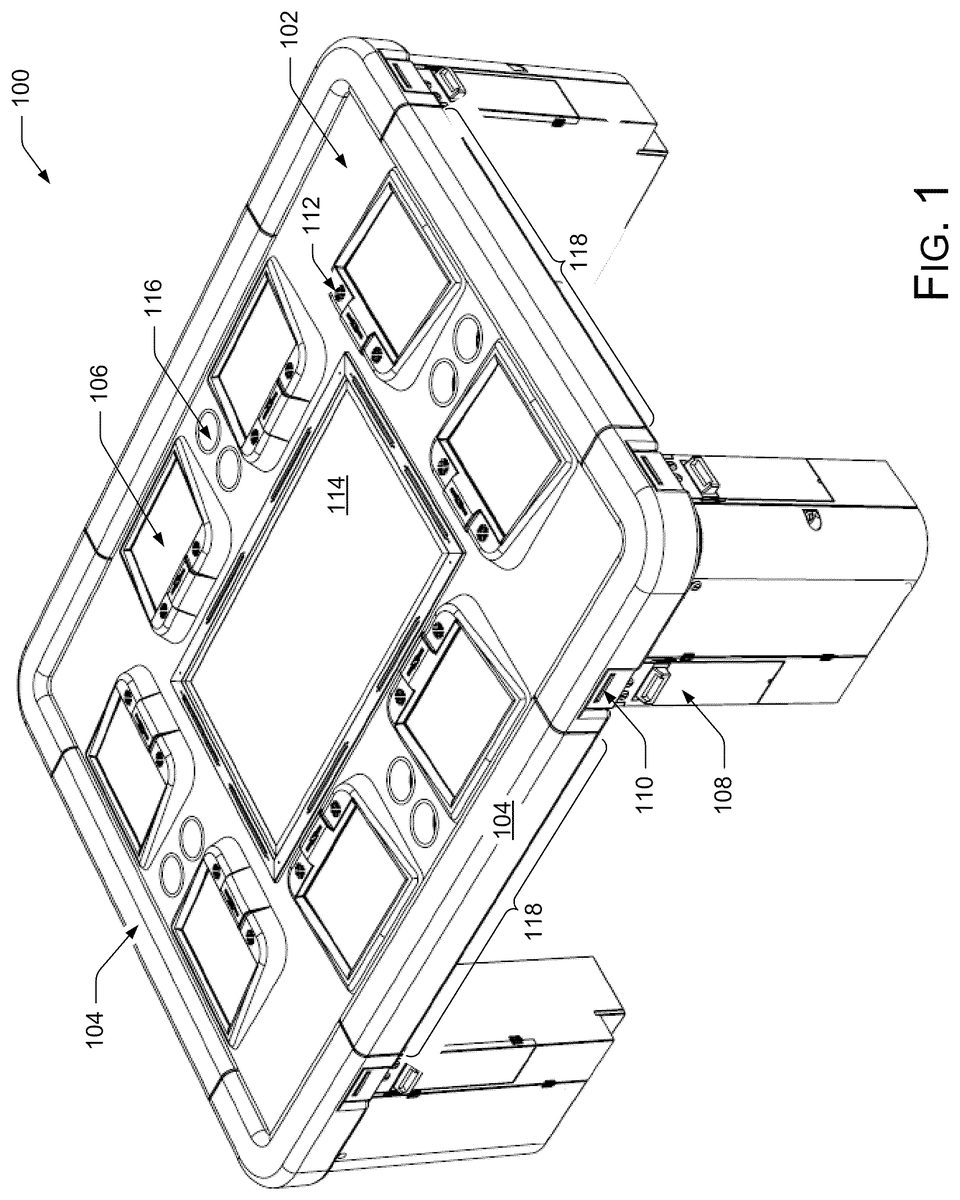
FIG. 1shows an example electronic game table100. Such a game table100is typically used for gambling, games of chance, card play, craps, roulette, etc., in a casino or card room. The game table100has a tabletop102, which may include or be attached to a border or trim, referred to herein as a rail104. The tabletop102provides a mount for video displays106for multiple players (or “users”). These may be touch-screen displays. The tabletop102may also support game controls and other user-interfaces placed at fixed locations. Money exchangers108and ticket printers110may be mounted either on the tabletop102or on one or more sides of the electronic game table100. Sound speakers112and a common display114may also be present on the tabletop102, as well as betting chip holders, chip sensors, drink holders116, dealer controls, and so forth.
Rail sections118may have removable covers to reveal bays for mounting hardware, such as additional user-interface hardware. A set of covers for a given rail section118may each have a different configuration of openings, to expose selected bays for mounting hardware. Exposed bays can host mounted user-interface hardware, or else a cover that hides empty bays is used. In the example shown inFIG. 1, removable covers for the rail sections118hide all of the underlying bays, so that none of the bays are exposed to a player's view. Without knowledge of underlying bays, and with no seams in the rail section to give away the locations of the bays, a user playing the game is not distracted or made curious to discover what is underneath the rail104.
FIG. 2shows another view of the example electronic game table100ofFIG. 1.FIG. 2shows eight rail sections118, numbered1-8, that may possess bays for mounting user-interface hardware. InFIG. 2, a cover for each rail section118hides the underlying bays from players' view.
Likewise, the trim or bezel202around each video display106may be swapped with interchangeable bezels202that can either hide or expose user-interface hardware located in the respective player station204. For example, by swapping bezels202, a table owner can hide or reveal card-reading hardware206.
FIG. 3shows a view of the electronic game table100in which a cover302for a rail section118has openings to expose two bays, bay304and bay306. Bay306has mounted within a player-tracking touch-screen display308for player viewing and use. Such a player-tracking user-interface (308) can be used to gather a player's nickname and other information to make a multi-player game more interesting and easier to follow. Bay304is depicted as an empty bay, ready to accept user-interface hardware.
FIG. 4shows another implementation of covers for bays located in rail sections, such as rail section118. In this implementation, individual bays have their own respective bay covers, such as bay covers402and404, and bay covers406and408;410and412. Each bay cover blends in with the rail104, so that when a bay is covered, the appearance of the rail section118that has bay covers installed is very similar to a rail section118′ that has a single end-to-end rail section cover414.
FIG. 5shows part of an electronic game table100and a rail section118. In this implementation, a rail section cover502has two top openings to expose two bays. One of the two top openings exposes bay304, which is empty and awaiting installation of player-tracking hardware, and the other top opening exposes bay306. Bay306has a player-tracking touch-screen display308mounted within. Rail section cover502also has a side opening for bay504, in which two player-ID card readers506and508are mounted, for players on either side of the bay504.
A set of the rail section covers502may provide various configurations of the openings to expose or hide different combinations of the bays underlying a rail104. When the installed hardware mounted in the bays that are adjacent to and associated with a player contain player-tracking hardware (e.g., bays306and504), then the selection of a particular rail section cover502allows a game table proprietor to select hardware appropriate for a given player-tracking mode. In a simplest form, a given electronic game table100may have two player-tracking modes “on” and “off.” For the “on” mode, the rail section cover502exposes either one or both of the player-tracking touch-screen display308and the player-ID card reader508.
As shown inFIG. 6, for the player-tracking “off” mode, the associated rail section cover502′ hides bays304,306, and504(FIG. 5). In an alternative implementation, the proprietor uses the associated rail section cover502′ to temporarily cover not just the bays, but also the hardware mounted in the bays.
In one implementation, the rail104is constructed so that a rail section cover502′ can slide onto or into an adjacent rail cover. In this scenario, the rail section cover502′ exposes bays of mounted hardware by sliding instead of being removed and swapped with another rail section cover502that has openings. Other ways of moving a rail section cover502′ can also be used, such as hinged movement, rolling the rail section cover502′ into a slot, expanding a telescoping rail section cover502′, and so forth.
Alternative Implementation
In an alternative implementation of an electronic game table, the layout of user-interface hardware on the tabletop102—displays, touch-screens, common displays, sound speakers, game controls, drink holders, and so forth—is selectable by installing one or more covers that hide hardware components not used in that configuration of the tabletop102, while exposing other hardware components relevant to the current tabletop configuration. Such a method of selecting a user-interface layout for multiple players can be used to allow the same game table platform to host different types of games, to select the degree of player-tracking user-interfaces exposed, to limit the table to a certain number of players, etc.
Conclusion
Although exemplary systems have been described in language specific to structural features and/or methodological acts, it is to be understood that the subject matter defined in the appended claims is not necessarily limited to the specific features or acts described. Rather, the specific features and acts are disclosed as exemplary forms of implementing the claimed systems, methods, and structures.
Claims
- An electronic game table, comprising: a tabletop;a rail for connecting to the tabletop, the rail having sections;bay openings in at least one of the sections, each bay opening for exposing user-interface hardware to a user of the game table, at least one of the bay openings hosting a mounted touch-screen display for tracking an associated user of the game table and at least one of the bay openings hosting a player-ID card reader for tracking the associated user of the game table;a set of interchangeable section covers, connectable to the rail;a first section cover of the set to hide all of the bay openings;a second section cover of the set to expose all of the bay openings;at least one section cover of the set to hide the mounted touch-screen display and the player-ID card reader;and at least one section cover of the set to expose the mounted touch-screen display and the player-ID card reader.
- The electronic game table as recited in claim 1 , wherein a section cover hides a selected first number of the bay openings from a view of an electronic game table user;and wherein the section cover exposes a selected second number of the bay openings to the view of the electronic game table user.
- The electronic game table as recited in claim 1 , wherein each section cover slidably connects to the tabletop.
- The electronic game table as recited in claim 1 , wherein each section cover removably connects to the tabletop.
- The electronic game table as recited in claim 1 , wherein segments of each section cover that hide one or more of the bay opening have a same appearance as a part of the rail that does not include a bay.
- A system, comprising: a rail for connecting to a tabletop of a game table, the rail having sections;bay openings in at least one of the sections, each bay opening for exposing user-interface hardware to a user of the game table, at least one of the bay openings hosting a mounted touch-screen display for tracking an associated user of the game table and at least one of the bay openings hosting a player-ID card reader for tracking the associated user of the game table;a set of interchangeable section covers, connectable to the rail;a first section cover of the set to hide all of the bay openings;a second section cover of the set to expose all of the bay openings;at least one section cover of the set to hide the mounted touch-screen display and the player-ID card reader;and at least one section cover of the set to expose the mounted touch-screen display and the player-ID card reader.
Disclaimer: Data collected from the USPTO and may be malformed, incomplete, and/or otherwise inaccurate.