U.S. Pat. No. 8,287,385
GAME DEVICE, GAME PROCESSING METHOD, INFORMATION RECORDING MEDIUM, AND PROGRAM
AssigneeKonami Digital Entertainment Co Ltd
Issue DateMarch 12, 2009
Illustrative Figure
Abstract
In a game device (200), a storage unit (201) stores a position of a player character, a position of an enemy character, and candidate positions for new enemy character appearance. A measuring unit (202) measures an elapsed time from the start of the game. The calculating unit (203) calculates a reference distance for determining a position where the new enemy character is to be produced based on the elapsed time measured by the measuring unit (202). The reference distance monotonically increases with respect to the elapsed time measured by the measuring unit (202). When a new enemy character is to be produced in the game, an appearance setting unit (204) selects from among the candidates stored in the storage unit (201) the candidate having a distance to the player character that is closest to the reference distance, and sets the selected position as the appearance position of the new enemy character.
Description
DESCRIPTION OF REFERENCE NUMERALS 100information processing device101CPU102ROM103RAM104interface105controller106external memory107DVD-ROM drive108image processor109sound processor110NIC200game device201storage unit202measuring unit203calculating unit204appearance setting unit205receiving unit206moving unit207deleting unit208output unit BEST MODE FOR CARRYING OUT THE INVENTION An embodiment of the present invention will now be described. While the following describes an embodiment in which the present invention is realized by using an information processing device for games for the ease of understanding, the following embodiment is given by way of illustration only, and does not limit the scope of the invention. Therefore, those skilled in the art can employ embodiments in which the individual elements or all the elements are replaced with equivalent ones, and such embodiments are also encompassed in the scope of the invention. Embodiment 1 FIG. 1is a schematic diagram illustrating a schematic configuration of a typical information processing device100that carries out a function of a game device of the present invention by executing a program. A description will be given hereinbelow referring to this diagram. The information processing device100has a CPU (Central Processing Unit)101, a ROM (Read Only Memory)102, a RAM (Random Access Memory)103, an interface104, a controller105, an external memory106, a DVD-ROM (Digital Versatile Disk-Read Only Memory) drive107, an image processor108, a sound processor109, and an NIC (Network Interface Card)110. As a DVD-ROM storing a program and data for a game is loaded into the DVD-ROM drive107and the information processing device100is powered on, the program is executed to realize the game device of this embodiment. The CPU101controls the overall operation of the information processing device100, and is connected to individual components to exchange control signals and data therewith. Further, by using an ALU (Arithmetic Logic Unit) (not shown), the CPU101can perform arithmetic operations such as addition, subtraction, multiplication, division, etc., logical operations such as logical addition, logical multiplication, logical negation, etc., bit operations ...
DESCRIPTION OF REFERENCE NUMERALS
100information processing device101CPU102ROM103RAM104interface105controller106external memory107DVD-ROM drive108image processor109sound processor110NIC200game device201storage unit202measuring unit203calculating unit204appearance setting unit205receiving unit206moving unit207deleting unit208output unit
BEST MODE FOR CARRYING OUT THE INVENTION
An embodiment of the present invention will now be described. While the following describes an embodiment in which the present invention is realized by using an information processing device for games for the ease of understanding, the following embodiment is given by way of illustration only, and does not limit the scope of the invention. Therefore, those skilled in the art can employ embodiments in which the individual elements or all the elements are replaced with equivalent ones, and such embodiments are also encompassed in the scope of the invention.
Embodiment 1
FIG. 1is a schematic diagram illustrating a schematic configuration of a typical information processing device100that carries out a function of a game device of the present invention by executing a program. A description will be given hereinbelow referring to this diagram.
The information processing device100has a CPU (Central Processing Unit)101, a ROM (Read Only Memory)102, a RAM (Random Access Memory)103, an interface104, a controller105, an external memory106, a DVD-ROM (Digital Versatile Disk-Read Only Memory) drive107, an image processor108, a sound processor109, and an NIC (Network Interface Card)110.
As a DVD-ROM storing a program and data for a game is loaded into the DVD-ROM drive107and the information processing device100is powered on, the program is executed to realize the game device of this embodiment.
The CPU101controls the overall operation of the information processing device100, and is connected to individual components to exchange control signals and data therewith. Further, by using an ALU (Arithmetic Logic Unit) (not shown), the CPU101can perform arithmetic operations such as addition, subtraction, multiplication, division, etc., logical operations such as logical addition, logical multiplication, logical negation, etc., bit operations such as bit addition, bit multiplication, bit inversion, bit shift, bit rotation, etc., on a storage area called a register (not shown) which can be accessed at a high speed. Further, the CPU101itself is designed to be able to rapidly perform saturate operations such as addition, subtraction, multiplication, division, etc., for handling multimedia processes, trigonometric function, etc., or vector operations, may realize these with a coprocessor.
An IPL (Initial Program Loader) which is executed immediately after power-on is recorded in the ROM102. As the IPL is executed, the program recorded in the DVD-ROM is read into the RAM103and its execution by the CPU101is started. Further, the ROM102stores a program and various data for an operating system necessary for controlling the overall operation of the information processing device100.
The RAM103is for temporarily storing data and programs, and retains the program and data read out from the DVD-ROM, and other data needed for progressing a game and chat communication. Further, the CPU101performs processes such as securing a variable area in the RAM103to work the ALU directly upon the value stored in the variable to perform operations, or once storing the value stored in the RAM103in the register, performing operations on the register, and writing back the operation result to the memory, etc.
The controller105connected via the interface104receives an operation input which is made when a user executes the game, such as a soccer game or card game.
The external memory106detachably connected via the interface104rewritably stores data indicating the play status (past performance, etc.) of a match-up game, etc., data indicating the progress status of the game, data of chat communication logs (records) in the case of a network match-up game, etc. As the user makes an instruction input via the controller105, these data can adequately be recorded in the external memory106.
The program for realizing the game and image data and sound data accompanying the game are recorded in the DVD-ROM to be loaded into the DVD-ROM drive107. Under the control of the CPU101, the DVD-ROM drive107performs a process of reading from the DVD-ROM loaded therein to read a necessary program and data, and these are temporarily stored in the RAM103or the like.
The image processor108processes data, which are read out from the DVD-ROM, by means of the CPU101and an image operation processor (not shown) the image processor108has, and then records the data in a frame memory (not shown) the image processor108has. The image information recorded in the frame memory is converted to a video signal at a predetermined synchronous timing, which is in turn output to a monitor (not shown) connected to the image processor108. Thereby, image displays of various types are available.
The image operation processor can provide rapid execution of an overlay operation of a two-dimensional image, a transparent operation such as α blending, and various kinds of saturate operations.
It is also possible to provide rapid execution of an operation of rendering polygon information which is arranged in virtual three-dimensional space and to which various kinds of texture information are added, by a Z buffer scheme to acquire a rendered image in which a polygon arranged in the virtual three-dimensional space is viewed down from a predetermined view point position, in a predetermined direction of a line of sight.
Further, the CPU101and the image operation processor cooperate to be able to write a string of characters as a two-dimensional image in the frame memory or on each polygon surface according to font information which defines the shapes of characters.
Information such as images of match-up games or images of playing cards may be prepared on the DVD-ROM so as to enable display of the state of match or the card hand by being opened in frame memory.
The sound processor109converts sound data read out from the DVD-ROM to an analog sound signal, and controls a speaker to output the sound signal from a speaker (not shown) connected thereto. Under the control of the CPU101, the sound processor109generates sound effects and music data to be generated during progress of the game, and outputs sound corresponding thereto from a speaker.
In a case where the sound data recorded on the DVD-ROM is MIDI data, the sound processor109refers to the sound source data included in the data, and converts the MIDI data to PCM data. Further, in a case where the sound data is compressed sound data of ADPCM (Adaptive Differential Pulse Code Modulation) format or Ogg Vorbis format, etc., the sound processor109expands the data, converting it to PCM data. The PCM data is D/A (Digital/Analog) converted at a timing corresponding to the sampling frequency of the data and output to the speaker, thereby enabling sound output.
The NIC110serves to connect the information processing device100to a computer communication network (not shown), such as the Internet. The NIC109includes those according to the 10 BASE-T/100 BASE-T standard which are used at the time of constructing a LAN (Local Area Network) or an analog modem for connecting to the Internet using a telephone line, an ISDN (Integrated Services Digital Network) modem, an ADSL (Asymmetric Digital Subscriber Line) modem, a cable modem for connecting to the Internet using a cable television circuit, or the like, and an interface (not shown) which intervenes between these modems and the CPU101.
In addition, the information processing device100may be configured to achieve the same functions as the ROM102, the RAM103, the external memory106, and a DVD-ROM or the like which is to be loaded into the DVD-ROM drive107by using a large-capacity external storage device, such as a hard disk.
Next, the processing performed by a game device200of the present embodiment will be described. The following description is given on the assumption that the game device200executes a match-up game between a player character object (hereinafter simply referred to as “player character”) configured to move within a virtual space in accordance with player instructions, and an enemy character object (hereinafter simply referred to as “enemy character”). The enemy character is given operation instructions by the game device200. The player character and enemy character are movable within this virtual space. Note, however, that the game content described herein is merely one example.
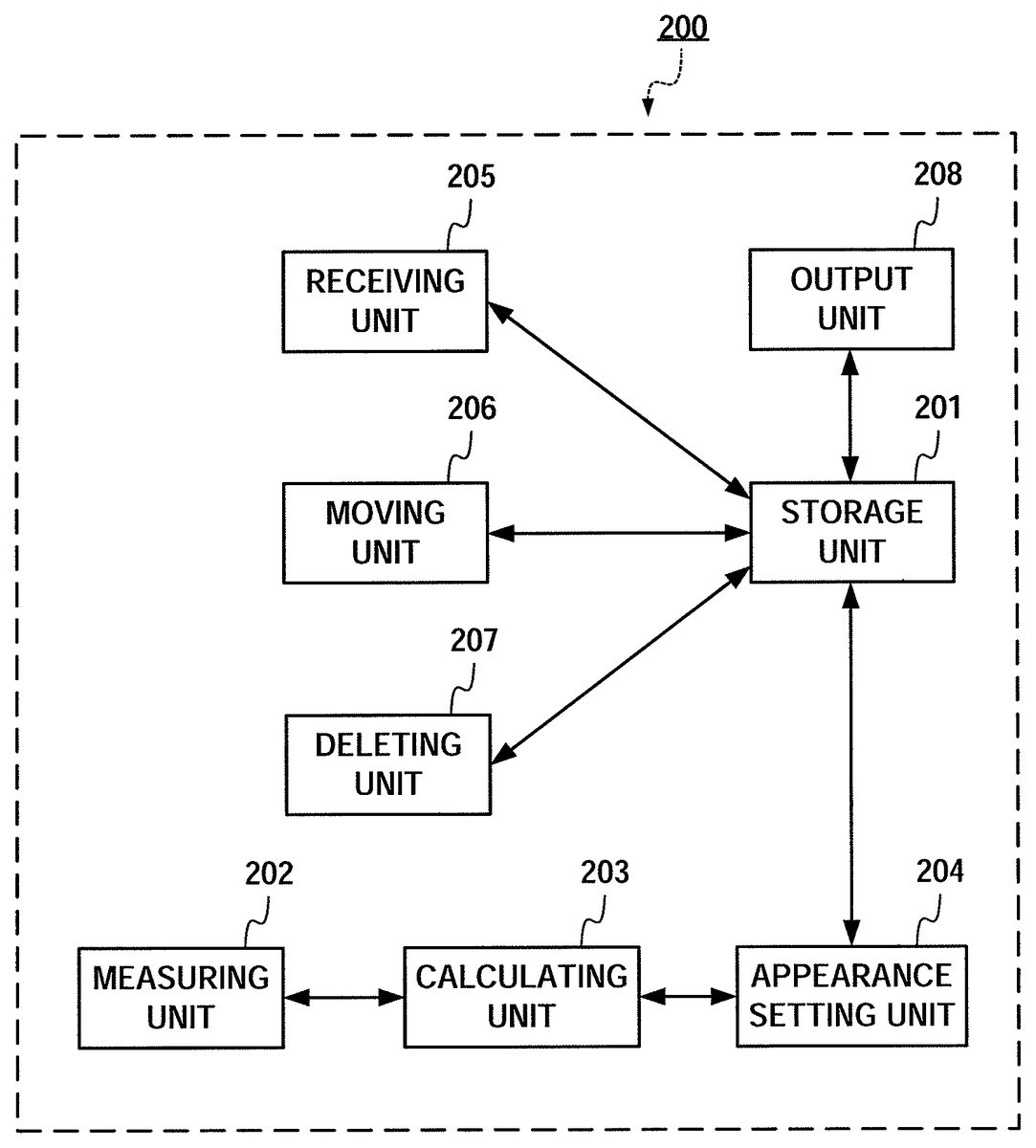
FIG. 2is a diagram illustrating the configuration of the game device200. The game device200comprises a storage unit201, a measuring unit202, a calculating unit203, an appearance setting unit204, a receiving unit205, a moving unit206, a deleting unit207, and an output unit208.
The storage unit201stores (1) a position of the player character within the virtual space, (2) a position of the enemy character, and (3) candidate positions for enemy character appearance. Each of these positions is expressed as space coordinate values based on a coordinate system set within the virtual space, for example. It can be determined in any way which coordinate system to use. For example, an orthogonal coordinate system based on three mutually orthogonal axes may be used, or a polar coordinate system such as a system with spherical coordinates based on one moving radius and two deflection angles may be used. The storage unit201stores these pieces of information in a predetermined storage area within the RAM103. The configuration may also be designed so that the information is stored in the external memory106.
The player operates the controller105so as to give instructions to the player character, making the player character move or fight the enemy character. If, for example, the player character attacks the enemy character and the damage level (so-called “damage”) from that attack or the total damage of the enemy character is greater than or equal to a predetermined value, the enemy character is brought down and the player character wins. The enemy character may also cease to exist (disappear from within the virtual space) regardless of the attacks from the player character, when a predetermined period of time has elapsed from the time the enemy character first appeared. The game device200suitably causes an enemy character to appear according to the development of the game. For example, the game device200produces a new enemy character within the virtual space when an enemy character is brought down or ceases to exist. The new position at which the enemy character appears is selected from the candidates stored in the storage unit201by the appearance setting unit204described later. The selection method will be described in detail later. Also, note that, in the following description, “the player character brings down the enemy character” means “the player character defeats the enemy character”.
FIG. 3Ashows an example of the structure of data indicating the position of the player character and stored in the storage unit201, andFIG. 3Bis an example of the structure of data indicating the positions of the enemy characters. The positions of the enemy characters are stored in an amount equivalent to the number of enemy characters that exist within the virtual space. The identification information is information for identifying the type and individual unit of the enemy character. This information is expressed, for example, using numbers, letters, or symbols. While there is one game player and one player character in this embodiment, a plurality of players may participate and a plurality of player characters may exist. In such a case, the storage unit201may store, as information indicating the position of the player character, the identification information for identifying a player character and the information of the position of the player character so that they are associated with each other. The following description refers to the combination of the identification information of the enemy character and the position of the enemy character as a “record.”
FIG. 3Cshows an example of the structure of data stored in the storage unit201and indicating the candidate positions for enemy character appearance. The identification information, similar to that ofFIG. 3B, is information for identifying the type and individual unit of the enemy character. A candidate list indicates the candidates for appearance positions in the case where an enemy character will be newly caused to appear. The list is not limited to one candidate, but may include a plurality of candidates. These candidates are preset. For example, in this figure, for the enemy character identified in identification information “0001”, the coordinate values (X1, Y1, Z1) are set as the first candidate and the coordinate values (X2, Y2, Z2) are set as the second candidate of the position where the enemy character will be newly caused to appear. When N number of candidates (where N is an integer of 1 or greater) exist in this manner, the appearance setting unit204selects any one candidate from the N number of candidates and updates the position of the enemy character stored in the storage unit201so as to position the enemy character at that position. Instead of using coordinate values, each of the candidate positions may be specified based on which area of a plurality of predetermined areas such as “Area1” and “Area2” the position is affiliated. In such a case, any one of the positions within the selected area becomes the position of appearance of the new enemy character. Note thatFIGS. 3A,3B, and3C are merely examples. The information in these figures may be included in part only, or other information may be stored in addition to that information.
Furthermore, the CPU101and the RAM103work in cooperation to function as the storage unit201.
The measuring unit202measures the elapsed time from the moment the game is started to the present, and stores the measured elapsed time to a predetermined storage area of the RAM103. The measuring unit202measures the elapsed time using an internal clock (not shown) provided in the game device200. The measuring unit202may obtain the elapsed time by measuring the correct time in units of hours, minutes, or seconds, for example, or by counting the number of times of periodic interrupt processing, such as monitor vertical synchronizing interrupt processing (generally a sixtieth second) and regarding the counted number as the elapsed time. Further, the measuring unit202can also measure the elapsed time from any given timing within the game to the present.
Furthermore, the CPU101functions as the measuring unit202.
While in the present embodiment the measuring unit202acquires the elapsed time from the moment the game is started, the elapsed time from any given timing within the game may be obtained. For example, in a case where the game comprises a plurality of stages or scenes according to the degree of progress of a scenario, the elapsed time from the start of each stage or scene may be used. The measuring unit202resets and starts measuring the elapsed time once again on a per stage or scene basis. Further, the elapsed time from the moment a predetermined event occurs within the game to the present may also be measured, when such event occurs.
The calculating unit203calculates a distance that increases as the elapsed time measured by the measuring unit202increases (hereinafter referred to as “reference distance”). This reference distance is used to determine the position at which the appearance setting unit204is to newly cause the enemy character to appear. The unit employed is arbitrary. Typically, the distance between two points based on a unit length determined in the coordinate system set within the virtual space where the game is played (the distance between the position coordinates of the player character and the position coordinates of the enemy character) is used.
The reference distance increases as the elapsed time from the moment of the game start increases. That is, the reference distance monotonically increases with respect to the elapsed game time as shown inFIG. 4, for example. In this figure, this relationship is drawn as a linear function, but the relationship is not limited thereto and may be any curving function. The reference distance may also be expressed as a non-continuous function such as a stepped function. Or the relationship may be expressed using a table that store a plurality of reference distances in association with the elapsed time. In such a case, the calculating unit203may perform spline interpolation between each point so as to uniquely obtain the reference distance for an arbitrary elapsed time. Any method can be used for the interpolation.
Furthermore, the CPU101functions as the calculating unit203.
The appearance setting unit204stores, from among the candidate positions for enemy character appearance stored in the storage unit201, the candidate position whose distance from the position of the player character stored in the storage unit201is the closest to the reference distance calculated by the calculating unit203, to the storage unit201as the position of the new enemy character.
Furthermore, the CPU101and the RAM103work in cooperation to function as the appearance setting unit204.
FIG. 5is a diagram illustrating an example of a relationship between a reference distance511from a player character510and a candidate position520for new enemy character appearance. Each of the stars shown in this figure indicates one candidate520of a position at which the enemy character may be newly caused to appear, and in this example the three candidates520A,520B, and520C are indicated. That is, the storage unit201stores a candidate list that includes the first to third candidates520A,520B, and520C as the candidates520of a position where the enemy character may be newly caused to appear.
First, the measuring unit202measures the elapsed time from the moment of the game start to the present. The calculating unit203then obtains the reference distance511corresponding to the measured elapsed time. The dashed curve shown in this figure is a circle having a radius of the obtained reference distance511. Then, the appearance setting unit204selects from among the candidates for enemy character appearance the candidate520closest to the reference distance511, that is, the candidate520that is closest to the arc of this circle, establishing that candidate as the new enemy character position. In this example, the appearance setting unit204sets the second candidate520B as the position of the new enemy character.
While in this example, the virtual space is expressed using two dimensions so as to make the present invention easier to understand, the virtual space may be a three-dimensional space. In the case of three dimensions, a sphere may be used instead of a circle. While in this figure the positions of the candidates520are indicated by stars and the circle showing the reference distance511is indicated by a dashed curve, the stars and dashed curve are merely for the purpose of giving explanation and do not appear on the actual game screen. This figure is merely one example; the screen layout, the positions of the candidates520, the number of candidates520, etc., may be arbitrarily changed.
The receiving unit205acquires the position of the player character and stores it to the storage unit201. For example, the receiving unit205receives instruction input inputted by the user using the controller105, obtains the position of the player character, and stores the obtained position of the player character to the storage unit201. The player can make an instruction to move the player character in any direction using the controller105. Note, however, that the player character sometimes cannot move as instructed when a non-moving fixed object (a rock, tree, or building, for example) exists in the instructed direction.
Furthermore, the CPU101, the RAM103, and the controller105work in cooperation to function as the appearance setting unit204.
The moving unit206moves the position of the enemy character. That is, the moving unit206updates the position of the enemy character stored to the storage unit201. The moving unit206updates the position of the enemy character that changes according to game development at a periodic timing, such as the timing of the monitor vertical synchronizing interrupt, for example.
Furthermore, the CPU101and the RAM103work in cooperation to function as the moving unit206.
The deleting unit207deletes the record associated with an enemy character from the storage unit201when the player character brings down that enemy character or the enemy character ceases to exist. As a result, the fallen enemy character is deleted from the game.
Here, when the player character brings down the enemy character, the deleting unit207may correspondingly store a flag indicating that the enemy character has been brought down at the position, stored in the storage unit201, of the enemy character. When the enemy character is caused to appear, the appearance setting unit204stores a flag indicating that the enemy character is alive at the position of the enemy character (the player character has not yet brought the enemy character down). The output unit208refers to this flag, determines whether or not the enemy character is to be displayed on the game screen, and outputs (or does not output) the enemy character. Or, the output unit208determines whether an image of a living character or an image of deceased character is to be displayed and then outputs the image of the enemy character accordingly.
Furthermore, the CPU101and the RAM103work in cooperation to function as the deleting unit207.
The output unit208reads out the positions of the player character and enemy character, which are stored in the storage unit201, and outputs the images of the player character and enemy character in those positions. When the positions of the player character and enemy character are set in the storage unit201, the CPU101reads out an image data of the player character from the DVD-ROM loaded to the DVD-ROM drive107and controls the image processor108so as to output the image of the player character at the position of the player character stored in the storage unit201. Similarly, the CPU101reads out the image data of the enemy character from the DVD-ROM loaded to the DVD-ROM drive107, and controls the image processor108so as to output the image of the enemy character at the position, stored in the storage unit201, of the enemy character. The CPU101also reads out data such as the image data of other character objects and text data in the game so as to generate a game screen in accordance with a predetermined game program stored in the DVD-ROM and outputs it on a monitor connected to the image processor108. As a result, the user can play the game by operating the controller105while viewing the screen. While the image data, such as those of the player character and enemy character, is typically expressed as numeric data obtained by dividing the surface into minute multi-angular polygons (typically triangles, rectangles, etc.), and the data may be one of another format such as bitmap data, and no limit is made by the present invention.
Furthermore, the CPU101, the RAM103, and the image processor108work in cooperation to function as the output unit208.
(Appearance Setting Processing)
The appearance setting processing performed by each unit of the game device200of the present embodiment will now be described with reference to the flowchart shown inFIG. 6. The appearance setting processing is performed when the game device200is to cause a new enemy character to appear. The following describes, an illustrative scenario of the appearance setting processing performed in a match-up game at the time the game device200determines to cause a new enemy character to appear after a player character operated by a player using the controller105has damaged and brought down an enemy character. Note, however, that this is merely an example, and the game device200may perform the appearance setting processing at any timing.
The receiving unit205receives an instruction input for moving the player character in a specified direction, as instruction input, for making the player character perform a specific operation (for example, to mount a sword or shield on the player character, etc.), and for other game related operations from the controller105operated by the user. The receiving unit205stores the data indicating the position of the player character to the storage unit201in accordance with these instruction inputs. The receiving unit205executes this processing at predetermined periodic timing, such as the timing of the monitor vertical synchronizing interrupt. With this arrangement, the latest position of the player character is stored in the storage unit201.
The moving unit206executes the process of updating the position of the enemy character that changes according to game development at predetermined periodic timing, such as the timing of the monitor vertical synchronizing interrupt, for example. With this arrangement, the latest position of the enemy character is stored to the storage unit201.
First, the measuring unit202obtains the elapsed time from the moment of the game start (step S601). For example, the measuring unit202stores the time the game started and the present time in a predetermined storage area of the RAM103, and obtains the elapsed time from the difference of these times.
The calculating unit203obtains from the elapsed time obtained in step S601the above-described reference distance used for determining the position at which the new enemy character is to be outputted (step S602). For example, the calculating unit203obtains the reference distance using a function for expressing a relationship between elapsed time and reference distance, such as that shown inFIG. 4.
The appearance setting unit204acquires the current position of the player character and the candidate position where the new enemy character is to be outputted from the storage unit201(step S603). In a case where there are a plurality of candidate positions, all positions are acquired.
Furthermore, the appearance setting unit204selects from among the candidates acquired in step S603, the one that is closest to the reference distance acquired in step S602(step S604). The candidate selected here is the position where the new enemy character is to be outputted.
Then, the appearance setting unit204updates the storage unit201so that the position of the candidate selected in step S604will be the output position of the new enemy character (step S605). Specifically, for example, a new record indicating the combination of the identification information of the enemy character to be newly caused to appear and the position of the enemy character to be newly caused to appear is added to the data shown inFIG. 3B.
The output unit208acquires the position of the player character and the position of the enemy character, which are stored in the storage unit201, and generates a game screen in which the respective characters are arranged and outputs it (step S606).
In the present embodiment the appearance setting unit204selects from among the candidates stored in the storage unit201the one closest to the reference distance and determines it as the appearance position of the new enemy character. However, the appearance setting unit204may select a candidate from among those candidates positioned farther away than the reference distance. For example, the appearance setting unit204may select at random a candidate from among the candidates that are at least the reference distance away, in a case where there are a plurality of candidates in positions farther away than the reference distance. The appearance setting unit204may execute a weighted random selection in such a manner that the larger the difference from the reference distance is, the smaller the probability of selection is.
For example, in general, beginner players often require a longer time than an advanced player to bring down an enemy character. If the position in which the enemy character appears is determined completely at random or always set to a fixed position, a new enemy character may appear very close to the player character once again immediately after the player character takes down an enemy character. When this happens, there is the possibility that a beginner player will feel that the game is very difficult, feel the sense of unfairness, and loose interest because of the excessive difficulty. However, according to the present invention, the position at which the enemy character newly appears is at a distance from the player character that increases as the time until the enemy character is brought down increases, thereby eliminating the perception that the game is unreasonably difficult for a beginner player.
Further, in general, advanced players often take a shorter time than a beginner player to take down an enemy character. If a new enemy character always appears in a location far away from the player character after the player takes down an enemy character, there is the possibility that the advanced player will feel that the game is very easy, find the game boring, and loose interest in the game. However, according to the present invention, the position at which the enemy character newly appears is at a distance such that the longer the time required to bring down the enemy character is, the farther from the player the enemy character appears, and any dissatisfaction felt by an advanced player can be eliminated.
According to the present embodiment, the game device200causes a next new enemy character to appear near the player character when an enemy character is brought down immediately after a game starts, and causes the next new enemy character to appear far from the player character when an enemy character is brought down some time after the game starts. With this arrangement, the enemy character never continually appears in positions close to the player character, which would unreasonably increase the degree of game difficulty level.
Note that an enemy character whose appearance position is controlled by the above-described appearance setting unit204and an enemy character that is not controlled in this manner may coexist within the game.
In this way, when causing a new enemy character to appear, the game device200changes the position at which the new enemy character appears according to the elapsed game time, making it possible to ensure that the game is not too difficult or too easy. For example, regardless if the player is a beginner player or an advanced player, the game device200causes the enemy character to appear in such a manner as not to greatly disrupt the game balance, thereby making the game interesting.
Embodiment 2
Next, another embodiment of the present invention will be described with reference to the flowchart shown inFIG. 7. The present embodiment differs from the above embodiment in the respect that the total number of enemy characters that appear in the game does not increase above a predetermined number. Note that the components common to the above embodiment are denoted by the same reference numerals, and descriptions therefor will be omitted.
The storage unit201further stores a threshold value (upper limit) of the total number of enemy characters that can simultaneously appear in the game. The threshold value is stored in advance in the game program stored in the DVD-ROM, and the CPU101reads out and stores the value in the storage unit201when the game is started. For example, the threshold value is predetermined per game stage and per scene. A single common upper value may also be set for the entire game.
First, the appearance setting unit204acquires the total number of enemy characters that already exist in the game (step S701). The appearance setting unit204acquires the total number by counting the number of records of data indicating the positions of enemy characters that are stored in the storage unit201.
The appearance setting unit204acquires from the storage unit201the threshold value of the total number of enemy characters that appear in the game (step S702).
The appearance setting unit204determines whether or not the total number of enemy characters acquired in step S701has reached the threshold value acquired in step S702(step S703).
In a case where the decision has been made that the threshold value has not been reached (step S703: NO), the game device200executes the above-described appearance setting processing shown inFIG. 6(step S704). On the other hand, if the decision is made that the threshold value has been reached (step S703: YES), the game device200ends the processing. The appearance setting processing performed in step S704is the same as the processing described in the above embodiment, and a description therefor will be omitted.
The deleting unit207deletes the data indicating the position of the enemy character from the storage unit201in a case where the player character damages the enemy character to a predetermined level or higher, or in a case where a predetermined length of time until the enemy character naturally expires has elapsed, for example. As a result, the output unit208can make the enemy character disappear from the game screen.
In this manner, according to the present embodiment, the game device200controls the total number of enemy characters that presently exists in the game so that the number does not exceed a predetermined threshold value. That is, when a new enemy character is to be caused to appear, the game device200changes the position where the enemy character is to appear according to the elapsed game time and causes the enemy character to appear if the total number of enemy characters has not reached the threshold value, thereby making it possible to ensure that the game is not too difficult. For example, regardless if the player is a beginner player or an advanced player, the game device200causes the enemy character to appear in such a manner as not to greatly disrupt the game balance, thereby making the game interesting.
Embodiment 3
Next, another embodiment of the present invention will be described with reference to the flowcharts shown inFIG. 8, and toFIG. 9. The present embodiment differs from the above embodiment in the respect that the enemy characters in the game are controlled so that they come closer to the location of the player character. Furthermore, the components common to the above embodiment are denoted by the same reference numerals, and descriptions therefor will be omitted.
First, the moving unit206determines whether or not an enemy character exists within the game presently in progress (step S801). The moving unit206counts the number of records of data indicating a position of an enemy character, which are stored in the storage unit201, and determines that enemy characters exist if the number of records is one or greater, or that enemy characters do not exist if the number is any other number.
In a case where it is determined that enemy characters do not exist (step S801: NO), the appearance setting unit204performs the processing from step S805down that is described later.
On the other hand, in a case where it is determined that an enemy character does exist (step S801: YES), the moving unit206acquires the current position of the player character and the position of the enemy character (step S802). In a case where there are a plurality of enemy characters, the moving unit206acquires all the positions of the enemy characters.
Further, the moving unit206determines whether or not the player character and the enemy character are a predetermined distance or more away from each other (step S803). For example, as shown inFIG. 9, a predetermined distance911is given as a sufficient distance for ensuring that the player character and enemy character do not overlap when the output unit208outputs a game image. The predetermined distance911is stored in advance in the game program stored in the DVD-ROM, and the CPU101reads out and stores the value in the storage unit201when the game is started.
In a case where it is determined that the two are not the predetermined distance911or more away from each other (step S803: NO), the game device200proceeds to the processing of step S805described later. Furthermore, in such a case, the moving unit206may change the position of the enemy character so that the player character and enemy character are the predetermined distance911or more away from each other, and store that position in the storage unit201.
In a case where it is determined that the two are the predetermined distance911or more away from each other (step S803: YES), the moving unit206moves the position of the enemy character so that the enemy character comes closer to the position of the player character (step S804), and stores the position after the move in the storage unit201. For example, as shown inFIG. 9, when the enemy character exists at position E1at a certain time, the moving unit206moves the enemy character by a distance of LA per unit of time, to position E2, bringing the enemy character closer to a player character910, obtains the position coordinates of the enemy character after the move and stores it in the storage unit201. The unit of time is, for example, a time interval based on the count of monitor vertical synchronizing interrupts. The distance LA moved per unit of time can be set to different values depending on the type and individual unit of the enemy character. This distance LA corresponds to the moving speed set per enemy character, and is calculated when the CPU101runs the game program and advances the game. The distance LA may be a fixed value, or may result in no movement at all (LA=0), depending on the enemy character. In a case where there are a plurality of enemy characters, the moving unit206performs processing configured to move the positions of all enemy characters, based on the positions acquired in step S802.
Further, the appearance setting unit204determines whether or not a new enemy character is to be positioned within the virtual space (step S805). For example, the appearance setting unit204performs the processing of step S701to step S703of the above embodiment so as to make the determination. That is, the appearance setting unit204makes the determination by acquiring the present total number of enemy characters (step S701), acquiring the threshold value (upper limit) in the number of the enemy characters that can be positioned (step S702), and determines whether or not the total number exceeds the threshold value (step S703).
In a case where it is determined that a new enemy character is to be positioned (step S805: YES), the appearance setting unit204performs the above-described appearance setting processing (step S806). On the other hand, in a case where it is determined that a new enemy character is not to be positioned (step S805: NO), the game device200ends the processing of moving the position of the enemy character. When an enemy character is newly positioned in step S805, the newly positioned enemy character is subject to movement the next time this processing is performed.
In this manner, according to the present embodiment, the game device200moves the enemy character that exists within the game toward the position of the player character, making it possible to ensure that the game is not too easy for the player. For example, even for an advanced player of the game, the game device200causes the enemy character to appear in such a manner as not to greatly disrupt the game balance, thereby making the game interesting.
Embodiment 4
The following describes another embodiment of the present invention. The present embodiment differs from the above embodiment in the respect that the present embodiment takes into consideration how a candidate is selected from among new enemy character candidates in a case where there are a plurality of candidates at distance away from the player character that is equivalent to the reference distance. Furthermore, the components common to the above embodiment are denoted by the same reference numerals, and descriptions therefor will be omitted.
FIG. 10is a flowchart for explaining the appearance setting processing performed by the game device200in the present embodiment.
FIGS. 11A and 11Bare diagrams illustrating an example of a relationship between a reference distance1130from a player character1110and a candidate position1120(1120A,1120B, and1120C in the figure) for new enemy character appearance. While in this figure the positions of the candidates1120are indicated by stars and the circle showing the reference distance1130is indicated by a dashed curve, the stars and dashed curve are merely for ease of explanation and do not appear on the actual game screen. Note that these figures merely show one example.
While the storage unit201stores the candidate1120of the position for enemy character appearance as described above, a plurality of candidates1120may be set. As a result, among the candidates1120of the position for enemy character appearance that are stored in the storage unit201, there may be a plurality of candidates1120whose distance from the position of the player character1110stored in the storage unit201are closest to the reference distance1130calculated by the calculating unit203. For example, inFIG. 11A, two candidates, the second candidate1120B and the third candidate1120C, are candidates closest to the reference distance1130. Further, the candidate1120of the position for enemy character appearance may be specified as an area rather than as coordinates. For example, inFIG. 11B, of the area of the first candidate1120A and the area of the second candidate1120B, there are, in the area of the second candidate1120B, countless points of the reference distance1130calculated by the calculating unit203. That is, the points on the arc of the circle showing the reference distance1130that overlap with the second area1120B are all possible candidate positions for enemy character appearance.
In such a case, the appearance setting unit204randomly selects one candidate from this plurality of candidates1120, and stores the selected candidate position as the new enemy character position in the storage unit201. For example, in the case ofFIG. 11A, the appearance setting unit204selects at random either the second candidate1120B or the third candidate1120C. For example, in the case ofFIG. 11B, the appearance setting unit204randomly selects one point from the points on the arc that overlaps with the second area1120B.
Furthermore, in a case where there are a plurality of the candidates stored in the storage unit201whose distances to the position of the player character are closest to the reference distance, the appearance setting unit204may set at random a bias (weight) to the probability of candidate selection, and randomly select a candidate accordingly. For example, a candidate set in a wooded area is given greater weight than a candidate set in a meadow area, thereby making it more likely that the candidate in the wooded area is selected if the distances are the same. That is, the larger weight a candidate is given, the more likely an enemy character appears there.
Further, a priority level may be set in advance for each candidate position for enemy character appearance, and the appearance setting unit204may select a candidate based on priority level. For example, the storage unit201may store the priority levels comprising a predetermined number of levels in association with candidate positions for enemy character appearance. Then, in a case where there are a plurality of characters having distances closest to the reference distance, the appearance setting unit204selects the candidate having the highest set priority level.
Next, the appearance setting processing of the present embodiment will be described with reference toFIG. 10. In this figure, the processing from step S1001to step S1004is the same as above steps S601to S604, respectively, and a description therefor will be omitted.
In step S1005, the appearance setting unit204determines whether or not there are a plurality of candidates closest to the reference distance selected in step S1004.
In a case where it is determined that the number is plural (step S1005: YES), the appearance setting unit204selects at random one candidate from these candidates (step S1006). The appearance setting unit204may also randomly select a candidate after applying weight to the selection probability of each candidate or after setting a priority level for each candidate. Then, the appearance setting unit204updates the storage unit201so that the position of the candidate selected will be the output position of the new enemy character (step S1007). The output unit208acquires the position of the player character and the position of the enemy character, which are stored in the storage unit201, and generates a game screen in which the respective characters are arranged (step S1008) and outputs it.
On the other hand, in a case where it is determined that the number is not plural (step S1005: NO), the appearance setting unit204updates the storage unit201so that the position of the candidate selected in step S1004will be the output position of the new enemy character (step S1007), and the output unit208generates a game screen in which the respective characters are arranged and outputs it (step S1008).
In this manner, according to the present embodiment, even if there are a plurality of candidates at a distance, equivalent to the reference distance, away, the game device200can appropriately select one candidate so as to cause an enemy character to appear, thereby ensuring that the game is not too difficult or too easy for the user. For example, regardless if the player is a beginner player or an advanced player, the game device200causes the enemy character to appear in such a manner as not to greatly disrupt the game balance, thereby making the game interesting.
Embodiment 5
The following describes another embodiment of the present invention. The present embodiment is that wherein the method of selection upon selecting a candidate from among several candidate positions for enemy character appearance is altered. Furthermore, the components common to the above embodiment are denoted by the same reference numerals, and descriptions therefor will be omitted.
The appearance setting unit204selects at random from among position candidates for enemy character appearance stored in the storage unit201one position from within a predetermined permissible range that includes the candidate position closest to the reference distance calculated by the calculating unit203, and stores the selected position in the storage unit201as the position of the new enemy character.
FIG. 12is a diagram illustrating an example of a relationship between a reference distance1230from a player character1210, a position candidate1220for new enemy character appearance, and a permissible range1240. Each of the stars shown in the figure indicates one candidate1220of a position where an enemy character may be newly caused to appear, and in this example the three candidates1220A,1220B, and1220C exist. First, the measuring unit202measures the elapsed time from the moment of the game start to the present. The calculating unit203then obtains the reference distance1230corresponding to the measured elapsed time. The dashed curve shown in this figure is a circle having a radius of the obtained reference distance1230. Then, the appearance setting unit204selects from among the candidate positions1220for enemy character appearance the candidate closest to the reference distance1230, that is, the candidate that is closest to the arc of the circle. In this figure, this is the second candidate1220B. Further, the appearance setting unit204sets the predetermined permissible range1240that includes the position of the selected candidate1220. In this figure, the area within the circle having a radius of a predetermined length and a center position of the second candidate1220B is set as the permissible range1240. Then, the appearance setting unit204selects at random one position from within the set permissible range1240, establishing that position as the appearance position of the new enemy character.
In this example the shape of the permissible range1240is an area within a circle having a radius of a predetermined length and being centered on the position of the candidate1220stored in the storage unit201. However, this is merely an example and the shape may be an arbitrary shape. Further, while in this figure the positions of the candidates1220are indicated by stars, the circle showing the reference distance1230is indicated by a dashed curve, and the permissible range1240is indicated by a shaded area, these are merely for ease of explanation and do not appear on the actual game screen.
For example, in a case where another character object is already disposed at the candidate position which is stored in the storage unit201and where an enemy character is to be newly caused to appear, the appearance setting unit204can set the permissible range to the area around the candidate position and avoid the position where another character object has already been disposed and select at random one position from within the permissible range set in the vicinity thereof.
Specifically, in step S1005of the above embodiment, the appearance setting unit204determines whether or not another character object is already disposed at the selected candidate position. In a case where another character is already disposed in that position, the appearance setting unit204in step S1006sets a predetermined permissible range that includes the position of the selected candidate, and then selects one position from within that permissible range and sets it as the appearance position of the new enemy character. In a case where no other character is disposed at the position, the appearance setting unit204sets the candidate position selected in step S1004as the appearance position of the new enemy character. The processing of the other steps is the same as that of the above embodiment, and details thereof will be omitted. In this manner, the character objects never overlap at the same position.
Even in a case, for example, where the game is designed so that a candidate position, stored in the storage unit201, for new enemy character appearance is specified by an area having a certain width rather than by the coordinate values of one point, the present embodiment is effective. That is, the present embodiment makes it possible to set the position where the enemy character is to be produced without using absolute coordinate values.
Further, priority levels may be set in advance for areas within the permissible range, and the appearance setting unit204may select a candidate based on priority level. In such a case, the storage unit201stores the priority levels of a predetermined number of levels in association with each position of the areas within the permissible range. Then, the selection probability is set so that the higher the priority level is, the higher the selection probability is. For example, the appearance setting unit204sets as the permissible range an area that is within the circle having a radius R0and being centered on the position of a certain candidate. Further, the appearance setting unit204sets lengths R1and R2that satisfy a relationship 0<R1<R2<R0. The appearance setting unit204then (1) sets the selection probability of the points within the concentric circle having a radius R1and being centered on the position of that candidate as P1, (2) the selection probability of the section that is within the concentric circle of radius R2that is not included in the concentric circle of radius R1as P2, and (3) the selection probability of the section that is within the concentric circle of radius R0and that is not included in the concentric circle of radius R2as (1−P1−P2), where 0≦P1, P2≦1, and P1+P2≦1. While in this example three concentric circles are used, an arbitrary shape and an arbitrary number of graphics may be used.
In this manner, according to the present embodiment, even under circumstances where the enemy character cannot be disposed on the candidate position for new enemy character appearance, the game device200appropriately selects an appearance position of the enemy character, thereby ensuring that the game is not too difficult or too easy. For example, regardless if the player is a beginner player or an advanced player, the game device200causes the enemy character to appear in such a manner as not to greatly disrupt the game balance, making the game interesting. Note that the present embodiment may be easily combined with other embodiments in its implementation.
Embodiment 6
The following describes another embodiment of the present invention. The present embodiment is another embodiment wherein the method of selection on selecting any one from among several candidate positions for enemy character appearance. The components common to the above embodiment are denoted by the same reference numerals, and descriptions thereof will be omitted.
The appearance setting unit204obtains the direction in which the player character moves within a predetermined period of time from the present. Then, the appearance setting unit204selects at random one candidate position in such a manner that the more in the obtained direction the candidate is, the higher the probability of being selected is, and stores the selected candidate position in the storage unit201as the new enemy character position.
Specifically, the appearance setting unit204stores the position of the player character in the RAM103as history information, at periodic timing, such as the timing of monitor vertical synchronizing interrupts. Then, the appearance setting unit204obtains the movement direction of the player character from this history information. For example, it is assumed that the position of the player character at a certain time T1is point PA (X1, Y1, Z1), and the position of the player character at the time T2after time T1is point PB (X2, Y2, Z2). The orientation of the direction vector (X2−X1, Y2−Y1, Z2−Z1) from point PA to point PB is set as the movement direction of the player character.
The method of determining the movement direction is not limited to the above method; other methods may also be used. For example, the appearance setting unit204may store the positions of three or more points as the history of the position of the player character, and obtain the movement direction based on the degree of distribution of these points. The time interval for acquiring the history of the position is preferably uniform, and the time length is arbitrary.
FIG. 13is a diagram illustrating an example of a relationship between a reference distance1330from a player character1310, a candidate position1320for new enemy character appearance, and the movement direction of the player character1310. The arrow Y1in the figure indicates the movement direction of the player character obtained by the appearance setting unit204. First, the measuring unit202measures the elapsed time from the moment of the game start to the present. The calculating unit203then calculates the reference distance1330corresponding to the measured elapsed time. The dashed curve shown in this figure is a circle having a radius of the obtained reference distance1330. Then, the appearance setting unit204selects from among the first to third candidates1320A,1320B, and1320C the candidate closest to the reference distance1330, that is, the candidate that is closest to the arc of the circle. In this figure, there are two selected candidates: the second candidate1320B and the third candidate1320C. Furthermore, the appearance setting unit204selects at random from among the candidates closest to the reference distance1330one candidate as the new enemy character appearance position, applying weight in such a manner that the closer in the movement direction Y1the candidate is, the larger the probability of being selected is. Then, the appearance setting unit204updates the storage unit201so that the position of the selected candidate1320will be the output position of the new enemy character. The output unit208acquires the position of the player character1310and the position of the enemy character stored in the storage unit201, and generates and outputs a game screen in which the respective characters are arranged.
Further, while in this figure the positions of the candidates1320are indicated by stars, the circle showing the reference distance1330is indicated by a dashed curve, and the movement direction is indicated by an arrow Y1, these are merely for ease of explanation and do not appear on the actual game screen.
Further, the appearance setting unit204may also apply weight to each candidate in such a manner that the closer in a movement direction of the player character a candidate is, the higher the probability of being selected is, and that the closer to the calculated distance a candidate locates at, the higher the probability of being selected is.
Further, rather than selecting at random one candidate upon applying weight to the probability of selection, the appearance setting unit204may also select the candidate that is closest in the movement direction as the appearance position of the new enemy character. The appearance setting unit204may also apply weight so that the probability of selection is set in such a manner that the closer in the movement direction a candidate is, the lower the probability of being selected is. Or, the appearance setting unit204may apply weight according to the difference in the type of area in which the enemy character can appear (for example, forest, grass, pond, etc.).
In place of the movement direction of the player character, the line of sight of the player character may also be used. The CPU101sets the viewpoint as the point where the player character positioned within the virtual space observes the state within the virtual space. The virtual image viewed in the line of sight from this viewpoint may be used for the display of 3D graphics, for example. The line of sight can be arbitrarily changed based on the operation of the controller105by the player. Then, the appearance setting unit204acquires the line of sight set by the user, applies weight in such a manner that the closer in the direction of the line of sight a candidate locates at, the higher the probability of being selected is, and selects at random one candidate as the appearance position of the new enemy character. In such a case as well, the candidate closest to the movement direction may also be selected as the appearance position of the new enemy character. When the line of sight is used in this manner, the enemy character can be readily caused to appear within the game screen (within the field of vision) viewed in the line of sight from the player character viewpoint, thereby making it possible to set a game having a decreased level of difficulty for a beginner player. Further, the enemy character can also be readily caused to appear outside the field of vision of the player character, thereby making it possible to set a game having an increased level of difficulty for an advanced player.
In this manner, according to the present embodiment, the game device200causes an enemy character to appear in the direction in which the player character moves, thereby ensuring that the game is not too difficult or too easy. For example, regardless if the player is a beginner player or an advanced player, the game device200causes the enemy character to appear in such a manner as not to greatly disrupt the game balance, thereby making the game interesting. The present embodiment may be simply implemented in combination with other embodiments.
The present invention is not limited to the above-described embodiments, and various modifications and applications can be made. Further, each of the elements of the above-described embodiments may also be freely used in combination.
While the flowcharts of each of the above embodiments do not include processing that makes the enemy character disappear, the deleting unit207can delete the data indicating the position of the enemy character from the storage unit201at an arbitrary timing in accordance with the development of the game executed by the CPU101, and the output unit208can remove the enemy character from the game screen. That is, the CPU101can remove the enemy character at an arbitrary timing. For example, the deleting unit207deletes the data indicating the position of the enemy character from the storage unit201and removes the enemy character in a case where the player character has damaged the enemy character to a predetermined level or higher, or in a case where a predetermined amount of time required for the enemy character to naturally expire has elapsed.
While the appearance setting unit204selects the appearance position of an enemy character in each of the above-described embodiments, the present invention may be used as a selection method of an appearance position in a case where another arbitrary character object is to be caused to appear, not limited to an enemy character. The above-described enemy character may include character objects that potentially have an adverse effect on the player character, such as lightning, a pit, a trap, or an obstacle.
While the appearance setting unit204selects one position as the appearance location of the enemy character in each of the above embodiments, the appearance setting unit204may select M number of positions or more (where M is an integer greater than or equal to 2 and less than or equal to the number of candidates). In such a case, the appearance setting unit204may select at step S604from among the candidates stored in the storage unit201the upper M candidates closest to the reference distance, and set these M positions as appearance positions of new enemy characters. The selected M number of positions are preferably enough away from each other so that the enemy characters do not overlap when they are arranged.
While one player character is used in each of the above embodiments, a plurality of player characters may be used, such as in a game in which a plurality of players can participate.
The program for operating the game device200as a system, in whole or in part, may be recorded on a computer readable information storage medium, such as a memory card, CD-ROM, DVD, or MO (Magneto Optical disk), distributed, installed on a different computer, and operated as the above-described means or used to execute the above-described processing.
Furthermore, the program may be stored on a disk device, etc., of a server on the Internet and, for example, superimposed on carrier waves and downloaded to a computer.
The present invention claims priority based on Japanese Patent Application No. 2006-248614, the entire contents of which are incorporated herein by reference.
INDUSTRIAL APPLICABILITY
As explained above, according to the present invention, it is possible to position character objects in such a manner to ensure that a game will not be too difficult or too easy for the users.
Claims
- A game device that executes a game wherein a player character configured to move based on player instructions and an enemy character exist within a virtual space, comprising: a storage unit which stores a position of the player character, a position of the enemy character, and a plurality of potential candidate positions for an appearance of the enemy character, within the virtual space;a measuring unit which measures an elapsed time of the game from an initial time;a calculating unit which calculates a distance that increases as the measured elapsed time increases;and an appearance setting unit which selects one of the plurality of potential candidate positions, where the selected one of the plurality of potential candidate positions is the potential candidate position whose distance from the player character is closest to the calculated distance, and which stores the selected one of the plurality of potential candidate positions as a position of a new enemy character, to the storage unit.
- The game device according to claim 1 , wherein the appearance setting unit stores the position of the new enemy character in the storage unit in such a manner that the number of positions of the enemy character stored in the storage unit does not exceed a predetermined threshold.
- The game device according to claim 1 , further comprising: a moving unit which moves the position of the enemy character closer to the position of the player character and updates information stored in the storage unit, in a case where the position of the player character is a predetermined distance or more away from the position of the enemy character.
- The game device according to claim 1 , wherein the appearance setting unit, in a case where of the stored potential candidate positions for enemy character appearance there are a plurality of potential candidate positions whose distances from the stored player character are same, selects at random a candidate position from potential candidate positions and stores, as the position of the new enemy character, the selected candidate position to the storage unit.
- The game device according to claim 4 , wherein the appearance setting unit obtains the movement direction in which the player character moves within a predetermined time period from present, selects at random a position in such a manner that the more in the obtained direction a candidate is, the higher the probability of being selected is, and stores the selected candidate position to the storage unit as the position of the new enemy character.
- The game device according to claim 1 , wherein the appearance setting unit selects at random, from among the stored potential candidate positions for enemy character appearance, a position from among positions included within a predetermined permissible range from a candidate position that locates at a distance that is closest to the calculated distance, and stores the selected position to the storage unit as the position of the new enemy character.
- The game device according to claim 6 , wherein the appearance setting unit selects at random a position in such a manner that the closer to the calculated distance a candidate locates at, the higher the probability of being selected is, and stores the selected candidate position to the storage unit as the position of the new enemy character.
- The game device according to claim 1 , wherein the appearance setting unit, in a case where of the stored potential candidate positions for enemy character appearance there are a plurality of stored candidate positions that are away by the calculated distance or more, selects at random a candidate position from the plurality of candidates and stores the selected candidate position to the storage unit as the position of the new enemy character.
- The game device according to claim 1 , further comprising a deleting unit which deletes a position of the enemy character from the storage unit in a case where the player character wins by attacking the enemy character or in a case where a predetermined length of time has elapsed from a moment the appearance setting unit stored the position of the enemy character to the storage unit.
- A game processing method executed on a game device comprising a storage unit and a processing unit, which executes a game wherein a player character configured to move based on player instructions and an enemy character exist within a virtual space, the game processing method comprises: a storing step of storing in the storage unit a position of the player character, a position of the enemy character, and a plurality of potential position candidates for an appearance of the enemy character, within the virtual space;a measuring step, performed by the processing unit, of measuring an elapsed time of the game from an initial time;a calculating step, performed by the processing unit, of calculating a distance that increases as the measured elapsed time increases;an appearance setting step, performed by the processing unit, of selecting one of the plurality of potential candidate positions, where the selected one of the plurality of potential candidate positions is the potential candidate position whose distance from the player character is closest to the calculated distance and storing the selected one of the plurality of potential candidate positions as a position of a new enemy character to the storage unit;and, an output step of acquiring the selected one of the plurality of potential candidate positions and the position of the player character from the storage unit and generating a game screen containing a representation of the player character and the enemy character as a function thereof.
- A non-transitory computer-readable information recording medium storing a program for controlling a computer which executes a game wherein a player character configured to move based on player instructions and an enemy character exist within a virtual space, to function as: a storage unit which stores a position of the player character, a position of the enemy character, and a plurality of potential candidate positions for an appearance of the enemy character, within the virtual space;a measuring unit which measures an elapsed time of the game from an initial time;a calculating unit which calculates a distance that increases as the measured elapsed time increases;and an appearance setting unit which selects one of the plurality of potential candidate positions, where the selected one of the plurality of potential candidate positions is the potential candidate position whose distance from the player character is closest to the calculated distance, and which stores the selected one of the plurality of potential candidate positions as a position of a new enemy character to the storage unit.
Disclaimer: Data collected from the USPTO and may be malformed, incomplete, and/or otherwise inaccurate.