U.S. Pat. No. 8,162,754
GAME DEVICE, NOTIFICATION METHOD, NON-TRANSITORY INFORMATION RECORDING MEDIUM AND PROGRAM FOR INFORMING DISPLACEMENT OF GAME CONTROLLER MAT
AssigneeKonami Digital Entertainment Co., Ltd
Issue DateFebruary 25, 2009
Illustrative Figure
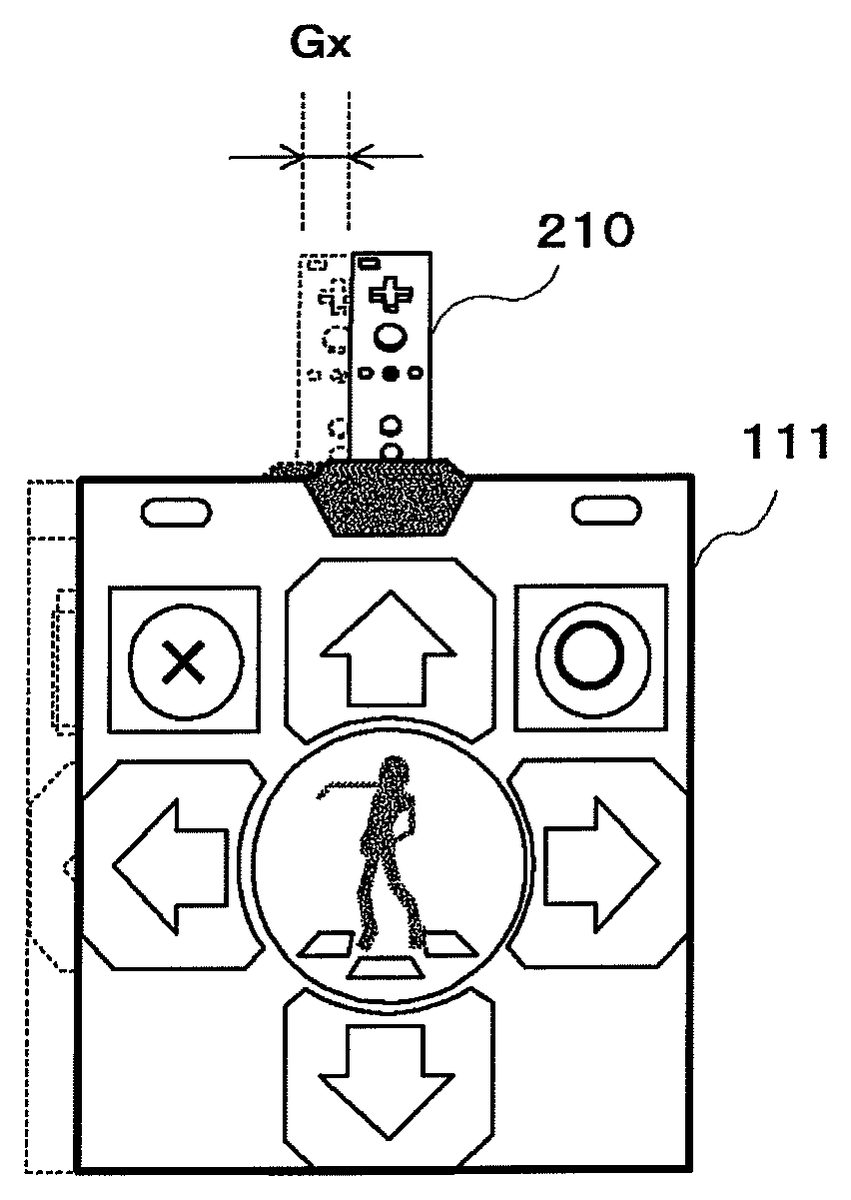
Abstract
A process control unit (306) controls a music reproduction unit (309) to output a music sound, while controlling a request content creation unit (305) to present content of a motion requested to the player. At the same time, the process control unit (306) compares content of the motion acquired from a motion content acquiring unit (302) with the presented, requested motion (and the timing) to evaluate the stepping motion of the player. Further, during the game, the process control unit (306) sequentially measures the amount of displacement of the game mat in accordance with the position, etc. of the controller, the position being detected by a controller detection unit (303). Then, when the measured amount of displacement exceeds a reference value, an alarm message is synthesized to a game screen and displayed, and the game mat displacement is informed to call attention of the player.
Description
EXPLANATION OF REFERENCE NUMERALS 100information processing device 101CPU 102ROM 103RAM 104interface 105controller unit 106external memory 107DVD-ROM drive 108image processor 109sound processor 110NIC 111game mat 300game device 301wireless communication unit 302motion content acquiring unit 303controller detection unit 304image information storage unit 305request content creation unit 306process control unit 307image rendering unit 308music information storage unit 309music reproduction unit BEST MODE FOR CARING OUT THE INVENTION Embodiments of the present invention will be described in the following. For ease of understanding, the embodiments below of the present invention are described as applications to information processing device designed specially for games. However, the present invention may be similarly applied to information processing devices, such as various computers, a PDA (Personal Data Assistants), or a mobile phone. In other words, the embodiments described in the following are provided to give explanations, not to limit the scope of the present invention. Therefore, those skilled in the art can adopt embodiments in which some or all of the elements herein have been replaced with respective equivalents, and such embodiments are also to be included within the scope of the present invention. (First Embodiment) FIG. 1is a schematic diagram showing a general configuration of a typical information processing device in which a game device according to an embodiment of the present invention is realized. The descriptions in the following will be given with reference to this diagram. An information processing device100is provided with a CPU (Central Processing Unit)101, ROM (Read Only Memory)102, RAM (Random Access Memory)103, an interface104, a controller unit105, an external memory106, a DVD (Digital Versatile Disc)-ROM drive107, an image processor108, a sound processor109, and an NIC (Network Interface Card)110and a game mat111. By inserting a DVD-ROM storing a program and data for a game into the DVD-ROM drive107and powering on the information processing device100, ...
EXPLANATION OF REFERENCE NUMERALS
100information processing device
101CPU
102ROM
103RAM
104interface
105controller unit
106external memory
107DVD-ROM drive
108image processor
109sound processor
110NIC
111game mat
300game device
301wireless communication unit
302motion content acquiring unit
303controller detection unit
304image information storage unit
305request content creation unit
306process control unit
307image rendering unit
308music information storage unit
309music reproduction unit
BEST MODE FOR CARING OUT THE INVENTION
Embodiments of the present invention will be described in the following. For ease of understanding, the embodiments below of the present invention are described as applications to information processing device designed specially for games. However, the present invention may be similarly applied to information processing devices, such as various computers, a PDA (Personal Data Assistants), or a mobile phone. In other words, the embodiments described in the following are provided to give explanations, not to limit the scope of the present invention. Therefore, those skilled in the art can adopt embodiments in which some or all of the elements herein have been replaced with respective equivalents, and such embodiments are also to be included within the scope of the present invention.
(First Embodiment)
FIG. 1is a schematic diagram showing a general configuration of a typical information processing device in which a game device according to an embodiment of the present invention is realized. The descriptions in the following will be given with reference to this diagram.
An information processing device100is provided with a CPU (Central Processing Unit)101, ROM (Read Only Memory)102, RAM (Random Access Memory)103, an interface104, a controller unit105, an external memory106, a DVD (Digital Versatile Disc)-ROM drive107, an image processor108, a sound processor109, and an NIC (Network Interface Card)110and a game mat111.
By inserting a DVD-ROM storing a program and data for a game into the DVD-ROM drive107and powering on the information processing device100, the program is executed, and the game device of the present embodiment is realized.
The CPU101controls the overall operation of the information processing device100, and is connected to individual components for exchanging control signals and data.
Recorded in the ROM102is an IPL (Initial Program Loader), which is executed immediately after power-on. By executing the IPL, the program recorded on the DVD-ROM is read into the RAM103, and execution of the program by the CPU101is commenced. Furthermore, the ROM102also stores programs and various data for an operating system necessary for controlling the overall operation of the information processing device100.
The RAM103is for temporarily storing data and/or programs, and retains the program and/or data read out from the DVD-ROM, as well as data needed for other operations, such as advancing the game or conducting chat communication.
The controller unit105, connected via the interface104, receives control input made when a user plays a game. Further, a controller210that will be described later can be attached to the game mat111. Upon the attachment, the controller unit105accepts input made by a stepping motion (step motion) of the player on the game mat111. The detail of the controller unit105will be described later.
The external memory106, being detachably connected via the interface104, stores in a rewritable manner information such as data indicating game progress or chat logs (records). By issuing command input via the controller unit105, the user can appropriately record such data on the external memory106.
Recorded on the DVD-ROM loaded into the DVD-ROM drive107is the program for realizing the game, as well as graphical and audio data associated with the game. Under the control of the CPU101, the DVD-ROM drive107conducts processing to read out the necessary program and/or data from the DVD-ROM loaded therein. The information read out is then temporarily stored in the RAM103or similar memory.
The image processor108processes data read from the DVD-ROM by using the CPU101and/or an image operation processor (not shown) provided in the image processor108, and then records the resulting data in frame memory (not shown) provided in the image processor108. The image information recorded in the frame memory is then converted into a video signal at a predetermined synchronous timing, and output to a monitor (the display290described later) connected to the image processor108. This makes it possible to display a variety of images.
The image operation processor is capable of executing transparency operations such as overlaying two-dimensional images and a blending, as well as various saturate calculations, at high speeds.
In addition, the image operation processor is also capable of executing high-speed computations whereby polygon information, being disposed in a virtual three-dimensional space and having various kinds of texture added thereto, is rendered by means of z-buffering, thereby acquiring a rendered image showing a view of the polygons disposed in the virtual three-dimensional space, viewed from a given point of view.
Furthermore, by means of the CPU101and the image operation processor operating in coordination, it is possible to draw a string of characters as a two-dimensional image in the frame memory or on respective polygon surfaces, in accordance with font information that defines the shapes of the characters. Although the font information is recorded in the ROM102, dedicated font information recorded on the DVD-ROM may also be used.
The sound processor109converts audio data read out from the DVD-ROM into an analog audio signal, and then causes the audio signal to be output from a speaker connected thereto (a speaker of the display290that will be described later). In addition, under control of the CPU101, the sound processor109also generates sound effects and music data that should be generated as the game progresses, and then causes a speaker to output sounds corresponding thereto.
The NIC110serves to connect the information processing device100to the Internet or a similar computer communications network (not shown). The NIC110may conform to the 10BASE-T/100BASE-T standard used when forming a LAN (Local Area Network), or alternatively, the NIC110may be made up of a modem, such as an analog modem for connecting to the Internet using a telephone circuit, an ISDN (Integrated Services Digital Network) modem, an ADSL (Asymmetric Digital Subscriber Line) modem, or a cable modem, etc. for connecting to the Internet using a cable television circuit, as well as an interface (not shown) that interfaces between the CPU101and any one of the above modems.
The game mat111is, for example, formed in a rectangular flat shape, and has a pressure sensor and switches, etc. disposed therein. When the game mat111is used, laid on a floor, and a predetermined area is pressed (pressed down) by foot by a player, the game mat111detects that the region is stepped.
Furthermore, a controller unit105(controller210described later) can be attached to the game mat111. The details of the game mat111will be described later.
In addition, the information processing device100may also be configured to use a hard disk or similar large-capacity external storage device to perform functions equivalent to components such as the ROM102, the RAM103, the external memory106, and the DVD-ROM loaded into the DVD-ROM drive107.
Furthermore, it may also be possible to employ a mode wherein a keyboard for receiving input for editing character strings from a user, or a mouse for receiving input that specifies various types of positions and makes selections, are connected thereto.
Furthermore, it is also possible to use a common computer (such as a general-purpose personal computer) as the game device, instead of the information processing device100of the present embodiment. For example, a common computer is provided with a CPU, RAM, ROM, a DVD-ROM drive, and an NIC, similarly to the information processing device100. Moreover, a common computer is also provided with an image processor having simplified functions compared to that of the information processing device100, as well as a hard disk that serves as an external storage device. Besides the above, a common computer may also be configured to use storage media such as flexible disks, magneto-optical disks, and magnetic tapes. In addition, in a common computer, devices such as a keyboard and a mouse are used as input devices, rather than a controller. Furthermore, after installing a game program, a common computer functions as a game device when the program is executed.
(Overview of Controller Unit and Game Mat)
FIG. 2is an external view for explaining the overview of the above-described controller unit105and the game mat111.
The controller unit105is structured to include a controller210and a light emission module220. The information processing device100is connected to the display290via a predetermined cable, and displays an image generated by the image processor108on a display screen of the display290, and outputs sound effects or the like generated by the sound processor109from a speaker of the display290.
The controller210has, for example, the exterior similar to a remote control for a television set, and connected wirelessly (by wireless communication) to the information processing device100. The controller210can be held and operated by one hand of a player.
On the other hand, the light emission module220is formed into a rod shape of a predetermined length and has one light emitting diode221embedded at each of both ends thereof. Then, for example, the light emission module220is appropriately fixed on the top of the display290along the orientation of the screen. This light emission module220is connected to the information processing device100by a cable, and causes the light emitting diode221to appropriately emit light by being supplied with power.
The controller210has a CCD camera211disposed on its end. This CCD camera211captures an image including two light emitting diodes221(two light emitting points) of the light emission module220when the end of the controller210is aimed at the display290. Further, the controller210comprises therein a wireless communication unit, and sequentially transmits information of captured image by wireless communication to the information processing device100.
The controller210can be attached to the game mat111.
The controller210comprises therein an acceleration sensor, an angular acceleration sensor and an inclination sensor, etc., and can measure a motion such as twisting. The result of the measurement is also transmitted to the information processing device100.
On the upper face of the controller210, a cross key212is provided and various input of direction instruction, etc. can be made when the controller210is held by the player by hand and operated. Further, an A button213and various buttons215are also provided on the upper face, and instruction inputs associated with the buttons can be made.
On the other hand, a B button214is provided on the lower face of the controller210. The button can be naturally pressed when being held by hand by the player and operated by the player, in conjunction with a dent formed on the lower face of the controller210.
An indicator216on the upper face of the controller210is appropriately lit so as to achieve recognition even when a plurality of controllers210are used.
A power button217prepared on the controller210instructs, for example, power on and power off of the information processing device100.
Further, inside the controller210, a vibration mechanism including a vibrator or the like is provided, and causes vibration in response to an instruction from the information processing device100.
On the other hand, the game mat111serves as a detection mat that is, in use, laid on a floor in front of the display290(light emission module220), and detects a region stepped by foot by a player.
More specifically, a ∘ key region251, designed after the model of a ∘ button, a x key region252designed after the model of a x button, and direction key regions253to256shaped after the model of each of direction buttons are provided on the mat so that a player can step on a desired region.
Pressure sensors and switches, etc. are embedded so as to correspond to each region, so that which region the player stepped on can be detected.
Further, a connection terminal257for attaching the controller210to the game mat111is provided to the game mat111. Then, in the use with the controller210attached to the connection terminal257, the content of the stepping motion (step motion) of the player on the game mat111is transmitted to the information processing device100via the controller210.
The following describes that the position, etc. of the game mat111is measured by a combination of the controller210and the light emission module220, with a state in which the controller210is attached to the game mat111taken as a standard state. The measurement of the position, etc. of the game mat111is not limited to the method in which the light emitting point (light emitting diode221) of the light emission module220is captured by the CCD camera211, and other methods can be applied appropriately. For example, the position, etc. of the controller210(game mat111) may be obtained from a time lag of wireless communication between two points via a predetermined sensor bar. Further, a supersonic wave or infrared light, etc. may be used to obtain the position of the controller210.
(General Configuration of Game Device)
FIG. 3is a schematic diagram showing a game device according to the present embodiment. This game device performs wireless communication with the controller210as described above and attached to the game mat111to acquire the content of the stepping motion of the player, as well as measuring displacement of the game mat111, etc. based on the position of the controller210and the orientation of its end, etc.
More specifically, the device is a dance game device which has installed therein a dance game which, while reproducing a predetermined music, displays an instruction of a motion requested to the player (designation of a region on which to step, etc.) on the display290, acquires the stepping motion of the player on the game mat111via the controller210and evaluates the stepping motion. Then, the device measures the amount of displacement, etc. of the game mat111and informs the player of it. The following provides an explanation with reference to this diagram.
A game device300includes: a wireless communication unit301; a motion content acquiring unit302; a controller detection unit303; an image information storage unit304; a request content creation unit305; a process control unit306; an image rendering unit307; a music information storage unit308; and a music reproduction unit309.
First, the wireless communication unit301performs wireless communication sequentially with the controller210to transmit and receive information needed.
For example, the wireless communication unit301sequentially acquires the content of the operation transmitted from the controller210and supplies the acquired contents to the motion content acquiring unit302. That is, the wireless communication unit301wirelessly acquires information as to the pressure over a predetermined range made by a player having stood on the game mat111, via the controller210attached to the game mat111.
Further, the wireless communication unit301sequentially receives information as to the position (position information and information as to the orientation of the frontal) that is transmitted from the controller210, and supplies it to the controller detection unit303.
The controller unit105may serve as such a wireless communication unit301.
The motion content acquiring unit302acquires the content of the stepping motion of the player, based on the information supplied from the wireless communication unit301. That is, the motion content acquiring unit302acquires in real time which region on the game mat111the player has stepped, etc.
Then, the motion content acquiring unit302supplies the acquired content of the stepping motion to the process control unit306.
The CPU101may serve as such a motion content acquiring unit302.
The controller detection unit303sequentially detects the position, etc. of the game mat111, based on information as to the position supplied from the wireless communication unit301. That is, the controller detection unit303detects the position, etc. of the game mat111by acquiring the position, etc. of the controller210attached to the game mat111.
The CPU101may serve as such a controller detection unit303.
The image information storage unit304stores decoration image for display in time with the music to be reproduced and various images for presenting the requested motions (for example, four arrows of four directions: up, down, left and right, etc.).
The DVD-ROM attached to the DVD-ROM drive107and the RAM103may serve as such an image information storage unit304.
The request content creation unit305is controlled by the process control unit306, selects appropriately an image for displaying the requested motion from the image information storage unit304and controls the image rendering unit307to render the selected image. For example, the request content creation unit305in time with the reproduced music and in a good timing selects any of the arrow images of up, down, left and right and controls the image rendering unit307to render the image.
The CPU101may serve as such a request content creation unit305.
The process control unit306controls the entire game device300.
For example, the process control unit306controls the music reproduction unit309to output a music sound, while controlling the request content creation unit305to present the content of the motion requested to the player (controls the display290to display arrow image or the like).
At the same time, the process control unit306compares the content of motion acquired from the motion content acquisition unit302with the presented requested motion (and timing) to evaluate the stepping motion of the player.
Further, the process control unit306measures the amount of displacement of the game mat111in accordance with the position, etc. of the controller210detected by the controller detection unit303.
Specifically, the process control unit306, as shown inFIG. 4A, measures the amount of displacement of the game mat111in the lateral direction based on the change of position (Gx) of the controller210in the lateral direction (x direction). Similarly, as shown inFIG. 4B, the process control unit306measures the amount of displacement in the lateral direction of the game mat111from the change of position (Gy) of the controller210in the vertical direction (y direction). Naturally, when the game mat111is displaced in both vertical and lateral directions at the same time, the amount of displacement in both directions are measured.
Further, even if the position of the controller210is the same, in some cases the orientation thereof may be different. That is, as shown inFIG. 4C, when the orientation of the frontal of the controller210is different between Da and Db, the game mat111is displaced in a rotational manner. In this case, the process control unit306measures the amount of displacement of the game mat111in the direction of rotation, based on a difference of the orientation of the frontal, etc.
Then, the process control unit306, when the amount of displacement of the game mat111measured during the game exceeds a reference value, generates a predetermined alarm message or an alarm image to call the attention of the player and synthesizes them to the game screen and displays it.
The CPU101can serve as such a process control unit306.
The image rendering unit307renders a predetermined decoration image, etc. in time with a music that is reproduced. Then, the image rendering unit307appropriately synthesizes an image for presenting the requested motion created by the request content creation unit305, to generate a display image (game screen) and displays it on the display290.
For example, the image rendering unit307generates a display image including arrows of four directions Ml, Md, Mu and Mr as shown inFIG. 5A. In this figure, arrows Ml, Md, Mu and Mr present the stepping motion requested to the player. For example, in the case where the arrow Ml is presented, the player is requested to step in the region255(left arrow) of the game mat111at the timing. Similarly, when the arrows Md, Mu and Mr are presented, the player is requested to step on a region254(down arrow), a region253(upper arrow) and a region256(right arrow) of the game mat111.
Further, when the amount of displacement of the game mat111exceeds a reference value, the image rendering unit307generates a display image including an alarm message mes as shown inFIG. 5B. That is, on the halfway of the game, and on the interval of the game and the termination of the game, the displacement of the game mat111is informed to call the attention of the player.
The image processor108can serve as such an image rendering unit307.
The music information storage unit308stores a plurality of pieces of music data that constitutes an accompaniment at the time of stepping of the player. That is, the player can select the preferred music and step to the music.
DVD-ROMs attached to the DVD-ROM drive107and the RAM103can serve as such a music information storage unit308.
The music reproduction unit309has a sound source such as a synthesizer, and sequentially synthesizes electronic sounds based on music data such as MIDI (Musical Instrument Digital Interface) data, and causes the speaker of the display290to output the music sound therefrom.
The sound processor109can serve as such a music reproduction unit309.
(Overview of Operation of Game Device)
FIG. 6is a flowchart showing the flow of the game control process executed on the game device300of the above-described structure. The following describes the operation of the game device300with reference to this flowchart. This game control process is suitable for a dance game that evaluates stepping motions (step motions) of a player while detecting the displacement of the game mat111.
First, the game device300commences reproduction of an accompaniment sound (step S401). That is, the music reproduction unit309reproduces an accompaniment arbitrarily selected by the player (a music that will be an accompaniment for the stepping of the player), and outputs the accompaniment from the speaker of the display290.
The game device300presents motions requested to the player (step S402). For example, the image rendering unit307generates a display image including the above-described four arrows Ml, Md, Mu and Mr in four directions as shown inFIG. 5Aand displays the image on the display290.
The game device300determines whether it has acquired the stepping motion of the player (step S403). That is, the process control unit306determines whether the motion content acquiring unit302has acquired the content of the stepping motion of the player, based on information supplied from the wireless communication unit301.
When the game device300determines that the stepping motion of the player has not been acquired (step S403; No), the game device300proceeds the process to step S406that will be describe later.
On the other hand, when the game device300determines that the stepping motion of the player has been acquired (step S403; Yes), the game device300checks correctness of the stepping motion (step S404).
That is, the process control unit306compares the contents of the motion acquired from the motion content acquiring unit302with the requested motion (and timing) presented in step S402to evaluate the stepping motion of the player.
The game device300adds points in accordance with the check result (evaluation result) (step S405). That is, the game device300adds points displayed on the display290in a case where the player performs in good timing a stepping motion that is the same as what is requested and presented. Where it is a different stepping motion or a stepping motion, albeit the same, off the timing, the points are not added.
The game device300acquires the position, etc. of the controller210(step S406). That is, the controller detection unit303detects the position, etc. of the game mat111based on the information that is in regards to the position and that is supplied from the wireless communication unit301.
The game device300measures the amount of displacement of the game mat111(step S407).
That is, the process control unit306measures the amount of displacement of the game mat111in the lateral and vertical directions based on the change of positions (Gx, Gy) in the lateral direction (x direction) and the vertical direction (y direction) of the controller210, as shown in the above-describedFIGS. 4A and 4B.
Further, the process control unit306, as shown in the above-describedFIG. 4C, measures the amount of displacement of the game mat111in the direction of rotation, based on the change of orientation (from Da to Db) of the frontal of the controller210, etc.
The game device300determines whether the measured amount of displacement of the game mat111exceeds a reference value (step S408).
That is, the process control unit306determines whether the amount of displacement in the lateral direction and the vertical direction of the game mat111exceeds a reference value, and whether the amount of displacement in the direction of rotation exceeds a reference value. The reference values to be compared are appropriate values each obtained by an experiment, etc.
The game device300, when determining that the amount of displacement of the game mat111does not exceed the reference value (step S408; No), proceeds the process to step S410that will be described later.
On the other hand, when the game device300determines that the amount of displacement of the game mat111exceeds the reference value (step S408; Yes), the game device300displays an alarm message by synthesizing (step S409). For example, the image rendering unit307generates a display image including the alarm message mes as shown in the above-describedFIG. 5B, and displays it on the display290.
That is, the game device300informs that the game mat111is displaced to call attention of the player.
The game device300determines whether the reproduction of a music has been ended (step S410). That is, the game device300determines whether one game of the dance game has been terminated.
The game device300, when determining that the reproduction of the music has not been ended (step S410; No), brings the process back to the above-described step S402. That is, the game device300repeats the processes of steps S402to410until the music ends.
On the other hand, when determining that the reproduction of a music has been ended (step S410; Yes), the game device300displays a predetermined end message and the total score, etc., and then terminates the game control process.
By such a game control process, it is possible to wirelessly acquire a stepping motion (step motion) of a player on the game mat111by using a controller210that carries out wireless communication.
This eliminates conventional problem of stumbling with a connection code and allows free choice of disposition of the game mat111.
Further, by the position, etc. of the controller210attached to the game mat111, the amount of displacement of the game mat111can appropriately be measured. Then, when the measured amount of displacement exceeds a reference value, it is possible to inform the player of the displacement by displaying the alarm message, etc.
As a result of this, it is possible to call attention to the displacement of the mat.
(Other Embodiments)
The above-described embodiment has described the case in which the amount of displacement of the mat is sequentially measured, and an alarm message, etc. is displayed when the amount of displacement exceeds the reference value. However, it may be so configured that: the position, etc. of the game mat111is detected at the start of the game and at the termination of the game (or at the time of musical interlude); and in a case where the amount of displacement of the game mat111obtained from both positions exceeds a reference value, an alarm message, etc. is displayed at the termination of the game (or at the time of musical interlude).
The above-described embodiment has described the case where the amount of displacement in the horizontal direction (the direction parallel to the floor) is obtained, as shown inFIGS. 4A to 4C. However, the momentary amount of displacement in the vertical direction (the direction perpendicular to the floor) may be obtained to calculate the strength, etc. of the stepping of the player.
More specifically, the process control unit306, as shown inFIG. 7A, measures the momentary amount of displacement in the vertical direction (z direction) of the game mat111, based on a momentary change (Gz) in the vertical direction (z direction) of the position of the controller210.
Such displacement in the vertical direction is prominent where the weight of the player is heavy or the strength of the stepping of the player is high. Where the strength of the stepping, etc. becomes larger than is necessary, the concern is about a significant vibration or noise to be given to the downstairs.
Therefore, the process control unit306, when the momentary amount of displacement in the vertical direction measured during the game exceeds a reference value, generates a predetermined alarm message or an alarm image for calling attention of a player, by synthesizing it to the game screen and displays the synthesized screen.
For example, the process control unit306generates a display image including an alarm message cmes as shown inFIG. 7B. That is, it is informed in the halfway of the game, etc. that the stepping is too strong and attention is also called for the player.
This makes the player adjust the strength of the stepping and makes it possible to suppress occurrence of vibration or noise.
The above embodiment has described the case where, if the amount of displacement exceeds the reference value, it is informed by an alarm message, etc. However, where the amount of displacement is abnormally large, the progress of the game may be temporarily stopped and the stepping motion of the player may be suspended.
Then, the progress of the game may be resumed after elapse of a predetermined time or in response to a specific operation from the player.
In this case, attention can be called to the mat displacement even in a case where the player is too enthusiastic to be aware of the alarm message, etc.
Further, it may be so configured that the tempo in reproduction of a music (the speed of reproduction) is changed according to the magnitude of the amount of displacement.
For example, the magnitude of amount of displacement is classified into levels (steps), and it is determined which level the measured amount of displacement of the game mat111corresponds to. Then, in accordance with the determined level, the reproduction tempo of the music is changed.
More specifically, the reproduction tempo is slowed by about ten percent from the reference tempo in the case where the level is a low level. If the level is a modest level, the reproduction tempo is slowed by twenty to thirty percent, and if the level is the maximum level, the reproduction tempo is slowed by forty to fifty percent.
In this case, it is possible to call attention to the mat displacement by the change of tempo of reproduction.
Further, because the slower the reproduction tempo becomes, the larger the time allowance for stepping motion is; it naturally makes the stepping motion slow and makes the amount of displacement of the game mat111small.
The above embodiment has described a case where attention is called to the mat displacement by an alarm message or suspension of the game where the amount of displacement exceeds the reference value. However, it may be so configured that the content of the stepping motion is changed to such one that corrects (eliminates) the displacement and the changed content of the stepping motion is displayed to call attention to the mat displacement while preventing the enlargement of the displacement.
Specifically, the process control unit306, when the measured amount of displacement exceeds the reference value, controls the request content creation unit305and makes changes to the content of the stepping motion.
For example, in order to correct the displacement of the game mat111, the request content creation unit305does not present the stepping motion toward the direction of displacement on purpose, and instead, presents the content of the stepping motion toward the inverse direction with respect to the displacement.
Further, the request content creation unit305does not present a stepping motion by which the weight shift of the player becomes comparatively large (for example, consecutive motions on diagonal lines, etc.) on purpose, and presents the stepping motion by thinning it to keep a sufficient time between the stepping motions (so that the weight shift is slow).
That is, the content of the stepping motion to be presented is changed to suppress the displacement of the game mat111as much as possible, by changing the content of stepping motion to be presented.
This makes it possible to call attention to the mat displacement while suppressing the enlargement of the displacement.
The above embodiment has described a case where attention is called to the mat displacement by an alarm message and a game interruption, etc. in the case where the amount of displacement exceeds the reference value. However, a stepping motion that does not cause mat displacement may be more highly evaluated.
For example, the process control unit306further uses the amount of displacement of the game mat111as a negative weight on checking the correctness of the stepping motion of the player, such that the smaller the amount of displacement is, the higher the evaluation (the higher the score) to be obtained is. That is, albeit the stepping motion of the player is correct (in a good timing) the score to be added is small if the amount of displacement of the game mat111is large. Conversely, if the stepping motion of the player is correct and the amount of displacement of the game mat111is small, then the score to be added is high.
As a result of this, a stepping motion that does not cause mat displacement can be highly evaluated. Then, by highly evaluating the stepping motion that does not cause the mat displacement, it becomes possible to prevent the strength of the stepping of the player from being larger than is necessary.
The above embodiment has described a case where attention of the player is called by display of an alarm message or the like. However, information to call attention (advisory information) is not limited to such an alarm message or the like and arbitrarily determined. For example, an alarm sound or an alarm voice may be output to call attention of the player.
In addition, attention of the player can be called by changing the mode of display of the display screen (game screen), instead of directly displaying an alarm message, etc.
For example, it is possible that, when the mat displacement is caused, the game screen may be vibrated (the vibration may correspond to the direction of displacement), the color, pattern or brightness, etc. of the screen may be changed to call attention of the player.
The above embodiment has described, as one example, a dance game application. However, application is also possible to various games using the game mat111suitably, not limited to the dance game.
The present invention claims the priority based on the Japanese Patent Application No. 2006-228691 and the contents of this basic application is incorporated herein by reference.
Industrial Applicability
As described above, according to the present invention, it is possible to provide a game device, a method for alarming, an information recording medium and a program that are suitable for calling attention to a player as to the displacement of a mat, in a game wherein the player performs a stepping motion on the mat.
Claims
- A game device, comprising: a detection mat, located on a surface, that detects a pressure onto the detection mat and a position of the pressure in the detection mat;a controller that is detachably attached to the detection mat;an acquiring unit that acquires, via the controller, an operation instruction made by a stepping motion of a player on the detection mat, based on the detected pressure and the detected position of the pressure;a controller detection unit that detects a position of the controller;a measuring unit that measures an amount of displacement of the detection mat relative to the surface in a predetermined direction, based on the detected position of the controller, the predetermined direction being parallel to the surface, wherein the measuring unit, in measuring an amount of displacement of the detection mat, acquires a first position of the controller from the controller detection unit, acquires an indication of the stepping motion of the player on the detection mat, and acquires a second position of the controller from the controller detection unit, the amount of displacement of the detection mat relative to the surface in the predetermined direction being a function of the first and second positions of the controller;and an output control unit that outputs advisory information in a case where the measured amount of displacement in the predetermined direction exceeds a reference displacement value.
- The game device according to claim 1 , wherein the measuring unit measures the amount of displacement of the detection mat and the direction of displacement of the detection mat, based on a position of the controller detected by the controller detection unit at a start of a game and a position of the controller detected by the controller detection unit at a termination of the game.
- The game device according to claim 1 , wherein;the measuring unit further measures a strength of stepping of the player, based on a change of a vertical position of the controller;and the advisory information further informs the strength of stepping of the player in a case where the measured strength of stepping of the player exceeds a reference strength value.
- The game device according to claim 1 , further comprising: a game control unit that suspends progress of the game in a case where the measured amount of displacement in the predetermined direction exceeds the reference displacement value.
- The game device according to claim 4 , wherein: the advisory information further informs that the progress of the game is suspended in a case where the game control unit suspends the progress of the game;and the game control unit resumes the progress of the game after elapse of a predetermined time from the suspension of the progress of the game.
- The game device according to claim 1 , further comprising: a reproduction unit that reproduces an accompaniment for the stepping motion performed by the player;and a reproduction control unit that sets a tempo of the accompaniment slower than standard, in a case where the measured amount of displacement in the predetermined direction exceeds the reference displacement value.
- A notification method performed by a game device including a detection mat, located on a surface, that detects a pressure and onto the detection mat and a position of the pressure in the detection mat and a controller that is detachably attached to the detection mat, comprising: an acquiring step of acquiring, via the controller, an operation instruction made by a stepping motion of a player on the detection mat, based on the detected pressure and the detected position of the pressure;a controller detection step of detecting a position of the controller;a measuring step of measuring an amount of displacement of the detection mat relative to the surface in a predetermined direction, based on the detected position of the controller, the predetermined direction being parallel to the surface, the measuring step including the steps of acquiring a first position of the controller from the controller detection unit, acquiring an indication of the stepping motion of the player on the detection mat, and acquiring a second position of the controller from the controller detection unit, the amount of displacement of the detection mat relative to the surface in the predetermined direction being a function of the first and second positions of the controller;and an output control step of outputting advisory information in a case where the measured amount of displacement in the predetermined direction exceeds a reference displacement value.
- A non-transitory information recording medium storing a program that causes a computer including a detection mat, located on a surface, that detects a pressure onto the detection mat and a position of the pressure in the detection mat and a controller that is detachably attached to the detection mat, to function as: an acquiring unit that acquires, via the controller, an operation instruction made by a stepping motion of a player on the detection mat, based on the detected pressure and the detected position of the pressure;a controller detection unit that detects a position of the controller;a measuring unit that measures an amount of displacement of the detection mat relative to the surface in a predetermined direction, based on the detected position of the controller, the predetermined direction being parallel to the surface, wherein the measuring unit, in measuring an amount of displacement of the detection mat, acquires a first position of the controller from the controller detection unit, acquires an indication of the stepping motion of the player on the detection mat, and acquires a second position of the controller from the controller detection unit, the amount of displacement of the detection mat relative to the surface in the predetermined direction being a function of the first and second positions of the controller;and an output control unit that outputs advisory information in a case where the measured amount of displacement in the predetermined direction exceeds a reference displacement value.
- A program stored in a non-transitory information recording medium, that causes a computer including a detection mat, located on a surface, that detects a pressure onto the detection mat and a position of the pressure in the detection mat and a controller that is detachably attached to the detection mat to function as: an acquiring unit that acquires, via the controller, an operation instruction made by a stepping motion of a player on the detection mat, based on the detected pressure and the detected position of the pressure;a controller detection unit that detects a position of the controller;a measuring unit that measures an amount of displacement of the detection mat relative to the surface in a predetermined direction, based on the detected position of the controller, the predetermined direction being parallel to the surface, wherein the measuring unit, in measuring an amount of displacement of the detection mat, acquires a first position of the controller from the controller detection unit, acquires an indication of the stepping motion of the player on the detection mat, and acquires a second position of the controller from the controller detection unit, the amount of displacement of the detection mat relative to the surface in the predetermined direction being a function of the first and second positions of the controller;and an output control unit that outputs advisory information in a case where the measured amount of displacement in the predetermined direction exceeds a reference displacement value.
Disclaimer: Data collected from the USPTO and may be malformed, incomplete, and/or otherwise inaccurate.