U.S. Pat. No. 8,080,722
PREVENTING AN UNINTENTIONAL DEPLOY OF A BONUS IN A VIDEO GAME
AssigneeHarmonix Music Systems, Inc.
Issue DateMay 29, 2009
Illustrative Figure
Abstract
Described are methods, systems, and apparatuses, including computer program products, for preventing an unintentional deploy of a bonus in a video game. In one aspect this is accomplished by displaying, on a display in communication with a game platform, a target music data of a musical composition. The game platform receives a music performance input data via the microphone, and also determines if the music performance input data has a predetermined degree of matching with a vocal cue. If so, the performance input data is prevented from executing an improvisation deploy.
Description
DETAILED DESCRIPTION Architecture FIG. 1Ais a diagram depicting a game platform100for running game software and various components in signal communication with the game platform. Each player may use a game platform100in order to participate in the game. In one embodiment, the game platform100is a dedicated game console, such as: PLAYSTATION® 2, PLAYSTATION® 3, or PSP® manufactured by Sony Corporation; WII™, NINTENDO DS®, NINTENDO DSi™, or NINTENDO DS LITE™ manufactured by Nintendo Corp.; or XBOX® or XBOX 360® manufactured by Microsoft Corp. In other embodiments, the game platform100comprises a personal computer, personal digital assistant, or cellular telephone. Throughout the specification and claims, where reference is made to “the game platform100” performing a function, “game platform100” may, for some implementations, be read as “game platform100with game software executing on it.” References to the game platform100and omission of reference to the game software does not imply absence of the game software. Game software alone may also embody the invention, e.g., a computer program product, tangibly embodied in a computer-readable storage medium, while in some embodiments the invention is implemented purely in hardware such as a computer processor configured to perform specific functions. In other embodiments the invention is embodied by a combination of hardware and software. The game platform100is typically in electrical and/or signal communication with a display105. This may be a television, an LCD monitor, projector, or the like. The game platform is also typically in electrical or signal communication with one or more controllers or input devices. InFIG. 1, the game platform100is in signal communication with a first microphone110a, a second microphone110b(microphones, collectively,110), a first simulated guitar controller115aand a second simulated guitar controller115b(guitar controllers, collectively,115). Other inputs can be other simulated instruments such as keyboards and drums (not shown), standard controllers for the respective game platforms, and/or keyboards and/or mice (also ...
DETAILED DESCRIPTION
Architecture
FIG. 1Ais a diagram depicting a game platform100for running game software and various components in signal communication with the game platform. Each player may use a game platform100in order to participate in the game. In one embodiment, the game platform100is a dedicated game console, such as: PLAYSTATION® 2, PLAYSTATION® 3, or PSP® manufactured by Sony Corporation; WII™, NINTENDO DS®, NINTENDO DSi™, or NINTENDO DS LITE™ manufactured by Nintendo Corp.; or XBOX® or XBOX 360® manufactured by Microsoft Corp. In other embodiments, the game platform100comprises a personal computer, personal digital assistant, or cellular telephone. Throughout the specification and claims, where reference is made to “the game platform100” performing a function, “game platform100” may, for some implementations, be read as “game platform100with game software executing on it.” References to the game platform100and omission of reference to the game software does not imply absence of the game software. Game software alone may also embody the invention, e.g., a computer program product, tangibly embodied in a computer-readable storage medium, while in some embodiments the invention is implemented purely in hardware such as a computer processor configured to perform specific functions. In other embodiments the invention is embodied by a combination of hardware and software.
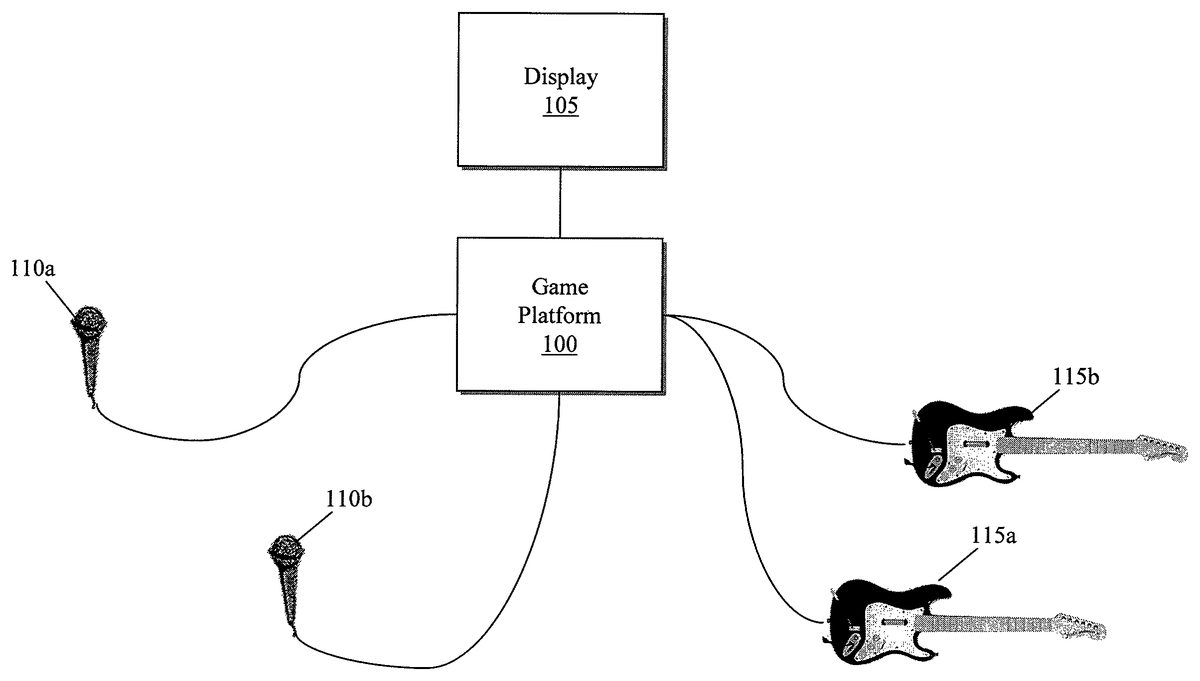
The game platform100is typically in electrical and/or signal communication with a display105. This may be a television, an LCD monitor, projector, or the like. The game platform is also typically in electrical or signal communication with one or more controllers or input devices. InFIG. 1, the game platform100is in signal communication with a first microphone110a, a second microphone110b(microphones, collectively,110), a first simulated guitar controller115aand a second simulated guitar controller115b(guitar controllers, collectively,115). Other inputs can be other simulated instruments such as keyboards and drums (not shown), standard controllers for the respective game platforms, and/or keyboards and/or mice (also not shown). Microphones, controllers, etc. may be connected via a physical wire, e.g., via a USB connection, or may be connected wirelessly, e.g., via Bluetooth, FM, a proprietary wireless protocol used by the Microsoft Xbox 360 game console, or other wireless signaling protocols.
Though reference is made to the game platform100generally, the game platform, in some embodiments such as that depicted inFIG. 1B, contains hardware and/or software that perform general or specific tasks, such as a central processing unit120, an instrument analysis module125, a singing analysis module130, a sound processing module135that provides sound output, e.g., to a speaker, a storage device140, Random Access Memory145, Read Only Memory150, peripheral interfaces155, networking interface160, media interfaces163(e.g., a CD-ROM, DVD, or Blu-Ray drive or SD, Compact Flash, or other memory format interfaces), graphic processors165and others. Each module may also contain sub-modules. For example the singing analysis module130may contain a data extractor module170, a digital signal processor module175, a comparison module180, and a performance evaluation module185. Alternatively, in software implementations of the modules, modules or combinations of modules may reside within the RAM145or ROM150(and/or be loaded into these from media via the media interface163or from storage160) for execution by the central processing unit120.
Prior art versions of some of these modules are found in U.S. Pat. No. 7,164,076 as they relate to processing vocal input. The data extractor module170extracts pitch data and timestamps stored in song data records, which may be stored in storage140, RAM145, ROM,150, on memory card or disc media in communication with the game platform100, or accessible via a network connection. The digital signal processor module175extracts pitch frequency data from the digital data stream using known pitch extraction techniques. In some embodiments, a time-based autocorrelation filter is used to determine the input signal's periodicity. The periodicity is then refined to include a fractional periodicity component. This period is converted into frequency data, which is then converted into a semitone value or index using known conversion techniques. The semitone value may be similar to a MIDI note number, but may have both integer and fractional components (e.g., 50.3). While the pitch data is typically represented by semitones, pitch data can be converted into any desired units (e.g., Hertz) for comparison with the sampled pitch data from a microphone input.
The comparison module180compares the timestamps of data records with the sample time associated with the pitch sample. The comparison module180selects a data record from a number of data records stored in a buffer that has a timestamp that most closely matches the sample time, then compares the pitch value stored in that data record (i.e., correct pitch) with the pitch sample associated with sample time. In some embodiments, the comparison includes determining the absolute value of the difference between the correct pitch value and the sample pitch data. The performance evaluation module185takes the results of the comparison module180and generates performance evaluation data based on the pitch error and other settings, e.g., the difficulty chosen by the player. This information includes a tolerance threshold, which can be compared against the pitch error to determine a performance rating. If the pitch error falls within the tolerance threshold, then a “hit” will be recorded, and if the pitch error falls outside the tolerance threshold, then a “miss” will be recorded. The hit/miss information is then used to compute a score and to drive or trigger the various performance feedback mechanisms described herein (e.g., pitch arrow, performance meter, crowd meter, etc.). Though pitch extraction and determining a hit or miss for one part are known, the modules, their functions and programming are improved by the present invention and provide new functionality described herein.
In some embodiments, execution of game software limits the game platform100to a particular purpose, e.g., playing the particular game. In these scenarios, the game platform100combined with the software, in effect, becomes a particular machine while the software is executing. In some embodiments, though other tasks may be performed while the software is running, execution of the software still limits the game platform100and may negatively impact performance of the other tasks. While the game software is executing, the game platform directs output related to the execution of the game software to the display105, thereby controlling the operation of the display. The game platform100also can receive inputs provided by one or more players, perform operations and calculations on those inputs, and direct the display to depict a representation of the inputs received and other data such as results from the operations and calculations, thereby transforming the input received from the players into a visual representation of the input and/or the visual representation of an effect caused by the player.FIG. 2provides some examples of data depicted on the display10S.
Game Interface
FIG. 2is an exemplary screenshot of one embodiment of a multiplayer rhythm-action game where multiple vocal parts are displayed via an input interface200and multiple vocal inputs are received. InFIG. 2, the vocal parts depicted represent a lead vocal part and two harmony vocal parts, though whether a part is designated a melody part or a harmony part is not mandated. In some embodiments, no musical distinction is made by the game platform100between parts, e.g., no distinction between melody and harmony; instead, the game presents all parts as simply different parts.
WhileFIG. 2depicts primarily vocal performances, players can also provide input via instruments115and/or game controllers, for example, a player can both sing and play a simulated guitar, keyboard, drums, or other instrument and the input is handled by the respective singing analysis module130or instrument analysis module125. Beneficially, additional players, e.g., fourth and fifth players (or more), may join the game as keyboard players, playing other instruments, and/or provide additional vocal inputs. Input provided via an instrument or microphone is not necessarily tied to a particular human player. For example, in the game there can be one vocal “instrument” or musical “player” that represents vocal input, and correspondingly one avatar representing singing input, but vocal input can actually come from one, two, or any number of microphones connected to the game platform, allowing multiple real-world players to contribute to the one vocal “player” in the game.
One or more of the players of the game may be represented on screen by an avatar205a,205b,205c(collectively205), rendered by the graphics processor165. In some embodiments, an avatar205may be a computer-generated image. In other embodiments, an avatar205may be a digital image, such as a video capture of a person. An avatar205may be modeled on a famous figure or, in some embodiments, the avatar may be modeled on the game player associated with the avatar. In cases where additional players enter the game, the screen may be altered to display an additional avatar205and/or music interface for each player.
InFIG. 2, an input interface200is displayed as a bounded space, i.e., a “lane” is used to display vocal cues and received vocal inputs. The lane200has an area for displaying a first set of lyrics210, an area for displaying a second set of lyrics215, and an area between the lyrical areas for displaying “vocal cues”220a,220b,220c(collectively220). During gameplay, the cues220, also referred to as “musical targets”, “target music data” or note tubes, appear to flow toward a target marker225, also called a Now Bar. Understandably, the Now Bar225represents what the player should be inputting at a particular moment, i.e., now. In some embodiments, the cues220flow from right to left. In other embodiments it is left to right. In other embodiments, the cues220appear to be flowing from the “back” of the screen towards a player as if in a three-dimensional space, on a spatial path that does not lie within the image plane.
The cues220are distributed in the lane200in a manner having some relationship to musical content associated with the song being audibly played. For example, the cues220may represent pitch (cues displayed towards the bottom of the lane represent notes having a lower pitch and cues towards the top of the lane, e.g.,220crepresent notes having a higher pitch), volume (cues may glow more brightly for louder tones), duration (cues may be “stretched” to represent that a note or tone is sustained), note information (cues spaced more closely together for shorter notes and further apart for longer notes), articulation, timbre or any other time-varying aspects of the musical content. The cues220may be tubes, cylinders, circlers, or any geometric shape and may have other visual characteristics, such as transparency, color, or variable brightness.
As the cues220move through the lane and intersect the Now Bar225, the player is expected to sing the musical data represented by the vocal cues. To assist the player, in some embodiments the music data represented by the note tubes220may be substantially simultaneously reproduced as audible music or tones. For example, during regular play or during a practice mode, to assist a player with a particular part, the pitch that the player is expected to sing is audibly reproduced, thereby assisting the player by allowing them to hear a pitch to match.
In certain embodiments, successfully performing the musical content triggers or controls the animations of avatars205. Additionally, the visual appearance of interface elements, e.g., the cues220, may also be modified based on the player's proficiency with the game. For example, failure to execute a game event properly may cause game interface elements220to appear more dimly. Alternatively, successfully executing game events may cause game interface elements220to glow more brightly. Similarly, the player's failure to execute game events may cause their associated avatar205to appear embarrassed or dejected, while successful performance of game events may cause their associated avatar to appear happy and confident. In other embodiments, successfully executing cues220in the lane200causes the avatar205associated with that performance to appear to sing in a particular manner. For example, where the singer is on key for a sustained period, the avatar205may appear to “belt out” the vocal part. In some embodiments, when two or more parts are being successfully sung, e.g., human players are singing the same or different vocal parts and the players are both on key for their respective parts (or the same part), avatars205will visually be depicted standing closer together or leaning into each other and singing. In some embodiments the avatars205will be depicted sharing a microphone on stage. Successful execution of a number of successive cues220may cause the corresponding avatar205to execute a “flourish,” such as kicking their leg, pumping their first, winking at the crowd, spinning around, or if the avatar is depicted with an instrument, performing a guitar “windmill,” throwing drum sticks, or the like.
Player interaction with a cue220may be required in a number of different ways. In one embodiment, there is one vocal “player” for the game, i.e., vocal input from any number of different microphones are represented as one member of the group, or by one avatar205, even though many real-world players may provide vocal input. For example, in one scenario, a real-world player can choose a microphone110aas their instrument from an instrument selection screen. When gameplay starts, the game platform detects, in some cases via peripheral interfaces155, that multiple microphones are in electrical and/or signal communication with the game platform (e.g., plugged into the game platform or connected wirelessly). When a vocal cue220is displayed to the players, not only can the person that chose the microphone110aat the instrument selection screen sing and provide vocal input, but so can anyone else singing into a microphone110bthat is in signal communication with the game platform100. Any singing input into the other microphones110bprovided by real-world players can be treated as coming from the person that chose the microphone110a, as additional input, or as complementary input to the person that chose the microphone110a. In some implementations, additional or complementary input provides a bonus score to the person that selected the microphone. Thus, several real-world people singing can be treated, along with the person that chose microphone, as one “player” or one “instrument” in the game.
Beneficially, no one player singing into a microphone110is necessarily tied to a vocal part, e.g., a melody or harmony part. In a multi-vocal part game, e.g., one that allows players to sing melody and harmony parts simultaneously, the player that chose the microphone110acan sing a harmony part while another player that has a microphone110bcan sing a melody part, or vice versa, or the two can switch dynamically during gameplay, even during a single phrase. Not tying players to particular parts is applicable to other instruments as well, e.g., guitars115, and not limited to vocal input. For example, in a game where there are multiple guitar parts, e.g., lead guitar and rhythm guitar, two players each playing a simulated guitar115a,115bcan play with one player performing the lead guitar part, the other playing the rhythm guitar part, or vice versa, or they can switch which part they are each playing dynamically during the game, even within a phrase. Similarly, where there are two or more keyboard parts displayed, two or more players with simulated keyboards (not shown) can each play different parts, e.g., parts played on the higher keys on the keyboard, in the middle of the keyboard, or parts involving the lower keys. Additionally or alternatively, combinations of parts can be played by a single player and additional players can play additional parts, e.g., one person plays high and middle key parts and the other plays low parts, or one person could perform high and low while another performs middle parts, or other combinations.
Referring back to vocal input, player interaction with a cue220may comprise singing a pitch and or a lyric associated with a cue220. In one aspect, multiple vocal parts220a,220b,220care displayed substantially simultaneously in the same lane200, with different vocal parts depicted using different colors. Additionally or alternatively, pitch indicators230a,230b,230c(collectively230) assigned to each microphone in communication with the game platform100have a particular shape, e.g., triangle, circle, square, or various stylized arrows, or other shapes. In some embodiments the pitch markers assigned to each microphone have a distinctive coloring or shaping allowing players to distinguish between them.
As an example, inFIG. 2, three stylized arrows230depict the received input from each of microphone110a,110b, and a third microphone (not shown) in communication with the game platform100. Though one to three vocal parts are displayed and explained herein, the system and game can process, score, and display any number of vocal parts and/or inputs. For example, a first microphone's110ainput is reflected by a spade-shaped marker230a, a second microphone's110binput is represented by an elongated, cross-shaped arrow230b, and the third microphone's input is represented by an arrow resembling a stylized pointer230c. Additionally, each vocal part is displayed using different color. For example, in some implementations, the tubes220afor a lead or main vocal part are displayed in blue, the tubes220bfor a first harmony part are displayed in brown, and the tubes220cfor a second harmony part are displayed in orange. InFIG. 2, the received pitch input from the first microphone110amatches the pitch of the main vocal tube220a. The received pitch input from the second microphone110bmatches the pitch of the first harmony vocal part tube220band the received pitch input from the third microphone (not shown) matches the pitch of the second harmony part tube220c. Notably, none of the microphones110, however, are permanently tied to any of the tubes220or parts; the input from the microphones110can dynamically switch during gameplay depending on various factors such as how closely the input matches a particular tube220or if the input from that microphone was successfully singing other tubes from that part, and other factors.
Still referring toFIG. 2, the arrows230provide the players with visual feedback regarding the pitch of the note that is currently being sung. If the arrow230is above the note tube220, the arrow230points down towards the tube220and the player needs to lower the pitch of the note being sung. Similarly, if the arrow230is below the note tube, the arrow points up to the tube220and the player needs to raise the pitch of the note being sung. However, as discussed herein, because microphones110are not forced to a particular vocal part220, any player can actually be singing any of these parts, e.g., the input represented by230afor the first player could be attempting to sign the first harmony vocal tube220band the player could just be off key. Beneficially, in some embodiments, all three players can all sing any of the parts together, e.g., all three players can sing the first harmony line, without any risk of failing the game because the other parts are not sung. In some implementations, however, only one input is assigned to any given part and even though three players may be attempting to sing the same part, only one of them gets credit for successfully performing it.
In addition to multiple vocal cues, multiple sets of lyrics can be sung. Still referring toFIG. 2, the first set of lyrics210, displayed at the bottom of the lane200in this embodiment, represents lyrics associated with a first vocal part220a, such as the main or lead vocals in the song. The second set of lyrics215, displayed at the top of the lane200in this embodiment, is associated with a second vocal part220b, such as the harmony vocals. Though the lyrics depicted inFIG. 2are the same for both parts, depending on the song, the harmony part220bmay have lyrics when the main part220adoes not and vice versa, or there may be multiple sets of lyrics, e.g., a lead and two sets of harmony lyrics. In some embodiments, there may be more parts (with associated lyrics) than there are display lanes for the lyrics. In the embodiment depicted inFIG. 2, there are three vocal parts, but only a means for displaying two sets of lyrics. In this type of situation, each set of lyrics is assigned a priority value by the game platform. The priority can be assigned by the game manufacturer when making the game, it can be assigned dynamically at runtime, or the game platform100can choose randomly. When displaying the lyrics, the game platform100determines the priority for each set of lyrics and displays the two sets of lyrics with the highest priority. In cases where two lyrics are assigned the same priority, the game platform100may chose one of the lyric sets randomly, or may choose from a preferred order, e.g., if there are two harmony parts, designated harmony part1and harmony part2, and both have the same priority, the game platform100may always choose the lyrics for harmony part1.
Still referring toFIG. 2, an indicator235of the performance of the singing players on a single performance meter237is shown. Where players are additionally or alternatively performing with instruments, each instrument is represented by an icon. In the figure shown, the multi-microphone icon235is a circle with graphics indicating the instrument the icon corresponds to, i.e., a multi-microphone icon is depicted representing the performance of the group singing multiple vocal parts. Where there is only one microphone110aplugged in, or only one player providing vocal input, only one microphone is displayed in the icon235. When two microphones110a,110bare plugged in, two microphones are depicted in the icon235, and so forth. The position of a player's icon235on the meter237indicates a current level of performance for the “player.” A colored bar on the meter237may indicate the performance of the band as a whole. Although the meter237shown displays the performance of one “player,” i.e., a multi-mic embodiment with many singing players treated as one player, in other embodiments, any number of players or bands may be displayed on the meter237, including two, three, four, five, six, seven, eight, nine, or ten players, and any number of bands.
Also inFIG. 2, phrase performance meters240a,240b,240c(collectively240) are displayed for each vocal part, reflecting how much of the particular vocal part has been completed or sung correctly for that phrase. As note tubes220are sung correctly for a particular vocal part, the corresponding phrase performance240meter fills up. In some embodiments, multiple players can contribute to filling the phrase meter for a particular vocal part. For example, a first person may sing the main vocal line220acorrectly for the first half of the phrase and fill the corresponding phrase performance meter240ahalfway. Then, a second player performs the main vocals220acorrectly for the second half of the phrase, thereby completely filling the phrase performance meter240afor the main vocals. In some embodiments, two players can simultaneously perform the same part and each contributes to filling the phrase performance meter240for that part. For example, the first and second players each sing the main vocal part220correctly for the first half of the phrase and neither sings for the second half of the phrase. Because the first player sang correctly for the first half of the phrase, the performance meter240ais filled half way. And because the second player also performed correctly for the first half, i.e., also performed half of the phrase correctly, the rest of the phrase performance meter240ais filled. In other embodiments, even if two players are singing the same part, e.g.,220a, the corresponding phrase performance meter240ais filled based on only one of the performances because only one input is counted per part. In other embodiments, the performance of one player, e.g., the first player, is used to fill the meter240aand additional performances, e.g., by the second player, fill the phrase performance meter240aonly incrementally. In still other embodiments, if two players are attempting to sing the same part, e.g., melody, and another part's cue, e.g., a harmony part, is close, one player will be assigned to the part both are trying to sing (melody) and the other player will be automatically assigned to the nearby part (harmony).
In some embodiments, a separate performance meter (not shown) may be displayed for each player. This separate performance meter may comprise a simplified indication of how well the player is doing. In one embodiment, the separate performance meter may comprise an icon which indicates whether a player is doing great, well, or poorly. For example, the icon for “great” may comprise a word such as “Fab” being displayed, “good” may be a thumbs up, and “poor” may be a thumbs down. In other embodiments, a player's lane may flash or change color to indicate good or poor performance.
Still referring toFIG. 2, a bonus meter245may be displayed indicating an amount of stored bonus. The meter may be displayed graphically in any manner, including a bar, pie, graph, or number. Bonuses may be accumulated in any manner including, without limitation, by playing or singing specially designated musical phrases, hitting a certain number of consecutive notes, or by maintaining a given percentage of correct notes. In some embodiments, players may contribute to a group bonus meter, where each player successfully performing their part adds to the bonus meter.
In some embodiments, if a given amount of bonuses are accumulated, a player may activate the bonus to trigger an in-game effect. An in-game effect may comprise a graphical display change including, without limitation, an increase or change in crowd animation, avatar animation, performance of a special trick by the avatar, lighting change, setting change, or change to the display of the lane of the player. An in-game effect may also comprise an aural effect, an increase in volume, or a crowd cheer, and/or an explosion or other aural signifier that the bonus has been activated. In embodiments where instruments are used, an effect could be a guitar modulation, feedback, distortion, screech, flange, wah-wah, echo, or reverb. An in-game effect may also comprise a score effect, such as a score multiplier or bonus score addition. In some embodiments, the in-game effect may last a predetermined amount of time for a given bonus activation. In some implementations, the singer may trigger or deploy the bonus by providing any manner of vocal input, e.g., percussion sounds such as tapping the microphone, speaking, screaming, wailing, growling, etc. This triggering or deployment is also called an “improvisation deploy.”
In some embodiments, bonuses may be accumulated and/or deployed in a continuous manner. In other embodiments, bonuses may be accumulated and/or deployed in a discrete manner. For example, instead of the continuous bar245shown inFIG. 2, a bonus meter may comprise a number of “lights” each of which corresponds to a single bonus earned. A player may then deploy the bonuses one at a time. In some embodiments, where a group bonus is accumulated, any of the players may activate or deploy the bonus. In some implementations, there are only certain periods during a musical composition that a bonus can be deployed, such as areas of the song where there are no lyrics or no assigned parts. In other embodiments, e.g., for instrumental parts, the deployable sections may be when the instrument has a solo, such as a drum fill for drum parts or a guitar solo for guitar parts. Alternatively, the bonus can be deployed by tilting or shaking an instrument or microphone. The improvisation deploy may be available at different times per part for a given instrument or microphone. For example, in one embodiment the melody part may prompt the player to sing while a harmony part does not have any vocal cues to present to the player. During the period of silence for the harmony, the bonus may be deployed. Then, for example, in the next bar where the harmony part is supposed to be sung and the melody part is silent, the ability to deploy the bonus may be available for melody part. In some embodiments, if an input is close to a particular note tube or assigned to a part, the input is prevented from activating the bonus to avoid accidentally triggering it by not counting the input towards the input required to deploy a bonus. Typically an area for a player to deploy a bonus is indicated visually by displaying colorful patterns or swirls to the players (see, e.g.,1100and1105ofFIG. 11).
FIG. 2also depicts a score multiplier indicator250. A score multiplier indicator250may comprise any graphical indication of a score multiplier currently in effect for a player, e.g.,4x. In some embodiments, a score multiplier may be raised by correctly singing a particular vocal part or hitting a number of consecutive note tubes. In other embodiments, the score multiplier may be raised by perfectly singing a certain number of phrases in a row, thereby creating a streak of well-sung phrases. In other embodiments, a score multiplier may be calculated by averaging score multipliers achieved by individual members of a band or individual people singing. For example, a score multiplier indicator250may comprise a disk that is filled with progressively more pie slices as a player hits a number of notes in a row. Once the player has filled the disk, the player's multiplier may be increased, and the disk may be cleared.
Dynamic Musical Part Determination
One feature of the game is that input received from a simulated instrument, e.g.,115, or microphone, e.g.,110, is not forcibly associated with a particular part for that instrument or microphone for the duration of a song. Specifically, players providing input can dynamically switch between melody and harmony parts, or lead and rhythm parts, different percussion parts where two or more drums are present, or, in the case of simulated guitars, even guitar parts and bass guitar parts, during gameplay. Though examples herein typically refer to microphones, vocal input, and vocal parts, the technology is applicable to guitars, bass guitars, drums, keyboards, and other simulated instruments as well. Furthermore, references to melody and harmony are not limiting; rather, in discussing two or more parts, the game can present any two or more parts to the players, e.g., two harmony parts and no melody, or two or more parts in general that are not designated as melody or harmony.
Using singing as an example, contrary to prior art games where a person chooses that they want to sing lead vocals or backup vocals at the beginning of a song, and are forced to remain with that selection for the duration of the song, in the in present invention, microphones110are not tied to a particular part. For example, a player can sing melody vocals and then, during the song, begin singing harmony vocals with no additional input to the game (e.g., the player does not need to pause the game, press a button, or manipulate a menu to switch parts). Instead, one aspect of the present invention dynamically determines which part a player is singing and associates input from that microphone110with that part “on the fly.” As an example, inFIG. 2, multiple parts are be displayed on the display105, each with its own respective vocal cue220a,220b,220c(or target music data) indicating the pitch the player is supposed to input (the height of the cue in the lane200) and for how long (represented by the vocal cue's horizontal length). When a player sings into a microphone110, the game platform100receives the input via the microphone and processes the input. The game platform100determines, e.g., via the singing analysis module130, which of the parts the player is trying to sing based on a degree of matching between the input and each part. When the game platform100determines that the user is singing a different part, e.g., the player was singing the melody and is now singing the harmony, the game platform detects this change and associates the input with the harmony part.
FIG. 3Adepicts an example of a player's input compared to vocal cues of two vocal parts, in this example, a cue300associated with the melody part and a cue305associated with the harmony part. “Parts” are represented throughout the musical composition by a series of vocal cues displayed to the players. InFIG. 3A, the player's input is represented, over time (t0-t3), by line310. Since various players have various singing abilities, each cue,300,305has a pitch tolerance threshold (typically not displayed to the player). The player's input is supposed to be within this tolerance threshold300,305to count as successfully singing that cue. The pitch tolerance threshold for each cue300,305can vary according to the difficulty of the game, and can vary for each part. For example, for a “hard” difficulty setting, the player's input pitch would need to be within range315above or below the melody cue300to count as being successful. Where the game is set to an “easy” mode, the tolerance threshold is significantly more forgiving and a greater range320above and below the expected pitch is allowed. Range325represents a forgiveness threshold for a medium or normal difficulty setting and is used for the remainder of the example. In some embodiments, the note tubes300,305become “fatter” or “skinnier” (e.g., vertically wider or thinner) the easier or harder, respectively, the game is set to, and the note tubes300,305themselves can represent the boundaries of their respective pitch tolerance thresholds in some implementations.
When comparing the pitch of an input to the expected pitch represented by a note tube (target music data), a degree of matching is determined based on how close or how far the input is from the expected pitch.FIG. 3Bdepicts relationships between the “distance” an input pitch is from the center of a note tube and the corresponding degree of matching used in some implementations of the invention. Input310and note tube300are used as examples. In some implementations, there is a linear relationship341between the degree of matching and an input pitch's310distance from the center of the note tube300. An input pitch310that is closer to the pitch at the center of the note tube305has a higher or greater degree of matching. As the distance between the input pitch310from the center of the note tube300increases, the degree of matching between the input and the note tube decreases.
In some implementations342, the degree of matching is non-linear as the input pitch310gets closer to the pitch of the note tube300, i.e., as the input pitch gets closer to the expected pitch, the degree of matching increasingly increases. In other implementations343, there is no degree of matching between the input pitch310and the note tube300unless the input pitch is within a tolerance threshold325of the note tube. In some implementations there is a constant, rather than zero, degree of matching for any input310outside the tolerance threshold325. In either implementation342or343, the degree of matching is non-linear once the input pitch is within the tolerance threshold325, i.e., as the input pitch gets closer to the pitch of the note tube, the degree of matching increasingly increases. Other implementations (not shown) combine these approaches, for example, there is no degree of matching until the input pitch310is within the tolerance threshold325and then the degree of matching and distance are linearly related. Other relationships correlating distance between the input pitch and the note tube pitch are also contemplated.
Additionally, in some versions of the implementations above, the pitch distance can be determined modulo octave. Specifically, the octave of the input pitch310from the player is not taken into account when determining distance from the expected pitch of the note tube300. For example, if the pitch of the note tube300is a C4and the input310from the player is a C5, the input pitch is a full octave's distance apart. Using MIDI note numbers, for example, the input pitch has a MIDI note number of 72 and the note tube's pitch has a MIDI note number of 60. However, in a modulo octave implementation, the distance would be zero since the difference in octave is not considered, e.g., there is a 12 MIDI note number difference between 60 and 72, but modulo octave, in this case, modulo12, the difference is zero. For example, if the pitch of the note tube300is C4, i.e., MIDI note number60, and the input310from a player is the B below C5, i.e., MIDI note number71, the distance can be computed as 11 MIDI note numbers difference. However, the distance between C5, i.e., 72, and B4, i.e., 71, is only 1, so preferentially the distance is instead determined to be 1. These eleven MIDI note numbers correspond to 11 half steps pitch-wise, i.e., C4to D (1step) to E (1 step) to F (½ step) to G (1 step) to A (1 step) to B (1 step). The distance, however, is only one half step, i.e., B to C because the implementation is modulo octave.
Another way of calculating the modulo octave operation is to determine the MIDI note number of the input pitch, increment or decrement it by octaves until the MIDI note numbers of the pitch above and below the target music data MIDI note number are known, and then determine the minimum difference between the target pitch and the modulo pitches above and below it. As an example, an input pitch has a MIDI note number of 86 (D6) and the note tube's pitch has a MIDI note number of 60 (C4). The input pitch's MIDI note number is decremented by an octave until it is within an octave of the MIDI note number of the target music data, i.e., 86 (D6) is decremented to 74 (D5), and, since 74 is still not within an octave of 60 (C4), the MIDI note number is decremented again to 62 (D4), which is within an octave above the MIDI note number of the target music data (D4is an “above-MIDI note number”). Then, because the difference could be smaller if another octave decrement is performed, the MIDI note number of the input pitch is decremented again to 50 (D3) so it is below the MIDI note number of the target music data (D3being a “below-MIDI note number”). Then the minimum of the difference between the MIDI note number of the target music data and the above-MIDI note number and the MIDI note number of the target music data and the below-MIDI note number is determined, i.e., 62—60=|2| and 50−60=|−10| (absolute values are used to negate negative numbers). Thus, because the difference between the above-MIDI note number and the target music data MIDI note number is smaller, the singer's input is scored as if it were sung at the above-MIDI note number, i.e., 62 (D4). The same principle is applied when the singer's input is below the pitch of the target music data; the input pitch is incremented octave by octave until the pitches within an octave below and an octave above the target music data's pitch are determined and the minimum difference is determined.
As a result, in some implementations, the degree of matching is not directly correlated to the distance of the input pitch310from the note tube300, or as the difference expressed as MIDI note numbers. As an input pitch310gets farther away from the pitch of the note tube300, after crossing half of the scale, the input pitch begins getting closer to the octave above the pitch of the note tube, and thus getting closer to the pitch, modulo octave, of the note tube. As a result, since octave differences are not considered, the degree of matching actually increases after the input pitch exceeds the halfway mark. Though MIDI note numbers and “pitch steps” are used above to describe the modulo octave example, the invention is not limited to this form of “distance” and, in many implementations, a difference in frequency from the input pitch and the note tube pitch is used in distance calculations.
Advantageously, in some implementations, the accumulation of points for a given note tube300is directly correlated to the degree of matching between the pitch of the input310and the pitch of the note tube300. A high degree of matching will generate a large number of points and a low degree of matching will generate a low number of, or zero, points. Where the relationship between the degree of matching and the distance is non-linear, the closer the input310is to the pitch of the note tube300, the faster score accumulates. Also, in some versions, a constant amount of points, or no points, are accumulated when the input pitch310is anywhere outside the tolerance threshold325of the note tube300because there is a constant or zero degree of matching.
Referring back toFIG. 3A, presented is an implementation where the degree of matching between an input and a cue is zero for any input that falls outside the threshold for that cue. At t0, the player is singing the pitch for cue300nearly perfect, and so there is a high degree of matching between the note tube300and the pitch that the player is inputting310. At t1, the player's pitch310is outside the range of the note tube300, but is within the tolerance threshold325. Therefore, the input310still has a degree of matching with cue300and so will be scored as being correct for cue300(even though the player's pitch at t1has a lower degree of matching to the expected pitch of the note tube300than at t0). As stated with respect toFIG. 3B, in some implementations, the closer a player's input is to the middle of a note tube, i.e., the higher the degree of matching between the player's input and the pitch of the part for that point in time, the faster their score for that part is accumulated. The farther away from the middle of a tube300, the lower the degree of matching and the slower their score accumulates for that cue, e.g., at t1compared to t0and more so at t2. In other embodiments, successfully singing the part anywhere within the tolerance threshold325is considered correctly singing the part and the degree of matching is high throughout the area of the threshold and low or nonexistent outside the area of the threshold325.
One of the benefits of the present invention is that when the player wants to shift parts dynamically, the game platform100allows them to do so, even in the middle of a phrase. When a player's input310is outside the tolerance threshold325for a particular cue300,305, the input310is no longer assigned to that part and the player is considered not to be singing that cue. For example, inFIG. 3Aat t3the player's input310is outside the tolerance threshold325for the melody cue300. As a result, there is a low or zero degree of matching between the player's input310and the note tube300. Similarly, the player does not accumulate any score with respect to the melody cue300. However, because the player is within the pitch threshold330for the harmony cue305, the player is scored as considered to be singing the harmony cue. In embodiments where the degree of matching varies within the threshold343, at t3the player's input accrues score slowly because it is still comparatively far from the center of the note tube305.
To appreciate the dynamic part determination, consider inFIG. 3A, that input310is has a degree of matching with the melody vocal part300at t0and t1. At t3and after, input310, however, has a very low degree of matching (in some implementations has no degree of matching) with the melody cue300and therefore input310is not assigned to the main vocal part at t3or after. When the game platform100determines, e.g., via the singing analysis module130, that input310has a greater or higher degree of matching with the harmony cue305at t3, compared to another part,300at t3, then the game platform assigns the input310to the harmony part and scores the input against the harmony cue305accordingly. This occurs even if input310was previously assigned to another part earlier in the phrase or song. For example, at t3input310is assigned to the harmony part based on the degree of matching with harmony cue305even though the input310was assigned to the melody part at t0and t1based on the degree of matching with melody cue300.
In embodiments with instruments, the degree of matching can be based on how close a provided input is to a particular part over a period of time, e.g., if, for example, a lead guitar part and rhythm guitar part both have a sequence of target music data, e.g., green gem, green gem, and then the lead guitar has a blue gem while the rhythm guitar has a third green gem, the player performing a third input corresponding to a green gem indicates that the player is attempting to play the rhythm guitar part and not the lead guitar part. Beneficially, allowance is made for the player to make mistakes, for example, in the prior example, if the fourth and fifth inputs for the lead guitar part are also blue gems and the rhythm guitar part is two more green gems, if the player plays a third input corresponding to a blue gem (indicating the lead guitar part) but mistakenly provides an input corresponding to the green gem part on the fourth input (which would indicate the player is attempting the rhythm guitar part), when the fifth input is provided as corresponding to a blue gem (again, lead guitar), the degree of matching allows for the mistaken input corresponding to the green gem and still indicates that the player is attempting the lead guitar part. In some embodiments, the degree of matching for instruments takes into consideration the proximity of the gem when determining if a mistake was made. For example, in the prior example, if the green gem is separated from the blue gem by a red gem, the player providing input corresponding to the green gem on the fourth input may not be determined to be a mistake because the green gem is too far, gem-wise, from the blue gem. In that scenario, the player would be assigned to the rhythm part. If, however, the fourth input corresponded to the red gem, because the ref gem is next to the blue gem, that is, in close proximity, the game platform determines that the fourth input, which does not correspond to either part, is a mistake and keeps the player associated with the lead guitar part.
Biasing a Music Performance Input to a Part
Dynamic part determination, however, presents an interesting problem itself: which part is input310assigned to when it is within the tolerance thresholds of two parts, i.e.,325for the melody300and330for the harmony305such as at t2? In scenarios where it is ambiguous which part the player is singing, including cases where the harmony and melody parts use the exact same pitch, a method of determining which part the player is likely singing is necessary to bias a player's input310towards a particular part to ensure proper scoring.
Still referring toFIG. 3A, in some embodiments, the player is scored for both parts300,305, and when it is determined which part the player is singing, e.g., via the dynamic part determination above, then the score accumulated for performing that part, e.g.,300, is assigned to the player and the score for the other part, e.g.,305, is discarded (since input310falls outside the threshold330for the harmony305after t2, the player is determined not to have been singing the harmony305at t2).
In some implementations, for cases like at t2where the part a player is trying to input is ambiguous, i.e., the singer could be attempting to sing300or305, historical data is examined to determine which part the player is intending to sing, in effect, making a player's input310“sticky” to a particular part the singer sang before. Historical data can be any information collected prior to the period of determination, e.g., a prior degree of matching between a prior input and a prior part, a score for each part based on prior degrees of matching between prior performance and prior cues, prior performance data from prior songs, etc. As an example, the game platform may store scoring data accumulated for a particular time period or window, e.g., the last 10 seconds, and store that scoring data in memory in locations such as melody score memory335, and harmony score memory340(though again, the game may simply refer to these as part1score memory, part2score memory, etc, where there is no designated melody or harmony). Though not depicted, historical information for any number of parts and for any length of time can be stored and used to in this calculation. Parts can be of any type (e.g., a second harmony part or an instrument part) and time periods may be of any length (e.g., seconds, the length of the entire current song, or the span of multiple song performances in the past). One use of the historical information is demonstrated with respect to t2.
During t0-t2, the player is accumulating score for the melody part while the singer is within the tolerance threshold325(or alternatively at varying rates depending on his accuracy within the threshold to the melody300). By t1, the player's input310has not entered the threshold330for the harmony cue305, and therefore the player has not accumulated any score for the harmony part, but has accumulated score for the melody part (though scoring per “part” can be based on generating a score for a cue, for a series of cues, or for portion of a cue, score can be kept per part, even across phrases). Approaching t2, the player continues to accumulate score for the melody cue300because input310is still within threshold325(and may slow as the singer gets further from the center of the tube300). The score information for the melody cue300is stored periodically, e.g., every 60thof a second, in the melody score memory335. As the player's input310approaches t2, it also enters threshold330for the harmony cue305and the player begins accumulating score for the harmony part. This score information for the harmony cue305is stored in the harmony score memory340. Since it is ambiguous which part the player is trying to sing due to the overlapping thresholds325and330, the game platform allows for the possibility that the player could be singing either part and therefore generates a score for both parts simultaneously depending on the degree of matching between the input310and each respective cue300,305. However, the player is still assigned to the melody part for the period where there is ambiguity because the score in the melody score memory335is higher than the score in the harmony score memory340(because the singer was singing the melody prior to the ambiguity period).
Note, because the player may switch parts at any time, the historical information is typically consulted only when it is ambiguous which part is being sung. For example, at t3in some implementations, there is no ambiguity as to which part the player is singing—input pitch310is outside the tolerance threshold325and therefore it is determined that the player cannot be singing the melody cue300and must be singing harmony cue305. In some implementations, where the input falls outside the tolerance threshold of a cue, the historical data stored in melody memory335and harmony score memory340is not consulted and that player's input is no longer assigned to that part regardless of history. However, should the player's input310again enter the threshold325of the part300, and it once again becomes ambiguous which part is being sung, the historical data is consulted and the player's input310could be reassigned to the original part300.
Biasing a player is also particularly useful when parts directly overlap, e.g., when the melody and harmony have the same pitch. Without biasing a player to a part, a scenario could result where, before the parts converged, a first player was singing the melody and the second player was singing the harmony. Upon convergence, because both players would be within the threshold of the part they were not singing, they could conceivably be scored for singing the other part. Naturally, this is not desirable—if the player singing the melody was consistently accurate before the convergence—and therefore accumulating bonus points—and then awarded no points during the convergence because the singer was scored only for the harmony part, this would ruin a player's enjoyment of the game. Instead, by determining that the first player was singing the melody before and is likely singing the melody now based on the historical performance data, the player is still associated with the melody during the converged, overlapping parts. Biasing the singer to the melody allows the singer to continue accruing score and bonus points for the melody. Likewise, if a player was singing the harmony part and the two parts converged, it would be undesirable to score the singer for only the melody parts, thereby negatively impacting his score for the harmony portion.
FIG. 3Cdepicts a scenario where cues for two vocal parts converge and the part being sung becomes ambiguous. InFIG. 3C, vocal cue344represents one part, such as a harmony part, and vocal cue345represents a different part, e.g., the melody part. Each cue has a tolerance threshold as described above with respect toFIG. 3A, i.e., threshold346is for cue344and tolerance threshold347is for cue345. The singer's input is depicted as line348. Before to, the singer's input348is within the tolerance threshold of only cue345and score data based on the degree of matching between input348and cue345is stored in melody score memory335. Around t1however, the cues344and345converge to similar, though not exactly the same, pitches. As a result, the singer's input348enters the tolerance threshold346of cue344while also still being within the tolerance threshold347of cue345. As described above, when an input is within the tolerance threshold of cues for two or more parts, it becomes ambiguous which part is being sung. Beneficially however, up until t1, score data has accumulated in melody score memory335but not in harmony score memory340. As a result, during the period of ambiguity (after t1), the game platform100determines which part is being sung using the various methods described herein, such as determining the degree of matching between the input348and cue345compared to the degree of matching between the input348and cue344, as well as determining the stickiness to the cues of345based on the score data stored in melody score memory335compared to the lack of, or minimal, score data stored in harmony score memory340. Again, melody score memory335and harmony score memory340are simply reflective of memory for two different parts. Additional memory could be used for a second harmony part or the memory could not be designated as being for a melody or harmony part, instead simply being memory for part1(one), part2(two), part3(three), and so forth for any number of parts.
Another example of parts converging, specifically overlapping, is depicted inFIG. 3D. InFIG. 3D, the melody and harmony parts overlap350,352,355. If a player is singing the pitch shared by the melody350and harmony parts352,355there is ambiguity between which part the singer is singing, i.e., the singer could be singing the melody (“Mos”) or the singer could be singing the harmony (two “da” syllables). If the person singing melody—and therefore singing “Mos”—is incorrectly assigned to the harmony part, score is only generated for portions352and355. In those scenarios, the player would get no score for successfully performing the melody portion (the game assigns the singer to the harmony portion and scores for that) and potentially a diminished score for the harmony portion (because that region is not scored for the harmony section and thus his singing is incorrect). However, biasing the player to a part overcomes this. If the player is biased towards the melody portion350, for example his historical score for the melody is high while his historical score for the harmony is low, then the singer will be assigned to the melody350and scored correctly. However, the player that is biased by the game toward the harmony part will be scored only for the harmony cues352,355and will not be negatively scored for not singing the melody at350. Referring to the harmony cues352,355, advantageously, in some versions, where there is an ambiguity as to which part the player is singing, and the part the input is assigned to has a rest period, i.e., a cue is not present such as between cues352and355, a score will be generated for not singing. In other words, where the part is ambiguous and the player is not singing when the part the singer is assigned to is not supposed to sing, the game platform100will generate a score for the part, based on the fact that the player silent where the singer is supposed to be silent.
FIG. 3Edepicts a block diagram outlining some procedures executed on the game platform100, in certain embodiments, to assign a part. The target music data is rendered by the game platform and displayed (360) on the display. Input is received (365), typically via an instrument or microphone, in response to the display of the target music data (360) as a player plays the game. The game platform, e.g., via the singing analysis module130, determines (370) if the input falls within the tolerance threshold of cues of two or more parts. If not, singing analysis module assigns (375) the input to the part that corresponds to the cue with the highest degree of matching with the input. If so, the historical data, e.g., a prior degree of matching with a part, a prior score for a prior input that was assigned to the part, etc., is examined (380) to determine which of the two or more parts the input should be assigned to, and the input is assigned (385) to the determined part. After the assignment, regardless if the input was within the thresholds of cues for multiple parts or not, the input is scored (390) based on a degree of matching with cues of the assigned part. Though biasing a player towards a particular part is useful, it may not be enough when the game platform determines later that it assigned the input to the incorrect part.
Scoring Musical Performances During and After Periods of Ambiguity
FIG. 4Adepicts an exemplary screenshot where part assignment based on biasing may be incorrect and scoring is retroactively reassigned. InFIG. 4A, the melody and harmony parts are sung with the same pitch for the cues400and405(the parts overlap so an indication is given on screen that the two parts are co-located, e.g., one part is outlined with the colors of the other part, the two parts alternate being displayed, effectively flashing each part at opposing times, or other visual effects). The singer's input is currently assigned to the melody portion using the biasing technique above, and as the player sings the cues of the melody, the performance meter440afills up. When the singer reaches the vocal cues410,415associated with the lyric “hand,” the two parts diverge and use different pitches—the harmony cue410has a higher pitch than the melody cue415. When the singer begins singing either part, it is known at that point which part the player is singing because the input will be outside the tolerance threshold of one of the vocal cues, either410or415. If the player sings the melody415, then the scoring originally generated for the melody, and reflected in440a, is correct and no retroactive scoring is necessary. However, if the player sings the harmony410, the game platform does not penalize the player for the game platform assigning the player's input to the incorrect part for400and405. Instead, the game platform, after the ambiguity is resolved, grants the players the points accumulated for the melody section for400and405during the ambiguity period. In some implementations, points scored before an ambiguity period, e.g., when the player was known to be singing the melody, are not assigned to the player for performance of the harmony after the ambiguity period—it is only score that accumulates during an ambiguity period that is retroactively assigned. In some embodiments, resolution can be delayed as long as an ambiguity period lasts, even across phrases or potentially throughout a song. In other embodiments, if the ambiguity still exists at the end of a phrase, the input is assigned to the part with the higher score, assigned to a part randomly, or assigned to a preferred part, e.g., always assigned to the melody or first part.
FIG. 4Bdepicts procedures executed by the invention during a period of ambiguity described above. First, the note tubes (target music data) associated with a part are displayed (445) on the display. Additionally, note tubes for a second part are also displayed on the display. Then the singing analysis module130receives (450) the input from the player via, e.g., a microphone. Then a determination (455) is made by the singing analysis module130if the received input data reflects a vocal performance that is within the tolerance thresholds of at least two of the target music data, e.g., is within the tolerance threshold of two parts. If not, the input is assigned to a part (if within a threshold at all) and scored (460) as it normally would be. If so, however, the singing analysis module130determines (465) a score based on the degree of matching with the note tubes of the first part and determines (465) a score based on the degree of matching with the note tubes of the second part. Though both parts accumulate score during the ambiguity, eventually one of the parts will have a greater score than the other by a predetermined amount—the player will sing one better or the parts will begin to diverge, etc. The game platform continues (470) to score both until this occurs. When the difference in scores for each part is greater than the pre-determined value, the game platform100assigns (475) the music performance input data to the first part or the second part, whichever has the greater score and keeps any score accumulated for the chosen part during the ambiguity as score information for that part.
In some cases, referring back toFIG. 3A, which part a player is singing can be ambiguous, e.g., at t2, without being for the exact same pitch, i.e., can be closer to one part than another yet still ambiguous. In these scenarios, score is accumulated for both parts. In embodiment where score accumulation is based on proximity of the received pitch to the center of the tube, each score is accumulated at a different rate depending on the degree of matching between the input and each part. In some implementations, when the difference between the two or more scores is above a certain threshold—that is a score accumulation for one part is outpacing, or has outpaced, the score accumulation for another part by a predetermined value—the input is assigned to the part with the faster accumulating score. In those implementations, the score accumulated during the period of ambiguity for the assigned part is granted to the player, and the score for the other part, i.e., the slower-accumulated score, is discarded. This approach is also useful where parts diverge from a common pitch to separate pitches over a period of time.
In some implementations, a score is determined based on which part of multiple parts was performed the most completely for a given time frame, e.g., for a phrase. In some of these implementations, any additional input is treated as a bonus or additional score. For example, inFIG. 5, cues for two parts are displayed: cues for the melody part500,505(depicted as cylinders), and the cues for the harmony part510,515,520(depicted as rectangles). The shaded cues,500,510,515represent cues that the player successfully sung and the unshaded cues are ones the player did not sing. Again, because multiple players can contribute vocal (or instrumental) input,500could be sung by one person,510by another, and515by still another. Or one person could sing or play all three tubes,500,510, and515, or players can take turns singing or playing, or other performance variations. Regardless of the number of people singing or playing, it is determined that for the phrase bounded by markers525and530, the input provided successfully matched one half of the melody part, i.e., only tube500was performed and tube505was not, and two-thirds of the harmony part were performed, i.e.,510and515, but tube520was not.
In some embodiments, the most completely performed part forms the basis of the score assigned to the vocal “player.” In this case, the performance of the harmony cues510,515is more complete for the harmony part than the melody cues500were for the melody part. As a result, in some embodiments, the player(s) are awarded 66% of the possible score for the harmony part for the phrase and nothing for the melody. In other embodiments, additional parts that were performed, but not as completely as the most-completely-performed part, are converted into bonus points that are added to the score. For example, the harmony part may be awarded 66% of the possible points for performing the harmony cues, and then 50% of the points possible for the melody are added to that. Or, in some implementations, a fraction of the less-completed score is awarded, e.g., 10% of the possible points for the other parts, in this case 50% multiplied by 10%, so 5% of the possible points for the melody are added to the harmony score. In some embodiments, duration of a cue may play a part in the determination of how complete the performance of a particular part was. For example, performing cue500is considered performing seventy five percent (75%) of the melody part because the cue500is longer than cues510and is deemed “worth more.” In some embodiments, performing only a portion of the cues is considered completing it 100% or a completion bonus is added to the amount performed to achieve 100% completion. For example, sustaining a pitch for a particular duration may be heavily weighted (considered a success) and thus performing500and only a fraction of505is necessary to get a 100% complete.
Allowing for a completion metric and supplemental scoring is beneficial in that it results in additional players singing to enjoy the game and achieve a high score. The supplemental scoring is accomplished by several functions. First, the target music data is displayed on the display105by the game platform100. The game platform100then receives music performance input from the player and the player's input is associated with the first music performance, e.g., the player is singing the melody of the song according to the displayed target music data. Then, a new set of target music data is displayed on the display105and a new, second, set of input is received by the game platform100. The game platform100calculates a score, e.g., via the singing analysis module130, for the first input based on the first music performance input data and calculates a second score based on the second music performance input data. Depending on which score is higher—first or second—the game platform chooses one as the preferred score. For illustration purposes, assume the first score was higher. That score—the score for the first part—becomes the effective score for both parts since it was the most complete. However, in some implementations, the second score is not discarded—instead the scores that were not selected to be the preferred scores are modified via a score multiplier and the preferred score is modified based on the non-preferred score and the multiplier. In other implementations, rather than picking a preferred score and adding to it or modifying it, a “final score” is determined based on both score, e.g., they are combined, added, the first is multiplied by the second, the second provides an incremental increase, or other means of combination.
In some implementations, the phrase performance meters240reflect the performance so far for a part, e.g., when a first harmony is sixty six percent complete, sixty-six percent of the corresponding phrase performance meter, e.g.,240b, fills. Similarly, when fifty percent of the melody is completed, fifty percent of the melody performance meter, e.g.,240a, is filled. In some implementations, phrase performance does not directly map to filling a meter. For example, performing sixty percent of a part is “good enough” to consider the phrase two-thirds complete, or eighty percent is good enough to consider the phrase one hundred percent complete where there are four tubes to sing (and thereby each tube counting for twenty-five percent). In some embodiments, the most-completely performed part—or most filled phrase performance meter—contributes to a counter that fills the score multiplier indicators250, e.g., the more complete the performance of a part, the more the meter is filled. In some implementations, less-complete performances of other parts also contribute to filling the score multiplier indicators250.
Pitch Guide that Displays Multiple Octaves and Harmonically Relevant Pitches
One aspect provides an improved method of displaying vocal cues. To increase the player's appreciation of the relative difference between pitches represented by the vertical position of a pitch cue, the shading on the backdrop behind the vocal cues divides the spaces into octave-sized regions. For example, inFIG. 6A, several octave ranges are depicted in lane600(denoted by the three groupings of three lines), e.g., an octave the singer is currently singing is605, an octave above610the one the singer is singing, and an octave below615what the singer is singing. Displaying the different octaves and specific note intervals in the scale, the game assists players in gauging the pitches the singer is supposed to sing. Showing the player that there are multiple octaves or only one provides context for the player to know how varied a part is pitch-wise. For example, inFIG. 6A, lane600displays a large vocal range, where as lane620, displays only one, or one and a half, octaves. Optionally, the octaves can be colored with different or alternating color patterns such that one octave's background is a dark tan and an octave above or below it is a light tan.
Another beneficial aspect is that horizontal lines625a,625b(collectively625) (and denoted by605,610,615as well) in each lane600,620indicate pitches that make musical sense in the context of the song. It is typical for note tubes pictured to line up with one of the background lines because the note tubes represent pitches in the song, and the pitches in the song are typically related musically. As an example, the songs depicted in600and625could both be in the key of A, in which case the lines625indicate A, C#, and E. Though for other songs these lines may refer to different pitches. For example, in the key of Cm, these lines would refer to C, E♭ (E flat), and G. Some songs use a wider range of pitches than others, and the background and line625spacing can pan and scale to accommodate variable ranges. For example, lane600has a wider pitch range (three octaves) than lane620, so the backdrops have different vertical scale.
What is harmonically relevant depends on the song. In some embodiments, the horizontal lines reflect specific notes or a scale or chord. For example, the specific notes of a major chord may be the tonic, the 3rd, and the 5th of the scale. In other embodiments, the horizontal lines reflect specific notes of a minor chord, e.g., a tonic, minor 3rd, and 5th of the scale. Optionally the notes could include a 7th or other notes of the scale. In some embodiments the horizontal lines reflect specific notes of a particular mode of a scale, e.g., the Ionian, Dorian, Phrygian, Lydian, Mixolydian, Aeolian, or Locrian modes, or the like. Beneficially, these embodiments can be combined. For example, the game platform causes the display to display the horizontal lines of a first phrase of a song as reflecting the notes a major chord, the horizontal lines of the next phrase is displayed reflecting the notes of a minor chord, and then a third phrase again is displayed reflecting a major chord. Optionally a mode can be substituted for any of the chords in the preceding example. Beneficially, the lines625a,625bindicate the harmonically relevant pitches. In some implementations,625a,625bare not lines, but are perceivable gaps in the coloring or shading of a section.
Before a song begins, the game platform100determines, in some implementations by a song analysis module (not displayed), which pitches to demarcate as harmonically relevant. Advantageously, the game platform100can also change the demarcations during a song on a per phrase basis if applicable, e.g., the song has multiple keys. The game platform100analyzes the song or phrase, (i.e., analyzes the musical data of the song) to determine a scale within the song. The lane is displayed with a number of interval demarcations based on the scale. Also, a background to the lane is displayed with a color scheme that is based on preselected pitches of the scale. Then the song data (or target music data) is displayed. Beneficially, the display of the pitch range for any phrase is can be dynamic—that is a phrase with low notes can be displayed with a given pitch range and note density and another phrase can be displayed with a different pitch range and note density.
Dynamically Displaying a Pitch Range
Dynamically displaying a pitch range allows the game to display a lane of a constant size, but to shift the displayed area to different upper and lower pitches, and to “zoom in” and “zoom out” of the displayed pitch range to display different pitch or note tube densities. In some embodiments pitch density is the spacing between the note tubes. In other implementations it corresponds to the thickness of note tubes. In still other implementations, pitch density is a combination of tube spacing and tube thickness. Where the pitch density of the current portions is different than the pitch density of a prior portion, the spacing between note tubes or gems of the displayed pitches is changed. Advantageously, some implementations utilize both dynamic range functionalities, that is utilizes both shifting the displayed pitch area and dynamically altering the pitch density. Beneficially, these determinations can be made before gameplay begins or during gameplay on a portion-by-portion basis.
To shift the displayed area, in some implementations, the game platform100divides a song into portions. In some implementations this is performed by a song analysis module (not displayed). Portions can be phrases or other musically significant divisions, e.g., bars or groupings of two or more notes. The game platform100then determines a deviation between the highest note and the lowest note for each portion to determine the pitch range for that portion. When displayed, the lowest note of a portion of the song typically aligns with the bottom of the lane and the upper note of a portion typically aligns with the top of the lane, even if there is a higher note later in the song. The game platform100then determines a pitch density for the entire song—which is used to determine the size of the lane in some implementations—based on the largest pitch range of all portions. This allows the highest note and lowest note of every portion to fit within the viewable area. Then, each portion is displayed via display logic of the game platform100within the lane on the display105. Beneficially, because some portions will have notes that are higher than notes in other portions (or notes lower than those in other portions) the viewable area that displays the notes for that portion can change positions according to the changes in pitches.
FIG. 6Bdepicts a shiftable display window627and a display628that utilizes a dynamic zoom. Regarding the shiftable display627, the musical composition is divided up into portions630,635, and640. The pitches of635are higher than the pitches of630or640. Rather than create a lane that is based on the lowest note of the entire song and the highest note of the entire song and then display630,635, and640within that static lane, the present invention shifts the position of the viewable area (shown in box outline) such that the displayed portion encompasses on the range between the highest and lowest notes of that portion. In some versions, as the portions are displayed, the viewable area is shifted or its position altered to reflect the change or transition to the player. For example, transitioning between portion630and635, the viewable area shifts up between the end of630and the beginning of635to make the higher notes in635visible. As a result, the note tubes will appear to slide down, which allows for higher notes to be displayed in the window for the duration of portion635. This indicates to the player that the notes of635should be sung higher than those of630. A similar transition is made from portion635to portion640, where the viewable area shifts down (causing the note tubes to appear to slide up). To clarify, the viewable area “shifting up” does not mean that the display itself slides up. Rather, the viewable area is the focal point that instructs which region of the pitches to display in the lane. In other words, when the viewable area conceptually shifts up, it has the effect of making the note tubes appear to slide downwards, allowing for more room to show higher notes in an upcoming portion. Similarly, when the viewable area shifts down, it has the effect of making the note tubes appear to slide upwards, allowing for more room to show lower notes in an upcoming portion. The shifting and/or the vertical manipulation of note tubes therefore provide a means to alter the viewable area's position based on the portion being displayed or about to be displayed.
In some implementations, the “zoom value,” or the deviation between highest and lowest notes is changeable. InFIG. 6B,628depicts three portions,645,650,655with altered zoom values. This allows portion that have a narrow range, e.g., with tubes spread over a small pitch range, e.g., one octave, such as645and655to easily be displayed with sufficient distance between the note tubes, while at the same time allowing for “zooming out” when it is necessary to display a wider pitch range, e.g., three octaves, such as that of650. As a reference, the note tubes657a,657b,657crepresent the same notes in each portion645,650,655. In portion650, the note tubes657bappear vertically closer together than the note tubes657aof portion645because the pitch density (i.e., zoom value) is higher for portion650to allow the greater pitch range of650to be displayed.
In some implementations, the game platform100, via display logic, directs the display105to visually zoom in and zoom out when displaying portions of different densities. This is accomplished similar to the steps above with respect to a shiftable display—the song is divided into portions, and the pitch range for each portion is determined. Then the game platform100determines a display density for each portion based on the pitch range of that portion. Then the portion is displayed with a pitch density that is alterable based on the displayed portion. For example, transitioning between portion645and650alters the appearance of the viewable area such that the portion appears to zoom out to show the greater pitch range of650(the highest note of650could not be displayed in645because it is outside the viewable area displayed in645). Then, because655does not have the high pitches that650does, the viewable area zooms in and displays a pitch density that corresponds to the highest note and lowest notes of655. In some implementations, the visual effect of transitioning from645to650is that the note tubes appear to shrink in the vertical dimension to allow for wider span, or larger number, of note tubes to be displayed in a single lane.
Referring back toFIG. 6A, for example, lane620has a particular zoom value, e.g., showing only a pitch range of an octave, whereas lane600has a pitch range that shows three octaves. Alternatively, the zoom value can be set based on the deviation between the lowest note of all portions and the highest note of all portions, i.e., the deviation can be determined for the whole song.
Beneficially, dynamic pitch range is not limited to vocal parts; some embodiments use dynamic pitch range for instrumental parts such as a keyboard, guitar, or drums as well.FIG. 6Cshows another example of dynamic range display as it applies to displaying instrumental target music data. InFIG. 6C, the range of target music data spans twelve sub-lanes660. For some displays, or in situations with multiple instruments and vocals being displayed on one display, twelve sub-lanes do not fit on the screen. Beneficially, one aspect of the present invention dynamically determines how many sub-lanes to display at once and which sections of the twelve lanes to display at one time, e.g., the low, left-most range662of five sub-lanes, middle range664of four sub-lanes, or high, right-most range666of three sub-lanes, or combinations of these, e.g., the low and middle range or portions of these combined, e.g., the two rightmost lanes of the low range662and the three left-most lanes of the middle range664.
Again, the musical composition is divided into portions668,670,672. Then the game platform100determines the pitch range for each portion, and each portion is displayed with the appropriate number of sub-lanes. The amount to zoom in, or in this case, the number of sub-lanes to display, is determined based on the left-most and right-most gems, e.g., five sub-lanes difference in portion668, four gems difference in portion670, and three gems difference in portion672. Additionally or alternatively, the game platform100determines a limited area of the total twelve-sub-lane to display, e.g., only the low portion, or only the middle portion, or only the high portion, or combinations of low and middle, middle and high, or other combinations. For portion668, the game platform100determines that only the five sub-lanes of section662are required. Therefore, during portion668, the display window's position is altered such that only662's sub-lanes are displayed, and a lane similar to674is displayed to the player. Then, as gameplay progresses, the game platform determines for portion670, only the sub-lanes of section664need to be displayed and the display window shifts horizontally to the right to display only the sub-lanes of664. Then, similarly, for portion672, the display window shifts to the right again and displays only the sub-lanes of section666, i.e., as shown in676ofFIG. 6D. It should be noted that in the above example, as the display window shifts to the right, the sub-lanes and gems appear to shift to the left while simultaneously scrolling towards the player.
Beneficially, continuing the above example, not only is the position of the display window altered by moving from left to right as gameplay transitions between portions, but similarly, the zoom value used to display each portion changes. Portion662is rendered as a five sub-lane lane674inFIG. 6Cwhereas portion672is rendered as a three sub-lane lane676inFIG. 6D. The pitch density of the lane, i.e., the number of sub-lanes, dynamically changes with each portion. Furthermore, if portions670and672combined, such as in implementations where a greater pitch range is allowed per portion, or implementations for a keyboard peripheral where the user can play the game with both hands, the displayed pitch density can account for more than one portion and display a lane to the player such as678that combines sub-lanes of different sections, here sections664and666. This is accomplished by determining the highest and lowest notes of adjacent portions and taking the maximum of the highest notes for each portion and the minimum of the lowest notes for each portion and determining the pitch range of the combination based on the maximum high note and the minimum low note.
Referring now toFIG. 7, displayed is a vocal performance where the player's input is displayed at both the pitch input and the pitch modulo octave to another part. Because some implementations are modulo octave, beneficially the present invention can display the player's input with respect to multiple octaves since performing at a modulo octave pitch may be closer to the target music data than the pitch being sung by the player. In implementations where the octave an input is does not matter, it may be ambiguous which part a player is singing. For example, inFIG. 7, the player's input705is close to cue710of a harmony part. However, if octaves are not considered, the player's input, an octave lower715(shown in phantom) is also close to cue720, which is part of the melody. Displaying the player's input at additional octave ranges allows the player to switch parts mid-phrase without drastically changing their pitch, should that pitch be close to the cues of another part. Additionally, the player's singing may be within the tolerance threshold of multiple parts when octave is not considered and they may be dynamically assigned to and/or scored for either part during the period where it is ambiguous if they are singing710or720.
Displaying multiple arrows is accomplished when the game platform100receives music performance data via a microphone. The game platform100displays the player's input on the display as pitch marker that is reflective of the music performance input data, e.g., indicates the relative pitch of the performance. Then, the game platform100displays, on the display105, substantially simultaneously with the display of the first pitch marker, a second pitch marker at a vertical offset from the first pitch marker. The offset is indicative of an octave difference between the first pitch marker and the second pitch marker, such as being an octave above the first pitch marker or an octave below the first pitch marker. Alternatively, if the lane is displayed to show multiple octaves, the second pitch marker can be displayed at any octave offset from the first pitch marker.
The singing analysis module130of the game platform100will, in some embodiments, calculate a score for the first pitch marker based on a comparison between the first pitch marker and the pitch component of the vocal cue. Additionally, the singing analysis module130of the game platform100calculates a second score for the second pitch marker based on a comparison between the second pitch marker and the pitch component of the vocal cue. Alternatively, the score can be calculated for the second pitch marker if the input has a degree of matching with a different part, e.g., a harmony line an octave below the melody line the player was singing.
Practice Mode for Multiple Musical Parts
To assist players that wish to sing or perform different parts, a practice mode is provided where multiple parts are displayed, but only one is scored. InFIG. 8, the player has selected to practice a harmony part (cues800,805,810). In certain embodiments, the other parts, e.g., the cues815, are still displayed, but are dimmed or made less visible (here shown in phantom). In some of these implementations, the dynamic part determination described above is turned off and a player's input is not assigned to any part but the chosen practice part. Further, the player's input will only generate score based on the degree of matching between the input and the note tube of the selected practice part. Additionally, in some versions, an audible tone is played via the sound processing module135that matches the pitch of the part being practiced. The tone can be barely audible, as loud as the other music data reproduced by the game platform100, or louder than other outputs of the game platform100.
Specifically, the practice mode is enabled by displaying, on the display105, a note tube or target music data associated with the song or musical composition. The game platform100receives via an input interface or menu, or alternatively determined based on the player's performance using dynamic part determination, a particular part the player wants performed, such as the part associated with800,805,810. Then the game platform100produces an audio output via the sound processing module135associated with the vocal cues, e.g., singing or music for the selected part. Optionally, audible sounds, lyrics, or notes can be played for all parts. Further, the game platform100can produce a synthesized tone associated with the selected part that helps the player match their voice to the pitch of the audible tone. As the player practices the part, a score is calculated based on the degree of matching between the player's input and the note tube of the selected part. If a different part is selected for practice, an audible tone for that part is played and the other, non-selected parts are then dimmed (including the first-selected part if it was not chosen again). Allowing the player to practice a section and not be dynamically assigned to a different part improve the player's enjoyment of the game.
Prior art games display scrolling vocal cues and scrolling text. Unfortunately, this can cause blurring of the text on certain displays105and or screen “tearing.” One aspect of the invention provides an improved way of displaying lyrics and target music data.
Displaying Song Lyrics and Vocal Cues
FIG. 9displays two visual modes for displaying target music data and lyrics in the game. Lane900depicts the display method described above, namely the note tubes920amove (from right to left in this case) towards a Now Bar925aand a first set of lyrics910moves towards the Now Bar in time with the cues920a. An improved method is depicted in lane915. In lane915, the vocal cues920bstill move towards the Now Bar925b, but the text of the lyrics is static—that is, the lyrics do not move horizontally with the vocal cues920b. Instead the lyrics remain fairly stationary while the cues920bmove towards the Now Bar925b. As the vocal cue that corresponds to a lyric begins to pass through (or in some cases before it passes through) the vertical plane of the Now Bar925b, the coloration of the text changes such that the player knows what lyric or syllable the singer is supposed to be singing. After the vocal cue for that portion has passed through the Now Bar925b, the coloration changes indicating the user is “done” with that lyric and does not need to sing it.
This is accomplished by the game platform100displaying, on the display105via display logic, a vocal cue and moving the vocal cue on the display towards a target marker in synchronization with the timing of the song. Then, the game platform100displays, on the display105, a lyric associated with the vocal cue in a fixed position until the vocal cue has moved to a particular position with respect to the target marker such as the over or past the target marker.
Beneficially, a “queued” word also has its color changed so the player knows it is not the lyric the singer is singing now, but it will be the next lyric the singer sings. For example the lyric that should be sung “or” in some versions would be colored green. “Madam”, the next lyric or syllable is colored white. Then the remaining lyrics, as well as lyrics already sung, are colored grey. By having the lyrics remain static and have the note tubes still move, this aspect of the invention overcomes the blurring and tearing of the lyric text experienced on some displays with prior art vocal games.
Selectively Displaying Song Lyrics
In one aspect of the invention, a way of determining which lyrics to display to players in a multi-vocal-part game is provided. InFIG. 10, two sets of lyrics are displayed: lyrics1010associated with the melody part or “main line” and lyrics1015associated with the harmony part. There are, however, three sets of vocal cues, i.e., cues1020associated with the melody, cues1025associated with a first harmony portion and cues1030associated with a second harmony portion. The two harmony lines1025,1030can have different pitches, but only one set of lyrics between the two can be displayed.
Advantageously, each set of lyrics is assigned a priority by the game platform100. Typically the two lyric lines with the highest priorities are displayed, although in some implementations the priority is determined randomly at run-time. In some embodiments, the priority is assigned to each lyric line by the game developer, while in others, it can be chosen by the players before gameplay begins or during gameplay.
Determining which lyrics to display begins by the game platform100determining how many vocal cues will need to be displayed. Then, based either on limitations provided by the game developer before the game is executed or determined at run-time, the game platform100determines the number of areas available to display lyrics. When the number of spaces to display lyrics is less than the number of vocal cues (or correspondingly the number of vocal cues is greater than the available spaces) the game platform100determines which lyrics have the highest priority and displays the lyrics, one set per display area, in priority order until the number available spaces have been exhausted.
InFIG. 10, the vocal cue1020is associated with a part such as the melody and the lyric1010is associated with the vocal cue1020. A second vocal cue1025and third vocal cue1030are displayed, each corresponding to a second and a third part in the song such as two respective harmony parts. Each lyric or set of lyrics is examined to determine the priority associated with each lyric or set of lyrics (though this determination can also be made before displaying the second and third cues, or even before the cues for the melody are displayed). As explained above, the lyrics (or set of lyrics) with the highest priority are displayed. In some implementations, where different parts are designated as melody and harmony parts, the melody lyrics are always displayed and priority determinations are only made with respect to the harmony parts. The game developer can also assign a predetermined priority to a certain part's lyrics on a per-song basis, e.g., the first harmony part's lyrics have a higher priority for “She's got a ticket to ride” whereas the second harmony part's lyrics have a higher priority for “Here comes the sun.” The game developer can also assign priorities such that the lyrics of one of the parts are always displayed irrespective of song, e.g., the first harmony part's lyrics are always displayed. In other embodiments, the player can select via a menu to always display a certain part's lyrics, e.g., the lyrics for the first harmony part. Additionally, in some versions, the player can actively decide to display a different set of lyrics during gameplay by selecting a different set of lyrics via a menu. This can be done by overriding the priority determination or, alternatively, by assigning the chosen lyrics the highest priority and performing the priority determination again.
In some embodiments, a lyric's priority can be determined randomly at run time if multiple sets of lyrics have the same priority assigned to them by the developer. Beneficially this adds to the player's enjoyment because different lyrics are displayed for each session and later gameplay sessions are not performed exactly like prior gameplay sessions. In some embodiments, the priority determination is done at the beginning of a song, while in others the determination is made on a per-phrase or per-bar basis. Notably, the parts associated with each set of lyrics do not need to be designated as the melody part and two harmony parts. In some embodiments there are three or more harmony parts with no melody parts. In other embodiments there are three or more parts that are not designated as a melody or harmony and instead are just considered different parts. Other combinations, e.g., two melodies and one harmony and the like are also contemplated
Preventing an Unintentional Deploy of a Bonus
As described earlier, either vocally or with an instrument, a deployable bonus can become available (see bonus meter245inFIG. 2) to the player. In some vocal implementations, a bonus is “deployed” when an input is received that is of a certain volume and for a certain duration, e.g., by singing or screaming or rapping or growling when no lyrics or note tubes are presented to the player. If a player attempts to deploy the bonus, the input from the player is added as “energy” to a “meter” (not displayed to the player) and if the meter fills within a certain timeframe, the bonus is deployed. Forcing the player to provide an input at a certain volume and/or for a certain duration, and therefore fill the internal meter, prevents accidental deploys caused by background noise or accidental input by the player. However, in systems where multiple players are providing input and microphones are not tied to particular parts, a person attempting to sing a vocal part may accidentally trigger a deployable bonus, which is undesirable. To solve this problem, players can at times be prevented from deploying a bonus.
FIG. 11depicts a screenshot of a scenario where a deployable bonus is available at different times1100,1105to the person singing lead vocals and to the person singing melody vocals. Again, because microphones are not tied to a part, the deployable bonus is really available in either time frame to anyone that wants to activate it. For example, during deploy period1100, in prior art systems someone singing “twist and shout” at a certain volume for a certain duration would trigger the bonus. Such an outcome is undesirable because the player's intent is to sing a part of a song, not to deploy a bonus. With the current invention, if the player signing into a microphone is determined to be successfully singing an available part because their input has a degree of matching with any given part, they will be prevented from deploying a bonus.
Continuing the example, during deploy period1105, the player is singing “shout” successfully and therefore the player's input1110has a degree of matching with vocal cue1115. As explained above, the degree of matching can be a measure of how close the input pitch1110is to the vocal cue1115, or the input pitch1110can simply be within the tolerance threshold (not displayed) of the vocal cue1115, or a combination of these depending on the implementation. When the singing analysis module130of the game platform100determines, e.g., via the singing analysis module130, that because an input has a degree of matching with a part being displayed, then the game platform prevents that input from satisfying the bonus deploy criteria (certain-volume-for-a-certain-time criteria) and effectively blocks that input from triggering the bonus deploy (in some embodiments, it accomplishes this by not counting the volume or duration of the input towards the internal meter that determines if the volume or duration of an input satisfies the triggering criteria). Then, because the melody part1115does not have a vocal cue or lyrics to be sung, the bonus can be deployed during the melody parts' period of silence (indicated at deploy period1100). During1100, if any player, including the person that just sung the melody, sings either the harmony part1120,1125successfully, that person is also prevented from deploying the bonus. However, if the person provides input that is above a certain volume for a certain period, and that input does not have a degree of matching with either cue/part1120,1125, then the bonus will be deployed.
The above-described techniques can be implemented in digital electronic circuitry, or in computer hardware, firmware, software, or in combinations of them. The implementation can be as a computer program product, i.e., a computer program tangibly embodied in a machine-readable storage device, for execution by, or to control the operation of, data processing apparatus, e.g., a programmable processor, a computer, a game console, or multiple computers or game consoles. A computer program can be written in any form of programming language, including compiled or interpreted languages, and it can be deployed in any form, including as a stand-alone program or as a module, component, subroutine, or other unit suitable for use in a computing environment. A computer program can be deployed to be executed on one computer or game console or on multiple computers or game consoles at one site or distributed across multiple sites and interconnected by a communication network.
Method steps can be performed by one or more programmable processors executing a computer or game program to perform functions of the invention by operating on input data and generating output. Method steps can also be performed by, and apparatus can be implemented as a game platform such as a dedicated game console, e.g., PLAYSTATION® 2, PLAYSTATION® 3, or PSP® manufactured by Sony Corporation; WII™, NINTENDO DS®, NINTENDO DSi™, or NINTENDO DS LITE™ manufactured by Nintendo Corp.; or XBOX® or XBOX 360® manufactured by Microsoft Corp. or special purpose logic circuitry, e.g., an FPGA (field programmable gate array) or an ASIC (application-specific integrated circuit) or other specialized circuit. Modules can refer to portions of the computer or game program and/or the processor/special circuitry that implements that functionality.
Processors suitable for the execution of a computer program include, by way of example, both general and special purpose microprocessors, and any one or more processors of any kind of digital computer or game console. Generally, a processor receives instructions and data from a read-only memory or a random access memory or both. The essential elements of a computer or game console are a processor for executing instructions and one or more memory devices for storing instructions and data. Generally, a computer also includes, or be operatively coupled to receive data from or transfer data to, or both, one or more mass storage devices for storing data, e.g., magnetic, magneto-optical disks, or optical disks. Data transmission and instructions can also occur over a communications network. Information carriers suitable for embodying computer program instructions and data include all forms of non-volatile memory, including by way of example semiconductor memory devices, e.g., EPROM, EEPROM, and flash memory devices; magnetic disks, e.g., internal hard disks or removable disks; magneto-optical disks; and CD-ROM and DVD-ROM disks. The processor and the memory can be supplemented by, or incorporated in special purpose logic circuitry.
To provide for interaction with a user, the above described techniques can be implemented on a computer or game console having a display device, e.g., a CRT (cathode ray tube) or LCD (liquid crystal display) monitor, a television, or an integrated display, e.g., the display of a PSP® or Nintendo DS. The display can in some instances also be an input device such as a touch screen. Other typical inputs include simulated instruments, microphones, or game controllers. Alternatively input can be provided by a keyboard and a pointing device, e.g., a mouse or a trackball, by which the user can provide input to the computer or game console. Other kinds of devices can be used to provide for interaction with a user as well; for example, feedback provided to the user can be any form of sensory feedback, e.g., visual feedback, auditory feedback, or tactile feedback; and input from the user can be received in any form, including acoustic, speech, or tactile input.
The above described techniques can be implemented in a distributed computing system that includes a back-end component, e.g., as a data server, and/or a middleware component, e.g., an application server, and/or a front-end component, e.g., a client computer or game console having a graphical user interface through which a user can interact with an example implementation, or any combination of such back-end, middleware, or front-end components. The components of the system can be interconnected by any form or medium of digital data communication, e.g., a communication network. Examples of communication networks include a local area network (“LAN”) and a wide area network (“WAN”), e.g., the Internet, and include both wired and wireless networks.
The computing/gaming system can include clients and servers or hosts. A client and server (or host) are generally remote from each other and typically interact through a communication network. The relationship of client and server arises by virtue of computer programs running on the respective computers and having a client-server relationship to each other.
The invention has been described in terms of particular embodiments. The alternatives described herein are examples for illustration only and not to limit the alternatives in any way. The steps of the invention can be performed in a different order and still achieve desirable results. Other embodiments are within the scope of the following claims.
Claims
- A method executed on a game platform in signal communication with a display and a first microphone, the method comprising: displaying, on the display, a first target music data of a musical composition;receiving, by the gaming platform, a first music performance input data via the first microphone;determining, by the game platform, if a degree of matching between the first music performance input data and a first vocal cue is greater than a predetermined degree of matching, wherein the first vocal cue is associated with the first target music data;preventing an execution of an improvisation deploy associated with an improvised musical performance if the degree of matching between the first music performance input data and the first vocal cue is greater than the predetermined degree of matching.
- The method of claim 1 further comprising determining, by the gaming platform, that an improvisation deploy value exceeds a predetermined threshold.
- The method of claim 1 further comprising executing the improvisation deploy when the first music performance input data accrues a sufficient amount of credits for an improvised musical performance, and wherein the step of preventing an execution of an improvisation deploy includes not granting improvisation credits for the first music performance input data if the degree of matching between the first music performance input data and the first vocal cue is greater than the predetermined degree of matching.
- The method of claim 1 further comprising: receiving, by the game platform, a second music performance input data via a second microphone;and executing the improvisation deploy if the second music performance input data does not have the predetermined degree of matching with the first target music data.
- A computer program product, tangibly embodied in a computer-readable storage medium, the computer program product including instructions operable to cause a data processing apparatus to: display, on a display in signal communication with the data processing apparatus, a first target music data of a musical composition;receive a first performance input data via a microphone in signal communication with the data processing apparatus;determine if a degree of matching between the first performance input data and a first vocal cue is greater than a predetermined degree of matching, wherein the first vocal cue is associated with the first target music data;and prevent an execution of an improvisation deploy associated with an improvised musical performance if the degree of matching between the first performance input and the first vocal cue is greater than the predetermined degree of matching.
- A system comprising: a data processing apparatus configured to: display, on a display in signal communication with the data processing apparatus, a first target music data of a musical composition;receive a first performance input data via a microphone in signal communication with the data processing apparatus;determine if a degree of matching between the first performance input data and a first vocal cue is greater than a predetermined degree of matching, wherein the first vocal cue is associated with the first target music data;and prevent an execution of an improvisation deploy associated with an improvised musical performance if the degree of matching between the first performance input and the first vocal cue is greater than the predetermined degree of matching.
- An apparatus comprising: means for displaying, on a display in signal communication with the apparatus, a first target music data of a musical composition;means for receiving a first music performance input data via the first microphone;means for determining if a degree of matching between the first music performance input data and a first vocal cue is greater than a predetermined degree of matching, wherein the first vocal cue is associated with the first target music data;and means for preventing an execution of an improvisation deploy associated with an improvised musical performance if the degree of matching between the first music performance input data and the first vocal cue is greater than the predetermined degree of matching.
- A method executed on a game platform in signal communication with a display and a microphone, the method comprising: displaying, on the display, a first target music data of a musical composition;receiving, by the gaming platform, a first performance input data via the microphone;determining, by the game platform, if a distance between the first performance input data and a first vocal cue is less than a tolerance threshold, wherein the first vocal cue is associated with the first target music data;and preventing an execution of an improvisation deploy associated with an improvised musical performance if the distance between the first performance input and the first vocal cue is less than the tolerance threshold.
- A computer program product, tangibly embodied in a computer-readable storage medium, the computer program product including instructions operable to cause a data processing apparatus to: display, on a display in signal communication with the data processing apparatus, a first target music data of a musical composition;receive a first performance input data via a microphone in signal communication with the data processing apparatus;determine if a distance between the first performance input data and a first vocal cue is less than a tolerance threshold, wherein the first vocal cue is associated with the first target music data;and prevent an execution of an improvisation deploy associated with an improvised musical performance if the distance between the first performance input and the first vocal cue is less than the tolerance threshold.
- A system comprising: a data processing apparatus configured to: display, on a display in signal communication with the data processing apparatus, a first target music data of a musical composition;receive a first performance input data via a microphone in signal communication with the data processing apparatus;determine if a distance between the first performance input data and a first vocal cue is less than a tolerance threshold, wherein the first vocal cue is associated with the first target music data;and prevent an execution of an improvisation deploy associated with an improvised musical performance if the distance between the first performance input and the first vocal cue is less than the tolerance threshold.
- An apparatus comprising: means for displaying, on a display in signal communication with the apparatus, a first target music data of a musical composition;means for receiving a first performance input data via a microphone in signal communication with the apparatus;means for determining if a distance between the first performance input data and a first vocal cue is less than a tolerance threshold, wherein the first vocal cue is associated with the first target music data;and means for preventing an execution of an improvisation deploy associated with an improvised musical performance if the distance between the first performance input and the first vocal cue is less than the tolerance threshold.
- A method executed on a game platform in signal communication with a display and a microphone, the method comprising: displaying, on the display, a first vocal cue corresponding to a first target music data of a musical composition;determining, by the gaming platform, that an improvisation deploy value exceeds a predetermined threshold;receiving, by the gaming platform, a first performance input via the microphone;and determining, by the game platform, if the first performance input is associated with the first vocal cue, and if so, preventing an execution of a first improvisation deploy for the first performance input, wherein the first improvisation deploy is associated with an improvised musical performance.
- The method of claim 12 further comprising: displaying, on the display, a second vocal cue corresponding to a second target music data of a musical composition;receiving, by the gaming platform, a second performance input via a second microphone in signal communication with the game platform;determining, by the game platform, if the second performance input is associated with the second vocal cue, and if not, allowing an execution of a second improvisation deploy for the second performance input.
- The method of claim 13 wherein the first target music data is a melody target music data and the second target music data is a harmony target music data.
- The method of claim 13 wherein the first target music data is a harmony target music data and the second target music data is a melody target music data.
- The method of claim 12 wherein determining if the first performance input is associated with the first vocal cue comprises determining if a degree of matching between a pitch component of the first performance input and the first vocal cue is greater than the predetermined degree of matching.
- The method of claim 12 wherein determining if the first performance input is associated with the first vocal cue comprises determining if a distance between the first performance input and the first vocal cue is less than the tolerance threshold.
- A computer program product, tangibly embodied in a computer-readable storage medium, the computer program product including instructions operable to cause a data processing apparatus to: display, on a display in signal communication with the data processing apparatus, a first vocal cue corresponding to a first target music data of a musical composition;determine that an improvisation deploy value exceeds a predetermined threshold;receive a first performance input via a microphone in signal communication with the data processing apparatus;and determine if a degree of matching between the first performance input and the first vocal cue is greater than a predetermined degree of matching, and if so, preventing an execution of an improvisation deploy associated with an improvised musical performance.
- A system comprising: a data processing apparatus configured to: display, on a display in signal communication with the data processing apparatus, a first vocal cue corresponding to a first target music data of a musical composition;determine that an improvisation deploy value exceeds a predetermined threshold;receive a first performance input via a microphone in signal communication with the data processing apparatus;and determine if a degree of matching between the first performance input and the first vocal cue is greater than a predetermined degree of matching, and if so, preventing an execution of an improvisation deploy associated with an improved musical performance.
- An apparatus comprising: means for displaying, on a display in signal communication with the apparatus, a first vocal cue corresponding to a first target music data of a musical composition;means for determining that an improvisation deploy value exceeds a predetermined threshold;means for receiving a first performance input via a microphone in signal communication with the apparatus;and means for determining if a degree of matching between the first performance input and the first vocal cue is greater than a predetermined degree of matching, and if so, preventing an execution of an improvisation deploy associated with an improvised musical performance.
Disclaimer: Data collected from the USPTO and may be malformed, incomplete, and/or otherwise inaccurate.