U.S. Pat. No. 8,057,290
DANCE RING VIDEO GAME
AssigneeDisney Enterprises, Inc.
Issue DateDecember 15, 2008
Illustrative Figure
Abstract
A video game application provided on storage media such as optical disks readable by computers, video game consoles, or other electronic devices to provide a ring dance game including sensing movement and position of two handheld controllers. The game method includes displaying a heads up display (HUD) on a screen that includes a dance ring defined by six or more target elements or ring segments that are positioned in different zones of the HUD ring such as on the periphery of the dance ring. Cue elements associated with a right hand controller and a left hand controller emanate in a pattern from the ring center and travel outward in the differing zones to strike the target elements. Play involves a player dancing by moving the handheld controllers in response to the cues striking the target elements, which allows a game designer to create a dance game with multi-directional, two-hand cues.
Description
DETAILED DESCRIPTION OF THE PREFERRED EMBODIMENTS Briefly, embodiments of the present invention are directed toward dance video games for game systems that include position/motion sensing controllers, and the dance game includes a dance ring heads up display (HUD) that has overlaid background animation. The dance ring HUD is divided into two or more zones or segments, and a cue target (or ring segment) is provided about the periphery of the ring in each zone/segment. In one embodiment, six zones and six cue targets (e.g., arched bars or the like) are provided to define a dance ring. The player selects a song to dance to, and the video game program provides dance cues in a pattern or sequence associated with that song, with the cues issuing from the center of the dance ring (and display screen) outward toward the target elements (or periphery of the ring). The player wins by moving one or more handheld controllers in the direction of the moving cue in time, or rhythmically, with the music (e.g., as the cue element contacts or is in contact with the target element). The cue elements may include flick or quick movement cues (e.g., balls) or flick and hold cues (e.g., rectangular bars with or without curved ends that indicate the player should hold down an input button/trigger and/or hold their hand in the particular position that can be sensed by the controller). The following discussion begins with a detailed discussion of the video game and play according to the game with reference to screen shots of game play and game processes/methods. The discussion then provides a description of game systems that may be used to execute/implement the dance ring video games of the invention. FIG. 1illustrates a mapping of a game display100that may be utilized by a dance ring ...
DETAILED DESCRIPTION OF THE PREFERRED EMBODIMENTS
Briefly, embodiments of the present invention are directed toward dance video games for game systems that include position/motion sensing controllers, and the dance game includes a dance ring heads up display (HUD) that has overlaid background animation. The dance ring HUD is divided into two or more zones or segments, and a cue target (or ring segment) is provided about the periphery of the ring in each zone/segment. In one embodiment, six zones and six cue targets (e.g., arched bars or the like) are provided to define a dance ring. The player selects a song to dance to, and the video game program provides dance cues in a pattern or sequence associated with that song, with the cues issuing from the center of the dance ring (and display screen) outward toward the target elements (or periphery of the ring). The player wins by moving one or more handheld controllers in the direction of the moving cue in time, or rhythmically, with the music (e.g., as the cue element contacts or is in contact with the target element). The cue elements may include flick or quick movement cues (e.g., balls) or flick and hold cues (e.g., rectangular bars with or without curved ends that indicate the player should hold down an input button/trigger and/or hold their hand in the particular position that can be sensed by the controller). The following discussion begins with a detailed discussion of the video game and play according to the game with reference to screen shots of game play and game processes/methods. The discussion then provides a description of game systems that may be used to execute/implement the dance ring video games of the invention.
FIG. 1illustrates a mapping of a game display100that may be utilized by a dance ring game application. As shown, the display100may be separated into two main parts, including a background/environment animation section110and a dance ring HUD120section. The background animation110may include other or non-player dancers and atmosphere elements such as a disco ball, flashing lights, and so on. The background animation110may also include a display of the player's character (e.g., a Mii in a Nintendo's Wii implementation), and the player's character may be animated to move rhythmically with the playing song/music (e.g., to indicate the “perfect” moves being directed by the cues in the dance ring HUD120) or to move at least in part in response to player input provided by movement of the controllers. For example, the legs and body of the character may move rhythmically with music while the arms and hands move in response to sensed/determined controller positioning/movement by the game console. The player's character (not shown inFIG. 1) may be displayed directly behind the HUD120so as to focus the player's eyes on the HUD120and concurrently on their dancing character, or the character may be provided as part of the background animation110in a variety of positions on the display100.
The dance ring HUD120is configured to allow a player's eyes to focus on the central portion of the display100and, hence, the center121typically is aligned with the center point of the display120. The dance ring HUD120is also configured to allow multi-directional cuing. To this end, the ring120is divided into multiple zones or segments with six zones being shown in display100, but other numbers of zones may be used. As shown, an up left zone144, an up right zone122, a right side zone126, a down right zone130, a down left zone134, and a left side zone138are utilized. The zones are generally shown to be triangular or wedge shaped, but other shapes may be utilized. Also, the zones are shown to be substantially equal in size, but size may also be varied from zone to zone to meet the needs of particular applications. The size/shape of each zone is generally defined by the cue target elements or ring segments124,128,132,136,140, and146that are provided about the periphery of the ring120(e.g., arched bars that may be spaced apart, as shown, or abutting and provided along the circumference of ring120). The size and shape of each ring zone/segment (and the corresponding dance ring120) is also defined by the segment spacing, dsegment, that is a measure of the distance from the center121of the ring120to the cue target in each zone, with shorter distances also making a dance move more difficult as the player has less time to react as a cue leaves the center121. With the use of the dance ring HUD120, player motions can be puppeted (e.g., the cue pattern acts as the puppet master of the player) or controlled in any direction or in a 360-degree manner relative to the center121of the ring by visual cues emanating from the center121and traveling outward to the targets/segments124,128,132,136,140, and146as explained below.
FIG. 2illustrates a screenshot200of a video game display (as may be provided on the screen of a TV or monitor connected to a video game console) when a dance ring video game application is executed/run by a processor of a game console. As shown, the display includes the cue targets124,128,132,136,140, and146that act together to define a dance ring120, with the zones not being animated/displayed but instead used to map the game play/dance motions by a game designer. However, some embodiments may animate these zones such as by coloring, lighting, or the like to provide and/or highlight an active zone with moving cue elements. During game play, music based on an audio file provided as part of the game is played by audio signals being output to game system speakers (or an audio output port). Along with the music, a sequence or pattern of visual cues is provided in the ring HUD120to indicate to a player to move the controller (and their hands) in a particular direction and/or take other actions such as holding a position or pressing a trigger/input button on the controller.
As shown inFIG. 2, a set of visual cue elements202,204,206are generated by the game application and emanate from the center121and travel outward. In this example, the set of cue elements202,204,206are colored (as indicated by a crosshatch pattern) to indicate to the player that these cues are for a particular controller and/or hand (e.g., for the main controller that typically is held in a player's right hand). The cue elements202,204,206are moving within the right side zone126toward the cue target128at a particular velocity, vcue, and with a particular cue spacing, dcue. Typically, the player is expected to move their controller to the right (such as with a flick of the worst with a return to center or “neutral”) as the cue crosses the target element such as shown for cue element206and target element or segment128inFIG. 2, and the game application may score the player's dancing based on the timing of the movement of their hands and the controllers held in those hands.
The cue spacing, dcue, and cue velocity, vcue, from the center121can be varied such as based on the game or song skill level to vary the difficulty and/or game experience (e.g., with higher velocities, smaller cue spacing, and/or smaller segment spacing making the game more difficult). Concurrently and/or sequentially, cue elements210,212that are associated with the other hand/controller (e.g., the joystick or Nunchuk), colored/shaped or otherwise designed to indicate such association, move (typically at the same velocity as main controller cues202,204,206or at a differing speed to increase game play difficulty) in a different direction from the center121(e.g., toward target element146or into the upper left zone). Again, the cue spacing and cue velocity are typically the same for both hands/controllers, but these may differ to increase difficulty or to provide a cue pattern that better matches the rhythm of the playing song (e.g., define a dance that suits the music/song). As the music plays, the cues for each controller may emanate from the center121in nearly any pattern and, significantly, in two or more (e.g., up to 6 or more) directions to create multi-directional body movements to simulate dancing to music.
The display200may include background animation including the animated player's character (or Mii in the Nintendo's Wii implementation)220, and this character220typically is positioned underneath the dance ring120to allow the user/player to focus on both elements120,220. The character220may be animated dancing to the playing song, performing the moves indicated by the cue elements (e.g., the game's or song's dance cue pattern), and/or moving in response the player's movement of the controllers. The background animation may include other features such as other dancing characters222that, again, typically dance or move in rhythm to the song playing as part of the dance ring game.
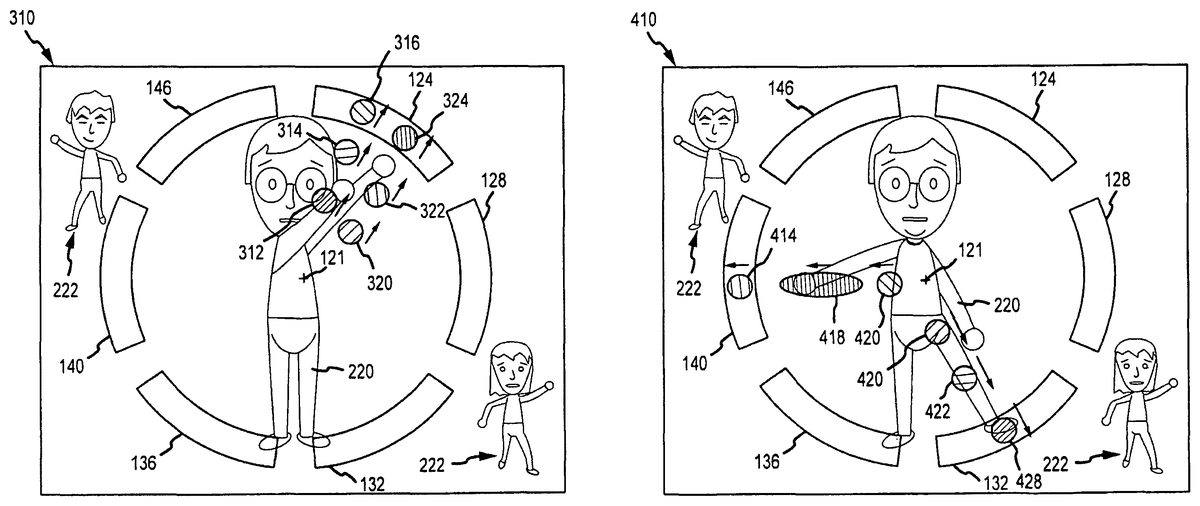
The variety of cue patterns that may be used in a dance ring game are very large and are generally only limited by the imagination of the game designer. For example,FIG. 3illustrates a screen shot310of another dance ring game display in which a player's character220is again dancing to a song with background dancers222. In this screen shot, though, the player is being asked through the cue pattern to move their hands concurrently and in the same way (e.g., to the same zone/segment of the ring (e.g., zone122shown inFIG. 1) at the same pace/rhythm, and so on). This is achieved by including a cue pattern with a section where cue elements312,314,316for a first hand/controller are paired with a like number of cue elements320,322,324for a second hand/controller. The pairs of cue elements travel outward from the ring center121in a common direction and zone toward the target element124. In this example, the player is successful when they move both hands/controllers concurrently (or nearly so) in the upper right direction as each pair of cue elements contacts/crosses the target element124. In a dance video game, the concurrent hand/controller cues may be sequentially combined with other such cues such as to move both of the player's hands/controllers in differing directions (or into differing zones) or with single hand/controller cues. For example, the patterns shown inFIG. 2may be followed by the pattern shown inFIG. 3or vice versa.
In addition to single, quick moves or wrist flicks, it may be desirable to cause the player to take other actions as part of the game play. For example, it may be desirable for a player to hold a position with or without also providing input (e.g., pulling a trigger, pressing a button, and so on) via the held controller.FIG. 4illustrates a cue pattern that includes a single or flick move cue414provided for a first controller/hand followed in sequence by a hold cue418, with both cue elements traveling from the center121in the same direction toward the left side target element440. In this case, the player is successful when they first flick their wrist toward the left with cue414contacting target element140and then flicking/moving their wrist to the left and holding this position for a period of time (e.g., while the hold cue418is still contacting the element140or some other preset hold period). The cue pattern may of display410may also include cue elements420,422,428associated with the other hand/controller as indicated in this case by their differing crosshatching, which is intended to indicate a differing color. The player taking these visual cues420,422,428is successful by moving the hand holding the second controller at least partially concurrently with the other hand/controller in a different direction as the cues contact the target132as shown with cue428(e.g., move this hand/controller down and to the right). As will be appreciated from these three relatively simple cue patterns, the variety of cue patterns that may be associated with a particular song are nearly limitless. Further, in addition, to holding a position, the player may be cued to take other action with differing cues with the invention not being limited to the two moves of flicking or moving the wrist and moving and then holding a position.
As noted above, the cuing may be enhanced by having the cue elements change as they travel from the center121to the target elements about a dance ring (e.g., the dance ring120shown inFIG. 1). For example, the cue elements may be transparent or nearly so as they first are generated near the center121and then become more fully animated (brighter or thicker lines or the like) as they approach the targets. In other cases, the cues may be otherwise changed to indicate that they are nearing the target elements and a dance move is expected such as by flashing, changing size or shape, or changing color.
FIG. 5illustrates a dance video game or game play method500provided when a video console or other processor executes or runs dance video game application or program in accordance with the present invention. As shown, the method500begins at504such as with a game disk or storage media being loaded into a video game console and the dance ring game application being loaded and run. At510, the method500continues with displaying a user interface on a game monitor (e.g., a TV or computer screen), and the game interface may include a menu of the dance ring game including game options, with one being to play a dance ring game. At520, the method500continues with a user/player providing input indicating selection of the dance ring game.
At530, the method500includes displaying skill levels and/or song lists for the player to choose (or in some embodiments, the game will cause the player to sequentially or randomly work through songs on a particular level prior to moving to a next level). At536, a user selection of a song and/or skill level is received from the user (e.g., the same songs may be provided but with differing dance cue patterns based on how hard the player wants the game to be or how hard they have “earned” by prior play). At540, game data including an audio file with the selected music/song and a cue or dance pattern for the chosen (or next) song and/or skill level is retrieved from memory on the game disc (or from game memory such as may be provided in the console or from an inserted game card/cartridge or the like). Step540also includes generating a game display on the game system monitor, and such a display includes a dance ring HUD and background animation as discussed above. At550, the method500includes initiating the dance ring game such as by playing music from the audio file and displaying dancing background characters and/or a player's character and the current score (and/or other game data such as the player's chosen character name).
At560, the dance ring HUD is displayed with cue elements shown in the game display according to a cue pattern associated with the song (and, in some cases, the skill or difficulty level associated with the song chosen/earned by the player). In some embodiments, the method500also includes a step564in which user feedback is provided to the player via visual displays and/or audio outputs. The user or player feedback is determined based upon the sensed controller movements/positions during the display of the cue pattern in the dance ring HUD (i.e., steps560and564include motion and/or position detection for the controllers to determine if the cued moves and/or actions are properly performed, such as movement in the correct direction and also at the right time). The feedback may include scoring the player's dancing or moves and providing an ongoing current score. The feedback may also include causing the controller(s) to vibrate when a move or number of moves are missed. In some cases, audio and/or visual feedback is provided, such as a cheering crowd when a series of moves are properly performed. At570, the method500includes monitoring for completion of the song (or a player quitting mid-song), and when detected, the method500may end at590or first include displaying the player's score and a listing of next actions including a list of additional songs/dances572that may be played. At580, the method500includes determining whether the user via their controller has selected an additional/next song, and if so, the method500continues at530. Otherwise, the method500ends at590. In some cases, the game may be ended590before the end of the song such as after so many mistakes or missed moves by the player.
FIG. 6illustrates a video game system600of an embodiment of the invention that includes a disc or other data storage media614storing a dance ring video game executable by the game system600. As shown, the system600includes a video game console610, a monitor or display device (such as a television)602, and controllers620,624(e.g., which may be adapted for sensing 3D positioning, gesturing, and acceleration as discussed in the background of this application). Game console600executes a game program or other application stored on optical disc (or other data storage media)614inserted into slot615formed in console housing610. For example, the game program may be a dance ring video game as described herein, and the memory of the game disc614may further store game data such as songs in digital format and cue patterns associated with such songs along with other game information useful for game play (e.g., scoring parameters for successfully following a dance pattern, noises or other effects (e.g., vibrating a controller) for moving (or failing to move) as visually cued with the music, and the like). The result of the execution of the game program or other application is displayed on display601of television or monitor602to which game console610is connected by cable616. Audio associated with the game program or other application is output via speakers609of television or monitor602. While an optical disk614is shown inFIG. 6for use in storing video game software, the game program or other application may alternatively or additionally be stored on other storage media such as semiconductor memories, magneto-optical memories, magnetic memories and the like and/or downloaded over a network, stored in memory of console610, provided in a game cartridge inserted to a connector port, or by other means.
Controller620(e.g., a main controller or first/right hand controller) wirelessly transmits data such as game control data to the game console600as shown via wireless signals/communications621. The game control data may be generated using an operation section622of controller620having, for example, a plurality of operation buttons, a key, a stick and the like. Controller620may also wirelessly receive data transmitted from game console610via wireless signals/communications621. Any one of various wireless protocols may be used for the wireless transmissions621between controller620and game console610. Controller624(e.g., a secondary or joystick controller/pod, Nunchuk, second/left hand controller) is provided to allow two hand or multi-functional control (e.g., to allow a player to move both hands with the position of each hand sensed/determined by system600, to allow a user to provide two types of input, and so on), and a cable625is provided to allow the controller624to provide input via input/operation section626(which may include a joystick and buttons as shown) to the main controller620and then to console610via signals621(e.g., in some cases, the controller is an analog unit).
Controller620(and in some cases controller624) also includes an imaging information calculation section for capturing and processing images from light-emitting devices618aand618bin a separate sensor or control strip618typically positioned above the center of the monitor screen601. Particularly, a center point between light-emitting devices618aand618bis aligned with a vertical centerline of television601. The images from light-emitting devices618aand618bcan be used to determine a direction in which controller620is pointing as well as a distance of controller620from sensor bar618. By way of example without limitation, light-emitting devices618aand618bmay be implemented as two infrared LED modules (hereinafter, referred to as “markers”) provided in the vicinity of a display screen601of television/monitor602. The markers each output infrared light, and the imaging information calculation section of controller620detects the light output from the LED modules to determine the direction in which controller620is pointing and the distance of controller620from sensor bar118. Although markers618aand618bare shown inFIG. 6as being above television/monitor602, they may also be positioned below television602or in other configurations/locations based on programmed code in game application of media614and/or controller620. In some embodiments, the controllers620,624are adapted to sense tilting and rotation up/down and left/right, rotation along the main axis of their housings, and acceleration (such as up/down, left/right, and toward/away the screen601) and provide this information in wireless communications/signals621to a dance game on disc614executed by or run by video game console610. In this manner, a player may hold one of the controllers620,624in each of their hands and provide input by flicking their wrists or otherwise moving the controllers620,624in a particular direction and, in some cases, then “holding” by not moving for a period of time or by selecting a trigger or other button in input/operation portion622,626.
FIG. 7shows one useful but not limiting implementation of the game console610ofFIG. 6. It includes a central processing unit (CPU)704(such as an RISC CPU or, other processor) for executing various types of applications including video game programs such as dance game application750provided on game storage media614(e.g., an optical disc, a game or memory card/cartridge, or the like). CPU704may execute a boot program stored in a boot ROM738to initialize game console610and then execute an application750stored on optical disc614, which is inserted into optical disk drive708. User-accessible eject button710provided on housing712of game console710may be used to eject an optical disk614from disk drive708.
The game storage media (disk or the like)614includes a dance game application or program750(e.g., software or programming code with instructions executable by the CPU704providing a video game including animating a dance ring, background animation, and scoring while playing music/audio files). The dance game application750includes a HUD generator752for generating/animating the dance ring display on a monitor such as a TV or computer/electronic device screen. Dance game modules754are provided to implement some of the game functionality such as playing songs, scoring a player's moves to a cue pattern, and so on. The game application750also includes a background animation module756for generating game environment such as other dancers and background scenes (e.g., dance party scenery, a disco, and the like) and may include the player character generator (e.g., animation routines for generating an avatar designed by the player or a Mii/character selected by the player and so on).
The game disc614also includes in memory game data760used by the game application750to provide the dance ring game during operation of the console610. For example, the game data760may include scoring parameters762used by the game modules754in determining a score for a player's movements and actions during a dance game and may also include effects/responses for successful and unsuccessful play (e.g., cause controller to vibrate when a move is missed, make cheering sounds upon completion of a series of moves, cause portions of the display to flash or change color based on game play, and so on). The game data760may be arranged in some embodiments by songs that can be selected by a player via a displayed user interface as shown with songs770. Associated with each selectable song (or game portion) an audio file772may be provided in memory or on disc614including music or a song stored in a digital form.
Associated with the music of audio file772may be a skill level774, and based on such a skill level, a cue pattern776may be provided for each song770. For example, at lower skill levels774, the cue pattern776may be designed to provide relatively simple movements of a controller620, with slower moving cues, greater cue spacing, and sequential hand/controller movement. At higher skill levels774, cue pattern776may likewise be designed to provide increasingly complex movements of a controller620, such as with concurrent hand/controller cues, smaller cue spacing, smaller target element spacing from the ring center, and other parameter settings that can make a dance more difficult to perform. The cue pattern776defines a dance to be performed by a player with the audio file772, and it may include definition of a variety of parameters/variables such as cue spacing778, cue velocity779, as well as the sequence and timing of generated cues (and whether the cues are flick cues or flick and hold movements).
In the illustrated console710, CPU704is connected to subsystem702that includes graphics processing unit (GPU)716with an associated graphics memory720, audio digital signal processor (DSP)718, internal main memory722, and input/output (IO) processor724. I/O processor724of subsystem702is connected to one or more USB ports726, one or more standard memory card slots (connectors)728, WiFi module730, flash memory732, and wireless controller module740(which in turn is in communication with controller620). USB ports726are used to connect a wide variety of external devices to game console610. These external devices include game controllers, keyboards, storage devices such as external hard-disk drives, printers, digital cameras, and the like. USB ports726may also be used for wired network (e.g., LAN) connections with one example implementation including two USB ports726. Standard memory card slots (connectors)728are adapted to receive industry-standard-type memory cards (e.g., SD memory cards). In one example implementation, one memory card slot728is provided. These memory cards are generally used as data carriers. For example, a player may store game data (e.g., data760) for a particular game on a memory card and bring the memory card to a friend's house to play the game on the friend's game console. The memory cards may also be used to transfer data between the game console610and personal computers, digital cameras, and the like.
WiFi module730enables game console610to be connected to a wireless access point. The access point may provide internet connectivity for on-line gaming with players at other locations (with or without voice chat capabilities), web browsing, e-mail, file downloads (including game downloads) and many other types of on-line activities. In some implementations, WiFi module730may also be used for communication with other game devices such as suitably-equipped hand-held game devices. Module730is referred to herein as “WiFi”, which is generally used in connection with the family of IEEE 802.11 specifications. However, game console610may alternatively or additionally use wireless modules that conform with other wireless standards as well as proprietary or non-standard protocols. Flash memory732stores, by way of example without limitation, game save data, system files, internal applications for the console, and downloaded data (such as games).
Wireless controller module740receives signals wirelessly transmitted from one or more controllers620and provides these received signals to I/O processor724. The signals transmitted by controller620to wireless controller module740may include signals generated by controller620itself as well as by other devices that may be connected to controller620. By way of example, some games may utilize separate right- and left-hand inputs. For such games, another controller624shown inFIG. 6may be connected to controller620, and controller620may transmit to wireless controller module740signals generated by itself and by the other controller624. Wireless controller module740may also wirelessly transmit signals to controller620. Controller620(and/or another game controller624for example connected thereto) may be provided with vibration circuitry, and vibration circuitry control signals based on game data760and/or game application750configuration may be sent via wireless controller module740to control the vibration circuitry. Controller620may be provided with or be connected to a speaker, and audio signals for output from this speaker may be wirelessly communicated to controller620via wireless controller module740. By way of still further example, controller620may be provided with or be connected to a display device (not shown), and display signals for output from this display device may be wirelessly communicated to controller620via wireless controller module740.
Memory card slots746may be adapted to receive proprietary memory cards. In one example implementation, two such slots are provided. These proprietary memory cards have some non-standard features such as a non-standard connector or a non-standard memory architecture. In an example implementation, memory card slots746may be used for read-only access to the memory cards inserted therein, and limitations may be placed on whether data on these memory cards can be copied or transferred to other storage media such as standard memory cards inserted into slots728.
One or more controller connectors744are adapted for wired connection to respective game controllers. In one example implementation, four such connectors are provided for wired connection to game controllers. Alternatively, connectors744may be connected to respective wireless receivers that receive signals from wireless game controllers. Among other things that they do, these connectors enable players to use controllers for a particular gaming platform when an optical disk for a game developed for this platform is inserted into optical disk drive708.
A DC connector748is provided for connecting game console610to a DC power source. GPU716performs image processing based on instructions from CPU704. GPU716includes, for example, circuitry for performing calculations necessary for displaying three-dimensional (3D) graphics. GPU716performs image processing using graphics memory720, which is dedicated for image processing and a part of internal main memory722. GPU716generates image data for output to television/monitor602(ofFIG. 6) by audio/video connector714via audio/video IC (interface)712. Audio DSP718performs audio processing based on instructions from CPU704. The audio generated by audio DSP718is output to television/monitor602by audio/video connector714via audio/video IC712. External main memory706and internal main memory722are storage areas directly accessible by CPU704. For example, these memories can store an application program, such as a game program read from optical disc614by the CPU704, various types of data, or the like. ROM/RTC738includes a real-time clock and preferably runs off of an internal battery (not shown) so as to be usable even if no external power is supplied. ROM/RTC738also may include a boot ROM and SRAM usable by the console. Power button742is used to power game console610on and off. In one example implementation, power button242must be depressed for a specified time (e.g., one or two seconds) to turn the consoled off so as to reduce the possibility of inadvertent turn-off. Reset button743is used to reset (reboot) game console610.
As shown in the block diagram ofFIG. 8, controller620may be implemented to include a three-axis, linear acceleration sensor820that detects linear acceleration in three directions, i.e., the up/down direction (e.g., the Z-axis), the left/right direction (e.g., the X-axis), and the forward/backward direction (e.g., the Y-axis). Alternatively, a two-axis linear accelerometer that only detects linear acceleration along each of the Y-axis and Z-axis may be used, or a one-axis linear accelerometer that only detects linear acceleration along the Z-axis may be used. Generally, the accelerometer arrangement (e.g., three-axis or two-axis) depends on the type of control signals desired. The three-axis or two-axis linear accelerometer may be of the type available from Analog Devices, Inc. or STMicroelectronics N.V. In some cases, acceleration or controller motion sensor820is an electrostatic capacitance or capacitance-coupling type that is based on silicon micro-machined MEMS (micro-electromechanical systems) technology. However, any other suitable accelerometer technology (e.g., piezoelectric type or piezoresistance type) now existing or later developed may be used to provide three-axis or two-axis linear acceleration sensor820.
Linear accelerometers, as used in acceleration sensor820, are only capable of detecting acceleration along a straight line corresponding to each axis of the acceleration sensor. In other words, the direct output of acceleration sensor820is typically limited to signals indicative of linear acceleration (static or dynamic) along each of the two or three axes thereof. As a result, acceleration sensor820may not directly detect movement along a non-linear (e.g. arcuate) path, or of a rotation, rotational movement, angular displacement, tilt, position, attitude or any other physical characteristic.
However, through additional processing of the linear acceleration signals output from acceleration sensor820, additional information relating to controller620can be inferred or calculated or otherwise determined. For example, by detecting static, linear acceleration (i.e., gravity), the linear acceleration output of acceleration sensor820can be used to determine tilt of the object relative to the gravity vector by correlating tilt angles with detected linear acceleration. In this way, acceleration sensor820can be used in combination with microcomputer802of controller620(or another processor) to determine tilt, attitude, or position of controller620(e.g., position and/or gesture information of controller620). Similarly, various movements and/or positions of controller620can be calculated through processing of the linear acceleration signals generated by acceleration sensor820when controller620containing acceleration sensor820is subjected to dynamic accelerations by, for example, the hand of a user/player. In another embodiment, acceleration sensor820may include an embedded signal processor or other type of dedicated processor for performing any desired processing of the acceleration signals output from the accelerometers therein prior to outputting signals to microcomputer802. For example, the embedded or dedicated processor could convert the detected acceleration signal to a corresponding tilt angle or other desired parameter when the acceleration sensor is intended to detect static acceleration, i.e., gravity.
Returning toFIG. 8, imaging information calculation section810of controller620includes infrared filter812, lens814, imaging element816, and image processing circuit818. Infrared filter812allows infrared light from the light that is incident on the front surface of controller620to pass through. Lens814collects and focuses the infrared light from infrared filter812on imaging element816. Imaging element816may be a solid-state imaging device such as, for example, a CMOS sensor or a CCD. Imaging element816captures images of the infrared light from markers618aand618b(shown inFIG. 6) collected by lens814. Accordingly, imaging element816captures images of the infrared light that has passed through infrared filter812and generates image data based thereon. This image data is processed by image processing circuit818, which detects an area thereof having high brightness, and based on this detecting, outputs processing result data representing the detected coordinate position and size of the area to communication section806. From this information, the direction in which controller620is pointing and the distance of controller620from display screen601(or, more accurately, from sensor strip618) can be determined.
Vibration circuit828may also be included in controller620. Vibration circuit828may be, for example, a vibration motor or a solenoid. Controller620is vibrated by actuation of the vibration circuit828(e.g., in response to signals from game console610) during execution of a dance ring game application, and the vibration is conveyed to the hand of the player holding controller620. Hence, a so-called vibration-responsive game may be realized. As described above, acceleration sensor320detects and outputs the acceleration in the form of components of three axial directions of controller620, i.e., the components of the up-down direction (Z-axis direction), the left-right direction (X-axis direction), and the front-rear direction (the Y-axis direction) of controller620. Data representing the acceleration as the components of the three axial directions detected by acceleration sensor820is output to communication section806. Based on the acceleration data that is output from acceleration sensor820, a motion of controller620can be determined by a game console such as console610ofFIGS. 6 and 7.
Communication section806includes microcomputer802, memory803, wireless module804, and antenna805. Microcomputer802controls wireless module804for transmitting and receiving data while using memory803as a storage area during processing. Microcomputer802is supplied with data, including operation signals (e.g., cross-switch, button or key data) from operation section824, acceleration signals in the three axial directions (X-axis, Y-axis and Z-axis direction acceleration data) from acceleration sensor820, and processing result data from imaging information calculation section810. Microcomputer802temporarily stores the data supplied thereto in memory803as transmission data for transmission to game console610. The wireless transmission from communication section806to game console610is performed at a predetermined time interval. At the transmission time, microcomputer802outputs the transmission data stored in memory803to wireless module804. Wireless module804sends the stored data from antenna805as a carrier wave signal having a specified frequency. In this manner, operation signal data from operation section824, the X-axis, Y-axis, and Z-axis direction acceleration data from acceleration sensor820, and the processing result data from imaging information calculation section810is transmitted from controller620. Game console610receives the carrier wave signal and demodulates or decodes the carrier wave signal to obtain the operation information (e.g., the operation signal data, the X-axis, Y-axis and Z-axis direction acceleration data, and the processing result data). Based on this received data and the application (e.g., dance ring game application) currently being executed, CPU704of game console610(shown inFIG. 7) performs application processing. In some cases, controller620can also receive data wirelessly transmitted thereto from devices including game console610.
The system described above can be used to execute software stored on optical disk614or in other memory that controls it to interactively generate displays on display601of a dance ring game display with background animation and a dance ring HUD overlay with dance cues and dance ring target elements in response to user input provided via controller620(and controller624).
Although the invention has been described and illustrated with a certain degree of particularity, it is understood that the present disclosure has been made only by way of example, and that numerous changes in the combination and arrangement of parts can be resorted to by those skilled in the art without departing from the spirit and scope of the invention, as hereinafter claimed. For example, the above description stresses game play with two controllers such that both hands may be cued or directed to move sequentially or concurrently in the same or differing directions. In some embodiments, a single controller may be used to make the game more of a one-hand game (or two hands holding a single controller or one or two hands holding a holder/case supporting two controllers). In some embodiments, additional inputs may be used to provide a more full body or fit game. For example, a balance board, a dance pad, or other device that receives input from the player's feet may be connected to the game console, and in such cases, the dance ring HUD may further include visual cue elements to instruct the player to move their feet side-to-side or in other directions. The feet movements may be simplified such as lifting one or the other or moving simply one to the left or right or vice versa or may be more complicated such as by providing visual cues related to the feet on the same or a differing dance ring HUD.
As can be seen from the above description and the accompanying figures, embodiments of the present invention address some problems associated with prior games and game systems by providing video games (or code and digital data) that can be executed by a video game console (or computer, electronic device with a processor and graphics capability, and the like) to provide a player experience that simulates dancing and also provides qualitative scoring of a player's motions as he or she rhythmically responds to music played during the dance game. The game systems include one or more controller(s) adapted for sensing movement (e.g., change in position or acceleration), gesture (e.g., rotation), and/or positioning of the controllers relative to the game system display screen (e.g., is the controller being moved to the left/right, up/down, or some other angle) and such controllers may be considered position and movement sensing controllers or the like. Implementations of the present invention provide a more natural way of puppeting players' body motions without relying on specific icons to tell them what to do as was the case in some prior games. The dance ring games in accordance with the present invention provide a solution to this problem through a 360-degree representation of the on-screen player's body or player's character.
When run or executed by a processor(s) of a video game console, the dance ring game generates a heads up display (HUD) overlay on the game system monitor (e.g., a television screen, a computer monitor, and the like) that directs player movement, and, in some cases, the player's character, displayed underneath the HUD overlay, is dancing with the music (e.g., making the moves indicated by the HUD overlay). The HUD overlay may be divided into multiple segments, such as two to five in some games, with one preferred embodiment utilizing six distinct segments, including upper left, upper right, middle left, middle right, lower left, and lower right. Other embodiments utilize additional segments such as seven to ten or more. During game play, music is played from an audio file (e.g., music stored in digital format and stored on the game disk, game cartridge, or memory of the console) and cues (or rhythmic cue elements) originate from the center of the screen, which may also be the center of the dance ring and HUD. In some embodiments, the cue elements are animated to range from transparent to opaque, with increased opaqueness occurring as the cues travel from the center of the ring toward the outer perimeter of the dance ring.
The outer perimeter of the dance ring may be defined with a cue target element or ring segment provided for each zone or segment of the dance ring. Hence, in one preferred embodiment, six cue target elements are displayed about the ring perimeter and the cues emanate from the ring center and travel outward toward these cue target elements or ring segments. To play the game successfully, the player holds in his or her right and left hands a main or secondary controller (e.g., a position and movement sensing controller such as may be distributed by game companies such as Nintendo of America Inc. under the names Wiimote and Nunchuk) and swings the controller(s) in the appropriate direction (e.g., upper left when a cue is crossing the upper left segment/zone cue target element or ring segment). The cues are preferably provided in a dance moves pattern that is matched to the playing music/song and configured to cause the cues to cross the ring segments rhythmically or in time with the playing music/song. The cue pattern may include single hand cues (e.g., just move the main controller) but more typically includes two-handed cues (or a cue for both hands) such as with cues of differing colors or shapes being associated with each controller (e.g., one for the Wiimote and one for the Nunchuk or the like). The two hand cues instruct the player to move both hands to the appropriate zone or segment of the dance ring in time with the playing song/music (e.g., to make dance moves directed by the game designer).
With the provision of the dance ring HUD, game designers can create a sequence/pattern of gameplay cues that require the player to move her hands and body in various poses without requiring the player to have an understanding of move-specific iconography. The dance ring HUD also facilitates providing a much smoother challenge ramping process by adjusting parameters such as cue spacing, cue velocity, timing, number, and pattern complexity, which allow for a deeper game experience. The dance ring game, with its unique HUD display and cues emanating in multiple directions from a center point (rather than a simple one direction scrolling action for cues like guitar and other dance games), provides a number of advantages. Ring dance games are intuitive, as the players do not have to memorize any iconography before playing the game, but instead they can simply move their hands with the traveling cue elements to portions or zones of the screen (or ring zones). This is a far more elegant method of providing dance gameplay in game systems with position/movement sensing controllers.
Another advantage in accordance with the present invention is the multiple levels of complexity or game variables/parameters it supports. The dance ring allows for design of very easy and also very challenging levels (e.g., game skill or challenge levels). Earlier dance game levels (with lesser degrees of difficulty and the like) may require only simple motions of the player. More challenge can be provided in higher levels (with higher degrees of difficulty) by varying game parameters such as the distance from the center of the ring to the target element (e.g., ring segment distance), cue spacing, single or two handed cues and whether such cues reach target elements sequentially or concurrently (and whether the two handed cues go to differing target elements or the same target element), timing of cues and their velocity from the center, and varying directions of the cues. These variables can be selected and/or adjusted to define a cue pattern for a song and a particular skill level. Other dance games typically can only manipulate one or two of these variables (e.g., cue spacing and cue velocity but not direction). A further advantage of the HUD is that players can view background action. Other rhythm-based games force players to view a HUD in one section of the screen (often the bottom of the screen), which means that the player can not see the background animations, characters, environments, and effects while they are playing. The dance ring HUD may be centered in the center of the display screen, which focuses the player's eyes squarely on the center of the screen, where both the gameplay elements such as dance cues and the background animations of the game are generated.
Claims
- A non-transitory computer-readable storage medium having a video game application stored therein, the game application causing a computer or processor of a video game system, which includes a display screen, and first and second handheld controllers adapted for sensing movement and positioning of the controllers relative to the display, to implement a method comprising: on the display screen, displaying a heads up display (HUD) comprising a ring with defined by at least two cue target elements positioned in differing zones of the HUD ring;playing a song by processing an audio file retrieved from the storage medium;and displaying a plurality of cue elements in a pattern associated with the playing song, each of the cue elements moving outward from a center of the ring toward one of the target elements.
- The storage medium of claim 1 , wherein each of the cue elements is associated to a particular one of the controllers and is configured to visually indicate such controller association.
- The storage medium of claim 2 , wherein the pattern is configured such that the cue elements travel in at least two, differing directions from the center of the ring.
- The storage medium of claim 3 , wherein the pattern is configured such that at least some of the cue elements are paired to travel concurrently from the ring center toward one of the target elements.
- The storage medium of claim 1 , wherein the ring is defined by at least six of the cue target elements positioned end-to-end at about a periphery of the ring.
- The storage medium of claim 5 , wherein the zones of the HUD ring comprise an up left zone, a left side zone, a left down zone, a right down zone, a right side zone, and an up right zone.
- The storage medium of claim 1 , further comprising sensing movement of the controllers, comparing the sensed movements of the controllers to the pattern of the cue elements displayed concurrently with the sensed movements, and generating a player score based on the comparing.
- The storage medium of claim 1 , wherein the center of the ring coincides with a center of the display screen and the method further comprises displaying background animation on the display screen with at least a portion beneath the HUD ring, the portion beneath the HUD ring comprising a player character moving rhythmically with the playing song.
- The storage medium of claim 1 , wherein a first set of the cue elements comprise wrist flick cues for the controllers and a second set of the cue elements comprise move and hold cues for the controllers.
- A computer program for a video game stored in memory and controlling a processor of a computer or video game console of a video game system to implement a game with image output on a display screen, the video game system including first and second handheld controllers and logic adapted for sensing position and movement of the controllers, comprising: code for displaying on the display screen a user interface that includes a ring divided into zones and having a center proximate to a center of the display screen, the ring having six cue target elements positioned about a periphery of the ring with one placed in each of the zones;and code for generating visual cue elements emanating from the ring center and traveling at a cue velocity outward to cross the cue target elements in a multi-directional cue pattern, wherein a first set of the visual cue elements are associated with the first handheld controller and a second set of the visual cue elements are associated with the second handheld controller.
- The video game computer program of claim 10 , wherein the memory stores audio files for songs and wherein the cue pattern is configured to have the visual cue elements cross the cue target elements rhythmically when one of the songs is played by the video game system.
- The video game computer program of claim 10 , wherein in the multi-directional cue pattern a portion of the first set and second set of cue target elements are paired to cross the cue target elements concurrently, whereby two hand cues are provided to a player of the video game.
- The video game computer program of claim 10 , wherein the zones divide the area of the ring into six substantially equal pie-shaped segments with tips at the ring center and the zones include an up left zone, a left side zone, a down left zone, a down right zone, an right side zone, and an up right zone, whereby a player of the video game can be directed to move either of the handheld controllers in six differing directions relative to the ring center.
- The video game computer program of claim 10 , wherein the multi-direction cue pattern is configured such that a portion of cue target elements emanate from the ring center sequentially with a cue spacing to sequentially cross a plurality of the cue target elements.
- The video game computer program of claim 14 , further comprising code for comparing a sensed movement of the handheld controllers to determine whether a player has followed the multi-directional cue pattern by moving a corresponding one of the handheld controllers in one of six directions corresponding to the zones as one of the visual cue elements crosses one of the cue target elements.
- A video game play method, comprising: displaying a set of target elements in a circular pattern on a video display;playing audio file;concurrently with the playing of the audio file, displaying a series of visual cue elements moving from a central portion of the video display outward toward the target elements, wherein the visual cue elements are each associated with one of a pair of handheld video game controllers and wherein only one of the visual cue elements associated with a particular one of the video game controllers contacts the target elements at a particular time;and determining movements of the video game controllers during the displaying of the visual cue elements and comparing the determined movements with timing of the visual cue elements contacting the target elements.
- The method of claim 16 , wherein at least some of the visual cue elements travel in opposite directions from the central portion toward the target elements.
- The method of claim 16 , wherein the set of target elements comprises at least six target elements positioned about a periphery of the circular pattern in an end-to-end pattern.
- The method of claim 16 , wherein the circular pattern is centered on the video display and the method further comprises displaying background animation including a player character on the video display with the player character being proximate to the target elements.
- The method of claim 16 , wherein the visual cue elements are displayed with at least two visual appearances during the movement from the central portion to the target elements to provide a visual cue on timing of performing the movements of the video game controllers about the circular pattern displayed on the video display and wherein the visual cue elements associated a first one of the video game controllers differ in color from the visual cue elements associated with a second one of the video game controllers.
Disclaimer: Data collected from the USPTO and may be malformed, incomplete, and/or otherwise inaccurate.