U.S. Pat. No. 7,717,789
GAME PROGRAM, GAME DEVICE, AND GAME METHOD
AssigneeKonami Digital Entertainment Co., Ltd.
Issue DateNovember 1, 2006
U.S. Patent No. 7,717,789: Game program, game device, and game method
U.S. Patent No. 7,717,789: Game program, game device, and game method
Issued May 18, 2010, to Konami Digital Entertainment Co., Ltd.
Priority Date May 1, 2004

Summary:
Fans of games such as PES or soccer video games will appreciate U.S. Patent No. 7,717,789 (the ‘789 Patent) concerning instant replays. Especially relevant to sports games, the ‘789 Patent concerns an invention which identifies what content or footage in a game is important, and saves it to the gaming memory unit. Once a player finishes a game or match, the invention saves certain replay footage according to which footage contained the most important plays of the game. After a number of games have occurred, either the latest replay of what happened is shown, or the invention replays footage which was saved to the memory unit from previous games according to what was ranked as the most important plays. Such examples of replays given in the patent include important baseball events such as “hitting a home run when the score is tied,” or “sending a come-from-behind hit when losing.” The inventor of this particular method sought to balance the amount of footage the game records to prevent the system’s memory from being overloaded. The ‘789 Patent allows games to simulate instant replays of live-action sports games to make the player feel like the latest NBA star.
Abstract:
The present invention provides a player with replay images without setting a reference value to the replay images. First, in a game implemented by a program of the present invention, a first event table that identifies event content and the importance level thereof, is set. Next, replay images of an event that occurred during the execution of the game are saved in the memory unit. Then, the first event table is referenced during execution of the game, and the importance level of the replay images saved in the memory unit is set. Next, a second event table used to identify the importance level of the replay images is set. Finally, at least either the latest replay images saved in the memory unit, or the replay images saved in the memory unit in accordance with the importance level of the replay image, or both, is displayed on a monitor.
Illustrative Claim:
1. A computer readable medium storing a game program for a video game in which replay images corresponding to various events are displayed on a monitor, the game program comprising: code for setting by the control unit a first event table containing events being predicted to occur during the course of the video game and a first importance level being predetermined on the video game; code for executing an event by a control unit, the event occurring on the course of the video game; code for determining by the control unit whether or not the event occurring on the course of the video game is same as one of the events defined on the first table; code for identifying by the control unit a second importance level of the event as the first importance level by referring to the first event table, if the event occurring on the course of the video game is same as one of the events defined on the first event table; code for setting by the control unit a second event table containing a replay image of the event occurring on the course of the video game and the second importance level, the replay image and the second importance level being saved in the memory unit; and code for displaying on the monitor at least one of the latest replay image of the latest event and the replay image in the second event table on the basis of how high the second importance level is, the code for setting the first event table including code for setting a first event label in order to identify the event, and code for generating the first event table including the first event label in accordance with the first importance level, the code for setting the second event table including code for saving the replay image in a first area in a memory unit, code for setting a second event label that identifies content of the replay image, code for detecting whether or not the second event label matches the first event label by increasing the first importance level on the first event table one by one from the lowest to the highest, code for setting the second importance level based on how many times the first importance level on the first event table is increased, code for unchanging the second importance level if the second event label does not match the first event label between the lowest and the highest on the first event table, code for generating the second event table in accordance with the second importance level, if the second event label matches the first event label, and code for saving the second event table, and the replay image in the second area in the memory unit.
Research By: Rachel Johns
Edited By: Andrew Thomas
Illustrative Figure
Abstract
The present invention provides a player with replay images without setting a reference value to the replay images. First, in a game implemented by a program of the present invention, a first event table that identifies event content and the importance level thereof, is set. Next, replay images of an event that occurred during the execution of the game are saved in the memory unit. Then, the first event table is referenced during execution of the game, and the importance level of the replay images saved in the memory unit is set. Next, a second event table used to identify the importance level of the replay images is set. Finally, at least either the latest replay images saved in the memory unit, or the replay images saved in the memory unit in accordance with the importance level of the replay image, or both, is displayed on a monitor.
Description
DETAILED DESCRIPTION OF THE PREFERRED EMBODIMENTS Selected embodiments of the present invention will now be explained with reference to the drawings. It will be apparent to those skilled in the art from this disclosure that the following descriptions of the embodiments of the present invention are provided for illustration only and not for the purpose of limiting the invention as defined by the appended claims and their equivalents. Configuration and operation of game device FIG. 1shows the basic configuration of a game device in accordance with an embodiment of the present invention. As an example of the video game device, a home video game device will be hereinafter explained. The home video game device comprises a home video game console and a home television set. A recording medium10can be loaded in the home video game console. Game data is read out of the recording medium10and a game is executed. The content of the game executed herewith is displayed on the home television set. The game system of the home video game device is comprised of a control unit1, a memory unit2, an image display unit3, an audio output unit4, an operation input unit5, and each of these units is connected to each other through a bus6. This bus6includes an address bus, a data bus, a control bus, and the like. Here, the control unit1, the memory unit2, the audio output unit4, and the operation input unit5are included in the home video game console of the home video game device, and the image display unit3is included in the home television set. The control unit1is mainly provided for controlling the progress of the overall game based on the game program. The control unit1is comprised of a CPU (Central Processing Unit)7, a signal processor8, and an image processor9, for instance. The CPU7, the ...
DETAILED DESCRIPTION OF THE PREFERRED EMBODIMENTS
Selected embodiments of the present invention will now be explained with reference to the drawings. It will be apparent to those skilled in the art from this disclosure that the following descriptions of the embodiments of the present invention are provided for illustration only and not for the purpose of limiting the invention as defined by the appended claims and their equivalents. Configuration and operation of game device
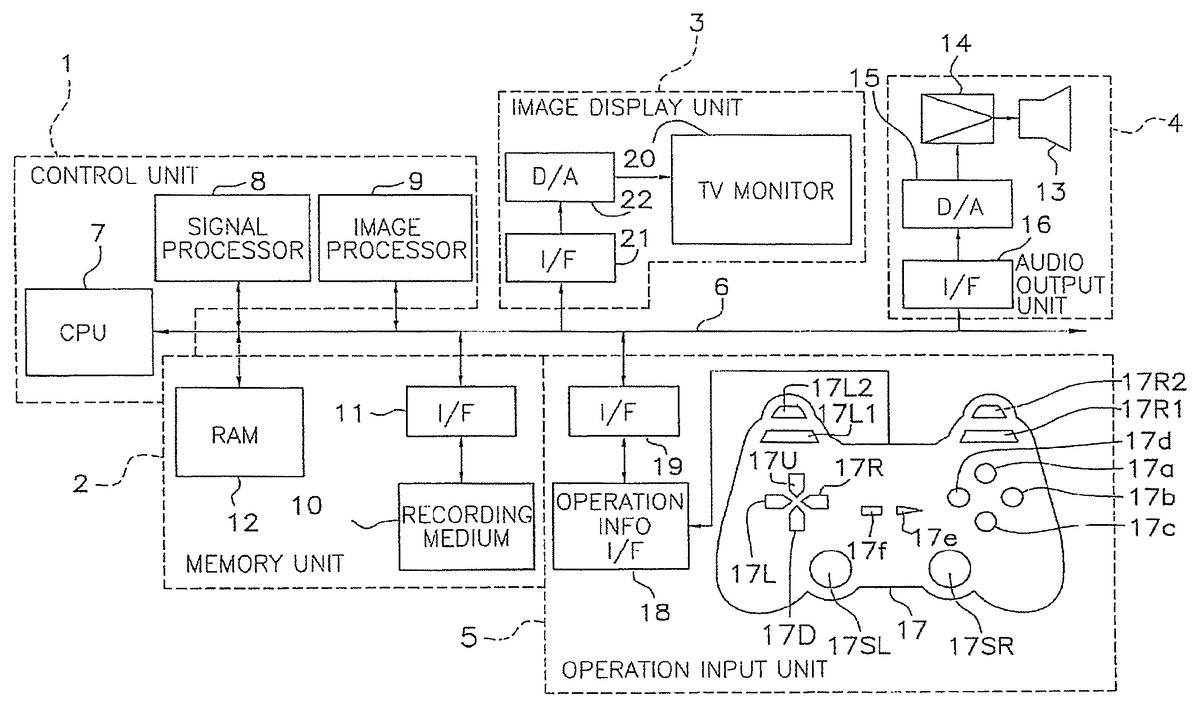
FIG. 1shows the basic configuration of a game device in accordance with an embodiment of the present invention. As an example of the video game device, a home video game device will be hereinafter explained. The home video game device comprises a home video game console and a home television set. A recording medium10can be loaded in the home video game console. Game data is read out of the recording medium10and a game is executed. The content of the game executed herewith is displayed on the home television set.
The game system of the home video game device is comprised of a control unit1, a memory unit2, an image display unit3, an audio output unit4, an operation input unit5, and each of these units is connected to each other through a bus6. This bus6includes an address bus, a data bus, a control bus, and the like. Here, the control unit1, the memory unit2, the audio output unit4, and the operation input unit5are included in the home video game console of the home video game device, and the image display unit3is included in the home television set.
The control unit1is mainly provided for controlling the progress of the overall game based on the game program. The control unit1is comprised of a CPU (Central Processing Unit)7, a signal processor8, and an image processor9, for instance. The CPU7, the signal processor8, the image processor9are connected to each other through the bus6. The CPU7interprets commands from the game program and performs various types of data processing and data control. For example, the CPU7commands the signal processor8to provide the image data to the image processor. The signal processor8primarily performs computations in three-dimensional space, position conversion computations from the three-dimensional space to a virtual three-dimensional space, a light source computation processing, and data generation and processing of image and audio data. The image processor9primarily performs a process to write image data to be rendered to a RAM12based on the computation results and processing results of the signal processor8.
The memory unit2is provided mainly for storing the program data, various types of data used for the program data, and the like. The memory unit2is comprised of the recording medium10, an interface circuit11, and the RAM (Random Access Memory)12, for instance. The interface circuitry11is connected to the recording medium10. The interface circuitry11and the RAM12are then connected through the bus6. The recording medium10stores program data of the operation system, game data comprised of image data, audio data, and various types of program data, and the like. For example, this recording medium10is a ROM (Read Only Memory) cassette, an optical disk, a flexible disk, or the like. The program data of the operating system, the game data, and the like are stored on this recording medium10. Note that a card memory is also included in the category of the recording medium10and primarily used for storing various game parameters at the point at which the game is interrupted. The RAM12is used for temporarily storing various types of data read out of the recording medium10, and for temporarily recording the processing results from the control unit1. This RAM12is mounted in the interior of the game device and functions as an internal memory unit. In addition to various types of data, address data indicating the memory location of various types of data is stored in the RAM12, and it is possible to specify an arbitrary address and read and write data from/to the address.
The image display unit3is primarily provided for outputting the image data written to the RAM12by the image processor9, the image data read out of the recording medium10, and the like, as an image. This image display unit3is comprised of a television monitor20, an interface circuit21, and a D/A converter (digital-to-analog converter)22, for instance. The D/A converter22is connected to the television monitor20, and the interface circuit21is connected to the D/A converter22. In addition, the bus6is connected to the interface circuit21. Here, the image data is provided to the D/A converter22through the interface circuit21, and is converted into an analog image signal. Then, the analog image signal is output to the television monitor20as an image.
The audio output unit4is primarily provided for outputting the audio data read out of the recording medium10as audio. The audio output unit4is comprised of a speaker13, an amplifier circuit14, a D/A converter15, and an interface circuit16, for instance. The amplifier circuit14is connected to the speaker13. The D/A converter15is connected to the amplifier circuit14. The interface circuit16is connected to the D/A converter15. In addition, the bus6is connected to the interface circuit16. Here, the audio data is provided to the D/A converter15through the interface circuit16and is converted into an analog audio signal. The analog audio signal is amplified by the amplifier circuit14and output as audio by the speaker13. ADPCM (Adaptive Differential Pulse Code Modulation) data, PCM (Pulse Code Modulation) data, and the like are included in the category of the audio data, for instance. In the case of the ADPCM data, the audio can be output by the speaker13with the same type of processing method as described above. In the case of the PCM data, if the PCM data is converted to the ADPCM data in the RAM12, the audio can be output by the speaker13with the same type of processing method as described above.
The operation input unit5is primarily comprised of a controller17, an operation information interface circuit18, and an interface circuit19. The operation information interface circuit18is connected to the controller17, and the interface circuit19is connected to the operation information interface circuit18. In addition, the bus6is connected to the interface circuit19.
The controller17is an operation unit used for the input of various operation commands by the video game player and transmits operation signals to the CPU7in accordance with the video game player's operation. A first button17a, a second button17b, a third button17c, a fourth button17d, an up key17U, a down key17D, a left key17L, a right key17R, a L1 button17L1, a L2button17L2, a R1 button17R1, a R2 button17R2, a start button17e, a select button17f, a left stick17SL, and a right stick17SR are provided with the controller17.
The up key17U, the down key17D, the left key17L, and the right key17R are used to provide the CPU7with commands which cause the characters and a cursor to move up, down, left, and right on the screen of the television monitor20, for instance.
The start button17eis used to command the CPU7to load the game program from the recording medium10, and the like.
The select button17fis used for commanding the CPU7to execute various selections with respect to the game program loaded from the recording medium10, for instance.
The left stick17SL and the right stick17SR are stick-shaped controllers with approximately the same constitution as a so-called joystick. This stick-shaped controller includes a upright stick. This stick is configured to be able to incline from the upright position and rotate 360 degrees around the fulcrum, including the front, back, left, and right directions. The left stick17SL and the right stick17SR transmit x and y coordinate values with the origin being the upright position to the CPU7through the operation information interface circuit18and the interface circuit19as the operation signal in accordance with the direction and angle of incline of the stick.
Various functions are allocated to the first button17a, the second button17b, the third button17c, the fourth button17d, the L1 button17L1, the L2 button17L2, the R1 button17R1, and the R2button17R2in accordance with the game program that is loaded from the recording medium10.
Note that each button and each key provided with the controller17other than the left stick17SL and the right stick17SR are configured to function as ON/OFF switches that turn on when pressed from the neutral position by external pressure and turn off when the pressure is released and then return to the neutral position.
The general operations of the home video game device configured as described above will be hereinafter explained. When a power switch (not shown in the figure) is turned on and the game system is powered on, the CPU7reads out image data, audio data, and program data from the recording medium10based on the operating system stored in the recording medium10. All or part of the read-out data including the image data, the audio data, and the program data are stored in the RAM12. Then, the CPU7issues commands for the image data and the audio data, both of which are stored in the RAM12, based on the program data stored in the RAM12.
In the case of image data, the signal processor8first performs a positional computation, a light source computation, and the like for a character in the three-dimensional space based on the command from the CPU7. Next, the image processor9writes the image data to be rendered to the RAM12based on the computation results by the signal processor8. Then, the image data written to the RAM12is provided to the D/A converter22through the interface circuit21. Here, the image data is converted into an analog image signal by the D/A converter17. Then, the image data is provided to the television monitor20and displayed as an image.
In the case of the audio data, the signal processor8first generates and processes audio data based on a command from the CPU7. Here, processing such as pitch conversion, noise addition, envelope setting, rank setting, and reverb addition is performed for the audio data. Next, the audio data is output from the signal processor8and provided to the D/A converter15through the interface circuit16. Here, the audio data is converted into an analog audio signal. Then, the audio data is output as audio by the speaker13through the amplifier circuit14.
Various Means in the Game Device
FIG. 2is a functional block diagram primarily for explaining means controlled by the control unit1shown inFIG. 1. Various means that play a primary role in the present invention will be explained with reference to the functional block diagram.
The present game device serves to implement a game in which replay images corresponding to various events can be displayed on the television monitor20, and comprises first event table setting means50, second event table setting means60, and replay image displaying means70.
The first event table setting means50is means for implementing a function which sets a first event table in order to identify event content and the importance level of event content. The first event table setting means50sets the first event table in the memory unit2, and the first event table is used so that the control unit1can identify event content that is controlled and executed by the control unit1during execution of the game, and identify the importance level of event content during execution of the game.
The first event table setting means50with this configuration comprises first event label setting means51and first label table generating means52.
The first event label setting means51is a means for implementing a function which sets first event labels in order to identify event content. The first event label setting means51sets a first event label corresponding to each event content in the memory unit2in order to identify event content that is controlled and executed by the control unit1during execution of the game.
The first label table generating means52is a means for implementing a function which generates a first event table comprised of the first event labels in accordance with the importance level of event content. The first label table generating means52in the control unit1generates the first event table comprised of the first event labels in the memory unit2. At this time, the control unit1rearranges the order of the first event labels in the first event table in descending order of the importance of the event content.
The second event table setting means60is a means for implementing a function to save replay images of an event that occurred during the execution of the game in the memory unit2, set the importance level of the replay images saved in the memory unit2by referencing the first event table during execution of the game, and set a second event table used to identify the importance level of the replay images. The second event table setting means60saves the replay images of an event that occurred during the execution of the game in the memory unit2. Then, the first event table is referenced during the execution of the game, and the importance level of the replay images saved in the memory unit2is set. Furthermore, the second event table is set in the memory unit2.
The second event table setting means60with this configuration comprises first replay image saving means61, replay image label setting means62, event label detecting means63, second label table generating means64, and second replay image saving means65.
The first replay image saving means61is a means for implementing a function which saves the replay images of an event that occurred during the execution of the game in a first area of the memory unit2. The first replay image saving means61saves the replay images of an event that occurred during the execution of the game in the first area of the memory unit2.
The replay image label setting means62is a means for setting a second event label to the replay images saved in the first area of the memory unit2in order to identify the content of the replay image. The replay image label setting means62in the control unit1sets the second event label used to identify the content of the replay image to the replay images saved in the first area of the memory unit2.
The event label detecting means63is a means for detecting if a second event label corresponds to one of the first event labels by sequentially referencing the first event table. The event label detecting means63in the control unit1sequentially references the first event table, and then detects if the second event label of the replay images corresponds to one of the first event labels in the first event table. At this time, the number of times in which the control unit1repeatedly and sequentially references the first event labels in the first event table in descending order of the importance of the event content is set in the memory unit2as the number of references.
The second label table generating means64is a means for setting the importance level of the replay images, based on the number of references, if a second event label corresponding to one of the first event labels is detected, and generates a second event table comprised of second event labels in accordance with the importance level of the replay images. The second label table generating means64in the control unit1sets the importance level of the replay images, based on the number of references, if a second event label corresponding to one of the first event labels is detected. Then, the control unit1generates the second event table comprised of second event labels in the memory unit2in accordance with the importance level of the replay images. At this time, a predetermined number of second event labels having a high importance level is selectively tabulated in the second event table by the control unit1.
The second replay image saving means65is a means for implementing a function which saves the second event table and the replay image corresponding to one of the second event labels in the second event table in a second area in the memory unit2. The second replay image saving means65saves the second event table and the replay image corresponding to one of the second event labels in the second event table in the second area in the memory unit2.
The replay image displaying means70is a means for implementing a function which displays, on the television monitor20, at least either the latest replay images to be saved in the memory unit2, or the replay images saved in the memory unit2in accordance with the importance level of the replay images, or both. The replay image displaying means70displays at least either the latest replay images to be saved in the memory unit2, or the replay images saved in the memory unit2in accordance with the importance level of the replay images, on the television monitor20, or both. At this time, the replay images for replaying an event that occurred during the execution of the game are displayed on the television monitor20by using the latest replay images saved in the first area of the memory unit2immediately after the event occurred. In addition, replay images for replaying highlights of the game can be displayed on the television monitor20by using the replay images saved in the second area of the memory unit2.
Method for Executing Various Game Functions
The general execution of various functions of the game in accordance with the present embodiment will be explained with reference to the flow charts shown inFIGS. 3 and 4. An example is described herein in which various functions are executed in a game, such as a baseball video game, in which replay images corresponding to various events can be displayed on the television monitor20.
In a baseball video game in which replay images corresponding to various events, i.e., various plays, can be displayed on the television monitor20, a game program stored in the recording medium10or the RAM12will be loaded, and a boot screen will be displayed on the television monitor20, when the recording medium10is put in the video game console and the main power supply is turned on.
At this time, a first event table30is preconfigured in the RAM12. The first event table30is used when the control unit1identifies event content that is controlled and executed by the control unit1during execution of the game, and identifies the importance level of this event content during the execution of the game. Here, as a first step, a first event label31that corresponds to the content of each event is read out from the recording medium10and set in the RAM12so that the control unit1can identify the event content that is controlled and executed by the control unit1during execution of the game (Step S1). For example, as shown inFIG. 5, 21 kinds of labels are prepared as first event labels31, which includes “walk-off victory”, “moment in which all-time record was achieved”, “shutout”, “completed game”, “hitting a come-from behind home run when losing”, “hitting a come- from-behind hit when losing”, “hitting a home run when the score is tied”, “hitting a come-from-behind hit when the score is tied”, “hitting a score-tying home run when losing”, “scoring point(s) in order to even the score when losing”, “failing to come from behind when losing,” “failing to tie the game when losing,” “failing to hit a go-ahead run when the score is tied,” “a home run not classified above,” “hitting a triple,” “hitting a double,” “hitting a single,” “hitting a sacrifice fly,” “hitting a sacrifice hit,” “error,” “out,” and the like. Next, the control unit1generates the first event table30comprised of the first event labels31in accordance with the importance level of the event content (Step S2). At this time, as shown inFIG. 5, the control unit1rearranges the order of the first event labels31in the first event table30in descending order of the importance of the event content. For example, as shown inFIG. 5, the order of the first event labels31is rearranged in the first event table30in descending order of the importance of the event content. Thus, the first event table30comprised of the first event labels31is set, and the control unit1controls and starts the baseball video game after the video game player completes various default settings before the start of the baseball video game (Step S3). After the start of the baseball video game, the baseball video game is executed by the player's operation of the controller17. Thus, the control unit1executes various events, that is, various plays in accordance with the pace of the game (Steps S4and S5).
Every time the control unit1executes an event during the baseball video game, i.e., a play, replay images of the play are saved in the first area of the RAM12(Step S6). For example, during the baseball video game, a series of actions performed from the home plate umpire's declaration of the start of a play until the end of the play are saved in the first area in the RAM12as replay images of an event, i.e., replay images of a play. For example, a play corresponds to a series of actions in which the pitcher starts throwing a ball and then the catcher catches the ball, a series of actions in which a pitcher starts throwing a ball, then the batter hits a home run, and finally the batter and one or more runners on base cross the plate, and the like. Every time a play occurs during the game, the replay images that were previously saved in the first area in the RAM12are rewritten with new replay images, and the new replay images are saved in the first area in the RAM12. Next, the control unit1sets a second event label41, used to identify the content of the replay images, to the replay images saved in the first area in the RAM12(Step S7). For example, the21labels noted above, including “walk-off victory”, “moment in which all-time record was achieved”, “shutout”, “completed game”, “hitting a come-from behind home run when losing”, “hitting a come-from-behind hit when losing”, “hitting a home run when the score is tied”, “hitting a come-from-behind hit when the score is tied”, “hitting a score-tying home run when losing”, “scoring point(s) in order to even the score when losing”, “failing to come from behind when losing,” “failing to tie the game when losing,” “failing to hit a go-ahead run when the score is tied,” “a home run not classified above,” “hitting a triple,” “hitting a double,” “hitting a single, ” “hitting a sacrifice fly,” “hitting a sacrifice hit,” “error,” “out,” and the like, and in addition, labels other than these that correspond to various plays, are prepared as the second event labels41.
Next, the control unit1sequentially references the first event table30, and detects whether or not the second event label41that was set to the replay images corresponds to one of the first event labels31in the first event table30. In other words, the control unit1sequentially references the first event table30, and executes a label determination process in order to detect whether the second event label41that was set to the replay images corresponds to one of the first event labels31in the first event table30.
As shown inFIG. 4, in the label determination process, the number of times in which the control unit1repeatedly and sequentially references the first event labels31in the first event table30in descending order of importance of the event content is set in the RAM12as the number of references n. In this label determination process, the control unit1repeatedly and sequentially refers to the first event labels31in the first event table30in descending order of importance of the event content (Step S81). For example, the first to the twenty-first labels of the first event label31are sequentially referenced one by one from the top to the bottom of the first event table30shown inFIG. 5in order to determine whether the second event label41corresponds to one of the first event labels31in the first event table30. Then, the control unit1determines whether the n-th first event label31matches the second event label41(Step S82). If the n-th first event label31does not match the second event label41(No in Step S82), the number of references n is sequentially incremented by one until the second event label41matches one of the first event labels31. Thus, the number of references n can be sequentially changed from “2” to “22 (the maximum number of references)” (Step S83). Then, it is determined whether or not the incremented number of references n has reached the maximum number of reference “22” (Step S84). Unless the incremented number of references n has reached the maximum number of reference “22” (No in Step S84), steps S82to S84are repeatedly executed. Then, if the number of references n has reached the maximum number of references (Yes in Step S84), the label determination process is completed. The case in which the label determination process is thus completed corresponds to the case in which a second event label41that matches one of the first event labels31was not detected (No in Step S8). At this time, the control unit1moves to the next event execution process without reflecting the second event label41in the second event table40(Step S4).
On the other hand, in the label determination process, if the control unit1repeatedly and sequentially references the first event labels31in the first event table30in descending order of importance of the event content (Step S81), and the n-th first event label31matches the second event label41(Yes in Step S82), the number of references n is set (Step S82). Here, the number of references n at which a first event label31matches the second event label41is set to be “n.” For example, if the second event label41is “hitting a come-from behind home run when losing,” the first event label31in the first event table30which matches “hitting a come-from behind home run when losing,” is arranged as the fifth label in the first event table30, as shown inFIG. 5. Therefore, the number of references n is set to be “5,” and this “5” is saved in the RAM12as the number of references n. In the same way, if the second event label41is “failing to come from behind when losing,” the first event label31in the first event table30which matches “failing to come from behind when losing” is arranged as the eleventh label in the first event table30, as shown inFIG. 5. Therefore, the number of references n is set to be “11,” and this “11” is saved in the RAM12as the number of references n. In the same way, if the second event label41is “failing to get a go-ahead run when the score is tied,” the first event label31in the first event table30which matches “failing to get a go-ahead run when the score is tied,” is arranged as the thirteenth label in the first event table30, as shown inFIG. 5. Therefore, the number of references n is set to be “13,” and this “13” is saved in the RAM12as the number of references n. Thus, if the number of references n is set, the label determination process is completed. This case corresponds to the case in which a second event label41that matches one of the first event labels31was detected (Yes in Step S8).
If a second event label41matching one of the first event labels31was detected (Yes in Step S8), the control unit1sets the importance level42of the replay images based on the number of references n (Step S9). Here, the importance level42set to the replay images is determined by the number of references n. For example, the importance level42is determined to be higher as the number of references n becomes smaller. On the other hand, the importance level42is determined to be lower as the number of references n becomes larger. For example, if the second event label41that matches one of the first event labels31is “hitting a come-from behind home run when losing,” the number of references n is “5.” Thus, “5” is set to the replay images as the importance level42. In the same way, if the second event label41matching one of the first event labels31is “failing to come from behind when losing,” the number of references n is “11.” Thus, “11” is set to the replay images as the importance level42. In the same way, if the second event label41that matches the first event label31is “failing to get a go-ahead run when the score is tied,” the number of references n is “13.” Thus, “13” is set to the replay images as the importance level42. Next, the second event table40that is comprised of the second event labels41is generated in the RAM12in accordance with the importance level42of the replay images (Step S10). At this time, a predetermined number of second event labels41having a high importance level42is selectively tabulated in the second event table40by the control unit1. In other words, even if the second event labels41are increasingly generated as the baseball video game is executed, a predetermined number of second event labels41having a high importance level42will be selectively tabulated in the second event table40. At this time, if a second event label41with an importance level that is higher than that of a second event label41with the lowest importance level42is generated, the selection of the second event label41in the second event table40will be implemented by replacing the second event label41with the lowest importance level42with the second event label42with an importance level42that is higher than the lowest importance level42. For example, as shown inFIG. 6, if the predetermined number of the second event labels41is three, the second event table40includes “hitting a come-from behind home run when losing” with the importance level42of “5”, “failing to come from behind when losing” with the importance level42of “11”, and “failing to get a go-ahead run when the score is tied” with the importance level “13”, and “walk-off victory” with an importance level42that is higher than that of “failing to get a go-ahead run when the score is tied” with the lowest importance level42occurs during the execution of the baseball video game, “failing to get a go-ahead run when the score is tied” with the importance level42of “13” will be displaced by the second event label41of “walk-off victory” with an importance level42of “1” in the second event table40. Note that if the number of the second event labels41in the second event table40is fewer than the predetermined number, second event labels41are sequentially added to the second event table40until the number of the second event labels41in the second event table40reaches the predetermined number. The second event table40set herewith and the replay images corresponding to the second event labels41in the second event table40are saved in the second area in the RAM12. Then, replay images for replaying an event that occurred during the execution of the game are displayed on the television monitor20by using the latest replay images saved in the first area of the RAM12immediately after the event occurred (Step S12).
The above described process is repeatedly executed every time an event, i.e., a play, occurs until the game is over (No in Step S13). When the game is over (Yes in Step S13), the replay images for replaying highlights of the game are displayed on the television monitor20by using the replay images saved in the second area of the RAM12(Step S14). At this time, the second event table40whose predetermined number of second event labels41is three, and the replay images corresponding to the second event labels41in the second event table40, are saved in the second area in the RAM12. Therefore, the replay images corresponding to three second event labels41are displayed on the television monitor20as the highlight replay images.
In the present embodiment, the first event table30that identifies event content and identifies the importance level thereof, and the second event table40that identifies the importance level42of the replay images by referencing the first event table30, are set. Then, the replay images saved in the first area in the RAM12, and the replay images corresponding to the second event labels41saved in the second area in the RAM12, are displayed on the television monitor20as the latest replay images and the highlight replay images of the events that occurred during the execution of the game. Thus, the latest replay images and the highlight replay images can be displayed on the television monitor20by setting the first event table30and the second event table40. In other words, it is possible to provide a player with the latest replay images and highlight replay images without setting a reference value to the replay images. In addition, a predetermined number of second event labels41having high importance levels42are selectively tabulated in the event table, and accordingly, it will be possible to prevent the number of replay images saved in the RAM12from increasing and the volume of the replay images from filling the free space of the RAM12. Furthermore, the replay images corresponding to the second event labels41with a higher importance level42can be preferentially displayed on the television monitor20.
Other Embodiments
(a) The present invention includes a program for executing the above described method and a computer-readable recording medium10on which this program is recorded. For example, a computer-readable flexible disk, a semiconductor memory, a CD-ROM, a DVD, a MO disk, a ROM cassette, and the like can be suggested as the recording medium10.
(b) In the above described embodiment, a case in which the game device of the present invention is applied to a home game device was described. However, the game device is not limited to the above described embodiment and can be applied to an arcade game device in which the television monitor20is integrated, a personal computer that functions as the game device when a game program is executed therein, a workstation, and the like as well.
(c) In the above described embodiment, an example was described in which the first event labels31in the first event table30are sequentially arranged in descending order of importance of the event content. However, the event labels31may be sequentially arranged in ascending order of importance of the event content. Thus, even if the order in which the first event labels31in the first event table30are arranged is inverted, it is possible to detect if the second event label41matches one of the first event labels31with the same method as in the above described embodiment by repeatedly and sequentially referencing the first event labels31in the first event table30in descending order of the importance level of the event content.
(d) In the above described embodiment, an example was described in which the predetermined number of second event labels41in the second event table40is three. However, the predetermined number of the second event labels41is not limited to the above described embodiment, and may be any number.
(e) In the above described embodiment, a case was described in which a highlight replay is displayed on the television monitor20after the game is over. However, the highlight replay corresponding to various events that occurred before an event occurred during the execution of the game may be displayed immediately after the event occurred during the execution of the game.
(f) In the above described embodiment, a case was described in which the latest replay image and the highlight replay images can be simultaneously displayed on the television monitor20. However, the display of the replay images is not limited to the above described embodiment, and only the latest replay images or only the highlight replay images may be displayed on the television monitor20.
According to the present invention, the first event table for identifying the event content and identifying the importance level thereof, and the second event table for identifying the importance level of replay images by referencing the first event table, are set. Then, at least either the latest replay images saved in the memory unit, or the replay images saved in the memory unit in accordance with the importance level of the replay images, will be displayed on the monitor as replay images of an event(s) that occurred during the execution of the game. Thus, at least either the latest replay images, or the replay images saved in the memory unit in accordance with the importance level thereof, or both, can be displayed on the monitor by setting the first event table and the second event table. In other words, it possible to provide a player with replay images without setting a reference value to the replay images. Here, replay images for replaying an event that occurred during the execution of the game are displayed on the monitor by using the latest replay images saved in the first area in the memory unit immediately after the event occurred. Therefore, when the latest replay images are requested, it is possible to provide a player with the latest replay images without setting a reference value to the replay images. In addition, the replay images saved in the memory unit in accordance with the importance levels thereof, that is, the replay images for replaying highlights of the game, are displayed on the monitor with the replay images saved in the second area in the memory unit. Therefore, when the highlight replay images are requested, it is possible to provide a player with highlight replay images without setting a reference value to the replay images. Furthermore, a predetermined number of second event labels with high importance levels are selectively tabulated. Therefore, it is possible to prevent the number of the replay images saved in the memory unit from increasing and prevent the volume of the replay images from filling the free space of the memory unit. In addition, only the replay images corresponding to the second event labels with the high importance levels can be preferentially displayed on the monitor.
General Interpretation of Terms
In understanding the scope of the present invention, the term “configured” as used herein to describe a component, section or part of a device includes hardware and/or software that is constructed and/or programmed to carry out the desired function. In understanding the scope of the present invention, the term “comprising” and its derivatives, as used herein, are intended to be open ended terms that specify the presence of the stated features, elements, components, groups, integers, and/or steps, but do not exclude the presence of other unstated features, elements, components, groups, integers and/or steps. The foregoing also applies to words having similar meanings such as the terms, “including”, “having” and their derivatives. Also, the terms “part,” “section,” “portion,” “member” or “element” when used in the singular can have the dual meaning of a single part or a plurality of parts. Moreover, terms that are expressed as “means-plus function” in the claims should include any structure that can be utilized to carry out the function of that part of the present invention. Finally, terms of degree such as “substantially”, “about” and “approximately” as used herein mean a reasonable amount of deviation of the modified term such that the end result is not significantly changed. For example, these terms can be construed as including a deviation of at least ±5% of the modified term if this deviation would not negate the meaning of the word it modifies.
While only selected embodiments have been chosen to illustrate the present invention, it will be apparent to those skilled in the art from this disclosure that various changes and modifications can be made herein without departing from the scope of the invention as defined in the appended claims. Furthermore, the foregoing descriptions of the embodiments according to the present invention are provided for illustration only, and not for the purpose of limiting the invention as defined by the appended claims and their equivalents.
Claims
- A computer readable medium storing a game program for a video game in which replay images corresponding to various events are displayed on a monitor, the game program comprising: code for setting by the control unit a first event table containing events being predicted to occur during the course of the video game and a first importance level being predetermined on the video game;code for executing an event by a control unit, the event occurring on the course of the video game;code for determining by the control unit whether or not the event occurring on the course of the video game is same as one of the events defined on the first table;code for identifying by the control unit a second importance level of the event as the first importance level by referring to the first event table, if the event occurring on the course of the video game is same as one of the events defined on the first event table;code for setting by the control unit a second event table containing a replay image of the event occurring on the course of the video game and the second importance level, the replay image and the second importance level being saved in the memory unit;and code for displaying on the monitor at least one of the latest replay image of the latest event and the replay image in the second event table on the basis of how high the second importance level is, the code for setting the first event table including code for setting a first event label in order to identify the event, and code for generating the first event table including the first event label in accordance with the first importance level, the code for setting the second event table including code for saving the replay image in a first area in a memory unit, code for setting a second event label that identifies content of the replay image, code for detecting whether or not the second event label matches the first event label by increasing the first importance level on the first event table one by one from the lowest to the highest, code for setting the second importance level based on how many times the first importance level on the first event table is increased, code for unchanging the second importance level if the second event label does not match the first event label between the lowest and the highest on the first event table, code for generating the second event table in accordance with the second importance level, if the second event label matches the first event label, and code for saving the second event table, and the replay image in the second area in the memory unit.
- The computer readable medium according to claim 1 , wherein the first event table contains a second event defined on the table having a third importance level with a third event label identifying the second event defined on the table, the code for setting the first event table includes code for identifying the highest of the first importance level and the third importance level by sequentially arranging the first event label and the third event label in a descending order of the first importance level and the third importance level, and code for detecting whether or not the second event label matches the first event label by referencing the first event table includes code for setting the number of times in which the first table is referenced as the number of times in which the first event label and the third event label labels in the first event table are sequentially referenced in the descending order.
- The computer readable medium according to claim 1 , wherein the first event table contains a second event defined on the table having a third importance level with a third event label identifying the second event defined on the table, the code for setting the first event table includes code for identifying the highest of the first importance level and the third importance level by sequentially arranging the first event label and the third event label in an ascending order of the first importance level and the third importance level, and code for detecting whether or not the second event label matches the first event label by referencing the first event table includes code for setting the number of times in which the first table is referenced as the number of times in which the first event label and the third event label labels in the first event table are sequentially referenced in the descending order.
- The computer readable medium according to claim 1 , wherein code for setting the second importance level includes code for selectively tabulating the second event label.
- The computer readable medium according to claim 1 , wherein code for displaying on the monitor at least one of the latest replay image of the latest event and the replay image in the second event table includes code for using the latest replay image saved in a first area in the memory unit in order to display on the monitor immediately after the latest event, if the latest replay image is selected to display.
- The computer readable medium according to claim 1 , wherein code for displaying on the monitor at least one of the latest replay image of the latest event and the replay image in the second event table includes code for using the replay image saved in the second area in the memory unit as a highlight of the game.
- A game device for implementing a video game in which replay images corresponding to various events including an event executed in the game displayed, comprising: a control unit configured to execute an event occurring on the course of the video game, the control unit including a first event table setting unit configured to set a first event table containing events being predicted to occur during a course of the video game and a first importance level being predetermined on the video game, and a second event table setting unit configure to determine whether or not the event occurring on the course of video game is same as one of the events defined on the first event table, identify a second importance level of the event as the first importance level by referencing to the first event table, if the event occurring on the course of the video game is same as one of the events defined on the first event table, and set a second event table containing a replay image of the event occurring on the course of the video game and the second importance level;and a replay image displaying unit configured to display at least one of the latest replay image of the latest event and the replay image in the second event table on the basis of how high the second importance level is, the first event table setting unit being configured to set a first event label in order to identify the event, and to generate the first event table including the first event label in accordance with the first importance level, the second event table setting unit configured to save the replay image in a first area in a memory unit, to set a second event label that identifies content of the replay image, to detect whether or not the second event label matches the first event label by increasing the first importance level on the first event table one by one from the lowest to the highest, to set the second importance level based on how many times the first importance level on the first event table is increased, to unchanged the second importance level if the second event label does not match the first event label between the lowest and the highest on the first event table, to generate the second event table in accordance with the second importance level, if the second event label matches the first event label, and to save the second event table, and the replay image in the second area in the memory unit.
- A method for implementing a video game in a computer in which replay images corresponding to various events are displayed on a monitor, comprising: setting by a control unit a first event table containing events being predicted to occur during a course of the video game and a first importance level being predetermined on the video game;executing by the control unit an event occurring during the course of the video game;determining by the control unit whether or not the event occurring on the course of the video game is same as one of the events defined on the first event table;identifying by the control unit a second importance level of the event as the first importance level by referencing to the first event table, if the event occurring on the course of the video game is same as one of the events defined on the first event table;setting by the control unit the first importance level of the replay images saved in a memory unit by referencing the first event table during execution of the game;setting by the control unit a second event table containing the replay image of the event occurring on the course of the video game and the second importance level, the replay image and the second importance level being saved in the memory unit;and displaying on the monitor at least one of the latest replay image of the latest event and the replay image in the second event table on the basis of how high the second importance level is, the setting by the control unit the first event table including setting a first event label in order to identify the event, and generating the first event table including the first event label in accordance with the first importance level, the setting by the control unit the second event table including saving the replay image in a first area in a memory unit, setting a second event label that identifies content of the replay image, detecting whether or not the second event label matches the first event label by increasing the first importance level on the first event table one by one from the lowest to the highest, setting the second importance level based on how many times the first importance level on the first event table is increased, unchanging the second importance level of the second event label does not match the first event label between the lowest and the highest on the first event table, generating the second event table in accordance with the second importance level, if the second event label matches the first event label, and saving the second event table, and the replay image in the second area in the memory unit.
Disclaimer: Data collected from the USPTO and may be malformed, incomplete, and/or otherwise inaccurate.