U.S. Pat. No. 7,628,697
GAME APPARATUS, GAME PROGRESSING METHOD, PROGRAM, AND RECORDING MEDIUM
AssigneeSquare Enix
Issue DateJanuary 26, 2007
U.S. Patent No. 7,628,697: Game apparatus, game progressing method, program, and recording medium

Summary:
The ‘697 patent describes a game apparatus where a character is moved between different areas of a map with greater ease. According to the invention, whenever a player approaches a door in the game which leads to a new area, a symbol is displayed for the player. Whenever a player attempts to open the door, if the requirements to unlock the door have been met, the door will open instantly. If, however, the requirements have not been satisfied, the invention calls for a message to be displayed explaining the objective that must be completed to open the door. A hint will also be displayed if the player needs one to help him progress in the game.
Abstract:
A game apparatus executes a game in which a player character is moved between different fields through a given traveling route according to an instruction input from a player. When the player character moves to a first area close to a door, a symbol “!” is displayed. When the character moves to a second area, a symbol set “!!” is displayed. In the second area, if unlocking conditions for the door are satisfied, a method of manipulation for opening the door is displayed. If the conditions are not satisfied, a method of manipulation for displaying a hint for opening the door is displayed. If the conditions for unlocking the door are satisfied, when the player performs the manipulation for opening the door, an action of the player character to open the door is displayed. Map data of the destination room is loaded into a temporary storage from a recording medium and then the player character moves to the opposite room through the door.
Illustrative Claim:
1. A game apparatus for executing a game that is advanced by moving a player character in a virtual space, including a first field and a second field, the second field opening into the first field via a predetermined traveling route, and for displaying an image representing a status of the game being executed on a display, the game apparatus comprising: a normal movement inputter operable to input an instruction to move the player character in the virtual space, including the first and second fields, in accordance with a player operation; a cross-field movement inputter operable to input an instruction to move the player character from the first field to the second field through the traveling route in accordance with a player operation; a normal mover operable to move the player character in any one of the first and second fields in which the player character is present in accordance with the instruction input from the normal movement inputter, the normal mover including a direction changer to change a direction of the player character in accordance with the instruction input from the normal movement inputter; a movement restriction switcher operable to switch a status of the game between a cross-field movement disabled state, in which the player character is not allowed to move from the first field to the second field, and a cross-field movement enabled state, in which the player character is allowed to move from the first field to the second field, in accordance with conditions established during progress of the game; a cross-field movement enable/disable determiner operable to determine whether the status of the game has been switched to the cross-field movement enabled state by the movement restriction switcher when the player character is moved by the normal mover to a specific region set based on a position of the traveling route within the first field; a direction determiner that determines whether the direction that the player character faces is a given direction relative to the position of the traveling route between the first and second fields when the player character has been moved into the specific region by the normal mover; a cross-field movement enable/disable displayer operable to display cross-field movement enable/disable information, indicating whether the player character is allowed to move from the first field to the second field on the display based upon the determination made by the cross-field movement enable/disable determiner, when the player character is determined to face in the given direction by the direction determiner; a cross-field movement enablement displayer operable to display information indicating conditions to be established for switching the status from the cross-field movement disabled state to the cross-field movement enabled state by the movement restriction switcher when the cross-field movement enable/disable determiner determines that the status has been switched to the cross-field movement disabled state and when an instruction to move the player character from the first field to the second field is input from the cross-field movement inputter; a cross-field mover operable to move the player character from the first field to the second field when an instruction to move the player character from the first field to the second field is input from the cross-field movement inputter and the cross-field movement enable/disable determiner determines that the status of the game is the cross-field movement enabled state; and a cross-field movement prohibiter operable to keep the player character within the first field without moving the player character to the second field when an instruction to move the player character from the first field to the second field is input from the cross-field movement inputter and the cross-field movement enable/disable determiner determines that the status of the game is the cross-field movement disabled state.
Illustrative Figure
Abstract
A game apparatus executes a game in which a player character is moved between different fields through a given traveling route according to an instruction input from a player. When the player character moves to a first area close to a door, a symbol “!” is displayed. When the character moves to a second area, a symbol set “!!” is displayed. In the second area, if unlocking conditions for the door are satisfied, a method of manipulation for opening the door is displayed. If the conditions are not satisfied, a method of manipulation for displaying a hint for opening the door is displayed. If the conditions for unlocking the door are satisfied, when the player performs the manipulation for opening the door, an action of the player character to open the door is displayed. Map data of the destination room is loaded into a temporary storage from a recording medium and then the player character moves to the opposite room through the door.
Description
DETAILED DESCRIPTION OF THE PREFERRED EMBODIMENTS Embodiments of the present invention are hereinafter described with reference to the appended drawings. FIG. 1is a block diagram showing a configuration of a video game apparatus1for executing a three-dimensional video game according to an embodiment of the invention. As shown, the video game apparatus1includes a game machine main body101. The game machine main body101includes a control portion103, a random access memory (RAM)105, a hard disk drive (HDD)107, a sound processor109, a graphics processor111, a DVD/CD-ROM drive113, a communications interface115, and an interface portion117. All of the components are connected via an internal bus119. The sound processor109of the game machine main body101is connected to a sound output device125which is a loudspeaker, for example. The graphics processor111is connected to a display device121having a display screen122. A recording medium (DVD-ROM or CD-ROM in the present embodiment)131can be loaded into the DVD/CD-ROM drive113. The communications interface115is connected to a network3. An input portion (such as, for example a game controller)161and a memory card162are connected with the interface portion117. The control portion103includes a central processing unit (CPU), a read only memory (ROM) and the like. The control portion103executes a program stored in the HDD107, or recording medium131, and controls the game machine main body101. The control portion103has an internal timer. The control portion103has a function of prohibiting acceptance of inputs. During the prohibition of the acceptance of inputs, processing is performed while not accepting inputs from the input portion161. The RAM105is a working area for the control portion103. The HDD107provides storage areas for storing programs and data. When a program executed by the control portion103gives an instruction to produce an output sound, the sound processor109interprets the instruction and delivers a sound signal to the sound output device125. The graphics processor111draws an image in a frame memory (frame buffer)112according ...
DETAILED DESCRIPTION OF THE PREFERRED EMBODIMENTS
Embodiments of the present invention are hereinafter described with reference to the appended drawings.
FIG. 1is a block diagram showing a configuration of a video game apparatus1for executing a three-dimensional video game according to an embodiment of the invention. As shown, the video game apparatus1includes a game machine main body101. The game machine main body101includes a control portion103, a random access memory (RAM)105, a hard disk drive (HDD)107, a sound processor109, a graphics processor111, a DVD/CD-ROM drive113, a communications interface115, and an interface portion117. All of the components are connected via an internal bus119.
The sound processor109of the game machine main body101is connected to a sound output device125which is a loudspeaker, for example. The graphics processor111is connected to a display device121having a display screen122. A recording medium (DVD-ROM or CD-ROM in the present embodiment)131can be loaded into the DVD/CD-ROM drive113. The communications interface115is connected to a network3. An input portion (such as, for example a game controller)161and a memory card162are connected with the interface portion117.
The control portion103includes a central processing unit (CPU), a read only memory (ROM) and the like. The control portion103executes a program stored in the HDD107, or recording medium131, and controls the game machine main body101. The control portion103has an internal timer. The control portion103has a function of prohibiting acceptance of inputs. During the prohibition of the acceptance of inputs, processing is performed while not accepting inputs from the input portion161.
The RAM105is a working area for the control portion103. The HDD107provides storage areas for storing programs and data. When a program executed by the control portion103gives an instruction to produce an output sound, the sound processor109interprets the instruction and delivers a sound signal to the sound output device125.
The graphics processor111draws an image in a frame memory (frame buffer)112according to a drawing instruction output from the control portion103, and outputs a video signal to display images on the display screen122of the display device121. Although the frame memory112is shown to be outside the graphics processor111in the figure, it may be mounted in the RAM contained in a chip constituting the graphics processor portion111. One frame period of an image included in a video signal output from the graphics processor is set to, for example, 1/30 second. The graphics processor111draws one image per frame time, i.e., 1/30 second, in this embodiment. However, the processor may draw images at different refresh rates, including, for example, 1/25 seconds per frame, or any other appropriate display rate as the skilled artisan will readily appreciate without departing from the spirit and/or scope of the invention.
The DVD/CD-ROM drive113reads programs and data from the recording medium131. The communications interface115is connected to the network3and communicates with other computers. The input portion161includes direction keys and plural control buttons. A player character (described later) is moved by manipulating the direction keys. A desired operation such as, for example, to cause the player character (described later) to open the door, may be performed by manipulating the control buttons. The direction keys may also be used for moving the cursor and for navigating and manipulating messages. The control buttons may also be used to enter a desired instruction.
The interface portion117receives the input data from the input portion161and outputs the data to the RAM105. The control portion103interprets the data and executes an arithmetic operation. The interface portion117also stores data representing the progress of the game stored in the RAM105, in the memory card162based on an instruction from the control portion103. The interface portion117reads data of an interrupted game stored in the memory card162, and transfers the read-out data to the RAM105.
A program and data for executing a game on the video game apparatus1are first stored, for example, in the recording medium131. The program and data are read out by the DVD/CD-ROM drive113, and loaded into the RAM105at the time of execution. The control portion103processes the program and data loaded in the RAM105, outputs a drawing instruction to the graphics processor111, and outputs an instruction for outputting a sound to the sound processor109. Intermediate data during execution of a process performed by the control portion103is stored in the RAM105.
In the video game apparatus1, the RAM105, HDD107, recording medium131, and memory card162form levels of storage hierarchy. Of these components, the RAM105has the highest data readout rate. The HDD107has the next highest data readout rate. The control portion103reads data necessary for the game in progress from the RAM105having the highest readout rate, and performs processing. Since the RAM105having the highest data readout rate has a storage capacity smaller than the capacities of the HDD107and recording medium131, only necessary data is divided into segments and loaded into the RAM105from the recording medium131according to the game progress as described later.
In the video game according to this embodiment, there is provided a map serving as a space in which a player character can move in a virtual space, and the map is made of multiple rooms (for example, four rooms A to D in this embodiment). The player advances the game while moving the player character on the map by manipulating the input portion161.
Map data of the respective rooms is stored in the recording medium131and read into the RAM105according to an instruction from the control portion103. Then, the data is displayed on the display screen122. The configuration of the RAM105and the data read-out processing from the recording medium131will be described next.FIG. 2schematically shows the relationship between the configuration of the storage areas of the RAM105and map data300stored in the recording medium131.
As shown, the map data300of each room is stored in the recording medium131. Each room has a door leading to other rooms as described later. The map data300of each room includes data for display of the doors provided in the room.
The RAM105has plural storage areas, including a map data area, a player character position data area, and a room data area. The map data area stores the map data of the room in which the player character is positioned, which map data is read from the recording medium131. The player character position data area stores a position of the player character on the map. The room data area stores a room data table, which will be described later.
When the game starts, the player character is positioned in a room set as an initial value. If the game is restarted from an interrupted status, the player character is placed in the room where the character was at the time of the interruption. The control portion103reads from the recording medium131the map data300indicating the room in which the player character should be positioned, and stores the data in the map data area. Images are displayed on the display screen122based upon the stored map data300of the room.
The player character can acquire an item if the player performs a predetermined manipulation using, for example, the input portion161, when the character arrives at a desired position on the map. In this case, the item may be held in a treasure, or the like. The player character can acquire the item when the player performs a predetermined manipulation of the input portion161to open the treasure chest. Furthermore, the player character may obtain an item by winning a battle against an enemy character. Otherwise, the character may purchase an item in a shop.
In this embodiment, items that the player character can acquire include items that can be continually used such as, for example, weapons and protectors worn and/or carried with the player character and a key used for opening the door. The items may also include a consumable item that is consumed in one operation, but which is useful for the game progress. Furthermore, items include information (such as, for example, a location where a key is present), which does not have a physical shape in the virtual space, but which is useful for the progress of the game.
FIG. 3is a diagram showing an example of a map used in a video game according to this embodiment. As shown, four rooms (rooms A to D) are formed on a map200. Positions on the map200are represented, for example, by X and Y coordinates. Any room can be uniquely identified by determining a position on the map.
As shown inFIG. 3, a player character100can move into another room (e.g., room B) from the present room (e.g., room A), on the map200, through a door201(hereinafter “door201” refers to one or more of doors201-ab,201-bc,201-bd). The door201can assume one of three states: a locked state, an unlocked state, and an open state. In the locked or unlocked states, the door201is closed. During normal times, the door201is closed. The door can be opened in accordance with an instruction from the player using the input portion161. To open the door201, it is first necessary to unlock the door201. To unlock the door201, the player character100may be required to satisfy one or more conditions required for unlocking the door201during the game progress.
Each of the rooms A, B, C, and D leads to other rooms via one or more doors201(201-ab,201-bc,201-bd). Advance notice areas are set in a given range near each door. Since the advance notice areas are formed in rooms on both sides of each door201, there are twice as many advance notice areas as there are doors201. The advance notice areas are set based on the positions of the doors201. Each of the advance notice areas includes a first area202and a second area203. In the case where the player character100is present in any one of the advance notice areas, advance notice information indicating that the player character100is in the advance notice areas is displayed on the display screen122.
InFIG. 3, the first area202(hereinafter “202” refers to one or more of areas202-ab,202-ba,202-bc,202-cb,202-bd,202-db) and second area203(hereinafter “203” refers to one or more of areas203-ab,203-ba,203-bc,203-cb,203-bd,203-db), which are set for each of the rooms for each of the doors201, are shown for explanatory purposes. However, it is not necessary to display information (such as, for example, boundaries), indicating whether they are advance notice areas on the display screen122.
For example, the room A is adjacent to the room B, and a player may move between the rooms through the door201-ab. The first area202-aband the second area203-abare set as advance notice areas in the room A. In room B, for example, the first area202for the door201-bc has a portion overlapping a part of the first area202for the other door201-bd. The second area203for one door does not overlap with the second area203for any other doors201.
Where the player character100is outside the advance notice areas of each room, no advance notice information is displayed. Where the player character100is in the first area202, a symbol “!”, for example, is displayed as advance notice information over the head of the player character100. Furthermore, where the player character100is in the second area203, a symbol set “!!”, for example, is displayed as advance notice information over the head of the player character100.
When the player character is present in the second area203-ab, the door201-abcan be opened if the player manipulates, for example, a circle button on the input portion161. Thus, the player character100can be moved from the present room A to the other room B through the door201-ab. In order to open the door201, it is necessary for the player character100to satisfy the conditions required for unlocking the door201, such that the door201becomes unlocked, or has already been unlocked. The conditions for unlocking the door are stored in a room data table (described later). In the second area203, information indicating whether the door201is in an unlocked state is also displayed as advance notice information, for example, over the head of the player character100.
FIG. 4shows an example of the room data table necessary for displaying the advance notice information. Room data table400is stored in the aforementioned room data area. More specifically, at the beginning of a game, room data table400is loaded into RAM105from the recording medium131. When the game is interrupted, the room data table is loaded into the memory card162from the RAM105. When the game is restarted, the room data table is loaded into the RAM105from the memory card162.
As shown, the room data table400includes three major kinds of data, that is, room data, advance notice data, and destination data. These three kinds of data correspond to each other. The room data includes a room identification (ID), area information, and a search flag. The ID indicates information that uniquely identifies each room. The area information indicates an area on the map200(e.g., inFIG. 3) of a room by, for example, using a range of coordinates. The search flag indicates whether the player character has moved out of the advance notice areas in the corresponding room. In the initial state, the search flag is set to “0”. When the player character100moves into another room and goes out of the advance notice areas, the flag is set to “1”. Once the flag is set, the flag is not reset to “0”. The font color of the advance notice information (described later) varies according to whether the flag is set for a destination room.
The advance notice data includes door position information, data of the advance notice areas, a non-display flag, an unlocking flag, unlocking conditions, and a comment. The door position information indicates the position of the door201that serves as a traveling route between rooms on the map200in terms of coordinates. The first advance notice area data and the second advance notice area data indicate areas in which symbols “!” and “!!” are respectively displayed as the advance notice information on the map200in terms of coordinates. The non-display flag indicates whether the advance notice information can be displayed on the display screen122.
When the player character100moves from the second area203to a new room through the door201, the non-display flag is set in association with the door201through which the player character passed through to get to the new room. When the character goes out of the first and second advance notice areas of the door201for which the flag has been set, the non-display flag is erased. When the player character moves into a new room, the non-display flags for the data relating to the other room and/or other door201are erased and reset to “0”. When the game is started, all of the non-display flags have a value of “0”.
For example, where the player character100moves into the room B from the second area203-abof the room A through the door201-ab, the non-display flag corresponding to the door201-abof the destination room B is set. At the same time or substantially the same time, the other non-display flags are all erased. When the player character100subsequently goes out of the first area202-baof the room B, the non-display flag corresponding to the door201-abof the room B is also erased.
The unlocking flag is set when the door201becomes unlocked. The unlocking flag for a door201, for which unlocking conditions are not established, is set from the initial state. The unlocking conditions are necessary to permit the character to unlock the locked door201from a given room. The unlocking conditions may include, for example, the player character100carrying an item such as a key, an action to be performed by the player character100to unlock the door201, and a hit point (HP) or experiential value of the player character100necessary for opening the door201.
The experiential value is incremented every time the player character completes an event (including a battle with an enemy character) set along the progress of the game. The experimental value is stored in a given area of the RAM. Furthermore, information of the item(s) presently possessed by the player is stored in a given area of the RAM. With respect to a door, for which these parameters have been set as unlocking conditions, the unlocking flag is set (i.e., if the unlocking flag has not yet been set) when the player performs an operation for opening the door201, provided that the information stored in the RAM reveals that the unlocking conditions are satisfied. Furthermore, in a case where a predetermined operation is specified as the unlocking condition, the unlocking flag may be set at the instant when the player character performs that operation.
Where the player character100does not satisfy the unlocking conditions for the door201, the comment gives the player a hint of the unlocking conditions. The comment may be a direct, simple hint such as, for example, “* key is needed”. It may also be an indirect hint such as, for example, “a button should be present anywhere,” urging the player to search for the button. In addition, the comment may be a detailed instruction such as, for example, a place and an action to be taken such as “* key is needed. Go to xxx and get the key.”
The comment is displayed on the display screen122when the player character100is present in the second area203for the door201and the player performs a predetermined manipulation of the input portion161, such as, for example, actuation of the circle button of the input portion161(i.e., if the unlocking conditions for the door201have not been satisfied). If the unlocking flag is set, it is determined that the unlocking conditions are satisfied.
Where the player character100is present in the second area203, a method of manipulating the input portion161is shown irrespective of whether the unlocking conditions for the corresponding door201are satisfied. That is, if the unlocking conditions are satisfied, the door201can be opened, and the character can move to an adjacent room. Therefore, a message indicating a method for opening the door201(hereinafter referred to as the door manipulating method) (i.e., to open the door using, for example, the circle button) is displayed. In this case, if the search flag is set for the destination room, the font color of the message is changed from a normal color of black to red. Meanwhile, if the unlocking conditions have not been satisfied, it is necessary to first satisfy the unlocking conditions to unlock the door201. Therefore, a manipulation method for displaying the comment regarding the unlocking conditions (hereinafter referred to as the comment manipulation method) (i.e., display comment with the circle button) is displayed.
Data of the destination location contains a room ID and positional information. The room ID is information indicating a destination room to which the character moves from the present room through the door201. The positional information is information about coordinates on the map200on which the player character100is placed after movement, and indicates the second area203within the room into which the character has moved.
Processing for advancing the video game according to the present embodiment is hereinafter described. However, an explanation for the processing executed by the control portion103and the graphics processor111for generating an image according to the game progress every frame period, and displaying the image on the display screen122, will be omitted because this processing is not different from the conventional one. In the following description, what is described as processing displayed on the display screen122is used to generate an image every frame. A description of processing other than the processing specific to this embodiment is omitted. Further, information about intermediate results (including information about contents to be displayed) obtained during the processing performed by the control portion103is temporarily stored in the working area of the RAM105.
When the game machine main body101of the video game apparatus1is powered on, an initial option window menu is displayed on the display screen122to determine whether the video game is started from the beginning, or the game is restarted from an intermediate point. The player manipulates the input portion161according to the initial option window menu and determines whether the game is to be started from the beginning or the game is to be restarted from an intermediate point. Where the option for starting the game from the beginning is selected, initial data is loaded into the RAM105from the recording medium131. Where the option for restarting the game from the intermediate point is selected, data saved at the time of interruption is loaded from the memory card162into the RAM105, and processing of the game is started. The initial data and the saved data contain the room data table400and the position of the player character. Map data300of the corresponding room is loaded into the RAM105from the recording medium131based on the position of the player character contained in the initial data, or the saved data.
FIG. 5is a flowchart illustrating the main processing in the video game according to the present embodiment. In the main processing, the control portion103decides whether a player's instruction has been input from the input portion161(step S101). The control portion103repeats the processing of step S101(“No” in step S101) until a player's instruction is input from the input portion161(“Yes” in step S101). Thus, the control portion waits for the player to input any instruction.
Where a player's instruction is input from the input portion161(“Yes” in step S101), the control portion103decides whether a comment is displayed on the display screen122(step S102). If the decision is affirmative (“Yes” in step S102), it follows that the player character100present in the second area203does not satisfy the unlocking conditions for the door201. The control portion103erases the displayed comment in response to an input of a new instruction (step S103). Then, the processing goes to step S104. If no comment is displayed (“No” in step S102), the processing proceeds directly to step S104.
In step S104, the control portion103decides whether the input instruction requires the player character100to be moved. If the decision is affirmative (“Yes” in step S104), the control portion103moves the player character100on the map200(step S105). If the direction of motion given by the instruction input from the input portion161is different from the direction to which the player character100faces, the control portion103first turns the player character100to the direction of motion given by the input instruction. After the player character100faces the direction of motion given by the input instruction, the control portion103moves the player character100in this direction.
Then, the control portion103decides whether the player character100has moved into the advance notice areas stored in the room data table400(step S106). If the player character100has moved into the advance notice areas (including the first and second areas) (“Yes” in step S106), the control portion103decides whether the non-display flag for the door201corresponding to the advance notice areas is set (step S107). If the flag is set (“Yes” in step S107), it means that the player character100is present within the advance notice areas but does not go out of the advance notice areas corresponding to the door201after moving to the present room through the door201. Therefore, the processing returns to step S101without displaying advance notice information.
Meanwhile, if the non-display flag is not set (“No” in step S107), the control portion103performs the processing for displaying the advance notice indicating that there is a door201that can be opened by satisfying the unlocking conditions in a position close to the player character100(step S108). This processing for displaying the advance notice will be described in detail later. When this processing for displaying the advance notice ends, the processing returns to step S101.
If it is determined that the player character100has not moved into the advance notice areas (“No” in step S106), the control portion103determines whether the search flag corresponding to the room is set (step S109). If the search flag is not set (“No” in step S109), it means that the player character100has moved out of the advance notice areas within the room. Therefore, the search flag for the room is set (step S110). Then, the processing proceeds to step S111. If the search flag has already been set (“Yes” in step S109), the processing proceeds directly to step S111.
In step S111, the control portion103determines whether the non-display flag for the door201is set. If the flag is set (“Yes” in step S111), the control portion103erases the non-display flag (step S112). Since the non-display flag is erased at this time, it is determined that the player character100has gone out of the advance notice areas corresponding to the door201after moving to the present room through the door201. The advance notice information can be displayed on the display screen122. Then, the processing proceeds to step S101.
Meanwhile, if the non-display flag is not set (“No” in step S111), the control portion103decides whether the advance notice information (such as, for example, “!”, “!!”, the door manipulating method, or the comment manipulation method) is being displayed on the display screen122(step S113). If the advance notice information is not being displayed (“No” in step S113), the control portion returns to the processing of step S101. If the advance notice information is being displayed (“Yes” in step S113), the control portion103erases the displayed advance notice information from the display screen122(step S114). Then, the processing returns to step S101.
If the input instruction is not an instruction for movement (“No” in step S104), the control portion103determines whether the door opening method, or the comment manipulation method, is displayed on the display screen122, and whether the input instruction corresponds to the displayed manipulation (i.e., manipulation of the circle button) (step S115). If an input is made by actuating the circle button (“Yes” in step S115), the control portion103erases the display of the advance notice information on the display screen122(step S116), and determines whether the player character100satisfies the unlocking conditions under which the player character100passes through the door201identified in step S208(described later) (step S117). If at least the unlocking flag is set, it is determined that the unlocking conditions are satisfied.
In the case where the unlocking conditions under which the door201is passed through are not satisfied (“No” in step S117), the control portion103reads comments on the room and door201from the room data table400and displays them on the display screen122(step S118). Then, the processing returns to step S101. In the case where the unlocking conditions under which the door201is passed through have been satisfied (“Yes” in step S117), the control portion103performs the processing for causing the character to move from the present room to the next room through the door201(step S119). The processing for the movement to the next room will be described in detail later. After the processing for the movement to the next room ends, the processing returns to step S101.
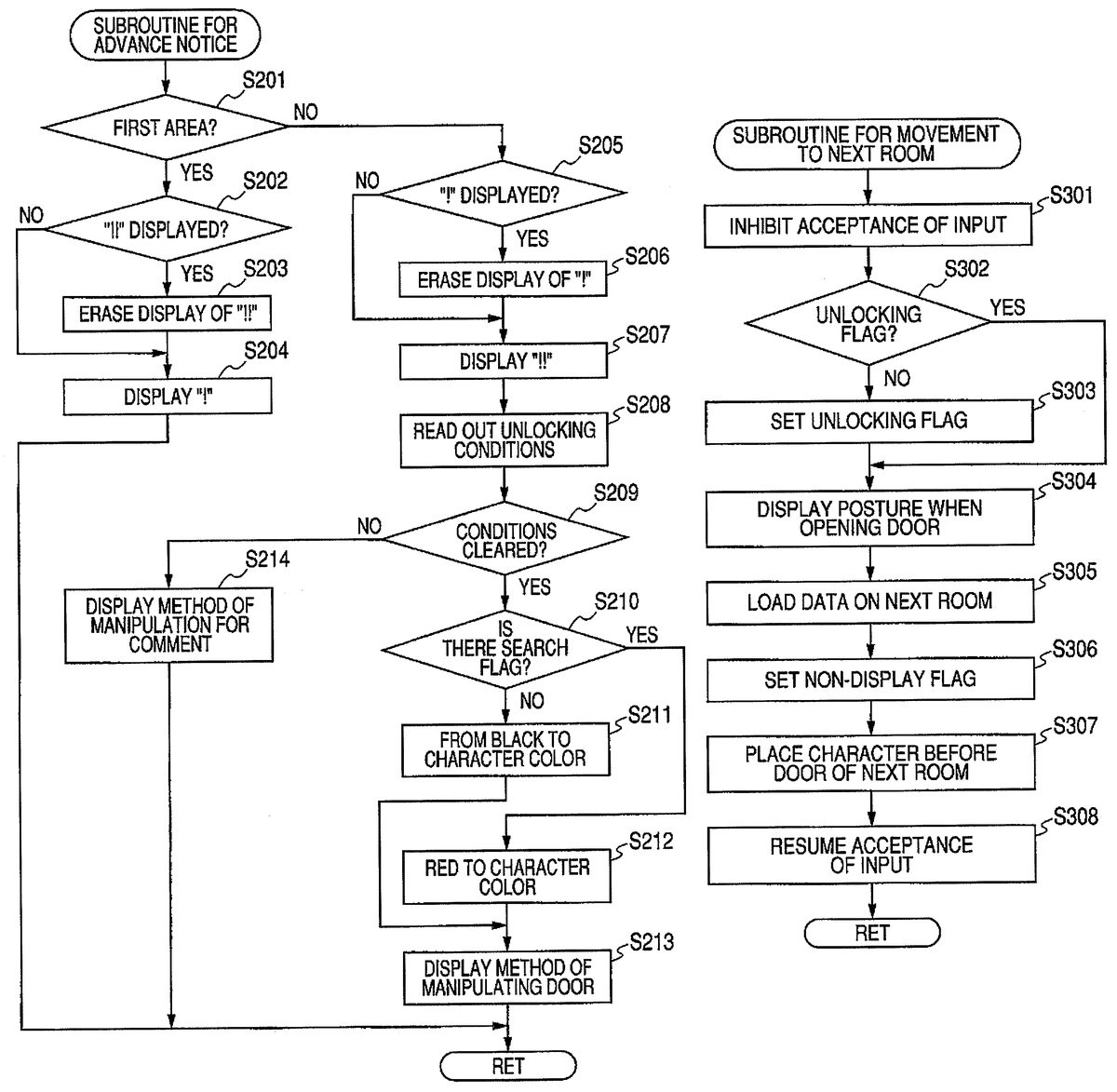
On the other hand, in the case where the input instruction is not an instruction responsive to the manipulation displayed on the display screen122(“No” in step S115), the control portion103performs various kinds of processing corresponding to the contents of the instruction (step S120). In the case where the given operation of the player character100is set as the unlocking conditions for a certain door, when the player character100performs this operation during this processing, an operation for setting the unlocking flag for the door is contained in the processing. Other processing is carried out, but because it does not directly relate to the present invention, its detailed description is omitted. Then, the processing returns to stepFIG. 6is a flowchart illustrating a non-limiting example of the processing for displaying the advance notice in step S108. In this processing, the control portion103determines whether the player character100is in the first area202of the map200(step S201). If the decision is affirmative (“Yes” in step S201), the control portion103determines whether a symbol set “!!” is displayed over the head of the player character100on the display screen122(step S202).
If the symbol set “!!” is not displayed (“No” in step S202), the processing directly proceeds to step S204. If the symbol set “!!” is displayed (“Yes” in step S202), the control portion103erases the displayed symbol set “!!” (step S203). If the door manipulating method or the comment manipulation method is also displayed, these methods are also erased (step S203). Then, the processing proceeds to step S204.
In the step S204, the control portion103displays the symbol “!!” over the head of the player character100and displays images on the display screen122. If the symbol “!” is already displayed on the display screen122, the control portion103continues the display of the symbol. Then, the processing for displaying the advance notice ends, and the processing returns to the flowchart ofFIG. 5.
If it is determined at step S201that the player character100is not in the first area202on the map200(i.e., the player character100is present in the second area203on the map200) (“No” in step S201), the control portion103determines whether the symbol “!” is displayed over the head of the player character100on the display screen122(step S205). If the symbol “!” is not displayed (“No” in step S205), the processing proceeds directly to step S207. If the symbol “!” is displayed (“Yes” in step S205), the control portion103erases the displayed symbol “!” (step S206). Then, the processing proceeds to step S207.
In step S207, the control portion103displays a symbol set “!!” over the head of the player character100on the display screen122. If the symbol set “!!” is already displayed on the display screen122, the control portion103continues the display. Then, the control portion103identifies the door201corresponding to the second area203in which the player character100is present. The control portion103reads the unlocking conditions required for passing through the identified door201(step S208), and determines whether the player character100satisfies the unlocking conditions (step S209). If an unlocking flag is set for the door201corresponding to the second area203in which the player character100is present, it means that the unlocking conditions are satisfied in step S208.
In the case where the player character100satisfies the unlocking conditions for the door201(“Yes” in step S209), the control portion103refers to the room data table400and determines whether a search flag for the room corresponding to the destination room ID of the destination of the door201identified in step S208is set (step S210). If the search flag for the destination room is not set (“No” in step S210), the control portion103sets the font color to black (step S211). Then, the processing proceeds to step S213. If the search flag is set (“Yes” in step S210), the control portion103sets the font color to red (step S212). Then, the processing proceeds to step S213.
In step S213, the control portion103displays the door manipulating method with the font color specified in step S211or S212on the display screen122. Then, the processing for displaying the advance notice ends and the processing returns to the flowchart ofFIG. 5.
If the unlocking conditions are not satisfied (“No” in step S209), the comment manipulation method is displayed on the display screen122(step S214). Then, the processing for displaying the advance notice ends and the processing returns to the flowchart ofFIG. 5.
FIG. 7is a flowchart illustrating a non-limiting example of the processing for movement into the next room in step S119. In this processing, the control portion103performs processing for inhibiting acceptance of inputs, i.e., does not accept any player's instruction from the input portion161(step S301). Then, the control portion103determines whether an unlocking flag is set for the door201identified in step S208(step S302). If the unlocking flag is not set (“No” in step S302), it means that the unlocking conditions have been satisfied but the door201is not yet unlocked. Then, the control portion103sets the unlocking flag and unlocks the door (step S303). In the case where an item such as, for example, a key is set as the unlocking condition for the door201, the player character100may insert the key into the keyhole. Then, the processing proceeds to S304. If the unlocking flag is set (“Yes” in step S302), the processing proceeds directly to step S304.
In step S304, the control portion103displays a posture of the player character100who is opening the door201on the display screen122. This processing is used to display a sequence of statuses of the player character100who opens the door201and so a certain period of time is required. Then, the control portion103refers to the ID of the destination room for the door201identified in step S208in the room data table400, and loads map data300of the destination room into the map data area of the RAM105from the recording medium131(step S305). Since the loading of the map data300requires reading the whole map data300of the destination room from the recording medium131, which has a slow data readout rate, and writing the data into the RAM105, a considerably long time is taken.
Then, the control portion103sets the non-display flag corresponding to the door201through which the player character has passed in the destination room and clears the non-display flags for all the other rooms and doors201in the room data table400(step S306). Then, the control portion103places the player character100at the position indicated by the destination position information about the door201identified in step S208in the room data table400(step S307). Here, the door201through which the player character has passed is closed and locked, and the player character100shows his back to the door201.
The placed player character100is positioned in front of the door201, through which the player character100has passed, and thus is present in a new second area203. However, the non-display flag is set, and therefore no advance notice information is displayed. Then, the player character100moves and exits from the advance notice areas. Consequently, the non-display flag is set to 0. As a result, new advance notice information can be displayed on the display screen122.
Then, the acceptance of an input that was inhibited in step S301is restarted such that a player's instruction can be accepted from the input portion161(step S308), and the processing for the movement into the next room is ended. The, the processing returns to the flowchart ofFIG. 5.
The advance notice information displayed on the display screen in a video game is next described in detail by referring toFIGS. 8A-8G. In any step ofFIGS. 8A-8G, the player character100is present within the room A. There is a door201-abthrough which movement is made from the room A to the room B. It is assumed that an area from L202-ab to L203-abis set as a first area202for the door201-aband an area extending from L203-abto the door201-abis set as a second area203.
InFIG. 8A, the player character100is outside the advance notice areas within the room A. Outside the advance notice areas, no advance notice information is displayed. Furthermore, the door201is not displayed at all. Then, the player character100is moved into the first area202in accordance with a player's instruction from the input portion161. In this case, as shown inFIG. 8B, the symbol “!”204is displayed over the head of the player character100. At this time, only a part of the door201-abis shown.
Furthermore, the player character100is moved into the second area203in accordance with a player's instruction from the input portion161. In this case, the advance notice information displayed on the display screen122differs according to whether or not the player character100satisfies the unlocking conditions for the door201.
If the unlocking conditions are satisfied, a symbol set “!!”205and a door manipulating method206are displayed over the head of the player character100as shown inFIG. 8C. Here, the door201-abis completely displayed. In the case where the player character100has never moved out of the advance notice areas of the room through the door201, the font color of the message of the door manipulating method206is black. In the case where the character has moved out of the advance notice areas in the room, the font color is red.
If the player manipulates the circle button that is displayed as the door manipulating method206, the posture of the player character is displayed as shown inFIG. 8D. That is, the player character100opens the door201and enters the next room through the door. The posture of the player character100who shows his back to the locked and closed door201of the next room is displayed on the display screen122as shown inFIG. 8E. During the steps ofFIGS. 8D-8E, operations of the input portion161by the player are nullified.
On the other hand, if the player character100does not satisfy the unlocking conditions, the set of symbols “!!”205and the comment manipulation method207are displayed over the head of the player character100as shown inFIG. 8F. Here, the door201-abis completely displayed. If the player manipulates the circle button in accordance with the comment manipulation method, the set of symbols “!!”205and the comment manipulation method207are erased. A window208displaying a comment corresponding to the door201stored in the room data table400is displayed at the top of the display screen122as shown inFIG. 8G. If the player manipulates the input portion161and enters a new instruction, the comment is erased.
As described so far, in the video game according to the present embodiment, the map200is provided in the virtual space, which map is made of multiple rooms serving as spaces in which the player character may move. The player character100can move from the present room to another room through the door201. The door may be in one of three states: a locked state, an unlocked state, and an open state. When the door201is in a locked or an unlocked state, the door is displayed in a closed state on the display screen122. At normal times during processing of the game, the door201is in a closed state. The door can be opened in accordance with a player's instruction from the input portion161. In order to open the door201, it is necessary to first unlock the door201. This is achieved by the player character100by satisfying the unlocking conditions for the door201.
When it is assumed that information indicating whether the player character100satisfies the unlocking conditions for the door201is not displayed on the display screen122, the player needs to enter an instruction for opening the door201using the input portion161in order to know whether the player character100can move to the other room through the door201. If the player character100does not satisfy the unlocking conditions for the door201, the door201will not open. This way, if the door201does not open in spite of the fact that the player enters an instruction for opening the door201, the inputting is useless. In other words, the player has been forced to perform complex manipulations.
On the other hand, in the video game according to this embodiment, if the player character100has moved into the second area203set based on the position of each door201, it is determined whether the unlocking conditions for the door201are satisfied. If the conditions are satisfied, the door manipulating method is displayed over the head of the player character100on the display screen122. The door manipulating method displayed on the display screen enables the player to recognize that the player character100satisfies the unlocking conditions for the door201and can open the door201without entering an instruction for opening the door201. Consequently, the player is not required to perform wasteful actions.
The font color of the message displayed on the display screen122to explain the door manipulating method is black if the player character100did not move out of the advance notice areas within the destination room. If the character moved out of the advance notice areas, the color is red. Therefore, if the player forgets that he moved the player character100into a room that was a destination, wasteful motion of the player character100into the room can be prevented. Hence, the game can be quickly and smoothly progressed.
When the player character100moves into the second advance notice area203, if the unlocking conditions for the door201are not satisfied, a comment manipulation method is displayed over the head of the player character100on the display screen122. The comment manipulation method displayed on the display screen makes it possible for the player to recognize that the player character100does not satisfy the unlocking conditions for the door201and the door201cannot be opened, without entering the instruction for opening the door201. In consequence, the player is not required to perform wasteful manipulations.
Furthermore, where the player only wants to know whether the player character100can be moved from the present room to another room, the player does not need to move the player character100to the other room in view of the game progress. The player is able to recognize whether the player character can move to the other room from the door manipulating method and the comment manipulation method displayed on the display screen122, without the actual manipulation for opening the door. Therefore, in the case where the player only wants to know whether the player character100can move from the present room to the other room, it is not required to perform wasteful manipulations. Since the player is not required to perform wasteful manipulations for moving the player character100from the present room to another room in this way, the game can be advanced smoothly.
The advance notice areas have two areas: the first area202and the second area203. When the player character100has moved into the first area202, which is relatively remote from the door201, the symbol “!” (i.e., advance notice information) is displayed over the head of the player character100. When the character has moved into the second area203, which is relatively close to the door201, the symbol set “!!” (i.e., advance notice information) is displayed over the head of the player character100. That is, advance notice information is displayed at two different stages on the advance notice areas.
In this embodiment, even in the case where the door201is not sufficiently or clearly displayed on the display screen122, the display of the symbols “!” and “!!”, which are kinds of advance notice information, makes it possible for the player to know the presence of the door201. Even if the player character100is in the first area202and the door201is not sufficiently clearly displayed, the player can easily know of the presence of the door. Furthermore, even where the door201is a hidden door, the player can understand that the player character has moved close the door201if the symbol set “!” is displayed after display of the symbol “!!”. If the symbol “!!” is displayed after display of the symbol set “!”, the player can recognize that the player character has moved further away from the door201. Since the advance notice information is displayed when the player character is in the advance notice areas in this way, the player can advance the game without missing the door201, and thereby can fully enjoy the game.
In the case where the player character100has moved and the comment manipulation method is displayed on the display screen122, a hint for unlocking the door201is displayed by performing the manipulation corresponding to the comment manipulation method. In this way, the player can check conditions required for moving to another room by performing a given manipulation even in the case where the door201is locked and the character cannot be moved to the other room. Consequently, the game can be quickly advanced.
In this embodiment, when the player character100is in front of the unlocked door201, if the player manipulates the circle button of the input portion161, the player character100moves to another room through the door201. When moving to the other room, processing is performed in such a way that the player character100opens the door201. This processing needs a given period of time. Furthermore, since the map data300is prepared for each different room and loaded into the RAM105, processing is necessary for loading the map data300for a new destination room from the recording medium131into the RAM105. This processing requires a considerably long time to perform.
If information is not displayed on the display screen122, allowing the player to determine whether the door201is unlocked or not, such as the door manipulating method or the comment manipulation method as in the present embodiment, the player must manipulate the circle button of the input portion161only to know whether the door201can be opened. In such a case, if the door201is in an unlocked state, the player character100is moved through the door201to the other room, irrespective of whether the player only wants to know whether the door201can be opened or wants to move the player character100to other room.
Here, a player's next instruction for advancing the game cannot be accepted until the operation of the player character100for opening the door201and the loading of the map data300of the destination room from the RAM105are completed. Even in the case where the player only wants to know whether the door201can be opened, he must wait for progress of the game during the above processing. In addition, if the character should be returned to the original room, the same processing needs to be repeated again. This doubles the period of time for which the player must wait for progress of the game.
On the other hand, in the game according to the present embodiment, if the player character100moves to the second area203close to the door201, the door manipulating method, or the comment manipulation method, is displayed. This enables the player to know ahead of time whether the door201is in an unlocked state, without having to perform a manipulation (such as, for example, an input using the circle button) to open the door201. If the player only wants to know whether the door201can be opened, information that the player wants to know is fully offered in this embodiment. Thus, since the manipulation for opening the door201is not performed, the player is not required to wait for progress of the game for a long time to display the operation for the player character100to open the door201and to load the map data300of the room on the opposite side of the door201. Consequently, the player can quickly and smoothly advance the game.
In the game according to the present embodiment, the virtual space in which the player character100moves has plural doors201providing traveling routes between different rooms. The player only needs to perform the same manipulation (e.g., manipulating the circle button of the input portion161) irrespective of which door201is to be opened. Furthermore, in the case where there are many doors, all of which can be opened with the same manipulation, the door manipulating method, indicating a manipulation for opening each door201, is information that is obvious to the player. Displaying the door manipulating method whenever the player character100moves into the second area203may be a nuisance to the player. Furthermore, although the comment manipulation method is also displayed, as in the case of the door manipulating method, if the comment is automatically displayed under the condition where the door201is locked and thus is not opened, displaying the comment manipulation method that teaches the conditions for unlocking the door to the player may also be a nuisance to the player.
Meanwhile, if the player still does not know whether the door201in front of the player character100can be opened under the condition where neither the door manipulating method nor the comment manipulation method is displayed, the player must actually perform a manipulation for opening the door201to know whether it can be opened. Obviously, performing a manipulation for opening the door201that cannot be opened is a nuisance to the player. However, it cannot be said that the manipulation is a nuisance to the player if the comment on the unlocking conditions is displayed when the door201cannot be opened. For this reason, not displaying either the door manipulating method or the comment manipulation method may cause fewer nuisances to the player.
However, only if the player manipulates, for example, the circle button to find out whether the door201can be opened, must the player wait for advancing the game by having to wait for the processing of the player character100for opening the door and the processing of loading the map data300of the destination room into the RAM105to complete. When the game advance is suspended for such a long time, smooth progress of the game is hindered. This causes maximum nuisance to the player. In the game according to the present embodiment, the door manipulating method and the comment manipulation method are purposely displayed. Although displaying the methods may seem like a nuisance to the player, this prevents the player's wasteful manipulations. Consequently, interruption of the progress of the game, which is the greatest nuisance, is prevented. Hence, quick and smooth progress of the game is achieved.
It is to be understood that the present invention is not limited to the above embodiments and that various changes, modifications and applications are possible. Some exemplary, non-limiting modifications of the above embodiments of the invention are hereinafter described.
In the above embodiments, the displayed advance notice information varies depending on whether the unlocking conditions are satisfied when the player character100has moved into the second area203. The invention is not limited to this configuration, and the displayed advance notice information may vary depending on whether the unlocking conditions are satisfied when the player character has moved into the first area202. For example, when the player character100has moved into the first area202, if the unlocking conditions for the door201are not satisfied, a display different from the symbol “!” may be provided. Otherwise, nothing may be displayed. In this case, it is not necessary for the player to purposely move the player character100close to the door201that cannot be opened, if the symbol “!” is not displayed in the first area202, which is relatively remote from the door201. As a result, the game can be advanced more quickly.
In the above embodiment, a door manipulating method is displayed as the advance notice information when the unlocking conditions for the door201are satisfied in the second area203. The displayed advance notice information is not limited to this kind of information. For example, the name of the next room may be displayed. In this case, the player can easily identify the destination room from the displayed name of the next room, even if different font colors, other than black and red, are used. As a result, it is easy to determine whether the player character can move into the next room.
In the above embodiment, a comment providing a hint for satisfying the unlocking conditions is displayed in a case where the player performs an action corresponding to the displayed comment manipulation method. The invention is not limited to this configuration, and the step of displaying the comment manipulation method may be omitted. In this case, a window208(see e.g.,FIG. 8G) displaying a comment may be displayed when the player character100moves into the second area203. That is, the comment manipulation method is not displayed in step S214(shown inFIG. 6.) At step S214, the window208may be displayed, and steps S117and S118(shown inFIG. 5) may be omitted.
In the above embodiment, the advance notice information is displayed based on the positional condition of the player character100on the map200, i.e., depending on whether the player character100has moved into the first area202or into the second area203. The invention is not limited to this configuration, and other conditions may be used together with the positional condition.
For example, the direction of the body of the player character100may be used as one condition. In this case, the advance notice information may be displayed when the player character100faces in a given direction relative to the door201within the advance notice areas. In the case where the player character100does not face in a given direction relative to the door201, the advance notice information may not be displayed. Furthermore, of the advance notice information, only the door manipulating method and the comment manipulation method may be displayed. In this case, the game may be configured so that the door201cannot be opened unless the player character100faces in a given direction relative to the door201. Where the character cannot be moved into another room unless the player character100faces in a given direction relative to the door201, the advance notice information, especially the door manipulating method and the comment manipulation method for indicating that the door201is locked, is useless information for the player. In this embodiment, such useless information displayed on the display screen122is minimized. Therefore, the player is not annoyed with information that is unnecessary for the progress of the game.
Furthermore, the conditions under which the advance notice information is displayed may be different between the first area202and the second area203. For example, where the player character100has moved into the first area202, the advance notice information may be displayed irrespective of the direction of body of the player character100. Where the character has moved into the second area202, the advance notice information may be displayed depending on the direction of the body of the player character100.
In addition, the first area202and the second area203may be set according to the distance between the player character100and the predetermined reference position of the door201. Further, the distance which is taken between the player character100and the door201, and which sets at least one of the first area202and second area203, may vary depending on the experiential value of the player or another element.
In the above embodiment, the advance notice areas have the first area202and second area203. The advance notice areas may have only the second area203. Furthermore, a zeroth area may be set outside the first area202. Symbol “?” may be displayed in the zeroth area. In this case, even if the player cannot recognize the display of the door201on the display screen122, the player can see that the character is approaching the door201when the display provided over the head of the player character100turns from “?” to “1”.
In the above embodiment, the symbols “!” and “!!” of the advance notice information are displayed in the case where the player character100does not satisfy the unlocking conditions for the door201. They may also be displayed only when the unlocking conditions are satisfied. In this case, when the player character100moves into the advance notice area, the control portion103reads the unlocking conditions about the advance notice area from the room data table400and determines whether the player character100satisfies the unlocking conditions. The subroutine for displaying an advance notice may be done only when the unlocking conditions are satisfied. Furthermore, the symbol “!” of the advance notice information may be displayed only when the unlocking conditions are satisfied and the symbol “!!” may be displayed regardless of satisfying the unlocking the condition. In this way, if the player character100fails to satisfy the unlocking conditions for the door201, it is not necessary to bring the player character100close to the door201. By displaying the advance notice information without having to bring the player character100close to the door201, the player is prevented from performing a useless operation for progressing the game, i.e., having to search for the door201leading to a room to which the character cannot be moved. Hence, the game can be advanced more quickly.
In the above embodiment, an advance notice of the door is made in the first area202and the second area203. The subject of an advance notice is not limited to doors. For example, the subject may be an item contained in a treasure chest that can assume a locked state and an unlocked state. In this case, the player character100is moved in accordance with the player's instructions using, for example, direction keys of the input portion161. When the character moves to the advance notice area close to the treasure chest containing the item, the advance notice information is displayed over the head of the player character100. In this case, advance notice information is displayed to indicate whether the treasure chest can be opened or not. In this way, the player is not urged to perform a useless manipulation to cause the player character100to acquire the item. Consequently, the game can be advanced smoothly.
In the above embodiment, it is assumed that the destination room, which may be entered through the door201, has been stored in advance in the room data table400. The present invention is not limited to this scheme. For example, when the player character100has moved into the advance notice areas, the destination room may be selected by lot. The map data300of the destination room determined by lot may be loaded into the RAM105. In this case, the character can be moved to a different room depending on the timing at which the character moves to the advance notice areas, assuming that there is only one door201. Consequently, the degree of pleasure of the game can be enhanced.
In the above embodiment, in the case where the room, in which the player character100went out of the advance notice areas, is the destination room, the font color of the message indicating the door manipulating method is turned from black to red. The invention is not limited to this configuration. The room already visited by the player character may be displayed on the display screen122, e.g., by a message “room already visited”. The conditions under which a search flag is set for each room are not limited to the fact that the player character went out of the advance notice areas. Another example of the conditions may be that the player character100has entered the room. A further example is that the player character has satisfied the conditions imposed by an event (e.g., a battle with an enemy character) set for the room. A yet further example is that the player character100has gained all the items placed in the room. A still further example is that the player character100has entered a given area that is set outside the advance notice areas of the room.
In the above embodiment, the virtual space in the game is divided into a plurality of areas by multiple rooms formed in a two-dimensional space. The virtual space may be divided into a plurality of areas by other methods, as the skilled artisan will readily appreciate, without departing from the spirit and/or scope of the invention. For example, the outside and inside of a building may be classified as different areas. Different floors in a building may be classified as different areas. Furthermore, partitioned areas can be obtained by arbitrarily combining these methods of classification (e.g., the outside and inside of a building may be classified as different areas; different floors may be classified as different areas; and the same floor may be divided into multiple rooms). Where the outside and inside of a building may be classified as different areas, the areas can be partitioned from each other using doors as traveling routes. Where different floors are classified as different areas, areas can be partitioned from each other using staircases (which might be prohibited from passage, for example) and elevators (which might not be operated, for example, due to power failure) as traveling routes. The present invention can similarly be applied to an outdoor space by dividing it into a plurality of areas where the traveling routes for the player character100may be restricted by gates, or the like.
In the above embodiment, when the player character100enters the second area203, the door manipulating method is displayed when the unlocking conditions for the corresponding door201are satisfied. In the case where the unlocking conditions are not satisfied, the comment manipulation method is displayed. In a modified embodiment, the advance notice may include only the door manipulating method that is displayed when the unlocking conditions for the door201are satisfied. In another modified embodiment, the advance notice may include only the comment manipulation method that is displayed when the unlocking conditions for the door201are not satisfied. In the former modified embodiment, it is possible to determine that the player can open the door201if the door manipulating method is displayed, and that the door201cannot be opened if nothing is displayed. On the other hand, in the latter modified embodiment, it is possible to determine that the player cannot open the door201if the comment manipulation method is displayed, and that the door201can be opened if nothing is displayed.
In the above embodiment, the game machine main body101, which is a dedicated machine, is used as a platform for executing a video game. A general-purpose personal computer can also be used if it possesses similar components as those of the game machine main body101and has a graphics function of drawing pictures. A portable game machine structured to house the display apparatus121and the sound processor155in the same casing of the game machine main body may be used. The present invention can also be applied to a network game which is advanced by plural players (users) using plural video game machines connected via servers on the network3, as well as to games which are progressed on a stand-alone video game machine, or the like.
A semiconductor memory card can be used as the recording medium131instead of a DVD-ROM or a CD-ROM. A card slot for inserting the memory card may be provided instead of the DVD/CD-ROM drive113. In the case of a general-purpose personal computer, programs and data associated with the present invention may be previously stored in the HDD107, instead of being stored in the recording medium131. According to the physical form of the hardware, and according to the method of circulation, any arbitrary type of medium capable of recording computer readable information can be used as the recording medium for storing and providing the programs and data associated with the present invention.
In the above embodiment, the program and data for the video game apparatus1are stored in the recording medium131and distributed. In contrast, the program and data may be stored in a hard disk drive possessed by a server machine existing on the network3, and the program and data may be delivered to the game machine main body101via the network3. In the video game apparatus1, the program and data that the communication interface115receives from the server machine can be stored in the HDD107and loaded into the RAM105during execution.
Although the invention has been described with reference to several exemplary embodiments, it is understood that the words that have been used are words of description and illustration, rather than words of limitation. Changes may be made within the purview of the appended claims, as presently stated and as amended, without departing from the scope and spirit of the invention in its aspects. Although the invention has been described with reference to particular means, materials and embodiments, the invention is not intended to be limited to the particulars disclosed; rather, the invention extends to all functionally equivalent structures, methods, and uses such as are within the scope of the appended claims.
Claims
- A game apparatus for executing a game that is advanced by moving a player character in a virtual space, including a first field and a second field, the second field opening into the first field via a predetermined traveling route, and for displaying an image representing a status of the game being executed on a display, the game apparatus comprising: a normal movement inputter operable to input an instruction to move the player character in the virtual space, including the first and second fields, in accordance with a player operation;a cross-field movement inputter operable to input an instruction to move the player character from the first field to the second field through the traveling route in accordance with a player operation;a normal mover operable to move the player character in any one of the first and second fields in which the player character is present in accordance with the instruction input from the normal movement inputter, the normal mover including a direction changer to change a direction of the player character in accordance with the instruction input from the normal movement inputter;a movement restriction switcher operable to switch a status of the game between a cross-field movement disabled state, in which the player character is not allowed to move from the first field to the second field, and a cross-field movement enabled state, in which the player character is allowed to move from the first field to the second field, in accordance with conditions established during progress of the game;a cross-field movement enable/disable determiner operable to determine whether the status of the game has been switched to the cross-field movement enabled state by the movement restriction switcher when the player character is moved by the normal mover to a specific region set based on a position of the traveling route within the first field;a direction determiner that determines whether the direction that the player character faces is a given direction relative to the position of the traveling route between the first and second fields when the player character has been moved into the specific region by the normal mover;a cross-field movement enable/disable displayer operable to display cross-field movement enable/disable information, indicating whether the player character is allowed to move from the first field to the second field on the display based upon the determination made by the cross-field movement enable/disable determiner, when the player character is determined to face in the given direction by the direction determiner;a cross-field movement enablement displayer operable to display information indicating conditions to be established for switching the status from the cross-field movement disabled state to the cross-field movement enabled state by the movement restriction switcher when the cross-field movement enable/disable determiner determines that the status has been switched to the cross-field movement disabled state and when an instruction to move the player character from the first field to the second field is input from the cross-field movement inputter;a cross-field mover operable to move the player character from the first field to the second field when an instruction to move the player character from the first field to the second field is input from the cross-field movement inputter and the cross-field movement enable/disable determiner determines that the status of the game is the cross-field movement enabled state;and a cross-field movement prohibiter operable to keep the player character within the first field without moving the player character to the second field when an instruction to move the player character from the first field to the second field is input from the cross-field movement inputter and the cross-field movement enable/disable determiner determines that the status of the game is the cross-field movement disabled state.
- The game apparatus as set forth in claim 1 , wherein the cross-field movement enable/disable displayer comprises a cross-field movement permission displayer operable to display cross-field movement permission information indicating that the player character is allowed to move from the first field to the second field as the cross-field movement enable/disable information when the cross-field movement enable/disable determiner determines that the status has been switched to the cross-field movement enabled state.
- The game apparatus as set forth in claim 1 , wherein the cross-field movement enable/disable displayer comprises a cross-field movement disability displayer operable to display cross-field movement disability information indicating that the player character is not allowed to move from the first field to the second field on the display as the cross-field movement enable/disable information when the cross-field movement enable/disable determiner determines that the status has been switched to the cross-field movement disabled state.
- The game apparatus as set forth in claim 1 , further comprising a traveling route displayer operable to display, on the display, traveling route information indicating a presence of a traveling route leading from the first field to the second field when the player character has been moved by the normal mover from the specific region to a second specific region within the first field, the second specific region being larger than the specific region, based on the position of the traveling route between the first and second fields.
- The game apparatus as set forth in claim 1 , further comprising: a movement information storage operable to store field movement information indicating whether the player character has been moved to the second field by the normal mover;a movement information determiner operable to determine whether the field movement information stored in the movement information storage indicates that the character has been moved to the second field when the cross-field movement enable/disable determiner determines that the status has been switched to the cross-field movement enabled state;and a movement history displayer operable to display movement history information indicating whether the player character has been moved to the second field on the display based upon the determination made by the movement information determiner.
- The game apparatus as set forth in claim 1 , wherein: the virtual space includes a movement restriction object provided in the traveling route between the first and second fields in a virtual space, the movement restriction object comprising two states, including, an open state, in which the player character is allowed to move from the first field to the second field, and a closed state, in which the player character is not allowed to move from the first field to the second field, in the cross-field movement enabled state, the movement restriction object further having only a closed state in the cross-field movement disabled state, and the game apparatus further comprises an object state switcher operable to switch the cross-field movement restriction object from the closed state to the open state prior to the cross-field mover moving the player character from the first field to the second field, the object state switcher being further operable to switch the cross-field movement restriction object back to the closed state after the player character has moved to the second field.
- The game apparatus as set forth in claim 1 , further comprising: a map data fixed storage operable to store first map data made up of graphics data of the first field, including the traveling route, and second map data made up of graphics data of the second field, including the traveling route, respectively;a high-speed storage having a data readout rate higher than the data readout rate of the map data fixed storage, and having a character data area that stores character data made up of graphics data of the player character and a map data area that stores map data for any one data set of the first and second map data corresponding to the field including the position in which the player character has moved;and a map data loader operable to, retrieve map data corresponding to the field to which the player character has moved from the map data fixed storage, and to store the retrieved map data as a substitute for the map data, which has been stored so far, corresponding to the field from which the player character has moved into the map data area when the player character moves between the first and second fields.
- The game apparatus as set forth in claim 6 , wherein: three or more fields, including the first and second fields, are provided in the virtual space, the fields neighboring with an other one or more fields via a predetermined traveling route, and the cross-field movement inputter is further operable to input an instruction that moves the player character from an arbitrary one of the fields, other than the first field, to another one of the fields adjacent to the arbitrary field via the traveling route in which the movement restriction object is provided, in accordance with the same player operation as the operation that inputs the instruction that moves the player character from the first field to the second field.
- A game progressing method for executing a game on a computer system, the game being advanced by moving a player character in a virtual space, including a first field and a second field, the second field opening into the first field via a predetermined traveling route, the computer system comprising: a storage including a character position storage area operable to store positions and directions of the player character in the virtual space;a normal movement inputter operable to input an instruction to move the player character in the virtual space, including the first and second fields, in accordance with a player operation;a cross-field movement inputter operable to input an instruction to move the player character from the first field to the second field through the traveling route in accordance with a player operation;and a displayer operable to generate and display game images representing a status of the game being executed, the game progressing method comprising: moving the player character in any one of the first and second fields, in which the player character is present, in accordance with an instruction input from the normal movement inputter, changing the direction of the player character in accordance with the instruction input from the normal moment inputter, and storing the position and direction of the moved player character in the character position storage area;switching the status between a cross-field movement disabled state, in which the player character cannot move from the first field to the second field, and a cross-field movement enabled state, in which the player character can move from the first field to the second field, according to conditions established during progress of the game, and storing information indicating to which of the cross-field movement disabled state and cross-field movement enabled state has the status been switched in a cross-field enable/disable storage area contained in the storage;determining to which of the cross-field movement disabled state and cross-field movement enabled state has the status been switched by referring to the cross-field movement enable/disable storage area when the player character moves into a specific region set based on a position of the traveling route within the first field;determining whether the direction that the player character faces is in a given direction relative to the position of the traveling route between the first and second fields when the player character has moved into the specific region;displaying cross-field movement enable/disable information, indicating whether the player character can be moved from the first field to the second field depending on a determination to which of the cross-field movement enabled state and cross-field movement disabled state has the status been switched on the displayer, together with the game images, when the player character is determined to face in the given direction;displaying information indicating the conditions to be established for switching the status from the cross-field movement disabled state to the cross-field movement enabled state when the status has been switched to the cross-field movement disabled state and when an instruction to move the player character from the first field to the second field is input from the cross-field movement inputter;moving the player character from the first field to the second field when it is determined that the status has been switched to the cross-field movement enabled state and, when the instruction to move the player character from the first field to the second field is input from the cross-field movement inputter, and storing the position of the moved player character in the character position storage area;and causing the position stored in the character position storage area to be retained within the first field without moving the player character to the second field when it is determined that the status has been switched to the cross-field movement disabled state, and when the instruction to move the player character from the first field to the second field is input from the cross-field movement inputter.
- A computer-readable recording medium in which a program executable on a computer system is recorded, the computer system being connected with a displayer for displaying an image representing a status of a game being executed, the game being advanced by moving a player character in a virtual space, including a first field and a second field, the second field opening into the first field via a predetermined traveling route, the recording medium comprising: a normal movement inputter executable to input an instruction to move the player character in the virtual space, including the first and second fields, in accordance with a player operation;a cross-field movement inputter executable to input an instruction to move the player character from the first field to the second field through the traveling route in accordance with a player operation;a normal mover executable to move the player character in any one of the first and second fields in which the player character is present in accordance with the instruction input from the normal movement inputter the normal mover including a direction changer that changes a direction of the player character in accordance with the instruction input from the normal movement inputter;a movement restriction switcher executable to switch a status of the game between a cross-field movement disabled state, in which the player character is not allowed to move from the first field to the second field, and a cross-field movement enabled state, in which the player character is allowed to move from the first field to the second field, in accordance with conditions established during progress of the game;a cross-field movement enable/disable determiner executable to determine whether the status has been switched to the cross-field movement enabled state by the movement restriction switcher when the player character is moved by the normal mover to a specific region set based on a position of the traveling route within the first field;a direction determiner that determines whether the direction that the player character faces is in a given direction relative to the position of the traveling route between the first and second fields when the player character has been moved into the specific region by the normal mover;a cross-field movement enable/disable displayer executable to display cross-field movement enable/disable information indicating whether the player character is allowed to move from the first field to the second field on the display based upon the determination made by the cross-field movement enable/disable determiner when the player character is determined to face in the given direction by the direction determiner a cross-field movement enablement displayer executable to display information indicating conditions to be established for switching the status from the cross-field movement disabled state to the cross-field movement enabled state by the movement restriction switcher when the cross-field movement enable/disable determiner determines that the status has been switched to the cross-field movement disabled state and when an instruction to move the player character from the first field to the second field is input from the cross-field movement inputter;a cross-field mover executable to move the player character from the first field to the second field when an instruction to move the player character from the first field to the second field is input from the cross-field movement inputter and when the cross-field movement enable/disable determiner determines that the status has been switched to the cross-field movement enabled state;and a cross-field movement prohibiter executable to keep the player character within the first field without moving the player character to the second field when an instruction to move the player character from the first field to the second field is input from the cross-field movement inputter and when the cross-field movement enable/disable determiner determines that the status has been switched to the cross-field movement disabled state.
- A game apparatus for executing a game that is advanced by moving a player character in a virtual space, including a first field and a second field, the second field opening into the first field via a predetermined traveling route, and for displaying an image representing a status of the game being executed on a display, the game apparatus comprising: a normal movement inputter operable to input an instruction to move the player character in the virtual space, including the first and second fields, in accordance with a player operation;a cross-field movement inputter operable to input an instruction to move the player character from the first field to the second field through the traveling route in accordance with a player operation;a normal mover operable to move the player character in any one of the first and second fields in which the player character is present in accordance with the instruction input from the normal movement inputter, the normal mover including a direction changer to change a direction of the player character in accordance with the instruction input from the normal movement inputter;a movement restriction switcher operable to switch a status of the game between a cross-field movement disabled state, in which the player character is not allowed to move from the first field to the second field, and a cross-field movement enabled state, in which the player character is allowed to move from the first field to the second field, in accordance with conditions established during progress of the game;a cross-field movement enable/disable determiner operable to determine whether the status of the game has been switched to the cross-field movement enabled state by the movement restriction switcher when the player character is moved by the normal mover to a specific region set based on a position of the traveling route within the first field;a direction determiner that determines whether the direction that the player character faces is a given direction relative to the position of the traveling route between the first and second fields when the player character has been moved into the specific region by the normal mover;a cross-field movement enable/disable displayer operable to display cross-field movement enable/disable information, indicating whether the player character is allowed to move from the first field to the second field on the display based upon the determination made by the cross-field movement enable/disable determiner, when the player character is determined to face in the given direction by the direction determiner;a cross-field mover operable to move the player character from the first field to the second field when the direction determiner determines that the player character faces in the given direction, the instruction to move the player character from the first field to the second field is input from the cross-field movement inputter, and the cross-field movement enable/disable determiner determines that the status of the game is the cross-field movement enabled state;and a cross-field movement prohibiter operable to keep the player character within the first field without moving the player character to the second field when the instruction to move the player character from the first field to the second field is input from the cross-field movement in putter and the cross-field movement enable/disable determiner determines that the status of the game is the cross-field movement disabled state, wherein the cross-field movement prohibiter is operable to keep the player character within the first field without moving the player character to the second field when the direction determiner determines that the direction the player character faces is not the given direction, even when the cross-field movement enable/disable determiner determines that the status of the game has been switched to the cross-field movement enabled state and the instruction to move the player character from the first field to the second field is input from the cross-field movement inputter.
- A game progressing method for executing a game on a computer system, the game being advanced by moving a player character in a virtual space, including a first field and a second field, the second field opening into the first field via a predetermined traveling route, the computer system comprising: a storage including a character position storage area operable to store positions and directions of the player character in the virtual space;a normal movement inputter operable to input an instruction to move the player character in the virtual space, including the first and second fields, in accordance with a player operation;a cross-field movement inputter operable to input an instruction to move the player character from the first field to the second field through the traveling route in accordance with a player operation;and a displayer operable to generate and display game images representing a status of the game being executed, the game progressing method comprising: moving the player character in any one of the first and second fields, in which the player character is present, in accordance with an instruction input from the normal movement inputter, changing the direction of the player character in accordance with the instruction input from the normal moment inputter, and storing the position and direction of the moved player character in the character position storage area;switching the status between a cross-field movement disabled state, in which the player character cannot move from the first field to the second field, and a cross-field movement enabled state, in which the player character can move from the first field to the second field, according to conditions established during progress of the game, and storing information indicating to which of the cross-field movement disabled state and cross-field movement enabled state has the status been switched in a cross-field enable/disable storage area contained in the storage;determining to which of the cross-field movement disabled state and cross-field movement enabled state has the status been switched by referring to the cross-field movement enable/disable storage area when the player character moves into a specific region set based on a position of the traveling route within the first field;determining whether the direction that the player character faces is in a given direction relative to the position of the traveling route between the first and second fields when the player character has moved into the specific region;displaying cross-field movement enable/disable information, indicating whether the player character can be moved from the first field to the second field depending on a determination to which of the cross-field movement enabled state and cross-field movement disabled state has the status been switched on the displayer, together with the game images, when the player character is determined to face in the given direction;moving the player character from the first field to the second field when it is determined that the direction the player character faces is the given direction, it is determined that the status has been switched to the cross-field movement enabled state, and the instruction to move the player character from the first field to the second field is input from the cross-field movement inputter, and storing the position of the moved player character in the character position storage area;causing the position stored in the character position storage area to be retained within the first field without moving the player character to the second field when it is determined that the status has been switched to the cross-field movement disabled state and the instruction to move the player character from the first field to the second field is input from the cross-field movement inputter;and causing the position stored in the character position storage area to be retained within the first field without moving the player character to the second field when it is determined that the direction the player character faces is not the given direction, even when it is determined that the status of the game has been switched to the cross-field movement enabled state and the instruction to move the player character from the first field to the second field is input from the cross-field movement inputter.
- A computer-readable recording medium in which a program executable on a computer system is recorded, the computer system being connected with a displayer for displaying an image representing a status of a game being executed, the game being advanced by moving a player character in a virtual space, including a first field and a second field, the second field opening into the first field via a predetermined traveling route, the recording medium comprising: a normal movement inputter executable to input an instruction to move the player character in the virtual space, including the first and second fields, in accordance with a player operation;a cross-field movement inputter executable to input an instruction to move the player character from the first field to the second field through the traveling route in accordance with a player operation;a normal mover executable to move the player character in any one of the first and second fields in which the player character is present in accordance with the instruction input from the normal movement inputter the normal mover including a direction changer that changes a direction of the player character in accordance with the instruction input from the normal movement inputter;a movement restriction switcher executable to switch a status of the game between a cross-field movement disabled state, in which the player character is not allowed to move from the first field to the second field, and a cross-field movement enabled state, in which the player character is allowed to move from the first field to the second field, in accordance with conditions established during progress of the game;a cross-field movement enable/disable determiner executable to determine whether the status has been switched to the cross-field movement enabled state by the movement restriction switcher when the player character is moved by the normal mover to a specific region set based on a position of the traveling route within the first field;a direction determiner that determines whether the direction that the player character faces is in a given direction relative to the position of the traveling route between the first and second fields when the player character has been moved into the specific region by the normal mover;a cross-field movement enable/disable displayer executable to display cross-field movement enable/disable information indicating whether the player character is allowed to move from the first field to the second field on the display based upon the determination made by the cross-field movement enable/disable determiner when the player character is determined to face in the given direction by the direction determiner;a cross-field mover executable to move the player character from the first field to the second field when the direction determiner determines that the player character faces in the given direction, the instruction to move the player character from the first field to the second field is input from the cross-field movement inputter, and the cross-field movement enable/disable determiner determines that the status has been switched to the cross-field movement enabled state;and a cross-field movement prohibiter executable to keep the player character within the first field without moving the player character to the second field when the instruction to move the player character from the first field to the second field is input from the cross-field movement inputter and the cross-field movement enable/disable determiner determines that the status has been switched to the cross-field movement disabled state, wherein the cross-field movement prohibiter is executable to keep the player character within the first field without moving the player character to the second field when the direction determiner determines that the direction the player character faces is not the given direction, even when the cross-field movement enable/disable determiner determines that the status of the game has been switched to the cross-field movement enabled state and the instruction to move the player character from the first field to the second field is input from the cross-field movement inputter.
Disclaimer: Data collected from the USPTO and may be malformed, incomplete, and/or otherwise inaccurate.