U.S. Pat. No. 7,559,842
GAME SYSTEM, GAME CONTROL METHOD, AND RECORDING MEDIUM FOR THE SAME
AssigneeSquare Enix
Issue DateNovember 15, 2002
U.S. Patent No. 7,559,842: Game system, game control method, and recording medium for the same

Summary:
The ‘842 patent describes a system for role-playing games where the player has a wide range of characteristics which can be assigned to his character. Each characteristic carries a certain weight which factors into how much the character can grow and advance in the game. Thus, the player must take careful consideration when assigning certain characteristics to his character in order to provide the most effective combination that will lead to the best growth potential.
Abstract:
A game system provides multiple classifications of character characteristic and is capable of advancing a game by assigning the desired characteristic to a character from multiple characteristics. Two jobs, that is, a main job and a support job are selectable for a character and a fixed pattern of table configuration data is provided as characteristic value information according to the job. In addition, the table configuration data corresponding to the classification of the job is extracted and applied to a growth table for each job, and ability values of the main job and support job are weighted differently so as to achieve character characteristic having two job abilities together. Accordingly, it is possible to effectively increase the job types to be assigned to the character and to create an interesting game, while reducing necessary memory capacity.
Illustrative Claim:
1. A game system, which, when executing a game by operating a character in accordance with a game program, provides a plurality of types of characteristics of the character and advances the game by assigning at least one type of characteristic to the character from among the plurality of types of characteristics, the game system comprising: a main characteristic assigning system that assigns one of the types of characteristics to the character, the assigned type of characteristic serving as a main type of characteristic of the character; a storage that stores a plurality of predetermined sequences of characteristic value information that determines characteristic values of the character for each character level, and also stores a plurality of growth pattern values of the assigned characteristic type, each of the plurality of growth pattern values corresponding to one of the predetermined sequences; an application system that extracts characteristic value information corresponding to a character level and the growth pattern values of the assigned type of characteristic from the stored characteristic value information, and applies the characteristic values of the character in accordance with the extracted characteristic value information; and a controller that controls the character according to the characteristic values applied by the application system, wherein the plurality of growth pattern values are combined based on the plurality of assigned characteristic types, wherein each of a plurality of growth patterns comprises a stored predetermined sequence of characteristic value information, each predetermined sequence representing a progression of the characteristic values corresponding to each of the assigned characteristic types, and wherein the growth pattern values are combined by weighting and adding the characteristic value information in the predetermined sequences, based on the assigned characteristic type corresponding to the characteristic value information.
Illustrative Figure
Abstract
A game system provides multiple classifications of character characteristic and is capable of advancing a game by assigning the desired characteristic to a character from multiple characteristics. Two jobs, that is, a main job and a support job are selectable for a character and a fixed pattern of table configuration data is provided as characteristic value information according to the job. In addition, the table configuration data corresponding to the classification of the job is extracted and applied to a growth table for each job, and ability values of the main job and support job are weighted differently so as to achieve character characteristic having two job abilities together. Accordingly, it is possible to effectively increase the job types to be assigned to the character and to create an interesting game, while reducing necessary memory capacity.
Description
DETAILED DESCRIPTION OF THE INVENTION An exemplary embodiment of the present invention is described in detail while referencing the drawings. An example of applying the present invention to a game system is described, more specifically, an exemplary role-playing game (RPG) is described. However, the games to which the present invention may be applied are not limited to role-playing games only. The present invention may also be applied to games, including battle games or table games, as long as they are games in which the operated characters mature as they gain experience. FIG. 1is a block diagram illustrating the overall configuration of a game system of an embodiment according to the present invention. Roughly divided, a game apparatus1includes a game apparatus main body2having main functions of the game apparatus1; and an input device3(such as a keypad and a controller) to be used for inputting operation commands to the game apparatus main body2. In addition, it is possible to load a removable memory card5, which stores game data such as game progression data or game environment setting data, into the game apparatus main body2. Moreover, the game apparatus main body2is configured to allow execution of a game via a connection to an output device6(including, for example, a monitor display and a speaker) that performs screen image display and audio output corresponding to the game contents based on a screen image signal and sound signal from the game apparatus main body2. In addition, a compact disc read only memory (CD-ROM)4that stores programs for implementing the game-related processing (described later), image data, and sound data, loads into the game apparatus main body2. Moreover, the game apparatus main body2may be connected to a network100via an embedded communication interface17. The game apparatus main body2includes: a main controller11including a central processing unit (CPU) and a read only ...
DETAILED DESCRIPTION OF THE INVENTION
An exemplary embodiment of the present invention is described in detail while referencing the drawings. An example of applying the present invention to a game system is described, more specifically, an exemplary role-playing game (RPG) is described. However, the games to which the present invention may be applied are not limited to role-playing games only. The present invention may also be applied to games, including battle games or table games, as long as they are games in which the operated characters mature as they gain experience.
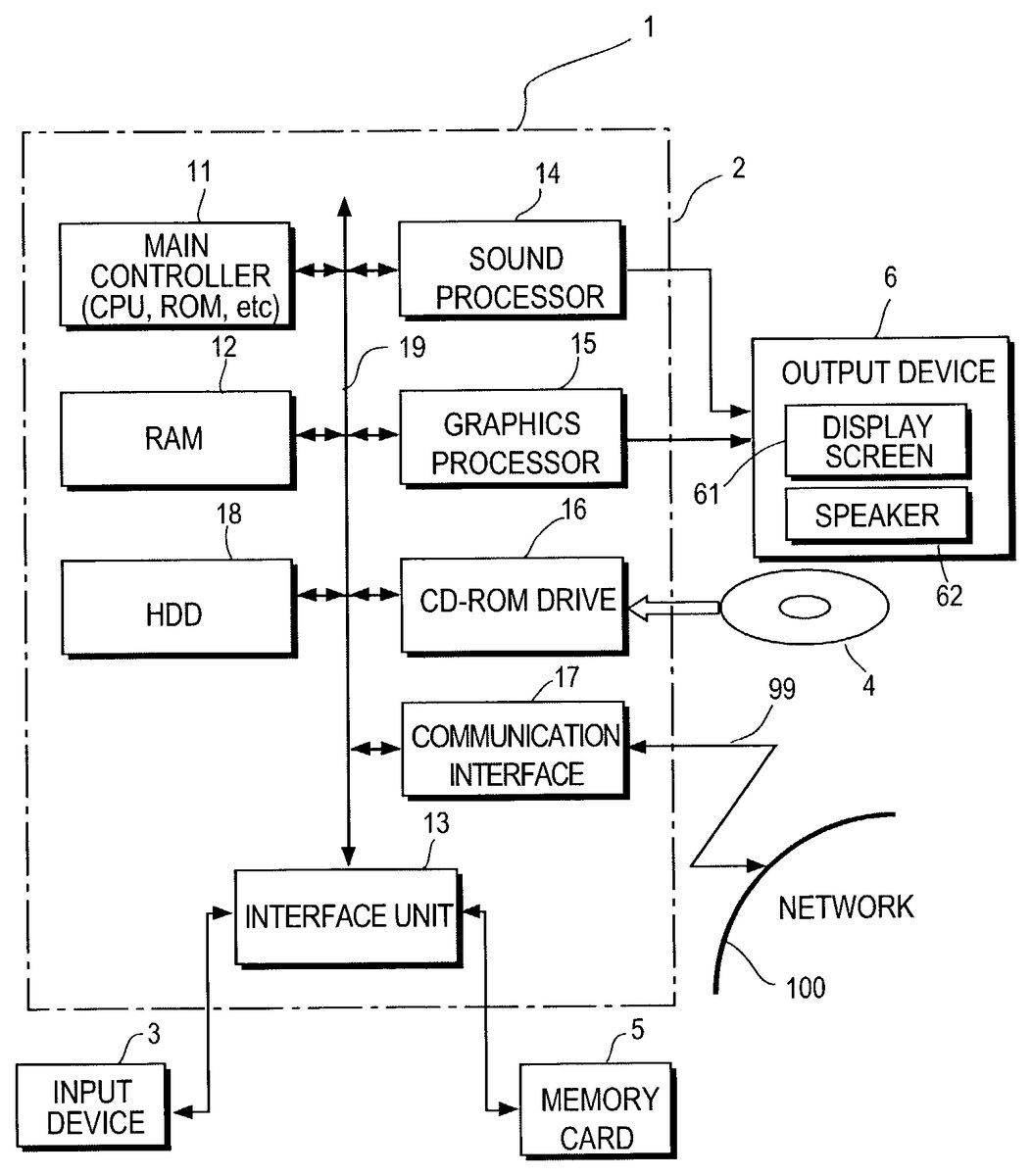
FIG. 1is a block diagram illustrating the overall configuration of a game system of an embodiment according to the present invention. Roughly divided, a game apparatus1includes a game apparatus main body2having main functions of the game apparatus1; and an input device3(such as a keypad and a controller) to be used for inputting operation commands to the game apparatus main body2.
In addition, it is possible to load a removable memory card5, which stores game data such as game progression data or game environment setting data, into the game apparatus main body2. Moreover, the game apparatus main body2is configured to allow execution of a game via a connection to an output device6(including, for example, a monitor display and a speaker) that performs screen image display and audio output corresponding to the game contents based on a screen image signal and sound signal from the game apparatus main body2.
In addition, a compact disc read only memory (CD-ROM)4that stores programs for implementing the game-related processing (described later), image data, and sound data, loads into the game apparatus main body2. Moreover, the game apparatus main body2may be connected to a network100via an embedded communication interface17.
The game apparatus main body2includes: a main controller11including a central processing unit (CPU) and a read only memory (ROM); a random access memory (RAM)12; an interface unit13; a sound processor14; a graphics processor15; a CD-ROM drive16that loads the removable CD-ROM4to access its contents; a communication interface17that performs data communication with other game machines via a communication medium (network)100; a hard disk drive (HDD)18; and a bus19that interconnects the above components.
The main controller11, which includes an oscillator and a timer/counter (neither shown in the figure), generates a clock signal based on a timing signal output from the oscillator in fixed intervals, and performs timekeeping by counting this clock signal using the timer/counter.
The RAM12is a main memory unit that the CPU in the main controller11uses for executing programs. The RAM12stores the programs to be executed by the CPU and the data required for execution thereof. The RAM12is also used as a work area during CPU program execution.
The interface unit13is configured so that the input device3and the memory card5are connected in a manner allowing them to be easily detached. This interface unit13controls data transfer between each unit (mainly the main controller11) connected to the bus19and the input device3or the memory card5.
The sound processor14performs processing for reproducing sound data such as background music (BGM) and sound effects in the game. This sound processor14generates a sound signal based on data stored in the RAM12and supplies the signal to the output device6in accordance with instructions from the main controller11.
The graphics processor15, which includes a frame buffer (not shown in the figure), renders images upon the frame buffer in accordance with instructions from the main controller11. The graphics processor15also generates a video signal by adding the predetermined synchronous signal to the image data drawn on the frame buffer, and supplies the signal to the output device6.
The CD-ROM drive16is a read device that reads data stored on the CD-ROM4, which is an exemplary recording medium. The game apparatus1performs game-related control, to be described later, by controlling the game apparatus main body2in accordance with a game program recorded on the CD-ROM4.
The communication interface17administers communication control during various types of data exchange and linked games with other communications devices connected to a network100, such as with servers, or with other game apparatuses via a server.
For instance, the communication interface17controls transfer of information (programs and data) between the game apparatus main body2and a communication network100. Game programs and data downloaded from the communication network100via the communication interface17and communication lines99may be stored on the HDD18.
The HDD18is an auxiliary memory unit that is used by the CPU in the main controller11for executing programs. Various data and programs including information downloaded via the communication interface17and data read out from the CD-ROM4may be stored on the HDD18.
As described above, programs for implementing the game-related processing and for performing communication, image data, and sound data are stored in the CD-ROM4. The game program includes a program that causes a game execution method according to an exemplary embodiment to be executed in the game apparatus1. The CD-ROM drive16reads the necessary game programs and game data from the game software stored on the CD-ROM4. The main controller11operates in accordance with the read-in program.
The game software read in from the CD-ROM drive16or transmitted from the communication network100may be pre-installed in the HDD18. In addition, a sound signal is generated based on data stored in RAM12and the signal is supplied to the output device6in accordance with instructions from the main controller11.
The input device3includes a controller that is operated by a player to input various game-related commands to the game apparatus main body2. The input device3transmits the instruction signals corresponding to the player's operations to the game apparatus main body2via the interface unit13.
In an exemplary embodiment, a command to proceed with the game is input by the controller. An example where input is performed with a controller being used as the input device3is described below.FIG. 2AandFIG. 2Bare examples of a configuration of a controller used as the input device3of an exemplary embodiment; whereinFIG. 2Aillustrates a planar view andFIG. 2Billustrates a back view.
InFIG. 2AandFIG. 2B, the controller30is provided with a cross-shape key31for inputting movement information and the like, and operation keys (such as ◯ button32, Δ button33, □ button34, × button35, start button36, and select button42) for inputting various instructions to the game apparatus main body2.
In addition, the controller30is provided with joysticks37for inputting movement information. As shown inFIG. 2B, operation keys (keys such as an R1button38, R2button39, L1button40, and L2button41) are provided on the back of the controller30.
All operation keys other than the start button36and select button42have a pressure-sensitive configuration. In addition, the controller30has a vibration function. In other words, the controller30, which has an embedded motor not shown in the figure, is capable of making the entire controller30vibrate through activation of the motor upon reception of a predetermined control signal from the game apparatus main body2. This allows vibrations to be conveyed to a player holding the controller30.
The game apparatus main body2may also adjust the intensity of the vibration, for example providing three levels of vibration intensities: “strong”, “medium”, and “weak”. The vibrations of controller30are intermittent, and it is possible to set vibrations having any of the intensities to occur randomly.
The memory card5, which is configured with flash memory, is an auxiliary memory unit controlled by the game apparatus main body2to store game data. Write-in of data to the memory card5and read-in of data from the memory card5are controlled by the main controller11via the interface unit13.
Based on an image signal and sound signal from the game apparatus main body2, the output device6displays a game image and outputs sound. In an exemplary embodiment, a speaker-embedded monitor device, for example a television (TV) set, is provided as the output device6. This monitor device includes a display screen61for displaying images, and a speaker62for outputting sound.
In addition, the output device6displays an image on the display screen61in response to a video signal from the graphics processor15, and outputs sound from the speaker62in response to a sound signal from the sound processor14. Accordingly, the output device6functions as both a display device and a sound output device.
The main controller11controls operation of the game apparatus main body2based on fundamental software stored in ROM and game software that is read out from the CD-ROM4via the CD-ROM drive16and stored in RAM12.
For instance, the main controller11reads out graphics data from the CD-ROM4, transfers the data to the graphics processor15, and sends an image generation instruction to the graphics processor15. In response to this instruction, the graphics processor15generates a video signal utilizing the graphics data. This video signal is transmitted to the output device6. This causes an image to be displayed upon the display screen of the output device6.
With the game apparatus including the above-mentioned configuration according to an exemplary embodiment, a network game is configured to allow communication with other game apparatuses via the network100and multiple players can participate in a single game via the network100. In this case, not only can the game program be read out from the CD-ROM4, but also the configuration allows the game program to be downloaded from other communication machines (server apparatus) connected to the network.
In the following, the configuration of the network game system in the case where a network game utilizing the above-mentioned functions is executed is described.FIG. 3illustrates a schematic configuration of the network game system that provides network-ready game services according to an exemplary embodiment.
With the network game system of an exemplary embodiment, game apparatuses1a,1b,1c,and1dhaving the configuration shown inFIG. 1are connected to a network system through a communication medium. For example, the game apparatuses1a,1b,1c,and1dare connected to a server group102through the network100, such as the Internet. It should be noted that the number of connected game apparatuses is not limited to that of the example shown inFIG. 3. There is no limitation to the number of connected apparatuses, and naturally a game can be executed by connecting two or any greater, arbitrary number of game machines according to the game contents.
The server group102is, for example, configured with an authentication server group111that performs account management for user authentication; a content server group112that provides an interface between the game apparatus1and other server groups and also provides content viewing services, such as for sound and video; a message server group113that provides an environment for chatting and messaging; a mail server group114that provides electronic mail service; a profile server group115that manages user profiles; and a game server group116that provides a game environment.
These server groups111through116are interconnected via a LAN117. The configuration of the server groups is not limited to the above-mentioned example, but may include other configurations including a configuration having one unit used to configure everything, or a configuration with the parts broken down into smaller, separate components.
The game server group116includes a lobby server that executes a game according to an exemplary embodiment. When the game apparatus1is connected to a lobby server, a screen that represents a virtual “lobby” is displayed on the display device6. On this lobby screen, a player's own character and the characters of other players connected to the lobby server are displayed. The players are able to chat, which makes it possible to interact with other players and find a partner to play a game with.
A schematic configuration of an individual server shown inFIG. 3is now described.FIG. 4is a block diagram illustrating a schematic configuration of the server shown inFIG. 3.
Each server includes a main controller401including a CPU; a read only memory (ROM)402that stores an operating program and various parameters of the main controller401; a random access memory (RAM)403; a large-capacity hard disk drive (HDD)404that files and stores various data; and a CD-ROM drive405that loads a removable CD-ROM410and accesses its contents.
It should be noted that this removable recording medium is not limited to the CD-ROM410, but a DVD-ROM or a semiconductor memory unit may also be used. Alternatively, multiple types of these media drives may be provided.
In addition, each server includes a communication interface406that performs game data communication with the game machine via the communication medium (network)100; and a LAN interface407that administers the interface with the LAN117to facilitate information exchanges with other servers.
Next, game programs and data to be stored on the CD-ROM4of the game apparatus main body2are described.FIG. 5is a diagram for describing the memory contents and memory regions of the CD-ROM4.
As shown inFIG. 5, the CD-ROM4is configured with a program memory region4athat stores a game program to be executed with the main controller11; a related data memory region4bthat stores data needed for proceeding with various games; an image data memory region4cthat stores modeling data of a three-dimensional model and two-dimensional image data used as background; a sound data memory region4dthat stores sound data, such as sound effects; and an icon data memory region4ethat stores game-specific icon information, such as characters appearing in the game.
It should be noted that in an exemplary embodiment, data needed for game continuation at a certain stage is loaded into RAM12from data stored in each storage region on the CD-ROM4, and the game continues based on the data loaded into RAM12.
If subsequent data becomes needed for game continuation, the required data is loaded into RAM12from data stored in each storage region on the CD-ROM4at that time.
With the above description, a case where a game apparatus independently performs a game in accordance with a game program stored on the CD-ROM4is described as an example, however, in the case of executing a network game, game progress control is performed based on control by the lobby server for executing a game in the game server group116of the server group102. In other words, in accordance with the progress control by the above-mentioned lobby server, either the necessary data is loaded, or data needed for game progression stored in each storage region on the CD-ROM4is partially loaded into RAM12, and the game then proceeds based on the data loaded into RAM12.
Next, programs and data to be stored in RAM12are described.FIG. 6is a diagram illustrating the memory configuration of RAM12according to an exemplary embodiment.
As shown inFIG. 6, RAM12includes a program storage region12a that stores programs to be executed by the main controller11; a related data storage region12bthat stores data needed for executing each processing; an image data storage region12cthat stores image data relating to modeling data of a three-dimensional model and two-dimensional image data used as background; and a sound data storage region12dthat stores sound data such as sound effects.
In an exemplary embodiment, in the case of playing a game with only the game apparatus1, the game data read out from the memory card5upon starting the game is read in to the related data storage region12b,and the game is resumed in accordance with the read-in game data, except for the case where the game is executed from the beginning.
In the case of performing a network game, game data supplied from the lobby server upon starting the game is stored in the related data storage region12b,and the game is resumed in accordance with the stored game data, except for the case where the game is executed from the beginning.
In the role-playing game of an exemplary embodiment, classifications for the characteristics of the operated character are provided, and desired characteristics from the characteristic classifications may be assigned to the character.
At least one job is assigned as a characteristic classification of the operated character. The prepared jobs may include, for example: a “Warrior” who is an expert with weapons; a “Monk” who is good at fighting and is a seeker of truth; a “White Magician” who is good at white magic (healing magic) and defensive magic, and has a strong self-sacrificing spirit; a “Black Magician” who is good at black magic (offensive magic), and has knowledge but is egocentric; a “Red Magician” who is a jack of all trades and master of none; a “Thief” who has good sense of direction and is good at stealing personal belongings; a “Knight” who is good at defense; a “Dark Knight” who is good at absorbing the enemy's power and offense; a “Beast Tamer” who is good at handling animals and displays strength in field action; a “Bard” who knows how to make good use of life and is good at minstrelsy; a “Ranger” who is good at remote attacks and archery; a “Samurai” who cuts a person with a single stroke of the sword; a “Ninja” who is good at covert action and the art of making himself invisible; a “Dragon Knight” who is good at wielding a spear and jumping; and a “Summoner” who is good at recalling magic.
As described later in detail, it should be noted that in an exemplary embodiment not all jobs are selectable from the beginning, that is, jobs from the “Warrior” to the “Thief” are jobs that can be engaged in from the initial stage of the game, and jobs from the “Knight” to the “Ranger” are jobs that can be taken on, after gaining experience in predetermined jobs. In addition, jobs from the “Samurai” to the “Summoner”, for example, are hidden jobs, so these jobs can be taken on when predetermined events are cleared or when predetermined conditions are satisfied, that is, only a specifically selected character can engage in these jobs.
In an exemplary embodiment, variation is given on the growth pattern of the character according to the characteristics of the operated character. That is, personal ability is improved in accordance with an acquired value, such as an experience value, which is given in the case of winning a battle against a monster during game play, so that this improving ability value varies depending on the job in which the character is engaged.
In such a case, information for determining all of the growth statuses for each job may be thought of as being retained, for example, as an individual table. However, as apparent from the description above, it is necessary to reduce the memory storage capacity needed for storing the tables because specialized techniques often overlap among jobs.
Therefore, an exemplary embodiment does not provide individual table information for each job, but rather, provides fixed-pattern table configuration data (characteristic value information group) as characteristic value information corresponding to the job, extracts the table configuration data (characteristic value information group) corresponding to the classification of the job (assigned characteristic), and performs the process of applying the data to the growth table for each job.
An example of a growth table configuration for each job, which is formed after the above-mentioned processing is performed, is now described.FIG. 7illustrates an example of a growth table configuration for each job according to an exemplary embodiment.FIG. 8is a diagram illustrating a specific configuration example of the table configuration data (characteristic value information group) of an exemplary embodiment.
As shown inFIG. 7, the most appropriate growth pattern according to the characteristics of a job has been assigned for each item HP, MP, etc. by figures ranging from 0 to 5, and each of the figures indicates a growth pattern chosen from among six growth patterns. The patterns ofFIG. 7also correspond to the table configuration data (characteristic value information group) HP0, HP1, etc. as shown inFIG. 8. It should be noted that the server side stores this growth table for each job.
In an exemplary embodiment, on the server or game machine side, jobs are specified using a number (job number) added to each job as shown inFIG. 7. For instance, job number1is assigned to the “Warrior”;2to the “Monk”;3to the “White Magician”;4to the “Black Magician”;5to the “Red Magician”; and6to the “Thief”.
Similarly, job numbers can be assigned as desired; for example, job number7can be assigned to the “Knight”;8to the “Dark Knight”;9to the “Beast Tamer”;10to the “Bard”;11to the “Ranger”;12to the “Samurai”;13to the “Ninja”;14to the “Dragon Knight”; and15to the “Summoner”.
As shown inFIG. 7, to facilitate growth factors for each job, such as “Hit Points (HP)”, “Magic Points (MP)”, “Strength (Str)”, “Dexterity (Dex)”, “Agility (Agi)”, and the like, the table is configured not by applying the individual specific data but by applying the table configuration data (characteristic information groups)0through5corresponding to the growth patterns of the characters that engage in a job.
For instance, for the job “Warrior”, information group (4) is assigned as “HP”, information group (0) as “MP”, information group (5) as “Str”, information group (3) as “Dex”, information group (3) as “Agi”, and so forth.
Even there are 15 jobs as described above, each parameter classification (characteristic value information group) includes six types for each classification, it is therefore possible to find a growth pattern for each job by combining each parameter depending on the job.
However, the exemplary embodiment is not limited to the above-mentioned examples, but the parameter classification (characteristic value information group) may have more than six types, or less than six, or the number of types may be different for each item.
Detailed examples of each information group are described with reference to a table ofFIG. 8, which is illustrating a specific configuration example of the table configuration data (characteristic value information group) of an exemplary embodiment. The server side also has this table configuration data, and as described later, the server side calculates the characteristic value of the job to be engaged in while referencing this data and transmits it to the game machine side.
As shown inFIG. 8, in the case where the growth level raises sequentially from (0), six types of table configuration data (characteristic value information groups), that is, “HP0” through “HP5” are provided for “HP”, which represents the physical strength of the character.
In the specific example shown inFIG. 8, HP is (1) in all of levels0through6for “HP0”; and for “HP1”, HP is (10) in level0, (11) in level1, (12) in level2, (13) in level3, (14) in level4, (15) in level5, (16) in level6, and so forth. Similarly, for “HP2”, HP is (10) in level0, (12) in level1, (14) in level2, (16) in level3, (18) in level4, (20) in level5, (22) in level6, and so forth.
As with the above, the HP maximum values corresponding to the character levels are also provided for “HP3”, “HP4”, and “HP5”.
As with the above, the acquired point values corresponding to the character levels are different for other parameters, such as MP representing magic power, and Str representing endurance of damage done, for example, by blows in the battle. Therefore, job selection may greatly influence game progression.
“Str (strength)”, “Dex (dexterity)”, “Agi (agility)”, and the like shown inFIG. 7are parameters representing the defensive strength and offensive strength in the battle and each value corresponding to the respective level falls within a predetermined range. Accordingly, with an exemplary embodiment, such parameters are regarded as battle skills (BS). The six types of BS: “BS1”, “BS2”, “BS3”, and the like, are regarded as growth patterns.
Values in the “NEXT” column ofFIG. 8represent the experience values to be acquired by the character, by the time he reaches the next level; wherein the necessary experience value differs depending on the number of monsters that the character defeats in battle and on its strength. Generally, the strength of the monster is controlled so as to increase and accordingly the experience value to be acquired during battle progression increases as the level of the character rises.
In addition, in an exemplary embodiment, the operations (commands) available for the character in battle are determined according to the character's level, and techniques that can be used by specifying the commands and types of magic that can be invoked increase as the character's level rises.
For instance, the levels required for executing each command have been determined for each job (job number) as shown inFIG. 9.FIG. 9illustrates an example of techniques available for each job of an exemplary embodiment. This information is needed for character operation, therefore not only does the server side stores this information, but the game apparatus side also retains this information by downloading it from the server side.
As shown inFIG. 9, the level required to use the “Fight” command is, for example, level0for the Warrior (job number1) and Monk (job number2), that is, they can use the command from the beginning of the game. Meanwhile, the level required to use the “Magic” command is, for example, level0for the White Magician (job number3), that is, he can use the command from the beginning of the game.
However, the Warrior (job number1) cannot execute the “Blow” command until reaching level5. Thus, a certain level must be reached to execute the high-level commands.
Taking “Magic” as an example, various types are provided, that is, there are multiple types: from magic that has small effects to magic that has large effects. With this same kind of magic, magic that has large effects can be executed when the character level rises.
FIG. 10is a diagram for describing an example of controlling the command executable levels of an exemplary embodiment. As shown inFIG. 10, in the case of recovery magic, which is healing magic, for example, the character with job number3(White Magician) is controlled to use the command (magic word) of “Kearu”, so that the lowest amount of recovery is invoked as magic in required level3; when using the command of “Kearu Ra”, a medium amount of recovery is invoked in required level15; and with using the command of “Kearu Ga”, a large amount of recovery is invoked after reaching level30. This information, which is needed for character operation, is stored not only on the server side, but the game apparatus side also downloads this information from the server side and stores it.
In an exemplary embodiment, the operator can select a job for a character to be operated and can utilize the growth pattern in accordance with the selected job. In this case, since common growth parameters can be unified, even if there are a large number of selectable jobs, it is possible to reduce the memory capacity needed for controlling the selected jobs.
In addition, in an exemplary embodiment, in order to diversify the game, it is possible to assign one job to one character. In addition, it is also possible to assign one additional job to the character.
In other words, an exemplary embodiment uses a configuration including a function to assign a main job (main characteristic) to a character as well as a function to assign a secondary or support job (support characteristic) to the same character. It should be noted that an example of assigning two jobs is described below, however, the present invention is not limited to this example, and naturally three or more jobs may be assigned to one character.
Here, the main job and secondary job are determined, and reflection of the characteristic value (seeFIG. 8) of the second or lower job on the character is suppressed to be lower than that of the main job. In other words, with respect to reflection effects of characteristic values, the support job characteristic value is weighted to 50% of the main job characteristic value, or lower than 50%, and the character characteristic values are calculated on the basis of the characteristic values that are found by adding each job's weighted characteristic value together. Through such control, it is possible to give further variations to the growth pattern of an operated character and to present the user with a challenge.
Next, a game progression control allowing a character to engage in multiple jobs at the same time is described.
It should be noted that in the following description, the case of executing a network game using the server group102is described as an example. Therefore, the game apparatus executes the game according to the game control by the server group102, and the server group102retains each table shown inFIG. 7throughFIG. 10, calculates the ability values of the characters operated by the game apparatus side, and transmits the values to the game apparatus.
FIG. 11is a flowchart for describing game execution control of the game apparatus according to an exemplary embodiment;FIG. 12is a diagram for describing command processing of an exemplary embodiment;FIG. 13is a diagram for describing determination control of character characteristic information values by the server group102accompanying job changes, according to an exemplary embodiment; andFIG. 14is a diagram for describing the job change check control of an exemplary embodiment.
To begin with, overall game control is described while referencingFIG. 11. This processing is started when the game apparatus main body2executes the game program stored on the CD-ROM4of the game apparatus.
In step S1ofFIG. 11, the initial processing is executed, that is, the necessary programs are read out from the CD-ROM4to the game apparatus main body2and stored in RAM12. Then display of an initial screen (such as a manufacturer's logo), check of the memory card5and display of a title screen are performed, and basic processing including loading of necessary data is performed.
In the subsequent step S2, it is determined whether there is a command to access the server through the network in order to execute the network game at the point in time where initial processing ends. If there is no server access command, processing proceeds to step S3, and it is determined whether the off-line game, instead of the network game, is to be executed using solely the game data stored in the loaded CD-ROM4. In the case of executing the off-line game, processing proceeds to step S4, and the game apparatus executes the game independently. In the case where there is no command to execute the off-line game in step S3, processing returns to step S2.
Meanwhile, in step S2, in the case where execution of the network game is designated and an access request is sent to the server, processing proceeds to step S10, where the server group is accessed to receive authentication, and connection status with, for example, the game server group116is made. In the subsequent step S11, game data relating to the game executed by the player, such as job-specific character value information retained on the server side is received from the server side.
Next, in step S12, whether to execute a new game or continue a game previously executed but not completed is selected. In the case where a new game is not executed, processing proceeds to step S15, and the network game is executed from the point of suspension in accordance with the game data received from the server side. Meanwhile, in step S12, in the case where execution of a new game is decided, processing proceeds to step S13, and a job is selected from the jobs allowing selection at the beginning of a new game. The main jobs can be selected at first, however, the support jobs cannot be selected at the initial time. More specifically, the main job selection command is prompted by receiving the main job selection screen as shown inFIG. 15from the server102, or by displaying the selection screen in accordance with the program read out in the initial processing.
FIG. 15is a diagram illustrating an example of the main job selection screen according to an exemplary embodiment. In an exemplary embodiment, not only on the main job selection screen, but also on other screens, only the objects (such as commands and items) capable of being input are displayed and the objects that cannot be input are not displayed. Accordingly, accidental invalid input may be prevented.
The jobs to be displayed on the selection window shown inFIG. 15are the above-mentioned jobs that are capable of being engaged in from the beginning. That is, six jobs, such as “Warrior” with job number1, “Monk” wih2, “White Magician” with3, “Black Magician” with4, “Red Magician” with5, and “Thief” with6, are displayed for selection on the selection window. InFIG. 15, since the job represented with a “▾” mark is a job being designated, the job with the “▾” mark is selected as the main job when the “Decide” button displayed beneath the window is selected.
Next, in step14ofFIG. 11, the game apparatus transmits job selection results to the server side. It should be noted that confirmation of the main job selection results may be requested prior to transmission or as confirmation operation for the transmission results. Performing this confirmation makes it less likely that an undesired job will be undertaken.
It should be noted that in an exemplary embodiment, only the main jobs are selectable in the initial status, however, it is naturally possible to engage secondary jobs, to be described later, from the initial status. With the game apparatus, the status of the operated character is determined from the characteristic value information received in step S11.
Next, in step S15, the game operation of the character is begun in accordance with the job determined in step S13, and the actual game is executed. In the case of a network game, a player can play a game with players operating other game apparatuses via the network100.
Processing proceeds to step S16in the case where, for example, the game screen changes in conformity with game progression, the controller30is operated, or a scene changes. In step16, it is determined whether a command is input. If a command is input, processing proceeds to step S17, and command input processing, to be described later, is executed. Then, in step S18, command execution processing is performed, and processing returns to step S15.
Meanwhile, in the case where it is determined that a command is not input in step S16, processing proceeds to step S29, and it is determined whether a job change is requested. If a job change has not been requested, processing proceeds to step S34, and character movement control is performed if a character movement is indicated. If the indication is other than the above, predetermined corresponding processing is executed, for example, an operation in response to the indication is performed.
Meanwhile, if a job change is requested in step S29, processing proceeds to job change processing beginning with step S30, and a part of or all jobs that have been selected are changed to other changeable jobs. This is described in more detail in the following.
To begin with, in step S30, main job selection processing is executed. The processing in step S30is basically similar to the processing in step S13. That is, the main job selection command is prompted by receiving the main job selection screen shown inFIG. 15from the server102, or by displaying the selection screen in accordance with the program read out in the initial processing. In this case, the job represented with a “▾” mark is selected as the main job by moving the “▾” mark up and down to the position of the job to be selected using the cross-shape keys and by pressing the “Decide” button displayed beneath the window.
Next, in step S31, support job selection processing is performed. A support job selection screen is displayed in step S31.FIG. 16illustrates an example of a support job selection screen display according to an exemplary embodiment. In the exemplary embodiment, since a main job has already been selected, the display of the main job is removed from the selectable jobs display (shown inFIG. 15) in the display screen example ofFIG. 16. In other words, since “Warrior” was selected as the main job,FIG. 16represents a display example where “Warrior” has been removed from the job selection list.
It should be noted that in an exemplary embodiment, the job change is enabled after a certain degree of experience is gained, so a job change cannot be requested before that experience is gained.
When the main job and support job are selected in steps S30and S31, respectively, the game apparatus transmits the selection results to the server side in the subsequent step S32.
It should be noted that confirmation of the selection results of the main job and support job may be requested prior to transmission or as a confirmation operation for transmission results. By performing this confirmation, it is possible to prevent engaging in an undesired job.
FIG. 17illustrates an example of the job selection result confirmation screen display according to an exemplary embodiment. Here, it is possible to “Redo” the selection as shown inFIG. 17, and processing returns to step S30again when the “Redo” command is selected. Accordingly, it is possible to positively confirm the selection results.
When job selection is complete, in step S32, the job selection results are transmitted. The server side, which receives the job selection results, extracts the characteristic values corresponding to the selected jobs while referencing the tables shown inFIG. 7andFIG. 8. For the support jobs, ability values to be assigned to the characters according to the predetermined weight are calculated, these ability values are added to those of the respective main jobs to determine ability values for characters with a selected job, and the characteristic value information is generated and sent back to the game apparatus. The game apparatus then determines the status of the operated characters from the characteristic value information received in step S33.
Next, processing proceeds to step S15, where game operation of the characters is started in the status that has been determined and the game is executed.
The above-mentioned command processing in step S17and step S18is described below while referencingFIG. 12.
When display of the command input screen is requested from the game apparatus, processing shifts to the processing inFIG. 12, and to begin with, a list of commands that can be executed with the main job is acquired from the server side in step S41. Subsequently, in step S42, it is determined whether a support job is selected. In the case where a support job is not selected, processing proceeds to step S44.
Meanwhile, in the case where a support job is selected in step S42, processing proceeds to step S43, and a list of commands that can be executed with the support job is acquired. Processing then proceeds to step S44.
In step S44, the command lists acquired in steps S41and/or S43are synthesized and displayed as selectable commands. Then, in step S45, it is monitored for the selection of one of the displayed commands.
When one of the commands is selected, processing proceeds to step S46, and it is determined whether a lower selection command group which uses the selected command as a keyword, exists. In the case where a lower command group exists, processing returns to step S41, and the lower command is acquired. For instance, corresponding cases may include the “Magic” command being selected and then selecting the specific magic; or the “Item” command being selected and then selecting the specific item.
In the case where no lower command exists in step S46, the selection command is transmitted to the server side. The server side that receives this command, performs a command check in step S48, and executes the command processing in step S49(corresponding to step S18) for performing attack processing, magic processing, recovery processing, and the like if the checked command is an executable command or a valid command selection instruction.
The server side then transmits the processing results to the game apparatus side. The game apparatus that receives these processing results, reflects the received processing results in step S47.
The details of the server side control of the above-mentioned job change process are described while referencingFIG. 13.
When the selection results of the newly selected job are transmitted from the game apparatus side to the server side in accordance with the job change processing on the game apparatus side shown in step S30through step S32inFIG. 11, processing on the server side shifts to the processing shown inFIG. 13.
To begin with, in step S51ofFIG. 13, the main job and support job are received from the game apparatus, which is the client side from the perspective of the server side. It should be noted that a support job is not transmitted in the case where only a main job is selected.
Next, in the subsequent step S52, in the case where special conditions are required for engaging in a job, such as7: Knight,8: Dark Knight,9: Beast Tamer,10: Bard,11: Ranger,12: Samurai,13: Ninja,14: Dragon Knight, or15: Summoner, job change check processing is performed to examine whether those conditions are satisfied. If the job can be engaged in from the initial status, such conditions are considered satisfied.
Next, in step S53, it is examined whether the job change conditions are satisfied, based on the results of the check performed in step S52. If the newly selected job cannot be engaged in, processing proceeds to step S54, where job change disable processing is performed and “job change not permitted” is returned with the reason why the job cannot be changed.
Generally, since only selectable jobs are displayed on the selection screen, a job that cannot be engaged in is not displayed. However, for job changes, if the user fraudulently changes data stored in a memory in association with game progress, “job change not permitted” is returned to the user.
Meanwhile, if job change conditions are determined to be satisfied in the job change check in step S53, processing proceeds to step S55, where main job level is acquired. More specifically, if the character, after a job change is made, has experienced the main job in the past and has the job level achieved at that time, the achieved level is retrieved. In the case where this is the first job change, the first level is obtained.
Next, in step S56, the main job growth pattern corresponding to the acquired level, after the job change; the experience value obtained by the operated character up to this point; and the operated character's new ability value corresponding to the attained level specific to the main job, are acquired.
Next, in step S57, if the support job, after the job change, has been experienced in the past, and if the character had the job level achieved prior to the change, the job level is retrieved. In the case of an initial job, the first level is acquired.
In the subsequent step S58, it is checked whether ½ of the main job level acquired in step S55is lower than the support job level acquired in step S57. In the case where ½ of the main job level is not lower than the support job level, processing proceeds to step S59. In step S59, the growth pattern of the support job is acquired, and the ability value of the support job according to the table inFIG. 8corresponding to the pattern acquired in step S57and the growth pattern of the support job is calculated and acquired. Processing then proceeds to step S61.
Meanwhile, in the case where it is determined that ½ of the level of the main job is lower than the support job level in step S58, processing proceeds to step S60. In step S60, the growth pattern of the support job is acquired and the ability value of the support job according to the table inFIG. 8corresponding to ½ of the main job level and the growth pattern of the support job is calculated and acquired. Processing then proceeds to step S61.
In step S61, the ability value, which is half (½) of the newly acquired ability value of the operated character specific to the support job found in step S59or step S60is added to the newly acquired ability value of the operated character specific to the main job found in step S56.
Then, in the subsequent step S62, the character ability value found in step S61is set as the new ability value of the operated character after the job change. Next, in step S63, the new ability value acquired in step S62is transmitted to the game apparatus side and processing returns.
It should be noted that if the support job is not selected, the ability value found in step S56is regarded as the ability value of the operated character.
An example of the ability value result of an operated character according to an exemplary embodiment is shown.FIG. 18is a diagram illustrating an example of the ability value of an operated character according to the exemplary embodiment. In the exemplary embodiment, it is possible for the same user to acquire multiple ID numbers and operate the different characters for each ID number to execute the network game. In the example inFIG. 18, the jobs and ability values of the operated characters are illustrated in the case where the user executes a game by logging into the server with the ID “HA000001”.
The example inFIG. 18shows that the “Warrior” with job number1is selected as the main job and the “White Magician” with job number3is selected as the support job. In addition, the current ability value examples of engaging in these two jobs are represented. This information on the operated characters is the information retained in the game apparatus and on the server side.
Thus, it is possible to obtain characters having different characteristics depending on which job is selected as the main job while selecting multiple jobs by adopting ability values having different weights for the main job ability value and support job ability value. As a result, it is possible to achieve various characteristics of the operated characters rather than the number of jobs to increase variety in the game and make it more interesting.
Even in such a case, it is possible to unify the data table that is used as a reference for acquiring the ability values for the main job and support job. In addition to common usage by job, this unification achieves a diverse game requiring a smaller memory capacity.
Moreover, it is possible to ignite a spirit of adventure as the game progresses by adding an ability value corresponding to the lower level of either the main job or support job when adding the ability value of the support job, while regarding the main job level as a reference for calculating the ability value. It is therefore possible to easily realize the degree of growth when a new job is selected.
The details of the above-mentioned job change check processing in step S52is described while referencingFIG. 14.
To begin with, in step S71of the job change check process, it is determined if the operated character that desires a job change exists at the location where the job change operation is allowed. For instance, should a job change be allowed at the save point, it is determined whether the character exists at the save point. Then if a specific store or room where a job change is allowed is specified as the location of the job change, it is determined whether the character is in the store or room. If the character is not at the location where a job change is allowed, processing proceeds to step S80.
In step S80, it is determined that a job change is not allowed as a result of the job change check, and after a job change has been disallowed, the processing returns.
Meanwhile, if it is determined in step S71that the operated character is at the location where a job change is allowed, processing proceeds to step S72, and it is determined whether the desired job change is appropriate. For instance, the job types that can be engaged in have been limited in an exemplary embodiment, and if a job other than the above-mentioned jobs numbered1through15is selected, it is determined as being inappropriate.
In an exemplary embodiment, since jobs are specified using the above-mentioned numbers1through15, if the sharing of information between the game apparatus side and server side is not normal due to unauthorized procedures being performed on the game apparatus side, it is assumed that an unauthorized job selection is made. Accordingly, it is determined that a job change is inappropriate in such a case. If the job change is inappropriate, processing proceeds to step S80.
Meanwhile, in step S72, if a job change is determined as being appropriate, the processing proceeds to step S73, and it is determined whether the character can engage in the selected main job, that is, it is determined whether the main job is available. As described above, some jobs require that the character achieve a certain level or higher, or clear predetermined events. If these conditions are not satisfied, a job change for the main job is determined as being inappropriate, and processing proceeds to step S80.
If engaging in the main job is determined as being appropriate in step S73, processing proceeds to step S74, and it is determined whether the support job can be added. In order to engage in the support job, the character is required to achieve a certain level. If the character has not achieved that level, engaging in the support job is determined to be inappropriate, and processing proceeds to step S80.
If it is determined that the support job can be added in step S74, processing proceeds to step S75, and it is determined whether the character can engage in the selected support job (whether the support job is available). As described above, some jobs require that the character achieve a certain level or higher, or clear predetermined events. Therefore, if these conditions are not satisfied, a job change to the support job is determined as being inappropriate, and processing proceeds to step S80.
Meanwhile, in the case where the job change to the support job is determined as being appropriate in step S75, processing proceeds to step S76, and it is determined whether the main job and support job are identical.
In an exemplary embodiment, the main job and support job must be different jobs. If the main job and support job are identical, the job change is determined as being inappropriate, and the processing proceeds to step S80.
However, if the main job and support job are not identical, the job change command is determined as being appropriate, and processing proceeds to step S77, whereby as a result of the job change check, it is determined that a job change is authorized. After the job change has been allowed, the processing returns.
It should be noted that the server side specifies the operated characters by using the ID numbers assigned to each user, and retains job histories that the characters have experienced as a batch table. A configuration example of the job history management table on the server side will be described.FIG. 19is a diagram illustrating a configuration example of a job history management table on the server side according to an exemplary embodiment.
The server side manages the job history levels in blocks that the operated characters engage or have engaged in for each user ID as shown inFIG. 19. In the example inFIG. 19, the character having user ID “HA00001” is a “Warrior” whose job number is1and level (LV) is10. The availability flag is indicated (flag is1) for that character, therefore it is possible for the character to engage in this job. The level of the “Monk” whose job number is2is7. It is possible to engage in this job since the availability flag is indicated. In addition, it is possible to add the support job since the currently acquired points of the character is 3500 and the sub job enabled flag is indicated.
Meanwhile, the character having user ID “HA000002” is a “Warrior” whose job number is1and level is3. It is possible for the character to engage in this job since the availability flag is indicated. The level of the “Monk” whose job number is2is0, and the availability flag is indicated. It is therefore possible for the character to engage in this job. However, it is impossible to add the support job since the currently acquired points of this character with ID “HA000002” is only 400 and the sub job enabled flag is not indicated (flag is0).
It should be noted that the availability flag and sub job enabled flag are set when predetermined conditions are satisfied during game play.
As described above, it is possible to provide a highly interesting game apparatus and a game control method capable of effectively increasing the job types to be assigned to the characters while keeping increases in necessary memory capacity in check.
In addition, it is possible to naturally diversify the character characteristics and to improve the interest level of the game since multiple jobs can correspond to one character and the character characteristic value is calculated based on the respective characteristic value of each job.
In this case, by strongly emphasizing the main job characteristics rather than the support job, character characteristics may vary greatly depending on which job is selected as the main job, and the diversity of the game further increases.
It is also possible to give variation according to the growth patterns of the operated characters and to present the user with a challenge by keeping character reflection for a support job lower than for a main job, for instance, by keeping weighting to reflection effects for the support job characteristic values to 50% of that for the main job characteristic values, or lower, and calculating the character characteristic value on the basis of the characteristic value found by adding the weighted characteristic values of each job together.
In addition, for instance, by keeping the support job characteristic value to 50% of the main job characteristic value through adoption of ability values having different weights for the main job ability value and the support job ability value, it is possible to make a character having different characteristics according to which job is selected as the main job while selecting multiple jobs, and thus achieve a greater variety of operated character characteristics than with just the number of jobs, increase the diversity of the game, and make a more interesting game.
In such a case as well, it is possible to unify the data table used as a reference for acquiring the ability value between the main job and support job, to further unify in addition to the common use for each job, and to achieve a diverse game with a small amount of memory.
Moreover, during calculation of the ability value, while regarding the main job level as the reference level, the ability value corresponding to the lower level of either the main job or support job may be added when adding the support job ability value. Accordingly, it is possible to ignite a spirit of adventure throughout the game. Since the degree of growth can be easily appreciated when a new job is selected, a sense of challenge may be presented to the user.
Furthermore, it is possible for the user to correctly and quickly grasp which command is executable since only the available commands are displayed on the selection window.
Other Embodiments
With the above description, an example using a CD-ROM drive16or server group102as a means for supplying the program to the game apparatus is described. However, the present invention is not limited to the above-mentioned example. For example, all programs may be stored on the HDD18, and the desired program to be executed may be selected from the stored program group and executed.
Alternatively, it is allowable to execute a game by loading the memory card5into the game apparatus, wherein the memory capacity of the memory card5is specified so as to contain a capacity capable of storing all game programs and game data; and all information required for executing the game is stored in the memory card5.
In addition, with the above-mentioned game system according to an exemplary embodiment, the case where a single game apparatus executes a single network game, or multiple game apparatuses execute a single network game together with other game apparatuses under the control of the server group102, is described as an example. Accordingly, the game proceeds by transmitting the information needed for the game to proceed between the server group102and the game apparatus.
However, the present invention is not limited to this example. For example, a game system may store all information needed for executing the game on a recording medium, such as the above-mentioned CD-ROM, memory card, HDD, DVD, or magneto optical disk, and perform each function needed for executing the game with the game apparatus independently. In this case, since the game apparatus stores all information in addition to the above-mentioned tables, the game apparatus may execute each game control such as the job change process independently.
In addition, a game system may be possible that receives all or a part of the information needed for the game from the server group102prior to game execution or at the necessary time during execution of the game. The information is received by connecting the game apparatus to the server group102via a communication medium, processing the information needed for executing the game that is received by the game apparatus independently, and executing the above-mentioned game without being controlled for game progression by the server group102. In this case, all of the information needed for the game being executed is retained in the game apparatus during game progression control, and the game is executed using the retained information.
In addition, with the above description, the case where the present invention is achieved by using a home game machine as a platform is described, however, the present invention may also be achieved using a general-purpose computer, such as a personal computer, or an arcade game machine as a platform.
The above-mentioned embodiment and modified example thereof store programs and data for achieving the present invention on a CD-ROM, and uses the CD-ROM as an information recording medium. However, the information recording medium is not limited to a CD-ROM. Other computer readable magnetic or optical recording media, such as a magnetic disk, or ROM card, or semiconductor memory may be used.
The program and data for achieving the present invention are not limited to the format provided by the medium, such as a CD-ROM that is freely removable from the game machine or computer. The format used may allow the saved data for achieving the present invention to be received from other apparatuses connected via communication lines, such as a server group, and to be recorded in the memory. Furthermore, the format may allow the above-mentioned programs and data to be recorded in memory on the other apparatus side that is connected via the communication lines, and used via the communication lines.
Accordingly, with the present invention, an interesting game apparatus and a game control method capable of effectively increasing the job types to be assigned to the characters may be provided while controlling the amount of memory which is needed.
While the invention has been described with reference to particular example embodiments, further modifications and improvements which will occur to those skilled in the art, may be made within the purview of the appended claims, without departing from the scope of the invention in its broader aspect.
Claims
- A game system, which, when executing a game by operating a character in accordance with a game program, provides a plurality of types of characteristics of the character and advances the game by assigning at least one type of characteristic to the character from among the plurality of types of characteristics, the game system comprising: a main characteristic assigning system that assigns one of the types of characteristics to the character, the assigned type of characteristic serving as a main type of characteristic of the character;a storage that stores a plurality of predetermined sequences of characteristic value information that determines characteristic values of the character for each character level, and also stores a plurality of growth pattern values of the assigned characteristic type, each of the plurality of growth pattern values corresponding to one of the predetermined sequences;an application system that extracts characteristic value information corresponding to a character level and the growth pattern values of the assigned type of characteristic from the stored characteristic value information, and applies the characteristic values of the character in accordance with the extracted characteristic value information;and a controller that controls the character according to the characteristic values applied by the application system, wherein the plurality of growth pattern values are combined based on the plurality of assigned characteristic types, wherein each of a plurality of growth patterns comprises a stored predetermined sequence of characteristic value information, each predetermined sequence representing a progression of the characteristic values corresponding to each of the assigned characteristic types, and wherein the growth pattern values are combined by weighting and adding the characteristic value information in the predetermined sequences, based on the assigned characteristic type corresponding to the characteristic value information.
- The game system according to claim 1 , wherein the application system weights characteristic value information of the main type of characteristic assigned by the main characteristic assigning system with a first factor to generate a first weighted value, weights characteristic value information of an assigned support type of characteristic with a second factor to generate a second weighted value, and sums the first and second weighted values.
- The game system according to claim 1 , wherein the storage stores combined information of the plurality of character growth pattern values for every characteristic of the character.
- The game system according to claim 1 , wherein the storage stores characteristic value information common to a plurality of different characters;and the application system applies the stored characteristic value information, the characteristic value information being assigned for each of the plurality of different characters.
- The game system according to claim 1 , further comprising: a game apparatus that includes the main characteristic assigning system, and the controller;and a server apparatus that connects to the game apparatus through a communication medium, and includes the storage and the application system;wherein the game apparatus assigning character characteristic using the main characteristic assigning system;and the server apparatus receiving characteristic assigning results from the game apparatus, finding and applying characteristic value information for the character, and providing the applied characteristic value information to the game apparatus;and wherein the game apparatus controls the character according to the provided characteristic value information.
- A game system, which, when executing a game by operating a character in accordance with a game program, provides a plurality of types of characteristics of the character and advances the game by assigning at least one type of characteristic to the character from among the plurality of types of characteristics, the game system comprising: a storage that stores a plurality of predetermined sequences of characteristic value information that determines characteristic values of the character for each character level, and also stores a plurality of growth pattern values of the assigned characteristic type, each of the plurality of growth pattern values corresponding to one of the predetermined sequences;and an application system that extracts characteristic value information corresponding to a character level and the growth pattern values of the assigned types of characteristics from the stored characteristic value information, and applies the extracted characteristic value information to the assigned types of characteristics, wherein the plurality of growth pattern values are combined based on the plurality of assigned characteristic types, wherein each of a plurality of growth patterns comprises a stored predetermined sequence of characteristic value information, each predetermined sequence representing a progression of the characteristic values corresponding to each of the assigned characteristic types, and wherein the growth pattern values are combined by weighting and adding the characteristic value information in the predetermined sequences, based on the assigned characteristic type corresponding to the characteristic value information.
- A game control method in a game apparatus, which, when executing a game by operating a character in accordance with a game program, provides a plurality of types of characteristics of the character and advances the game by assigning at least one type of characteristic to the character from among the plurality of types of characteristics, the game control method comprising: assigning one of the types of characteristic to the character, the assigned type of characteristic serving as a main type of characteristic of the character;storing, within a storage, a plurality of predetermined sequences of characteristic value information that determines characteristic values of the character for each character level, and a plurality of growth pattern values of the assigned characteristic type, each of the plurality of growth pattern values corresponding to one of the predetermined sequences;extracting characteristic value information corresponding to a character level and the growth pattern values of the main type of characteristic from stored characteristic value information;applying characteristic values of the character in accordance with the extracted characteristic value information;controlling the character according to the applied characteristic values, and outputting an image of the controlled character to a display, wherein the plurality of growth pattern values are combined based on the plurality of assigned characteristic types, wherein each of a plurality of growth patterns comprises a stored predetermined sequence of characteristic value information, each predetermined sequence representing a progression of the characteristic values corresponding to each of the assigned characteristic types, and wherein the growth pattern values are combined by weighting and adding the characteristic value information in the predetermined sequences, based on the assigned characteristic type corresponding to the characteristic value information.
- The game control method according to claim 7 , wherein the characteristic value information of the main type of characteristic is weighted with a first factor to generate a first weighted value, characteristic value information of a support type of characteristic is weighted with a second factor to generate a second weighted value, and the first and second weighted values are summed.
- The game control method according to claim 7 , comprising: assigning the main type of characteristic and controlling the character with a game apparatus;and controlling, with a server apparatus, the server apparatus being connected to the game apparatus through a communication medium, includes the storage, and applying an application characteristic value to the character;wherein the server apparatus receives from the game apparatus character assignment results to find and apply characteristic value information for the character, and provides the applied characteristic value information to the game apparatus;and wherein the game apparatus controls the character according to the provided characteristic value information.
- A game control method in a game apparatus, which, when executing a game by operating a character in accordance with a game program, comprises a storage that stores a plurality of types of characteristics of the character, and is capable of advancing the game by assigning at least one type of characteristic to the character from among the plurality of types of characteristics, the game control method comprising: providing a combination of parameters having a plurality of growth patterns for each parameter, based on predetermined sequences of stored characteristic value information;extracting characteristic value information corresponding to a character level and a plurality of growth pattern values of the assigned types of characteristics from the stored characteristic value information;applying characteristic values of the character in accordance with the extracted characteristic value information;combining the plurality of types of growth patterns according to characteristics to be assigned to the character, and outputting an image of the controlled character to a display, wherein the plurality of growth pattern values are combined based on the plurality of assigned characteristic types, and wherein each of the plurality of growth pattern values corresponds to one of the predetermined sequences, wherein each of a plurality of growth patterns comprises a stored predetermined sequence of characteristic value information, each predetermined sequence representing a progression of the characteristic values corresponding to each of the assigned characteristic types, and wherein the growth pattern values are combined by weighting and adding the characteristic value information in the predetermined sequences, based on the assigned characteristic type corresponding to the characteristic value information.
- A computer readable recording medium on which a game program executed by a game apparatus is recorded, which, when executing a game by operating a character in accordance with the game program, comprises a storage that stores a plurality of types of characteristics of the character, and advances the game by assigning at least one type of characteristic to the character from among the plurality of types of characteristics, the game program causing the game apparatus to execute: assigning a main type of characteristic to the character;storing a plurality of predetermined sequences of characteristic value information that determines characteristic values of the character for each character level, and a plurality of growth pattern values of the assigned characteristic type, each of the plurality of growth pattern values corresponding to one of the predetermined sequences;extracting characteristic value information corresponding to a character level and growth pattern values of the assigned characteristic type from stored characteristic value information;applying characteristic values of the character in accordance with the extracted characteristic value information;and controlling the character according to the applied characteristic values, wherein the plurality of growth pattern values are combined based on the plurality of assigned characteristic types, wherein each of a plurality of growth patterns comprises a stored predetermined sequence of characteristic value information, each predetermined sequence representing a progression of the characteristic values corresponding to each of the assigned characteristic types, and wherein the growth pattern values are combined by weighting and adding the characteristic value information in the predetermined sequences, based on the assigned characteristic type corresponding to the characteristic value information.
- The computer readable recording medium according to claim 11 , wherein the game program further causes the game apparatus to weight the characteristic value information of the main type of characteristic with a first factor to generate a first weighted value, weight characteristic value information of a support type of characteristic with a second factor to generate a second weighted value, and sum the first and second weighted values.
- A computer readable recording medium on which a game program executed by a game apparatus is recorded, which, when executing a game by operating a character in accordance with the game program, comprises a storage that stores a plurality of types of characteristics of the character, and advances the game by assigning at least one type of characteristic to the character from among the plurality of types of characteristics, the game program causing the game apparatus to execute: storing in the storage a plurality of predetermined sequences of characteristic value information for determining characteristic values of the character for each character level, and a plurality of growth pattern values of the assigned characteristic types, each of the plurality of growth pattern values corresponding to one of the predetermined sequences;extracting characteristic value information corresponding to a character level and growth pattern values of the assigned types of characteristic from the stored characteristic value information;applying characteristic values of the character in accordance with the extracted characteristic value information;and controlling the character according to the applied characteristic values, wherein the plurality of growth pattern values are combined based on the plurality of assigned characteristic types, wherein each of a plurality of growth patterns comprises a stored predetermined sequence of characteristic value information, each predetermined sequence representing a progression of the characteristic values corresponding to each of the assigned characteristic types, and wherein the growth pattern values are combined by weighting and adding the characteristic value information in the predetermined sequences, based on the assigned characteristic type corresponding to the characteristic value information.
- The computer readable recording medium according to claim 13 , wherein the game program further causes the game apparatus to store a combination of information on the plurality of growth pattern values for each of the characteristics.
Disclaimer: Data collected from the USPTO and may be malformed, incomplete, and/or otherwise inaccurate.