U.S. Pat. No. 7,507,157
PERIPHERAL INFORMATION AND DIGITAL TELLS IN ELECTRONIC GAMES
AssigneeMicrosoft Technology Licensing LLC
Issue DateJuly 14, 2005
Illustrative Figure
Abstract
An indication of actions by participants taking part in an interactive environment that can represent peripheral information or tells (i.e., not essential to participating in the environment) are communicated to computing devices used by other participants in the interactive environment. Each such action or behavior being monitored is associated with a corresponding indicator. After one of the additional behaviors is detected, the corresponding indicator can be presented to another participant by a computing device used by the other participant. Thus, the other participant may perceive, and respond to the peripheral behavior. For example, if the interactive environment is a card game, a player's act in reordering cards that are held, counting chips, moving the input device in a spurious manner, and other such behaviors are indicated to other players. Receiving indicators of these behaviors enables other players to respond to these behaviors, making the interactive environment more like playing face-to-face.
Description
DESCRIPTION Figures and Disclosed Embodiments are not Limiting Exemplary embodiments discussed below are illustrated in referenced Figures of the drawings. It is intended that the embodiments and Figures disclosed herein are to be considered illustrative rather than restrictive. On-Line Card Game Employing an Embodiment of the Present Invention FIGS. 2A through 2Dillustrate screens200athrough200d, respectively, from an interactive computing environment in which two participants are playing an online card game. More particularly, screens200aand200bshow a first player moving a card202to another position in the first player's hand204, using cursor206to drag card202along path208to its new position as shown in screen200b. The moving of card202to another position in the first player's hand may indicate to the second player that the first player is collecting cards of similar suit or rank. On the other hand, moving card202may mean nothing at all, it might suggest that the first player is indecisive, or moving card202may represent an attempt to bluff the other player. In any case, sitting across from the first player at a real card table, the second player could observe the first player's actions over time and determine whether such movements might suggest to the second player the quality of the cards that the first player is holding. However, as described above in connection withFIGS. 1F and 1G, the second player would not be shown any movement of the first player's cards until the first player actually played a card, and any information the second player might gain from the first player's actions is not available to the second player in a conventional online interaction. However, as shown in screens200cand200dofFIGS. 2C and 2D, which show a second player's view of the game, respectively, according to one embodiment of the new development described herein, the first player's actions, beyond those involved in completing a turn or ...
DESCRIPTION
Figures and Disclosed Embodiments are not Limiting
Exemplary embodiments discussed below are illustrated in referenced Figures of the drawings. It is intended that the embodiments and Figures disclosed herein are to be considered illustrative rather than restrictive.
On-Line Card Game Employing an Embodiment of the Present Invention
FIGS. 2A through 2Dillustrate screens200athrough200d, respectively, from an interactive computing environment in which two participants are playing an online card game. More particularly, screens200aand200bshow a first player moving a card202to another position in the first player's hand204, using cursor206to drag card202along path208to its new position as shown in screen200b. The moving of card202to another position in the first player's hand may indicate to the second player that the first player is collecting cards of similar suit or rank. On the other hand, moving card202may mean nothing at all, it might suggest that the first player is indecisive, or moving card202may represent an attempt to bluff the other player. In any case, sitting across from the first player at a real card table, the second player could observe the first player's actions over time and determine whether such movements might suggest to the second player the quality of the cards that the first player is holding. However, as described above in connection withFIGS. 1F and 1G, the second player would not be shown any movement of the first player's cards until the first player actually played a card, and any information the second player might gain from the first player's actions is not available to the second player in a conventional online interaction.
However, as shown in screens200cand200dofFIGS. 2C and 2D, which show a second player's view of the game, respectively, according to one embodiment of the new development described herein, the first player's actions, beyond those involved in completing a turn or a play as dictated by the rules of the game, are indicated to the second player in an online interaction. Thus, as shown in screen200aofFIG. 2A, just as the first player moves card202to another position in first player's hand204, the movement of card202is indicated to the second player in screen200c. The second player, who is able to view cards212in his own hand214, is not able to see the values of cards in the first player's hand204. However, just as in an actual card game that is played face-to-face, the second player can determine that the first player is manipulating card202in first player's hand204and can derive from the movement whatever information the second player might.
Similarly, other actions besides those required of a participant in an interactive computing environment to complete a turn or make a move, or carry out some other function, also can be communicated or indicated to other participants, even when the actions do not result in movement of an object. For example, as shown in screen300aofFIG. 3Arepresenting an on-line card game, a player might play a card302by placing a cursor304over card302, and either double-click with a pointing device (not shown) or by use the pointing device to direct cursor304to drag card302out of the player's hand. Before choosing to play a particular card, a player might let cursor304linger over card302, or might select card302by clicking with the pointing device, but then decide not to play card302. In an actual card game, other players might see the player staring at card302, or touching an edge of card302, before playing a different card from a hand306of the player. Such an action may be attempt by the first player to bluff the other players, or it might signal indecision. As noted above, in a convention online interaction, any information that may be gleaned from the first player's actions prior to actually playing a card is not available to other players.
On the other hand, according to an embodiment of this new development, as shown in a screen300bofFIG. 3B, which conveys a second player's view of the game, if the first player were to allow his cursor (not shown inFIG. 3B) to linger over card302, or use a pointing device to select card302, that action would be communicated or indicated to the second player. More specifically, card302would be partially displaced from the rest of the cards in first player's hand306. Thus, the first player's attention to a particular card would be communicated or indicated to the second player.
It should be appreciated that in an actual card game, a player may touch or stare at a particular card without actually moving it. Thus, other indicators could be used to show the second player that the first player is causing a cursor to linger over card302, or may have initially selected card302using the cursor. For example, as shown in a screen300cofFIG. 3C, when the first player causes his cursor to linger over card302, an eye icon310is shown over card302, as viewed by the second player. Alternatively, as shown in a screen300dinFIG. 3D, if the first player selects card302with a pointing device, even if the first player does not play card302, a hand icon312appears over card302to show that the player may be thinking or considering playing card302. It should be appreciated that many other suitable indicators could be used to manifest the first player's attention or actions to the second player, and that such indicators may or may not be differentiated to manifest whether a player has caused his cursor to linger over a particular card for an extended period of time, i.e., for at least a predefined measurement or threshold time, or whether the player has actually selected a particular card. For example, an eye icon310could change color or intensity, or otherwise change in appearance the longer that the first player's cursor lingers over a particular card. Similarly, once the first player causes the cursor to no longer linger over a particular card and actually selects a card, eye icon310may change into a hand icon312. Similarly, in a different game, if a player makes an initial selection of another type of object, but does not complete an action associated with the object initially selected, that initial selection can be communicated to the other players as a tell.
For the exemplary use in games and other interactive computing environments, various embodiments are neither limited to communicating a participant's actions preceding a play or a move, nor are they limited to objects within the participant's control. For example, in the on-line card game shown in a screen400aofFIG. 4A, in contemplating another play, the first player may wish to glance at a card402previously played face down on the virtual table. The first player may wish to look at the face of card402to consider the rank or suit of the card, because the first player has forgotten those parameters for card402, or may just wish to look at card402in considering his/her next play. As shown in a screen400bofFIG. 4B, to check the face of card402, the first player may cause cursor404to move over card402, and as shown in a screen400cofFIG. 4C, use a pointing device (not shown) to select card402, causing face402fof card402to be exposed to the first player. In an actual card game, other players would be able to see the first player look at face402fof card402.
As shown in a screen400dofFIG. 4D, according to an exemplary embodiment of this new development, other players also are able to know that the first player has checked face402fof card402. When the first player performs any control action or actions that are necessary to view face402f, an indicator such as eye icon406is presented adjacent to or over card402. Other players cannot see face402f, but it is communicated to them that the first player has checked face402f.
In addition, as shown in screen500aofFIG. 5A, in many card games, players also each have a number of virtual chips502. Players in real card games may count or estimate the value of their chips or the chips of another player in determining their next move(s) or their strategy. As shown in a screen500a, a first player may count the value of his own chips502by moving a cursor504over chips502, resulting in a value indicator506displaying the value of chips502to the first player.
In an exemplary game in which an embodiment of this new development is used, as shown in a screen500bofFIG. 5Brepresenting a second player's view of the game, when a first player is “counting” his/her chips, as shown inFIG. 5A, an eye icon508appears over first player's chips502. Thus, the second player has a chance to see the first player considering his/her chips502, and make any related determination that the second player will about the first player's actions. Similarly, eye icon508or another indicator—such as value indicator506—may be used to indicate to other players when the first player is considering the value of his/her own chips, or that of other players.
Thus, in the example of an on-line poker game to which an embodiments of this new approach is applied, other players are provided with information about a first player's actions that is peripheral to the first player's plays or moves, adding richness and realism to the interactive gaming computing environment.
Other Exemplary Games Employing an Embodiment of this New Development
Peripheral information regarding the actions of other participants prior to, ancillary to, or after completing a play or turn has value to a participant in interactive computing environments other than card games. Thus, embodiments of this new development also add richness and realism to these other interactive computing environments.
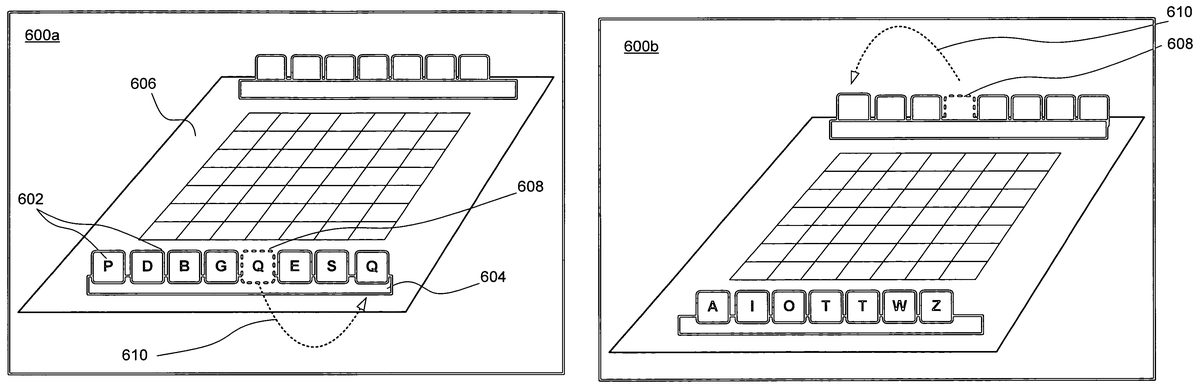
For example, word games, such as SCRABBLE™ manufactured by Hasbro, Inc., involve spelling words using letter tiles or cubes. The letters each player has are typically unknown to other players. Thus, as shown in a screen600aofFIG. 6A, each player may have letter tiles602arrayed in a rack604so that one player cannot view another player's letter tiles602before the letter tiles are played on a playing board606.
As shown in screen600a, just as card players may wish to rearrange cards held in their hands, players of other games may wish to adjust their playing pieces, e.g., to place like letters together or to organize the letter tiles alphabetically, or in groups forming one or more whole words and/or parts of a word. Also, just as in card games, movement or touching of these pieces by one player may potentially provide information to other players that may prove useful. In screen600a, a first player has a Q tile608. The tile may have great value, or the first player may be unable to play Q tile608until the player draws other tiles or after another player plays specific tile(s) (e.g., a U tile). Thus, the first player may move Q tile608along a path610to another position on rack604, where Q tile608will be out of the way until it becomes possible to play Q tile608.
Ordinarily, the moving of tiles is permitted in an on-line version of such a game; however, other participants are unable to see the movement of the tiles and instead only see the tiles that are played on the board. A seasoned player may see a first player move tile608to an end of rack604and speculate that tile608bears a J, Q, X, Z, or other tile that the first player might desire to or be forced to wait to play. However, in a conventional online interactive environment, the other participants would not see the first player move tiles until the first player completed a move or turn.
However, as shown in a screen600bofFIG. 6Bshowing a second player's view of the game illustrated in screen600a(FIG. 6A), as the first player moves Q tile608to an end of rack604, the second player also can see the movement of tile608. Being able to see movement of tile608may allow the second player to infer what letter tile608bears, and act accordingly. Thus, for example, if the second player correctly concludes that tile608bears a Q or some other specific letter, the second player may be careful not to play a tile bearing the letter U (or other letter), if the first would benefit from that placement.
Embodiments of this new development are adaptable to a number of interactive computing environments where playing pieces are used. As another example, screens700athrough700dofFIGS. 7A through 7D, respectively, show how an embodiment may add further richness and depth to an on-line chess game. Screen700ashows a first player causing a cursor702to move over a piece704on a board706, as though the first player is contemplating moving piece704to that position on the board. Screen700b, showing the second player viewing board706, includes a hand indicator708that is poised over piece704, communicating to the second player that the first player might be considering moving piece704. It is understood that good players do not touch their pieces while contemplating a move, except perhaps to confuse an opponent. Instead, a good chess player only watches the board and plans moves mentally. In typical on-line chess games, the second player would not know if the first player was hinting at the next move by “touching” cursor702to piece704. However, as shown in screens700aand700b, if a player should make such an overt gesture, it would be communicated to the second player with hand indicator708or some other indicator.
In chess, a move is not final until a player not only moves a playing piece to a new (legal) position, but also releases the playing piece at that position. Again, in most on-line chess games, a player cannot only touch a piece without his opponent knowing it, but can move it around the board to consider the ramifications without his opponent knowing it, because a move is not presented to the opponent until the player releases the chess piece at its new position. However, as shown in screen700cofFIG. 7C, if a player should move piece704but not release it, this action is still communicated to the second player by showing hand indicator708over piece704, while indicating original position710of piece704. If the first player should release piece704and, thus, complete the move, the hand indicator (not shown inFIG. 7D) is removed, leaving piece704in its new position. It will be appreciated that, without employing an embodiment of the new development, screen700din showing piece704at its new position is the only information that would be received by the second player, thereby concealing some of the first player's preliminary machinations that may well provide useful information to the second player.
From the examples of the card games (FIGS. 2A-5B) and the board games (FIGS. 6A-7D), advantages of the new development in interactive computing environments in which games are played should be clear. It should also be appreciated that the richness added to games similarly will be added to other types of interactive computing environments. For example, by monitoring actions of a first participant in on-line messaging sessions such as instant messaging sessions or chat rooms, conferencing sessions, financial transaction environments, and other interactive computing environments, embodiments of the new development may be similarly valuable in enriching the experiences of the participants. Taking the example of a chat room, typically other participants only see a message appear after another participant has finalized the message and hit “send” or “enter” to complete the messaging turn or move dictated by the parameters or rules of the session. Using an embodiment of the new development, however, if a participant repeatedly edited or retyped phrases, apparently taking pains to state just the right words, other participants may learn something about the participant's tone or attitude in regard to the textual exchange. Other participants could thereby, for example, detect hesitation, uncertainty, haste, and other aspects of the participant's behavior in responding and reacting to messages.
Communicating Tells According to an Embodiment
Peripheral information regarding the actions of participants prior to, ancillary to, or after completing a play or turn has value to participants in interactive computing environments other than card games. Thus, embodiments of the new development are useful in adding richness and realism to these other interactive computing environments. In addition, embodiments of the new development also are useful in communicating “tells” regarding the behavior of a participant arising from actions of which the participant may not be cognizant.
The types of peripheral behavior previously described include deliberate actions made by a participant, such as reordering cards, counting chips, touching cards or pieces, etc. However, in many face-to-face encounters, including games and other interactive situations, individuals may unconsciously act in a particular way that may manifest what they are thinking, even though they are unaware of it. In a real poker game, for example, a player nervous or excited about a hand may drum his or her fingers, make faces, or exhibit other telling behavior that the other players learn to “read,” and to which they then may respond. Using embodiments of the new development, behavior measurable by a computing system similarly may be able to discern these tells and communicate or indicate them to other participants.
For example, as previously described in connection withFIG. 1D, a participant in an on-line card game who has become distracted, may switch to another window, such as browser window124, during the course of the game, or may stop interacting with the on-line card game for a predefined period of time, e.g., sufficiently long for a screen saver to run. Such an action may indicate that the player is losing interest because the player may have drawn poor cards, or is simply bored or distracted. The player may not be cognizant that he/she is manifesting a lack of interest in the game. In a face-to-face game, other players would be able to see that such a player is looking around disinterestedly, but in a conventional on-line game, other players would have no idea that the player has become distracted.
According to one embodiment, if a player opens or activates another window, this behavior can be communicated to other participants by an indicator. As shown in a screen800aofFIG. 8Athat represents the view of other players, a disinterest indicator802, representative of snoring, may appear by a player's hand804, indicating that the player has opened or activated another window. Similarly, as represented in a screen800bofFIG. 8B, instead of showing a visual indicator that indicates another player has opened a browser or other window, an audible indicator806may be provided to other players. For example, audible indicator806may actually play a sound of snoring to other players to show the first player's apparent disinterest. As an alternative approach to presenting or conveying tells to a player, a haptic device such as a haptic game pad, or haptic joystick could provide the indication of another player's behavior.
Similarly, a player who is excited or nervous may fidget with his/her hands. If a player is so fidgeting, the player may unconsciously move the mouse back and forth. Thus, as shown in screen800cofFIG. 8Crepresenting views seen by other players, if a first player starts fidgeting and thereby moves the mouse810with his hand812around the surface (not shown) where mouse810rests, an indicator may appear on other players' screens800cshowing that the player is fidgeting. If the player fidgets even more and moves mouse810even more animatedly, a variable indicator832may change to indicate the degree of movement exhibited by the first player in his interaction with the mouse. Thus, while other players may not be able to see another player twitch, drum his fingers, or otherwise manifest some atypical behavior, movements imparted to mouse810are presented to provide some indicia of the first player's movements that may convey a “tell.” It is even contemplated that a video camera coupled with appropriate software might optically detect predefined types of behavior by a player, which could be communicated or indicated to other players, but without transmitting the video image of the player.
As shown in screens800eand800fofFIGS. 8E and 8F, respectively, other players may be shown when another player plays a card with an unusual degree of forcefulness. In a face-to-face game, players may slap card down with more force when excited or disgusted, or to make a point. As shown in screen800e, if a player presses a mouse button840with a nominal degree of force within expected nominal parameters in playing a card844, other players will see card844played, but will not be presented with additional information about the play. However, assuming mouse button840is able to measure a level of force imparted to actuate the mouse button, should a player press mouse button840with a heightened degree of force852beyond a predefined expected amount of force, screen800fshows that a cue854may be associated with the playing of card844to signal the other players that card844was played with an unusual degree of force. As is the case with other visual indicators, an audible indicator also could be used to convey to other players the heightened degree of force852used in playing card844.
Logical Steps for Communicating Additional Information to Other Participants
FIG. 9Ais a flow diagram900illustrating exemplary logical steps for communicating additional information to other participants in an interactive computing environment regarding the actions of another participant. Flow diagram900begins at step902. At a step904, a participant's actions are monitored by one or more input devices associated with a computing system at which the participant engages the interactive computing environment. Examples of input devices include a keypad, a joystick, a pointing device, a keyboard, an optical sensor, a force sensor; and almost any form of a player manipulated device.
At a decision step906, it is determined if a participant's input reflects monitored peripheral information. For example, monitored peripheral information may include a participant moving playing cards or game pieces during an online computer games, as described above. If it is determined at decision step906that a participant has presented input reflecting peripheral information, at a step908, a representation indicating the manifestation of the peripheral information is presented to other participants.
If it is determined at decision step906that no peripheral information is detected, or that peripheral information detected has been communicated to other participants at step908, at a decision step910, it is determined if the participant input is indicative of monitored tells. For example, as described above, if a participant should press a mouse key with a heightened degree of force (e.g., above a predefined level), such input may register as conveying tell information. If it is determined that a participant has tells, at a step912, representative indicators for each such tell are presented to other participants. If it is determined at decision step910that no tell is discerned or, after indicators representative of the telling behavior have been presented at step912, at a decision step914, it is determined if the interactive environment has been ended. If not, flow diagram900loops to step904, where participant's actions will continue to be monitored. On the other hand, if it is determined at decision step914that the interactive environment has ended, exemplary flow diagram900ends at a step916.
For the sake of illustration,FIG. 9Bshows a flow diagram950representing exemplary logical steps involved in communicating peripheral information and tells for one player to other participants in an online card game. The same logic would be applied to each of the players in the online card game. Also, similar steps would be carried out for each participant, if the new development is employed in other types of online interactive environments. Flow diagram950begins at a step952. At a step954, a player's actions are monitored for manifestations of peripheral information or behavior representing one or more tells. At a decision step956, it is determined if the player has repositioned cards in his/her hand. If so, at a step958, the movement of the card(s) in the player's hand is shown to other players. At a decision step960, it is determined if the player has activated another window at his/her computing system. If so, at a step962an inactive indicator is presented to the other players. At a decision step964, it is determined if a player has moved his/her mouse beyond a predefined threshold amount. If so, in a step966, an indicator representing the heightened movement is communicated to other players.
At a decision step968, it is determined if a player has checked the value of any facedown cards. If so, at a step970, an indicator representing the attention shown by the player to the facedown cards is provided to other players. At a decision step972, it is determined if a player has counted his/her chips or the chips of other players. As described above, chips may be counted by directing a cursor to a representation of the chips presented on screen. If so, in a step974, an indicator representing that the player has shown attention to the chips is presented to other players relative to the chips the player has counted.
At a decision step976, it is determined if a card has been selected by a player. If so, at a step978the card the player has selected in his hand is indicated to other players. At a decision step980, it is determined if a card has been played. In other games, the selection of another type of object, such a graphic object, without completing an action related to the object may be conveyed to the other players. If not, flow diagram950loops to step954to continue monitoring the player's actions to detect behaviors that may represent peripheral information or tells. On the other hand, if it is determined at decision step980that a card has been played, at a decision step982, it is determined if the card has been played with more than a predefined threshold amount of force. If so, at a step984, the use of heightened force (or the amount of heightened force) with which the card was played is indicated to other players.
If it is determined at decision step982that no unusual amount of force has been used, or after the use of heightened degree force has been communicated to other players, at a decision step986, it is determined if the game has ended. If not, flow diagram950loops to step954to continue monitoring the player's actions. On the other hand, if it is determined at decision step986that the game has ended, flow diagram950ends at a step988.
Although not discussed above, it is contemplated that any one or more of the participants in an interactive environment might be a computer-simulated participant, rather than an actual human participant. Further, to add to the interest in a game or other interactive environment using such a computer simulated participant, the computer could be programmed to either manifest an additional behavior to provide information or tells to the human participants, just as described above. The additional behavior might be either randomly determined or based upon a defined rule set corresponding to one or more parameters in the interactive environment.
Exemplary Computing System for Implementing this Functionality
With reference toFIG. 10, an exemplary system suitable for implementing the functionality described above is shown. The exemplary system ofFIG. 10includes a general purpose computing device in the form of a conventional PC1020, provided with a processing unit1021, a system memory1022, and a system bus1023. The system bus couples various system components including the system memory to processing unit1021and may be any of several types of bus structures, including a memory bus or memory controller, a peripheral bus, and a local bus using any of a variety of bus architectures. The system memory includes read only memory (ROM)1024and random access memory (RAM)1025. A basic input/output system1026(BIOS), containing the basic routines that help to transfer information between elements within the PC1020, such as during start up, is stored in ROM1024. PC1020flurther includes a hard disk drive1027for reading from and writing to a hard disk (not shown), a magnetic disk drive1028for reading from or writing to a removable magnetic disk1029, and an optical disk drive1030for reading from or writing to a removable optical disk1031, such as a compact disk-read only memory (CD-ROM) or other optical media. Hard disk drive1027, magnetic disk drive1028, and optical disk drive1030are connected to system bus1023by a hard disk drive interface1032, a magnetic disk drive interface1033, and an optical disk drive interface1034, respectively. The drives and their associated computer readable media provide nonvolatile storage of computer readable machine instructions, data structures, program modules, and other data for PC1020. Although the exemplary environment described herein employs a hard disk, removable magnetic disk1029, and removable optical disk1031, it will be appreciated by those skilled in the art that other types of computer readable media, which can store data and machine instructions that are accessible by a computer, such as magnetic cassettes, flash memory cards, digital video disks (DVDs), Bernoulli cartridges, RAMs, ROMs, and the like, may also be used in the exemplary operating environment.
A number of program modules may be stored on the hard disk, magnetic disk1029, optical disk1031, ROM1024, or RAM1025, including an operating system1035, one or more application programs1036, other program modules1037, and program data1038. A user may enter commands and information in PC1020and provide control input through input devices, such as a keyboard1040and a pointing device1042. Pointing device1042may include a mouse, stylus, wireless remote control, or other pointer. As used hereinafter, the term “mouse” is intended to encompass virtually any pointing device that is useful for controlling the position of a cursor on the screen. Other input devices (not shown) may include, for example, a microphone, joystick, haptic joystick, yoke, foot pedals, game pad, game controller, voice command hardware, gesture command through video camera detection, eye movement detection hardware, satellite dish, scanner, and almost any other form of user manipulated input device, or the like. Also, PC1020may include a Bluetooth radio or other wireless interface for communication with various types of interface device, such as printers, or the interactive display table of the new development. These and other input/output (I/O) devices are often connected to processing unit1021through an I/O interface1046that is coupled to the system bus1023. The term I/O interface is intended to encompass each interface specifically used for a serial port, a parallel port, a game port, a keyboard port, and/or a universal serial bus (USB). A monitor1047can be connected to system bus1023via an appropriate interface, such as a video adapter1048. It will be appreciated that PCs are often coupled to other peripheral output devices (not shown), such as speakers (through a sound card or other audio interface—not shown) and printers.
The new development may be practiced on a single machine, although PC1020would provide interactive functionality with other participants by operating in a networked environment using logical connections to one or more remote computers, such as a remote computer1049. Remote computer1049may be, for example, another PC, a server (which is typically generally configured much like PC1020), a game console, a PDA, a mobile phone, a router, a network PC, a peer device, or a satellite or other common network node, and typically includes many or all of the elements described above in connection with PC1020, although only an external memory storage device1050has been illustrated inFIG. 10. The logical connections depicted inFIG. 10include a local area network (LAN)1051and a wide area network (WAN)1052, either of which might be public (like the Internet), or private, like Microsoft Corporation's XBOX LIVE™ network. Such networking environments are common in offices, enterprise wide computer networks, intranets, and as noted, may include the Internet.
When used in a LAN networking environment, PC1020is connected to LAN1051through a network interface or adapter1053. When used in a WAN networking environment, PC1020typically includes a modem1054, or other means such as a cable modem, Digital Subscriber Line (DSL) interface, or an Integrated Service Digital Network (ISDN) interface for establishing communications with other computing devices over WAN1052, such as the Internet. Modem1054, which may be internal or external, is connected to the system bus1023or coupled to the bus via I/O device interface1046, i.e., through a serial port. In a networked environment, program modules, or portions thereof, used by PC1020may be stored in the remote memory storage device. It will be appreciated that the network connections shown are exemplary and other means of establishing a communications link between the computers may be used, such as wireless communication and wide band network links.
Although the new development has been described in connection with the preferred form of practicing it and modifications thereto, those of ordinary skill in the art will understand that many other modifications can be made to the new development within the scope of the claims that follow. Accordingly, it is not intended that the scope of the invention in any way be limited by the above description, but instead be determined entirely by reference to the claims that follow.
Claims
- A method for representing at least one additional behavior of a first participant to a second participant in an interactive computer environment during play of an electronic game, where the first participant is interacting using a first computing system coupled in communication with a second computing system that is being used for the interactive computer environment by the second participant, comprising the steps of: (a) specifying at least one additional behavior that is not dictated by rules of the interactive computer environment;(b) associating an indicator with the at least one additional behavior;(c) the first computing system monitoring actions of the first participant to detect an occurrence of the at least one additional behavior by the first participant corresponding with a user interaction with a first at least one displayed game piece of an electronic game in a manner that does not complete a turn or a move in the electronic game, wherein the user interaction with the first at least one displayed game piece comprises one or more of reordering the first at least one displayed game piece, selecting the first at least one displayed game piece in a manner that does not complete a turn or a move, or positioning an input cursor over the first at least one displayed game piece in excess of a predefined period of time;(d) after detecting the occurrence of the user interaction with the first at least one displayed game piece by the first participant, the first computing system sending a signal to the second computing system, which is in a remote location from the first computing system, and signifying the occurrence of the at least one additional behavior;and (e) wherein the signal causes the second computing system to display an indicator on the second computing system proximate a second at least one displayed game piece that corresponds to the first at least one displayed game piece to reflect the user interaction with the first at least one displayed game piece at the first computing system.
- The method of claim 1 , wherein the interactive computer environment comprises an electronic game in which a mandated interactive behavior by participants playing the game is dictated by the rules of the game, so that the at least one additional behavior is not a required interactive behavior.
- The method of claim 2 , wherein the at least one additional behavior further includes one of: (a) manipulating an input device in a manner not intentionally directed to effecting a displayed game piece;(b) activating a control with a degree of force that exceeds a predefined level, when initiating a mandated interactive behavior;(c) interacting with a window presented by the first computing system, other than a window in which the interactive computer environment is presented;and (d) not interacting with the computing system for at least a predefined time.
- The method of claim 3 , wherein the indicator includes at least one of a visual indicator, a haptic indicator, and an audible indicator.
- The method of claim 4 , wherein the visual indicator includes at least one of: (a) repositioning the second at least one displayed game piece on the second computing system by manipulating the second at least one displayed game piece on the second computing system in a manner that does not complete one of the turn and the move;(b) a movement indicator representing an extent of movement of the input device that is not intentionally directed to effecting the first at least one displayed game piece;(c) a force indicator representing a degree of force with which the first participant activates the control in initiating a behavior that is mandated;and (d) an idle indicator, indicating one of: (i) that the first participant is interacting with the window presented by the first computing system other than the widow in which the interactive computer environment is presented;and (ii) that the first participant has not interacted with the first computing system for more than the predefined period of time.
- The method of claim 3 , wherein the electronic game comprises a card game involving a plurality of displayed game pieces, including at least one of playing cards and chips, and wherein the additional behavior includes at least one of: (a) moving a playing card from one position to another position in a hand of playing cards controlled by the first participant;(b) viewing a face of a playing card previously laid face down by the first participant;and (c) scrutinizing a number of chips that are one of: (i) available to at least one participant in the game;(ii) in front of at least one participant in the game;and (iii) provided by at least participant in a shared bet.
- The method of claim 3 , wherein the electronic game includes at least one of a plurality of playing pieces and a plurality of objects, and the additional behavior includes at least one of: (a) manipulating an input device for purposes of selecting a piece for a potential move;(b) directing the playing piece selected from a current position to a new position as part of the potential move;(c) directing the playing piece selected back to a current position without completing the turn or the move;and (d) selecting one of the plurality of objects without completing an action related to the one object that was selected.
- The method of claim 1 , wherein monitoring actions includes the step of monitoring and interaction of the first participant with an input device comprising at least one of: (a) a keypad;(b) a joystick;(c) a pointing device;(d) a keyboard;(e) an optical sensor;(f) a force sensor;and (g) a player manipulated device.
- The method of claim 1 , wherein in response to detecting the reordering of the first at least one displayed game piece, an indicator comprising an arrow which indicates the new position of the at least one displayed game piece is displayed proximate the second at least one displayed game piece.
- The method of claim 1 , wherein in response to detecting the selection of the first at least one displayed game piece in a manner that does not complete a turn or a move, the indicator comprises one or more of displacing the second at least one game piece, or displaying an eye or hand icon proximate the second at least one game piece.
- The method of claim 10 , further comprising modifying the color or intensity of the eye icon to indicate the duration of the selection of the first at least one displayed game piece.
- A memory media on which are stored machine instructions for communicating to a second player that a first player in a computer game has performed at least one additional behavior, the machine instructions causing the following functions when executed by a processor of a first computing system being used by a first player for participating in the computer game: (a) specifying at least one additional behavior that is not a mandated behavior dictated by rules of the game to complete a turn or a move;(b) associating an indicator with the at least one additional behavior;(c) monitoring actions of the first player to detect an occurrence of the at least one additional behavior by the first player and that at least includes a user interaction with a first at least one displayed game piece of an electronic game in a manner that does not complete a turn or a move in the electronic game, wherein the user interaction with the first at least one displayed game piece comprises one or more of reordering the first at least one displayed game piece, selecting the first at least one displayed game piece in a manner that does not complete a turn or a move, or positioning an input cursor over the first at least one displayed game piece in excess of a predefined period of time;(d) after detecting the occurrence of the user interaction with the first at least one displayed game piece by the first player, transmitting a signal to a second computing system being used by a second player for participating in the computer game, the second computing system being in a remote location from the first player, and the signal causing the second computing system to display an indicator at the second computing system proximate a second at least one displayed game piece corresponding to the first at least one displayed game piece to reflect the user interaction with the first at least one displayed game piece at the first computing system.
- The memory media of claim 12 , wherein the at least one additional behavior further comprises at least one of: (a) moving an input device in a manner not specifically directed to manipulating a displayed game piece in the computer game;(b) activating an input control with a force greater than a predefined threshold to initiate a mandated behavior in the computer game;and (c) interacting with a displayed object that is not included in the computer game.
- The memory media of claim 12 , wherein the indicator includes at least one of: (a) indicating movement of the first at least one displayed game piece in a manner that does not complete a turn or a move in the computer game;(b) a movement indicator representing a degree of movement of an input device, where the movement is not directed to manipulating the first at least one displayed game piece in the computer game;(c) a force indicator representing that an excessive force was applied by the first player in activating a control on the input device for initiating a mandated behavior in the computer game;and (d) an idle indicator indicating when the first player is interacting with an object that is not included in the computer game.
- The memory media of claim 12 , wherein the computer game comprises a card game involving a plurality of displayed game pieces including at least one of playing cards and chips, and the additional behavior of the first player includes at least one of: (a) moving a playing card from one position to another position in a hand of playing cards controlled by the first participant;(b) viewing a face of a playing card previously laid face down by the first participant;and (c) scrutinizing a number of chips that are one of: (i) available to at least one participant in the game;(ii) in front of at least one participant in the game;and (iii) provided by at least participant in a shared bet.
- The memory media of claim 12 , wherein the computer game includes at least one of a plurality of playing pieces and a plurality of objects, and the additional behavior includes at least one of: (a) manipulating an input device for purposes of selecting a piece for a potential move;(b) directing the playing piece selected from a current position to a new position as part of the potential move;(c) directing the playing piece selected back to a current position without completing the turn or the move;and (d) selecting one of the plurality of objects without completing an action related to the one object that was selected.
- The memory media of claim 12 , wherein the additional behavior is detected by an interaction of the first player with at least one of: (a) a keypad;(b) a joystick;(c) a pointing device;(d) a keyboard;(e) an optical sensor;(f) a force sensor;and (g) a player manipulated device.
- The memory media of claim 12 , wherein the first player is a computer-simulated player in accord with the machine instructions, and the machine instructions, when executed by the processor used by the first player cause the processor to manifest the at least one additional behavior.
- The memory media of claim 12 , wherein the at least one additional behavior provides at least one of: (a) peripheral information corresponding to at least one conscious action of the first player beyond the behavior mandated by the rules of the computer game to complete a turn or a move;and (b) tell information corresponding to at least one action of which the first player may not be conscious, but which represents a potential correlation with a thought process of the first player.
- A system for communicating that at least one additional behavior was carried out by a participant in an interactive computer environment, to at least one other participant in the interactive computer environment, comprising: (a) at least one user input device;(b) a display operable to present visual content on a display screen;(c) a network interface operable to communicate with at least one additional computing system over a network;(d) a processor in communication with the at least one input device, the display, and the network interface;and (e) a memory in communication with the processor, the memory storing data and machine instructions that cause the processor to carry out a plurality of functions, including: (i) detecting at least one additional behavior that is not dictated by rules of the interactive computer environment and that includes a user interaction with a first at least one displayed game piece of an electronic game in a manner that does not complete a turn or a move in the electronic game, wherein the user interaction with the first at least one displayed game piece comprises one or more of reordering the first at least one displayed game piece, selecting the first at least one displayed game piece in a manner that does not complete a turn or a move, or positioning an input cursor over the first at least one displayed game piece in excess of a predefined period of time;(ii) associating an indicator with the at least one additional behavior;(iii) monitoring the at least one user input device to detect an occurrence of at least one additional behavior as a result of actions of the participant;and (iv) after detecting the user interaction with the first at least one displayed game piece, transmitting a signal through the network interface over a network to the at least one additional computing system, which is remote from the first computing system, signifying the occurrence of the at least one additional behavior and that causes the at least one additional computing system to display an indicator proximate a second at least one displayed game piece corresponding with the first at least one displayed game piece to reflect the user interaction with the first at least one displayed game piece at the first computing system.
- The system of claim 20 , wherein the plurality of functions carried out by the processor further include: (a) receiving a signal through the network interface from the at least one additional computing system indicating that another participant in the interactive computer environment has performed an additional behavior that is not dictated by rules of the interactive computer environment;and (b) responding to the signal received from the at least one additional computing system by providing an indication on the display corresponding to the additional behavior performed by the other participant.
Disclaimer: Data collected from the USPTO and may be malformed, incomplete, and/or otherwise inaccurate.