U.S. Pat. No. 7,458,894
ONLINE GAMING SPECTATOR SYSTEM
AssigneeMicrosoft Technology Licensing LLC
Issue DateSeptember 15, 2004
Illustrative Figure
Abstract
During an online event, a spectator process monitors a state of the event, updating a spectator model, so that spectator data streams can be generated and provided to spectators. The spectator data streams can be formatted and provided with content appropriate for use by different types of spectator devices used by the spectators. The spectator process can also automatically generate virtual commentary appropriate for the action occurring in the event for inclusion in the spectator data streams. A media server receives the rendered data streams and distributes them to the electronic devices being used by the spectators. The distribution can be delayed to avoid a spectator conveying information to a participant that would provide an unfair advantage. Executable code can be included in the spectator data stream to provide additional functionality and facilitate interaction between the spectators, and to enable a spectator to also “play” the game.
Description
DESCRIPTION OF THE PREFERRED EMBODIMENT Exemplary Computing System for Implementing at Least Part of the Present Invention With reference toFIG. 1, an exemplary system suitable for implementing at least part of the present invention is shown. The system includes a general purpose computing device in the form of a conventional PC20(or server), provided with a processing unit21, a system memory22, and a system bus23. Clearly, some spectators will be using a PC such as PC20to receive the audio and video data provided as spectator data streams in the present invention. Also, PC20represents an embodiment of a server such as may be used to host an online game, or to implement the spectator process, or distribute the different types of spectator data streams to the electronic devices being used by the spectators. In PC20, the system bus couples various system components, including the system memory, to processing unit21and may be any of several types of bus structures, including a memory bus or memory controller, a peripheral bus, and a local bus using any of a variety of bus architectures. The system memory includes read only memory (ROM)24and random access memory (RAM)25. A basic input/output system26(BIOS), containing the basic routines that help to transfer information between elements within the PC20, such as during start up, is stored in ROM24. PC20further includes a hard disk drive27for reading from and writing to a hard disk (not shown), a magnetic disk drive28for reading from or writing to a removable magnetic disk29, and an optical disk drive30for reading from or writing to a removable optical disk31, such as a compact disk-read only memory (CD-ROM) or other optical media. Hard disk drive27, magnetic disk drive28, and optical disk drive30are connected to system bus23by a hard disk drive interface32, a magnetic disk drive interface33, and an optical disk ...
DESCRIPTION OF THE PREFERRED EMBODIMENT
Exemplary Computing System for Implementing at Least Part of the Present Invention
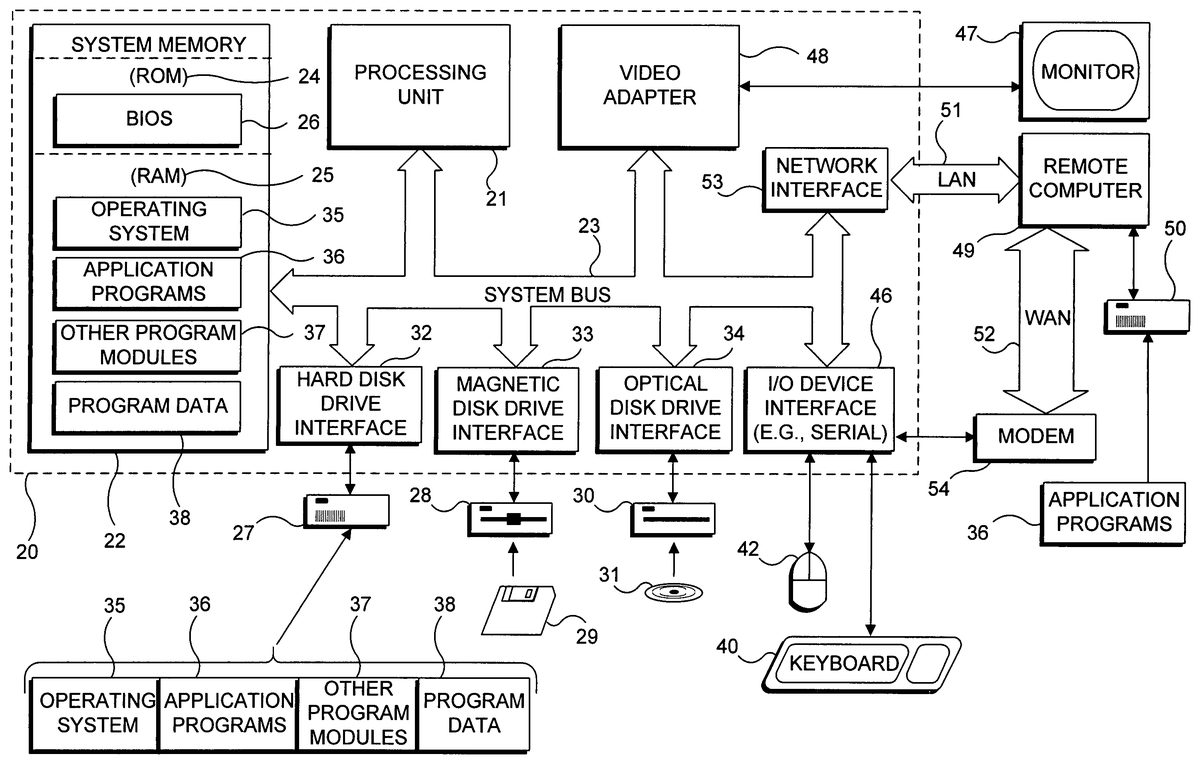
With reference toFIG. 1, an exemplary system suitable for implementing at least part of the present invention is shown. The system includes a general purpose computing device in the form of a conventional PC20(or server), provided with a processing unit21, a system memory22, and a system bus23. Clearly, some spectators will be using a PC such as PC20to receive the audio and video data provided as spectator data streams in the present invention. Also, PC20represents an embodiment of a server such as may be used to host an online game, or to implement the spectator process, or distribute the different types of spectator data streams to the electronic devices being used by the spectators.
In PC20, the system bus couples various system components, including the system memory, to processing unit21and may be any of several types of bus structures, including a memory bus or memory controller, a peripheral bus, and a local bus using any of a variety of bus architectures. The system memory includes read only memory (ROM)24and random access memory (RAM)25. A basic input/output system26(BIOS), containing the basic routines that help to transfer information between elements within the PC20, such as during start up, is stored in ROM24. PC20further includes a hard disk drive27for reading from and writing to a hard disk (not shown), a magnetic disk drive28for reading from or writing to a removable magnetic disk29, and an optical disk drive30for reading from or writing to a removable optical disk31, such as a compact disk-read only memory (CD-ROM) or other optical media. Hard disk drive27, magnetic disk drive28, and optical disk drive30are connected to system bus23by a hard disk drive interface32, a magnetic disk drive interface33, and an optical disk drive interface34, respectively. The drives and their associated computer readable media provide nonvolatile storage of computer readable machine instructions, data structures, program modules, and other data for PC20. Although the exemplary environment described herein employs a hard disk, removable magnetic disk29, and removable optical disk31, it will be appreciated by those skilled in the art that other types of computer readable media, which can store data and machine instructions that are accessible by a computer, such as magnetic cassettes, flash memory cards, digital video disks (DVDs), Bernoulli cartridges, RAMs, ROMs, and the like, may also be used in the exemplary operating environment.
A number of program modules may be stored on the hard disk, magnetic disk29, optical disk31, ROM24, or RAM25, including an operating system35, one or more application programs36, other program modules37, and program data38. A user may enter commands and information in PC20and provide control input through input devices, such as a keyboard40and a pointing device42. Pointing device42may include a mouse, stylus, wireless remote control, or other pointer. As used hereinafter, the term “mouse” is intended to encompass virtually any pointing device that is useful for controlling the position of a cursor on the screen. Other input devices (not shown) may include a microphone, joystick, haptic joystick, yoke, foot pedals, game pad, satellite dish, scanner, or the like. These and other input/output (I/O) devices are often connected to processing unit21through an I/O interface46that is coupled to the system bus23. The term I/O interface is intended to encompass each interface specifically used for a serial port, a parallel port, a game port, a keyboard port, and/or a universal serial bus (USB). A monitor47is connected to system bus23via an appropriate interface, such as a video adapter48. It will be appreciated that PCs are often coupled to other peripheral output devices (not shown), such as speakers (through a sound card or other audio interface—not shown, which can be used by an audience for listening to audio data) and printers.
The present invention may be practiced on a single machine, although PC20can also implement the present invention in a networked environment using logical connections to one or more remote computers, such as a remote computer49. Remote computer49may be another PC, a server (which is typically generally configured much like PC20), a router, a network PC, a peer device, or a satellite or other common network node, and typically includes many or all of the elements described above in connection with PC20, although only an external memory storage device50has been illustrated inFIG. 1. The logical connections depicted inFIG. 1include a local area network (LAN)51and a wide area network (WAN)52. Such networking environments are common in offices, enterprise wide computer networks, intranets, and the Internet.
When used in a LAN networking environment, PC20is connected to LAN51through a network interface or adapter53. When used in a WAN networking environment, PC20typically includes a modem54, or other means such as a cable modem, Digital Subscriber Line (DSL) interface, or an Integrated Service Digital Network (ISDN) interface for establishing communications over WAN52, such as the Internet. Modem54, which may be internal or external, is connected to the system bus23or coupled to the bus via I/O device interface46, i.e., through a serial port. In a networked environment, program modules, or portions thereof, used by PC20may be stored in the remote memory storage device. It will be appreciated that the network connections shown are exemplary and other means of establishing a communications link between the computers and other electronic devices used by spectators may be employed, such as wireless communications and wide band network links.
Exemplary Gaming System for Use by a Participant or a Spectator
While many other types of electronic devices can be employed by spectators in accord with the present invention, to follow play of a game, it is likely that initially, the present invention will be employed to provide a spectator data stream of video and audio data to spectators using a gaming system, perhaps of the same type employed by the participants in an online game. Accordingly, it is appropriate to provide further information about a suitable gaming system, as an example of at least one suitable electronic device (other than PC20) that might be used by a spectator to monitor the play of an online game.
As shown inFIG. 2, an exemplary electronic gaming system100includes a game console102that supports up to four user input devices, such as controllers104aand104b.Game console102is equipped with an internal hard disk drive (not shown in this Figure) and a portable media drive106that supports various forms of portable optical storage media, as represented by an optical storage disc108. Examples of suitable portable storage media include DVD discs and compact disk-read only memory (CD-ROM) discs. In this gaming system, game programs are preferably distributed for use with the game console on DVD discs, but it is also contemplated that other storage media might instead be used, or that games and other programs can be downloaded over the Internet or other network.
On a front face of game console102are four connectors110that are provided for electrically connecting to the controllers, although other types of connectors or wireless connections might alternatively be employed. A power button112and a disc tray eject button114are also positioned on the front face of game console102. Power button112controls application of electrical power to the game console, and eject button114alternately opens and closes a tray (not shown) of portable media drive106to enable insertion and extraction of storage disc108so that the digital data on it can be read and loaded into memory or stored on the hard drive for use by the game console.
Game console102connects to a television or other display monitor or screen (not shown) via audio/visual (A/V) interface cables120. A power cable plug122conveys electrical power to the game console when connected to a conventional alternating current line source (not shown). Game console102may be further provided with a data connector124to communicate data through an Ethernet connection to/from a network and/or the Internet, or through a broadband connection. Alternatively, it is contemplated that a modem (not shown) may be employed to communicate data to/from a network and/or the Internet. As yet a further alternative, the game console can be directly linked to another game console via an Ethernet cross-over cable (not shown).
Each controller104aand104bis coupled to game console102via a lead (or alternatively, through a wireless interface). In the illustrated implementation, the controllers are Universal Serial Bus (USB) compatible and are connected to game console102via USB cables130. Game console102may be equipped with any of a wide variety of user devices for interacting with and controlling the software executed by the game console. As illustrated inFIG. 2, each controller104aand104bis equipped with two thumb sticks132aand132b,a D-pad134, buttons136, and two triggers138. These controllers are merely representative, and other gaming input and control mechanisms may be substituted for or used in addition to those shown inFIG. 2, for controlling game console102.
Removable function units or modules can optionally be inserted into controllers104to provide additional functionality. For example, a portable memory unit (not shown) enables users to store game parameters and port them for use on another game console by inserting the portable memory unit into a controller on the other console. Other removable function units are available for use with the controller. In connection with the present invention, a removable function unit comprising a voice communicator module140is employed to enable a user to verbally communicate with other users locally and/or over a network. Connected to voice communicator module140is a headset142, which preferably includes a boom microphone144or other type of audio sensor that produces an input signal in response to incident sound, and an headphone146or other type of audio transducer for producing audible sound in response to an output signal from the game console. Alternatively, the voice communicator capability is included as an integral part of a controller (not shown) that is generally like controllers104aand104bin other respects. The controllers illustrated inFIG. 2are configured to accommodate two removable function units or modules, although more or fewer than two modules may instead be employed. The voice communication capability, when game console102is used by one or more spectators, enable the spectators to engage in a voice chat session with other spectators, or with a moderator of a game, and can be used instead of the speakers coupled to the television or other monitor to enable the spectators to follow spectator audio data streamed to the game console in accord with the present invention.
In addition to its use by one or more participants in playing games (or by one or more spectators in following the action in games), gaming system100can also play music, and videos on CDs and DVDs. It is contemplated that other functions can be implemented by the game controller using digital data stored on the hard disk drive or read from optical storage disc108in drive106, or from an online source, or from a function unit or module, or provided as metadata that are included with the spectator video/audio data that are streamed to the game console, as further discussed below.
Functional Components of the Game Console
Turning now toFIG. 3, a functional block diagram illustrates, in an exemplary manner, the components of the game console that enable game playing and facilitate voice or verbal communication between participants or between spectators using the multiplayer game console. As noted above, up to four people can use exemplary game console100, and each person can be provided with a controller and voice communicator. Details of a voice communicator module140′ are illustrated in connection with its associated controller104a.It will be understood that controllers104b,104c,and104d(if coupled to game console100) can optionally each include a corresponding voice communication module140′ like that coupled to controller104a.In this example, voice communication module140′ includes a digital signal processor (DSP)156, an analog-to-digital converter (ADC)158, a digital-to-analog converter (DAC)161, and a universal serial bus (USB) interface163. In response to sound in the environment that is incident upon it, microphone144produces an analog output signal that is input to ADC158, which converts the analog signal into a corresponding digital signal. The digital signal from ADC158is input to DSP156for further processing, and the output of the DSP is applied to USB interface163for connection into controller104a. In this embodiment, voice communication module140′ connects into the functional unit or module port on controller104athrough a USB connection (not separately shown). Similarly, digital sound data coming from game console100are conveyed through controller104aand applied to USB interface163, which conveys the digital signal to DSP156and onto DAC161. DAC161converts the digital signal into a corresponding analog signal that is used to drive headphone146.
With reference to game console102, several key functional components are shown, although it should be understood that other functional components are also included, but not shown. Specifically, game console100includes a central processing unit (CPU)150, a memory152that includes both read only memory (ROM) and random access memory (RAM). Also provided is a DSP154. The digital signal produced by ADC158in response to the analog signal from microphone144is conveyed through controller104ato CPU150, which handles encoding of the voice stream signal for transmission to other local voice communication modules and to other game consoles over a broadband connection through an Ethernet port (not shown inFIG. 3) on the game console.
Alternatively, DSP156in voice communication module140′ can be employed to encode the digital signal produced by ADC158in response to the analog signal from microphone144. The encoded data are then conveyed through controller104ato CPU150, which again handles transmission of the encoded data to other local voice communication modules and other game consoles over the broadband connection on the game console.
It should be noted that game console102can be either directly connected to another game console using a crossover Ethernet cable as a link for local peer-to-peer communications, or can be connected to one or more other game consoles through a more conventional network using a hub, switch, or other similar device, and/or can be connected to the Internet or other network through an appropriate cable modem, digital subscriber line (DSL) connection, other appropriate interface broadband connection, or even a telephone modem (not shown). Digital signals conveyed as packets over a direct or network connection are input to CPU150through the Ethernet port on game console100(or from other voice communication modules and controllers connected to the same game console), and are processed by the CPU to decode data packets to recover digital sound data that is applied to DSP154for output mixing. The signal from DSP154is conveyed to the intended voice communication module for the player who is the recipient of the voice communication for input through USB interface163.
Overview and the Spectator Process Used in an Embodiment
A preferred embodiment uses a spectator process to produce spectator data streams for the each of the electronic devices used by spectators to follow an event. The spectator process is a generic concept that can be applied to any event where a computer is involved in tracking the progress of one or more participants in the event (i.e., the players, athletes, competitors, etc). Participants are those who are actively engaged in events, while spectators passively watch and/or listen to events, but may have an indirect effect on an event (e.g., by voting, where the results of the vote can alter the course of an event). Events can be of different types depending upon physicality, location, viewability, etc. Each type of event is not exclusive of other types, since hybrid events can share real, recorded data and virtual, simulated data. Also, events can have portions that are real and portions that are virtual.
In a virtual event, there is no physical manifestation of an environment in which a participant interacts. Virtual events can be single player or multiplayer. Players usually access these events over a network (e.g., through a LAN, a WAN, a telephone, a wireless connection, or an Internet connection). The spectators usually access the viewable stream that enables them to follow the action in an event through a network, but they do not have to be on the same network as each other or as the participants. For example, participants can be playing a game over the Internet and spectators can be watching the game on their television sets or following the action on a cell phone or a PDA.
In connection with the present invention, events typically comprise games where a game “state” is produced and stored on a computer (e.g., in memory, on disk, or in other storage). Online computer games are by far the largest category of virtual events and include single-player, client/server, peer-to-peer, and massively multiplayer games.
Simulated events are based upon real action that cannot be viewed by spectators and must be simulated using measured input. For example, if the National Aeronautics and Space Administration (NASA) wanted to show spectators a Mars landing in real time based upon telemetric position data received from sensors on the lander, the spectator process of the present invention could monitor the “state” of each lander sensor (gyroscopes, accelerometers, barometers, temperature gauges, etc), internally simulate the position and status of the spacecraft lander modeling its state, and then render a graphical and commentator spectator data stream based upon the simulation. In contrast, real events have a physical manifestation that is augmented by the spectator process to become the spectator stream.
Video events are those that can be directly captured by a video camera. The role of the spectator process is to augment the video data stream by adding commentary and additional data (e.g., position around a track, a rank, and/or a score), which is the main mode of spectator events for television (TV). Examples of such events include the Superbowl™, the World Series™, the World Cup™, and the World Poker Tour™. However, if the present invention is used in connection with such events, an automated spectator process would receive the input video stream and create a spectator-ready output data stream for distribution over the network feed.
Some events (i.e., “augmented events”) may have a physical manifestation, but in addition to following the action in the event, a spectator will typically want to also receive metadata providing information about the event. For example, a spectator data stream for a chess match intended for spectators following the game on a PC might include video data graphically showing the disposition of the chess pieces on a chess board, but in addition, the data stream that the spectator process creates can also include a two-dimensional (2D) virtual representation showing the possible moves in response to the last actual move, lines of attack, previous moves as a history relative to the current positions of the game pieces, and other information of interest to the spectators.
Much of what are now conventional video events (TV programs broadcast with live commentators) may, in the future, become augmented events using the present invention, as metadata providing information surrounding the event are included in a spectator data stream delivered over TV data distribution networks, such as cable, satellite, and over the air broadcasts. For example, the Tour de France™ currently is represented in TV programs primarily as video showing the participants riding bikes. What is currently missing in such coverage is a real-time update of the position of each rider compared to the peloton and relative to the position of the various team leaders, as well as information about the competition for various jerseys, and other items of interest to spectators who are avidly following the race. Future broadcasts using the present invention may include this augmented information, in addition to a pure video stream with voice over.
There are different methods of viewing a spectator data stream, depending mostly upon the type of electronic device being used by the spectator to follow the action in the event. The following discussion shows various types of spectator data streams that may be produced for this purpose, but is not clearly not intended to be exhaustive of the possibilities for applying this invention. The current plan is to offer multiple spectator data streams simultaneously to different audiences, where the spectators in each audience are using a plurality of different types of electronic devices to follow the action in an event.
The TV spectator data stream can be broadcast to many TVs at once, via a broadcast tower, cable, satellite, closed circuit, etc. The format of this type of spectator data stream would be provided to match the National TV Standards Committee (NTSC) format used in North America, and variants of the Phase Alternating Line (PAL) format used in much of the rest of the world. However, it is also contemplated that the TV spectator data stream may be digital and compressed with the Moving Picture Experts Group (MPEG) or Windows™ Media Video (WMV) standards, or other appropriate compression scheme. The spectator for such an event would need to set up the electronic device used for viewing to receive a specific channel to watch the spectator data stream provided. Viewing habits are moving toward on-demand and time-shifted recorded content, which can also be applied in receiving such a spectator data stream.
The Web spectator data stream will be a digital data stream that will be accessed via a web browser or other client component provided on an electronic device that connects over a network (Internet, LAN, etc). This digital stream will likely be compressed before transmission. The display clients used for browsing the Web are usually not content-specific and can view any type of data stream that is formatted for that client. Client software components that are usable in connection with enabling the spectator to follow an event through a spectator data stream that is broadcast over the Web include, for example, Microsoft Corporation's Internet Explorer™ and Media Player, Real Network Corporation's Real Player™, Macromedia Corporation's Flash™ program module, etc. The spectators would type in an appropriate Uniform Resource Locator (URL) in the browser address dialog (or click on one that has previously been defined) to select the spectator data stream being broadcast over the Web that they want to view. Web spectator data streams will most likely not be realtime so that they can be viewed at the convenience of the spectator.
It is also contemplated that a proprietary client spectator data stream may be provided that can only be viewed on specialized clients. For example, there may be events that can only be rendered on a specific type of game console, due to the requirements of the system and the proprietary format of the spectator data stream. There may be events which are limited to spectators having a PC executing a special software (e.g., those executing the software game Quake™). Or, the client (e.g. a specific type of game console) may be proprietary, while the format of the spectator data stream may be standard (for example MPEG).
If a spectator is using a device such as a radio, or a simple cell phone that only receives audio, a data stream data stream that is audio is appropriate to enable the spectator to follow the action in an event. The audio data will include a commentary that describes the action using words and will be streamed to the spectator's radio or cell phone. Other simple electronic devices, such as a PDA (Personal Digital Assistant) will be able to receive a spectator data stream with much the same content as will also be used for other small, hand-held devices, such as SPOT™ Watches, SmartPhones™, Windows™ Pocket PCS™, Palm™ handhelds, etc. Since these devices usually have much less resources (network bandwidth, rendering power, screen size, limited user input, etc., compared to PCs or game consoles), it will likely be appropriate to render the spectator data stream locally on the device. For example, a spectator data stream to enable a spectator to follow the World Poker Tour™ on a PDA might include audio, but not video graphics data. Instead, the spectator data stream provided such devices will indicate the cards in a participant's hand, so that the card faces of the hands held by the participants can be drawn on the screen of the PDA using vector graphics that are local to the PDA.
Different Types of Commentary
A large portion of a spectator's experience while following an event is likely to come not only from the visual display of the event, but also from the running commentary that is integrated with the visual display of the action. Most of the current sports broadcasts that have a large spectator following are dependant upon good commentary that provides “color” and interest. In the present invention, computer commentary is optionally provided by the spectator process, which accesses prerecorded data or produces synthesized human voice to augment the visual input in the spectator data stream(s). The spectator process combines this appropriate computer-generated commentary with the visual data to provide the same type of enhanced experience to which spectators of conventional sporting events are accustomed. The addition of computer generated commentary is an important focus of the spectator process in the present invention, and greatly improves the spectator experience.
Although the spectator process will typically include data showing virtual activities along with an appropriate computer commentary, the inclusion of human commentary with these data in the spectator data steam is clearly not precluded. For example, if there is a special event (such as an online Celebrity Poker™ tournament), a producer of the tournament may want to provide a human to add commentary to the virtual game data. The human commentator(s) would be able to view the input stream(s) (possibly real, simulated or virtual data) and add voice over to the data. The voice(s) of the commentator(s) will then be converted into a digital signal and used as input (along with the initial input stream(s)) to the spectator process to create the output delivered in one or more spectator data streams to the spectators of the event. The spectator process may also augment the human commentary with a computer commentary or other audio information included as metadata in the spectator data stream.
Different Levels of Engagement for Spectators
The spectators of an event increasingly have more choices regarding their level of engagement with the event. Even with the passive medium of TV, it is now possible to make real-time choices by calling in on a phone (e.g., voting for songs on the Total Request Live™ (TRL) show on the MTV™ channel, voting for singers on American Idol™, or voting for specific people to be cut from reality shows). The following discusses some examples of the type of spectator engagement that will optionally be provided by the present invention to spectators of events, but these example are intended to be neither exclusive nor exhaustive of the contemplated capabilities of this invention.
Spectators are usually considered to be passive in that they “sit back” and simply follow an event. “Passive” means that the spectator has no interactivity with the experience (other than, for example, changing the channel to achieve a different experience). This passive mode is still the most popular, mass-market form of event data to enable a spectator to watch an event. Accordingly, by default, the present invention employs a mode that is based upon a visual aesthetic appropriate for passive viewing by spectators receiving the spectator data streams.
Semi-passive experiences provide the spectator some interaction, but not interaction that feeds back into the activity being followed. For example, a semi-passive experience would include participating in side-betting against other spectators on the outcome of an event, or creating a “Fantasy Team” that is awarded points based upon an action occurring in an event.
Semi-Active experiences provide for minimal feedback from the user to the experience. Examples of a semi-active experience include voting a contestant off of next week's reality show; or voting for a winner of a talent show. A spectator experience is semi active when the user has a limited choice that is not based upon the actual activity (i.e., voting “Yes/No” for a singer on the American Idol™ TV show is not the same as actively singing as a participant on the show) and if it is not directly affecting the current performance of a participant, even if it has an affect on an outcome in the event, although indirectly.
Active experiences enable a spectator to “play” alongside of the action, without actually being a true participant in an event. There are several different categories for the active level of engagement, depending upon the feedback relationship with the activity. One category is referred to as an “influencing” level of engagement, because the participant(s) in an event can be directly affected by the spectators. For example, a future reality show may REQUIRE the contestants to work with people online to solve a problem. A “ghosting” category of active experience includes many types of real, augmented, and virtual events, such as the ability to drive a virtual car alongside a professional racecar driver, or play a round of virtual golf alongside a professional golfer. The ghosting category of active experience is applicable when the spectator does not have any influence over the participants, but the actions of the spectator are joined with the participant(s) for the spectator's experience.
There are some types of experiences where a spectator can play alongside the participant(s) and the spectator process will simulate what the participant would do. For example, in a Poker Game, the spectator might only see the cards held by a single participant and make decisions each turn as to what that participant should do in playing the hand. If the spectator deviates from what the actual participant did, the computer running the spectator's experience may simulate what would have happened because, having received the spectator data stream, it knows both the card hands of all of the participants and can predict a possible outcome based upon the decisions made by the spectator, even though different than what occurred during the actual hand played in the event. Similarly, playing chess against a master might employ the computer to search for previous moves from that master in other matches. The program would then advise the spectator whether their choices have deviated from the actual match currently being played by the participants and give the spectator the choice to play it out or go back “on path,” by returning to the moves actually made in the current match by the participants.
Different Types of “Time”
The spectator process can also work under different types of “time.” In a “real-time” spectator process, one minute of participant action equals one minute of spectator data stream, but the two need not occur concurrently, since there may be delay between the participant action and the spectator action, or breaks in the streaming of the participant action to the spectators. The reporting of an event can have commercial breaks and interstitials, but the production of the spectator data stream may be happening in real-time, concurrently with the action, or be delayed. A live, real-time spectator data stream is one that is produced simultaneously with the action. What the spectator sees (and/or hears) is what is happening (i.e., a modulo any transmission delay). A delayed real-time spectator data stream is one that has been delayed (spooled or stored) for later viewing. The delay could have been done because access to information in the spectator data stream could provide an unfair advantage if disclosed to one or more of the participants in the event. For example, a virtual game show in which the user must answer questions could be adversely affected by enabling the information included in the spectator data stream to be conveyed (out of channel) by a spectator to a participant, enabling the participant to effectively cheat at the game by learning the answer to a question from a spectator who called the participant on the telephone.
Although the block diagrams ofFIGS. 7 and 10, discussed below, might imply that the spectator process is a “filter” that is in-line with the input and output data streams, the operation of the spectator process does not preclude the ability for a game state to be stored (usually onto disk in digital fashion), so that the spectator process can then run “offline” or in batch mode to generate the output that will be transmitted as spectator data streams at a later time. Additional “offline” polish may be placed on these spectator data streams so that the final product is a well-edited result. The data used for the spectator data streams can also be censored to eliminated undesired language, before being applied in producing the spectator data streams.
A separate instance of a batch spectator process scenario is one where game state is stored and the spectator process is only invoked when a spectator wants to view (and/or listen to) it. For example, a tournament may include games for thousands of participants that are stored, but only accessed to create the spectator data streams when the winner is known, so that only the winner's previous matches are pulled from storage to produce the spectator data streams.
Additionally, on-demand spectator data streams may be generated in response to a spectator's request. For example, information for many types of games may be stored, but the data for a specific game will only be accessed and used to produce a spectator data stream when that game is requested by a spectator. The spectator data streams will thereby only be produced when requested by a spectator.
The spectator process may also compress time for an event when producing a spectator data stream by deleting gaps of time where inactivity occurred during the event. A chess match may have long periods where the participants are simply sitting and thinking, which does not provide much entertainment. This inactive time would be available for commentary, but once the commentary is completed, the spectator process can pause writing the output stream until the next move is made. Time compression can also be employed when generating non-real-time spectator data streams.
System for Enabling Multi-Type Spectator Data Streams
FIG. 7provides an overview450, showing an exemplary preferred embodiment for the present invention in which a game server452is connected to enable one or more participants to play an online game. To simplify this illustration, only participants454and456are illustrated, but it should be understood that any number of participants, including massive numbers of participants can be connected to game server452for playing an online game, depending upon the game and other factors. The type of online game being played using game server452will usually impact upon the expectations of spectators desiring to follow the game play. For example, if the game being played is a card game between 2-4 participants, the spectators would want to see the cards that are being held by each participant, and perhaps be provided information about each participant and about details concerning the play of the card game, and the rules, if appropriate to better understand some complex aspect of the game. The present invention enable spectators to follow the play during the card game, as well as providing this additional meta information by way of a computer generated audio commentary.
Game server452is coupled to a spectator process458, which monitors the game play and carries out the functions discussed above. Although other software platforms could be used instead, the embodiment shown in overview450distributes the output from spectator process458to the various spectators using Microsoft Corporation's Windows™ Media Server™460. The Windows Media Server is connected to the Internet and/or to various other networks and distribution channels to provide spectator data streams in appropriate formats for a variety of different types of electronic devices used by spectators to follow the play of the game. By way of example, these spectators might include a PC spectator462, a gaming device A spectator464, a gaming device B Spectator466, a TV spectator468, a cell phone spectator470, and a PDA spectator472. It will again be understood that the electronic devices mentioned for each of these spectators are not in any way intended to be limiting of the different types of electronic devices with which the present invention can be used to provide data to spectators, but instead, only represent examples of a few such devices. Also, it will be understood that thousands of spectators might be using each type of electronic device to follow the game play.
The spectator data stream provided to PC spectator462, for example, over the Internet, will clearly differ from the format of the spectator data stream provided to cell phone spectator470. Whereas PC spectator462can display full-screen graphics corresponding to the game play and produce audio data that can be listened to on external speakers, cell phone spectator470will typically be limited to audio and graphics that are generated on a cell phone in response to commands. For example, the cards held by a player in the electronic game might be displayed on the cell phone display screen, but generated locally in response to card font data included in the spectator data stream received over the cell phone network. Similarly, the spectator data stream provided to PDA spectator472, although more complex than that provided to cell phone spectator470, will also likely be much less complex than that provided to gaming device spectators464and466. In addition to differences in the amount and complexity of the data provided in each of these different data streams, there will clearly be differences in the format of the data. For example, TV spectator468will likely be provided NTSC (or PAL in locations other than North America) formatted television signals that convey the data for enabling TV spectator468to follow the online game play. Even similar electronic devices may require very different formats for the spectator data stream. For example, gaming device A spectator464may be using a gaming device that is a different model and/or from a different manufacturer than gaming device B spectator466. Accordingly, the spectator data stream provided to each of these two gaming devices will thus likely be very different in both format and content.
FIG. 8illustrates another functional feature of the present invention. As shown therein, spectators480,482,484, and486are connected over a network to Windows media server460to receive spectator data streams that enable spectators to follow the action during an event. In addition, each of the spectators is connected with the others through a peer-to-peer connections488. Once thus connected, the spectators can follow the action during the event through the connection to the media server, as well as carry on a voice chat session or a text chat session with the other spectators over the peer-to-peer connection. It is also possible to implement such additional functions using a client/server connection in which the windows media server (or another server) is used for hosting communications between the spectators (i.e., the clients). In one embodiment of the present invention, is generally considered preferable to do all communications, such as voice chat, in a peer-to-peer mode, while conducting other functions that must be secure, such as purchasing or voting, using a client/server connection. However, this choice will typically be up to the designer of the electronic game or up to the designer or host of the event.
While many electronic games include a real-time virtual narrative of pre-recorded or synthesized speech comments that are intended to accompany the play and actions of the participants, it is only in conventional sport games and events that human commentators provide a narrative track intended for spectators. However, the present invention enables an automatically generated (by a computer) virtual narrative or commentary of appropriate comments to be included with the spectator data streams that are transmitted to each of the spectators, who are following an event. The narrative may explain rules of the event that relate to activities that just occurred in the event, or explain details of the game, or provide information about the participants, or about other matters of likely interest to the spectators. These metadata will be automatically generated, but can also be combined with a human commentary, for special events, if desired by the organizer of the event. Again, the spectator data streams provided for use on different types of electronic devices used to listen to and/or view the data streams will be tailored to match the capabilities of the devices. For example, only a subset of metadata comprising the virtual commentary might be provided to electronic devices having a limited bandwidth or limited capability to receive continuous audio data streams.
Metadata can also comprise executable content that is conveyed with the audio/video data in the spectator data streams transmitted to the spectators. In an example illustrating the use of this capability, which is shown inFIG. 9, rendered data, including both audio and video data for an event, as well as programmatic metadata, are provided to Windows media server460and are distributed by it as indicated in a block490, to spectator electronic devices492. Programmatic metadata can be native code (compiled for or targeted for specific electronic devices), interpreted code (such as code in the programming language Lua, which is able to run in a virtual machine), or a mix of both (such as C# code and Java script), which are compiled on-the-fly by the target electronic device. Electronic devices that are capable of executing the programmatic metadata can thereby offer additional features to the spectators using the devices to follow the action in an event. For example, such devices can execute code conveyed to the device that enables a spectator to place side bets with other spectators while the action in an event is taking place, or can enable a spectator to apparently “play along” with a participant (but without interfering with the action of that participant in the event, since the apparent play is only local to the spectator's electronic device. Further, the programmatic metadata can be executed to enable a spectator to communicate with other spectators who may be using different types of electronic devices to follow the action in an event.
FIG. 10includes a block diagram500showing further details of spectator process458, which monitors the action occurring during the event and carries out the other functions discussed above. For example, when monitoring an event comprising an online game, a game state502is provided from the game host server to the spectator process, as an input stream504. Input stream504may include video, and/or voice data, as well as other data. The spectator renders each of the spectator data streams for each type of electronic device that might be used by spectators following the game. Resulting output streams506are provided in formats and with content appropriate for TV, Web browser viewing, game consoles, or other types of electronic devices. Optionally, as indicated in a block508, using an available database of media assets, spectator process458can access prerecorded virtual human commentary, sound effects and animation, graphics, selected fonts, and other components that will be included in the streams that are rendered and transmitted to the spectators desiring to follow the event.
As noted above, the spectator data streams that are rendered may also be stored as files that can be subsequently accessed by spectators rather than in real-time while the event is in progress. Also, spectator process458can produce the spectator data streams nominally in real-time, delayed sufficiently (e.g., for a predetermined time interval or until an event such as the completion of a card hand has occurred) so that any spectator receiving information conveyed by the data streams would not be able to provide that information to one of the participants in a game that would provide that participant with an unfair advantage relative to the other participants. For example, if the spectators are watching a poker game in real-time and are provided information regarding the cards held by each of the participants, the information will not be provided to the spectators until a hand is first completed, since otherwise, a spectator receiving information regarding the participants' cards might call one of the participants by telephone and provide that information to the participant, so that the participant would know how to bet the hand in the virtual card game.
A block510indicates a further option, which is to include a commentary provided by a human using a microphone, as part of the spectator data streams that are transmitted to the spectators, who are following the event. As noted above, the live commentary can be combined with the automatically computer produced virtual commentary, if desired. Spectator process458prepares an appropriate simulation of game state, using data from the optional database of media assets and by applying appropriate logic to develop a virtual commentary that provides an enhanced experience to spectators following the action in the game or other type of the event. The spectator data are formatted and provided as an appropriate signal and through an appropriate interface to be input to the electronic devices that they are using to follow the event.
A flowchart600of the logic used in the present invention is shown inFIG. 11. This logic begins in a block602with initiating game online play. Most events with which the present invention will likely be used will be online games; however, it should be apparent that this logic is also applicable to other types of events. A step604provides for the spectator process to examine the current game state through a data link with a game server606. Unlike some of the prior art approaches, the data provided by game server606to the spectator process does not require that any spectator receiving a spectator data stream execute the same game software that is being executed on the electronic devices used by the participants to play the online game. The game state simply conveys the current action occurring in the game as a data stream that the spectator process is designed to convert to different formats that are appropriate for the different types of electronic devices used by spectators who are currently following the action, or that will be stored and subsequently accessed by spectators. The spectator process can alternatively produce the spectator data stream(s) on demand, when a spectator connects to the media server or other server handling the distribution of the spectator data streams and makes a request for the spectator data for a specific game or other event.
As the action in a game progresses, a step608provides that the spectator process updates the spectator model that is maintained, thereby following the game action as it evolves. With each updates of the spectator model, a step610provides that the spectator process generates data streams for the current game that can be used by each type of spectator device to follow or track the online game play. The spectator data streams are then provided to the Windows media server, as indicated in a block612. In a step614, the spectator data streams are propagated to each of the spectators in the form and format required by the electronic devices being used by the spectator. Optionally, as indicated in a step616, programmatic metadata (or code already available to the spectator device) can be executed by the electronic device (e.g., a PC) to enable the spectator to interact with the online game action, by playing with one of the participants, or by choosing how to proceed with the game for comparison with what the participants chose to do in the game. It will be understood that none of the participants are aware of any decision by a spectator to play with that participant and the decision and actions of the spectator in such cases are not evident to the participants who are involved in the game. For example, a spectator can optionally choose to play alongside a participant, although without affecting the participant, by driving a race car around a course curve that the participant just completed, or by playing a hands of cards against the participants. Spectator interaction can also involve voting for the outcome, which can affect the game, or betting with other spectators in regard to the action occurring during a game or other event.
Following step610, a decision step618determines if the game is over, and if not, the logic continues examining the current game state in step604. Otherwise, if the game is completed, the logic is done.
Although the present invention has been described in connection with the preferred form of practicing it and modifications thereto, those of ordinary skill in the art will understand that many other modifications can be made to the present invention within the scope of the claims that follow. Accordingly, it is not intended that the scope of the invention in any way be limited by the above description, but instead be determined entirely by reference to the claims that follow.
Claims
- A method for enabling spectators to follow play in an online game or other online event without requiring a spectator device to execute the online game or other online event, comprising the steps of: (a) creating a spectator process that responds to a changing state of the electronic game or other online event, said spectator process continuously updating a plurality of spectator models, wherein each spectator model is updated to track the changing state of the electronic game or other online event, and wherein the plurality of spectator models correspond to a plurality of different types of spectator devices that are being used by spectators to follow the action in the online game or other event;(b) using the spectator models for the plurality of different types of spectator devices, generating a different data stream customized for use by each different type of spectator device, wherein each customized data stream may be displayed by the corresponding spectator device without requiring the spectator device to execute the online game or other online event;(c) adding metadata to one or more of the plurality of data streams, the metadata providing executable code that enables a spectator to interact in a portion of the electronic game or other online event, as if the spectator were playing in the electronic game or other online event, but without affecting participants of the online game or other online event;and (d) transmitting each of the plurality of data streams to the spectator devices, enabling the spectators using the different types of spectator devices to follow the play of the electronic game by receiving a stream customized for the spectator's specific type of spectator device without requiring the spectator device to execute the online game or other online event.
- The method of claim 1 , wherein the data streams comprise at least one of audio data and visual data provided by a media server to the spectator devices over at least one network.
- The method of claim 2 , wherein the at least one network comprises at least one of the Internet, a telephone network, a local area network, a wireless network, a radio network, and a television network.
- The method of claim 1 , further comprising the step of dynamically allocating computer processing resources between computing tasks that include hosting the electronic game or other online event for participants, implementing the spectator process, and transmitting the data streams to the spectator devices, the step of dynamically allocating being done as a function of a load requirement on the computer processing resources for each of the computing tasks.
- The method of claim 1 , wherein the data streams for the different types of spectator devices have different formats meeting requirements for the different types of spectator devices.
- The method of claim 1 , further comprising the step of adding narrative audio to at least one of the data streams that are generated.
- The method of claim 6 , wherein said narrative audio comprises a primary portion of any data stream generated for spectator devices having a limited video display capability.
- The method of claim 1 , further comprising the step of hosting a chat session for at least a portion of the spectators. tk
- The method of claim 1 , wherein the metadata further provides at least one of: (a) an explanation of rules applied in the electronic game or other online event;(b) possible moves or actions that can be made by a participant in the electronic game or other online event;and (c) statistics based upon events that have occurred in the electronic game or other online event.
- The method of claim 1 , further comprising the step of delaying transmission of the data streams for the electronic game or other online event sufficiently long so that any information about the play in the electronic game or other online event that is provided in the data streams cannot be conveyed by a spectator, to a participant, to unfairly aid the participant.
- The method of claim 1 , further comprising the step of filtering undesired language from any audio chat by participants in the electronic game in the electronic game or other online event before transmitting the audio chat in the data streams, to the spectators.
- A memory medium storing machine executable instructions for carrying out the steps of claim 1 .
- The method of claim 1 , further comprising the step of delaying transmission of the data streams to the plurality of spectators for a defined time interval, so that a spectator receiving a data stream is unable to provide information included in the data stream to any participant during the play of the electronic game, where the information might provide an advantage to a participant receiving the information relative to other participants in the electronic game.
- The method of claim 1 wherein the executable code comprises one of C# or Java script.
- A method for providing a data stream to a plurality of spectators for an electronic game being played online, to enable the spectators to follow play in the electronic game, comprising the steps of: (a) examining a current game state;(b) updating a plurality of different spectator models, wherein a spectator model is updated which corresponds to one of each of a plurality of different types of devices used by spectators to follow the play in the electronic game, as a function of the current game state, producing an updated spectator model for each different type of device;(c) generating a plurality of appropriate data streams based upon the updated spectator model, such that a data stream customized for receipt by each different type of device being used by the spectators is generated such that each device may display the electronic game without executing the electronic game;(d) adding metadata to one or more of the data streams, the metadata providing executable code that enables a spectator to interact in a portion of the electronic game, as if the spectator were playing in the electronic game, but without affecting participants of the electronic game;and (e) transmitting the appropriate data streams to the type of device being used by each spectator and for which the corresponding data stream was specifically generated, to enable the spectators to follow the play in the electronic game without requiring the spectator device to execute the electronic game;and (f) repeating steps (a)-(e) until the electronic game is completed or a session enabling spectators to follow the play in the electronic game is terminated.
- The method of claim 15 , further comprising the step of hosting the electronic game that is being played by participants on a computing device that also carries out at least one of steps (a)-(e).
- The method of claim 15 , further comprising the step of including a narrative for the play in the electronic game with at least one data stream that is generated for transmission.
- The method of claim 15 , further comprising the step of providing with at least one data stream that is generated, an explanation of one of: (a) a play that has occurred in the electronic game;and (b) a rule applied in the electronic game.
- The method of claim 15 , further comprising the step of providing additional content with at least one data stream that is generated, the additional content including at least one of: (a) background information about one of a participant and a play that has occurred in the electronic game;(b) sound effects relating to a play that has occurred in the electronic game;and (c) an animation relating to a play that has occurred in the electronic game.
- The method of claim 15 , wherein at least one data stream includes audio data, but not video data.
- The method of claim 15 , wherein at least one data steam comprises a generic data stream that is rendered as a presentation on at least one type of device.
- The method of claim 15 , wherein the metadata further includes executable code that enables a spectator to make a wager on a condition in the electronic game.
- The method of claim 15 , further comprising the step of hosting one of a voice and a text chat session in which a group of the spectators are engaging while following the play in the electronic game.
- The method of claim 15 , further comprising the step of editing data streams that are transmitted to the different types of devices to do one of: (a) delete undesired language;and (b) mask the undesired language with a sound that makes the undesired language incomprehensible to a listener.
- A memory medium storing machine executable instructions for carrying out the steps of claim 15 .
- A system for providing data streams to a plurality of spectators for an electronic game being played online over a network by a plurality of participants, wherein participants actively participate in the play of the electronic game and wherein spectators are passive viewers that do not actively participate in the play of the game, the system enabling the spectators to follow play of the electronic game on a plurality of spectator devices, the system comprising: (a) a memory in which machine instructions are stored;(b) a network interface that enables data streams to be transmitted over the network, wherein each data stream is adapted for input to one of a plurality of different spectator devices being used by the plurality of spectators such that each spectator device may display the data stream without executing the electronic game;and (c) a processor coupled to the memory and to the network interface, the processor executing the machine instructions and carrying out a plurality of functions, including: (i) examining a current game state of the electronic game;(ii) updating a spectator model for each of the plurality of different types of spectator devices used by a plurality of spectators to follow the play in the electronic game, and as a function of the current game state, producing an updated spectator model for each different type of spectator device being used;(iii) generating an appropriate data stream for each different type of spectator device, based upon the updated spectator model, such that each data stream is customized for a specific type of spectator device, and such that each data stream enables the corresponding spectator device to display the electronic game without executing the electronic game;(iv) adding metadata to one or more of the data streams, the metadata providing executable code that enables a spectator to interact in a portion of the electronic game, as if the spectator were playing in the electronic game, but without affecting participants of the electronic game;(v) transmitting each appropriate data stream over the network, for use by a corresponding type of spectator device employed by spectators to follow the play in the electronic game;(vi) include a narrative for the play of the participants in the electronic game within at least one audio-only stream, the narrative providing an explanation of a play that occurs in the electronic game;and (vii) repeating functions (i)-(vi) until the electronic game is completed.
- The system of claim 26 , wherein the machine instructions further cause the processor to host the electronic game that is being played.
- The system of claim 26 , wherein the machine instructions further cause the processor to include a narrative providing an explanation a rule applied in the electronic game.
- The system of claim 26 , wherein the machine instructions further cause the processor to include additional content relating to the play in the electronic game with at least one data stream that is generated, the additional content including: (a) background information about one of a participant and a play that has occurred in the electronic game;(b) sound effects relating to a play that has occurred in the electronic game;and (c) an animation relating to a play that has occurred in the electronic game.
- The system of claim 26 , wherein the metadata further includes executable code adapted to be executed on a spectator device being used by a spectator that enables the spectator to make a wager on a condition in the electronic game.
- The system of claim 26 , wherein the machine instructions further cause the processor to host one of a voice and a text chat session in which a set of spectators are engaging while following the play in the electronic game.
- The system of claim 26 , wherein the machine instructions further cause the processor to edit data streams that are transmitted to the different types of devices to do one of: (a) delete undesired language;and (b) mask the undesired language with a sound that makes the undesired language incomprehensible to a listener.
Disclaimer: Data collected from the USPTO and may be malformed, incomplete, and/or otherwise inaccurate.