U.S. Pat. No. 7,446,772
SPECTATOR EXPERIENCE FOR NETWORKED GAMING
AssigneeMicrosoft Technology Licensing LLC
Issue DateDecember 19, 2005
Illustrative Figure
Abstract
A spectator experience corresponding to an occurrence of one or more games or events is generated based on each associated occurrence. The occurrence of a game or event varies in response to contributions and/or interactions of one or more participants of the game or event. The spectator experience enables users thereof to observe an augmented version of the game or event, such as by implementing enhanced viewpoint controls and/or other spectator related effects. In a particular aspect, the spectator experience can provide an indication of the spectator' presence, which is made available to the spectators and/or to the participants of the game.
Description
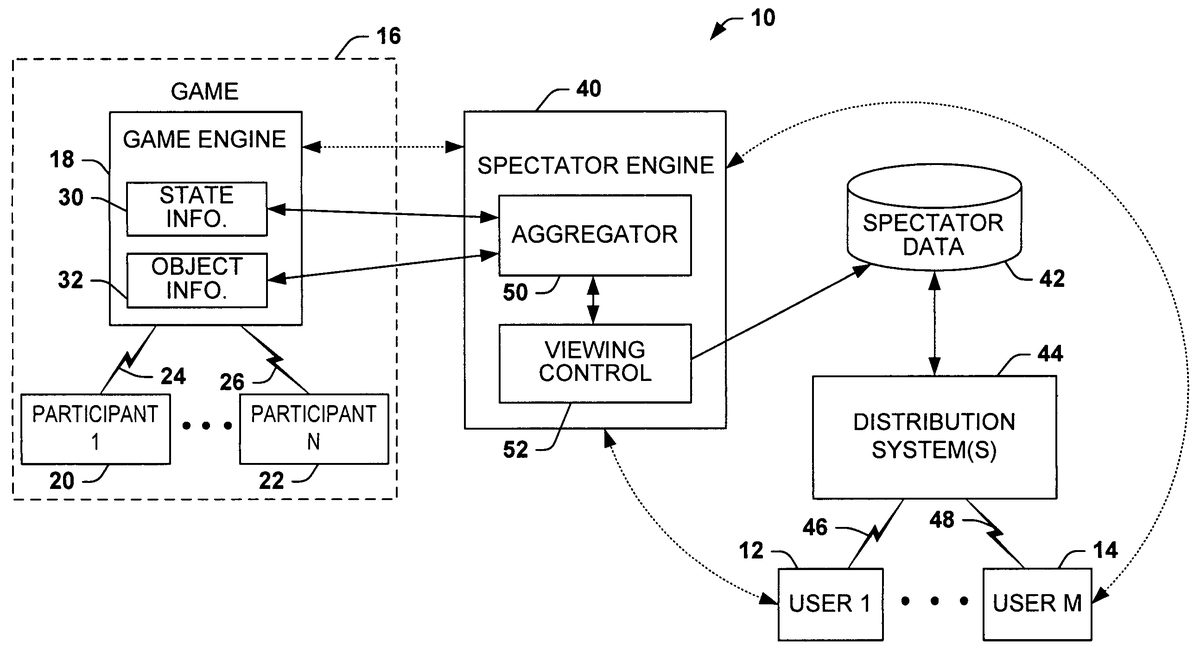
DESCRIPTION FIG. 1illustrates an example of a system10operative to provide a spectator experience to one or more users (USER1through USER M, where M is a natural number)12and14in accordance with an aspect of the present invention. The system10includes an occurrence of a game or event16. For purposes of simplicity of explanation, the occurrence of a game or event is hereinafter referred to as a “game”, although it is to be appreciated that the present invention is not limited to games. The game16can include a live, real time occurrence and/or be based on stored data for a previous occurrence thereof. The game16includes a game engine18with which one or more participants20and22can interact with other participants and/or with items that form part of the environment within the game. The participants20and22are indicated as “PARTICIPANT 1” to “PARTICIPANT N”, where N is natural number greater than or equal to 1. It is to be appreciated that the participants20and22can be associated with live persons and/or be computer implemented and controlled. By way of example, the game engine18is implemented as a process running at one or more computers programmed to facilitate interaction between participants20and22and the game16. The participants20and22are coupled to the game engine18through respective communication links24and26. The links24and26can be direct or indirect connections, such as through one or more proxy servers. Each participant20,22provides instructions to the game engine18that indicate a manner in which each respective participant is to interact with the game. Such instructions affect the game16, including the relationship of participants20and22and other attributes of the game. The game engine18, for example, includes one or more interfaces that expose methods and/or functions associated with the game16. The interfaces enable participants20and22to communicate with the game16, such as by a corresponding process running at each participant that facilitates communication of game data between the participant process and the game engine18. ...
DESCRIPTION
FIG. 1illustrates an example of a system10operative to provide a spectator experience to one or more users (USER1through USER M, where M is a natural number)12and14in accordance with an aspect of the present invention. The system10includes an occurrence of a game or event16. For purposes of simplicity of explanation, the occurrence of a game or event is hereinafter referred to as a “game”, although it is to be appreciated that the present invention is not limited to games. The game16can include a live, real time occurrence and/or be based on stored data for a previous occurrence thereof.
The game16includes a game engine18with which one or more participants20and22can interact with other participants and/or with items that form part of the environment within the game. The participants20and22are indicated as “PARTICIPANT 1” to “PARTICIPANT N”, where N is natural number greater than or equal to 1. It is to be appreciated that the participants20and22can be associated with live persons and/or be computer implemented and controlled.
By way of example, the game engine18is implemented as a process running at one or more computers programmed to facilitate interaction between participants20and22and the game16. The participants20and22are coupled to the game engine18through respective communication links24and26. The links24and26can be direct or indirect connections, such as through one or more proxy servers. Each participant20,22provides instructions to the game engine18that indicate a manner in which each respective participant is to interact with the game. Such instructions affect the game16, including the relationship of participants20and22and other attributes of the game. The game engine18, for example, includes one or more interfaces that expose methods and/or functions associated with the game16. The interfaces enable participants20and22to communicate with the game16, such as by a corresponding process running at each participant that facilitates communication of game data between the participant process and the game engine18.
By way of further illustration, the game engine18includes state information30and object information32. The state information30includes parameters, which have values that define the status and relationship of the participants20and22relative to the game16. The state information30is continually updated as a function of time in response to instructions received (and/or the absence of instructions) from the participants20and22. The state information30further can include a time stamp to facilitate synchronization of game data for each of the participants20,22. The state information30, for example, can include a relative game time (e.g., via the time stamp), the relative position or condition of the participants20and22(e.g., health, strength, abilities, etc.), historical or biographical information, etc. The object information32provides information about the geometry of the game16. The object geometry, for example, can identify the relative position of participants20and22, and other items and features associated with the game16.
The object information32together with the state information30(or relevant selected portions thereof) can be provided to each participant20,22to help render an animated representation of the game for each respective participant. Corresponding audio information also can be generated for each participant20,22based on the state and object information30and32and instructions provided at the participants.
The system10also includes a spectator engine40in accordance with an aspect of the present invention. The spectator engine40, for example, includes a process running on one or more computers (e.g., a server) that operatively communicates with the game engine18, such as through interfaces of the game engine. The spectator engine40receives information indicative of the occurrence of the game16, based on which it can generate spectator data42that may be provided to the spectators12and14. In particular, one or more distribution systems44may employ the spectator data to, in turn, distribute (or broadcast) a corresponding signal to the spectators12and14based on the spectator data. The spectators12and14receive the distributed spectator information from associated distribution system44via communication links46and48. The communications links46and48, for example, can be direct connections, such as wired (e.g., optical or electrically conductive) or wireless connections, or indirect connections through one or more proxies. The links46and48also could be unidirectional or bidirectional communications channels.
By way of further example, the spectator engine40includes an aggregator50that receives the state information30and the object geometry information32from the game engine18. As mentioned above, the state information30and object information32collectively indicate where all the players are, the condition of the game environment and players, as well as other attributes associated with the occurrence of the game. Such information is sufficient to reconstruct the game16, including audio and video features for each of the players. As a result, the spectator engine40can provide the spectator data42, based on which a representation of the spectator experience can be generated at the spectators12and14.
A viewing control component52is coupled to the aggregator50to receive the aggregated game data. The viewing control52processes the aggregated data to provide enhanced spectator data. In one aspect of the present invention, the viewing control52can implement virtual camera control in which a plurality of virtual cameras are utilized to provide a cinematic features, such as to provide spectators with desirable viewing angles. For example, the virtual cameral control can automatically select virtual cameras, such as based on preprogrammed cinematographic algorithms, or manually, such as based on instructions from an authorized person or spectator (e.g., a human director). In addition, a spectator12,14could employ virtual camera control to select a desired viewpoint to observe the occurrence of the game. For example, a spectator can select to move between different virtual cameras, to couple the virtual camera with one or more participants of the game16, or implement an automatic camera control based on designated spectator preferences.
The virtual camera of the viewing control52also can be loosely coupled with a participant, such as to follow that participant's activities in the game. In certain types of games, for example, an over the shoulder view of a selected player can be utilized to visualize part of the game from the perspective of that player. The viewing control52further can dampen motion of the participant in the representation provided to the spectators12and14so as to mitigate quick jerky movements, which are not visually pleasing.
In accordance with an aspect of the present invention, the spectator engine40also can provide an indication (or representation) of the spectator audience in the spectator data42. For example, a spectator consciousness can include presenting an indication (e.g., audio and/or visual) of the spectators of the game16. This can include an indication about the number of spectators in the audience. Additionally or alternatively, a group of spectators further can be associated with each other, such as through a messaging service, to enable communication between such spectators during the spectator experience for the game16. Accordingly, the spectators12and14can be more than passive observers of the game isolated from the other spectators. Instead, spectators can “feel” the presence of other spectators, have side conversations, etc.
In accordance with another aspect of the present invention, an indication of some or all spectators can be fed back to the participants20and22through the spectator engine40. The indication can be provided to the participants20and22based on corresponding parameters of the state information30, which are updated based on the number of spectators. By way of example, the indication can be a graphical, textual, and/or audible indication of the number of spectators in the spectator audience. The identity of certain spectators also could be revealed to selected participants during the game16, such as based on a messaging system in which the selected participants have been previously associated with the spectators. That is, the spectator engine40can interface with the game engine18in a manner similar to the participants20and22, but collectively representing the spectators12and14of the game16by updating state and object information30and32based on the presence and/or interactions of the spectators. As a result, the game experience provided to the participants20and22and/or the spectator experience provided to the spectators12and14can simulate a live game or event. That is, both the game and the spectator experience can implement features that cause the spectators and participants to be aware of each other.
In situations when the broadcast of the game16by the distribution system44is offline (e.g., a delayed transmission), a postproduction phase could be utilized to further enhance the spectator experience. For example, improved animation and rendering could be implemented, which otherwise might not be available in a real time processing. Editing, highlights and/or fanciful replays also could be used. In such circumstances, the features relating to audience awareness and interactions between associated spectators can still enrich the spectator experience beyond a passive experience.
Various possible architectures exist in which the system10could be implemented in accordance with an aspect of the present invention. Even within a given architecture, more than one possible implementation might exist. Typically, the architecture and implementation therein, will be driven by bandwidth considerations associated with the communication links by which the participants20and22and the spectators12and14receive and/or transmit information.
By way of illustration, in a high bandwidth environment, the entire spectator experience including graphical and/or audio elements can be rendered from the spectator data42and then be transmitted over the distribution system(s)44to the spectators12and14. In other circumstances, partial rendering may occur at the spectators12and14and prior to transmission from the distribution system44. Some of the logic and graphical features further could be transmitted to the spectators12and14to facilitate generation of the spectator experience at the spectators12and14. In low bandwidth environments, it may be desirable to store most of the logic and graphical elements operative to generate the game environment at the spectators12and14(e.g., in CD ROM, DVD, hard disk drive, etc.), such that appropriate graphical and/or audio data can be accessed from such stored data to more rapidly create the spectator experience based on the spectator data. Alternatively or additionally, the spectators12,14could employ game consoles, such as are operative to connect to the Internet or other communication frameworks. In another aspect, the spectators12and14could include televisions that receive the spectator experience as conventional broadcast data (e.g., broadband cable, digital cable, satellite, streaming, etc.). It is to be appreciated that a spectator could employ more that one communications infrastructure to communicate data that creates the spectator experience.
FIG. 2illustrates an example of a system100that facilitates accessing spectator experiences for more than one game in accordance with an aspect of the present invention. The system100includes a portal102, which may be a Website or other service, to which one or more users104and106(USER1to USER M, where M is a natural number) may connect. The users104and106, for example, can include any microprocessor-based device (e.g., PC, workstation, handheld appliance, entertainment or game console, etc.). The users104and106connect to the portal102via associated communication channels108and110. The communication channels108and110could be direct or indirect connections and can implement wired and/or wireless communication protocols over any communications framework.
In accordance with an aspect of the present invention, the portal102provides information112and114about one or more games, indicated as GAME1to GAME N, wherein N is a natural number greater than or equal to one. In essence, the portal102operates as a spectator of each of the games GAME1to GAME N. That is, it extracts information from spectator experiences for GAME1to GAME N (and/or directly from such games) and presents the information at a single location (e.g., the portal) to facilitate access to the information about associated spectator experiences GAME1to GAME N.
By way of illustration, the game information112and114can identify games by name. The game information also can include information about the participants of the games, such as statistical information, an identification of the players by name (or by alias). Spectator information also can indicate the number of spectators.
In certain circumstances, the spectator information112,114further can indicate the identity of selected spectators. The portal102can employ an existing messaging service116in combination with the game information to locate and identify other spectators and/or participants that are associated with each other through the messaging service. For example, specific participants and/or spectators may be identified to selected users104,106of the portal102, such as according to a public key shared between the selected users and the specific participants and/or spectators. The identification of particular participants and/or spectators further facilitates instant messaging by which mutually identified users of the portal can communicate with each other. Similarly, users of the spectator experience can employ the messaging service116to provide other users links to active spectator experiences and or commentary about the games themselves. Such an arrangement also affords spectator participation, such as in the form of audience feedback, although spectator participation could be implemented using other techniques.
In accordance with an aspect of the present invention, the game information112and114is provided based on information collected from (or provided by) associated spectator experiences120and122. The spectator experiences120and122, for example, include real time distribution (or broadcast) of spectator information pertaining to GAME1and GAME N. Accordingly, as each game GAME1, GAME N progresses, the game information112,114is updated, such as at periodic intervals or continuously. It is to be appreciated that the real time distribution of the game can be of a live or delayed occurrence of the game.
Each spectator experience120,122is produced based on spectator data provided by a spectator engine124,126in conjunction with game data provided by a game engine128,130for each corresponding game GAME1, GAME N. The spectator engine120,122aggregates game data from the game engine128,130and implements selected viewing controls to provide corresponding spectator data. The spectator data is then rendered (e.g., before and/or after its distribution) to provide graphics and/or audio associated with the spectator experience120,122. It is to be appreciated that the resulting representation of a spectator experience120,122can be customized, such as based on user preferences and spectator parameters selected by respective spectators.
In accordance with an aspect of the present invention, the portal102also provides a link to facilitate access to the spectator experiences120and122identified at the portal. For example, the game information112and114include user interface elements that can be selected by the users104and106to redirect the users to the location of the associated spectator experiences120and122.
FIG. 3illustrates another condition of the system100ofFIG. 2, in which identical reference characters refer to features previously identified with respect toFIG. 2. InFIG. 3, the user104is connected to the spectator experience120of GAME1via communications link132and the user106is connected to the spectator experience122of GAME N via communications link134. It is to be appreciated that any number of users can access any of the spectator experiences120and122via the portal102. Further, a user could log on to more than spectator experience concurrently. When a user104,106logs on (or connects) to a spectator experience120,122, that user becomes a spectator and the corresponding game and spectator information112and114at the portal102is adjusted accordingly.
FIGS. 4,5, and6are examples of graphical representations that could be employed to implement various aspects of a portal and/or spectator experience in accordance with an aspect of the present invention. The graphics could be provided at websites, for example, which can be accessed from a remote computer, a handheld appliance, a game console, etc. It is to be appreciated that the illustrated graphical representations are for purposes of simplicity of explanation and that any configuration of display and graphical user interface may be implemented in accordance with an aspect of the present invention.
Referring toFIG. 4, an example of a graphical user interface150for a portal is illustrated. As mentioned, the portal may be implemented at a Website that collects information from and spectator experiences associated with games and/or from one or more games. The interface150includes a plurality of user interface elements152, each associated with a different occurrence of a game. That is, more than one occurrence of a given game can exist concurrently.
By way of example, each user interface element152can present a variety of information about the occurrence of the associated game, including an image154for the game, the name of the game156, the number of players158, and the number of spectators160. Each item of information154-160further can be implemented as a user interface element, which, upon being activated, presents additional related information. For example, by selecting the image element154, highlights of the current game may be presented to the user, such as by streaming or other communication protocols. The PLAYERS interface element158can be activated to provide information about the top-rated players, such as player statistics, highlights for such players from the present and/or previous games, etc.
The interface150also can include user interface elements or links to other related websites and/or services. By way of example, the interface can include selectable buttons or links, generally indicated at162, which include: a link to the service provides homepage (HOME); an interactive of list of new games and/or games for which new spectator services are available (WHAT'S NEW); an interactive list of games having the largest following, such as based on the size of audience and/or number of participants (WHAT'S HOT); and an interactive list for star participants of selected games (STAR PLAYERS). The interactive list of stars, for example, can provide links to Web pages that contain more detailed information about each star player, such as statistical information, biographical information, etc.
The illustrated interface150also includes a BUDDIES user interface element164that provides information indicative of other persons logged on as spectators that are linked or associated with the user of the interface, such as by identifying characteristics shared between two or more users (e.g., through an instant messaging service). The BUDDIES interface element164, for example, is a button or link that accesses another Web page or service operative to provide additional information about the user's associates. Such information can include a representation of the associate (e.g., graphical and/or textual) as well as each associate's location, namely, an indication of which game(s) the associate is a spectator.
FIG. 5illustrates an example of another graphical user interface180that provides information about a user's associates in accordance with an aspect of the present invention. The interface180can include selectable buttons or hypertext links182, (e.g., HOME, WHAT'S NEW, WHAT'S HOT, and STAR PLAYERS), such as described above with respect toFIG. 4.
The interface180also can include user interface elements184for each associate that currently is a spectator of one or more games. By way of example, each user interface elements184includes a representation interface element186of the respective associate. The representation element186can include a graphical and/or textual representation of the associate as well as provide a link to the location(s) (e.g., URL(s)) where the associate is located. The interface elements184also include a location interface element188corresponding to the location of the user's associates. The location interface element188might identify which game the associate is a spectator of as well as provide a link to the spectator experience (and location therein) where that associate is located. Thus, by activating or selecting one of the interface elements186,188, a user may access the spectator experience in which the user's associate already is a spectator.
FIG. 6illustrates a diagrammatic representation200of a spectator experience, such as could be provided by a spectator engine in accordance with an aspect of the present invention. In this example, the representation200includes one or more players202that interact with a game environment204. It will be understood and appreciated by those skilled in the art that a spectator experience could be implemented for any type of game or event (e.g., action video games, adventure video games, board games, music and theatrical performances, sporting events, etc.) in accordance with an aspect of the present invention.
The representation200also includes an indication of spectators206of the game being played. The indication of spectators206, for example, can be represented in a graphical, textually and/or audible manner, such as to provide audience awareness for all spectators. In one particular aspect, spectators can be arranged in groups so that associated spectators of a given game are more specifically identified with each other, such as through a messaging service. Accordingly, a group of friends can spectate a game as a group. A given spectator further can be associated with more than one group and communicate with others in the group. The messaging service further can enable communication (e.g., voice, text, and/or video) between the associated spectators. An indication of the spectator' presence also can be provided to the players of a given game, such as in the form of audio, text and/or a graphically created audience based on the spectator information.
Another aspect of the present invention provides a mechanism to provide other information that might be useful to spectators. For example, an advertisement (or link)208for one or more related games could be provided to the spectators. Those skilled in the art will understand and appreciate various presentation formats that could be utilized. For example, the advertisement can be in the form of a HTML or DHTML DIV that provides a message about the item for sale together with selectable buttons to buy the offered item or cancel the advertisement. Such functionality can be controlled by individual spectators and/or by the service that provides the spectator experience.
FIG. 7illustrates an example of a functional block diagram of a system210operative to implement viewing controls for a spectator experience in accordance with an aspect of the present invention. The system210includes an interactive user process212, which can run locally at a user device (e.g., a PC, a game console, a handheld device, etc.) and/or at another machine, such as in a distributed computing environment. The user process212is programmed to control the representation of the game or event being provided at the user.
By way of example, the user process212includes viewing controls214, which control the representation of graphical features displayed to the spectator. In accordance with an aspect of the present invention, the viewing controls214can be programmed to select viewing angles for a virtual camera216associated with the spectator experience of the game. For example, the viewing control214can access stored viewing data218, which includes graphical and/or logical elements associated with the game. The virtual camera216thus can aggregate the stored graphical (and/or audio) viewing data218and the spectator data to provide a corresponding representation as part of the spectator experience. The user process212also includes a user interface220operative to select one or more camera control methodologies to implement a desired viewing angle, to follow actions of one or more players, and/or otherwise customize the user's spectator experience. Alternatively or additionally, the viewing controls214can create a spectator experience based on historical viewing selections of a user and/or based on preselected viewing preferences.
The viewing controls214also can be coupled to a renderer222that renders a corresponding animated graphical visualization224for the associated spectator experience based on processed spectator data provided by the viewing controls. The renderer222can be implemented as part of the user process212and/or as part of a service implemented in conjunction with the spectator engine226, such as illustrated in phantom.
The spectator engine226also can implement a central viewing control component228. The central viewing control component228, for example, can determine what spectator data should be routed to each user process212, such as by filtering extraneous information from the aggregated game data collected from an associated game engine230or adding other enhancements thereto. In one aspect, the viewing controls214and228might cooperate to affect different granular levels of the spectator experience, such that the central viewing control implements basic, high level controls with user viewing controls214implementing user specific, customized spectator features.
By way of illustration, the spectator experience can be programmed to implement automatic as well as manual (e.g., user-selected) virtual camera control. When operating in an automatic mode, the central viewing controls228operate in conjunction with various components of the spectator engine226to provide a selected subset of the aggregated data to the user process212. The selected subset of data, for example, includes information about the current occurrence of the game (e.g., participant interaction, description of events, etc.) and state information. The viewing controls228, in turn, determine virtual camera placement for the selected data based on a defined rule set, which can be based on cinematographic heuristics for selecting good viewpoints and/or idioms for capturing the interesting circumstances or events associated with a game. The camera specification data is provided to the renderer220. The renderer220generates a visual representation of the game using animation parameters and a description of the current game environment, such as provided by the game engine230as well as based on the camera specification derived by the viewing controls228.
It is to be appreciated that the particular implementation of the renderer(s)220and viewing controls214,228generally will vary according to the architecture in which the system210is implemented.
FIGS. 8-12illustrate examples of architectures that can be utilized to implement a spectator experience in accordance with an aspect of the present invention. It will be understood and appreciated that a spectator experience is not limited to being implemented according to the illustrated architectures, as other suitable arrangements exist.
FIG. 8shows a basic architecture240in which a spectator system can be implemented as part of a client-server model in accordance with an aspect of the present invention. The architecture240includes a plurality of users242that communicate with a server244, such as via associated communications links. The users242, for example, include the graphical and logical elements for an associated game (or games) to facilitate generation of the spectator experience. The executable instructions that include the logical and graphical elements of the game, such as include the game engines or a spectator version thereof, could be provided to the users via CD (e.g., a spectator CD or game CD), or be downloaded via the Internet and stored at the users242.
The server244, for example, is operatively coupled to a game server246for receiving game data that varies over time. The game server246, for example, could provide a file or stream data corresponding to a replay of previously played game, which information identifies state changes of the game over time. The server244processes the game and enhances the data to include spectator features in accordance with an aspect of the present invention. The server244then distributes the enhanced spectator data to the users242, which generate corresponding spectator experiences. The server244further can enable interactive communication between the users242during a shared spectator experience, such as in conjunction with an associated messaging service.
The servers244and246also can be operatively coupled to a spectator Website248, which can be hosted by one of the servers244,246or one or more other machines. The Website248, for example, provides a portal through which the users242can access the spectator experience for an occurrence of a game at the server246. The Website248could also provide spectator information about other games. For example, the server244can provide the Website248with statistical information about the participants of the game, information about the pool of spectators of one or more games, as well as other game-related information.
FIG. 9illustrates another architecture250that can be utilized to implement a spectator experience in accordance with an aspect of the present invention. The architecture250includes a game server252to which one or more game clients254are operatively coupled to participate in an occurrence of a game. Game and movement information, including state information and object geometry information, is communicated between the game server252and each of the game clients254. As a result, each of the clients254is able to generate a unique multiplayer game experience based on their interactions with and information provided from the game server252.
The game server252is coupled to a spectator server256to provide an indication of the game and movement information. The game server252, for example, provides live (or delayed) game data to the server256, such as in response to interactions from one or more participants254of the game. The spectator server256distributes to spectators258corresponding spectator data for the game based on the game data provided from the game server252. The spectator data can include the game and movement information (or at least selected portions thereof) received from the game server252. The spectator data also can include other spectator data, such as statistical information about the game and/or its participants, highlight footage from a current or previous games, information about the spectators of the current game, etc. The spectators258, for example, are programmed with graphical and logical elements for the game, so that a representation of an associated spectator experience can be generated based on the spectator data from the server256. Accordingly, the representation of the spectator experience can be rendered locally at each spectator258. The spectators258further can control different aspects of the spectator experience, such as selecting parameters to define camera angle and viewpoints.
The servers252and256also can be coupled to a spectator Website260that collects spectator data and game data. One of the servers252,256can host the Website260, or it can be hosted by one or more other computers. By way of illustration, the Website260provides a portal through which the users can obtain information about a spectator experience for one or more games. For example, the server252can provide the Website260statistical information about the participants of the game, information about the pool of spectators258of one or more games, as well as other game-related information. Such information can be utilized to provide enhanced features for a spectator experience, such as described herein.
FIG. 10illustrates another architecture264that can be utilized to provide a spectator experience in accordance with an aspect of the present invention. The architecture264includes a game server266that provides a multiplayer game to which one or more participants or game clients268can connect to play an occurrence of the associated game. Accordingly, game and movement information are communicated between each of the game clients268and the game server266during the occurrence of the game.
A spectator server270is operatively coupled to the game server266, such as through an associated communication link. The spectator server270receives state and object geometry information from the game server266based on which the spectator server can generate a spectator experience that includes some or all of the participants at the game clients268. The spectator sever270, for example, includes the logical and graphical elements for the game as well as viewing controls for implementing cinematographic functionality that determines the virtual camera position and viewing angle. The spectator server270further can remove obstructions, enhance graphics or perform other actions to make a resulting spectator experience more visually pleasing. The spectator server270can render a scene of the game based on the viewing control data and animation parameters associated with the current description of the game. The rendered data is provided to a distribution system272. The distribution system272, for example, includes an encoder operative to distribute (e.g., stream) the rendered spectator experience to one or more spectators274of the game. In this particular example, it is not necessary that the graphical and logical elements of the game be stored at the spectators274, as the spectator experience is rendered (at least in part) prior to being distributed by the distribution system272.
The architecture264includes a spectator Website276, such as hosted by one or more servers, with which the game server266and spectator server270can communicate. The Website276, for example, collects information about the occurrence of the game at the game server266, such as player information or other events that transpire within the game. The Website276also can collect and post information about spectators274, such as information about the number of spectators as well as contain an indication of their identity, such as could be implemented in conjunction with a messaging system. Highlights and sample spectator scenes also can be available at the Website276. The spectator server270and/or the game server266can utilize the aggregated information to further augment the spectator experience and/or the game itself, respectively.
FIG. 11illustrates another example of an architecture280that can be utilized to implement a spectator experience in accordance with an aspect of the present invention. The architecture280is similar to the architecture264ofFIG. 10, except for the manner in which the spectator experience is distributed and received.
Briefly stated, the architecture280includes a game server282to which one or more participants or game clients284are connected to communicate game and movement information therebetween. This creates a game that varies over time according to the interaction of the participants at the clients284.
A spectator server286is operatively coupled to the game server282such as to receive state and object geometry information from the game server, similar to the game clients. The spectator server286is programmed to implement cinematographic methods or functions to determine the graphical and functional features that are to be provided as part of a spectator experience. An animated representation of the spectator experience is rendered based on selected game and animation parameters associated with the current game.
The rendered data is provided to a distribution system288to distribute (e.g., broadcast) a representation of the rendered spectator experience to one or more spectators290of the game. In the example ofFIG. 11, the distribution system288is a broadcast system operative to broadcast the spectator experience over one or more associated media. For example, the broadcast can be a satellite transmission, broadband cable, digital cable, cellular transmission, etc. The spectators290, which may include televisions or other entertainment appliances, are configured to receive and decode the broadcast data and provide a corresponding visual and/or audio representation of the spectator experience. The communication between the spectators and the broadcast system can be bidirectional with communication over one or more media so that spectator information can be provided back to the spectator server286.
The architecture280also can include a spectator Website292that communicates with the game server282and spectator server286. The Website292, for example, collects information about the occurrence of the game at the game server282, such as player information or other significant events associated with the game. The Website292also can collect and post information about spectators, such as information received at the spectator server286from the spectators290, including an indication of the number of spectators, an indication of their identity, and/or commentary from the spectators. Highlights and sample spectator scenes also can be available at the Website292. The spectator server286and/or the game server282can utilize information aggregated at the Website292to augment the spectator experience and/or the game itself, respectively. Alternatively or additionally, such information can be communicated between the servers282and286.
FIG. 12illustrates an example of a multi-game spectator system300implemented in accordance with an aspect of the present invention. The system300includes three games302,304, and306, although it is to be appreciated that any number of one or more games could be implemented in the system. Each of the games302,304,306includes one or more participants. Each game is associated with a Website308, such as may be hosted by one or more servers. The Website308is programmed and/or configured to present information about each of the games302,304, and306. Accordingly, the games302,304, and306feed information to the Website308. The information, for example, includes statistical information (e.g., number of players, number of participants, performance rating, rankings of players, etc.), highlights from current and/or recent games, interactive spectator activities, and/or links to connect users of the Website to game servers and/or spectator servers for each game302,304,306.
One or more users310can access the Website308through a communications framework312, such as the Internet. Accordingly, the users310can obtain information about one or more of the games302,304, and306. In addition, the users310can utilize the Website308to connect to a game or spectator experience associated with one or more of the games302,304, and306. By way of illustration, the Website308provides a portal by which users can become spectators or participants of the games302,304, and306. A user310thus can connect to the Website308and, by selecting an appropriate link, be redirected to a location (e.g., a URL associated with a server) at which the game or spectator experience exists. That is, the Website308facilitates connecting users310with servers hosting a game or spectator experience.
For sake of brevity, an example of a subsystem architecture is illustrated for the game304. It is to be understood and appreciated that similar architectures, which can differ from that of the game304, are implemented in connection with the other games302and306in accordance with an aspect of the present invention.
The game304includes a game server314and a spectator server316. The game server310is operatively coupled to one or more game clients318. The game clients318, for example, can include PCs, game consoles, workstations, handheld devices, and other entertainment appliances. The game clients318interact with the game server314through physical and/or wireless connections, such as by communicating game and movement information. Such interactions define the state and object geometry for the occurrence of the game.
The game server314also communicates information to and/or from the Website308. For example, the game server314can provide game and movement information associated with an occurrence of the game from which a spectator module associated with the Website308can generate a representation of the data (e.g., highlights, examples of recent play, etc.). The Website308also can provide feedback to the game server314, such as including an indication of the spectator audience. For example, the game server314can employ the feedback to create an indication of a spectator presence that can communicate to each game client318. The spectator presence can take any form within the game, such as can include audio and/or graphical features implemented as part of the multiplayer game.
One or more spectators320can be connected to the spectator server316. Game and movement data can be communicated from the game server314to the spectator server316, based on which the spectator server can generate a spectator experience that is provided to the spectators320in accordance with an aspect of the present invention. The spectator server316also can collect information from the spectators320, such as to discern the number of spectators as well as an indication of their identity. Spectators320also can provide commentary and/or other spectator feedback to the spectator server316. The spectator server316, in turn, can pass such information to the Website308and/or to the game server314. Such information can include an indication of the number of spectators320, an indication of the identity of the spectators, as well as other information about the interaction between spectators and the spectator experience being provided by the server316. The spectators320also could provide instructions to the spectator server316to control graphical and/or audio that form the spectator experience. For example, the spectators320can be programmed and/or configured to implement viewing controls to selectively control what aspects of the game and the level of zoom are used to create a representation of a spectator experience. It is to be appreciated that the viewing controls can be implemented locally at each spectator320and/or remotely at the spectator server316.
The spectator server316also can communicate with the game server314, such as by providing the game server314information about the spectators and the spectator experience. The game server314, for example, can employ such information to implement spectator effects within the occurrence of the game (or games) at the game server. As a result, the participants of the game at the game clients318can perceive the presence of the spectator audience.
In order to provide additional context for various aspects of the present invention,FIG. 13and the following discussion are intended to provide a brief, general description of one possible suitable environment400in which the various aspects of the present invention may be implemented. It is to be appreciated that the computing environment400is but one possible computing environment and is not intended to limit the environments with which the present invention can be employed. Those skilled in the art will appreciate that the inventive methods may be practiced with other system configurations, including single-processor or multiprocessor computer systems, minicomputers, mainframe computers, as well as personal computers, hand-held computing devices, microprocessor-based or programmable consumer electronics, video game consoles, and the like.
The illustrated aspects of the invention may also be practiced in distributed computing environments where certain tasks are performed by remote processing devices that are linked through a communications network. In a distributed computing environment, program modules may be located in both local and remote memory storage devices.
While various aspects of the present invention have been described above in the general context of computer-executable instructions that may run on one or more computers or other microprocessor-based equipment, it is to be recognized that the invention also may be implemented in combination with other program modules and/or as a combination of hardware and software. Generally, program modules include routines, programs, components, data structures, etc. that perform particular tasks or implement particular abstract data types.
FIG. 13illustrates one possible hardware configuration to support the systems and methods described herein. It is to be appreciated that although a standalone architecture is illustrated, that any suitable computing environment can be employed in accordance with the present invention. For example, computing architectures including, but not limited to, stand alone, multiprocessor, distributed, client/server, minicomputer, mainframe, supercomputer, digital and analog can be employed in accordance with the present invention.
With reference toFIG. 13, the exemplary environment400for implementing various aspects of the invention includes a computer402, including a processing unit404, a system memory406, and a system bus408that couples various system components including the system memory to the processing unit404. The processing unit404may be any of various commercially available processors. Dual microprocessors and other multi-processor architectures also can be used as the processing unit404. The computer402and/or portions thereof may be implemented as any electronic appliance operable to communicate with a Web-based service, such as, for example, a telephone (wired or wireless), a personal computer (PC) (e.g., handheld, desktop, portable, etc.), a roaming PC, a PDA, game console or entertainment appliance, or any other suitable microprocessor-based appliance.
The system bus408may be any of several types of bus structure including a memory bus or memory controller, a peripheral bus, and a local bus using any of a variety of commercially available bus architectures. The system memory406includes read only memory (ROM)410and random access memory (RAM)412. A basic input/output system (BIOS)414, containing the basic routines that help to transfer information between elements within the computer402, such as during start-up, is stored in ROM412.
The computer402may further include a hard disk drive416, a magnetic disk drive418, e.g., to read from or write to a removable disk420, and an optical disk drive422, e.g., for reading and/or writing data relative to424optical media. The hard disk drive416, magnetic disk drive418, and optical disk drive422are connected to the system bus408by a hard disk drive interface426, a magnetic disk drive interface428, and an optical drive interface430, respectively.
The computer402typically includes at least some form of computer readable media. Computer readable media can be any available media that can be accessed by the computer402. By way of example, computer readable media may comprise computer storage media and communication media. Computer storage media may include volatile and nonvolatile, removable and non-removable media implemented in any method or technology for storage of information such as computer readable instructions, data structures, program modules, or other data. Computer storage media may include RAM, ROM, EEPROM, flash memory or other memory technology, CD-ROM, digital versatile disks (DVD), or other magnetic storage devices, or any other medium which can be used to store the desired information and which can be accessed by the computer402. Communication media typically embodies computer readable instructions, data structures, program modules or other data in a modulated data signal such as a carrier wave or other transport mechanism and includes any information delivery media. A modulated data signal includes a signal that has one or more of its characteristics set or changed in such a manner as to encode information provided in the signal. By way of example, communication media may include wired media such as a wired network or direct-wired connection, and wireless media such as acoustic, RF, optical and other wireless media. Combinations of any of the above should also be included within the scope of computer readable media.
A number of program modules may be stored in the drives and RAM412, including an operating system432, one or more application programs434, other program modules436, and program non-interrupt data438. The operating system432in the illustrated computer can be any of a number of commercially available or proprietary operating systems.
A user may enter commands and information into the computer402through a keyboard440and a pointing device, such as a mouse442. Other input devices (not shown) may include a microphone, an IR remote control, a joystick, a game pad, a satellite dish, a scanner, or the like. These and other input devices are often connected to the processing unit404through a serial port interface444that is coupled to the system bus408, but may be connected by other interfaces, such as a parallel port, a game port, a Universal Serial Bus (“USB”), an IR interface, etc. A monitor446, or other type of display device, is also connected to the system bus408via an interface, such as a video adapter448. In addition to the monitor, a computer typically includes other peripheral output devices (not shown), such as speakers, printers etc.
The computer402may operate in a networked environment using logical connections to one or more remote computers, such as a remote computer(s)460. The remote computer(s)460may be a workstation, a server computer, a router, a personal computer, a microprocessor based entertainment appliance, a peer device, or other common network node. The remote computer may include many or all of the elements described relative to the computer402, although, for purposes of brevity, only a memory462is illustrated. The logical connections depicted include a local area network (LAN)464and a wide area network (WAN)466, such as the Internet. Such networking environments are commonplace in offices, enterprise-wide computer networks, intranets, and the Internet.
When used in a LAN networking environment, the computer402is connected to the local network464through a network interface or adapter468. When used in a WAN networking environment, the computer402typically includes a modem470, or is connected to a communications server on the LAN, or has other means for establishing communications over the WAN466. The modem470, which may be internal or external relative to the computer402, is connected to the system bus408via the serial port interface444. In a networked environment, program modules436, application programs, or portions thereof, may be stored in the remote memory storage device462. Similarly, when the computer402stores target data, such data may be stored in memory426,428,430of the computer or remote memory462. It will be appreciated that the network connections shown are exemplary and other means of establishing a communications link between the computers can be used.
In view of the exemplary systems shown and described above, methodologies, which may be implemented in accordance with the present invention, will be better appreciated with reference to the flow charts ofFIGS. 14 and 15. While, for purposes of simplicity of explanation, the methodologies are shown and described as implementing serially, it is to be understood and appreciated that the present invention is not limited by the illustrated order, as some features can, in accordance with the present invention, occur in different orders and/or concurrently with other features shown and described herein. Moreover, not all illustrated aspects may be required to implement a methodology in accordance with the present invention. In addition, the methodologies ofFIGS. 14 and 15may be described in the general context of computer-executable instructions, such as program modules, executed by one or more computers or other devices. Generally, program modules include routines, programs, objects, components, data structures, etc. that perform particular tasks or implement particular abstract data types. Typically the functionality of the program modules may be combined or distributed as desired in various embodiments.
FIG. 14illustrates an example of a methodology for providing a spectator experience in accordance with an aspect of the present invention. At500, general initializations occur, such as in connection with activation of a game or event. Such initializations might include allocating memory, establishing pointers, establishing data communications, acquiring resources, instantiating objects and setting initial values for variables.
At502, game data is received. The game data, for example, can include state information and object geometry information, which can vary in response to player interaction during the occurrence of the game. The state and object geometry information, for example, are sufficient to generate an audio and/or visual representation of the occurrence of the game in conjunction with stored graphical and functional features corresponding to the game.
At504spectator data also is received, such as from users of the spectator experience, a game server, or another service that collects such information. The spectator data, for example, can provide an indication of the number and/or identity of spectators operatively associated with the occurrence of a game or event. The spectator data also could provide spectator preference information. The spectator preference information can be utilized to implement desired camera control, such as to focus the spectator experience on activities of one or more selected players of the game. The spectator preferences also can be used to control other spectator effects to be implemented in connection with the spectator experience.
At506the game data is aggregated with spectator control data. The aggregation could include a correlation of the game data, such as filtering out of extraneous game data in view of the spectator data. In addition or alternatively, the aggregation can place the aggregated data into a specified format to facilitate processing thereof.
At508, viewing control is implemented. The viewing control can include manual and/or automatic control of one or more virtual cameras operative to configure the spectator experience. Manual control could be implemented by one or more persons selectively editing portions of the game into the spectator experience. Automatic camera controls, for example, select viewing angles by employing virtual cameras arranged throughout the environment that operate according to cinematographic heuristics implemented as cinematographic virtual camera control algorithm. Some of the camera control information also can be selected by the spectators, such as being associated with a given player or players and/or a selected level of resolution.
The viewing control, for example, can be used to select which graphical and and/or audio data are to comprise the spectator experience. The graphical features can include the viewing angle and/or applicable zoom to be applied relative to each scene. In addition, viewing control can implement other spectator features, such as an indication of the spectator audience by adding graphical and/or audio elements in combination with the associated game data and spectator data. The viewing control further can employ the spectator data to augment or modify various graphical and/or audio elements of the game as a function of the spectator interactions. Such elements can further be implemented for one or more different groups of associated spectators to provide customized spectator experiences. Moreover, a spectator could be part of one or more of such spectator groups.
At510, the spectator experience is provided based on viewing control applied to the aggregated game and spectator data. The spectator experience can include any number of representations, each of which can be provided by any data communications means, such as streaming over a network, broadcast over satellite, cable or other communication frameworks. In addition, some of the graphical and audio elements can be stored locally at the spectator site, such as to facilitate local generation of the representation of the spectator experience. The amount of data stored locally will tend to vary depending on the architecture in which the spectator system is being implemented. Other considerations include the available bandwidth and the performance characteristics of the machine receiving the spectator experience information. For example, a television or Internet appliance may store little (if any) data while a PC or game console can store a much greater amount of game data, such as graphical and logical elements of the game.
At512, a determination is made as to whether the occurrence of the game has ended. If the occurrence of the game continues, the methodology returns to502in which the preceding functionality is repeated for updated game and spectator data. Alternatively, if the game has ended, the methodology proceeds to514in which post game features can be implemented. The post game features can include highlights and commentary for the game, spectator interactive functionality, preparations for a subsequent game, etc. The particular post game features can vary depending on the architecture in which the spectator experience is implemented as well as the particular application of the game being implemented.
FIG. 15illustrates an example of a methodology for implementing a portal associated with one or more spectator experiences in accordance with an aspect of the present invention. The methodology begins at550in which general initializations occur, such as in connection with activating a service programmed and/or configured to provide the portal. For example, the portal can be a Website hosted by a server that receives information relating to a plurality of games and spectator experiences and posts a representation of such information for access by users of the site. At552, game data is received (or collected) and aggregated for one or more games. The game data, for example, can be received from one or more corresponding game servers or other computers operative to gather information about the occurrence of such games. The game data can include state information and object geometry information based on which an indication of the status of each participant and the game environment can be determined. In addition, the game data can provide an indication as to the identity of the participants.
At554, spectator data also is received or collected for the spectators associated with each of the games. The spectator data is aggregated, for example, to derive an indication as to the number spectators associated with each of the game. The spectator data also can include an indication of the identity of certain spectators, such as based on one or more public keys operative to associate holders of the keys through a messaging service. Commentary from one or more spectators also can form part of the spectator data.
At556, the aggregated game and spectator information is provided at the portal for each game for which the spectator and/or game data has been acquired. The aggregated game and spectator information is combined to provide information about the occurrence of each game as well as information about the audience of each game. The information, for example, includes graphics, text, and/or audio that are presented to users of portal. For example, information about the identity of players of each game can be made available to some users of the portal. That is, certain users can see if their favorite players are participants of a game. In addition, the identity of certain users can be made available to other users with which they have been previously associated, such as through a messaging service. In this way, a user can determine if and at which game their favorite players are participating as well as at which games their friends are spectating. Accordingly, users of the portal can determine which, if any, game or games the user would like to become spectators, such as based on who is participating in the game and/or the spectator audience. Highlights and replays of fascinating parts of games can also be made available at the portal. The information provided for each game further can include one or more user interface elements. A user interface element, for example, can provide a selectable link (e.g., HTML or DHTML executable instructions), operative to redirect or connect a user with a corresponding spectator server.
At558, a determination is made as to whether a user selection has been made. If a user has selected a link to a spectator experience, the methodology proceeds to560. At560, for example, the user is redirected to the selected spectator experience, such as by providing the user's browser appropriate location information (e.g., the URL) for the experience. As a result, the user can connect to the spectator experience and, in turn, become part of the spectator audience of the associated game. A user also can return to the portal and, in turn, select to connect to other spectator experiences or implementing other functionality shown and described herein.
If the user selects additional information at558, the methodology proceeds to562. At562, information corresponding to the selected interface element is provided to the user, such as associated with another page of the Website, a pop-up window, or by refreshing the current page. The portal also can provide links to enable spectators to become participants of the games.
If no user selection is made at558or after the information is provided at562, the methodology returns to552in which552-558can repeat with updated game and spectator data. Such information can be continually aggregated and presented at the portal.
In view of the foregoing, it is to be appreciated that the present invention provides an enhanced spectator experience. The spectator experience can provide a rich form of graphical and audio entertainment that requires little initial commitment. The spectator experience also is a great way to get gently introduce spectators into the often-complex games that are currently being played. With more engaging experience, more people may be willing to watch a new game. As the size of an audience for a game builds, there will be significant worthwhile of opportunities for advertisement, merchandizing, and cross promotion between games and game accessories, such as PCs, game consoles, etc. If the spectator experience is sufficiently entertaining, some users might buy an entertainment appliance mainly for watching games as spectators.
As described herein, the experience for spectators can be made much richer by employing techniques often used in sports broadcasting, such as a commentator providing analysis and background stories, slow motion and instance replay. For 3D games, cinematic camera movements and shot cuts be much more visually interesting than the first-person views often provided to the players. Spectators can be more easily targeted for advertising, such as product placement, banner ads, etc. Finally, supporting the spectator experience may help drive sales of the games themselves, as casual viewers take the next step to become players.
What has been described above includes exemplary implementations of the present invention. It is, of course, not possible to describe every conceivable combination of components or methodologies for purposes of describing the present invention, but one of ordinary skill in the art will recognize that many further combinations and permutations of the present invention are possible. Accordingly, the present invention is intended to embrace all such alterations, modifications and variations that fall within the spirit and scope of the appended claims.
Claims
- A system for providing a spectator experience of an event, comprising: a spectator engine that aggregates selected portions of an event-related information and real-time spectator data that includes non-participant initiated event-related information, the non-participant initiated event-related information is generated between a non-participant and one of a participant and a disparate non-participant;and a distribution system that transforms the real-time spectator data into a representation of the spectator experience, the spectator experience customized based at least in part on a spectator preference or spectator parameters.
- The system of claim 1 , the spectator engine further comprises a viewing control that implements a cinematographic feature relative to the real-time spectator data.
- The system of claim 2 , the spectator engine further comprises a plurality of virtual cameras, each of the virtual cameras selectively animates associated portions of the real-time spectator data based at least in part upon the viewing control.
- The system of claim 3 , the viewing control automatically selects one of the virtual cameras based at least in part upon a camera selection algorithm.
- The system of claim 1 , the real-time spectator data comprises an indication of a number of users associated with the spectator experience.
- The system of claim 5 , the spectator data further comprises data that provides the spectator experience with at least one of an audio and visual representation indicative of the number of spectators associated with the event.
- The system of claim 5 , the spectator data further comprises data that provides the spectator experience with at least one of an audio and visual representation of previously associated users of the spectator experience for the event.
- The system of claim 1 , further comprising a portal that facilitates posting information based at least in part on the real-time spectator data onto a network.
- A system for providing a spectator experience for an electronic game comprising: means for receiving game data corresponding to an occurrence of the electronic game;means for receiving spectator data that is based at least in part upon a spectator view of the occurrence, the spectator data is generated between a spectator and one of a participant and a disparate spectator;means for aggregating the game data with the spectator data;means for rendering the spectator experience based at least in part upon the aggregated data;and means for customizing the spectator experience based at least in part on a spectator preference or spectator parameters.
- The system of claim 9 , further comprising means for generating the game data and the spectator data in real-time.
- The system of claim 9 , further comprising means for dynamically selecting the spectator view based at least in part upon a predefined camera selection algorithm.
- The system of claim 11 , the means for dynamically selecting the spectator view is based at least in part on a spectator preference.
- The system of claim 11 , the means for dynamically selecting the spectator view is based at least in part upon on a manual instruction.
- The system of claim 11 , farther comprising means for determining a number of spectators;the means for rendering the spectator experience incorporates the number of spectators.
- A method for providing a spectator experience associated with an event, comprising: receiving event information that corresponds to an occurrence of the event;selecting a portion of the event information;aggregating the selected portion of the event information with non-participant initiated information that corresponds to the occurrence, the non-participant initiated information is generated between a spectator and one of a participant and a disparate spectator;rendering the spectator experience that includes the aggregated information;and customizing the spectator experience based at least in part on a spectator preference or spectator parameters.
- The method of claim 15 , farther comprising receiving the event information in real-time with respect to the occurrence.
- The method of claim 16 , the non-participant initiated information includes an indication of a number of spectators of the spectator experience.
- The method of claim 17 , farther comprising rendering the indication of the number of spectators of the spectator experience.
- The method of claim 18 , farther comprising identifying one or more spectators and rendering the identification of the one or more spectators.
- The method of claim 15 , the act of rendering the spectator experience further comprises rendering a spectator view based at least in part upon the occurrence.
Disclaimer: Data collected from the USPTO and may be malformed, incomplete, and/or otherwise inaccurate.