U.S. Pat. No. 7,086,946
GAME METHOD USING NETWORK, SERVER EXECUTING THE GAME METHOD, AND STORAGE MEDIUM STORING PROGRAM EXECUTING THE GAME METHOD
AssigneeAruze Co. Ltd.
Issue DateMay 10, 2002
U.S. Patent No. 7,086,946: Game method using network, server executing the game method, and storage medium storing program executing the game method

Summary:
The ‘946 patent provides a way to identify opposing player’s skill levels during online play. The invention calls for using facial recognition which is directly tied to a player’s skill. Before a match the player submits a facial picture which will be shown to his opponent. The picture will change based on the outcome of the game. This way a player is identified not only by his username but also by a picture. The invention offers a quick scan method of determining an opponent’s skill level since all the player has to do is glance at the picture and he will know the level of his opponent.
Abstract:
On a server, face image is registered and updated according to the player’s skill-level. Specifically, as personal information, not only registration of user’s address, name, or pen name, but also face information is registered and changed according to the game result. Therefore, this permits a quick visual recognition of the previous game result. As the result, when performing a battle game between terminals, the player can understand the competitor’s skill-level.
Illustrative Claim:
1. A game method with which a game player connects to a server by using a terminal and plays a game on the server, the method including the steps of: before starting the game on the server, making the game player register a face image information as personal information; changing the face image information according to the game result; and using the changed face image information as face information of the next game.
Illustrative Figure
Abstract
On a server, face image is registered and updated according to the player's skill-level. Specifically, as personal information, not only registration of user's address, name, or pen name, but also face information is registered and changed according to the game result. Therefore, this permits a quick visual recognition of the previous game result. As the result, when performing a battle game between terminals, the player can understand the competitor's skill-level.
Description
DETAILED DESCRIPTION OF THE PREFERRED EMBODIMENT One preferred embodiment of the present invention will be described below in detail, based on the accompanying drawings. [Configuration of Information-Providing System] FIG. 1is a diagram showing, in simplified form, the configuration of network system to which applied is an information-providing system providing net-games and other information according to one preferred embodiment of the invention. Referring toFIG. 1, a network system10includes a public telephone network51, to which personal computers (hereinafter referred to as “PCs”)53A,53B,53C, . . . are accessible via modems52A,52B,52C, . . . . The PCs53A,53B,53C, . . . are accessible to information-providing servers (hereinafter referred to merely as “servers”)17A,17B, . . . via the public telephone network51and internet16(i.e., host computers of providers connected to internet). Following is one example of access method. Thus, between the internet16(the provider's host computer) and the PC53A,53B,53C, . . . sending/receiving of packets created by TCP/IP protocol group are performed by using dial-up PPP (Point-to-Point Protocol) connection. On the other hand, communication in TCP/IP protocol is performed on the internet16(between the provider's host computer and information-providing servers). Therefore, the PCs53can obtain various distribution information from the servers17A,17B, . . . In addition to information receipt from the servers17A,17B, . . . , the PCs53A,53B,53C, . . . can mutually send/receive voice data and character data (e.g., electric mail), via the servers17A,17B, . . . FIG. 2is a block diagram showing the electrical configuration of personal computer. Although the following is description of PC53A, other PCs53B,53C, . . . have the same configuration. Referring toFIG. 2, the PC53A includes a data bus BUS. To the data bus BUS, there is connected i) CPU21, ii) memory22, iii) communication interface23performing signal sending to/receiving from a modem52A, iv) display part24configured with a liquid crystal display panel, CRT, etc., and v) operation ...
DETAILED DESCRIPTION OF THE PREFERRED EMBODIMENT
One preferred embodiment of the present invention will be described below in detail, based on the accompanying drawings.
[Configuration of Information-Providing System]
FIG. 1is a diagram showing, in simplified form, the configuration of network system to which applied is an information-providing system providing net-games and other information according to one preferred embodiment of the invention. Referring toFIG. 1, a network system10includes a public telephone network51, to which personal computers (hereinafter referred to as “PCs”)53A,53B,53C, . . . are accessible via modems52A,52B,52C, . . . . The PCs53A,53B,53C, . . . are accessible to information-providing servers (hereinafter referred to merely as “servers”)17A,17B, . . . via the public telephone network51and internet16(i.e., host computers of providers connected to internet). Following is one example of access method. Thus, between the internet16(the provider's host computer) and the PC53A,53B,53C, . . . sending/receiving of packets created by TCP/IP protocol group are performed by using dial-up PPP (Point-to-Point Protocol) connection. On the other hand, communication in TCP/IP protocol is performed on the internet16(between the provider's host computer and information-providing servers). Therefore, the PCs53can obtain various distribution information from the servers17A,17B, . . .
In addition to information receipt from the servers17A,17B, . . . , the PCs53A,53B,53C, . . . can mutually send/receive voice data and character data (e.g., electric mail), via the servers17A,17B, . . .
FIG. 2is a block diagram showing the electrical configuration of personal computer. Although the following is description of PC53A, other PCs53B,53C, . . . have the same configuration.
Referring toFIG. 2, the PC53A includes a data bus BUS. To the data bus BUS, there is connected i) CPU21, ii) memory22, iii) communication interface23performing signal sending to/receiving from a modem52A, iv) display part24configured with a liquid crystal display panel, CRT, etc., and v) operation part25comprising a keyboard, jog dial, etc.
The CPU21executes various operations according to operation programs stored in the memory22, and controls the corresponding circuit part according to the operation. The various processing contents of the CPU21are displayed on the display part24, as required.
When the user inputs address information of desired communication destination (URL (Uniform Resource Locator), etc.), the operation part23supplies data showing the address information to the CPU21. The CPU21sends the provider of the internet16a request for connection to the communication destination showed by the address information that the user inputted. The provider forwards the information from the PC53A to the servers17A,17B, . . . , which are the requested connection destination.
When the PC53A demands (requests) certain information providing of the servers17A,17B, . . . , the provider of the internet16forwards the request to the servers17A,17B, . . . . Then, the servers17A,17B, . . . send the provider information that meets the request. At this time, the PC53A sends to the servers17A,17B, . . . a terminal-specifying information together with a request signal. The terminal-specifying information is composed of i) password that is previously stored in the memory22, ii) terminal-discriminating information (data that shows PC model), iii) information that specifies sending means, iv) telephone number of PC 53A, and v) various option data.
The provider forwards the information sent from the servers17A,17B, . . . to the PC53A that is the request origin. Thus, the PC53A can receive the desired information only by sending the provider the address of the servers17A,17B, . . . , and the request for information. As a result, the PC53A displays the received information on the display part24, thereby providing the information to the user of the PC53A.
FIG. 3is a block diagram showing the electrical configuration of an information-providing server. Although the following is description of the server17A, other servers17B . . . have the same configuration.
Referring toFIG. 3, the server17A includes a data bus BUS. To the data bus BUS, there is connected i) CPU31, ii) memory32, iii) communication interface33, and iv) database34.
The CPU31executes a variety of processing according to i) control programs stored in the memory32, and ii) various contents and their programs stored in the database34. Specifically, the CPU31receives, via a line connected to the communication interface33, information from the PCs53A,53B,53C, . . . , which are sent from the provider of the internet16, and stores the information in the memory32.
The information from the PCs53A,53B,53C, . . . includes the request for information that the user inputted by operating the operation part25of the PCs53A,53B,53C, . . . ; and the results of operation (operation information) that the user operated the operation part25on the PCs53A,53B,53C, . . . , in accordance with the progress of a game program executed in the servers17A,17B, . . .
The CPU31executes the control program and game program, based on operation information according to the game program progress. The result of program progress is stored in the database34.
[Information Provision by Information-Providing Server]
The server17A provides, as information distributed to the PCs53A,53B,53C, . . . various contents such as information about pachinko (pinball game) and pachislo (Japanese slot game), user-join-type pachinko/pachislo battle game service, etc. Control programs for providing these contents are stored in the memory32of the server17A. When the CPU31executes this program, image data stored in the database34is read and distributed. In addition, the CPU21expands on the memory32a game program, such as of pachinko game, pachislo game, and their respective battle games, stored in the database34, and executes the game program. As a result, the contents are provided to the PCs53A,53B,53C, . . . . The program for providing contents, and game programs may be stored in other storage medium such as magnetic disk, instead of the database34.
Examples of pachinko/pachislo contents provided by the server17A are, as shown inFIG. 4, i) “personal data” contents C11, ii) “NEWS” contents C12, iii) “parlor” contents C13, iv) “pachislo bulletin board” contents C14, v) “various pachislo information” contents C15, vi) “ranking” contents C16, and vii) “setting hall search” contents C17. Specifically, “personal data” contents C11is used for viewing personal data. “NEWS” contents C12provides a variety of new information. “Parlor ” contents C13provides pachinko and pachislo game plays, and is also designed such that many people can join at the same time through communication with other players. “Pachislo bulletin board” C14provides pachislo information by local or machine, by carrying on electronic bulletin board. “Various pachislo information” contents C15provides pachislo-hall information and machine information. “Ranking” contents C16provides pachislo game ranking. “Setting hall search” contents C17provides information of halls setting pachinko machines and pachislo machines that are provided by the server17A.
The service of providing “pachislo bulletin board” C14includes the following services: i) “national bulletin board (by local)”, ii) “attack method bulletin board (by machine)”, and iii) “rumor reality room”. Specifically, “national bulletin board (by local)” is an electronic bulletin board for information exchange between pachinko or pachislo players in locals across the nation. “Attack method bulletin board (by machine)” is an electronic bulletin board for exchanging information such as the user's personal attack method, etc. “Rumor reality room” provides a place at which rumors or doubtful attack methods are collected from players and resolved.
The service of providing “various pachislo information” contents C15includes the following services: i) pachi-pro (professional pachislo player) practical information room”, ii) “new information room”, iii) “ranking room”, and iv) “data room.” Specifically, “pachi-pro practical information room” carries, in column style, pach-pro and amateur play data in actual halls. “New information room” carries new machine information and its setting hall information, hall event information across the nation, etc. “Ranking room” carries ranking of players within “parlor” contents C13(i.e., within virtual parlor). “Data room” carries each parlor data within “parlor” contents C13(i.e. within virtual parlor), and hall data across the nation.
[Parlor Contents]
Following is details of “parlor” contents C13. “Parlor” contents C13is a site to provide information stored in the database34of the server17A, pachinko and pachislo game programs, and other programs, to terminal devices such as PCs53A,53B,53C, . . . Its concept is, as shown inFIG. 5, to provide pachinko and pachislo games to the users, as well as play elements related thereto and communication with others. Therefore, this site makes it possible to have communication with others through pachislo game.
Typical services of “parlor” contents C13are i) “battle room” service C13A, ii) “famous machine room” service C13B, iii) “attack room” service C13C, iv) beginner room” service C13D, v) “pair room” service C13E, vi) “event room” service C13F, and vii) “chat room” service C13G. Specifically, “battle room” service C13A is designed to purely enjoy pachinko or pachislo game, and its battle with others. “Famous machine room” service C13B is designed to enjoy the past famous machines. “Attack room” service C13C is designed to practice pachinko or pachislo attack methods. “Beginner room” service C13D is designed for those who are not familiar with or desire to practice pachinko or pachislo. “Pair room” service C13E provides pair game play and a place at which players can met others. “Event room” service C13F opens various events and contests. “Chat room” service C13G is designed to enjoy chat while playing pachinko or pachislo game.
These services are, as shown inFIG. 6, classified into three systems (“Net-gamble” system, “Net-contents” system, and “pachislo-fan” system). Specifically, “Net-gamble” system is designed to enjoy pachinko and pachislo, and includes the following services: i) “battle room” service C13A, and ii) “famous machine room” service C13B. “Net-contents” system provides chat services and various events, and includes the following services: i) “chat room” service C13G, ii) “pair room” service C13E, and iii) “event room” service C13F. “Pachislo-fan” system provides various promotions or information for obtaining beginners and enclosing present fan, and includes the following services: i) “beginner room” service C13D, and ii) “attack room” service C13C.
FIG. 7is a diagram showing, in simplified form, the whole system of contents provided by information-providing servers. Referring toFIG. 7, the basic principles of this contents is to provide pachinko and pachislo games to PCs53A,53B,53C, . . . Every time players who are users of PCs53A,53B,53C, . . . play these games, their play results are reflected to various services. For instance, the amount of coins that a player obtains by playing pachislo game in the game world is reflected to ranking in the game world. In addition to the foregoing, the player can also talk with other players by using chat service. Thus, through pachinko or pachislo game, the user can compete ranking with other players and add new mates.
Description will next be given of registration that is performed when players join contents provided by the information-providing server17A. For instance, when a player joint contents that the server17A provides via PC53A, the player accesses to the server17A via the PC53A, to make entry to the contents. That is, as shown inFIG. 8, in accordance with the player's input operation, the PC53A calls the server17A via the public telephone network51and internet16, thereby securing a communication path.
The PC53A establishes a session by information sending/receiving means with the PC53A, such as PPP (Point To Point Protocol) processing, and then demands information for entry of the server17A. At this time, the PC53A sends the server17A (specifically, via the provider on the internet16) a terminal-specifying information and address information that specifies the requested information (information for entry). The terminal-specifying information is composed of i) password that is previously stored in the memory22, ii) terminal-discriminating information (data that shows PC model), iii) information that specifies sending means, iv) telephone number of PC53A, v) protocol information used for making connection, and vi) various option data.
On receipt of the request for information, the server17A sends the PC53A, the request sending origin, information for performing entry (image information and character information), which are stored in the database34. On receipt of such information, the PC53A displays a screen for performing entry on the display part24, based on the received information. When the player inputs personal information (pen name, etc.) while watching the screen, the PC53A sends the server17A the inputted personal information. The server17A stores this personal information in the database34, so that the player's entry is accepted and its registration is executed.
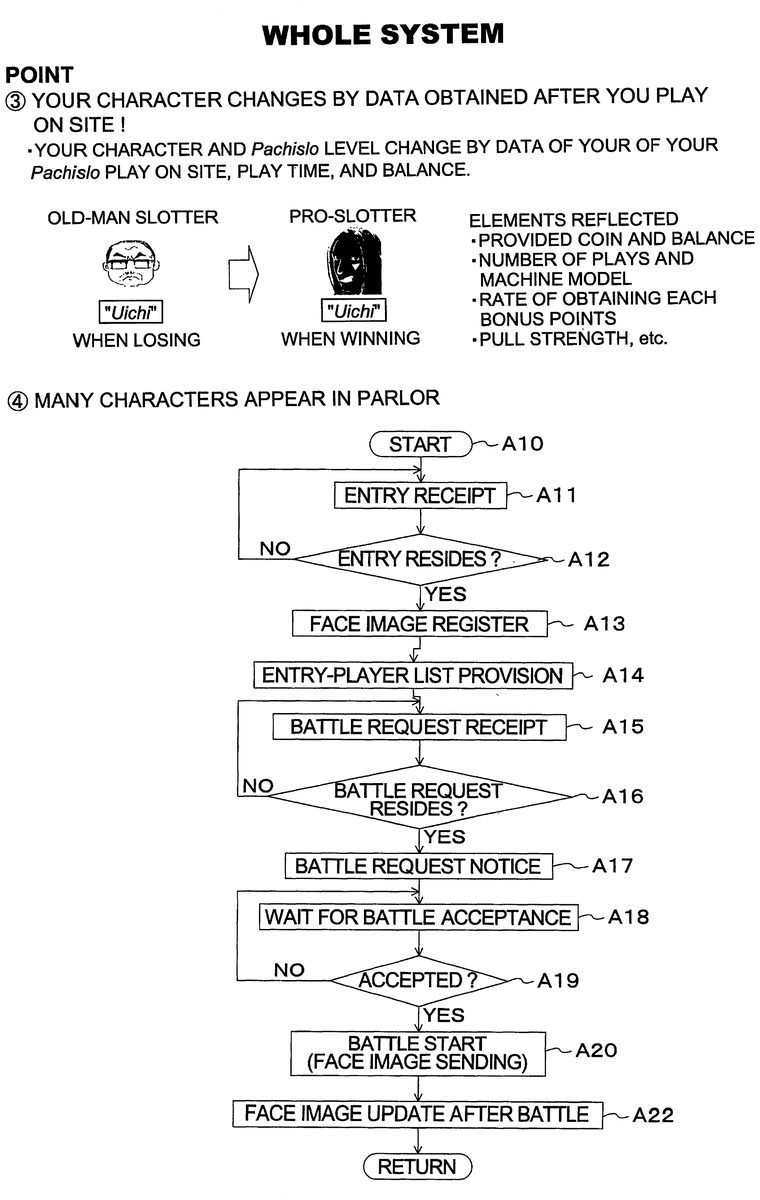
At the acceptance of the entry, the server17A also registers the player's face image together with the player's personal information in the database34. For instance, as shown inFIG. 9, the server17A changes the player's face image, which is registered in the database34, according to the entry player's winning-percent in the game, and the player's skill level can be understood by this face image. In the initial step that the player makes entry, the face image is, for example, registered as face image of “old-man slotter” character CA11. Watching this face image, other players recognize that this player has just made entry. As this player repeats pachislo game, etc., its face image can be changed to a higher-skill-level character image one by one, according to the provided coin number, the results of battle with other player, or ranking. Finally, the face image is expressed in “pro-slotter” character CA12.
FIG. 10is a conceptual diagram showing the outline of “battle room” service. Referring toFIG. 10, the “battle room” service C13A enables to play various pachislo machines in real parlor atmosphere. The server17A sends PC53A a virtual pachislo hall (parlor) data (i.e., image data and pachislo game program), and reproduces a parlor on the display part24of the PC53A. In this parlor, a plurality of pachislo machines are arranged as in real parlor. The player operating the PC53A can select one from the pachislo machines and enjoy pachislo play on the display part24.
Data of provided coins and balance (the proportion of credit amount and provided coins) in pachislo play is immediately sent from the PC53A to the server17A, thereby updating the balance data of each player stored in the database34. Based on the balance data, each player's ranking is determined by the server17A.
Also, in “battle room” service C13A, any player can ask other player for assist such as “pushing the stop button (observation push (aiming),” through chat. In this instance, the player sends, through chat, a message stating that the player needs an assist, to other players who join in “battle room.” That is, when the player operates to send a request for assist on the PC53A, the PC53A sends the request to the server17A. On receipt of this request, the server17A sends a message to ask for assist to other players in the corresponding parlor (“battle room”). PCs53B,53C, . . . , which are used by other players receiving this message, displays a message to ask for assist (e.g., “Please help me with “observation push (aiming).”, on their respective display part24. When a certain player sees this message and inputs a message stating that he/she can assist through his/her PC, this input result is sent to the server17A. Upon this, the server17A sends a message stating that the request for assist is accepted, to the PC53A of the player waiting for assist. The server17A removes the right to use of the pachislo machine of the player who receives assist to the player who performs assist, so that the latter player is capable of operating this pachislo machine. In this state, it is possible to perform assist such as “observation push,” as well as talk with any player who joins in the parlor. Herein, “observation push” is operation of the stop button by the game player with the careful observation of the symbol marks.
FIG. 11is a diagram showing, in simplified form, details of “famous machine room” service. Referring toFIG. 11, in “famous machine room” service C13B, the server17A reads the past famous machine data stored in the database34(e.g., image data and play programs, information of halls at which famous machines are actually set), and sends this data to PC53A. The PC53A displays the famous machine data on the display part24, so that the player can play a famous machine and obtain its various information on the screen displayed on the display part24.
FIG. 12is a diagram showing, in simplified form, details of “event room” service. Referring toFIG. 12, in “event room” service C13F, among a plurality of players, who join in “event room” service C13F, some players perform a battle game by using the famous machine, and other players join a quiz about the winner of this battle.
FIG. 13is a diagram showing, in simplified form, details of “pair room” service. Referring toFIG. 13, in the “pair room” service C13F, the player operates PC53A to create his/her own profile and sends it to the server17A. The server17A makes a congenial pair by considering each player's profile, and sends paired players a screen for face-to-face conversation. Then, on this screen, each of the paired players inputs a conversational sentence. A conversational sentence inputted by one player is sent to the server17A through PC that this player operates. The server17A sends the other player the conversational sentence received from this PC, and the sentence is displayed on the screen of the other player's PC. Thus, the paired players made by (through) the server17A can enjoy conversation in chat style. As the result, each player can enjoy pachislo game while having conversations on their respective screens (through the server17A).
FIG. 14is a diagram showing, in simplified form, details of “attack room” service and “beginner room” service. Referring toFIG. 14, in “attack room” service C13C and “beginner room” service C13D, explanations of the latest attack method and its play method of each machine type are sent from the server17A to the PC53A. The player can learn play methods and attack methods of pachislo game by referring to such information displayed on the display part24of the PC53A.
More specifically, as shown inFIG. 15, the “attack room” service C13C is also designed to provide attack-information providing service, hall-information providing service, and personal balance service, via a mobile phone13(see FIG.1). In this instance, when the player inputs, on the mobile phone13, contents address (address designating a server that is the server17A or another server to provide the contents), the mobile phone13accesses to the server17A or another server via a base station12and public telephone network11. The server17A and another server has a contents file that is described in simplified HTML (compact HTML) form so as to be provided to mobile phones, in addition to contents files described in HTML form. On receipt of access to the file from the mobile phone13, the server provides the mobile phone13with data described in simplified HTML form. Thus, simplified information corresponding to each contents shown inFIG. 4is displayed on the display part of the mobile phone13, in accordance with the player's operation for designation. As the result, the player can always enjoy contents that the server17A provides.
[Battle Room]
FIG. 16is a flowchart showing the processing procedure of selecting a pachislo machine (Japanese slot machine) in contents of “battle room” service, which are sent from an information-providing server to a personal computer. Referring toFIG. 16, when a contents demand signal is sent from PC53A, the server17A accepts this demand and provides a parlor layout screen to the PC53A, in step Al.
The parlor layout screen (machine selection screen) is, as shown inFIG. 17, a screen on which a parlor layout is visually displayed by arrangement per pachislo machine area and character image expressing each pachislo machine player. This screen accompanies the followings: i) display of machine type of arranged pachislo machines, ii) display of ranking within the parlor, iii) display of users who are now playing, iv) display of machine information per arranged pachislo machine, v) display of data per arranged pachislo machine, and vi) display of chat frame that displays conversation with other player.
Referring toFIG. 18, “machine type display” displays the type of machine in currently displayed area (machine selection screen). “Ranking display” displays real-time ranking within the displayed area. “User display” displays whether a certain player is using the machine, in character that expresses the player. “Machine-type selection icon” is used for selecting the machine type in the area displayed on the machine selection screen. “Machine information display” displays machine conditions. By clicking this display, the player can proceed to the machine's play screen. “Chat frame” is used for hall information or communication between players.
FIG. 19shows a machine-type selection icon on the machine type display previously described with reference to FIG.17. Referring toFIG. 19, the machine-type selection icon is used for selecting the type of pachislo machine in the area displayed on the machine selection screen. When the player clicks the machine-type selection icon and selects the desired machine type, there is displayed the area where pachislo machines of the desired machine type are arranged.
FIG. 20shows an example of ranking display on the machine selection screen previously described with reference to FIG.17. Referring toFIG. 20, the ranking of player, who is now playing in the area displayed on the machine selection screen, is displayed in real time. As shown inFIG. 21, this ranking is decided based on the number of obtained coins, which is calculated by reducing the number of credit coins from the number of payout coins. In accordance with the player's play to the pachislo machine, the player's ranking, which is stored in the database34of the server17A, is updated in real time.
FIG. 22is a diagram showing, in simplified form, details of the chat frame previously described with reference to FIG.17. Referring toFIG. 22, the chat frame is used for display of hall broadcast, in addition to conversation between players.
FIG. 23shows an example of the chat frame display. Referring toFIG. 23, the chat frame display is divided into two parts: i) input frame part on which the player's input is displayed, and ii) general chat part on which the input result of other player is displayed. Specifically, in the general chat part, individual conversation of other player (individual chat) and hall broadcast are displayed in different display styles, such as different character sizes. As shown inFIG. 24, the chat frame is classified into two types: one which is displayed on the machine selection screen showing parlor layout (see FIG.17); and the other which is displayed on play screen showing a pachislo screen on which a certain player is playing (see FIG.37). Chat is classified, as shown inFIGS. 25 and 26, into two types: “area chat” that shows chat within parlor, as machine selection screen (see FIG.17); and “island chat” that shows chat per island (an aggregate (unit) of pachislo machines wherein is circulating coins) in a certain area. The player can select chat type by selecting and operating changeover button (seeFIG. 23) of the chat frame.
FIG. 27shows an example of hall broadcast displayed on chat frame, saying that “Congratulations! A big-hit (big-prize or big bonus) at machine #1!!.” Referring toFIG. 27, especially large characters are used in order to discriminate from conversations with other player.
FIG. 28shows an input frame in the chat frame. Referring toFIG. 28, when the player inputs a conversational sentence by operating the keyboard of PC53A, its contents is displayed on the input frame. The player clicks the sending button of the input frame, thereby the PC53A sends the server17A the inputted message displayed on the input frame. The server17A sends this message to the PC of another player who joins the area chat. Thus, the message sent from the PC53A is displayed on the display screen of another player's PC. As the result, a conversation between the players is made on the chat frame.
FIG. 29is an example of area display on which there are arranged pachislo machines on the machine selection screen previously described with reference to FIG.17. Referring toFIG. 29, this area display shows, as machine information, i) machine number of each machine, ii) big-hit display showing the occurrence of big hit; and iii) possessed coin-number of the player of machine currently in use. When the player selects the desired machine in this area, its play screen with the selected pachislo machine is displayed.
FIG. 30shows details of the machine information previously described with reference to FIG.29. Referring toFIG. 30, the machine number of each pachislo machine, which is assigned within the parlor, is displayed as machine information.
FIG. 31shows a big-hit display in the machine information display. Referring toFIG. 31, with respect to the pachislo machine at which a big-hit occurs, characters saying “Big-hit” are displayed instead of its machine number.
FIG. 32shows an example of display of big-hit frequency in the machine information display. Referring toFIG. 32, the color and brightness of the machine information display part of pachislo machine are changed according to the number of big hits occurred in the machine.
FIG. 33shows a display example in the case that the player using the machine is displayed at the location corresponding to the machine information of each pachislo machine, in the area display part of the machine selection screen previously described with reference to FIG.17. In this case, the player is displayed, for example, by using such a face image as previously described with reference toFIG. 9, according to the ranking of the player, etc. By doing so, the player's skill level (ranking, etc.) can be understood.
FIG. 34shows an example of data display that is obtained by clicking each pachislo machine. Referring toFIG. 34, in this display style, there are displayed i) machine number, ii) the number of rotations between one “BIG HIT” and another “BIG HIT,” iii) the number of “BIG HIT” obtained that day, and iv) the number of “REGULAR HIT (REGULAR PRIZE OR REGULAR BONUS)” obtained that day. As shown inFIG. 35, these data are retained in the database34of the server17A, even when the player of the pachislo machine is changed.
Referring again toFIG. 16, when the player selects machine type on the parlor layout screen (step A2), a certain area where pachislo machines of the selected machine type are arranged, that is, machine selection screen (see FIG.17), is displayed. The player selects the desired pachislo machine within the area by clicking that machine on the machine selection screen, the selected pachislo machine's screen (play screen) is displayed on the display part24of PC53A that the player uses (steps A3to A7).
Outline of this play screen is shown in FIG.36. Referring toFIG. 36, deciding the machine (step B1), play screen is displayed on the display part24(step B2). On this screen, the player can select one or more of the followings: i) machine information view, ii) play, iii) machine explanation view, and iv) chat. When the player terminates play of pachislo game (step B3), the server17A performs clear and saves data in the database34(step B4), thereby returning to the parlor layout screen (machine selection screen) (step B5).
FIG. 37is a diagram showing, in simplified form, a play screen according to image of pachislo machine. Referring toFIG. 37, the image of pachislo machine that the player plays is displayed on the play screen. In addition to this, as shown inFIG. 38, the play screen includes the followings: i) coin container/coin display that roughly shows the present possessed medal-number in coin or coin container image, ii) machine number display that shows the machine number of currently selected machine, iii) machine type display that shows the type of currently selected machine, iv) machine information display that shows various data of the machine (e.g., the number of STARTs, and the number of big-hits, v) explanation-button display that shows information about the machine (play method, attack method, etc.), vi) personal data display that shows personal balance in the whole parlor on site, and vii) clear-button display that is used for terminating pachislo game. As shown inFIG. 39, the play screen further includes the followings: i) display of medal-number that is paid out during play of pachislo machine, ii) display of medal-number that the player debited to the pachislo machine, and iii) display of medal-number balance that the player obtained with the pachislo machine (i.e., medal-number that the player possesses currently).
FIG. 40shows an example of display of coin container/coin display in the play screen. From this display style, the player can roughly understand the number of medals obtained with the machine.
FIG. 41shows an example of machine number display on the play screen. From this display style, the player can understand the machine number of pachislo machine that is displayed as play screen.
FIG. 42shows an example of machine-type display on the play screen. From this display style, the player can understand the machine type of pachislo machine that is displayed as play screen.
FIG. 43shows an example of machine-information display on the play screen. From this display style, the player can understand various information (the number of STARTs, big-hits, etc.) of pachislo machine that is displayed as play screen.
In the above-mentioned machine information display, as shown inFIG. 44, machine information is retained in the database34of the server17A, even when the player of the pachislo machine is changed.
FIG. 45shows an example of explanation-button display on the play screen. From this display style, the player can understand basic play method and attack method of pachislo machine that is displayed as play screen.
FIG. 46shows an example of personal data display on the play screen. From this display, the player can understand personal balance in the whole parlor on site. Details of site total-balance displayed as personal data is, as shown inFIG. 47, calculated based on the amount of coins obtained by pachislo game and the amount of coin purchase. Thereafter, as shown inFIG. 48, the player's ranking is decided based on the total balance.
The above-mentioned personal data is, as shown inFIG. 49, displayed by reading the previous data (the balance of previous pachislo play on site) from the database34.
FIG. 50shows an example of coin-purchase button display on the play screen. By operating this button, the player can purchase the desired number of coins.
FIG. 51shows an example of clear-button display on the play screen. By operating this button, the player can terminate pachislo play and perform clearing.
FIG. 52shows an example of pachislo display on the play screen. This display style is designed to give realistic impression to the player by using the same image as actual machine.
FIG. 53shows an example of payout medal-number display on the play screen. From this display style, the player can understand the number of medals paid out during pachislo game.
FIG. 54shows an example of debit medal-number display on the play screen. From this display style, the player can understand the number of medals debited to pachislo game.
FIG. 55shows an example of possessed medal-number display on the play screen. From this display style, the player can understand the number of possessed medals.
FIG. 56shows the whole configuration of data used for playing pachislo game. Referring toFIG. 56, data of pachislo machine and data of obtained medal-number, ranking, etc. of the player, are sent to the server17A and updated in real time. On the other hand, personal data such as balance is sent to the server17A and updated after play.
[Provision of Contents Using Face Image]
On the above-mentioned site for playing pachislo game, as previously described with reference toFIG. 9, face image as the personal information of the entry player, which is stored in the database34, changes according to the player's ranking. By watching such face image change, when starting a battle game, etc., the player can roughly understand the competitor's skill-level. That is, when a certain player performs a battle game with others, the player selects the battle mode by operating his/her own PC. In this battle mode, the server17A reads the face image of the entry player from its database34, and this face image is downloaded to the PC. This face image changes according to player's ranking, thereby a certain player who demands a battle game can determine the desired competitor based on the competitor's face image. When the player designates the desired competitor on the PC, the result is sent from the PC to the server17A. The server17A receives this information and sends a message (information), saying that there is a battle game demand, to the designated competitor. The competitor receives this information and, when the competitor accepts this battle game demand by operating his/her own PC, the result is forwarded to the server17A. As a result, the competitor is determined, and the battle game is started by the server17A. It should be noted that, without limiting this battle to between one player and the other, it can be performed among a plurality of players. In the battle game of this style, a plurality of players perform pachislo game for a predetermined period of time, and the player having the largest number of obtained medals becomes the winner. Following is another method of selecting the competitor. On the machine selection screen previously described with reference toFIG. 17, any player can make an application for a battle game by clicking the face image of the player of pachislo machine in use (user display). On each machine display, the player's face image is displayed by face image according to the player's ranking. Also in this method, the server17A, receiving the competitor designation from the player's PC, sends the designated competitor a message describing it to notify that other player made the application for a battle game demand.
FIG. 57is a flowchart showing the processing procedure according to characteristic features of the present invention which are related to contents-providing using face image, from personal information registration to battle game play. Program for executing this flowchart is stored in the database34of the server17A, and the CPU31of the server17A expands this program on the memory32and executes it.
Referring toFIG. 57, the server17A executes the above-mentioned processing procedure from step A10, and goes into entry-receiving status in step A11.
On receipt of entry from one player's PC, the server17A waits a positive response from the other player's PC (step A12). Receiving the positive response, the server17A goes to the processing in step A13. In step A13, the server17A registers, in the database34, one player's personal information sent from one player side PC, as well as one player's face image. When one player is a beginner, such a beginner's face image that is previously stored in the database34is used as this player's face image. When one player is already a ranking holder on the site, this player's history is searched from the database34and, based on the ranking, the corresponding face image stored in the database34is used.
Finishing the face image registration, the server17A goes to the processing in step A14. In step A14, the server17A provides a list of registered players on demand from the other player. This list is attached to the face images of the registered players. Viewing this list, the other player understands each player's skill-level based on the corresponding face image. For instance, while watching this list, the other player selects a competitor, as described with reference toFIG. 12, or joins winner-forecasting game. As a result, the player can select the competitor based on the competitor's skill-level.
Thereafter, in step A15, the server17A receives an application for battle. Receiving the application, the server17A goes to the processing from step A16to step A17. In step A17, the server17A sends the waiting player's (one player's) PC a message describing that the other player made the application. In step A18, the server17A waits for the battle acceptance signal from the player that is the message destination. Receiving the acceptance signal, the server17A goes to the processing from step A19to step A20. In step A20, the server17A starts the battle. This battle is designed, for example, to play pachislo game for a predetermined period of time and determine the winner based on the number of obtained medals. During this battle, the server17A sends each competitor's face image (one player's face image to the other player, and the other player's face image to one player). As a result, both players can play game while recognizing the opponent skill-level with each other.
At the end of the battle game, the server17A goes to the processing in step A21. In step A21, the server17A updates each player's ranking according to the battle result, and updates, according to the update result, player's face image based on the new ranking.
At the completion of a chain of processing procedures, the server17A returns from step A22to whole-site control routine.
As stated above, the player's face image changes according to the ranking (skill-level), thereby others can select the competitor on the basis of the skill-level. In this connection, the player's face image is also used for the player display during play, on the parlor screen previously described with reference to FIG.17. Therefore, it is also possible that when a certain player asks others for assist in “observation push (aiming), etc., the player can select an assistant on the basis of his/her face image.
[Game-Watch Service]
Other player's play can be watched on the pachislo battle game previously described with reference toFIG. 12, and parlor screen (machine selection screen) previously described with reference to FIG.17.
FIG. 58is a flowchart showing the processing procedure of server that provides service for watching other player's play and battle game. Program for executing this flowchart is stored in the database34of the server17A, and the CPU31of the server17A expands this program on the memory32and executes it. A conversation between a game watcher and a player of which play is watched is performed in chat style, through the server17A.
Referring toFIG. 58, the server17A goes into the above-mentioned processing procedure from step A30, and goes to the processing in step A31. In step A31, the server17A creates a display data of game circumstances based on the game circumstances sent from the PCs53A,53B,53C, . . . , in accordance with the progress of each player's pachislo game, and stores the created data in the database34.
Then, the database34of the server17A stores the latest play circumstances of each player (step A32). When one player demands a view of the other player's data, the server17A goes to the processing from step A33to step A34. In step A34, the server17A sends the view-demand origin a game-circumstance display data of each player in play. In this connection, when performing a view demand, it is necessary to designate a candidate player. Player-designation can be performed by the following methods: i) clicking a pachislo machine in the play state or the player's image attached to the machine display, on the parlor layout screen previously described with reference toFIG. 17; and ii) clicking one of players who compete with each other in a battle game. The PC of the player having a game-watch demand sends a demand together with the player's password that is preset to the server17A. Even when a certain player other than the play-state player accesses to the server17A, the play screen of the play-sate player can be read and provided by receiving the certain player's password, etc. As the result, on the display part24of the PC of the player who sent the view demand, there is displayed, for example, the play screen of the player who was designated during play, as shown in FIG.37.
Thus, while the play contents of the playing one player is watched by the other player, the server17A sends a message describing that “Your play is being watched.” to the PC of one player, in step A35. One player can recognize as being watched, by this message, which is displayed on the display part24.
The other player, who watches the first player's play by sending the game-watch demand, can send various messages to the first payer. In this case, inputting a message through PC by the other player, this message is sent to the server17A. Receiving this message, the server17A goes to the processing from step A36to step A37. In step A37, the server17A sends one player (of which play is being watched). Then, a message (e.g., catcalling, cheering, or advice) from the other player is displayed on the display part24of one player (i.e., the chat frame previously described with reference to FIG.17). The server17A recognizes the addresses of terminal devices (e.g., PCs) of the both players, thereby one player can also send a reply to this message.
At the end of one player's play, the server17A goes to the processing from step A38to step A39, thereby completing the foregoing processing procedure.
As stated above, it is possible to watch the play of the other player, as well as message exchange between one player of which play is watched and the other watching the player's play. As the result, the players can experience such actuality that they were playing pachislo at an actual hall.
For reference,FIG. 59shows an example of actual display of the parlor layout screen (machine selection screen), which has been described with reference to FIG.17. Conversations between players, hall broadcast, etc., are displayed on the chat frame of this display.
[Operations and Effects]
The foregoing preferred embodiment produces mainly the following operations and effects.
(1) A game player connects to a server through a terminal and plays a game on the server. Before playing the game on the server, the face image information of the game player is registered as personal information. This face image information changes according to the game result. The changed face-image information is used as the player's face image information at the next game. That is, in addition to address, name, or pen name, which has conventionally been registered in advance as personal information, face image information is registered and changed according to the game result. Therefore, this permits a quick visual recognition of the previous game result. Furthermore, the face image changes continuously as the number of games is increased. Hence, when the player plays a battle game, only glancing the competitor's face image, it can visually and sensibly understand whether the competitor has high skill level or not.
(2) A plurality of game players connect to a server through their respective terminals, and the game players play a battle game on the server. Before playing the battle game on the server, their face image information are registered in the server, as personal information. Their respective face image information are changed by the server every time when the corresponding player plays a battle game, according to the game result. When a plurality of players perform a battle game on the server, the stored face image of the corresponding player is sent to the terminal of the opponent player. Hence, only glancing the competitor's face image, the players can play a battle game after roughly recognizing the competitor's skill-level.
(3) The above-mentioned face image information is sent to the respective player terminals before starting the battle game, together with a list information of players who are accepted as the competitor and capable of playing a battle game. Therefore, before the battle game, the players can play the game after roughly recognizing the competitor's skill-level, in order words, by selecting the competitor. As the result, without reference-operation of the competitor's battle history, etc., the competitor's skill-level can be understood only by glancing the face image.
(4) When performing a battle game as a game, it is configured to receive entry for a battle game from a plurality of game players who are previously entered on a server and capable of joining the game. The terminal through which one player performed the entry for the battle game is notified that there is other entry player, and then an acceptance from the terminal is received. On receipt of the acceptance, the battle game execution is permitted. Therefore, both players are capable of selecting the competitor. In other words, the choice range of competitors is wide. Specifically, when playing a battle game, it is more amusing for game players to battle with competitors of equal skill level. It is however inconvenient for game players demanding a battle game with a strong competitor that a game player of the same skill level is evenly and forcedly assigned. This inconvenience is not limited to game players of relatively low skill level, because even game players of high skill level may sometimes desire to accept a battle game with a low-skill game player. Without making the server forcedly select the competitor (the server side has not pick of the choices), allowing game players to select the competitor can solve the above problem.
Claims
- A game method with which a game player connects to a server by using a terminal and plays a game on the server, the method including the steps of: before starting the game on the server, making the game player register a face image information as personal information;changing the face image information according to the game result;and using the changed face image information as face information of the next game.
- The game method according to claim 1 in which a network is used, further including the step of: before starting the game, sending the terminals the face image information together with a list information of game players who are entered as competitor and capable of playing a battle game.
- The game method according to claim 1 in which a network is used, the method further including, when the game is a battle game, the steps of: receiving in advance entry for the battle to a plurality of game players who are entered on the server and capable of playing the battle game;notifying the terminal of the other player receiving the battle entry as competitor that the entry was performed from one player, and receiving an acceptance of the battle from the notified terminal;and permitting execution of the battle game at the receipt of the acceptance.
- The game method according to claim 2 in which a network is used, the method further including, when the game is a battle game, the steps of: receiving in advance entry for the battle to a plurality of game players who are entered on the server and capable of playing the battle game;notifying the terminal of the other player receiving the battle entry as competitor that the entry was performed from one player, and receiving an acceptance of the battle from the notified terminal;and permitting execution of the battle game at the receipt of the acceptance.
- A game method with which a plurality of game players connect to a server by using a terminal and play a battle game on the server, the method including the steps of: before starting the battle game on the server, making the game players register a face image information as personal information in a memory part with the server;changing the face image information every time a control part with the server executes the battle game, according to the game result;and when the game players play a battle game on the server, sending the respective players' face image stored in the memory part to the terminals of the game players who complete the entry in the battle game.
- The game method according to claim 5 in which a network is used, further including the step of: before starting the game, sending the terminals the face image information together with a list information of game players who are entered as competitor and capable of playing a battle game.
- The game method according to claim 5 in which a network is used, the method further including, when the game is a battle game, the steps of: receiving in advance entry for the battle to a plurality of game players who are entered on the server and capable of playing the battle game;notifying the terminal of the other player receiving the battle entry as competitorm that the entry was performed from one player, and receiving an acceptance of the battle from the notified terminal;and permitting execution of the battle game at the receipt of the acceptance.
- The game method according to claim 6 in which a network is used, the method further including, when the game is a battle game, the steps of: receiving in advance entry for the battle to a plurality of game players who are entered on the server and capable of playing the battle game;notifying the terminal of the other player receiving the battle entry as competitor that the entry was performed from one player, and receiving an acceptance of the battle from the notified terminal;and permitting execution of the battle game at the receipt of the acceptance.
- A program storage medium used when a game player connects to a server by using a terminal and plays a game on the server, the program storage medium storing: a program for making, before starting the game on the server, the game player register a face image information as personal information;a program for changing the face image information according to the game result;and a program for using the changed face image information as face information of the next game.
- The program storage medium according to claim 9 further storing: a program for sending, before starting the game, the terminals the face image information together with a list information of game players who are entered as competitor and capable of playing a battle game.
- The program storage medium according to claim 9 further storing, when the game is a battle game, a program for receiving in advance entry for the battle to a plurality of game players who are entered on the server and capable of playing the battle game;a program for notifying the terminal of the other player receiving the battle entry as competitor that the entry was performed from one player, and receiving an acceptance of the battle from the notified terminal;and a program for permitting execution of the battle game at the receipt of the acceptance.
- The program storage medium according to claim 10 further storing, when the game is a battle game, a program for receiving in advance entry for the battle to a plurality of game players who are entered on the server and capable of playing the battle game;a program for notifying the terminal of the other player receiving the battle entry as competitor that the entry was performed from one player, and receiving an acceptance of the battle from the notified terminal;and a program for permitting execution of the battle game at the receipt of the acceptance.
- A program storage medium used when a plurality of game players connect to a server by using a terminal and play a battle game on the server, the program storage medium storing: a program for making, before starting the battle game on the server, the game players register a face image information as personal information in a memory part with the server;a program for changing the face image information every time a control part with the server executes the battle game, according to the game result;and a program for sending, when the game players play a battle game on the server, the respective players' face image stored in the memory part to the terminals of the game players who complete the entry in the battle game.
- The program storage medium according to claim 13 further storing: a program for sending, before starting the game, the respective terminal the face image information together with a list information of game players who are entered as competitor and capable of playing the battle game.
- The program storage medium according to claim 13 further storing, when the game is a battle game: a program for receiving in advance entry for the battle game from a plurality of game players who are entered on the server and capable of playing the battle game;a program for notifying the terminal of the other player receiving the battle entry as competitor that the entry was performed from one player, and receiving an acceptance of the battle from the notified terminal;and a program for permitting execution of the battle game at the receipt of the acceptance.
- The program storage medium according to claim 14 further storing, when the game is a battle game: a program for receiving in advance entry for the battle game from a plurality of game players who are entered on the server and capable of playing the battle game;a program for notifying the terminal of the other player receiving the battle entry as competitor that the entry was performed from one player, and receiving an acceptance of the battle from the notified terminal;and a program for permitting execution of the battle game at the receipt of the acceptance.
- A server for playing a game via a network, to which a plurality of game players are connectable through a terminal, the server including: means for making, before starting the game on the server, the game players register a face image information as personal information;means for changing the face image information according to the game result;and means for using the changed face image information as face information of the next game.
- The server according to claim 17 further including: means for sending, before starting the game, the respective terminal the face image information together with a list information of game players who are entered as competitor and capable of playing the battle game.
- The server according to claim 17 further including, when the game is a battle game: means for receiving in advance entry for the battle game from a plurality of game players who are entered on the server and capable of playing the battle game;means for notifying the terminal of the other player receiving the battle entry as competitor that the entry was performed from one player, and receiving an acceptance of the battle from the notified terminal;and means for permitting execution of the battle game at the receipt of the acceptance.
- The server according to claim 18 further including, when the game is a battle game: means for receiving in advance entry for the battle game from a plurality of game players who are entered on the server and capable of playing the battle game;means for notifying the terminal of the other player receiving the battle entry as competitor that the entry was performed from one player, and receiving an acceptance of the battle from the notified terminal;and means for permitting execution of the battle game at the receipt of the acceptance.
- A server for playing a game via a network, to which a plurality of game players are connectable through a terminal, the server including: means for making, before starting a battle game on the server, the game players register a face image information as personal information in a memory part with the server;means for changing the face image information every time a control part of the server executes the battle game, according to the game result;and means for sending, when the game players play the battle game on the server, the respective players' face image stored in the memory part to the terminals of the game players who complete the entry in the battle game.
- The server according to claim 21 further including: means for sending, before starting the game, the respective terminals the face image information together with a list information of game players who are accepted as competitor and capable of playing the game.
- The server according to claim 21 further including: means for receiving in advance, when the game is a battle game, entry for the battle game to a plurality of game players who are entered on the server and capable of playing the battle game;means for notifying the terminal of the other player receiving the battle entry as competitor that the entry was per formed from one player, and receiving an acceptance of the battle from the notified terminal;and means for permitting execution of the battle game at the receipt of the acceptance.
- The server according to claim 22 further including: means for receiving in advance, when the game is a battle game, entry for the battle game to a plurality of game players who are entered on the server and capable of playing the battle game;means for notifying the terminal of the other player receiving the battle entry as competitor that the entry was performed from one player, and receiving an acceptance of the battle from the notified terminal;and means for permitting execution of the battle game at the receipt of the acceptance.
Disclaimer: Data collected from the USPTO and may be malformed, incomplete, and/or otherwise inaccurate.