U.S. Pat. No. 6,932,705
VIDEO GAME WITH SUB-DISPLAY FOR TRACKING TARGET
AssigneeSquare Enix Co., Ltd.
Issue DateOctober 10, 2001
Illustrative Figure
Abstract
A video game including a player's character that can move in a currently executed game stage. When the target position to be next reached by a player's character does not exist within a radar screen display area in the game field, a flashing target position mark is displayed in the vicinity of the intersection of a segment connecting the player's character position, the target position and the end portion of the radar screen. Thus, the direction toward the target position viewing from the player's character position can be recognized by the target position mark.
Description
DESCRIPTION OF THE PREFERRED EMBODIMENTS One embodiment of the present invention is described below. An example of the present invention is applied to a game apparatus by using an RPG as a specific game example. However, the present invention is applicable to any game which may be executed between game machines in real time, such as an action game and a table game. FIG. 1is a block diagram showing an exemplary constitution of a game system according to one embodiment of the present invention. A game apparatus1mainly includes a game apparatus body2having main functions of the game apparatus1and an input apparatus3(including a keypad and controller, for example) for inputting manipulation instructions to the game apparatus body2. Further, a memory card5for storing game data such as game-in-progress data and game environment setting data may be attached removably to the game apparatus body2. Furthermore, an output apparatus6(including a monitor display and a speaker, for example) for performing video display, sound output, and so on in accordance with game contents based on video and/or audio signals from the game apparatus body2is connected to the game apparatus body2for game execution. Still further, a compact disk read only memory (CD-ROM)4for storing a program for implementing processing relating to a game described below and/or image data, sound data, and so on is mounted to the game apparatus body2. The game apparatus body2includes a main control portion11having a central processing unit (CPU) and/or a read only memory (ROM) built-in, a random access memory (RAM)12, an interface portion13, a sound processing portion14, a graphics processing portion15, a CD-ROM drive16for accessing contents on the removable CD-ROM4mounted therein, a communication interface17for performing data communication and the like with another game machine over a communication medium (network)100, a hard disk drive (HDD)18, and a bus19for connecting the above-described components to each ...
DESCRIPTION OF THE PREFERRED EMBODIMENTS
One embodiment of the present invention is described below. An example of the present invention is applied to a game apparatus by using an RPG as a specific game example. However, the present invention is applicable to any game which may be executed between game machines in real time, such as an action game and a table game.
FIG. 1is a block diagram showing an exemplary constitution of a game system according to one embodiment of the present invention. A game apparatus1mainly includes a game apparatus body2having main functions of the game apparatus1and an input apparatus3(including a keypad and controller, for example) for inputting manipulation instructions to the game apparatus body2.
Further, a memory card5for storing game data such as game-in-progress data and game environment setting data may be attached removably to the game apparatus body2. Furthermore, an output apparatus6(including a monitor display and a speaker, for example) for performing video display, sound output, and so on in accordance with game contents based on video and/or audio signals from the game apparatus body2is connected to the game apparatus body2for game execution.
Still further, a compact disk read only memory (CD-ROM)4for storing a program for implementing processing relating to a game described below and/or image data, sound data, and so on is mounted to the game apparatus body2.
The game apparatus body2includes a main control portion11having a central processing unit (CPU) and/or a read only memory (ROM) built-in, a random access memory (RAM)12, an interface portion13, a sound processing portion14, a graphics processing portion15, a CD-ROM drive16for accessing contents on the removable CD-ROM4mounted therein, a communication interface17for performing data communication and the like with another game machine over a communication medium (network)100, a hard disk drive (HDD)18, and a bus19for connecting the above-described components to each other.
The main control portion11further includes an oscillator and a timer counter (both of which are not shown), and creates a clock signal based on a timing signal output from the oscillator for every predetermined period. Then, the main control portion11counts the clock signal by using the timer counter so as to measure time.
The RAM12is a main memory apparatus used when a CPU in the main control portion11executes a given program. Programs executed by the CPU and data required for the execution of the programs are stored therein. Further, the RAM12is used as a working area for program execution.
The interface portion13is arranged to accept the removable input apparatus3and the removable memory card5. The interface portion13controls data transfer between each portion (mainly, main control portion11) connected to the bus19and the input apparatus3or the memory card5.
The sound processing portion14is a circuit for performing processing for reconstructing audio data such as background music (BGM) and/or sound effects of a game. The sound processing portion14creates audio signals based on data stored in the RAM12in accordance with an instruction from the main control portion11and supplies them to the output apparatus6.
The graphics processing portion15includes a frame buffer (not shown) and renders an image on the frame buffer in accordance with an instruction from the main control portion11. Further, the graphics processing portion15creates video signals by adding a predetermined simultaneous signal to image data rendered on the frame buffer and supplies them to the output apparatus6.
The CD-ROM drive16is a reading apparatus for reading data stored on the CD-ROM4, which is a recording medium. The game apparatus1causes the game apparatus body2to execute control over the game described later in accordance with a game program recorded on the CD-ROM4.
The communication interface17transfers data to and controls communications with another communication enabling apparatus, such as another game apparatus, connected to the network100. For example, the communication interface17controls exchanges of information (programs and/or data) between the game apparatus body2and the communication network100. A game program and data are downloaded from the communication network100through the communication interface17and the communication circuit99and can be stored in the HDD18.
The HDD18is an auxiliary memory apparatus used when the CPU of the main control portion11executes a given program. Various data and programs may be stored in the HDD18, such as information downloaded by using the communication interface17and information read from the CD-ROM4.
Programs, image data, sound data, and so on are stored in the CD-ROM4for implementing processing regarding a given game, as described above. Programs causing the game apparatus1to execute a method according to this embodiment are included in the game programs. Game software stored in the CD-ROM4activates and causes the CD-ROM drive16to read necessary game programs and game data. Further, the game software operates the main control portion11in accordance with the read programs.
The game software is pre-installed in the HDD18. In accordance with an instruction from the main control portion11, audio signals are created based on data stored in the RAM12and then supplied to the output apparatus6. Notably, the game apparatus1can store game software in the HDD18.
The graphics processing portion15includes a frame buffer (not shown) and renders a game image on the frame buffer in accordance with control by the main control portion11. Further, the graphics processing portion15creates video signals by adding a predetermined simultaneous signal to image data having been rendered in the frame buffer and supplies them to the output apparatus6.
The input apparatus3includes a controller to be manipulated by the player in order to input various instructions to the game apparatus body2regarding a given game. The input apparatus3sends an instruction signal corresponding to player's manipulation to the game apparatus body2through the interface portion13.
In this embodiment, instructions for advancing a given game are input by a controller. An example where a controller30is used for inputting instructions as the input apparatus3is now described. A constitutional example of the controller30used as the input apparatus3in this embodiment will be shown inFIGS. 2A and 2B.FIGS. 2A and 2Bare diagrams for describing an example of the input apparatus according to this embodiment.FIGS. 2A and 2Bshow a plan view and a back view thereof, respectively.
InFIG. 2A, the controller30includes a cross key31for inputting movement information and so on, and manipulation keys (for example, a ∘ button32, a Δ button33, a □ button34, a × button35, a start button36, and a select button42) for inputting different kinds of instructions to the game apparatus body2.
Further, the controller30includes a joystick37for inputting movement information. As shown inFIG. 2B, each of multiple manipulation keys (an R1button38, an R2button39, an L1button40, and an L2button41) is provided at the back of the controller30.
The keys, except for the start button36and the select button42, are arranged to be pressure-sensitive. Further, the controller30has a vibration function with a motor built-in. The motor operates in response to a predetermined control signal from the game apparatus body2so as to vibrate the controller30entirely. Thus, vibration is transmitted to a player who holds the controller30.
The game apparatus body2can adjust the strength of vibration including three types of “strong”, “medium” and “weak”. The vibration of the controller30is intermittent and can be controlled such that vibration with either one type of strength is created randomly.
The memory card5includes a flash memory and is an auxiliary memory apparatus for storing game data under control of the game apparatus body2. Writing data in the memory card5and reading data from the memory card5are controlled by the main control portion11through the interface portion13.
The output apparatus6displays game images and outputs voices based on video signals and audio signals from the game apparatus body2. Further in this embodiment, a monitor apparatus, such as a television (TV) set having a speaker built-in, is provided as the output apparatus6. The monitor apparatus includes a display screen61for displaying images and a speaker62for outputting voices.
Further, the output apparatus6displays an image on the display screen61in response to video signals from the graphics processing portion15and outputs voice from the speaker62in response to sound signals from the sound processing portion14. Therefore, the output apparatus6functions as both display apparatus and voice output apparatus.
The main control portion11controls operations of the game apparatus body2based on basic software stored in the ROM or game software which has been read from the CD-ROM4by the CD-ROM drive16and stored in the RAM12.
For example, the CPU reads graphic data from the CD-ROM4and transfers it to the graphics processing portion15. Then, the CPU instructs the graphics processing portion15to create an image. In response to the instruction, the graphics processing portion15creates video signals by using the graphic data. The video signals are sent to the output apparatus6. Thus, an image is displayed on the display screen of the output apparatus6.
The game apparatus, according to this embodiment having the above-described constitution, is arranged to be able to communicate with another game apparatus through the network100, which enables a networked game by which multiple players can participate in one game over the network100. In this case, the game program can be not only read from the CD-ROM4but also downloaded from another communication equipment (server equipment) connected to the network100.
A constitution of a networked game system for a case where a networked game is executed by using above-described functions is described below with reference to FIG.3.FIG. 3is a schematic diagram showing a constitution of the networked game system for providing networked game services according to this embodiment.
In the networked game system according to this embodiment, game apparatuses1a,1b,1cand1d, which have the constitution shown inFIG. 1, are connected to a network system through a communication medium, such as a server group102over the Internet100. Notably, the number of connected game apparatuses is not limited to the number in the example shown in FIG.3. Further, the number of connected game apparatuses is not limited regardless of game contents, and any number more than one of game apparatuses can be connected for game execution.
The server group102includes an authentication server group111for performing account management for user authentication, for example, a contents server group112for providing an interface between the game apparatus1and another server group and for providing services for viewing contents such as voices and animation, a message server group113for providing chat and/or messenger environment, a mail server group114for providing e-mail services, a profile server group115for managing user profiles, and game server group116for providing game environment.
Server groups111to116are connected to each other through a LAN117. The constitution of the server groups is not limited to the above-described example. All of the server group functionality may be implemented in one server, or may be divided.
The game server group116includes a lobby server for executing a given game according to this embodiment. When the game apparatus1is connected to the lobby server, a screen showing a virtual “lobby” is displayed on the display apparatus6. In this lobby screen, the player's character and characters of other players connecting to the lobby server are displayed. Players can participate in chat so that they can communicate with other players or can look for a partner to play the game together.
According to this embodiment, in addition to a chat message for displaying text information input by the player in realtime, a message selected by the player from predetermined candidates can be displayed continuously in the vicinity of the player's character.
Next, game programs and data, which have been read by the CPU of the main control portion11from the CD-ROM4and then stored in the main memory, that is RAM12, will be described.
FIG. 4shows a diagram for describing stored contents and storage areas in the CD-ROM4.
As shown inFIG. 4, the CD-ROM4includes a program storage area4afor storing a game program to be executed by the main control portion11, a related data storage area4bfor storing data required for advancing different kinds of games, an image data storage area4cfor storing, for example, modeling data in three-dimensional model and two-dimensional image data used as a background, a sound data storage area4dfor storing sound data such as sound effects, icon data storage area4efor storing icon information unique to the game, such as characters appeared in the game, and so on.
In this embodiment, some of data required for advancing the game in a certain stage among different kinds of data stored in respective storage areas in the CD-ROM4are loaded to the RAM12. The game advances based on the data loaded to the RAM12.
If data is required for advancing the game, the next data required for advancing the game is loaded to the RAM12among different types of data stored in respective storage areas in the CD-ROM4.
If a networked game is executed, the advance of the game is under the control of the lobby server for executing a game in the game server group116in the server group102. Some data, which are stored in respective storage areas in the CD-ROM4and are required for the advance of the game, are loaded to the RAM12in accordance with the advance control by the lobby server. The game advances based on the data loaded to the RAM12.
Next, programs and data to be read by the main control portion11from the CD-ROM4and then be stored in the RAM12are described.
FIG. 5is a diagram showing an exemplary memory constitution of the RAM12according to this embodiment. As shown inFIG. 5, the RAM12has a program storage area12afor storing programs to be executed by the main control portion11, a related data storage area12bfor storing data required for execution of different kinds of processing, an image data storage area12cfor storing modeling data for a three-dimensional model, image data relating to two-dimensional image data used as a background, for example, and so on, and sound data storage area12dfor storing sound data such as sound effects.
In this embodiment, except for a case where a game is started newly, game data having read from the memory card5is read to the related data storage area12bat the beginning, and the game is re-started in accordance with the read game data.
In this embodiment, game data is updated in the related data storage area12bof the RAM12as the game advances. Then, if game data is instructed to save during the game, game data (game-in-progress information) stored in the related data storage area12bis read and then is written in a specified game-data storage area in the memory card5.
When the game apparatus1is powered off, the game data is maintained as it was saved in the memory card5. Therefore, when the game apparatus1is powered on and the game is re-started, the saved data is read from the memory card5and stored in the related data storage area12b. Thus, the game apparatus1is controlled to allow re-starting the game from the game scene having been saved.
Control over an RPG according to this embodiment including the above-described constitution is described with reference to a flowchart shown in FIG.6.FIG. 6is a flowchart for describing control over an RPG according to this embodiment. The game apparatus body2executes a game program stored in the CD-ROM4in order to implement the processing.
In step S1inFIG. 6, the CD-ROM4on which a game program is recorded is set in the game apparatus body2. This leads the processing to step S2, where a necessary program is read from the CD-ROM4and stored in the RAM12. Then, an initial screen (such as manufacturer's logo) is displayed, the memory card5is checked, and a title screen is displayed. Then, basic processing including data loading is performed.
In step S3, a game selection screen is displayed, and game data to be executed is selected there from game saved data relating to a given game read from the memory card5at the end of the basic processing. Then, the processing goes to step S4.
In step S4, the selected game data is read from a corresponding game data file thereof and stored in the related data storage area4bof the RAM12. The game is started from the state having been saved. Notably, when there is no data having saved, that is, when a player would play a game from the first stage, a new game is started automatically.
Further, when the game is a networked game and when a partner is a player manipulating another game apparatus over the network100, the player interacts with the partner player by playing the game.
When the controller30is manipulated or a field is changed in accordance with the advance of the game, the processing goes to step S5. In step S5, it is checked whether or not the display of a radar screen is requested. If so, the processing goes to step S10.
On the other hand, if the display of a radar screen is not requested in step S5, the processing goes to step S6, where it is checked whether or not the movement of a game character is instructed by manipulating the controller30. If not, the processing goes to step S7, where game advance processing required for a given game scene is performed. Then, the processing returns to step S4. For example, in a fighting scene, the game advances in a fighting mode.
On the other hand, if the movement of a game character is instructed by manipulating the controller30in step S6, the processing goes to step S8, where the game character is moved within a given game field in accordance with the instruction through the manipulation on the controller30. Then, the processing goes to step S9, where it is checked whether or not a radar screen is being displayed. If not, the processing goes to step S4.
On the other hand, if a radar screen is being displayed in step S9, the processing goes to step S10.
In step S10, the radar screen is displayed with the magnification defined with respect to a current position of player's character. More specifically, a mark indicating the current position of the player's character is placed in the vicinity of substantially the center of the radar screen in order to display geographical features and a condition around player's character within the game field.
Next, in step S11, it is checked whether or not a target point to be reached by the player's character, which is fixed depending on the advance of the game, is positioned within the displayed radar screen. If not, the processing goes to step S12, where a direction of the final target position with respect to the player's character at the end of the radar screen is calculated. Then, a target position mark is flashing-displayed in the vicinity of an intersection of the end portion of the radar screen and the direction of the target position. Then, the processing goes to step S4.
Specifically, the intersection of a segment connecting a mark indicating player's character on the radar screen and a final target position within the game field and the radar screen end portion is calculated, and a target mark is displayed in the vicinity of the intersection. An example of a displayed game screen according to this embodiment is shown inFIG. 7, in which a radar screen displaying the target position mark is displayed in the vicinity of the radar screen end portion.
FIG. 7includes an illustrative game screen71displayed on the display screen61and an illustrative radar screen72displayed at a part of the game screen71. The radar screen72includes a mark73for indicating a position of player's character and a target position mark75for indicating a direction towards a target to be reached by the player's character.
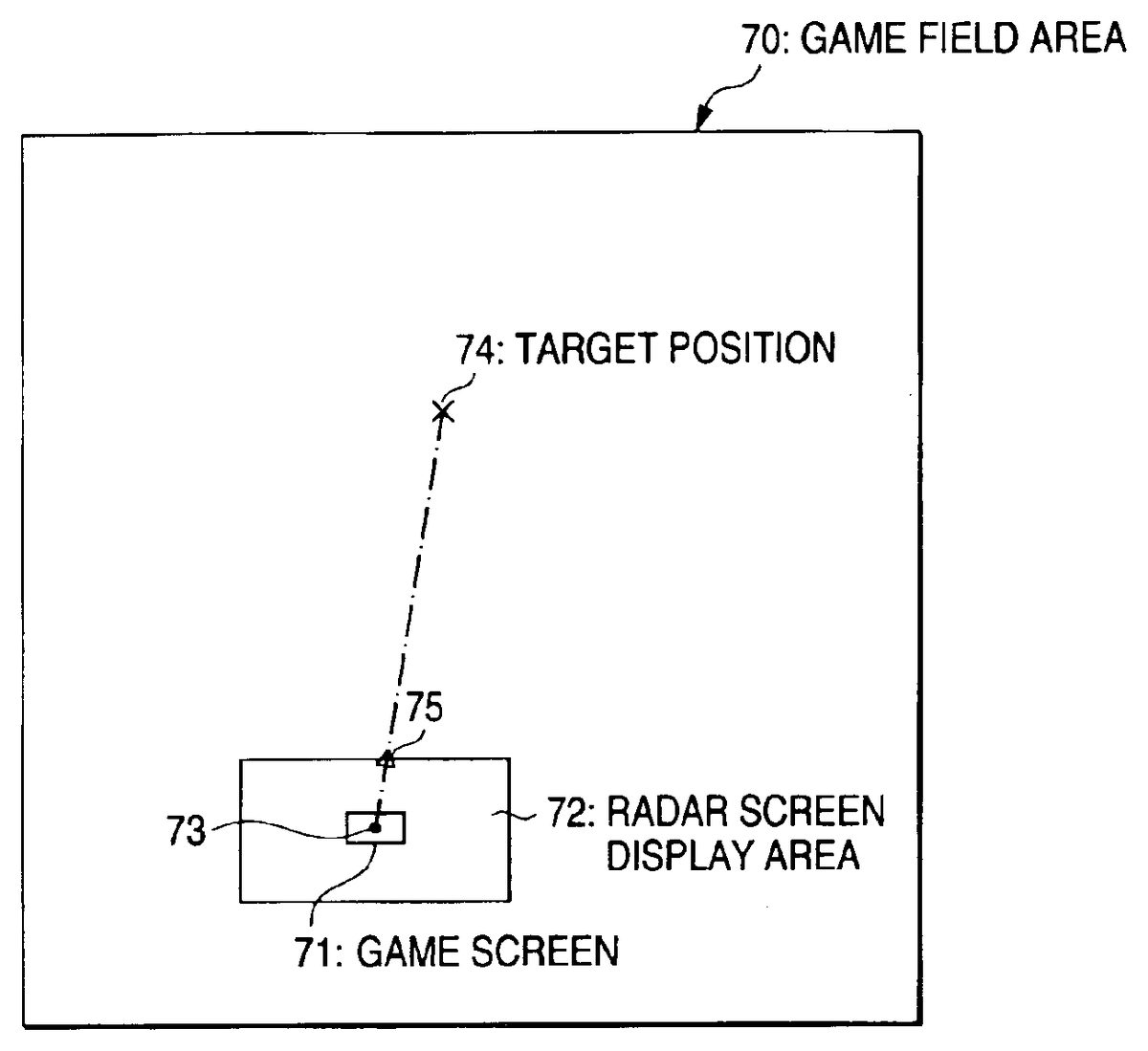
A principle for the display of the radar screen72is described with reference to FIG.8.FIG. 8is a diagram for describing a principle of the display of a radar screen according to this embodiment.
FIG. 8includes a whole area of a game field70where player's character can move in a currently executed game stage, a displayed area71in a radar screen displayed at a part of the display screen61, and a displayed area72of a game screen displayed on the display screen61.
Further,FIG. 8includes a player's character position73in the game field70and a target position74to be reached by player's character next in the game field70.
Under this condition, a target position mark75is flashing-displayed in the vicinity of the intersection of a segment connecting the player's character position73and the target position74and the end portion of the radar screen72such that the direction toward the target position viewing from the player's character position can be recognized by the target position mark.
As a result, the direction that player's character should go can be realized easily without setting the radar screen displaying a wider area including a target position. Therefore, the radar screen can display such that the player's character can realize his/her surrounding geographical features best as he/she goes forward. Thus, the operability of games can be increased significantly.
The player can cause the player's character to go to the direction toward the target position easily only by checking the radar screen shown inFIG. 7, for example, and by moving the player's character toward the direction of the target position mark. As the player's character moves, the game screen displayed area72also moves by the same distance as that the player's character has moved under the display control over the game screen, which is display-controlled in step S8.
Then, the radar screen displayed area71in step S10also moves by the distance that player's character has moved, which moves the target position mark. Thus, the player's character is manipulated to approach the target position step by step so that the target position enters into the radar screen. Then, in step S11, the target position is within the radar screen. In this case, the processing advances from S11to S13, and the target position mark75is flashing-displayed at the target position within the radar screen72. Then, the processing returns to step S4.
An example of the displayed radar screen where a target point to be reached by player's character is positioned within the radar screen will be described with reference to FIG.9.FIG. 9is a diagram schematically showing an example of the displayed radar screen where a target position mark is displayed within the radar screen according to this embodiment.
When the target enters into the radar screen72, the form of the target position mark may be changed to a mark in the other form, such as an “!” mark. Thus, the screen can be differentiated from the previous displayed screen.
As described above, according to this embodiment, when the next target position74to be reached by the player's character does not exist within the displayed radar screen area72in the game field70where the player's character can move in the currently executed game stage, a target position mark75is displayed flashing in the vicinity of the intersection of a segment connecting the player's character position73and the target position74and the end portion of the radar screen72. Thus, the direction toward the target position viewing from the player's character position can be recognized by the target position mark.
Therefore, the direction that the player's character should go can be realized surely since the radar screen displayed area is displayed with the magnification which allows easy manipulation of player's character. Thus, surroundings of player's character can be realized, and, at the same time, the player's character can be moved toward a final target accurately.
While the present invention has been described above specifically based on embodiments and the modification examples, the present invention is not limited to the above-described embodiments and the modification examples and can be changed as necessary without departing from the principle.
For example, in the above-described embodiments and the modification examples, a case where the present invention is implemented by using a home game machine as the platform has been described. However, the present invention may be implemented by using a generic computer such as a personal computer and a street game machine as the platform.
Further, in the above-described embodiments and the modification examples, programs and data for implementing the present invention are stored in a CD-ROM, and the CD-ROM is used as an information recording medium. However, the information recording medium is not limited to a CD-ROM and may be the other computer-readable, magnetic or optical recording medium, such as a magnetic disk and a ROM card, or a semiconductor memory.
Further, programs and data for implementing the present invention are not limited to forms provided through a medium such as a CD-ROM, which can be mounted to a game machine or a computer removably. Saved data for implementing the present invention may be received from the other equipment, such as a server group, connected through a communication circuit, for example, and may be recorded in a memory. Further, the above-described programs and data may be recorded in a memory of the other equipment connected through a communication circuit, for example, and the recorded programs and data may be used through the communication circuit.
Claims
- A game apparatus, which can execute a game in accordance with a game program, comprising: a display controller that displays, in a first display area, a game field and a position of a player's character moving in said game field and, in a second smaller display area, separately displays a larger predetermined area of said game field around said player's character;and a recognizer that recognizes a target position of said player's character, which is fixed in said game field, and a position of said player's character within said game field, wherein said display controller displays an indicator for said target position for said player's character in said larger predetermined area when said target position is in said larger predetermined area of said game field, and when said target position of said player's character cannot be displayed in said larger predetermined area said display controller displays an indicator for indicating a direction to said target position, the indicator being located in a vicinity of an edge of said second display area in accordance with a recognition result by said recognizer.
- The game apparatus according to claim 1 , wherein said indicator has periodically changing brightness.
- The game apparatus according to claim 1 , wherein said display controller displays, at least in a part of a game screen, said position of said player's character within said game field of said first display area and said second display area.
- A game control method for a game apparatus, which can execute a game in accordance with a game program, comprising: displaying, in a first display area, a game field and a position of a player's character moving in the game field and, in a second smaller display area, separately displaying a larger predetermined area of the game field around the player's character;recognizing a target position of the player's character, which is fixed in the game field, and a position of the player's character within the game field;and displaying an indicator for the target position of the player's character in the larger predetermined area when the target position is in the larger predetermined area of the game field, and when the target position of the player's character cannot be displayed in the larger predetermined area displaying an indicator for indicating a direction toward the target position, the indicator being displayed in vicinity of an edge of the second display area in accordance with a recognition result of recognizing the target position.
- The game control method according to claim 4 , further comprising periodically changing the brightness of the indicator.
- The game control method according to claim 4 , wherein the displaying comprises displaying, at least in a part of a game screen, the position of the player's character within game field of the first display area and second display area.
- A computer readable recording medium, which can be read by a game apparatus for executing a game in accordance with a game program, comprising: a display control program for displaying, in a first display area, a game field and a position of player's character moving in said game field and, in a second smaller display area, separately displaying a larger predetermined area around said player's character;and a recognition program for recognizing a target position of said player's character, which is fixed in said game field with the advance of said game, and a position of said player's character within said game field, wherein, said display control program displays an indicator for said target position for said player's character in the larger predetermined area when said target position is in said larger predetermined area of said game field, and when said target position of said player's character cannot be displayed in the predetermined area said display control program displays an indicator for indicating a direction toward said target position in the vicinity of an edge of said second display area in accordance with a recognition result by said recognition program.
- The computer readable recording medium according to claim 7 , wherein said indicator displays periodically changing brightness.
- The computer readable recording medium according to claim 7 , wherein said display control program displays, at least in a part of a game screen, said position of said player's character within said game field of the first display area and the second display area.
- The game apparatus according to claim 1 , wherein said display controller further defines a display magnification of the predetermined area around said player's character based on said character's position.
- The game control method according to claim 4 , wherein the displaying further defines a display magnification of the predetermined area around the player's character based on the character's position.
- The computer readable recording medium according to claim 7 , wherein said display control program further defines a magnification of the predetermined area around said player's character based on said character's position.
- The game apparatus according to claim 1 further comprising: a determiner that determines whether said target position can be displayed in said second display area.
- The game control method according to claim 4 , further comprising: determining whether the target position can be displayed in the second display area.
- The computer readable recording medium according to claim 7 further comprising: a determination program that determines whether said target position can be displayed in said second display area.
Disclaimer: Data collected from the USPTO and may be malformed, incomplete, and/or otherwise inaccurate.