U.S. Pat. No. 6,251,010
Game Machine Apparatus and Method with Enhanced Time-Related Display of Pokemon-Type Characters
AssigneeNintendo Co. Ltd.
U.S. Patent No. 6,251,010: Game machine apparatus and method with enhanced time-related display of pokemon-type characters
U.S. Patent No. 6,251,010: Game machine apparatus and method with enhanced time-related display of pokemon-type characters
Issued June 26, 2001, Nintendo Co., Ltd., Game Freak Inc., and Creatures Inc.
Filed: May 18, 2000 (claiming priority to August 26, 1999)
Overview:
U.S. Patent No. 6,251,010 (the ‘010 patent) relates to varying the likelihood for a character to appear in a particular territory based on the time of day. The ‘010 patent details a player object moving within a displayed territory to encounter a character, the player object being able to potentially encounter several different characters. There is a clock generating time information and time related criteria is evaluated using the time information from the clock, varying the likelihood of a character to appear in said territory.
The ‘010 patent is likely exemplified in a great many Pokémon games, and is how the same area can have different Pokémon spawn at different times of day.
Abstract:
A game machine of a type that a player object is moved on a map to encounter with a character includes a program storage storing a game program, a clock at least clocking a time, an operation device for operating the player object, and an image processor for varying a display image based on the operation of the operation device. The game program storage stores a program for varying an appearance condition of the character appearing on the game map based on time information of the clock.
Illustrative Claim:
- A game machine for executing a game program of a type having an associated display wherein a player object is moved within a displayed territory to encounter a character, comprising: a program storage for storing a game program; a clock for generating time related information; an operation control member actuated by a player for controlling the display of a player object; and a processor for executing said program to vary a displayed image based on the operation of said operation control member, wherein said game program storage stores a program for evaluating a time related criteria using said time related information, and for varying the likelihood for a character to appear on the game display in a portion of said territory based at least in part on the evaluation of said time related criteria.
Illustrative Figure
Abstract
No abstract is available for this record.
Description
DESCRIPTION OF THE PREFERRED EMBODIMENT As shown in FIG. 1, an image-display game machine GBP of a present embodiment is roughly classified into a program source 100 and a game machine 200. The program source 100 stores information such as programs necessary for executing an image-display game on the game machine 200 and is detachably connected to the game machine 200. The program source 100 is preferably structured in a form of cartridge including a ROM 11, a RAM 12, a clock 14, and a memory bank controller 15. The ROM 11 is implemented by non-volatile memory such as ROM, flash memory, and EEPROM to fixedly store the game program. The ROM 11 stores programs required depending on the contents of the game. If the game is a type of capturing and training monsters, for example, stored programs are a capturing program and a training program. Further, the ROM 11 stores dot data for displaying each monster as an image, and at the same time, stores a program for exchanging data, as required, among other portable game machines 200 (not shown) and a program for achieving compatibility with the program stored in the program source 100C of the conventional image-display game machine GBC shown in FIG. 12. Note that, hereinafter, the program source 100 (new cartridge) and the conventional program source 100C (cartridge already in the market) are collectively referred to as a cartridge 100 except for the case where the distinction is required therebetween. The RAM 12 is implemented by readable/writable memory, typified by RAM, and includes a memory region for storing a plurality of property data items for each of characters obtained in the course of playing the game. Next, by referring to FIG. 2, the structure of the memory region of the ROM 11 is described in ...
DESCRIPTION OF THE PREFERRED EMBODIMENT
As shown in FIG. 1, an image-display game machine GBP of a present
embodiment is roughly classified into a program source 100 and a game
machine 200. The program source 100 stores information such as programs
necessary for executing an image-display game on the game machine 200 and
is detachably connected to the game machine 200.
The program source 100 is preferably structured in a form of cartridge
including a ROM 11, a RAM 12, a clock 14, and a memory bank controller 15.
The ROM 11 is implemented by non-volatile memory such as ROM, flash
memory, and EEPROM to fixedly store the game program. The ROM 11 stores
programs required depending on the contents of the game. If the game is a
type of capturing and training monsters, for example, stored programs are
a capturing program and a training program.
Further, the ROM 11 stores dot data for displaying each monster as an
image, and at the same time, stores a program for exchanging data, as
required, among other portable game machines 200 (not shown) and a program
for achieving compatibility with the program stored in the program source
100C of the conventional image-display game machine GBC shown in FIG. 12.
Note that, hereinafter, the program source 100 (new cartridge) and the
conventional program source 100C (cartridge already in the market) are
collectively referred to as a cartridge 100 except for the case where the
distinction is required therebetween.
The RAM 12 is implemented by readable/writable memory, typified by RAM, and
includes a memory region for storing a plurality of property data items
for each of characters obtained in the course of playing the game.
Next, by referring to FIG. 2, the structure of the memory region of the ROM
11 is described in detail. The memory region of the ROM 11 in the present
embodiment broadly includes a program region, an image data region, a
Pokemon data region, a sound memory region, a Pokemon appearance
probability table storage region, a zone map storage region, and other
regions.
Among these regions, a time-varying factor such as time and time zone,
which is a feature of the present invention, is introduced in the Pokemon
data region, the sound memory region, and the Pokemon appearance
probability table storage region.
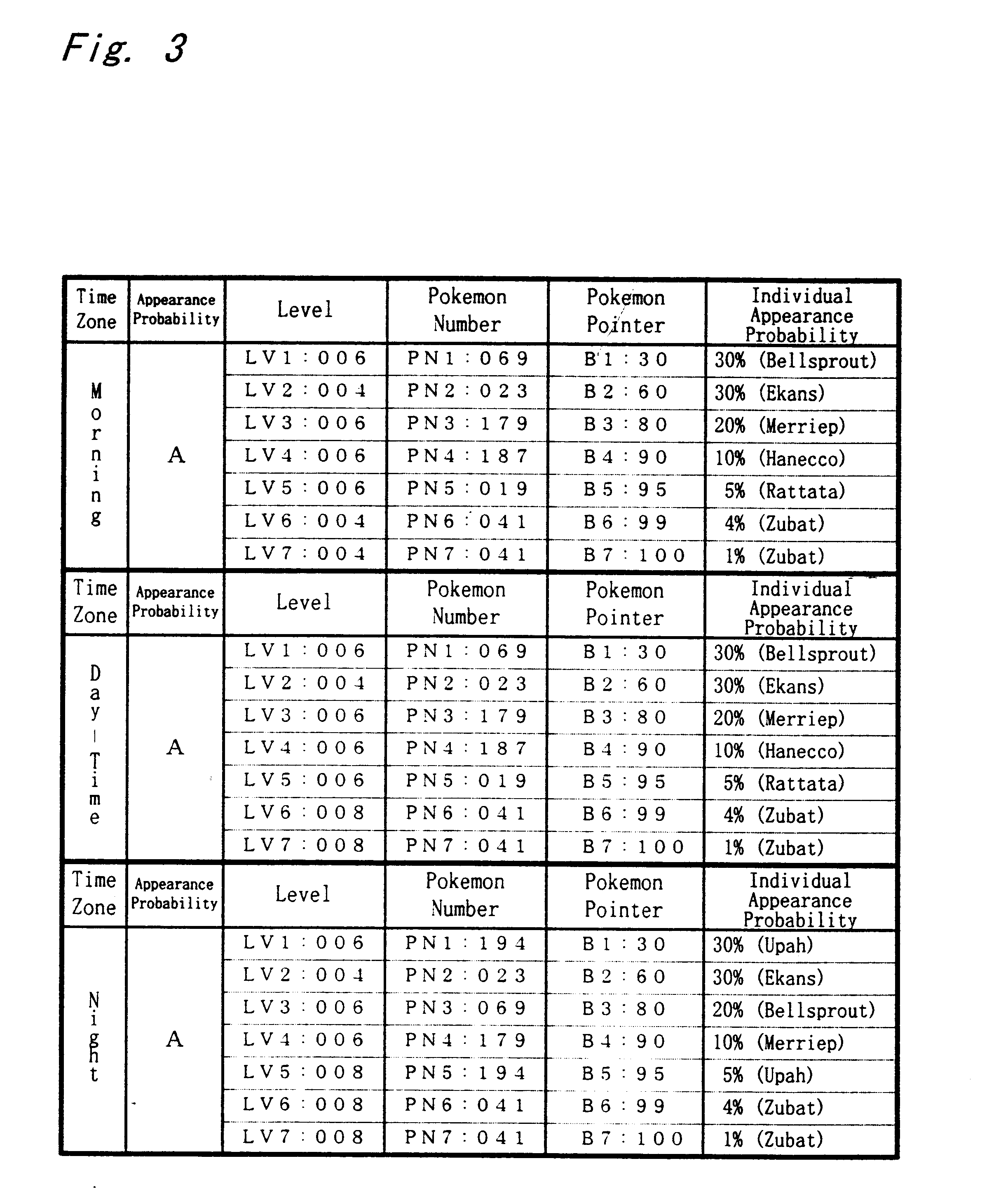
First, by referring to FIG. 3, a Pokemon appearance probability table
stored in the Pokemon appearance probability table storage region is
described. The Pokemon appearance probability table is provided for
varying the appearance probability of the Pokemon depending on a location
on the game map and on a time zone. Although not clearly indicated in FIG.
3, the Pokemon appearance probability table defines the appearance
probabilities for every Pokemons that appear at the same location during
the same time zone.
More specifically, in the Pokemon appearance probability table, three time
zones, morning, daytime, and night, are set for each location. Further,
for each time zone, a total appearance probability A, which is the
probability that all Pokemon may appear at the location is defined. In the
present embodiment, the seven units of Pokemons are assumed to appear at
the same location for each time zone of morning, daytime, and night. The
seven units of Pokemons may be selected from all Pokemons, allowing that
the same type of Pokemon is repeatedly selected.
For convenience of description, the morning time zone is taken as an
example, and the structure of the Pokemon appearance probability table is
specifically described. Pokemon numbers (monster codes) of the seven
Pokemon units that can appear during one time zone (morning) are
registered in appearing Pokemon numbers of PN1 to PN7, respectively. That
is, in the appearing Pokemon number PN1, the BELLSPROUT is registered.
Similarly, in the appearing Pokemon numbers of PN2, PN3, PN4, PN5, PN6,
and PN7, the EKANS, MERRIEP, HANECCO, RATTATA, ZUBAT, and ZUBAT are
registered, respectively. Note that the ZUBAT is registered twice.
The Pokemons registered in the appearing Pokemon numbers PN1 to PN7 are set
with respective levels of LV1 to LV7, Pokemon pointers of B1 to B7 as
being thresholds to permit the appearance of respective Pokemons, and
individual appearance probabilities. To be specific, the individual
appearance probability of the BELLSPROUT, which is registered in the
appearing Pokemon number PN1 as the Pokemon number 069, is 30 percent, and
the Pokemon pointer B1 and the level LV1 thereof are 30 and 006,
respectively.
In the same manner, the individual appearance probability of the EKANS,
which is registered in the appearing Pokemon number PN2 as the Pokemon
number 023, is 30 percent, and the Pokemon pointer B2 and the level LV2
thereof are 60 and 004, respectively. The appearing Pokemon numbers PN3 to
PN7 are defined as well, as shown in FIG. 3.
Note that, in the similar way to the morning time zone, the Pokemons are
individually registered in the appearing Pokemon numbers PN1 to PN7
respectively provided for the time zones of daytime and night.
Next, by referring to FIG. 4, a memory region of the RAM 12 is structurally
described in detail. In the embodiment, the memory region of the RAM 12
includes an obtained Pokemon data region DAamP and an environmental data
region DoP. The obtained Pokemon data region DAamP is similar to the
obtained Pokemon data region DAamC of the conventional RAM 12C in that the
obtained game characters, or the Pokemons and the properties thereof are
stored therein. Accordingly, the obtained Pokemon data region DAamP
includes the records R1 to RN, each of which is structured by the fields
I1 to I9 that are included in the obtained Pokemon data region DAamC.
In each record R included in the obtained Pokemon data region DAamP,
however, at least four fields of J1, J2, J3, and J4 are newly provided in
addition to the above fields I1 to I9.
In the field J1, the sex of the obtained Pokemon is stored.
In the field J2, the item(s) possessed by the obtained Pokemon is/are
stored.
In the field J3, a state indicative of whether the obtained Pokemon is
infected by a virus is stored. An infected monster is rarely found as a
scarcity value, and is set to raises the HP, experience points, the level,
the ability value, or the like by training at the faster rate compared
with the uninfected monsters.
The field J4 is the spare field for storing data other than the above items
stored in the fields J1 to J3.
Note that an arbitrary number of O fields J1 to JO can be provided instead
of four fields of J1 to J4, where O is a natural number.
Also note that the above described fields I1 to I9 are the storage regions
commonly allocated for the conventional program source 100C and the
program source 100 of the present invention. Thereby, the program source
100C (RAM 12C) and the program source 100 (RAM 12) become compatible with
each other. On the other hand, the fields J1 to J4 are regions uniquely
allocated for the program source 100 (RAM 12) of the present invention.
In the present invention, the obtained Pokemons are defined by the records
R1 to RN, respectively, and the properties of the each obtained Pokemon
are defined by the fields I1 to I9 and J1 to J4. That is, a property of an
obtained Pokemon is represented by P (Rn, Im) or P (Rn, Jo), where o is a
natural number equal to or smaller than 4.
The environmental data region DoP includes, the environmental data region
DoC shown in FIG. 13, and a region DoN newly provided for storing
environmental data relating to the data newly set for the ROM 11 in the
present invention.
Referring back to FIG. 1, the clock 14 includes at least a timer for
clocking, and also includes a calendar function of indicating a date
(month/day) and a day of the week, as required.
The memory bank controller 15 divides a memory chunk of the ROM 11 into a
plurality of banks when the memory chunk is too large for an address bus
to address, and generates bank data for the higher address in the ROM 11
and for addressing a memory chunk in the RAM 12.
The clock 14 and the memory bank controller 15 are preferably implemented
in a single chip of integrated circuit (IC) to reduce the number of chips,
reducing costs. A substrate on which the single chip IC including the ROM
11 and RAM 12 is accommodated in a case or housing.
The game machine 200 is identical to that described by referring to FIG.
12.
In FIG. 5, an example of a game map displayed on the game machine 200 based
on image data stored in the image data region is shown.
In FIG. 6, zone data and map data stored in the zone map storage region is
schematically shown.
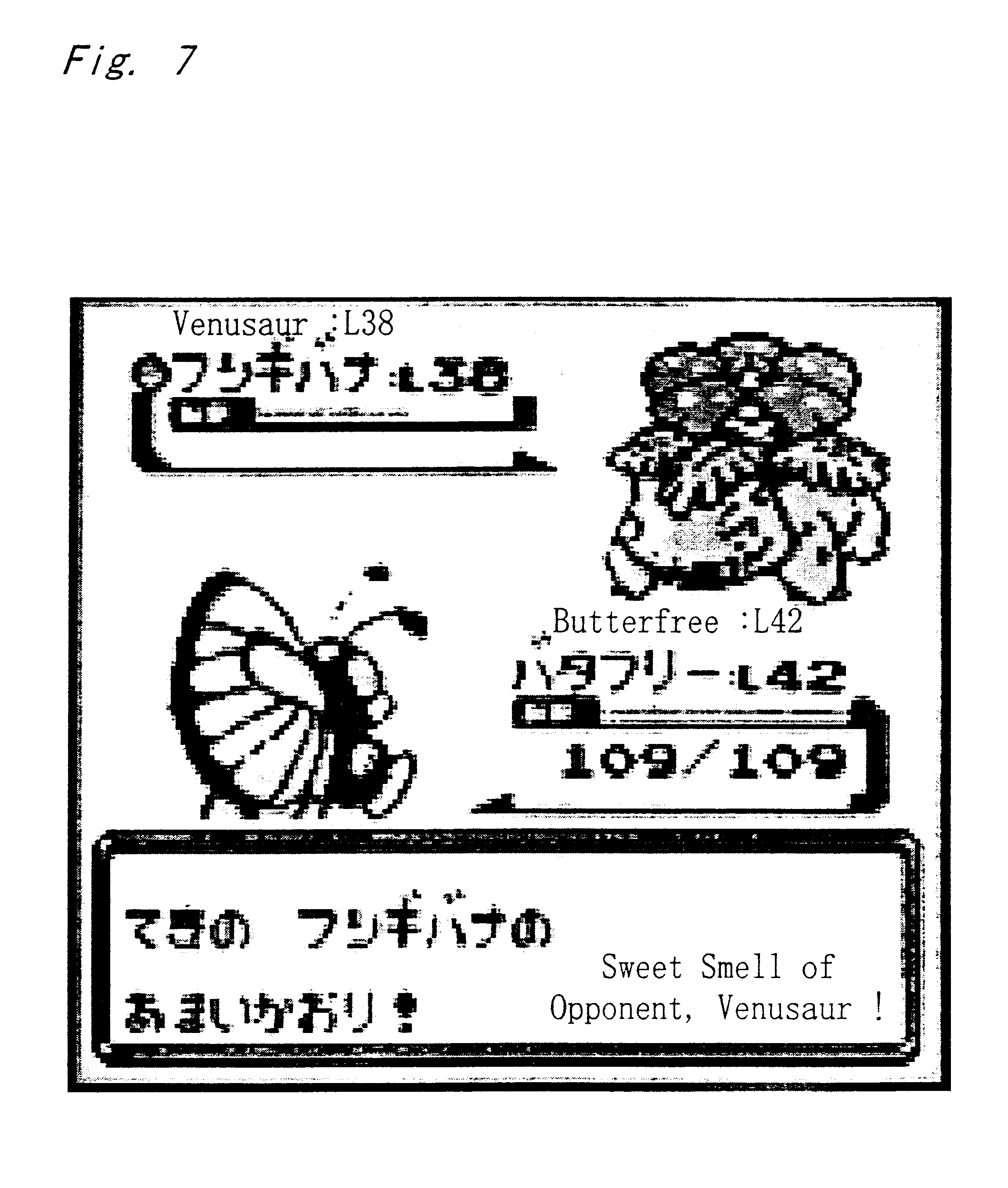
In FIG. 7 an example of a battle state in the game performed in the
image-display game machine according to the present invention is shown.
In FIG. 8, an exemplary implementation of the image-display game machine
GBP of the present invention as a portable game machine is shown. In the
image-display game machine GBP, a connector 13 of the cartridge 100 (FIG.
1) is engaged into a connector 24 (FIG. 1) provided on the rear surface of
the game machine 200. On the lower-end side of front surface (plane) of a
housing 21 of the game machine 200, the operation switch portion 22 is
provided, and on the upper part thereof, the LCD 27 is provided. In the
housing 21, a circuit board composed of the circuitry components shown in
FIG. 1 is provided.
The operation switch 22 includes a direction switch 22a for instructing
cursor movement or moving directions of the character operable by the
player, an action switch 22b for instructing character's action including
movement, a start switch 22c , and a select switch 22d.
Described next is the operation of the image-display game machine according
to the embodiment of the present invention. First, the player presses the
start switch 22c and then the game starts. After a title screen is
displayed, some area of the game map shown in FIG. 5 is displayed as an
initial screen.
To capture the monster, the player operates the direction switch 22a to
move a player character (player object) to a probable location on the game
map where the monster is hiding. A water-type monster hides in a pond or
sea, and a herbivorous-type monster hides in a grassy area, farm field, or
woods.
As described by referring to the Pokemon appearance probability table shown
in FIG. 3, the monsters each have the characters unique thereto, and some
of them appear only at a specified location and time. The appearance or
disappearance of the monster is changed conditionally on whether the time
measured by the clock 14 is at the time or in the time zone determined by
a program. The appearance condition set for a nocturnal monster such as an
owl or bat, for example, is gradually increasing or holds a constant low
value for the evening; high-probability for the midnight; and gradually
decreasing towards the dawn. No nocturnal monster appears during the
daytime (zero probability).
On the other hand, a diurnal monster is set with the chronologically
reverse appearing condition. Further, for a monster that changes a hiding
place depending on a time zone or time, the program is so set that the
location of the appearance is changed depending on time. For a monster
living in water during the daytime but on land during the night, the
program is set to change the habitat or move the monster depending on the
time zone. Thus, the appearance probabilities in the Pokemon appearance
table are properly set for each time zone and each type of Pokemon.
When the player captures a monster, the data items thereof are written in
the corresponding fields of I1 to I9 and J1 to J4 in a vacant record Rn of
the obtained Pokemon data region DAamp. As described by referring to FIG.
4 (and as shown in FIG. 13), the hit points (HP), the experience points,
the level, the status, the possible attack, the ability, and the like
possessed by the monster when it is captured are written in the respective
fields of I2, I3, I4, I5, I6, I7, and I8 at the same time of a monster
code of the captured monster is written in the field I1,
Further, if the cartridge used by the player is the program source 100
according to the present invention defining the monster's properties of
the sex, item, virus, or the like, such data items are stored in the
respective fields of J1 to J3. A virus-infected monster is very rare as a
scarcity value, and is set to raise the HP, the experience points, the
level, the ability value, or the like by the training at the faster rate
compared with the uninfected monster.
Accordingly, the player is willing to infect the captured monster with the
virus for accelerating the growth or training thereof. The player,
therefore, searches for the virus-infected monster to capture it. The
player then puts the captured infected monster in a incubation box
(incubation room) together with the uninfected monster so that the
uninfected monster is infected with the virus to grow faster.
As described, the monster can be grown faster by being infected with the
virus which helps the monster grow or raise the level, thereby
advantageously shortening the training period required to raise the
monster to a certain level.
Furthermore, when playing with the cartridge provided with the program
source 100, the monster is provided with sex data. The time or the date
when male and female monsters of the same type (same monster code) among
the captured monsters are coupled and put in the same incubation box
(incubation room) is temporarily recorded in a register. After
predetermined days determined by a program have been counted starting from
the registered time or date in the clock 14, a child inheriting the
property data (ability, strength, etc.) from both of the male and the
female monsters is born, increasing the types of collected monsters.
As such, various types of monsters become collectable with ease, the
acceleration of the progress of the game become possible, and further, the
player can enjoy training the child monster from the ground up. Note that
if the player captures several of the same type monsters, it is also
possible to exchange one of them with one of another type of monster that
are captured by the friend and not owned by the player.
In a case where a player having the new version cartridge provided with the
program source 100 and a player having the old version cartridge provided
with the conventional program source 100C exchange the monsters, it is
preferable to ensure compatibility therebetween as much as possible in
handling of the data such as the sex data, item data and virus-infection
data, or the like. For the sake of compatibility, one-bit data indicating
the presence of data for fields J1 to J3 is stored in the field I9 at the
time when the data is transferred from the new version cartridge to the
old version cartridge.
When the game is played with the old version cartridge, additional data
such as the sex data, item data, and virus-infection data is not used. In
a case of transferring back the data from the old version cartridge to the
new version cartridge, the one-bit data stored in the field I9 is also
transferred, thereby enabling the utilization of the additional data by
the player having the new version cartridge.
On the other hand, when the data is transferred from the old version to the
new version, the sex data not stored in the old version cartridge, for
example, is determined in a predetermined rule and written in the field J1
of the new version cartridge. As the exemplary rule, sex can be determined
as male if the one place number of the "minutes" measured by the clock 14
is an odd number, and as female if an even number. Alternatively, the
determination can be made based on random number data.
In such manner, compatibility is ensured as much as possible even if the
monsters are exchanged between the old and the new version cartridges,
thereby enabling data exchange among all players. Furthermore, when the
player having the old version cartridge purchases the new version
cartridge, the monsters trained with the old version cartridge can be
transferred to the new version cartridge and can be effectively utilized.
The monsters newly captured by the player, the monsters newly born from the
couple of the obtained monsters, and the monsters exchanged with the
friends in the above described manner are used for the battles with the
friends' monsters. The battle is performed by connecting the connectors 29
on the game machines 200 each other via the cable, and put each monster
designated by each player on a battle field. In FIG. 7, the example of the
battle state is shown.
Next, by referring to a main flowchart shown in FIG. 9, the major operation
of the image-display game machine GBP of the present invention is
described. Thereafter, by referring to detailed flowcharts shown in FIGS.
10 and 11, a Pokemon appearance processing subroutine of step #500 in FIG.
9 is described in detail.
First, the player presses the start switch 22c, as shown in the main
flowchart of FIG. 9.
In step #100, game-start processing is executed. Then the procedure
advances to step #200.
In step #200, a player object processing subroutine is executed, and then
the procedure advances to step #300.
In step #300, an object processing subroutine for the objects other than
the player object is executed. Then the procedure advances to step #400.
In step #400, a background image processing subroutine is executed.
Following the title screen displayed after going through the above steps
#100, #200, #300, and #400, some area of the game map is displayed as the
initial screen, and the player is ready for capturing the monsters. Then
the procedure advances to step #500.
In step #500, the Pokemon appearance processing subroutine is executed. For
capturing the monster, the player character (player object) is moved by
operating the direction switch 22a to a probable location on the game map
where the monster is hiding. Then the procedure advances to step #700.
In step #700, a communication processing subroutine is executed. In this
step, for the purpose of exchanging the obtained monsters with a friend,
or starting the battle with the monster obtained by the friend, the game
machines 200 of the player and the friend are connected with each other
for communication. Then, the procedure goes back to the above described
step #200 and repeats steps #200 to #700 until the player turns off the
switch of the image-display game machine GBP to end the game.
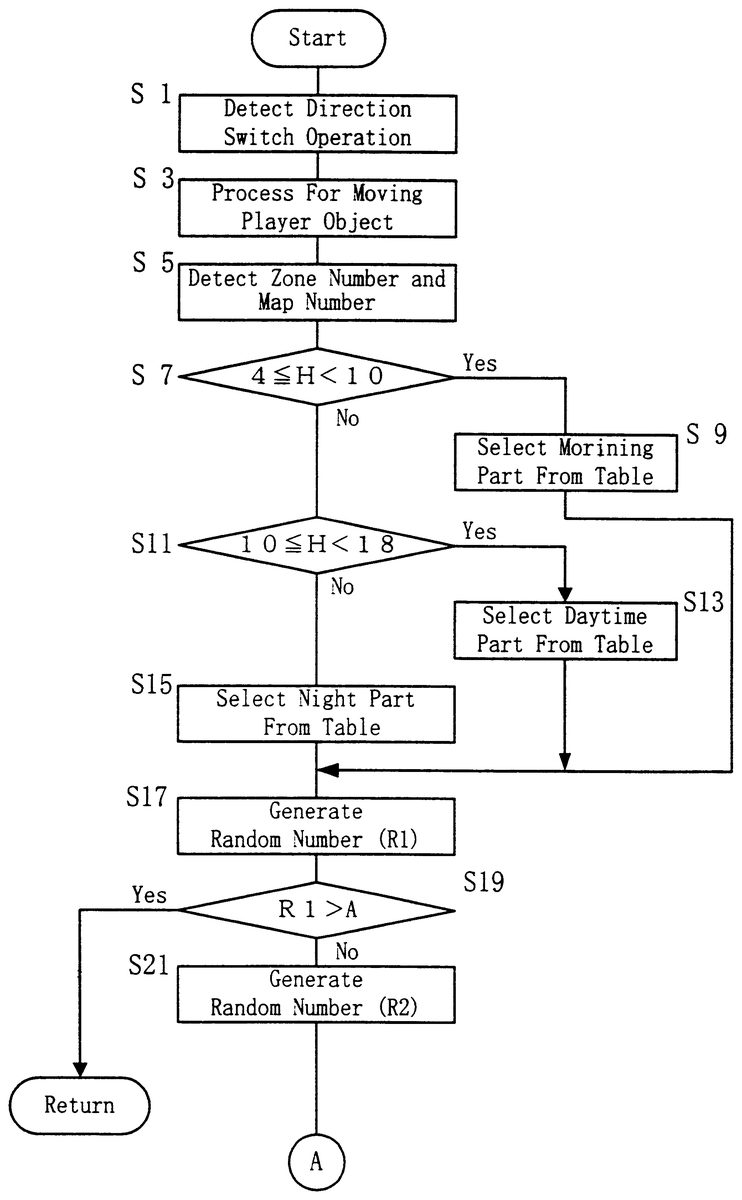
Next, by referring to FIG. 10, the detailed procedure in the above
described Pokemon appearance subroutine of step #500 is described. After
the processing in step #400, in this subroutine, when the player operates
the direction switch 22a, in step S1, detection is made on a
player-operation of the direction switch 22a and a direction thereof.
Then, the procedure advances to step S3.
In step S3, processing to move the player object to the direction
instructed by the direction switch 22a is performed. Then, the procedure
advances to step S5.
In step S5, zone number and map number indicating the position on the game
map exemplarily shown in FIG. 6 are detected. The player object stands on
that position after moving in step S3. The procedure then advances to step
S7.
In step S7, it is determined whether a time parameter H supplied from the
clock 14 is equal to or larger than 4 and smaller than 10. That is to say,
if the game is played between 4 a.m. and 10 a.m., "yes" is determined, and
the procedure advances to step S9.
In step S9, a part indicating the morning time zone is selected from the
Pokemon appearance probability table shown in FIG. 3. Then, the procedure
advances to step S17.
On the other hand, if the time H is earlier than 4 a.m. or later than 10
a.m., "no" is determined in step S7, and the procedure advances to step
S11.
In step S11, whether H is equal to or larger than 10 and smaller than 18 is
determined. That is to say, if the time H is in the daytime between 10
a.m. and 6 p.m., "yes" is determined, and the procedure advances to step
S13.
In step S13, a part indicating the daytime time zone is selected from the
Pokemon appearance probability table. Then, the procedure advances to step
S17.
On the other hand, if the time H is in the night hours of later than 6 p.m.
and earlier than 4 a.m., "no" is determined in step S11, and the procedure
advances to step S15.
In step S15, a part indicating the night time zone is selected from the
Pokemon appearance probability table. Then the procedure advances to step
S17.
In step S17, a random number R1 is generated in the range of 1 to 100. The
procedure then advances to the next step S19.
In step S19, it is determined whether the random number R1 generated in
step S17 is larger than the appearance probability A of total Pokemons
provided for the time zone selected in step S9, S13, or S15. If determined
to be "yes", the subroutine of step #500 ends and the procedure moves to
step #700.
That is to say, in this step, the appearance or disappearance of the
Pokemon at the place where the player object currently locates is randomly
changed by comparing the random number R1 with the appearance probability
A. In this manner, Pokemon appearance or disappearance is unexpected each
time even at the same place. If "no" is determined, on the other hand, the
procedure advances to the next step S21.
In step S21, a random number R2 is generated in the range of 1 to 100.
Then, the procedure advances to step S25 as shown by FIG. 11.
In step S25, it is determined whether the random number R2 generated in
step S21 is equal to or larger than 1 and not larger than a value of the
Pokemon pointer B1. If determined to be "yes", the procedure advances to
step S27.
In step S27, the Pokemon of PN1 appears on the game map at the rate defined
by its individual appearance probability. That is, if the random number R2
is equal to or larger than 1 and also not larger than or equal to the
value of the Pokemon pointer B1, BELLSPROUT of the appearing Pokemon
number PN1 defined by the Pokemon pointer B1 appears on the game map at 30
percent ratio with the image and sound. Then, the procedure advances to
step S51.
On the other hand, if determined to be "no" in step S25, the procedure
advances to step S29.
In step S29, it is determined whether the random number R2 is larger than
B1 and not larger than or equal to B2. If determined to be "yes", the
procedure advances to step S31.
In step S31, the Pokemon of PN2 appears on the game map. Then, the
procedure advances to step S51. As such, one unit of Pokemon is selected
from among seven units (Pokemons PN1 to PN7) by comparing the random
number R2 with each of the Pokemon pointers B1 to B6. As a result, the
selected Pokemon unit appears on the game in accordance with the
individual appearance probability thereof.
On the other hand, if determined to be "no" in step S29, the procedure
advances to step S33.
In step S33, whether the random number R2 is larger than B2 and not larger
than or equal to B3 is determined. If "yes", the procedure advances to
step S35.
In step S35, the Pokemon PN3 appears on the game map in accordance with the
individual appearance probability thereof. The procedure then advances to
step S51.
On the other hand, if determined to be "no" in step S33, the procedure
advances to step S37.
In step S37 whether the random number R2 is larger than B3 and not larger
than or equal to B4 is determined. If "yes", the procedure advances to
step S39.
In step S39, the Pokemon PN4 appears on the game map in accordance with the
individual appearance probability thereof. The procedure then advances to
step S51.
On the other hand, if determined to be "no" in step S37, the procedure
advances to step S41.
In step S41, whether the random number R2 is larger than B4 and not larger
than or equal to B5 is determined. If "yes", the procedure advances to
step S43.
In step S43, the Pokemon PN5 appears on the game map in accordance with the
individual appearance probability thereof. The procedure then advances to
step S51.
On the other hand, if determined to be "no" in step S41, the procedure
advances to step S45.
In step S45, whether the random number R2 is larger than B5 and not larger
than or equeal to B6 is determined. If "yes", the procedure advances to
step S47.
In step S47, the Pokemon PN6 appears on the game map in accordance with the
individual appearance probability thereof. The procedure then advances to
step S51.
On the other hand, if determined to be "no" in step S45, that is, if it is
determined that the random number R2 is larger than B6, the procedure goes
to step S49.
In step S49, the Pokemon PN7 appears on the game map, and then the
procedure advances to the next step S51.
In step S51, the battle is started with the Pokemon appeared in any of the
steps S27, S31, S35, S39, S42, S47, or S49. Then the subroutine in step
#500 ends and the procedure advances to step #700.
As described in the foregoing, in the present invention, the appearance
probability of total Pokemons is defined for each location of the player
object on the game map and each time zone (three types of morning,
daytime, and night). Further, in each time zone, the appearance
probabilities are respectively set for the seven units of Pokemons each
having the individual level (LV1 to LV7).
When the player object is located on the game map, the Pokemons PN1 to PN7,
in a part of the Pokemon appearance probability table indicating the
corresponding time zone and the location, are initially selected as
potential monsters for appearance.
Next, by using a first random number R1 as the threshold, in a case of the
total appearance probability A of the selected Pokemons being smaller than
the random number R1, all of the selected Pokemons are kept hiding at the
location. The player's next operation of the direction switch 22a is
awaited.
On the other hand, if the total appearance probability A of the selected
Pokemons is larger than the first random number R1, it is decided to make
one of the seven potential monsters PN1 to PN7 appeared at the location To
select one out of seven, a second random number R2 is generated and
compared, as the threshold, with each of the Pokemon pointers B1 to B7
specifying the selected Pokemons, respectively. As a result, only a
Pokemon unit (PN) corresponding to a Pokemon pointer B that satisfies a
predetermined relationship between the second random number R2 appears on
the game.
As described, the first random number R1 and the total Pokemon appearance
probability A are randomly determined in consideration of time and time
zone factors for permitting the appearance of the Pokemon at a certain
place on the game map. In this aspect, the first random number R1 and the
total Pokemon appearance probability A serve as Pokemon appearance
permitting means.
In addition, the second random number R2 and the Pokemon pointer B
determine one of Pokemon units when the appearance is permitted. In this
aspect, the second random number R2 and the Pokemon pointer B serve as
individual Pokemon appearance permitting means.
Note, in the above described embodiment, although the portable game machine
and the cartridge used therefor are described as the example of the
image-display game machine, a video game machine connected to a television
receiver may serve as an alternative. In such case, the information
storage medium may be a game cartridge, an optical storage medium such as
CD-ROM or DVD, a magnetic disk, or the like.
In the present invention, a game cartridge detachably connected to a
portable game machine includes: program storage means (e.g., ROM) for
storing a game program; readable/writable temporal storage means (e.g.,
RAM) for storing a plurality of property data items for each of the
characters obtained in the course of playing the game; and clock means for
clocking at least a time. The portable game machine (main body) includes:
operation means (operation switch) operated by a player for performing
operation for at least obtaining the character and training the character
to increase its experience points; processing means (CPU); and display
means (LCD) for displaying the result of processing performed by the
processing means.
The processing means, by executing the program and based on the operation
of the operation means, performs image processing as to vary the image on
the display. The processing means also varies the property data to be
written in the temporal storage means based on the proceeding of the game
that varies in accord with the operation of the operation means. The game
program storage means stores a program set to vary an appearance condition
of the monster which appears at a given place on the game map based on
time information of the clock means. The stored program is processed by
the processing means, thereby varying the appearance condition of the
monster based on the time information.
As to the appearance condition of the monster, the program may be set so
that the probability in the time zone based on the time information is
distributed in a predetermined manner such as a normal distribution curve.
As to the appearance condition of the monster, the program may be set so
that the appearing location varies depending on the time zone based on the
time kept by the clock means.
If the characters are imaginary creatures that are distinguishable by sex,
the program in the game program storage means may be set so that, when the
same type creatures having different sex are coupled and kept in the same
region, a child inheriting the properties of the both sexes of the
creature type is born based on the elapse of a predetermined time.
Furthermore, in the present invention, the game cartridge detachably
connected to the portable game machine includes the program storage means
for storing the game program and the readable/writable temporal storage
means for storing the plurality of property data items for each of the
characters obtained in the course of playing the game. The temporal
storage means includes a region storing the plurality of property data
items for each of the obtained characters and a virus-infection data
region for storing whether each character is infected with a virus that
accelerates its growth. The portable game machine (main body) includes the
operation means operated by the player for performing operation for at
least obtaining the character and training the character to increase its
experience points, the processing means, and the display means for
displaying the result of processing performed by the processing means. The
processing means, by executing the program and following the operation of
the operation means, performs the image processing as to vary the image on
the display. The processing means also varies the property data to be
written in the temporal storage means in accord with the proceeding of the
game that varies based on the operation of the operation means, and varies
the character image based on the varied property data. Furthermore, when a
newly captured character has data that indicates virus infection, the
processing means writes the data into at least one of the virus-infection
data regions provided for each of the other captured characters being
stored in the temporal storage means.
The image-display game machine is so structured as to become connectable
with other image-display game machines by a data cable. When exchanging
data between the other image-display game machine and receiving the
virus-infected character therefrom, the processing means in the
image-display game machine writes, based on the program stored in the
program storage means, the data indicating virus infection into at least
one of the virus-infection data regions provided for each of the other
captured characters being stored in the temporal storage means.
Still further, in the present invention, an image-display game system
includes an information storage medium storing a game program and an
image-display game machine so structured that the information storage
medium is detachably connected thereto. The information storage medium
includes program storage means for fixedly storing the game program, and
readable/writable temporal storage means for storing a plurality of
property data items including sex data for each of characters obtained in
the course of playing the game. The image-display game machine includes
operation means operated by a player, processing means for processing
information based on the operation status of the operation means and the
program, and display means for displaying the result of processing
performed by the processing means. The processing means, by executing the
program and following the operation of the operation means, performs image
processing as to vary the image on the display. The processing means also
varies the property data to be written in the temporal storage means in
accord with the proceeding of the game, and writes the sex data of the
captured character to the temporal storage means.
As described above, in the present invention, the time-varying factor is
introduced to further diversify the contents of the game and increase the
appeal of the game, thereby achieving the image-display game machine, and
the information storage medium storing the game program therefor, that is
challenging for the user.
Further, according to the present invention, the image-display game machine
and the information storage medium storing the game program therefor that
provides more fun are obtained by changing the property data of the
characters such as the monsters based on the, thus introduced,
time-varying factor to further diversify the developments in the game
depending on a player's knowledge and thinking.
While the invention has been described in detail, the foregoing description
is in all aspects illustrative and not restrictive. It is understood that
numerous other modifications and variations can be devised without
departing from the scope of the invention.
Claims
- A game machine for executing a game program of a type having an associated display wherein a player object is moved within a displayed territory to encounter a character, comprising: a program storage for storing a game program;a clock for generating time related information;an operation control member actuated by a player for controlling the display of a player object;and a processor for executing said program to vary a displayed image based on the operation of said operation control member, wherein said game program storage stores a program for evaluating a time related criteria using said time related information, and for varying the likelihood for a character to appear on the game display in a portion of said territory based at least in part on the evaluation of said time related criteria.
- The game machine as claimed in claim 1, wherein said game program storage stores a program in which the likelihood for a character to appear on the game display is set at a predetermined probability based on the evaluation of said time related criteria.
- The game machine as claimed in claim 1, wherein said territory is represented by a displayed map and wherein said game program storage stores a program in which a type of the character appearing at a location on the game map is set to vary depending on a time range based on the time related information from said clock.
- The game machine as claimed in claim 2, further comprising: a first random number generator for generating a first random number;a first comparator for comparing data related to the likelihood of a character appearing with said first random number;and wherein said processor is operable to perform character appearance processing when said data related to the likelihood of a character appearing has a predetermined relationship with said first random number.
- The game machine as claimed in claim 4, further comprising: a second random number generator for generating a second random number;a second comparator for comparing a plurality of character pointers each indicating a different value with said second random number;and wherein said processor is operable to control the display of a character indicated by any of the character pointers having a predetermined relationship with said second random number.
- The game machine as claimed in claim 1, wherein said character is an imaginary creature distinguishable by sex, and said game program storage stores a program in which, when the same type creatures having different sex are coupled and kept in a same region in said territory, and in which a child inheriting properties of the both sexes of the creature type is set to be born after a predetermined elapsed time.
- A storage medium in which a game program is stored for controlling a game machine having an associated display, wherein a player object is moved within a territory to encounter a character, said game program controlling said game machine to perform the operations comprising the steps of: generating time related information;detecting operation of a control member by a player to control movement of the player object;varying a displayed image based on said detected movement of the player object;evaluating a time-related criteria using said time related information;varying the likelihood for a character to appear on the game display in a portion of the territory based at least in part on the evaluation of said time-related criteria.
- A method of operating a game machine having an associated display wherein a player object is moved within a territory to encounter a character, comprising the steps of: generating time related information;controlling movement of the player object in response to actuation of an operation control member;varying a displayed image based on detected movement of the player object;evaluating a time-related criteria using said time related information;varying the likelihood for a character to appear on the game display in a portion of the territory based at least in part on the evaluation of said time-related criteria.
- A method according to claim 8, wherein said step of varying the likelihood includes the step of storing data relating to a predetermined probability based on the time related information.
- A method according to claim 8, wherein said territory is represented by a displayed map and further including the step of storing data relating to the type of character appearing at a location on the game map to vary based on the time related information.
- A method according to claim 8, further including the steps of generating a first random number;comparing data related to the likelihood of a character appearing with said first random number;and displaying said character when said data related to the likelihood of a character appearing has a predetermined relationship with said first random number.
- A method according to claim 11, further including the steps of generating a second random number;comparing a plurality of character pointers each indicating a different value with said second random number;and controlling the display on said game map of a character indicated by any of the character pointers having a predetermined relationship with said second random number.
- A method according to claim 8, wherein said character is an imaginary creature distinguishable by sex, and further including the steps of associating a pair of same type creatures having different sex, keeping said pair in a same region of said game map, storing data relating to a child of said pair inheriting properties of the both sexes of the creature type of said pair;and scheduling said child to be born based on a predetermined elapsed time.
Disclaimer: Data collected from the USPTO and may be malformed, incomplete, and/or otherwise inaccurate.