U.S. Pat. No. 12,394,131
GRAPHICS PROCESSING ARCHITECTURE IN A CLOUD GAMING ENVIRONMENT
AssigneeNetflix, Inc.
Issue DateJune 22, 2023
Illustrative Figure
Abstract
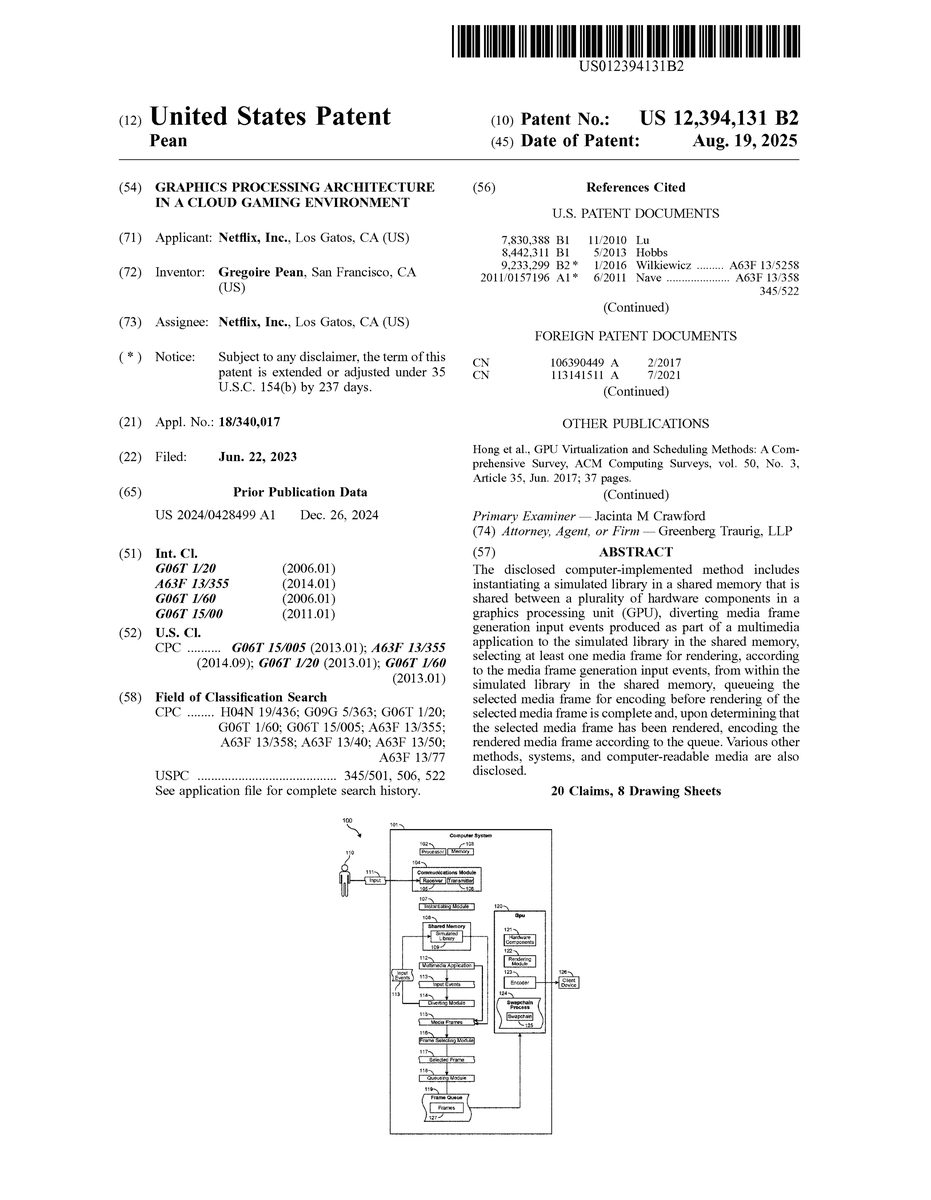
The disclosed computer-implemented method includes instantiating a simulated library in a shared memory that is shared between a plurality of hardware components in a graphics processing unit (GPU), diverting media frame generation input events produced as part of a multimedia application to the simulated library in the shared memory, selecting at least one media frame for rendering, according to the media frame generation input events, from within the simulated library in the shared memory, queueing the selected media frame for encoding before rendering of the selected media frame is complete and, upon determining that the selected media frame has been rendered, encoding the rendered media frame according to the queue. Various other methods, systems, and computer-readable media are also disclosed.
Description
Throughout the drawings, identical reference characters and descriptions indicate similar, but not necessarily identical, elements. While the exemplary embodiments described herein are susceptible to various modifications and alternative forms, specific embodiments have been shown by way of example in the drawings and will be described in detail herein. However, the exemplary embodiments described herein are not intended to be limited to the particular forms disclosed. Rather, the present disclosure covers all modifications, equivalents, and alternatives falling within the scope of the appended claims. DETAILED DESCRIPTION OF EXEMPLARY EMBODIMENTS The present disclosure is generally directed to methods and systems for efficiently processing graphics within a graphics processing architecture. As noted above, applications, such as video games, are often hosted remotely on cloud computing systems. These cloud computing systems are capable of running many thousands or millions of concurrent gaming instances across many different games. As part of hosting these gaming instances, cloud computing systems implement many simultaneous graphics processing units (GPUs) to render and encode video frames. These video frames are then streamed to client devices (e.g., televisions, phones, tablets, etc.) over the internet or other networks where they are presented to users. Traditional GPUs receive inputs from gaming engines indicating how a given frame is to be rendered. These inputs may indicate game elements, position information, lighting information, background information, or other data that may indicate how a given video frame or series of video frames are to be generated. The GPU's rendering components may then render the video frame and prepare the frame for encoding. The GPU's encoder will then take the rendered video frame and encode it at a given resolution and/or at a given frame rate. The resolution and frame rate may differ for different playback devices or for different regions. As part of this process, the ...
Throughout the drawings, identical reference characters and descriptions indicate similar, but not necessarily identical, elements. While the exemplary embodiments described herein are susceptible to various modifications and alternative forms, specific embodiments have been shown by way of example in the drawings and will be described in detail herein. However, the exemplary embodiments described herein are not intended to be limited to the particular forms disclosed. Rather, the present disclosure covers all modifications, equivalents, and alternatives falling within the scope of the appended claims.
DETAILED DESCRIPTION OF EXEMPLARY EMBODIMENTS
The present disclosure is generally directed to methods and systems for efficiently processing graphics within a graphics processing architecture. As noted above, applications, such as video games, are often hosted remotely on cloud computing systems. These cloud computing systems are capable of running many thousands or millions of concurrent gaming instances across many different games. As part of hosting these gaming instances, cloud computing systems implement many simultaneous graphics processing units (GPUs) to render and encode video frames. These video frames are then streamed to client devices (e.g., televisions, phones, tablets, etc.) over the internet or other networks where they are presented to users.
Traditional GPUs receive inputs from gaming engines indicating how a given frame is to be rendered. These inputs may indicate game elements, position information, lighting information, background information, or other data that may indicate how a given video frame or series of video frames are to be generated. The GPU's rendering components may then render the video frame and prepare the frame for encoding. The GPU's encoder will then take the rendered video frame and encode it at a given resolution and/or at a given frame rate. The resolution and frame rate may differ for different playback devices or for different regions. As part of this process, the GPU will render the video frame and then put the frame in a queue for encoding. This process, in traditional GPUs, does not allow for pipelining between these tasks. As such, encoding is performed subsequently to the rendering, necessitating at least some time gap between the rendering and the encoding. This time gap may lead to delays in encoding and may result in lower frame rates, lags in game play, or other deleterious effects. These effects may cause users to play fewer games or stop playing some games altogether.
In contrast to traditional rendering plus encoding processes, the embodiments herein pipeline the rendering and encoding processes using an improved graphics processing architecture. Using the graphics processing architecture described herein, GPUs can queue video frames for encoding before the rendering is even complete. Thus, while the video frame is being rendered, the unfinished video frame is, in advance, inserted into the encoding queue. Then, as soon as rendering completes, the rendered video frame will have already worked its way through the encoding queue and is immediately encoded without having to wait through the encoding queue, as would be the case in traditional systems.
This advance queueing process may occur without any blocking or waiting by the hardware encoding components themselves. Still further, this improved graphics processing architecture provides dynamic control over the encoded frame rate. Thus, for example, this graphics processing architecture could switch instantly from 30 frames per second (fps) to 60 fps. Accordingly, in video games where a higher frame rate is advantageous, the graphics processing architecture could switch from 30 fps to 60 fps dynamically and could do so without blocking or waiting for the hardware encoding components. These embodiments will be described in greater detail below with regard toFIGS.1-8.
FIG.1illustrates a computing environment100that includes a computer system101. The computer system101includes software modules, embedded hardware components such as processors, or includes a combination of hardware and software. The computer system101includes substantially any type of computing system including a local computing system or a distributed (e.g., cloud) computing system. In some cases, the computer system101includes at least one processor102and at least some system memory103. The computer system101includes program modules for performing a variety of different functions. The program modules are hardware-based, software-based, or include a combination of hardware and software. Each program module uses computing hardware and/or software to perform specified functions, including those described herein below.
The computer system101includes a communications module104that is configured to communicate with other computer systems. The communications module104includes any wired or wireless communication means that can receive and/or transmit data to or from other computer systems. These communication means include hardware interfaces including Ethernet adapters, WIFI adapters, hardware radios including, for example, a hardware-based receiver105, a hardware-based transmitter106, or a combined hardware-based transceiver capable of both receiving and transmitting data. The radios are cellular radios, Bluetooth radios, global positioning system (GPS) radios, or other types of radios. The communications module104is configured to interact with databases, mobile computing devices (such as mobile phones or tablets), embedded or other types of computing systems.
The computer system101also includes an instantiating module107. The instantiating module107is configured to instantiate a simulated library109in a shared memory108that is shared between multiple hardware components121in a graphics processing unit (GPU)120. The simulated library109provides a library of application files that may be used to perform different functions while running a cloud game. In contrast with a conventional file library, however, the simulated library109runs in a shared memory108and processes input events113that have been diverted from the conventional file library. In this manner, the underlying game engine running the cloud game may think that it is sending its game processing input events113to a legitimate, conventional file library when, in fact, the events are being diverted to the simulated library109in the shared memory108.
In some embodiments, the simulated library109in the shared memory108may refer to a Vulcap module, while in other cases, the simulated library may refer to an SDLX module (both of which are described further below with regard toFIG.3). Both the Vulcap module and the SDLX are hooking libraries that are loaded or injected in the game or application process itself. In these embodiments, the Vulcap module and the SDLX share the memory of the game. But, those libraries also share GPU memory (VRAM) with a GSP/encoding process. As such, the simulated library109in the shared memory108may refer to a swapchain hook library, or a controls/windowing hook library. Moreover, the shared memory108may be VRAM resources (e.g., render targets, framebuffers, etc.) or just system memory or shared memory spaces between the game and those libraries.
Along these lines, the computer system101further includes a diverting module114that is configured to divert media frame generation input events113produced as part of a multimedia application112(e.g., a cloud video game) to the simulated library109in the shared memory108. The diverting module114receives media frame generation input events113and diverts those events to the simulated library109instead of a traditional file library. The frame selecting module116of computer system101then selects at least one media frame115for rendering, according to the media frame generation input events113, from within the simulated library109in the shared memory108.
The selected media frame117may be selected for rendering or may currently be in the process of being rendered (e.g., by rendering module122) and may be ready or nearly ready for encoding by the encoder123. The queueing module118then enqueues the selected media frame117for encoding before rendering of the selected media frame117is complete. Then, upon the computer system101determining that the selected media frame117has been rendered by the rendering module122, the encoder123encodes the rendered media frame127according to the queued position in the frame queue119. These embodiments will be explained further below with regard to method200ofFIG.2.
FIG.2is a flow diagram of an exemplary computer-implemented method200for efficiently processing video game graphics. The steps shown inFIG.2may be performed by any suitable computer-executable code and/or computing system, including the system illustrated inFIG.1. In one example, each of the steps shown inFIG.2may represent an algorithm whose structure includes and/or is represented by multiple sub-steps, examples of which will be provided in greater detail below.
As illustrated inFIG.2, a computer-implemented method200may be provided that includes: instantiating, at step210, a simulated library109in a shared memory108that is shared between multiple hardware components121in a graphics processing unit120. The method200further includes, at step220, diverting media frame generation input events113produced as part of a multimedia application112(e.g., a cloud-based video game) to the simulated library109in the shared memory108and selecting, at step230, at least one media frame115for rendering, according to the media frame generation input events113, from within the simulated library109in the shared memory108. The method200also includes, at step240, queueing the selected media frame117for encoding before rendering of the selected media frame is complete and, at step250, upon determining that the selected media frame117has been rendered, encoding the rendered media frame according to the queueing in the frame queue119.
As used herein, the term “shared memory” may refer to memory that is shared between different hardware and/or software components. These hardware and software components can reside on the GPU120or on other GPUs, on the computer system101or on other computer systems. The GPUs and computer systems may be local or remote and may be part of the same system or may be independent of each other. The shared memory108may include volatile or non-volatile memory or combinations thereof.
The term “simulated library” may refer to a file repository or file storage area that includes dynamic link libraries, applications, programs, functions, or other computer-executable code. The reference to “simulated” indicates that the simulated library109is different from a traditional library that is not hosted in shared memory. The simulated library is designed to appear and act like a traditional library, providing access to specific files or functions, but, instead of residing as a separate entity within the computer system or within the game engine, the simulated library resides directly in the game engine. This allows input events to be diverted to the simulated library109and handled within the game engine. This, in turn, streamlines the graphics generation process, decreasing the time needed to render video frames and decreasing the time needed to prepare a video frame for encoding.
The term “cloud game” or “cloud-based game” may refer to any type of video game provided over a local network and/or over the internet where a backend server provides at least some of the data used to play the game. In some cases, cloud-based servers may render and encode the video frames that are sent to the client device126for display to the user. In other cases, the cloud-based servers may receive inputs and calculate changes to the game, while offloading some or all of the video rendering to the client device.
The cloud games or other multimedia applications (e.g., video streaming, audio streaming, interactive content, etc.) may be processed by the GPU120and/or by the computer system101. In some cases, the GPU120may be part of the computer system101and, in other cases, the GPU120may be separate from the computer system. When the computer system101and/or GPU120are generating video frames as part of a multimedia application, the frame selecting module116selects certain frames that are to be rendered by the rendering module122. These frames may be video frames or audio frames and may be part of a video game, part of a movie, part of a song, or part of other content.
In some cases, media frame generation input events113are generated as part of the multimedia application112running on the computer system101. The frame generation input events113provide details regarding a video or audio frame or series of frames, including information about how the frame is to be generated. In some cases, the frame generation input events113are generated as part of a swapchain process124running on the GPU120. The swapchain process is described further below with regard to embodiment300ofFIG.3.
FIG.3describes a graphics generating architecture301that includes a plurality of different components. For example, the graphics generating architecture301includes a host computing system302(or computing instance) that, itself, includes different components and modules including a gaming operating system (OS) management module306, a docker/container307, GPU drivers308, a gaming OS container309, a registry303, a server instance304, a control plane305, various process daemons310, and other modules.
In some embodiments, a Vulkan layer (e.g., a shared object within software code) is loaded in a cloud-based game313process by a Vulkan loader. The Vulkan loader intercepts and reimplements swapchain calls in order to cause the cloud game313to render directly to Vulkan images. These images (i.e., video frames) are controlled by the gaming support container312(as opposed to a third party that may own or control the cloud game). The gaming support container312, is part of the graphics generating architecture301and is controllable by a user (e.g., user110ofFIG.1via input111). The gaming support container312exports the images as file descriptors outside of the gaming support container to the game session manager318.
The GSP312includes an SDLX module314. The SDLX module is a shared object within a software language that is preloaded into the game process. The SDLX module314intercepts library calls (which may be invoked by the SDL on behalf of another application) by hooking and redirecting the commands. The SDLX module314is configured to remove the dependency to a gaming server (e.g., an X server) and make the game headless (i.e., able to run without specific components such as an X window). The graphics generating architecture301aims to avoid interaction with a specific server (e.g., a Linux-based X server), which would add overhead to the graphics generation process. The SDLX module314intercepts the swapchain via Vulcap315, and the graphics generating architecture301avoids sending images to the X server for compositing. In order to achieve this, the architecture reimplements or simulates various Xlib and X library calls inside SDLX and presents itself to the cloud game313as a legitimate X library.
The SDLX module314further provides a non-intrusive input injection mechanism by funneling input events into the simulated Xlib implementation. Moreover, the SDLX module314provides an in-game-process, zero-latency audio capture mechanism by intercepting and/or simulating advanced Linux sound architecture (ALSA) library calls and presenting itself as a legitimate ALSA implementation.
The game support layer (GSL)316is a shared library that is used by or shared between the SDLX module314and Vulcap315. The GSL316interfaces with the GSP encoder317. The GSL316contains a game streaming session singleton, which handles the capture and injection lifecycle of the cloud game. This includes setting up the connection to the GSP: socket signaling and sharing, as well as shared memory setup for sharing audio pulse-code modulation (PCM) buffers with the GSP, handling pacing of the game render loop at desired frame rate, and/or handling pacing of audio buffer writes.
The game support process is a software program that connects to the cloud game313via the GSL and handles multiple low-level duties including receiving swapchain image references from Vulcap315in order to encode them (via GSP encoder317), after having performed color space conversion, if necessary. The video encoder may have multiple different implementations available based on the encoder manufacturer and/or GPU manufacturer (e.g., depending on whether the GPU manufacturer and encoder manufacturer are separate) and may receive the audio buffers from SDLX and encode them. The GSP hands over the encoded bitstreams to the GSM session manager (318) over shared memory. The GSP also receives orders from the GSM, including indicating when the GSP is to emit a new instantaneous decoder refresh (IDR) frame. This IDR frame is a standalone frame that does not depend on the history of previously encoded frames in order to be fully decoded.
The game session manager (GSM)318is a software program that handles different aspects of the game session. The transport module320handles audio/video real time transport (e.g., via WebRTC) browsers or other applications. The transport module320also handles signaling and negotiation, handles input protocols, consumes input states at the input manager319from the transport or from other dedicated network channels, depending on the input device, feeds those input events directly to the game via the GSL316, collects metrics and logs from other local components (GSP, GSL), and synthesizes or acts upon those metrics as necessary.
The game appliance manager (GAM)311is a software program that supervises or manages gaming appliances. The GAM311is configured to spawn, manage, and monitor the game session container309, handle game mounts and game installs, listen for client connections (e.g.,321), handle various protocols, receive game start requests, negotiate real-time audio/video stream transport modalities over the network through session description protocol (SDP) exchanges to the GSM318, and proxy game control messages (e.g., game pause commands or other commands).
Video frames are captured by Vulcap315in a non-intrusive, copy-free way. Vulcap reimplements the Vulkan swapchain functions, meaning that it provides the images that are to be rendered to the game engine, as the game engine acquires them. When the game engine is finished queuing render command buffers to the GPU driver, the game engine calls the present swapchain function. The graphics generating architecture will then send this image reference (e.g., a file descriptor) over to the GSP encoder317so that the image can be queued for encoding as soon as possible.
At least in some cases, these functions occur asynchronously from the actual GPU work and video encoder work. The GSP will have enqueued the image for encoding before the GPU is done rendering the frame. Vulcap and the GSP, in effect, work in advance of the GPU and the encoder, without any blocking, or waiting on the hardware itself. The GPU and video encoder run freely and unobstructed by the CPU, while the CPU runs freely and unobstructed by the GPU.
FIG.4illustrates an embodiment400of a GPU processing trace. In this trace, the pipelining of various GPU events can be seen. For example, at4), a cloud game engine issues render commands (forward slash bars401indicate CPU activity), at5) the GSP receives the presented image (402) and queues the encoding based on the events (403), at7) GPU hardware activity (as shown in the backslash bars at404) indicates that the render is still ongoing when the GSP is already done enqueueing the encoding (405), and at9) the video encoder hardware picks up the frame as soon as the GPU is done rendering (406) without further intervention from the GSP. Thus, in the embodiments herein, video or audio frames may be queued for encoding before they have finished rendering, thereby leading to faster processing of video frames and a more favorable gameplay experience.
In some cases, the embodiments described herein operate without creating external elements to capture keyboard and mouse inputs. For example, game engines running on certain operating systems (e.g., Linux) will expect to create an “X window” to capture keyboard and mouse events. The X window will also provide a place for the Vulkan (or GL) swapchain to have a destination for the set of (e.g., 2-3) swapchain images or framebuffers. This X window is then composited with the rest of the desktop, unless in full screen mode. However, for a cloud gaming service, where there is no display or desktop, and where many hundreds or thousands of concurrent sessions (or more) may be running, the dependency on creating an X window greatly reduces processing efficiency. Intercepting or replacing the swapchain most optimally (at the graphics API level) means that the X window will not receive images to display, even if an X window is created. The embodiments herein avoid creating an X window and associated resources in the first place.
In contrast, the embodiments herein inject keyboard and mouse inputs directly at the game process level, bypassing the creation of X windows that lead to increased complexity and increased latency. The SDLX, as noted above, nullifies and/or simulates the dependencies that are to be avoided in the cloud game. Instead, the SDLX provides hooking and injection capture points for inputs (e.g., mouse and keyboard inputs), as well as audio (e.g., SDLX hooks multiple libraries and, as such, at least in some cases, ALSA hooking is performed by the SDLX as well). This allows cloud games to be operated on specific operating systems without having to create or use X windows. This is performed without modifying the game engines, thus allowing third parties to continue providing games without having to modify their games to work with the graphics processing architectures described herein.
At least in some embodiments, a game loop pacer and/or an audio pacer is implemented within the GSL library. The game loop pacer (or audio pacer) is configured to make up for any lack of hardware clocking, and pace the free-running threads within a game engine to a desired rate. The game loop pacer does this by using a real time locking system call (e.g., a futex) for scheduling precision. The game loop pacer can be woken up early or on demand, from the GSP or GSM, if a frame is to be rendered as soon as possible (e.g., when the transport session starts (rather than waiting up to 33 ms)). Another benefit is that the game loop pacer has dynamic control over the frame rate. That is, the game loop pacer may switch from 30 fps to 60 fps instantly, for example.
Still further, suspension (pausing) may be forced upon the cloud game at any point by making the game loop pacer wait indefinitely using the locking system call. Each of these changes of the frame rate and suspension are performed without having to modify the game engine. As such, this allows third parties to provide games for a gaming platform, and those games will run properly without needing to be modified to work with the game loop pacer. The game loop pacer uses hooks within the simulated library to perform the desired tasks without the game engine realizing that changes are being made. In some cases, game loop pacers are configured to account for latencies in OS kernels when computing the time they need to wait next. The game loop pacers then correct course and guarantee an average clock rate so that the transport and/or client will not have to make up for this drift or skew themselves, and either catch up or wait for consistently late packets.
FIG.5generally illustrates this process500, in which SDLX502, Vulcap503, and GSL504are operated in conjunction with a cloud game501. A render thread507queues commands against a swapchain N. The Vulcap acquires a next image or video frame at508and sends a request for an available frame buffer. A server instance510(which may be separate from the GPU memory server505) then acquires information from a pool descriptor. The render thread507then queues the image descriptor to the GSP at509. A pacer thread513(which may be the same as the game loop pacers described above) then waits on the queue up to a frame period-based deadline. If no image is posted (e.g., the game stalled or was suspended), the pacer thread513repeats the last image. The pacer thread then retires the last frame buffer unless no image was posted, and the previous frame is reused.
The pacer thread submits color space conversion information and GPU commands to the server instance510and further enqueues encoder command signals to an encoder thread. The pacer thread513waits for the remainder of the frame period and wakes up when signaled. The server instance510then returns to the pool at512. At the GSP506, the encode thread waits on the encoder command signal and waits until encoding is finished at514. The encode thread then reads the encoded frame and sends the encoded frame to the GSM. Thus, at least in this example, the pacer thread513may be implemented to maintain an average clock rate, and further provide the ability to change frame rate dynamically as well as perform game suspensions when needed.
In some embodiments, as noted inFIG.1, when generating graphics for a cloud-based game, the frame generation input events113produced by the game engine may be diverted to the simulated library109in shared memory108. In some cases, this diverting process is performed without altering the swapchain process124. As mentioned above, a swapchain125is a series of virtual frame buffers used by the graphics processing unit and associated graphics APIs for synchronization, stutter reduction, and/or frame rate stabilization. Because the event diverting process can be performed without disrupting the swapchain, diverting the input events to the simulated library108can be performed to substantially any video game running on substantially any video game engine. The simulated library, then, allows for hooking, advanced queueing, and other features that are not available in traditional graphics generation architectures.
After a frame has been queued, rendered, and encoded, that encoded rendered frame is inserted back into the swapchain process124of an associated Vulkan driver. In some embodiments, the simulated library allows the media frame to be rendered and encoded without creating an input window. Indeed, while traditional systems may require the use of X windows or similar features to receive mouse, keyboard, and other inputs, the embodiments herein implement a simulated library109to render and encode video and audio frames without creating such an input window. Instead, peripheral inputs are injected at a predetermined injection point at a game process level. In this manner, the video game (or other multimedia application) functions as if the application were communicating directly with a display server when, in actuality, the application is communicating with the simulated library109in shared memory108.
Still further, because the swapchain process is not interrupted, the embodiments described herein are generally nonintrusive. That is, the cloud video game does not think that it is communicating with a simulated library. However, because the video game is communicating with the simulated library109, that library can provide access to the video game's audio and video, allowing queueing and other techniques to be performed in advance. Moreover, media frame references and audio buffers are provided to a game support process, which creates a pipeline directly from the multimedia application to the encoder123. This pipeline (as generally described inFIG.4) allows more tasks to be performed in a simultaneous, overlapping manner, which speeds up the rendering and encoding processes and provides a more desirable gameplay experience to the user.
In some cases, the created pipeline directly from the multimedia application to the encoder allows synchronization to be performed on the GPU without support from an associated central processing unit (CPU). Accordingly, in these cases, the GPU does not wait on and is not dependent on the CPU, and the CPU does not wait on and is not dependent on the GPU. Instead, when a video frame has been rendered, it provides a fence signal that the encoder123will see and pick up the frame for encoding. The pipeline described inFIG.4from the multimedia application112to the encoder123allows synchronization to take place within the GPU120and does not need assistance from a CPU (e.g.,102).
At least in some cases, because the systems herein may lack a proper display system or controller (because, at least in some cases as noted above, the server is headless) these systems emulate the display interrupts in software and perform that emulation without drifting. In some cases, the drift is avoided “on average.” The drifting can happen because of the system clock drift or the inability of the kernel scheduler to schedule every task at exactly the requested time. In some cases, a pacing module is implemented within the GPU to avoid synchronization drift with the output display. Then, even if, for example, the game was slightly late producing a frame, the pacing module will help recover and compensate for that momentary drift.
In some embodiments, the CPU may asynchronously provide data or information to the GPU120. For instance, the CPU may provide metadata, fence references, or frame references to various components of the GPU. This information may be used to identify specific video frames or sequences of frames, for example. In such cases, the synchronization is performed between hardware components121of the GPU120.
In some embodiments, diverting the media frame generation input events113produced as part of the multimedia application112to the simulated library109allows dynamic control over the frame rate of the media frames115produced by the multimedia application. In some cases, for instance, diverting frame generation input events113to the simulated library109allows a dynamic and substantially instantaneous change in encoded frame rate (e.g., from 30 fps to 60 fps). In other cases, diverting frame generation input events113to the simulated library109allows the multimedia application112to be suspended for at least a minimum specified amount of time. The suspension may end at the request of a user or as controlled by the game engine.
In some examples, upon determining that a client device126has dropped media frames, the graphics processing architecture reencodes the dropped frame by the GPU. That reencoded frame is then sent to the client device for display. Some video games may involve multiple cameras or multiple displays. In such scenarios, the graphics processing architecture may be configured to send different camera feeds to different graphics processing pipelines. Thus, for example, in a kart driving game, different gaming world views and game progress contexts are provided for different users, using the same game process for rendering. In some cases, the embodiments herein implement multiple swapchains in the same game to provide the different camera views to the client device(s). Moreover, multiple encoded streams may be provided for the same swapchain, where the same content is provided to different devices that may each have different playback capabilities. In this manner, the graphics processing architectures described herein provide support for multiple streams from a single game, and even at different resolutions or encoded frame rates.
In addition, a corresponding system includes at least one physical processor, and physical memory comprising computer-executable instructions that, when executed by the physical processor, cause the physical processor to: instantiate a simulated library in a shared memory that is shared between a plurality of hardware components in a graphics processing unit (GPU), divert one or more media frame generation input events produced as part of a multimedia application to the simulated library in the shared memory, select at least one media frame for rendering, according to the one or more media frame generation input events, from within the simulated library in the shared memory, queue the selected media frame for encoding before rendering of the selected media frame is complete, and upon determining that the selected media frame has been rendered, encode the rendered media frame according to the queueing.
In some examples, the above-described method is encoded as computer-readable instructions on a computer-readable medium. For example, the computer-readable medium may include one or more computer-executable instructions that, when executed by at least one processor of a computing device, cause the computing device to instantiate a simulated library in a shared memory that is shared between a plurality of hardware components in a graphics processing unit (GPU), divert one or more media frame generation input events produced as part of a multimedia application to the simulated library in the shared memory, select at least one media frame for rendering, according to the one or more media frame generation input events, from within the simulated library in the shared memory, queue the selected media frame for encoding before rendering of the selected media frame is complete, and upon determining that the selected media frame has been rendered, encode the rendered media frame according to the queueing.
FIGS.6-8illustrate cloud gaming systems, infrastructure, and clients that may be implemented with the embodiments herein. For example, the following will provide, with reference toFIG.6, detailed descriptions of exemplary ecosystems in which content is provisioned to end nodes and in which requests for content are steered to specific end nodes. The discussion corresponding toFIGS.7and8presents an overview of an exemplary distribution infrastructure and an exemplary content player used during playback sessions, respectively.
FIG.6is a block diagram of a content distribution ecosystem600that includes a distribution infrastructure610in communication with a gaming client620, content player, or other software application designed to present rendered graphics to a user. In some embodiments, distribution infrastructure610is configured to encode data at a specific data rate and to transfer the encoded data to gaming client620. Gaming client620is configured to receive the encoded data via distribution infrastructure610and to decode the data for playback to a user. The data provided by distribution infrastructure610includes, for example, audio, video, text, images, animations, interactive content, haptic data, virtual or augmented reality data, location data, gaming data, or any other type of data that is provided via streaming.
Distribution infrastructure610generally represents any services, hardware, software, or other infrastructure components configured to deliver content to end users. For example, distribution infrastructure610includes content aggregation systems, media transcoding and packaging services, network components, and/or a variety of other types of hardware and software. In some cases, distribution infrastructure610is implemented as a highly complex distribution system, a single media server or device, or anything in between. In some examples, regardless of size or complexity, distribution infrastructure610includes at least one physical processor612and at least one memory device614. One or more modules616are stored or loaded into memory614to enable adaptive streaming, as discussed herein.
Gaming client620generally represents any type or form of device or system capable of playing audio, video, or other gaming content that has been provided over distribution infrastructure610. Examples of gaming client620include, without limitation, mobile phones, tablets, laptop computers, desktop computers, televisions, set-top boxes, digital media players, virtual reality headsets, augmented reality glasses, and/or any other type or form of device capable of rendering digital content. As with distribution infrastructure610, gaming client620includes a physical processor622, memory624, and one or more modules626. Some or all of the adaptive streaming processes described herein is performed or enabled by modules626, and in some examples, modules616of distribution infrastructure610coordinate with modules626of gaming client620to provide adaptive streaming of multimedia content.
In certain embodiments, one or more of modules616and/or626inFIG.6represent one or more software applications or programs that, when executed by a computing device, cause the computing device to perform one or more tasks. For example, and as will be described in greater detail below, one or more of modules616and626represent modules stored and configured to run on one or more general-purpose computing devices. One or more of modules616and626inFIG.6also represent all or portions of one or more special-purpose computers configured to perform one or more tasks.
In addition, one or more of the modules, processes, algorithms, or steps described herein transform data, physical devices, and/or representations of physical devices from one form to another. For example, one or more of the modules recited herein receive audio data to be encoded, transform the audio data by encoding it, output a result of the encoding for use in an adaptive audio bit-rate system, transmit the result of the transformation to a content player, and render the transformed data to an end user for consumption. Additionally or alternatively, one or more of the modules recited herein transform a processor, volatile memory, non-volatile memory, and/or any other portion of a physical computing device from one form to another by executing on the computing device, storing data on the computing device, and/or otherwise interacting with the computing device.
Physical processors612and622generally represent any type or form of hardware-implemented processing unit capable of interpreting and/or executing computer-readable instructions. In one example, physical processors612and622access and/or modify one or more of modules616and626, respectively. Additionally or alternatively, physical processors612and622execute one or more of modules616and626to facilitate adaptive streaming of multimedia content. Examples of physical processors612and622include, without limitation, microprocessors, microcontrollers, central processing units (CPUs), field-programmable gate arrays (FPGAs) that implement softcore processors, application-specific integrated circuits (ASICs), portions of one or more of the same, variations or combinations of one or more of the same, and/or any other suitable physical processor.
Memory614and624generally represent any type or form of volatile or non-volatile storage device or medium capable of storing data and/or computer-readable instructions. In one example, memory614and/or624stores, loads, and/or maintains one or more of modules616and626. Examples of memory614and/or624include, without limitation, random access memory (RAM), read only memory (ROM), flash memory, hard disk drives (HDDs), solid-state drives (SSDs), optical disk drives, caches, variations or combinations of one or more of the same, and/or any other suitable memory device or system.
FIG.7is a block diagram of exemplary components of content distribution infrastructure610according to certain embodiments. Distribution infrastructure610includes storage710, services720, and a network730. Storage710generally represents any device, set of devices, and/or systems capable of storing content for delivery to end users. Storage710includes a central repository with devices capable of storing terabytes or petabytes of data and/or includes distributed storage systems (e.g., appliances that mirror or cache content at Internet interconnect locations to provide faster access to the mirrored content within certain regions). Storage710is also configured in any other suitable manner.
As shown, storage710may store a variety of different items including content712, user data714, and/or log data716. Content712includes television shows, movies, video games, user-generated content, and/or any other suitable type or form of content. User data714includes personally identifiable information (PII), payment information, preference settings, language and accessibility settings, and/or any other information associated with a particular user or content player. Log data716includes viewing history information, network throughput information, and/or any other metrics associated with a user's connection to or interactions with distribution infrastructure610.
Services720includes personalization services722, transcoding services724, and/or packaging services726. Personalization services722personalize recommendations, content streams, and/or other aspects of a user's experience with distribution infrastructure610. Encoding services724compress media at different bitrates which, as described in greater detail below, enable real-time switching between different encodings. Packaging services726package encoded video before deploying it to a delivery network, such as network730, for streaming.
Network730generally represents any medium or architecture capable of facilitating communication or data transfer. Network730facilitates communication or data transfer using wireless and/or wired connections. Examples of network730include, without limitation, an intranet, a wide area network (WAN), a local area network (LAN), a personal area network (PAN), the Internet, power line communications (PLC), a cellular network (e.g., a global system for mobile communications (GSM) network), portions of one or more of the same, variations or combinations of one or more of the same, and/or any other suitable network. For example, as shown inFIG.7, network730includes an Internet backbone732, an internet service provider734, and/or a local network736. As discussed in greater detail below, bandwidth limitations and bottlenecks within one or more of these network segments triggers video and/or audio bit rate adjustments.
FIG.8is a block diagram of an exemplary implementation of gaming client620ofFIG.6. Gaming client620generally represents any type or form of computing device capable of reading computer-executable instructions. Gaming client620includes, without limitation, laptops, tablets, desktops, servers, cellular phones, multimedia players, embedded systems, wearable devices (e.g., smart watches, smart glasses, etc.), smart vehicles, gaming consoles, internet-of-things (IoT) devices such as smart appliances, variations or combinations of one or more of the same, and/or any other suitable computing device.
As shown inFIG.8, in addition to processor622and memory624, gaming client620includes a communication infrastructure802and a communication interface822coupled to a network connection824. Gaming client620also includes a graphics interface826coupled to a graphics device828, an input interface834coupled to an input device836, and a storage interface838coupled to a storage device840.
Communication infrastructure802generally represents any type or form of infrastructure capable of facilitating communication between one or more components of a computing device. Examples of communication infrastructure802include, without limitation, any type or form of communication bus (e.g., a peripheral component interconnect (PCI) bus, PCI Express (PCIe) bus, a memory bus, a frontside bus, an integrated drive electronics (IDE) bus, a control or register bus, a host bus, etc.).
As noted, memory624generally represents any type or form of volatile or non-volatile storage device or medium capable of storing data and/or other computer-readable instructions. In some examples, memory624stores and/or loads an operating system808for execution by processor622. In one example, operating system808includes and/or represents software that manages computer hardware and software resources and/or provides common services to computer programs and/or applications on gaming client620.
Operating system808performs various system management functions, such as managing hardware components (e.g., graphics interface826, audio interface830, input interface834, and/or storage interface838). Operating system808also provides process and memory management models for playback application810. The modules of playback application810includes, for example, a content buffer812, an audio decoder818, and a video decoder820.
Playback application810is configured to retrieve digital content via communication interface822and to play the digital content through graphics interface826. Graphics interface826is configured to transmit a rendered video signal to graphics device828. In normal operation, playback application810receives a request from a user to play a specific title or specific content. Playback application810then identifies one or more encoded video and audio streams associated with the requested title. After playback application810has located the encoded streams associated with the requested title, playback application810downloads sequence header indices associated with each encoded stream associated with the requested title from distribution infrastructure610. A sequence header index associated with encoded content includes information related to the encoded sequence of data included in the encoded content.
In one embodiment, playback application810begins downloading the content associated with the requested title by downloading sequence data encoded to the lowest audio and/or video playback bitrates to minimize startup time for playback. The requested digital content file is then downloaded into content buffer812, which is configured to serve as a first-in, first-out queue. In one embodiment, each unit of downloaded data includes a unit of video data or a unit of audio data. As units of video data associated with the requested digital content file are downloaded to the gaming client620, the units of video data are pushed into the content buffer812. Similarly, as units of audio data associated with the requested digital content file are downloaded to the gaming client620, the units of audio data are pushed into the content buffer812. In one embodiment, the units of video data are stored in video buffer816within content buffer812and the units of audio data are stored in audio buffer814of content buffer812.
A video decoder820reads units of video data from video buffer816and outputs the units of video data in a sequence of video frames corresponding in duration to the fixed span of playback time. Reading a unit of video data from video buffer816effectively de-queues the unit of video data from video buffer816. The sequence of video frames is then rendered by graphics interface826and transmitted to graphics device828to be displayed to a user.
An audio decoder818reads units of audio data from audio buffer814and outputs the units of audio data as a sequence of audio samples, generally synchronized in time with a sequence of decoded video frames. In one embodiment, the sequence of audio samples is transmitted to audio interface830, which converts the sequence of audio samples into an electrical audio signal. The electrical audio signal is then transmitted to a speaker of audio device832, which, in response, generates an acoustic output.
In situations where the bandwidth of distribution infrastructure610is limited and/or variable, playback application810downloads and buffers consecutive portions of video data and/or audio data from video encodings with different bit rates based on a variety of factors (e.g., scene complexity, audio complexity, network bandwidth, device capabilities, etc.). In some embodiments, video playback quality is prioritized over audio playback quality. Audio playback and video playback quality are also balanced with each other, and in some embodiments audio playback quality is prioritized over video playback quality.
Graphics interface826is configured to generate frames of video data and transmit the frames of video data to graphics device828. In one embodiment, graphics interface826is included as part of an integrated circuit, along with processor622. Alternatively, graphics interface826is configured as a hardware accelerator that is distinct from (i.e., is not integrated within) a chipset that includes processor622.
Graphics interface826generally represents any type or form of device configured to forward images for display on graphics device828. For example, graphics device828is fabricated using liquid crystal display (LCD) technology, cathode-ray technology, and light-emitting diode (LED) display technology (either organic or inorganic). In some embodiments, graphics device828also includes a virtual reality display and/or an augmented reality display. Graphics device828includes any technically feasible means for generating an image for display. In other words, graphics device828generally represents any type or form of device capable of visually displaying information forwarded by graphics interface826.
As illustrated inFIG.8, gaming client620also includes at least one input device836coupled to communication infrastructure802via input interface834. Input device836generally represents any type or form of computing device capable of providing input, either computer or human generated, to gaming client620. Examples of input device836include, without limitation, a keyboard, a pointing device, a speech recognition device, a touch screen, a wearable device (e.g., a glove, a watch, etc.), a controller, variations or combinations of one or more of the same, and/or any other type or form of electronic input mechanism.
Gaming client620also includes a storage device840coupled to communication infrastructure802via a storage interface838. Storage device840generally represents any type or form of storage device or medium capable of storing data and/or other computer-readable instructions. For example, storage device840may be a magnetic disk drive, a solid-state drive, an optical disk drive, a flash drive, or the like. Storage interface838generally represents any type or form of interface or device for transferring data between storage device840and other components of gaming client620.
Many other devices or subsystems are included in or connected to gaming client620. Conversely, one or more of the components and devices illustrated inFIG.8need not be present to practice the embodiments described and/or illustrated herein. The devices and subsystems referenced above are also interconnected in different ways from that shown in FIG.8. Gaming client620is also employed in any number of software, firmware, and/or hardware configurations. For example, one or more of the example embodiments disclosed herein are encoded as a computer program (also referred to as computer software, software applications, computer-readable instructions, or computer control logic) on a computer-readable medium. The term “computer-readable medium,” as used herein, refers to any form of device, carrier, or medium capable of storing or carrying computer-readable instructions. Examples of computer-readable media include, without limitation, transmission-type media, such as carrier waves, and non-transitory-type media, such as magnetic-storage media (e.g., hard disk drives, tape drives, etc.), optical-storage media (e.g., Compact Disks (CDs), Digital Video Disks (DVDs), and BLU-RAY disks), electronic-storage media (e.g., solid-state drives and flash media), and other digital storage systems.
A computer-readable medium containing a computer program is loaded into gaming client620. All or a portion of the computer program stored on the computer-readable medium is then stored in memory624and/or storage device840. When executed by processor622, a computer program loaded into memory624causes processor622to perform and/or be a means for performing the functions of one or more of the example embodiments described and/or illustrated herein. Additionally or alternatively, one or more of the example embodiments described and/or illustrated herein are implemented in firmware and/or hardware. For example, gaming client620is configured as an Application Specific Integrated Circuit (ASIC) adapted to implement one or more of the example embodiments disclosed herein
EXAMPLE EMBODIMENTS
Example 1: A computer-implemented method comprising: instantiating a simulated library in a shared memory that is shared between a plurality of hardware components in a graphics processing unit (GPU), diverting media frame generation input events produced as part of a multimedia application to the simulated library in the shared memory, selecting at least one media frame for rendering, according to the media frame generation input events, from within the simulated library in the shared memory, queueing the selected media frame for encoding before rendering of the selected media frame is complete and, upon determining that the selected media frame has been rendered, encoding the rendered media frame according to the queueing.
Example 2: The computer-implemented method of Example 1, wherein the selected frame comprises a video frame.
Example 3: The computer-implemented method of Example 1 or Example 2, wherein the selected frame comprises an audio frame.
Example 4: The computer-implemented method of any of Examples 1-3, wherein the multimedia application comprises a video game.
Example 5: The computer-implemented method of any of Examples 1-4, wherein the one or more frame generation input events are generated as part of a swapchain process running on the GPU, and wherein the one or more frame generation input events are diverted to the simulated library in shared memory without altering the swapchain process.
Example 6: The computer-implemented method of any of Examples 1-5, further comprising inserting the encoded rendered frame back into the swapchain process of a Vulkan driver.
Example 7: The computer-implemented method of any of Examples 1-6, wherein the simulated library allows the media frame to be rendered and encoded without creating an input window.
Example 8: The computer-implemented method of any of Examples 1-7, wherein peripheral inputs are injected at a predetermined injection point at a multimedia application process level.
Example 9: The computer-implemented method of any of Examples 1-8, wherein the multimedia application functions as if the multimedia application were communicating directly with a display server.
Example 10: The computer-implemented method of any of Examples 1-9, wherein media frame references and audio buffers are provided to a game support process, creating a pipeline directly from the multimedia application to an encoder.
Example 11: The computer-implemented method of any of Examples 1-10, wherein the created pipeline directly from the multimedia application to the encoder allows synchronization to be performed on the GPU without support from an associated central processing unit (CPU).
Example 12: The computer-implemented method of any of Examples 1-11, wherein the CPU provides at least one of: metadata, one or more fence references, or one or more frame references to one or more components of the GPU, while the synchronization is performed between hardware components of the GPU.
Example 13: A system comprising: at least one physical processor, and physical memory comprising computer-executable instructions that, when executed by the physical processor, cause the physical processor to: instantiate a simulated library in a shared memory that is shared between a plurality of hardware components in a graphics processing unit (GPU), divert one or more media frame generation input events produced as part of a multimedia application to the simulated library in the shared memory, select at least one media frame for rendering, according to the one or more media frame generation input events, from within the simulated library in the shared memory, queue the selected media frame for encoding before rendering of the selected media frame is complete, and upon determining that the selected media frame has been rendered, encode the rendered media frame according to the queueing.
Example 14: The system of Example 13, wherein diverting the one or more media frame generation input events produced as part of a multimedia application to the simulated library allows dynamic control over the frame rate of the media frames produced by the multimedia application.
Example 15: The system of Example 13 or Example 14, wherein diverting the one or more media frame generation input events produced as part of a multimedia application to the simulated library in the shared memory allows the multimedia application to be suspended for at least a specified amount of time.
Example 16: The system of any of Examples 13-15, further comprising: upon determining that a client device has dropped one or more media frames, reencoding the dropped frame by the GPU.
Example 17: The system of any of Examples 13-16, wherein a pacing module is implemented within the GPU to avoid synchronization drift with an associated output display.
Example 18: The system of any of Examples 13-17, further comprising attaching a plurality of video pipelines to one or more swapchain instances that are generated as part of the multimedia application.
Example 19: The system of any of Examples 13-18, wherein video feeds from multiple different cameras are fed to different video pipelines among the plurality of video pipelines.
Example 20: A non-transitory computer-readable medium comprising one or more computer-executable instructions that, when executed by at least one processor of a computing device, cause the computing device to: instantiate a simulated library in a shared memory that is shared between a plurality of hardware components in a graphics processing unit (GPU), divert one or more media frame generation input events produced as part of a multimedia application to the simulated library in the shared memory, select at least one media frame for rendering, according to the one or more media frame generation input events, from within the simulated library in the shared memory, queue the selected media frame for encoding before rendering of the selected media frame is complete, and upon determining that the selected media frame has been rendered, encode the rendered media frame according to the queueing.
As detailed above, the computing devices and systems described and/or illustrated herein broadly represent any type or form of computing device or system capable of executing computer-readable instructions, such as those contained within the modules described herein. In their most basic configuration, these computing device(s) may each include at least one memory device and at least one physical processor.
In some examples, the term “memory device” generally refers to any type or form of volatile or non-volatile storage device or medium capable of storing data and/or computer-readable instructions. In one example, a memory device may store, load, and/or maintain one or more of the modules described herein. Examples of memory devices include, without limitation, Random Access Memory (RAM), Read Only Memory (ROM), flash memory, Hard Disk Drives (HDDs), Solid-State Drives (SSDs), optical disk drives, caches, variations or combinations of one or more of the same, or any other suitable storage memory.
In some examples, the term “physical processor” generally refers to any type or form of hardware-implemented processing unit capable of interpreting and/or executing computer-readable instructions. In one example, a physical processor may access and/or modify one or more modules stored in the above-described memory device. Examples of physical processors include, without limitation, microprocessors, microcontrollers, Central Processing Units (CPUs), Field-Programmable Gate Arrays (FPGAs) that implement softcore processors, Application-Specific Integrated Circuits (ASICs), portions of one or more of the same, variations or combinations of one or more of the same, or any other suitable physical processor.
Although illustrated as separate elements, the modules described and/or illustrated herein may represent portions of a single module or application. In addition, in certain embodiments one or more of these modules may represent one or more software applications or programs that, when executed by a computing device, may cause the computing device to perform one or more tasks. For example, one or more of the modules described and/or illustrated herein may represent modules stored and configured to run on one or more of the computing devices or systems described and/or illustrated herein. One or more of these modules may also represent all or portions of one or more special-purpose computers configured to perform one or more tasks.
In addition, one or more of the modules described herein may transform data, physical devices, and/or representations of physical devices from one form to another. Additionally or alternatively, one or more of the modules recited herein may transform a processor, volatile memory, non-volatile memory, and/or any other portion of a physical computing device from one form to another by executing on the computing device, storing data on the computing device, and/or otherwise interacting with the computing device.
In some embodiments, the term “computer-readable medium” generally refers to any form of device, carrier, or medium capable of storing or carrying computer-readable instructions. Examples of computer-readable media include, without limitation, transmission-type media, such as carrier waves, and non-transitory-type media, such as magnetic-storage media (e.g., hard disk drives, tape drives, and floppy disks), optical-storage media (e.g., Compact Disks (CDs), Digital Video Disks (DVDs), and BLU-RAY disks), electronic-storage media (e.g., solid-state drives and flash media), and other distribution systems.
The process parameters and sequence of the steps described and/or illustrated herein are given by way of example only and can be varied as desired. For example, while the steps illustrated and/or described herein may be shown or discussed in a particular order, these steps do not necessarily need to be performed in the order illustrated or discussed. The various exemplary methods described and/or illustrated herein may also omit one or more of the steps described or illustrated herein or include additional steps in addition to those disclosed.
The preceding description has been provided to enable others skilled in the art to best utilize various aspects of the exemplary embodiments disclosed herein. This exemplary description is not intended to be exhaustive or to be limited to any precise form disclosed. Many modifications and variations are possible without departing from the spirit and scope of the present disclosure. The embodiments disclosed herein should be considered in all respects illustrative and not restrictive. Reference should be made to the appended claims and their equivalents in determining the scope of the present disclosure.
Unless otherwise noted, the terms “connected to” and “coupled to” (and their derivatives), as used in the specification and claims, are to be construed as permitting both direct and indirect (i.e., via other elements or components) connection. In addition, the terms “a” or “an,” as used in the specification and claims, are to be construed as meaning “at least one of.” Finally, for ease of use, the terms “including” and “having” (and their derivatives), as used in the specification and claims, are interchangeable with and have the same meaning as the word “comprising.”
Claims
- A computer-implemented method comprising: instantiating a simulated library in a shared memory that is shared between a plurality of hardware components in a graphics processing unit (GPU);diverting one or more media frame generation input events produced as part of a multimedia application to the simulated library in the shared memory;selecting at least one media frame for rendering, according to the one or more media frame generation input events, from within the simulated library in the shared memory;queueing the selected media frame for encoding before rendering of the selected media frame is complete;and upon determining that the selected media frame has been rendered, encoding the rendered media frame according to the queueing.
- The computer-implemented method of claim 1, wherein the selected frame comprises a video frame.
- The computer-implemented method of claim 1, wherein the selected frame comprises an audio frame.
- The computer-implemented method of claim 1, wherein the multimedia application comprises a video game.
- The computer-implemented method of claim 1, wherein the one or more frame generation input events are generated as part of a swapchain process running on the GPU, and wherein the one or more frame generation input events are diverted to the simulated library in the shared memory without altering the swapchain process.
- The computer-implemented method of claim 5, further comprising inserting the encoded rendered frame back into the swapchain process of a Vulkan driver.
- The computer-implemented method of claim 1, wherein the simulated library allows the media frame to be rendered and encoded without creating an input window.
- The computer-implemented method of claim 7, wherein peripheral inputs are injected at a predetermined injection point at a multimedia application process level.
- The computer-implemented method of claim 7, wherein the multimedia application functions as if the multimedia application were communicating directly with a display server.
- The computer-implemented method of claim 1, wherein media frame references and audio buffers are provided to a game support process, creating a pipeline directly from the multimedia application to an encoder.
- The computer-implemented method of claim 10, wherein the created pipeline directly from the multimedia application to the encoder allows synchronization to be performed on the GPU without support from an associated central processing unit (CPU).
- The computer-implemented method of claim 11, wherein the CPU provides at least one of: metadata, one or more fence references, or one or more frame references to one or more components of the GPU, while the synchronization is performed between hardware components of the GPU.
- A system comprising: at least one physical processor;and physical memory comprising computer-executable instructions that, when executed by the physical processor, cause the physical processor to: instantiate a simulated library in a shared memory that is shared between a plurality of hardware components in a graphics processing unit (GPU);divert one or more media frame generation input events produced as part of a multimedia application to the simulated library in the shared memory;select at least one media frame for rendering, according to the one or more media frame generation input events, from within the simulated library in the shared memory;queue the selected media frame for encoding before rendering of the selected media frame is complete;and upon determining that the selected media frame has been rendered, encode the rendered media frame according to the queueing.
- The system of claim 13, wherein diverting the one or more media frame generation input events produced as part of a multimedia application to the simulated library allows dynamic control over a frame rate of the media frames produced by the multimedia application.
- The system of claim 13, wherein diverting the one or more media frame generation input events produced as part of the multimedia application to the simulated library in the shared memory allows the multimedia application to be suspended for at least a specified amount of time.
- The system of claim 13, further comprising: upon determining that a client device has dropped one or more media frames, reencoding the dropped frame by the GPU.
- The system of claim 13, wherein a pacing module is implemented within the GPU to avoid synchronization drift with an associated output display.
- The system of claim 13, further comprising attaching a plurality of video pipelines to one or more swapchain instances that are generated as part of the multimedia application.
- The system of claim 18, wherein video feeds from multiple different cameras are fed to different video pipelines among the plurality of video pipelines.
- A non-transitory computer-readable medium comprising one or more computer-executable instructions that, when executed by at least one processor of a computing device, cause the computing device to: instantiate a simulated library in a shared memory that is shared between a plurality of hardware components in a graphics processing unit (GPU);divert one or more media frame generation input events produced as part of a multimedia application to the simulated library in the shared memory;select at least one media frame for rendering, according to the one or more media frame generation input events, from within the simulated library in the shared memory;queue the selected media frame for encoding before rendering of the selected media frame is complete;and upon determining that the selected media frame has been rendered, encode the rendered media frame according to the queue.
Disclaimer: Data collected from the USPTO and may be malformed, incomplete, and/or otherwise inaccurate.