U.S. Pat. No. 12,128,317
INFORMATION PROCESSING PROGRAM, INFORMATION PROCESSING DEVICE, AND INFORMATION PROCESSING SYSTEM FOR DECK MANAGEMENT OF A COMPUTER GAME
AssigneeCYGAMES, INC.
Issue DateNovember 22, 2021
Illustrative Figure
Abstract
A computer realizes: a management function for managing first management information and second management information as information for managing game media having assigned thereto medium identifiers that are common for each same kind, the first management information indicating the medium identifiers and the number of game media possessed by a player, and the second management information indicating the medium identifiers and usage periods of game media having the usage periods set therefor; a determination function for determining game media available to the player based on the first management information and the second management information; and a set creation function for creating a medium set that includes a plurality of game media and that can include a plurality of game media of the same kind, based on an operation performed by the player to select from the game media available to the player, determined by the determination function.
Description
PREFERRED MODE FOR CARRYING OUT THE INVENTION An embodiment of the present invention will be described below with reference to the drawings. [Overall Configuration of the System] The overall configuration of this embodiment will be described with reference toFIG.1.FIG.1is a block diagram showing the overall configuration of an information processing system S according to this embodiment. As shown inFIG.1, the information processing system S is configured to include a server1, n (n is an arbitrary integer greater than or equal to one) player terminals2, and a network5. The information processing system S is what is called a client-server system. The information processing system S is realized by mutually carrying out communication between the n player terminals2acting as clients and the server1via the network5. The server1is realized, for example, by a server device. Furthermore, the player terminals2are realized, for example, by smartphones, installed or portable game machines, or personal computers. Furthermore, the network5is realized, for example, by a network such as a local area network (LAN), the Internet, or a mobile phone network, or a network formed by combining these types of networks. In the drawings, a player terminal2a,a player terminal2b,and a player terminal2nare shown as the n player terminals2. In the following description, however, these n player terminals2will be simply referred to as the “player terminals2”, with the reference signs partially omitted, in the case where no distinction is made thereamong. Overview of this Embodiment Next, an overview of processing by the information processing system S according to this embodiment, shown inFIG.1, will be described. The information processing system S is directed to more simply managing game media having various properties on a computer. For this purpose, in the information processing system S, a medium management process is executed through cooperation between the server1and the player terminals2. Here, the medium ...
PREFERRED MODE FOR CARRYING OUT THE INVENTION
An embodiment of the present invention will be described below with reference to the drawings.
[Overall Configuration of the System]
The overall configuration of this embodiment will be described with reference toFIG.1.FIG.1is a block diagram showing the overall configuration of an information processing system S according to this embodiment.
As shown inFIG.1, the information processing system S is configured to include a server1, n (n is an arbitrary integer greater than or equal to one) player terminals2, and a network5.
The information processing system S is what is called a client-server system. The information processing system S is realized by mutually carrying out communication between the n player terminals2acting as clients and the server1via the network5.
The server1is realized, for example, by a server device. Furthermore, the player terminals2are realized, for example, by smartphones, installed or portable game machines, or personal computers. Furthermore, the network5is realized, for example, by a network such as a local area network (LAN), the Internet, or a mobile phone network, or a network formed by combining these types of networks.
In the drawings, a player terminal2a,a player terminal2b,and a player terminal2nare shown as the n player terminals2. In the following description, however, these n player terminals2will be simply referred to as the “player terminals2”, with the reference signs partially omitted, in the case where no distinction is made thereamong.
Overview of this Embodiment
Next, an overview of processing by the information processing system S according to this embodiment, shown inFIG.1, will be described.
The information processing system S is directed to more simply managing game media having various properties on a computer.
For this purpose, in the information processing system S, a medium management process is executed through cooperation between the server1and the player terminals2. Here, the medium management process refers to a series of processing steps through which game media available to players and having various properties are simply managed on a computer.
In the medium management process, as information for managing game media (e.g., cards) having assigned thereto a common medium identifier (e.g., a card ID) for each medium of the same kind, the information processing system S manages first management information indicating the medium identifier and the number of game media that a player possesses, as well as second management information indicating the medium identifiers and available periods of game media having available periods set therefor. Furthermore, the information processing system S determines game media available to the player on the basis of the first management information and the second management information.
Then, on the basis of an operation performed by the player to select game media from the game media determined as being available to the player, the information processing system S creates a medium set (e.g., a deck) that includes a plurality of game media and that can include a plurality of game media of the same kind (e.g., having the same graphics and the same ability).
With the medium management process described above, it is possible to individually manage types of cards having different properties, namely, “cards possessed by a player”, which are constantly available to the player, and “cards having available periods set therefor”, which are not possessed by the player but are available only within the available periods, on the basis of card IDs that are common for each kind irrespective of properties.
That is, with the information processing system S, it is possible to more simply manage game media having various properties on a computer, without having to execute the laborious processing necessary in common technologies, such as managing game media on the basis of unique serial numbers individually assigned thereto. Furthermore, with the information processing system S, it is possible to proceed with a game while performing such simple management and creating a deck including cards having different properties as selected by a player.
In the above description of the medium management process, cards are considered as an example of game media, card IDs are considered as an example of medium identifiers, a deck is considered as an example of a medium set, and game media having the same graphics and the same ability are considered as an example of game media of the same kind. However, these are merely examples, and the subjects of the medium management process are not limited thereto.
For example, in the medium management process, characters or items may be considered as game media instead of cards, the IDs of these game media may be considered as medium identifiers, and a team or group constituted of these game media may be considered as a medium set. Furthermore, in the medium management process, game media having different graphics and the same ability or game media having very similar abilities may be considered as game media of the same kind.
[Hardware Configurations]
Next, the hardware configurations in this embodiment will be described with reference toFIG.2.FIG.2is a block diagram showing the hardware configuration of the server1and the hardware configuration of the player terminal2, included in the information processing system S according to the embodiment of the present invention. In the figure, reference signs corresponding to the hardware of the server1are shown without parentheses added thereto, and reference signs corresponding to the hardware of the player terminal2are shown with added parentheses.
First, the hardware configuration of the server1will be described. As shown inFIG.2, the server1includes a central processing unit (CPU)11, a read only memory (ROM)12, a random access memory (RAM)13, a bus14, an input/output interface15, an input unit16, an output unit17, a storage unit18, a communication unit19, and a drive20.
The CPU11executes various kinds of processing according to programs recorded in the ROM12or programs loaded from the storage unit18into the RAM13.
The RAM13also stores, as appropriate, data, etc. needed for the execution of various kinds of processing by the CPU11.
The CPU11, the ROM12, and the RAM13are connected to each other via the bus14. The input/output interface15is also connected to the bus14. The input unit16, the output unit17, the storage unit18, the communication unit19, and the drive20are connected to the input/output interface15.
The input unit16is formed of various kinds of buttons, a touchscreen, a microphone, or the like, and accepts the input of various kinds of information in accordance with instruction operations performed by the administrator or the like of the server1. Alternatively, the input unit16may be realized by an input device, such as a keyboard or a mouse, that is independent of a main unit accommodating the other units of the server1.
The output unit17outputs image data and music data to a display, a speaker, etc. The image data and music data output from the output unit17are output from the display, the speaker, etc. in forms recognizable by the player, as an image and music.
The storage unit18is formed of a semiconductor memory, such as a DRAM (Dynamic Random Access Memory), and stores various kinds of data.
The communication unit19realizes communication that is carried out with other devices. For example, the communication unit19carries out communication mutually with the individual player terminals2via the network5.
The drive20is provided as needed and as appropriate. A removable medium100formed of a magnetic disk, an optical disk, a magneto-optical disk, a semiconductor memory, or the like is loaded, as appropriate, in the drive20. The removable medium100stores a program for executing a game, as well as various kinds of data, such as image data. The program and the various kinds of data, such as image data, read by the drive20from the removable medium100, are installed in the storage unit18, as needed.
Next, the hardware configuration of the player terminal2will be described. As shown inFIG.2, the player terminal2includes a CPU21, a ROM22, a RAM23, a bus24, an input/output interface25, an input unit26, an output unit27, a storage unit28, a communication unit29, and a drive30. These units individually have functions equivalent to those of the units having the same names and different reference signs in the server1described above. Thus, repeated descriptions will be omitted.
In the case where the player terminal2is configured as a portable device, the individual hardware units of the player terminal2, as well as a display, a speaker, and a battery for supplying electric power to these devices, may be realized in the form of an integrated device.
[Functional Configurations]
Next, the functional configuration of the server1and the functional configuration of the player terminal2, shown inFIGS.1and2, will be described with reference toFIG.3.FIG.3is a functional block diagram showing, in the functional configurations of the server1and the player terminal2, functional configurations for executing the medium management process described above.
First, the functional configuration of the player terminal2will be described.
In the case where the medium management process is executed, the CPU21functions as a game-running execution unit211and a player-operation notification unit212, as shown inFIG.3. Furthermore, a game-running-data storage unit281is set in an area of the storage unit28. These individual functional blocks send information to and receive information from each other as needed.
The game-running execution unit211executes processing for running a game. The game-running execution unit211runs the game on the basis of game software included in the game-running-data storage unit281, which will be described later, the content of player operations relating to the game, input via the input unit26and included in notifications from player-operation notification unit212, which will be described later, and the results of processing by the individual functional blocks included in the server1, included in notifications from a game-running control unit111, which will be described later.
Furthermore, as the game is run, the game-running execution unit211executes control processing for generating game images from image data included in the game-running-data storage unit281, which will be described later, and displaying the generated images on the display connected to the output unit27. Similarly, as the game is run, the game-running execution unit211executes control processing for generating game music (including sound effects) and audio from music data and audio data included in the game-running-data storage unit281, which will be described later, and outputting the generated game music and audio from the speaker connected to the output unit27.
Here, in this embodiment, the server1manages prescribed parameters in the game run by the game-running execution unit211. For example, the server1manages a parameter indicating which cards, items, etc. are possessed by the player, a parameter indicating cards included in a deck created by the player, a parameter indicating the past game results, such as wins and losses in the game, and a parameter corresponding to the amount of in-game currency possessed in the game.
Thus, in the case where processing involving changes in these prescribed parameters has occurred in the game, the game-running execution unit211carries out communication with the server1to update the parameters managed by the server1. Then, the game-running execution unit211receives the updated parameters from the server1and continues to run the game in accordance with the updated parameters.
For example, purchasing a card pack, generating and decomposing a card, which will be described later, creating a deck, winning or losing in a battle game, and acquiring an item constitute processing involving changes in the prescribed parameters. Thus, in the case where processing involving changes in these prescribed parameters has occurred, the game-running execution unit211carries out communication with the server1to update the parameters.
This communication with the server1by the game-running execution unit211is carried out by using the communication unit29. As described earlier with reference toFIG.1, the network5for realizing communication is present between the player terminal2and the server1; however, the network5is not shown inFIG.3.
It is assumed that, as the game in this embodiment, the game-running execution unit211runs a digital card game in which a deck is created by using cards available to the player and in which a battle is performed by using the created deck. The opponent of the battle in this game may be a non-player character (NPC) or other players using the other player terminals2. That is, the game may be what is called a multi-play game, in which battles are played among a plurality of players.
However, the digital card game is merely an example of a game that can be run in this embodiment, and it is possible with this embodiment to run various games utilizing a plurality of game media other than digital card games. That is, the scope of application of this embodiment is not limited to digital card games.
The player-operation notification unit212notifies the game-running execution unit211of the content of selection by the player. For example, on the basis of a player operation input via the input unit26, the player-operation notification unit212accepts a deck creating operation including an operation for selecting cards to be included in a card deck, a deck using operation (e.g., an operation for starting a battle in which a deck is used) including an operation for selection from a created card deck, an instruction operation of various kinds in the battle, and an instruction operation for card generation or decomposition. Then, the player-operation notification unit212notifies the game-running execution unit211of the content of the accepted player operation. Upon receiving this notification, the game-running execution unit211continues to run the game on the basis of the content of the operation according to the notification.
The game-running-data storage unit281stores various kinds of data needed for the game-running execution unit211to run the game (a battle-type digital card game here, as described earlier). For example, the various kinds of data for running the game refer to game software, which is a program for executing the game, as well as image data, music data, and audio data for generating game images and sounds. Furthermore, in the case where at least a portion of card graphics, characters, and the background is displayed by using three-dimensional computer graphics in the game, the game-running-data storage unit281also stores polygon data, texture data, etc. for realizing display utilizing three-dimensional computer graphics.
Although these various kinds of data for running the game may be stored in only the game-running-data storage unit281of the storage unit28, the data may also be read, as appropriate, from the removable medium100by the drive20.
Alternatively, these various kinds of data may be transmitted, as appropriate, to the player terminal2through communication via the communication unit29from the server1or other devices such as servers not shown. That is, these various kinds of data may be downloaded, as needed and as appropriate, when the game is installed or when the game is updated.
Next, the functional configuration of the server1will be described.
In the case where the medium management process is executed, the CPU11functions as a game-running control unit111, a data management unit112, an available-object determination unit113, an increase/decrease-processing check unit114, a display control unit115, and a medium-set generation unit116, as shown inFIG.3. Furthermore, a possessed-medium storage unit181, a universal-fixed-term-medium storage unit182, a conditional-fixed-term-medium storage unit183, and a management-information storage unit184are set in an area of the storage unit18. These individual functional blocks send information to and receive information from each other as needed.
The game-running control unit111executes control relating to the game (a battle-type digital card game here, as described earlier) run at the player terminal2by carrying out communication with the game-running execution unit211of the player terminal2and cooperating with the individual functional blocks of the server1.
For example, the game-running control unit111carries out communication with the game-running execution unit211in the case where processing involving changes in prescribed parameters in the game has occurred. Then, by cooperating with the individual functional blocks of the server1, the game-running control unit111changes the prescribed parameters and notifies the game-running execution unit211of the changed prescribed parameters as well as information concerning how the game is subsequently run.
Upon receiving this notification, the game-running execution unit211continues to run the game on the basis of the notification from the game-running control unit111. Specifically, the game-running execution unit211runs the game on the basis of the prescribed parameters included in the notification, while generating images and sounds corresponding to how the game is run and outputting the generated images and sounds from the output unit27.
As described above, in this embodiment, it is possible to run the game through cooperation between the player terminal2and the server1. Furthermore, in this embodiment, since at least a part of processing relating to the game is executed at the server, as described above, it is possible to reduce processing at the player terminal2. Furthermore, in this embodiment, it is possible to prevent tampering of the content of processing relating to the game and of parameters at the player terminal2.
The data management unit112manages various kinds of data relating to the game. For example, the various kinds of data relating to the game refer to data such as the prescribed parameters in the game, described earlier in the description of the game-running execution unit211. The data such as the prescribed parameters, managed by the data management unit112, are stored in the storage unit18. Furthermore, the stored data are updated by the data management unit112, as appropriate, as the game is run. Note that a plurality of player terminals2are connected to the server1, as described earlier with reference toFIG.1. Thus, data such as the prescribed parameters are stored individually for each player terminal2or for each player on the basis of identification information of that player terminal2, identification information of that player, or the like. Note, however, that data such as some prescribed parameters are managed as data shared among players.
In the figure, as storage units relating to the medium management process in particular, the figure shows the possessed-medium storage unit181, the universal-fixed-term-medium storage unit182, and the conditional-fixed-term-medium storage unit183as storage units that store data for managing media. Furthermore, the figure shows the management-information storage unit184as a storage unit that stores data such as other prescribed parameters other than the data stored in the possessed-medium storage unit181, the universal-fixed-term-medium storage unit182, and the conditional-fixed-term-medium storage unit183. Next, the data stored in these individual storage units will be described in detail.
The possessed-medium storage unit181store data for managing “possessed cards”. A possessed card is a card that is possessed by the player, as the name suggests. In the medium management process, possessed cards are handled as cards that are constantly available to the player. A possessed card comes into a state possessed by the player, for example, on the basis of the purchase of a card pack, card generation, or a success in a prescribed in-game mission by the player. Furthermore, a possessed card comes into a state not possessed by the player, for example, on the basis of card decomposition by the player.
Specifically, as the data for managing possessed cards, the possessed-medium storage unit181stores a “player ID” for identifying the player who possesses the possessed cards, “card IDs” for identifying the kinds of the possessed cards, and a “number” indicating the number of the cards possessed by the player, in association with each other.
The universal-fixed-term-medium storage unit182and the conditional-fixed-term-medium storage unit183store data for managing “fixed-term cards”. A fixed-term card is a card that is not possessed by the player but that is available only within the usage period thereof. Here, in this embodiment, as fixed-term cards, there are types of fixed-term cards having different properties, namely, “universal fixed-term cards” and “conditional fixed-term cards”. That is, in this embodiment, there are cards having three types of properties, namely, possessed cards, universal fixed-term cards, and conditional fixed-term cards.
In the medium management process, universal fixed-term cards are handled as cards that are available to all players only within the usage periods thereof. The usage periods of universal fixed-term cards are set, as appropriate, by the game-service business entity that manages the server1.
Specifically, as the data for managing universal fixed-term cards, the universal-fixed-term-medium storage unit182stores “period information” indicating the start times and end times of the usage periods of the universal fixed-term cards, “card IDs” for identifying the kinds of the universal fixed-term cards, and a “number” indicating the number of the universal fixed-term cards available to the player, in association with each other. Note, however, that there is no need to store the number in association in the case where the number of universal fixed-term cards available to the player is set to be a prescribed number (e.g., one).
Furthermore, in the medium management process, conditional fixed-term cards are handled as cards that are available only within the usage periods thereof only for some players satisfying prescribed conditions. The usage periods of conditional fixed-term cards are set, as appropriate, by the game-service business entity that manages the server1. Furthermore, the prescribed conditions are also set, as appropriate, by the game-service business entity. For example, a prescribed condition is clearing a prescribed in-game mission. In the case where the player has satisfied a prescribed condition, data for managing a conditional fixed-term card for that player is added to the conditional-fixed-term-medium storage unit183.
Specifically, as the data for managing conditional fixed-term cards, the conditional-fixed-term-medium storage unit183stores “period information” indicating the start times and end times of the usage periods of the conditional fixed-term cards, “card IDs” for identifying the kinds of the conditional fixed-term cards, and a “number” indicating the number of conditional fixed-term cards available to the player, in association with each other. Note, however, that there is no need to store the number in association in the case where the number of conditional fixed-term cards available to the player is set to be a prescribed number (e.g., one).
As the game is run, the data management unit112updates, as appropriate, the data for managing media, stored in the possessed-medium storage unit181, the universal-fixed-term-medium storage unit182, the conditional-fixed-term-medium storage unit183, etc.
As described above, three storage units, namely, in this embodiment, the possessed-medium storage unit181, the universal-fixed-term-medium storage unit182, and the conditional-fixed-term-medium storage unit183, store data individually corresponding to cards having three types of properties. This makes it possible to eliminate the need for storing the properties of individual cards in one-to-one association with individual items of data in the individual storage units (i.e., individual records in databases) and to eliminate the need for management utilizing serial numbers. That is, this embodiment makes it possible to more simply manage game media having various properties on a computer.
Although the storage format in these individual storage units is not particularly limited, for example, for the ease of management by the game-service business entity, a commonly used file format, such as comma-separated values (CSV), may be used for individual storage. In this case, for example, data concerning universal fixed-term cards in the universal-fixed-term-medium storage unit182may be stored in such a format that single master files provided for individual usage periods are associated with period information.
Furthermore, in addition to the usage periods, the game-service business entity also arbitrarily sets which kinds of cards are to be set as universal fixed-term cards or conditional fixed-term cards. For example, the game-service business entity sets cards having lower probabilities of card occurrence (what is called high rarity) than other cards in the game as universal fixed-term cards or conditional fixed-term cards. This allows the player to use, as a trial, a high-rarity card that the player himself or herself does not possess, which increases the variety of selection in the game, serving to improve game intricacies. Furthermore, in this case, it is assumed that, for example, the player may purchase a new card pack, wishing to possess by himself or herself the high-rarity card that the player has used as a trial. This makes it possible for the game-service business entity to promote the sales of new card packs, etc.
Furthermore, in this embodiment, without limitation to cards having the three types of properties described above, cards having other properties may be managed. For example, some or all conditional fixed-term cards may be managed as conditional indefinite-term cards, setting indefinite usage periods.
The management-information storage unit184stores data such as other prescribed parameters other than the data stored in the possessed-medium storage unit181, the universal-fixed-term-medium storage unit182, and the conditional-fixed-term-medium storage unit183. Specifically, the management-information storage unit184stores a parameter indicating which items, etc. are possessed by the player, a parameter indicating cards included in a deck created by the player, a parameter indicating the past game results, such as wins and losses in the game, and a parameter corresponding to the amount of in-game currency possessed in the game.
As the game is run, the data management unit112updates, as appropriate, the data such as prescribed parameters stored in the management-information storage unit184similarly to the data stored in the possessed-medium storage unit181, the universal-fixed-term-medium storage unit182, and the conditional-fixed-term-medium storage unit183.
The available-object determination unit113determines cards that are available to the player in the game on the basis of the data stored in the possessed-medium storage unit181, the universal-fixed-term-medium storage unit182, and the conditional-fixed-term-medium storage unit183described above.
Specifically, the available-object determination unit113, by cooperating with the game-running control unit111, obtains the player ID of the player playing the game at the player terminal2at the communication destination.
Then, the available-object determination unit113extracts the card IDs of the possessed cards associated with the obtained player ID, as well as the number of the possessed cards, from the possessed-medium storage unit181.
Furthermore, the available-object determination unit113extracts the card IDs of universal fixed-term cards for which the usage periods have not yet expired, as well as the number of the universal fixed-term cards, from the universal-fixed-term-medium storage unit182. Furthermore, the available-object determination unit113extracts the card IDs of conditional fixed-term cards that are associated with the obtained player ID and for which the usage periods have not yet expired, as well as the number of the conditional fixed-term cards, from the conditional-fixed-term-medium storage unit183. In the case where the numbers of universal fixed-term cards and conditional fixed-term cards are prescribed numbers (e.g., one), there is no need to extract the numbers, and the prescribed numbers are used as the numbers of the individual types of cards.
In this manner, the available-object determination unit113extracts cards IDs and the number of cards from the individual storage units. Then, the available-object determination unit113determines cards available to the player corresponding to the obtained player ID by aggregating these kinds of extracted information.
Furthermore, there are cases where display is performed so that the player can distinguish whether a card available to each player is a possessed card or a universal fixed-term card/conditional fixed-term card or where processing is executed while making distinction thereamong in the game. In this case, the available-object determination unit113performs checking for distinctly determining, among the cards available to the player, how many are possessed cards and how many are universal fixed-term cards/conditional fixed-term cards. It is possible to perform this checking, for example, by comparing the cards available after the aggregation with the card IDs and the number of cards extracted from the possessed-medium storage unit181and the card IDs and the numbers of cards extracted from the universal-fixed-term-medium storage unit182and the conditional-fixed-term-medium storage unit183before the aggregation.
The available-object determination unit113notifies the individual functional blocks of the server1, as needed, of information concerning the cards available to the player, as well as information distinctly indicating how many are possessed cards and how many are universal fixed-term cards and conditional fixed-term cards.
The increase/decrease-processing check unit114performs checking as to whether or not it is allowed to execute special processing involving an increase or decrease in the number of cards. In this embodiment, separately from ordinary processing involving an increase or decrease in the number of cards, such as purchasing a card pack, three kinds of processing, namely, “card generation”, “card decomposition”, and “card premiumization”, are provided as special processing involving an increase or decrease in the number of cards.
Card generation is processing for generating a card desired by the player and making it a new possessed card at the price of consuming items for generating a card (hereinafter referred to as “material items”). That is, card generation is processing involving an increase in the number of cards. In this case, for example, the amount of material items to be consumed is set so as to vary depending on the rarity of the card. For example, the amount of material items to be consumed is set so as to be greater as the rarity of the card becomes higher. The player can increase material items on the basis of card decomposition, which will be described later, a success in a prescribed in-game mission, etc.
Regarding this point, in this embodiment, as described earlier, a deck can include three cards of the same kind at most. That is, there is no need to newly generate a card of the same kind and to possess four or more cards of the same kind. Thus, the increase/decrease-processing check unit114determines that card generation may be executed in the case where an amount of material items greater than or equal to the amount of consumption necessary for the player to generate a desired card is present and three or more cards of the same kind as the card desired by the player are not included (i.e., not more than two such cards are included) in the available cards determined by the available-object determination unit113.
Card decomposition is processing for increasing material items at the price of decomposing a possessed card and making it no longer possessed. That is, card decomposition is processing involving a decrease in the number of cards. In this case, for example, the amount of increase in material items is set so as to vary depending on the rarity of the card. For example, the amount of increase in material items is set so as to be greater as the rarity of the card becomes higher.
In this embodiment, only possessed cards can be subjected to card decomposition, and universal fixed-term cards and conditional fixed-term cards cannot be subjected to card decomposition. This is because universal fixed-term cards and conditional fixed-term cards are directed to improving game intricacies by letting the player try using cards that the player does not possess, and this purpose is not served if these cards were decomposed into material items. Thus, the increase/decrease-processing check unit114determines that card decomposition may be executed when possessed cards are present. Here, the increase/decrease-processing check unit114may ascertain whether or not possessed cards are present by receiving a notification from the available-object determination unit113or by referring to the possessed-medium storage unit181.
Card premiumization is processing for changing one kind of card into another kind of card. That is, card premiumization is processing involving a decrease in the number of cards of the one kind and an increase in the number of cards of the other kind. Here, for example, a card of the other kind is a card having an ability equivalent to that of a card of the one kind and having different graphics. For example, different graphics refer to displaying graphics with animation so that the player can watch the graphics more enjoyably.
In this embodiment, only possessed cards can be subjected to card premiumization, and universal fixed-term cards and conditional fixed-term cards are not subjected to card premiumization. The reason for this is the same as the reason for card decomposition; that is, premiumization of universal fixed-term cards and conditional fixed-term cards does not serve the purpose of improving game intricacies by letting the player try using cards that the player does not possess. Thus, the increase/decrease-processing check unit114determines that card premiumization may be executed when possessed cards are present. Here, the increase/decrease-processing check unit114may ascertain whether or not possessed cards are present by receiving a notification from the available-object determination unit113or by referring to the possessed-medium storage unit181.
The increase/decrease-processing check unit114, by cooperating with the game-running control unit111, notifies the player terminal2of whether or not it is allowed to execute special processing involving an increase or decrease in the number of cards, determined in the manner described above. The game-running execution unit211of the player terminal2runs the game on the basis of whether or not the execution is allowed according to the notification.
The display control unit115executes control for performing switching, in accordance with the game scene, between the manners of display so that the player can distinguish or cannot distinguish whether each card available to the player is a possessed card or a universal fixed-term card/conditional fixed-term card.
Specifically, the display control unit115determines a display screen on the basis of which scene is the current scene in the game. That is, the display control unit115determines the choice between a display screen with which the player can distinguish whether each card available to the player is a possessed card or a universal fixed-term card/conditional fixed-term card and a display screen with which the player cannot. Then, the display control unit115, by cooperating with the game-running control unit111, notifies the player terminal2of the determined display screen. The game-running execution unit211of the player terminal2displays the cards available to the player in the display screen according to the notification. For example, in the case of the distinguishable manner of display, the number of possessed cards and the number of universal fixed-term cards/conditional fixed-term cards are indicated distinctly. Meanwhile, in the case of indistinguishable manner of display, distinction is not made among the numbers of these types of cards.
Specific examples of display screens in this embodiment will be described later with reference toFIGS.5to9.
The medium-set generation unit116creates a deck that includes a plurality of cards and that can include a plurality of cards of the same kind on the basis of a deck creating operation including an operation performed by the player to select cards from the cards available to the player, determined by the available-object determination unit113.
In this embodiment, as an example, a deck is created by using forty cards. Furthermore, the deck can include three cards of the same kind at most. Obviously, the numbers of cards concerning a deck are merely examples, and there is no particular limitation to the examples.
A deck can include any cards that are available to the player, irrespective of whether the cards are possessed cards or universal fixed-term cards/conditional fixed-term cards.
However, in the case where both a possessed card and a universal fixed-term card/conditional fixed-term card of the same kind are present as available cards, the possessed card is included in a deck preferentially than the universal fixed-term card/conditional fixed-term card. This serves to reduce the possibility that the number of cards included in a deck becomes insufficient due to the expiration of the usage periods of universal fixed-term cards or conditional fixed-term cards and the resulting decrease in the number of available cards, which results in the need for the player to recreate a deck.
Under the conditions described above, the medium-set generation unit116creates a deck on the basis of a deck creating operation including an operation performed by the player to select cards. Furthermore, the medium-set generation unit116stores the created deck in the management-information storage unit184together with the card IDs of the cards included in the deck and the player ID of the player who has created the deck. In this case, there is no need to store information indicating the attributes of cards included in the deck in the management-information storage unit184. That is, after creating a deck, the medium-set generation unit116can manage the deck on the basis of the number of cards available to the player, determined by the available-object determination unit113, without having to distinguish whether each of the cards included in the deck is a possessed card or a universal fixed-term card/conditional fixed-term card.
Furthermore, in the case where the player uses an already created deck in order to play a battle, the medium-set generation unit116checks whether or not the number of cards included in the deck has become insufficient due to the expiration of the usage periods of universal fixed-term cards or conditional fixed-term cards and the resulting decrease in the number of available cards.
Specifically, in the case where a deck is used, the medium-set generation unit116compares the number of cards included in that deck with the number of cards currently available to the player, determined by the available-object determination unit113, to check whether or not the number of cards included in the deck is insufficient. In the case where the number of cards is not insufficient, the medium-set generation unit116, by cooperating with the game-running control unit111, notifies the player terminal2of an indication to the effect that the number of cards is not insufficient and that the deck is usable. The game-running execution unit211of the player terminal2runs the game by using the deck on the basis of the notification.
Meanwhile, in the case where the number of cards is insufficient, the medium-set generation unit116, by cooperating with the game-running control unit111, notifies the player terminal2of an indication that the number of cards is insufficient and that the deck is not usable. The game-running execution unit211of the player terminal2performs the indication according to the notification. This encourages the player to recreate the deck or to use another deck.
Regarding this point, in this embodiment, as described earlier, among cards of the same kinds, a possessed card is included in a deck more preferentially than a universal fixed-term card or a conditional fixed-term card. However, in the case where a number of cards not less than the number of possessed cards are included in a deck, or in the case where there are no possessed cards among available cards, universal fixed-term cards or conditional fixed-term cards are included in a deck. In such cases, when the usage periods expire and the number of available cards decreases, the medium-set generation unit116determines that the number of cards included in the deck is insufficient.
Note, however, that in the case where the usage periods expire and the number of available cards decreases after a deck is created but the number of possessed cards increases in the meantime, there are cases where the number of available cards does not become insufficient as a whole. Thus, in such cases, the medium-set generation unit116considers that the cards with expired usage periods have been deleted from the deck and that the increased possessed cards have been added, and determines that the number of cards included in the deck is not insufficient.
The medium-set generation unit116, by cooperating with the game-running control unit111, notifies the player terminal2of whether or not the deck is usable on the basis of whether or not the number of cards included in the deck is insufficient, determined in the manner described above. The game-running execution unit211of the player terminal2runs the game on the basis of whether or not the deck is usable according to the notification.
[Operation]
The functional blocks of the player terminal2and the server1have been described above. Next, the operation in the medium management process that is executed by the player terminal2and the server1will be described with reference toFIG.4. Here,FIG.4is a sequence diagram for explaining the flow of the medium management process.
The medium management process is executed, for example, in the case where the player has performed a game start operation. Although not specifically mentioned in the following description of the medium management process, it is presupposed for the medium management process that the individual functional blocks of the player terminal2and the individual functional blocks of the server1executes, as needed and as appropriate, computational processing and communication necessary for executing the medium management process and running the game.
In step S11, the game-running execution unit211accepts a game start operation from the player via the player-operation notification unit212.
In step S12, the game-running execution unit211notifies the server1of a request for running the game in accordance with the current game scene, by transmitting the request. The notification also includes a notification as to which scene is the current game scene.
In step S21, the available-object determination unit113determines cards that are available to the player on the basis of the current data stored in the storage unit18.
In step S22, the increase/decrease-processing check unit114, on the basis of the number of the cards available to the player, determined in step S21, whether or not it is allowed to execute special processing involving an increase or decrease in the number of cards.
In step S23, a display screen is determined on the basis of which scene is the current game scene, included in the notification in step S12.
In step S24, the game-running control unit111notifies the player terminal2of the available cards determined in step S21, whether or not it is allowed to execute special processing involving an increase or decrease in the number of cards, determined in step S22, and the display screen determined in step S23, by transmitting these items of information.
In step S13, the game-running execution unit211runs the game on the basis of the content included in the notification in step S24.
In step S14, the game-running execution unit211checks whether or not an operation involving a game scene transition has been accepted from the player via the player-operation notification unit212. For example, the game-running execution unit211checks whether or not an operation for changing the game display screen or an operation involving an increase or decrease in the number of cards (e.g., an operation for executing ordinary processing involving an increase or decrease in the number of cards, such as purchasing a card pack, or an operation for executing special processing described earlier, such as card decomposition) has been accepted.
In the case where such an operation involving a game scene transition has been accepted, the check in step S14results in Yes, and the process returns to step S12. Then, the process described above is executed again in accordance with a new scene. Meanwhile, in the case where such an operation involving a game scene transition has not been accepted, the check in step S14results in No, and the process proceeds to step S15.
In step S15, the game-running execution unit211checks whether or not a deck creating operation including a card selecting operation has been accepted from the player via the player-operation notification unit212. In the case where a deck creating operation has been accepted, the check in step S15results in Yes, and the process proceeds to step S16. Meanwhile, in the case where a deck creating operation has not been accepted, the check in step S15results in No, and the process proceeds to step S17.
In step S16, the game-running execution unit211notifies the server1of the card selection by the player, accepted in step S15, by transmitting the card selection.
In step S25, the medium-set generation unit116creates a deck on the basis of the card selection accepted in step S16, and stores the deck in the management-information storage unit184.
In step S17, the game-running execution unit211checks whether or not a deck using operation (e.g., an operation for starting a battle in which a deck is used) including a deck selecting operation has been accepted from the player via the player-operation notification unit212. In the case where a deck using operation has been accepted, the check in step S17results in Yes, and the process proceeds to step S18. Meanwhile, in the case where a deck using operation has not been accepted, the check in step S17results in No, and the process proceeds to step S19.
In step S18, the game-running execution unit211notifies the server1of the deck selection by the player, accepted in step S17, by transmitting the deck selection.
In step S26, the medium-set generation unit116checks whether or not the number of cards included in the deck according to the notification in step S18is insufficient due to the expiration of the usage periods of universal fixed-term cards or conditional fixed-term cards and the resulting decrease in the number of available cards.
In step S27, the game-running control unit111notifies the player terminal2of whether or not the deck is usable on the basis of the result of the check in step S27by transmitting this information. The game-running execution unit211continues to run the game on the basis of whether or not the deck is usable according to the notification.
In step S19, the game-running execution unit211checks whether or not a game termination operation has been accepted from the player via the player-operation notification unit212. In the case where a game termination operation has been accepted, the check in step S19results in Yes, and the process is terminated. Meanwhile, in the case where a game termination operation has not been accepted, the check in step S19results in No, the process returns to step S13, and the process described above is repeated.
As described above, the medium management process is executed through cooperation between the player terminal2and the server1. With the medium management process, it is possible to more simply manage game media having various properties on a computer, without having to execute laborious processing necessary with ordinary technology, such as managing game media on the basis of unique serial numbers individually assigned to the game media. Furthermore, with the medium management process, while performing such simple management, it is possible to proceed with the game while creating a deck including cards having different properties on the basis of selection by the player.
DISPLAY EXAMPLES
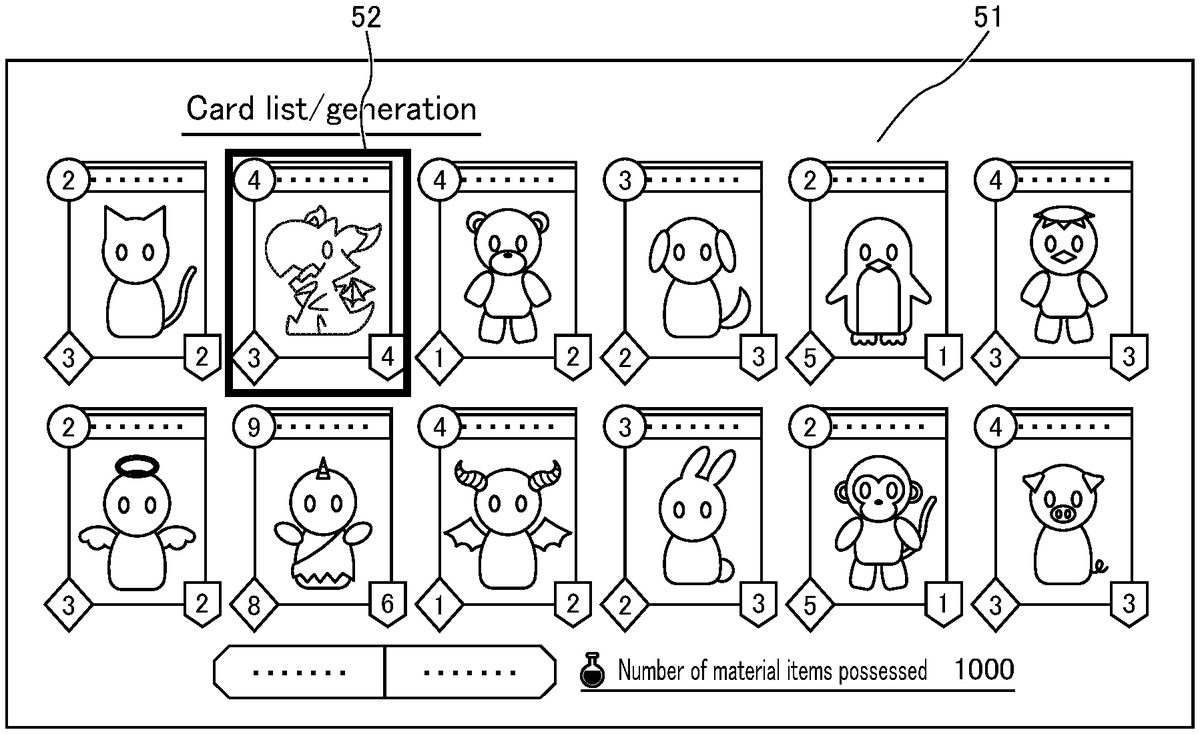
Next, examples of display screens that are displayed with the medium management process on the display connected to the output unit27under the control of the game-running execution unit211will be described with reference toFIGS.5to9.FIGS.5to9are schematic illustrations showing the example display screens.
FIG.5shows an example card list screen that is displayed in the medium management process. The player performs an operation for transitioning to this screen when confirming the cards available to the player himself or herself in a list. In the display example shown inFIG.5, cards that are currently available to the player are individually shown at the middle rows in the screen, as shown as an indication51. Specifically, each card is displayed together with the card name, the graphics of a character corresponding to the card, a numerical value indicating the ability of the card, and a numerical value indicating the rarity of the card. This list screen is directed to clearly representing all the cards available to the player. Thus, each card is displayed in such a manner that it is not possible to distinguish whether the card is a possessed card or a universal fixed-term card/conditional fixed-term card. That is, cards are displayed without making distinction as to card properties.
Suppose that, in this case, the player performs an operation for selecting the card indicated as an indication52. Then, a transition to a card detail screen representing the details of this card occurs.
FIG.6shows an example card detail screen. In the example display shown inFIG.6, the card for which details are displayed is displayed similarly toFIG.5, as shown as an indication61.
Furthermore, this detail screen is directed to showing the details of the card selected by the player. Thus, each card is displayed in such a manner that it is possible to distinguish whether the card is a possessed card or a universal fixed-term card/conditional fixed-term card. That is, cards are displayed while making distinction as to card properties. Specifically, values indicating how many possessed cards of this kind and how many universal fixed-term cards/conditional fixed-term cards of this kind are present are displayed, as shown as an indication62. In this example, the indication “×2” indicates that two possessed cards of this kind are present. Furthermore, the indication “+1” indicates that one universal fixed-term card/conditional fixed-term card is present. In order to facilitate distinction between these individual indications “×2” and “+1”, the colors or the like of the characters of the individual indications may be varied.
Furthermore, operation icons for executing various kinds of processing with this card are displayed, as shown as an indication63. In this example, since a possessed card of this kind is present, it is possible to premiumize this card. Thus, for example, an icon for premiumizing this card is displayed as an operation icon.
Furthermore, text indicating the properties, etc. of this card is displayed, as shown as an indication64. Furthermore, in this example, since a possessed card of this kind is present, it is possible to decompose this card. Thus, an operation button for decomposing this card is displayed as an operation button, together with the number of material items that can be acquired by decomposition, as shown as an indication65. Meanwhile, in this example, two possessed cards of this kind and one universal fixed-term card/conditional fixed-term card of this kind are present, the total number of cards of this kind is three. Thus, it is not possible to generate a card of this kind. Thus, although an operation button for generating a card of this kind is displayed as an operation button together with the number of material items that are consumed for the generation, the operation button is displayed in a state in which an operation is not accepted, as shown as an indication66. For example, the operation button is displayed in a state of color similar to the background color so as to indicate the state in which an operation is not accepted. In the figure, this state is represented by using broken lines.
FIG.7shows another example card detail screen. Since the display example shown inFIG.7is basically the same as the display example shown inFIG.6, only differences will be described with different reference signs attached thereto. As opposed to the indication62inFIG.6, in this example, the indication “×0” indicates that no possessed card of this kind is present, as shown as an indication67. Furthermore, the indication “+1” indicates that one universal fixed-term card/conditional fixed-term card of this kind is present.
In this example, since no possessed card of this kind is present, it is not possible to premiumize or decompose a card of this kind. Thus, as opposed to the indication63inFIG.6, some icons including an icon for premiumizing a card of this kind are not displayed, as shown as an indication68. Furthermore, as opposed to the indication65inFIG.6, text indicating that decomposition is not allowed, such as “decomposition is not allowed since the card is a fixed-term card”, is displayed, as shown as an indication69. Meanwhile, in this example, since no possessed card of this kind is present and one universal fixed-term card/conditional fixed-term card of this kind is present, the total number of cards of this kind is one. Thus, it is possible to generate a card of this kind. Accordingly, as opposed to the indication66inFIG.6, an operation button for generating a card of this kind is displayed as an operation button in an operable state, together with the number of material items that are consumed for the generation, as shown as an indication70.
As described above, through the individual processing steps in the medium management process described above, available cards and whether or not increase/decrease processing is allowed are clearly displayed to the player. Furthermore, depending on the purpose of the display screen, switching is performed, in accordance with the game scene, between manners of display so that the player can distinguish or cannot distinguish whether each card available to the player is a possessed card, a universal fixed-term card, or a conditional fixed-term card.
FIG.8shows an example deck creation screen as another example display. The player performs an operation for transitioning to this screen when performing a deck creating operation for creating a deck, including a card selecting operation. Similarly to the indication51inFIG.5, cards that are currently available to the player are individually displayed, as shown as an indication71. As the card selecting operation, the player can include one of the available cards in a deck by selecting that card and moving the card into an area shown as an indication72at the middle row in the screen. Furthermore, the player can finish a deck creating operation by including a prescribed number of cards (forty cards here) in the deck through such selecting operations.
Suppose that, in this case, the player performs an operation for selecting a card shown as an indication73. Then, text indicating the properties, etc. of the card is displayed, as shown as an indication74.
Furthermore, this deck generation screen is directed to clearly showing all the cards available to the player. Thus, each card is displayed in such a manner that it is not possible to distinguish whether the card is a possessed card or a universal fixed-term card/conditional fixed-term card. That is, cards are displayed without making distinction as to card properties. However, similarly to indications65and66inFIG.6or indications69and70inFIG.7, operation buttons for card decomposition and card generation, shown as indications75and76, are displayed on the basis of the numbers of possessed cards and universal fixed-term cards/conditional fixed-term cards that are present. That is, whether increase/decrease processing is allowed is clearly displayed to the player.
FIG.9shows an example deck confirmation screen as another example display. The player performs an operation for transitioning to this screen when confirming the cards that are included in a created deck. Similarly to the indication51inFIG.5, cards included in a deck are individually displayed, as shown as an indication81. Furthermore, the deck name and a bar graph indicating the deck composition are displayed in an area displayed at the top row in the screen, as shown as an indication82.
This deck confirmation screen is directed to clearly showing all the cards included in a deck. Furthermore, as described above, the cards included in a deck are managed irrespective of the properties thereof. Thus, each card is displayed in such a manner that it is not possible to distinguish whether the card is a possessed card or a universal fixed-term card/conditional fixed-term card. That is, cards are displayed without making distinction as to card properties.
As in the display examples described above, in this embodiment, through the individual processing steps in the medium management process described above, information necessary for the purpose of display screens corresponding to game scenes can be displayed clearly to the player. [Modifications]
Although the embodiment of the present invention has been described above, the embodiment is merely an example and does not limit the technical scope of the present invention. The present invention can be embodied in various other forms, and it is possible to make various modifications, such as omission and substitution, without departing from the spirit of the present invention. These embodiments and modifications thereof are encompassed in the scope and spirit of the invention disclosed in this description, etc. and are encompassed in the scope of the invention recited in the claims and equivalents thereof.
As a first modification, some of the functional blocks of the server1may be realized by the player terminal2. For example, some or all of the available-object determination unit113, the increase/decrease-processing check unit114, the display control unit115, and the medium-set generation unit116may be realized by the player terminal2. The functional configurations in the case of this modification will be described with reference toFIG.10.FIG.10is a functional block diagram showing, in the functional configuration of the server1and the functional configuration of the player terminal2, functional configurations for executing the medium management process in this modification. For the purpose of distinction from the server1and the player terminal2in the embodiment described above, this modification will be described while additionally attaching the reference sign “a” to the server1and referring to the server as a server1a.Similarly, this modification will be described while additionally attaching the reference sign “a” to the player terminal2and referring to the player terminal as a player terminal2a.
As shown inFIG.10, in the case where the medium management process in this modification is executed, the CPU21of the player terminal2afunctions as the available-object determination unit113, the increase/decrease-processing check unit114, the display control unit115, and the medium-set generation unit116in addition to the game-running execution unit211and the player-operation notification unit212. Meanwhile, in the case where the medium management process in this modification is executed, the CPU11of the server1adoes not function as the available-object determination unit113, the increase/decrease-processing check unit114, the display control unit115, or the medium-set generation unit116.
With these functional configurations, the server1amanages the individual items of data stored in the storage unit18in particular through cooperation between the game-running control unit111and the data management unit112.
Furthermore, the game-running control unit111of the server1aextracts the individual items of data stored in the storage unit18, for example, in the case where a query for cards available to the player is received from the available-object determination unit113of the player terminal2a.That is, the game-running control unit111extracts the card IDs and the number of possessed cards associated with the player ID of the player for which the query has been received. Furthermore, the game-running control unit111extracts, from the universal-fixed-term-medium storage unit182, the card IDs and the number of universal fixed-term cards for which the usage periods have not yet expired. Furthermore, the game-running control unit111extracts, from the conditional-fixed-term-medium storage unit183, the card IDs and the number of conditional fixed-term cards that are associated with the obtained player ID and for which the usage periods have not yet expired.
Furthermore, the game-running control unit111notifies the player terminal2aof these items of extracted data by transmitting the data. Upon receiving the notification, the available-object determination unit113of the player terminal2adetermines cards that are available to the player, similarly to the available-object determination unit113in the embodiment described above.
Furthermore, upon receiving the notification, the increase/decrease-processing check unit114, the display control unit115, and the medium-set generation unit116of the player terminal2aindividually execute processing similarly to the increase/decrease-processing check unit114, the display control unit115, and the medium-set generation unit116in the embodiment described above. Also with this modification, it is possible to realize a process that is equivalent to the medium management process described above.
Furthermore, as a second modification, all of the functional blocks of the server1and the functional blocks of the player terminal2may be realized by a single device. That is, all the functional blocks in the embodiment described above may be realized by a single device. Also with this modification, it is possible to realize a process that is equivalent to the medium management process described above.
In the embodiment described above, fixed-term cards including universal fixed-term cards and conditional fixed-term cards are managed in addition to possessed cards. Here, without limitation to these fixed-term cards, which are cards that can be used by the player only within the usage periods thereof, cards having other properties may be managed. For example, instead of the usage periods, which are period-based conditions, cards whose availability is determined on the basis of other conditions may be managed. Here, examples of the other conditions include a condition that the availability is effective for a prescribed number of times of usage in battles, a condition that the availability is effective until the player wins a prescribed number of times (or loses a prescribed number of times) in battles, and a condition that the availability is effective when the level of the player is not lower than a prescribed level (or is lower than a prescribed level).
In the case where cards whose availability is determined on the basis of these other conditions are managed, the “other conditions” are stored instead of “period information” in the universal-fixed-term-medium storage unit182and the conditional-fixed-term-medium storage unit183. Furthermore, the available-object determination unit113determines cards that are available to the player in the game on the basis of whether or not the “other conditions” stored in the universal-fixed-term-medium storage unit182and the conditional-fixed-term-medium storage unit183are satisfied instead of whether or not the usage periods of cards have expired. Furthermore, the increase/decrease-processing check unit114handles the cards whose availability is determined on the basis of the other conditions similarly to fixed-term cards in increase/decrease processing, such as card generation, card decomposition, and card premiumization.
Also in this case, it is possible to realize management similar to that in the case of managing fixed-term cards, which makes it possible to more simply manage game media having various properties on a computer.
Note that cards whose availability is determined on the basis of other conditions may be managed in addition to fixed-term cards or cards whose availability is determined on the basis of other conditions may be managed instead of fixed-term cards.
For example, although the server1and the player terminal2to which the present invention is applied have been described by using a server device, a game machine, and a smartphone as examples in the context of the above-described embodiment, there is no particular limitation to these examples. The present invention is generally applicable to electronic appliances having information processing functions. Furthermore, the functional configurations of the server1and the player terminal2may be realized with a single device. Alternatively, the functions of the server1may be realized with a plurality of devices by distributing the functions to a plurality of server devices such as cloud servers.
In other words, the functional configurations shown inFIG.3are merely examples, and there is no particular limitation thereto. That is, it suffices to provide the server1and the player terminal2with functions that make it possible to execute the series of processing steps described above as a whole, and the choice of specific functional blocks for realizing those functions is not particularly limited to that in the examples inFIG.3.
Furthermore, the functional configurations described above can be executed by hardware, by software, or by a combination of hardware and software. For example, the functional configurations in the embodiment are realized by using processors that execute computational processing. Processors that can be used in the embodiment include a processor constituted of only one information processing device of various kinds, such as a single processor, a multiprocessor, or a multicore processor, as well as a combination of one of these various kinds of processing devices and a processing circuit such as an application specific integrated circuit (ASIC) or a field-programmable gate array (FPGA).
In the case where the functional configurations are executed at least partially by software, a program constituting the software is installed in a computer or the like from a network or a recording medium.
The computer may be a computer embedded in special hardware. Alternatively, the computer may be a computer that is capable of executing various functions when various programs are installed therein, such as a general-purpose personal computer.
A recording medium including such a program is implemented by the removable medium100inFIG.2, which is distributed separately from the main unit of a device in order to provide a player with the program, or is implemented by a recording medium or the like that is provided to a player in a state embedded in advance in the main unit of a device. The removable medium100is implemented, for example, by a magnetic disk (including a floppy disk), an optical disk, or a magneto-optical disk. The optical disk is implemented, for example, by a compact disk-read only memory (CD-ROM), a digital versatile disk (DVD), or a Blu-ray (registered trademark) disc. The magneto-optical disk is implemented, for example, by a mini-disk (MD). Furthermore, the recording medium that is provided to a player in a state embedded in advance in the main unit of a device is implemented, for example, by the ROM12inFIG.2or the ROM22inFIG.2, in which the program is recorded, or a semiconductor memory included in the storage unit18inFIG.2or the storage unit28inFIG.2.
Note that, in this description, steps defining the program recorded in the recording medium may include processing that is not necessarily executed sequentially but is executed in parallel or individually, as well as processing that is executed sequentially in order. Furthermore, steps that are executed according to the program recorded in the recording medium may be executed in an arbitrary order within a scope not departing from the spirit of the present invention.
EXPLANATION OF REFERENCE NUMERALS
1,1aServer2,2aPlayer terminal5Network11,21CPU12,22ROM13,23RAM14,24Bus15,25Input/output interface16,26Input unit17,27Output unit18,28Storage unit19,29Communication unit20,30Drive100Removable medium111Game-running control unit112Data management unit113Available-object determination unit114Increase/decrease-processing check unit115Display control unit116Medium-set creation unit181Possessed-medium storage unit182Universal-fixed-term-medium storage unit183Conditional-fixed-term-medium storage unit184Management-information storage unit211Game-running execution unit212Player-operation notification unit281Game-running-data storage unitS Information processing system
Claims
- A non-transitory computer readable medium storing an information processing program for causing a computer to perform a method comprising: managing first management information and second management information as information for managing a plurality of game media having assigned thereto a plurality of common medium identifiers that are common for each game medium of the plurality of game media having of the same kind, wherein the first management information indicates a first plurality of medium identifiers and a number of game media possessed by a player, and wherein the second management information indicates a second plurality of medium identifiers and a plurality of usage periods for game media;determining a plurality of available game media available to the player based on the first management information and the second management information;creating a medium set that includes a plurality of selected game media based on an operation performed by the player to select from the plurality of available game media;managing, after creating the medium set, the medium set based on a number of the plurality of available game media available to the player and without regard to whether the plurality of selected game media are possessed by the player or the plurality of selected game media have at least one usage period;deleting a first game medium from the medium set and in response to: determining that a usage period of the first game medium expires, determining that the first game medium is included in the medium set, determining that the number of game media possessed by the player has increased by a second game medium, and determining that the second game medium is the same kind as the first game medium;and adding the second game medium to the medium set in response to deleting the first game medium.
- A non-transitory computer readable medium storing an information processing program according to claim 1, wherein the method further comprises managing, as the second management information, both information indicating a second plurality of medium identifiers and a second plurality of usage periods of game media available to all players among a plurality of players as well as information indicating a portion of the second plurality of medium identifiers and a portion of the second plurality of usage periods of game media available to some players among the plurality of players.
- A non-transitory computer readable medium storing an information processing program according to claim 1, wherein the method further comprises: determining, based on a number of the plurality of game media available to the player, and determining whether execute increase processing involving the plurality of game media.
- A non-transitory computer readable medium storing an information processing program according to claim 1, wherein the method further comprises: determining, based on the number of the game media available to the player, whether to execute decrease processing involving the plurality of game media.
- A non-transitory computer readable medium storing an information processing program according to claim 1, wherein in response to creating the medium set, the medium set includes the plurality of game media possessed by the player preferentially than the plurality of game media having the usage periods set therefor.
- A non-transitory computer readable medium storing an information processing program according to claim 1, wherein the method further comprises: executing control to perform switching between a plurality of manners of display so that the player can distinguish whether a game medium available to the player is a game medium possessed by the player or a game medium having the usage period set therefor, in accordance with a scene in a game that is played by using the plurality of game media.
- An information processing device comprising: a processor;and a memory connected to the processor, wherein the memory comprises a program configured to perform a method comprising: managing first management information and second management information as information for managing a plurality of game media having assigned thereto a plurality of common medium identifiers that are common for each medium of the same kind, wherein the first management information indicates a first plurality of medium identifiers and a number of game media possessed by a player, and wherein the second management information indicates a second plurality of medium identifiers and a plurality of usage periods for game media;determining a plurality of available game media available to the player based on the first management information and the second management information;creating a medium set that includes a plurality of selected game media based on an operation performed by the player to select from the plurality of available game media;managing, after creating the medium set, the medium set based on a number of the plurality of available game media available to the player and without regard to whether the plurality of selected game media are possessed by the player or the plurality of selected game media have at least one usage period;deleting a first game medium from the medium set and in response to: determining that a usage period of the first game medium expires, determining that the first game medium is included in the medium set, determining that the number of game media possessed by the player has increased by a second game medium, and determining that the second game medium is the same kind as the first game medium;and adding the second game medium to the medium set in response to deleting the first game medium.
- An information processing system comprising a server and a terminal communicatively connected to the server, the server comprising: a first processor and a first memory connected to the first processor, wherein the first memory comprises a first program configured to perform a first method comprising: managing first management information and second management information as information for managing a plurality of game media having assigned thereto a plurality of common medium identifiers that are common for each game medium of the plurality of game media having the same kind, wherein the first management information indicates a first plurality of medium identifiers and a number of game media possessed by a player, and wherein the second management information indicates a second plurality of medium identifiers and a plurality of usage periods for game media;and transmitting the first management information and the second management information to the terminal, and the terminal comprising: a second processor and a second memory connected to the second processor, wherein the second memory comprises a second program configured to perform a second method comprising: receiving the first management information and the second management information;determining a plurality of available game media available to the player based on the first management information and the second management information;and creating a medium set that includes a plurality of selected game media an operation performed by the player to select from the plurality of available game media;managing, after creating the medium set, the medium set based on a number of the plurality of available game media available to the player and without regard to whether the plurality of selected game media are possessed by the player or the plurality of selected game media have at least one usage period;deleting a first game medium from the medium set and in response to: determining that a usage period of the first game medium expires, determining that the first game medium is included in the medium set, determining that the number of game media possessed by the player has increased by a second game medium, and determining that the second game medium is the same kind as the first game medium;and adding the second game medium to the medium set in response to deleting the first game medium.
Disclaimer: Data collected from the USPTO and may be malformed, incomplete, and/or otherwise inaccurate.