U.S. Pat. No. 12,102,905
NON-TRANSITORY COMPUTER-READABLE MEDIUM AND VIDEO GAME PROCESSING SYSTEM
AssigneeSQUARE ENIX CO., LTD.
Issue DateMay 28, 2021
Illustrative Figure
Abstract
A non-transitory computer-readable medium including a video game processing program for causing a server to perform functions to control progress of a video game using a virtual space corresponding to map information of a real space and positional information of a user terminal of a user is provided. The functions include: a registering function configured to register objects of a plurality of users; a generating function configured to generate a predetermined event on a basis of positional information of a user terminal of a first user; and a participating function configured to cause an object of a second user different from the first user, for whom the event is generated, among the objects registered by the registering function to participate in the event.
Description
DETAILED DESCRIPTION Hereinafter, examples of embodiments according to the present disclosure will be described with reference to the drawings. Note that various components in the respective embodiments described below can be appropriately combined without any contradiction or the like. In addition, the description of the content described as a certain embodiment may be omitted in another embodiment. Further, the content of an operation or processing that does not relate to features of each of the embodiments may be omitted. Moreover, the order of various processes that constitute various flows described below may be changed without any contradiction or the like of processing content. First Embodiment FIG.1is a block diagram illustrating an example of a configuration of a video game processing system100according to one embodiment of the present disclosure. As illustrated inFIG.1, the video game processing system100includes a video game processing server10(hereinafter, referred to as a “server10”) and user terminals20, and201to20n(“n” is an arbitrary integer) respectively used by users of the video game processing system100. In this regard, the configuration of the video game processing system100is not limited to this configuration. The video game processing system100may be configured so that the plurality of users uses a single user terminal, or may be configured so as to include a plurality of servers. Each of the server10and the plurality of user terminals20and201to20nis connected to a communication network30such as the Internet. In this regard, although it is not illustrated in the drawings, the plurality of user terminals20and201to20nis connected to the communication network30by executing data communication with base stations managed by a telecommunication carrier by means of a radio communication line. The video game processing system100includes the server10and the plurality of user terminals20and201to20n, whereby various kinds of functions for executing various kinds of processing in response to an operation of the user are performed. The ...
DETAILED DESCRIPTION
Hereinafter, examples of embodiments according to the present disclosure will be described with reference to the drawings. Note that various components in the respective embodiments described below can be appropriately combined without any contradiction or the like. In addition, the description of the content described as a certain embodiment may be omitted in another embodiment. Further, the content of an operation or processing that does not relate to features of each of the embodiments may be omitted. Moreover, the order of various processes that constitute various flows described below may be changed without any contradiction or the like of processing content.
First Embodiment
FIG.1is a block diagram illustrating an example of a configuration of a video game processing system100according to one embodiment of the present disclosure. As illustrated inFIG.1, the video game processing system100includes a video game processing server10(hereinafter, referred to as a “server10”) and user terminals20, and201to20n(“n” is an arbitrary integer) respectively used by users of the video game processing system100. In this regard, the configuration of the video game processing system100is not limited to this configuration. The video game processing system100may be configured so that the plurality of users uses a single user terminal, or may be configured so as to include a plurality of servers.
Each of the server10and the plurality of user terminals20and201to20nis connected to a communication network30such as the Internet. In this regard, although it is not illustrated in the drawings, the plurality of user terminals20and201to20nis connected to the communication network30by executing data communication with base stations managed by a telecommunication carrier by means of a radio communication line.
The video game processing system100includes the server10and the plurality of user terminals20and201to20n, whereby various kinds of functions for executing various kinds of processing in response to an operation of the user are performed.
The server10is managed by an administrator of the video game processing system100, and has various kinds of functions to provide information regarding various kinds of processing to the plurality of user terminals20and201to20n. In the present embodiment, the server10is constructed by an information processing apparatus, such as a WWW server, and includes a storage medium for storing various kinds of information. In this regard, the server10is provided with a general configuration for executing the various kinds of processing as a computer, such as a control section and a communicating section. However, its explanation herein is omitted. Further, in the video game processing system100, it is preferable that the server10manages various kinds of information from a point of view to reduce a processing load on each of the plurality of user terminals20and201to20n. However, a storing section for storing various kinds of information may include a storage region in a state that the server10C an access the storage region. For example, the server10may be configured so as to be provided with a dedicated storage region outside the server10.
FIG.2is a block diagram illustrating a configuration of a video game processing server10A (hereinafter, referred to as a “server10A”), which is an example of the server10. As illustrated inFIG.2, the server10A at least includes a registering unit11, a generating unit12, and a participating unit13.
The registering unit11has a function to register objects of the plurality of users corresponding to the plurality of user terminals20, and201to20n.
Here, each of the objects of the plurality of users means an object corresponding to the user. Further, the object means a virtual object that appears in a video game. A configuration of each of the objects of the plurality of users is not limited particularly. However, it is preferable that the object may be used for progress of the video game by the user. As an example of the objects of the plurality of users, there is a character of the corresponding user.
Further, the phase “register objects” means that information regarding the objects is stored in a predetermined storage unit. A configuration to register objects is not limited particularly. However, it is preferable that the registering unit11is configured so that information for causing the object to appear in the video game is stored in the predetermined storage unit. As an example of the configuration to register objects, there is a configuration in which identification information and parameters of the object are stored in the predetermined storage unit
The generating unit12has a function to generate a predetermined event on the basis of positional information of the user terminal20of the user (that is, a first user).
Here, the positional information of the user terminal20means information indicating a position of the user terminal20in the real space. A configuration of the positional information is not limited particularly. However, it is preferable that the positional information is configured so as to contain coordinates that can specify the position of the user terminal20in the real space. As examples of the configuration to obtain the positional information of the user terminal20, there are a configuration to obtain the positional information by using a GPS signal, and a configuration to obtain the positional information on the basis of reception intensity information of wireless signals from a plurality of beacon transmitters.
Further, the phrase “on the basis of positional information of the user terminal20” means that the positional information of the user terminal20is used. As examples to a configuration to generate the predetermined event using the positional information of the user terminal20, there are a configuration in which satisfaction of a predetermined condition regarding the positional information of the user terminal20is included in a generation condition of the event, and a configuration in which the content of the event is defined by using the positional information of the user terminal20.
Further, the event means any of various kinds of occurrences that can be generated in the video game. A configuration of the event is not limited particularly. However, it is preferable that the event is configured so that the event is generated in a case where a generation condition is satisfied in a virtual space corresponding to map information of the real space in accordance with progress of the video game. As an example of the predetermined event, there is an event that is associated with an object arranged in the virtual space corresponding to the map information of the real space. In this regard, as an example of the event associated with the object, there are various kinds of events each of which is associated with a type of the object.
Here, the virtual space corresponding to the map information of the real space means a virtual space that is generated by using the map information of the real space. A configuration to generate the virtual space is not limited particularly. However, it is preferable that the generating unit12is configured so that the user can recognize that the virtual space is generated on the basis of the map information of the real space. As an example of such a configuration, there is a configuration in which the virtual space is generated by respectively arranging objects corresponding to roads and buildings in the real space at positions corresponding to roads and buildings in the real space. In this regard, a configuration of the object corresponding to each of the roads and the buildings in the real space is not limited particularly. However, it is preferable that the object is configured so that the user can recognize that it has a correspondence relationship with a road, a building, or the like. As examples of such a configuration, there are an object created to resemble the appearance of a road and an object (for example, an enemy character) different from objects that constitute the virtual space (for example, the ground). Further, a configuration to associate the position in the real space with the position in the virtual space is not limited particularly. However, the generating unit12may be configured so that a coordinate in the real space and a coordinate in the virtual space are defined in a one-to-one relationship, or may be configured so that the coordinates are defined in a plural-to-one relationship or a one-to-plural relationship.
The participating unit13has a function to cause an object of another user different from the user (that is, a second user), for whom the event is generated, among the objects registered by the registering unit11to participate in the event.
Here, a configuration to specify the object of the other user different from the user for whom the event is generated is not limited particularly. The participating unit13may be configured so as to specify a predetermined number of objects in accordance with a predetermined rule from the registered objects, or may be configured so as to cause the user to select an object. In this regard, it is preferable that the other user different from the user for whom the event is generated uses another user terminal20different from the user terminal20of the user (for example, the user terminal201).
Further, a configuration to cause the object to participate in the event is not limited particularly. However, it is preferable that the object is caused to contribute progress of the event. As an example of such a configuration, there is a configuration in which a character is caused to fight with an enemy character in a battle event with the enemy character.
Each of the plurality of user terminals20, and201to20nis managed by the user, and is configured by a communication terminal capable of playing a network delivery type game, such as a cellular telephone terminal, a PDA (Personal Digital Assistants), a portable game apparatus, or a so-called wearable device, for example. In this regard, the configuration of the user terminal that the video game processing system100can include is not limited to the example described above. Each of the user terminals20, and201to20nmay be configured so that the user can recognize the video game. As the other examples of the user terminal, there are one obtained by combining various kinds of communication terminals, a personal computer, and a stationary game apparatus.
Further, each of the plurality of user terminals20, and201to20nis connected to the communication network30, and includes hardware (for example, a display device for displaying a browser screen or a game screen based on a coordinate and the like) and software for executing various kinds of processes by communicating with the server10A. In this regard, each of the plurality of user terminals20, and201to20nmay be configured so as to be able to directly communicate with each other without the server10A.
Next, an operation of the video game processing system100(hereinafter, referred to as the “system100”) according to the present embodiment will be described.
FIG.3is a flowchart illustrating an example of game processing executed by the system100. In the game processing according to the present embodiment, processes related to a control of progress of the video game using the positional information of the user terminal20are executed. Hereinafter, a case where the server10A and the user terminal20(hereinafter, referred to as the “terminal20”) execute the game processing will be described as an example.
The game processing is started as an opportunity that the terminal20accessing the server10A requests display of the virtual space, for example.
In the game processing, the server10A first registers objects of the users (Step S11). In the present embodiment, the server10A stores information regarding the objects of the users in a predetermined storage region.
When the objects of the users are registered, the server10A generates a predetermined event on the basis of positional information of the terminal20of the user (Step S12). In the present embodiment, the server10A transmits event information for causing the terminal20to generate the predetermined event to the terminal20.
When the predetermined event is generated, the server10A cause an object of another user different from the user for whom the event is generated among the registered objects to participate in the predetermined event (Step S13). In the present embodiment, the server10A transmits, to the terminal20, participation information for causing an object different from that of the user for whom the event is generated to participate in the event.
When the participation information is received from the server10A, the terminal20outputs a game screen to a display screen of a predetermined display device (Step S14). In the present embodiment, when the terminal20outputs the game screen, the terminal20and the server10A terminate the processes herein.
FIG.4is a flowchart illustrating an example of an operation of the server10A in the game processing. Here, an operation of the server10A in the system100will be described again.
In the game processing, the server10A first registers objects of the plurality of users (Step S101); generates a predetermined event on the basis of positional information of the terminal20of the user (Step S102); and causes an object of a user different from the user, for whom the event is generated, among the registered objects to participate in the predetermined event (Step S103). When the object is caused to participate in the event, the server10A terminates the processes herein.
FIG.5is a flowchart illustrating an example of an operation of the terminal20in a case where the terminal20executes the game processing. Hereinafter, a case where the terminal20executes the game processing by a single body will be described as an example. In this regard, the configuration of the terminal20includes the similar functions to those of the server10A except that the terminal20receives various kinds of information from the server10A. For this reason, its explanation is omitted from a point of view to avoid repeated explanation.
In the game processing, the terminal20first registers objects of the users (Step S201); generates a predetermined event on the basis of positional information of the terminal20of the user (Step S202); and causes an object of a user different from the user, for whom the event is generated, among the registered objects to participate in the predetermined event (Step S203). When the object is caused to participate in the event, the terminal20terminates the processes herein.
As explained above, as one aspect of the first embodiment, the server10A that controls progress of the video game using the virtual space corresponding to the map information of the real space and the positional information of the user terminal20is configured so as to include the registering unit11, the generating unit12, and the participating unit13. Thus, the registering unit11registers the objects of the users; the generating unit12generates the predetermined event on the basis of the positional information of the terminal20of the user; and the participating unit13causes the object of the other user different from the user, for whom the event is generated, among the registered objects to participate in the event. Therefore, it becomes possible to maintain interest of the user in the video game.
Namely, by causing the users to interact with each other through the object in the video game using the virtual space corresponding to the map information of the real space and the positional information of the user terminal, it becomes possible to enhance the sense of unity among the users that the video game is progressing in the same virtual space. As a result, it becomes possible to maintain interest of the user in the video game. In other words, by causing the object of the other user to participate in the generated event in the video game using the virtual space corresponding to the map information of the real space and the positional information of the user terminal, it is possible to give the user a feeling of causing the video game to proceed with the other user through the object in the virtual space, and this makes it possible for the user to further have interest in progress of the video game. Moreover, by causing the object of the other user to participate in the event generated on the basis of the positional information, it is possible to give the user the feeling of causing the video game to proceed with the other user even in the real space, and this makes it possible for the user to further have interest in progress of the video game.
Second Embodiment
FIG.6is a block diagram illustrating a configuration of a video game processing server10B (hereinafter, referred to as a “server10B”), which is an example of the video game processing server10. In the present embodiment, the server10B at least includes a registering unit11B, a generating unit12, a participating unit13B, and an updating unit14.
The registering unit11B has a function to register registration related information, in which a user is associated with objects of the other users different from the user, in a predetermined storage region.
Here, the registration related information means a combination of information in which identification information of the user is at least associated with information regarding the objects of the other users different from the user. The registration related information is not limited particularly. However, it is preferable that the registration related information contains information indicating whether the user can participate in an event or not.
The participating unit13B has a function to cause at least a part of the objects associated with the user for whom the event is generated to participate in the event.
Here, at least the part of the objects means an object or objects defined in accordance with a predetermined rule among the objects registered by the registering unit11B. A configuration to specify at least the part of the objects is not limited particularly. However, it is preferable that the participating unit13B is configured so as to specify the object in accordance with a predetermined rule that the user can recognize. As an example of such a configuration, there is a configuration in which an object is specified on the basis of information regarding the user.
The updating unit14has a function to update the registration related information so that participation of each of the objects, which have already participated in the event by the participating unit13B, in a new event generated after the event is restricted.
Here, the phrase “after the event” means after a time when the event is generated. A definition of “after the event is generated” is not limited particularly. However, it is preferable to be after a time when the user can recognize that restriction of generation of an event is started. As examples of the definition of “after the event is generated”, there are after a time when the event is started, after a time when the event is terminated, and after a predetermined time in the started event.
Further, the phrase “participation of the object in the event is restrict” means that a permissible range where the object is caused to participate in the event is defined. A configuration to restrict participation of the object in the event is not limited particularly. However, it is preferable that participation in the event is disabled in a case where the permissible range is exceeded for the object. As an example of such a configuration, there is a configuration in which a period of time during which a character cannot participate in a battle event with an enemy character is defined. In this regard, as examples of the permissible range, there are a predetermined period of time from a predetermined time and a predetermined upper limit of the number of times of participation in an event.
Further, the phrase “update the registration related information” means that at least part of the registration related information is changed. A configuration to update the registration related information is not limited particularly. However, it is preferable that information is updated so that an object caused to participate in an event by the participating unit13B is specified. As examples of the configuration to update the registration related information, there are a configuration in which information indicating an object caused to participate in an event by the participating unit13B is changed, and a configuration in which flag information corresponding to each object is changed.
FIG.7is a flowchart illustrating an example of game processing executed by the video game processing system100(seeFIG.1). Hereinafter, operations of the server10B and a user terminal20(hereinafter, referred to as a “terminal20”) will be described as an example. In this regard, a flowchart illustrating an operation of each of the server10B and the terminal20is omitted from a point of view to avoid repeated explanation.
The server10B registers registration related information, in which a user is associated with an object of another user different from the user, in a predetermined storage region (Step S2-11). In the present embodiment, the server10B respectively registers registration related information, in which each user is associated with objects of users different from the corresponding user, in predetermined storage regions.
When the registration related information is registered, the server10B causes at least a part of the objects corresponding to the user for whom an event is generated to participate in the event (Step S2-12). In the present embodiment, the server10B transmits, to the terminal20, participation information for causing at least a part of the objects to participate in the event.
When the object is caused to participate in the event, the server10B updates the registration related information so that participation of each of the objects, which have already participated in the event, in a new event generated after the event is restricted (Step S2-13). In the present embodiment, the server10B changes information indicating the object that participate in the event, which is part of the registration related information, so as to designate another object associated with the user.
As explained above, as one aspect of the second embodiment, the server10B that controls progress of the video game using the virtual space corresponding to the map information of the real space and the positional information of the user terminal20is configured so as to include the registering unit11B, the generating unit12, the participating unit13B, and the updating unit14. Thus, the registering unit11B registers the registration related information, in which the user is associated with the objects of the other users different from the user, in the predetermined storage region; the participating unit13B causes at least the part of the objects associated with the user for whom the event is generated to participate in the event; and the updating unit14updates the registration related information so that the participation of the object caused to participate in the event in another event that is generated after the event is restricted. Therefore, it becomes possible to interact with more users through the object compared with a case where participation of the object in another event is not restricted, and this makes it possible to further maintain interest of the user in the video game.
Third Embodiment
FIG.8is a block diagram illustrating a configuration of a video game processing server10C (hereinafter, referred to as a “server10C”), which is an example of the video game processing server10. In the present embodiment, the server10C at least includes a registering unit11, a generating unit12, and a participating unit13C.
The participating unit13C has a function to cause an object, which is registered by the registering unit11and satisfies a predetermined condition in accordance with progress of a video game by a user, to participate in an event generated by the user.
Here, the phrase “in accordance with progress of a video game” means that occurrence of various kinds of progress or changes and the like that can be generated in the video game becomes timing or a standard of a specific process. As examples of the specific process, there are a determining process, an information updating process, and the like. Further, as examples of the various kinds of progress or changes that can be generated in the video game, there are progress of time, a change in a game element value, a specific status or update of a flag, an operation input by the user, and the like.
Further, the content of the predetermined condition is not limited particularly. However, it is preferable that the user can recognize the content of the predetermined condition. As examples of the predetermined condition, there are a condition that the object is associated with a user who has a predetermined relationship with the user for whom the event is generated, and a condition that the object has a common point to the object of the user for whom the event is generated.
FIG.9is a flowchart illustrating an example of game processing executed by the video game processing system100(seeFIG.1). Hereinafter, operations of the server10C and a user terminal20(hereinafter, referred to as a “terminal20”) will be described as an example. In this regard, a flowchart illustrating an operation of each of the server10C and the terminal20is omitted from a point of view to avoid repeated explanation.
When a predetermined event is generated, the server10C causes an object, which is registered by the registering unit11and satisfies a predetermined condition in accordance with progress of the video game by the user, to participate in an event generated by the user (Step S3-11). In the present embodiment, the server10C transmits, to the terminal20, participation information for causing the object to participate in the event.
As explained above, as one aspect of the third embodiment, the server10C that controls progress of the video game using the virtual space corresponding to the map information of the real space and the positional information of the user terminal20is configured so as to include the registering unit11, the generating unit12, and the participating unit13C. Thus, the participating unit13C cause the registered object, which satisfies the predetermined condition in accordance with progress of the video game by the user, to participate in the event generated by the user. Therefore, it becomes possible to cause an object, which can contribute to maintenance of interest of the user in the video game relatively significantly, to participate in the event, and it becomes possible to cause the object to participate in the event while maintaining an appropriate game balance.
Fourth Embodiment
FIG.10is a block diagram illustrating a configuration of a video game processing server10D (hereinafter, referred to as a “server10D”), which is an example of the video game processing server10. In the present embodiment, the server10D at least includes a registering unit11, a generating unit12, a participating unit13D, and a determining unit15.
The determining unit15has a function to determine whether an object of another user (the other user) different from a user for whom an event is generated is caused to participate in the event or not on the basis of information regarding a generated event.
Here, the information regarding the event is not limited particularly. However, it is preferable that the information regarding the event is information regarding a type of an event. As an example of the information regarding the event, there is information in which a type of an event is associated with a probability to cause an object of the other user to participate in an event.
Further, a configuration to determine whether the object is caused to participate in the event or not is not limited particularly. However, it is preferable that the configuration is a configuration in which a probability corresponding to a type of an event is used. As an example of such a configuration, there is a configuration in which plural types of events each of which has a different probability to cause an object of the other user to participate in an event are provided.
The participating unit13D has a function to cause the object to participate in the event in a case where the determining unit15determines that the object is caused to participate in the event.
Here, a configuration to cause the object, for which it is determined to be caused to participate in the event, (a participation object) to participate in the event is not limited particularly. However, it is preferable that the participating unit13D is configured so that the object can participate in the event as the same time as the start of the event. As an example of such a configuration, there is a configuration in which a user for whom an event is generated is notified of a participation object as the same time as the start of the event.
FIG.11is a flowchart illustrating an example of game processing executed by the video game processing system100. Hereinafter, operations of the server10D and the user terminal20(hereinafter, referred to as the “terminal20”) will be described as an example. In this regard, a flowchart illustrating an operation of each of the server10D and the terminal20is omitted from a point of view to avoid repeated explanation.
When a predetermined event is generated, the server10D determines whether an object of another user different from a user for whom the predetermined event is generated is caused to participate in the predetermined event or not on the basis of information regarding the generated event (Step S4-11). In the present embodiment, the server10D determines whether the object of the other user different from the user for whom the event is generated is caused to participate in the event or not on the basis of a probability corresponding to a type of the event.
When it is determined whether the object is caused to participate in the event or not, the server10D causes the object to participate in the event in a case where it is determined that the object is caused to participate in the event (Step S4-12). In the present embodiment, the server10D transmits, to the terminal20, participation information for causing the object to participate in the event.
As explained above, as one aspect of the fourth embodiment, the server10D that controls progress of the video game using the virtual space corresponding to the map information of the real space and the positional information of the user terminal20is configured so as to include the registering unit11, the generating unit12, the participating unit13D, and the determining unit15. Thus, the determining unit15determines whether the object of the other user different from the user for whom the event is generated is caused to participate in the event or not on the basis of the information regarding the generated event; and the participating unit13D causes the object to participate in the event in a case where it is determined that the object is caused to participate in the event. Therefore, it becomes possible to provide an opportunity for interaction among users through an object, and to set an appropriate game balance at the same time.
Fifth Embodiment
FIG.12is a block diagram illustrating a configuration of a video game processing server10E (hereinafter, referred to as a “server10E”), which is an example of the video game processing server10. In the present embodiment, the server10E at least includes a registering unit11, a generating unit12, a participating unit13E, and a displaying unit16.
The displaying unit16has a function to selectably display, for a user, an object of another user different from the user.
Here, the phrase “selectably display an object for a user” means that information regarding the object is displayed so that a selection operation for the object can be received from the user. A configuration to selectably display the object for the user is not limited particularly. However, it is preferable that the displaying unit16is configured so as to display information for comparing the object with another object on a user terminal20of the user in a state where the selection operation can be received from the user. As an example of such a configuration, there is a configuration in which an image and a name of an object, and a numerical value corresponding to the object are displayed on the user terminal20of the user in a state where the selection operation can be received from the user.
The participating unit13E has a function to cause an object selected by the user to participate in a generated event.
Here, the object selected by the user means an object that is selectably displayed by the displaying unit16and for which a selection operation is received from the user.
FIG.13is a flowchart illustrating an example of game processing executed by the video game processing system100. Hereinafter, operations of the server10E and he user terminal20(hereinafter, referred to as the “terminal20”) will be described as an example. In this regard, a flowchart illustrating an operation of each of the server10E and the terminal20is omitted from a point of view to avoid repeated explanation.
When an object is registered, the server10E selectably displays, for the user, an object of a user different from the user (Step S5-11). In the present embodiment, the server10E transmits, to the terminal20, object information for selectably displaying the object.
When the object information is received from the server10E, the terminal20selectably displays, for the user, the object on the basis of the object information (Step S5-12). In the present embodiment, the terminal20outputs a game screen, which includes an image by which the object can be selected, to a display screen of a predetermined display device.
When the object is selectably displayed for the user, the terminal20receives a selection operation against the object from the user (Step S5-13). In the present embodiment, the terminal20transmits, to the server10E, selection information regarding selection of the object.
When an event is generated, the server10E causes the object selected by the user to participate in the generated event (Step S5-14). In the present embodiment, the server10E transmits, to the terminal20, participation information for causing the object to participate in the event.
As explained above, as one aspect of the fifth embodiment, the server10E that controls progress of the video game using the virtual space corresponding to the map information of the real space and the positional information of the user terminal20is configured so as to include the registering unit11, the generating unit12, the participating unit13E, and the displaying unit16. Thus, the displaying unit16selectably displays, for the user, the object of another user different from the user; and the participating unit13E causes the object selected by the user to participate in the generated event. Therefore, it becomes possible to interact with more other users desired by the user through the object, and this makes it possible to further maintain interest of the user in the video game.
Sixth Embodiment
FIG.14is a block diagram illustrating a configuration of a video game processing a server10F (hereinafter, referred to as a “server10F”), which is an example of the video game processing server10. In the present embodiment, the server10F at least includes a registering unit11, a generating unit12, a participating unit13, and a giving unit17.
The giving unit17has a function to give, on the basis of at least an operation by a user for whom an event is generated, a reward to an object that is caused to participate in the event by the participating unit13or a user of the object.
Here, the operation by the user means an operational input to a user terminal20by the user. The operation by the user is not limited particularly. However, it is preferable that the operation is an operation related to the object caused to participate in the event by the participating unit13. As an example of the operation by the user, there is a selection operation against the object caused to participate in the event by the participating unit13.
Further, the content of the reward is not limited particularly. However, it is preferable that the reward is meaningful to a player of a video game. As examples of the reward, there are an in-game element, occurrence of a temporary process in the video game (for example, occurrence of a so-called buff, or occurrence of an effect of an item), equipment, items, in-game currency, an experience point associated with the user or an object, and the like.
FIG.15is selectable a flowchart illustrating an example of game processing executed by the system100. Hereinafter, operations of the server10F and the user terminal20(hereinafter, referred to as the “terminal20”) will be described as an example. In this regard, a flowchart illustrating an operation of each of the server10F and the terminal20is omitted from a point of view to avoid repeated explanation.
When participation information is received from the server10F, the terminal20receives an operation by a user (Step S6-11). In the present embodiment, the terminal20transmits, to the server10F, information regarding the operation by the user (user operation information).
When the user operation information is received from the terminal20, the server10F gives, on the basis of at least the operation by the user for whom an event is generated, a reward to an object that is caused to participate in the event or the user of the object (Step S6-12). In the present embodiment, the server10F transmits, to the server10F, reward information for giving the reward.
As explained above, as one aspect of the sixth embodiment, the server10F that controls progress of the video game using the virtual space corresponding to the map information of the real space and the positional information of the user terminal20is configured so as to include the registering unit11, the generating unit12, the participating unit13, and the giving unit17. Thus, the giving unit17gives the reward to the object that participate in the event or the user of the object on the basis of at least the operation of the user for whom the event is generated. Therefore, it is possible to expect that the user is caused to register the object for the purpose of giving the reward.
Seventh Embodiment
FIG.16is a block diagram illustrating a configuration of a video game processing server10Z (hereinafter, referred to as a “server10Z”), which is an example of the video game processing server10. In the present embodiment, the server10Z at least includes a registering unit11Z, a generating unit12Z, a participating unit13Z, an updating unit14Z, and a determining unit15Z.
The registering unit11Z has a function to register objects of users.
Here, each of the objects of the users means an object corresponding to the user. Further, the object means a virtual object that appears in a video game. In this regard, each of the objects of the users may be an object that can carry out any action in the video game. Hereinafter, a case where the object of the user is a character that can be operated by the user will be described as an example.
Further, the phase “register objects” means that information regarding the objects is stored in a predetermined storage unit. Hereinafter, a case where the character of the user can be associated with the other users will be described as an example. In this regard, the registering unit11Z may be configured so that information on the character registered by the user at the time of registration is maintained until next registration, or may be configured so that the information on the character registered by the user is periodically updated to the latest information. Further, the registering unit11Z may be configured so that the user is allowed to register a plurality of characters.
The generating unit12Z has a function to generate a predetermined event on the basis of positional information of a user terminal20(hereinafter, referred to as a “terminal20”) of a user.
Here, the positional information of the terminal20means information indicating a position of the terminal20in a real space. Further, the event means any of various kinds of occurrences that can be generated in the video game. Hereinafter, a configuration in which a battle with an enemy character occurs on the basis of the position of the terminal20owned by the user in the real space will be described as an example.
The participating unit13Z has a function to cause an object of another user different from the user (that is, a second user), for whom the event is generated, among the objects registered by the registering unit11Z to participate in the event.
Here, a configuration to cause the object of the other user to participate in the event is not limited particularly. However, it is preferable that progress of the event becomes advantageous when the other user participates in the event. Hereinafter, a configuration in which a character associated with the user, for whom the event is generated, among characters registered by the other user before the event is generated, participates in a battle against an enemy character as a helper will be described as an example. In this regard, in a case where a plurality of characters is associated with the user, the participating unit13Z may be configured so that one character is selected as a helper in accordance with a predetermined priority rule. As an example of such a configuration, there is a configuration in which a character registered by a friend or a character registered by a user having a similar progress (a level or a rank) of the video game is preferentially selected.
The updating unit14Z has a function to update registration related information so that participation of each of the objects, which have already participated in the event by the participating unit13Z, in a new event generated after the event is restricted.
Here, the phrase “participation of the object in the event is restrict” means that a permissible range where the object is caused to participate in the event is defined. Hereinafter, a case where a character that participates in a battle event as a helper becomes unable to participate in the battle of the same user for a certain period of time when a predetermined period of time elapses since the character participates in the battle event will be described as an example. In this regard, the server10Z may be configured so that in a case where a predetermined period of time elapses after participation, another character is automatically set as the helper at random. Further, the server10Z may also be configured so that in a case where the character is changed into a specific character, the user selects a character caused to participate in the battle event as the helper from a plurality of characters associated with the user himself or herself.
The determining unit15Z has a function to determine whether an object of another user different from the user for whom the event is generated is caused to participate in the event or not on the basis of information regarding the generated event.
Here, the information regarding the event is not limited particularly. However, it is preferable that the information regarding the event is information regarding a type of the event. Hereinafter, a case where the character selected as the helper participates in a battle event generated by the user with a probability corresponding to the type of the battle event for a predetermined period of time since a time of selection will be described as an example.
In the present embodiment, a “normal battle”, a “quest boss battle”, and a “strong enemy battle” are included in the event. A battle participation rate as a helper differs depending upon the content called as the helper. The battle participation rate is set to a certain probability in the normal battle; is set to no helper participation in the quest boss battle; and is set to 100% participation in the strong enemy battle.
FIG.17is an explanatory drawing for explaining an example of a storage state of information stored in a storage unit (not illustrated in the drawings) included in the server10Z. As illustrated inFIG.17, the storage unit stores a user ID, a registered own character name, a selected other character name, and a candidate other character name therein as the registration related information so as to be associated with each other.
Here, the user ID means information for identifying the user.
Further, the registered own character name means a character name of the user identified by the user ID. In the present embodiment, a character of each user himself or herself is registered therein.
Further, the selected other character name means a character name that is selected by the participating unit13Z as an object caused to participate in the battle event among characters of users different from the user identified by the user ID. In the present embodiment, the selected other character name is a character name of a user who is selected by the user and is different from the user.
Further, the candidate other character name means a character name of a candidate that can be set as an object caused to participate in the battle event by the participating unit13Z among the characters of the users different from the user identified by the user ID.
FIG.18is a flowchart illustrating an example of game processing executed by a video game processing system100Z (hereinafter, referred to as a “system100Z”) provided with the server10Z. In the game processing according to the present embodiment, processes related to a control of progress of the video game using positional information of the terminal20are executed in response to an operation of the user. Hereinafter, each of the processes will be described. In this regard, the order of the processes may be changed without any contradiction or the like of processing content.
The game processing is started as an opportunity that the terminal20accessing the server10Z requests display of a registration screen for an object, for example.
In the game processing, the system100Z first receives a registration operation for an object from the user (Step S301).
When the registration operation for the object is received from the user, the system100Z registers registration related information, in which the user is associated with a character of another user different from the user, in a predetermined storage region (Step S302). In the present embodiment, the system100Z registers the registration related information, in which the user, a character of the user, and the object of another user different from the user are associated with each other, in the predetermined storage region.
When the registration related information is registered, the system100Z selectably displays, for the user, the object of another user different from the user (Step S303). In the present embodiment, the system100Z causes the terminal20of the user to selectably display information indicating the character of another user different from the user.
When the object is selectably displayed, the system100Z receives a selection operation for the selectably displayed object from the user (Step S304).
When the selection operation for the object is received from the user, the system100Z selects the object selected by the user as an object caused to participate in a predetermined event (Step S305). In the present embodiment, the system100Z selects a character of the other user different from the user, which is caused to participate in a battle event generated for the user, as a helper.
When the object is selected, the system100Z generates a predetermined event on the basis of positional information of the terminal20of the user (Step S306). In the present embodiment, the system100Z generates a battle event against an enemy character by the character of the user.
When the predetermined event is generated, the system100Z determines whether the object of the other user different from the user for whom the event is generated is caused to participate in the event or not on the basis of information regarding the generated event (Step S307). In the present embodiment, the system100Z determines whether the object is caused to participate in the battle event generated for the user or not with a probability corresponding to a type of the battle event.
When it is determined whether the object is caused to participate in the event or not, the system100Z causes the object selected from registered objects to participate in the event in a case where it is determined that the object is caused to participate in the event (Step S308). In the present embodiment, the system100Z causes the character selected by the user to participate in the battle event against the enemy character.
When the object is caused to participate in the event, the system100Z updates the registration related information so that participation of the object, which has already participated in the event, in a new event generated after the event is restricted (Step S309). In the present embodiment, the system100Z updates the registration related information so that the character cannot participate in a battle event against an enemy character.
In the present embodiment, when the registration related information is updated so that participation in a new event is restricted, the system100Z terminates the processes herein.
FIG.19is an explanatory drawing for explaining an example of a game screen. As illustrated inFIG.19, a screen explanation area1901, a candidate other character display button1902, a participation history display button1903, a non-selection button1904, candidate other character information areas1905, and detailed information display buttons1906are illustrated on the game screen.
The screen explanation area1901is an area for indicating a title of a screen displayed currently. In the present embodiment, the screen explanation area1901is an area for indicating that the currently displayed screen is a screen for selecting a character that is caused to participate in a battle event as a helper.
The candidate other character display button1902is a button for displaying information regarding characters that becomes candidate caused to participate in the battle event. In the present embodiment, the candidate other character display button1902is in a state where a selection operation is made. In this regard, a method of selecting the characters that become the candidates is not limited particularly. However, it is preferable that a plurality of characters is selected as candidates on the basis of a relationship with the user. As an example of such a configuration, there is a configuration in which 10 characters registered by friends in the video game are selected every day. In this case, the characters of the friends may be configured so as to be displayed preferentially from the top of 10 frames, and characters of users other than the friends may be configured so as to be displayed below the 10 frames.
The participation history display button1903is a button for displaying a participation history in battle events by a character of the other user different from the user. In the present embodiment, when a selection operation is made against the participation history display button1903, information regarding the characters caused to participate in the battle events as the helpers and the users of the characters is displayed.
The non-selection button1904is a button for selecting a situation that the character of the other user different from the user is not caused to participate in the battle event. In the present embodiment, when a selection operation is made against the non-selection button1904, any helper does not participate in the battle event.
Each of the candidate other character information areas1905is an area in which information regarding the character that becomes the candidate caused to participate in the battle event is displayed. In the present embodiment, each of the candidate other character information areas1905is an area for displaying an appearance image, a name, a job, a level, and the like of the corresponding character. Here, when a touch operation against the information regarding the character displayed in the candidate other character information area1905is made, the character against whose information the touch operation is made is selected as a helper. In this regard, as a method of displaying the information regarding the character, part of the information may be configured so as to be changed or not to be displayed. As an example of such a configuration, there is a configuration in which when a character registered by a user is associated with another user, the character is associated with another user in a state where a name of the character is changed in accordance with a predetermined rule (for example, selected from a plurality of names at random). This makes it possible to strengthen protection of user privacy.
Each of the detailed information display buttons1906is a button for displaying detailed information of an object that is a candidate caused to participate in an event. In the present embodiment, when a selection operation is made against the detailed information display button1906, equipment information of the character is displayed so that information is displayed in the candidate other character information area1905.
FIG.20is an explanatory drawing for explaining another example of the game screen. As illustrated inFIG.20, a character2001of the user, an event generable area2002based on a position of the character2001, an enemy character2003, selected other character information2004, and participation period information2005are illustrated in the game screen.
The character2001is an image indicating the character of the user. The character2001is illustrated at a position near the center of the display screen, and is displayed at a position in a virtual space corresponding to positional information of the terminal20. When the position of the terminal20changes in a real space, the character2001similarly moves in the virtual space. Further, the event generable area2002also moves in accordance with the movement of the character2001.
The event generable area2002is an area that satisfies a positional condition included in conditions for generating an event corresponding to an object. The positional condition indicates that a position of the user in the virtual space and a position of the object have a predetermined relationship.
The enemy character2003is an image for which a battle event against an enemy character is generated when the user carries out a touch operation against the enemy character2003in a state where the enemy character2003exists in the event generable area2002. When the user carries out a selection operation against the enemy character2003in the event generable area2002, a screen for starting a battle against the enemy character2003is displayed.
The selected other character information2004is information indicating the character selected in the game screen illustrated inFIG.19so as to be caused to participate in the event. In the present embodiment, an image of a character “AAA” displayed in the game screen illustrated inFIG.19is displayed as the selected other character information2004.
The participation period information2005is information indicating a period of time during which the character selected in the game screen illustrated inFIG.19so as to be caused to participate in the event can be caused to participate in the event. In the present embodiment, a period of time during which the character “AAA” can be caused to participate in the battle event is displayed as the participation period information2005in the form of the remaining time.
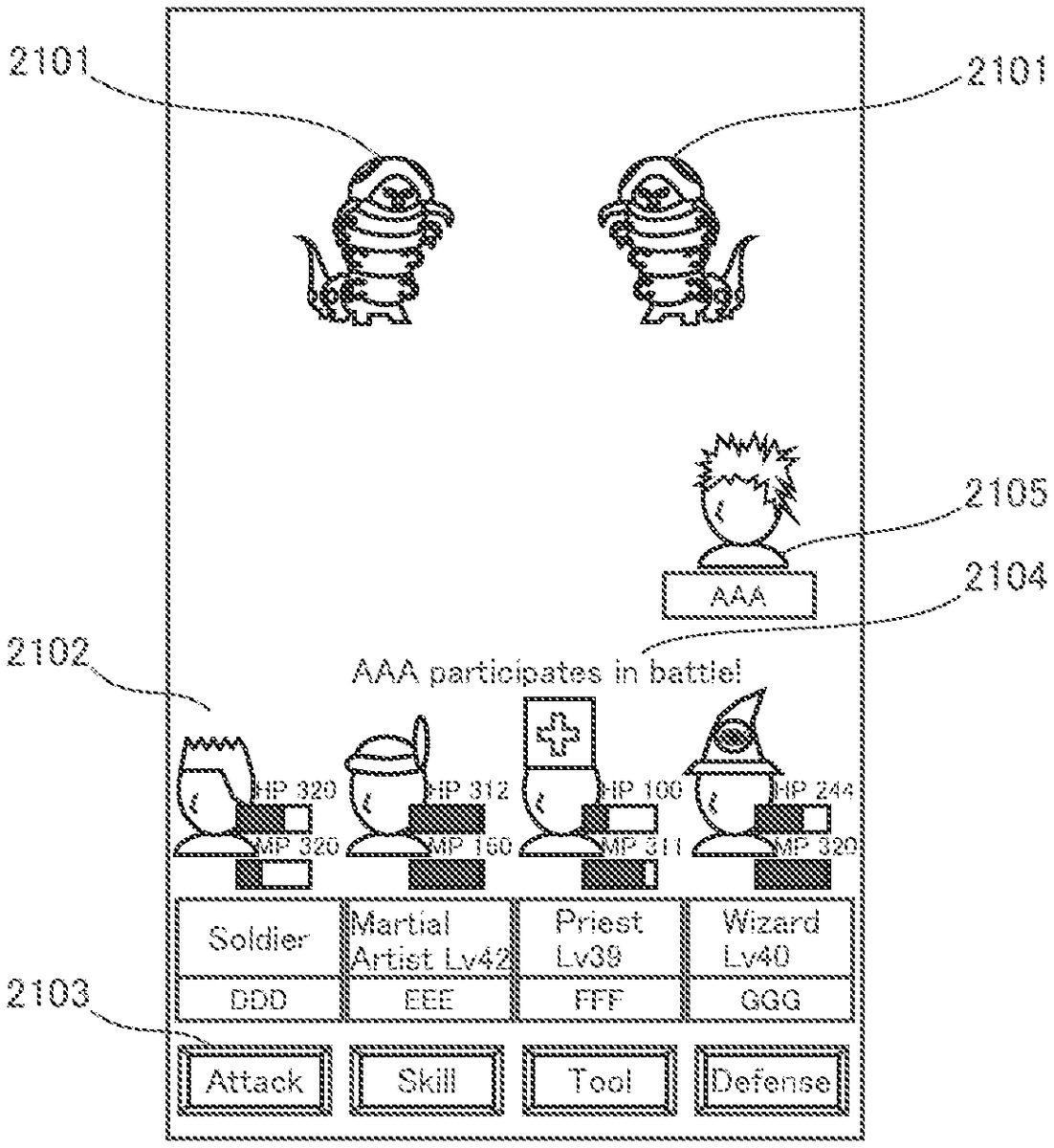
FIG.21is an explanatory drawing for explaining still another example of the game screen. As illustrated inFIG.21, enemy characters2101, own character information2102, a command selecting area2103, participation notification information2104, and other character participation information2105are illustrated in the game screen.
Each of the enemy characters2101is an image of an enemy character (for example, a monster) that becomes a defeat target in a generated battle event. In the present embodiment, each of the enemy characters2101is the same as the enemy character2003illustrated inFIG.20.
The own character information2102is information regarding a user character of a user himself or herself for whom the battle event is generated. In the present embodiment, the own character information2102contains an appearance image, a name, a job, a parameter, and the like of the character of the user for whom the battle event is generated.
The command selecting area2103is an area for inputting an operation for causing the character to act in the battle event.
The participation notification information2104is information for notifying the user that a character of another user different from the user for whom the battle event is generated participates in the battle event. In the present embodiment, the user is notified by text that the character “AAA” participates in the battle event.
The other character participation information2105is information regarding the character that is selected in the game screen illustrated inFIG.19and further participated in the battle event. In the present embodiment, the appearance image and the name of the character “AAA” are displayed. In this regard, in a case where the character “AAA” acts in the battle event, the whole appearance of the character “AAA” is displayed on the screen.
In this regard, the server10Z may be configured so that a reward is given to the character that carries out a battle as a helper or the user of the character on the basis of an operation of the user during the battle event illustrated inFIG.21or after the battle event. Here, the content of the reward is not limited particularly. However, it is preferable that the user who receives the reward can recognize that by registering the character, gratitude or favor is indicated from the other user. As an example of such a configuration, there is an increase of a point that each user can possess or a parameter indicating a degree of intimacy between two users. Further, the server10Z may be configured so that the reward is given to the character or the user of the character in accordance with participation of the character in the battle event (regardless of the operation of the user).
As explained above, as one aspect of the seventh embodiment, the server10Z that controls progress of video game using the virtual space corresponding to the map information of the real space and the positional information of the user terminal20is configured so as to include the registering unit11Z, the generating unit12Z, the participating unit13Z, the updating unit14Z, and the determining unit15Z. Thus, the registering unit11Z registers the objects of the users; the generating unit12Z generates the predetermined event on the basis of the positional information of the terminal20of the user; the participating unit13Z causes the object of another user different from the user, for whom the event is generated, among the registered objects to participate in the event. Therefore, it becomes possible to maintain interest of the user in the video game.
Further, in the example of the seventh embodiment described above, the server10Z is configured so that: the registering unit11Z registers the registration related information in the predetermined storage region, the user being associated with the objects of the users different from the user in the registration related information; the participating unit13Z causes at least the part of the objects associated with the user to participate in the event; and the updating unit14Z updates the registration related information so that participation of each of the objects, which have already participated in the event by the participating function, in the new event generated after the event is restricted. Therefore, it is possible to interact with more users through the object compared with a case where participation of an object in an event is not restricted, and this makes it possible to further maintain interest of the user in the video game.
Further, in the example of the seventh embodiment described above, the server10Z is configured so that: the determining unit15Z determines whether the object of the user different from the user, for whom the event is generated, is caused to participate in the event or not on the basis of information regarding the generated event; and the participating unit13Z causes the object to participate in the event in a case where the determining unit15Z determines that the object is caused to participate in the event. Therefore, it becomes possible to provide an opportunity for interaction among users through an object, and to set an appropriate game balance at the same time.
Further, in the example of the seventh embodiment described above, the server10Z may be configured so that: a displaying unit selectably displays, for the user, the object of another user different from the user; and the participating unit13E causes the object selected by the user to participate in the generated event. Therefore, it becomes possible to interact with more other users desired by the user through the object, and this makes it possible to further maintain interest of the user in the video game.
Further, it has not been mentioned particularly in the example of the seventh embodiment described above. However, the server10Z as the updating unit14Z may be configured so as to update the registration related information so that participation of an object in the new event generated after the event is restricted on the basis of a relationship between the user of the object that has participated in the event by the participating unit13Z and the user for whom the event is generated. Here, the relationship with the user means a type of connection to the user. The relationship with the user is not limited particularly. However, it is preferable that the relationship with the user is one related to progress of the video game. As examples of the relationship with the user, there are a relationship that a user is a friend with the user, and a relationship that a parameter (or a rank) indicating progress of the video game is within the predetermined same range as that of the user. In the example described above, the server10Z may be configured so that in a case where the user of the character is a friend, a period of time during which participation in a battle event is permitted is longer compared with a case where the user is not a friend. By configuring the server10Z in this manner, it becomes possible to encourage interaction through the objects with users who are more likely to heighten the sense of unity compared with the other users.
Further, it has not been mentioned particularly in the example of the seventh embodiment described above. However, the server10Z may be configured so as to: update the registration related information so that each of the objects that have already participated in the event by the participating unit13Z becomes a participation impossible state where the corresponding object cannot participate in the new event generated after the event; and cause, in a case where the plurality of objects other than the objects that become the participation impossible state is associated with still another user, for whom an event is newly generated, an object of a user who satisfies a specific condition for the third user of the plurality of objects to participate in the event in a preferential manner. Here, the content of the specific condition is not limited particularly. However, it is preferable that the specific condition is an object of a user who has a predetermined relationship with the user for whom the event is generated. As an example of the specific condition, there is a condition that the object is an object of a user who is a friend with the user for whom the event is generated. Further, the phrase “cause an object to participate in the event in a preferential manner” means that the object is cause to participate in more events compared with the other objects. In the example described above, the server10Z may be configured so that after a predetermined time elapses since the user selects one character as a helper, a character of a user who has a friend relationship with the user is newly causes to participate in a battle event as a helper. By configuring the server10Z in this manner, it becomes possible to increase an opportunity for interaction with a predetermined user through an object.
Further, it has not been mentioned particularly in the example of the seventh embodiment described above. However, the server10Z may be configured so as to cause an object of a user, who satisfies a predetermined condition regarding a position of the user for whom the event is generated or a position designated by the user, to participate in the event. Namely, the server10Z may be configured so that an object of a user who plays the video game in the vicinity of a current location of the user (for example, a user who uses the same spot or destination used most recently without leaving the current location on the server) is caused to participate in the generated event. Here, the position of the user means a position of the user in the real space or the virtual space. The position of the user is not limited particularly. However, it is preferable that the position of the user is a position in the virtual space corresponding to the positional information of the terminal20of the user. As an example of the position of the user, there is a position in the virtual space corresponding to a predetermined point (or a spot) in the real space. Further, the position designated by the user means a position in the real space or the virtual space that is specified by the user. A configuration to specify the position designated by the user is not limited particularly. However, it is preferable that the position in the virtual space is specified on the basis of an operation received from the user. As examples of such a configuration, there are a position of a base (home) set in the virtual space by the user, and any position in a predetermined area in which a position of the base is included. By configuring the server10Z in this manner, it becomes possible to further enhance the sense of unity among the users that the video game is progressing in the same virtual space.
Further, it has not been mentioned particularly in the example of the seventh embodiment described above. However, the server10Z may be configured so as to control the object that is caused to participate in the event by the participating unit13Z without depending upon an operation of the user for whom the event is generated. Here, the operation of the user means an operation from the user against the object caused to participate in the event by the participating unit13Z or an operation from the user against the event. Further, the phrase “control the object without depending upon an operation of the user” means that the object is controlled without the operation of the user as a condition. In the example described above, the server10Z may be configured so that the character that participates in the battle event by the participating unit13Z automatically fights against an enemy character. By configuring the server10Z in this manner, it becomes possible to provide an opportunity for interaction with the other user more flexibly without the need to adjust the time among users. In this regard, the object that is caused to participate in the event by the participating unit13Z may be controlled by an operation of the user.
Further, it has not been mentioned particularly in the example of the seventh embodiment described above. However, the server10Z may be configured so as to restrict, in the generated event, an effect generated by the object that is caused to participate in the event. Here, the phrase “restrict an effect generated by the object” means that a permissible range is provided for a degree of influence of the object on the event in which the object participates. In the example described above, the server10Z may be configured so that the character that participate in the battle event by the participating unit13Z does not fight against the enemy character after a predetermined turn or a predetermined time elapses. By configuring the server10Z in this manner, it becomes possible to maintain a game balance even in a case where an object of a user whose progress of the video game is different from that of the user participates in the event generated for the user.
As explained above, one shortage or two or more shortages can be solved by each of the embodiments according to the present application. In this regard, the effects by each of the embodiments are non-limiting effects or one example of the non-limiting effects.
In this regard, in each of the embodiments described above, each of the plurality of user terminals20, and201to20nand the server10executes the various kinds of processing described above in accordance with various kinds of control programs (for example, a video game processing program) stored in the storage device with which the corresponding terminal or server is provided.
Further, the configuration of the system100is not limited to the configuration that has been explained as an example of each of the embodiments described above. For example, the system100may be configured so that the server10executes a part or all of the processes that have been explained as the processes executed by the user terminal20. Alternatively, the system100may be configured so that any of the plurality of user terminals20, and201to20n(for example, the user terminal20) executes a part or all of the processes that have been explained as the processes executed by the server10. Further, the system100may be configured so that a part or all of the storage unit included in the server10is included in any of the plurality of user terminals20, and201to20n. Namely, the system100may be configured so that a part or all of the functions of any one of the user terminal20and the server10according to the system100is included in the other.
Further, the system100may be configured so that the program causes a single apparatus to perform a part or all of the functions that have been explained as the example of each of the embodiments described above without including a communication network.
Appendix
The explanation of the embodiments described above has been described so that the following embodiments can be at least performed by a person having a normal skill in the art to which the present disclosure belongs.
(1)
A non-transitory computer-readable medium including a video game processing program for causing a server to perform functions to control progress of a video game using a virtual space corresponding to map information of a real space and positional information of a user terminal of a user, the functions comprising:a registering function configured to register objects of a plurality of users;a generating function configured to generate a predetermined event on a basis of positional information of a user terminal of a first user; anda participating function configured to cause an object of a second user different from the first user, for whom the event is generated, among the objects registered by the registering function to participate in the event.
(2)
The non-transitory computer-readable medium according to (1),wherein the registering function includes a function configured to register registration related information in a predetermined storage region, the first user being associated with the objects of the users different from the first user in the registration related information,wherein the participating function includes a function configured to cause at least a part of the objects associated with the first user to participate in the event, andwherein the functions further include an updating function configured to update the registration related information so that participation of each of the objects, which have already participated in the event by the participating function, in a new event generated after the event is restricted.
(2-1)
The non-transitory computer-readable medium according to (2),wherein the updating function includes a function configured to update the registration related information so that participation of an object in the new event generated after the event is restricted on a basis of a relationship between a user of the object that has participated in the event by the participating function and the first user for whom the event is generated.
(2-2)
The non-transitory computer-readable medium according to (2) or (2-1),wherein the updating function includes a function configured to update the registration related information so that each of the objects that have already participated in the event by the participating function becomes a participation impossible state where the corresponding object cannot participate in the new event generated after the event, andwherein the participating function includes a function configured to cause, in a case where the plurality of objects other than the objects that become the participation impossible state is associated with the first user for whom an event is newly generated, an object of a user who satisfies a specific condition for the third user of the plurality of objects to participate in the event in a preferential manner.
(3)
The non-transitory computer-readable medium according to (1) or (2),wherein the participating function includes a function configured to cause an object, which is registered by the registering function and satisfies a predetermined condition in accordance with progress of the video game by the first user, to participate in the event generated for the first user.
(4)
The non-transitory computer-readable medium according to any one of (1) to (3), the functions further comprising:a determining function configured to determine whether the object of the second user different from the first user, for whom the event is generated, is caused to participate in the event or not on a basis of information regarding the generated event,wherein the participating function includes a function configured to cause the object to participate in the event in a case where the determining function determines that the object is caused to participate in the event.
(5)
The non-transitory computer-readable medium according to any one of (1) to (4), the functions further comprising:a displaying function configured to selectably display the objects of the users different from the first user to the first user, andwherein the participating function includes a function configured to cause an object selected by the first user to participate in the generated event.
(6)
The non-transitory computer-readable medium according to any one of (1) to (5), the functions further comprising:a giving function configured to give, on a basis of at least an operation by the first user for whom the event is generated, a reward to the object that is caused to participate in the event by the participating function or the user of the object.
(7)
The non-transitory computer-readable medium according to any one of (1) to (6),wherein the participating function includes a function configured to cause an object of a user, who satisfies a predetermined condition regarding a position of the first user for whom the event is generated or a position designated by the first user, to participate in the event.
(8)
The non-transitory computer-readable medium according to any one of (1) to (7), the functions further comprising:a controlling function configured to control the object that is caused to participate in the event by the participating function without depending upon an operation of the first user for whom the event is generated.
(9)
The non-transitory computer-readable medium according to any one of (1) to (8),wherein the participating function includes a function configured to restrict, in the generated event, an effect generated by the object that is caused to participate in the event.
(10)
A non-transitory computer-readable medium including a video game processing program for causing a user terminal to perform at least one function of the functions that the video game processing program described in any one of (1) to (9) causes the server to perform, the user terminal being capable of communicating with the server.
(11)
A video game processing system for controlling progress of a video game using a virtual space corresponding to map information of a real space and positional information of a user terminal of a user, the video game processing system comprising a communication network, a server, and the user terminal, the video game processing system further comprising:a registerer configured to register objects of a plurality of users;a generator configured to generate a predetermined event on a basis of positional information of a user terminal of a first user; anda participator configured to cause an object of a second user different from the first user, for whom the event is generated, among the objects registered by the registerer to participate in the event.
(12)
The video game processing system according to (11),wherein the server includes the registerer, the generator, and the participator, andwherein the user terminal includes an output controller configured to output a game screen to a display screen of a display device, the game screen indicating a state of the predetermined object.
(13)
A non-transitory computer-readable medium including a video game processing program for causing a user terminal to perform functions to control progress of a video game using a virtual space corresponding to map information of a real space and positional information of the user terminal of a user, the functions comprising:a registering function configured to register objects of a plurality of users;a generating function configured to generate a predetermined event on a basis of positional information of a user terminal of a first user, anda participating function configured to cause an object of a second user different from the first user, for whom the event is generated, among the objects registered by the registering function to participate in the event.
(14)
A video game processing method of controlling progress of a video game using a virtual space corresponding to map information of a real space and positional information of a user terminal of a user, the video game processing method comprising:a registering process configured to register objects of a plurality of users;a generating process configured to generate a predetermined event on a basis of positional information of a user terminal of a first user; anda participating process configured to cause an object of a second user different from the first user, for whom the event is generated, among the objects registered in the registering process to participate in the event.
(15)
A video game processing method of controlling progress of a video game by a video game processing system using a virtual space corresponding to map information of a real space and positional information of a user terminal of a user, the video game processing system comprising a communication network, a server, and the user terminal, the video game processing method comprising:a registering process configured to register objects of a plurality of users;a generating process configured to generate a predetermined event on a basis of positional information of a user terminal of a first user; anda participating process configured to cause an object of a second user different from the first user, for whom the event is generated, among the objects registered in the registering process to participate in the event.
INDUSTRIAL APPLICABILITY
According to one of the embodiments of the present disclosure, it is useful to allow interest of a user in a video game to be maintained.
Claims
- A non-transitory computer-readable medium storing a video game processing program for causing a computer of a server to perform functions to control progress of a video game, the functions comprising: using a virtual space corresponding to map information of a real space;registering a plurality of objects of a plurality of users;generating a predetermined first event on a basis of positional information of a first user terminal of a first user of the plurality of users;and causing an object of a second user of the plurality of users among the plurality of objects to participate in the first event, wherein the second user is different from the first user, wherein the functions further comprise: registering registration related information in a predetermined storage region, wherein the first user is associated with one or more objects of one or more users different from the first user in the registration related information;causing at least one of the one or more objects associated with the first user to participate in the first event;and updating the registration related information to restrict the at least one of the one or more objects from participating in a second event generated after the first event, wherein the functions further comprise: updating the registration related information to change each object of the objects that have already been caused to participate in the first event into a participation impossible state where the each object is restricted from participating in the second event;and causing an object of a user, who satisfies a specific condition related to a third user of the plurality of objects, to participate in a third event newly generated for the third user with a priority, when the plurality of objects other than the objects in the participation impossible state are associated with the third user.
- The non-transitory computer-readable medium according to claim 1, the functions further comprising: updating the registration related information to restrict an object from participating in the second event on a basis of a relationship between the first user and a user of the object caused to participate in the first event.
- The non-transitory computer-readable medium according to claim 1, the functions further comprising: causing an object among the plurality of registered objects that satisfies a predetermined condition in accordance with progress of the video game by the first user to participate in the first event.
- The non-transitory computer-readable medium according to claim 1, the functions further comprising: determining whether the object of the second user is to be caused to participate in the first event on a basis of information regarding the generated first event;and causing the object of the second user to participate in the first event when the object of the second user is determined to be caused to participate in the first event.
- The non-transitory computer-readable medium according to claim 1, the functions further comprising: selectably displaying the objects of the plurality of users different from the first user to the first user;and causing an object selected by the first user to participate in the generated first event.
- The non-transitory computer-readable medium according to claim 1, the functions further comprising: giving, a reward to the object that is caused to participate in the first event or the user of the object on a basis of at least an operation by the first user.
- The non-transitory computer-readable medium according to claim 1, the functions further comprising: causing an object of a user to participate in the first event, when the user satisfies a predetermined condition regarding either a position of the first user or a position designated by the first user.
- The non-transitory computer-readable medium according to claim 1, the functions further comprising: controlling the object that is caused to participate in the first event without depending upon an operation of the first user.
- The non-transitory computer-readable medium according to claim 1, the functions further comprising: restricting an effect in the first event generated by the object that is caused to participate in the first event.
- A video game processing system comprising: a communication network;a user terminal;and a server configured to control progress of a video game using a virtual space corresponding to map information of a real space and positional information of the user terminal, wherein the system is configured to: register a plurality of objects of a plurality of users;generate a predetermined first event on a basis of positional information of a user terminal of a first user of the plurality of users;and cause an object of a second user of the plurality of users among the plurality of registered objects to participate in the first event, wherein the second user is different from the first user, wherein the system is further configured to: register registration related information in a predetermined storage region, wherein the first user is associated with one or more objects of one or more users different from the first user in the registration related information;cause at least one of the one or more objects associated with the first user to participate in the first event;and update the registration related information to restrict the at least one of the one or more objects from participating in a second event generated after the first event, wherein the system is further configured to: update the registration related information to change each object of the objects that have already been caused to participate in the first event into a participation impossible state where the each object is restricted from participating in the second event;and cause an object of a user, who satisfies a specific condition related to a third user of the plurality of objects, to participate in a third event newly generated for the third user with a priority, when the plurality of objects other than the objects in the participation impossible state are associated with the third user.
- A non-transitory computer-readable medium including a video game processing program for causing a computer of a user terminal to perform functions to control progress of a video game, the functions comprising: using a virtual space corresponding to map information of a real space and positional information of the user terminal of a user;registering a plurality of objects of a plurality of users;generating a predetermined first event on a basis of positional information of a user terminal of a first user of the plurality of users;and causing an object of a second user of the plurality of users among the plurality of objects registered to participate in the first event, wherein the second user is different from the first user, wherein the functions further comprise: registering registration related information in a predetermined storage region, wherein the first user is associated with one or more objects of one or more users different from the first user in the registration related information;causing at least one of the one or more objects associated with the first user to participate in the first event;and updating the registration related information to restrict the at least one of the one or more objects from participating in a second event generated after the first event, wherein the functions further comprise: updating the registration related information to change each object of the objects that have already been caused to participate in the first event into a participation impossible state where the each object is restricted from participating in the second event;and causing an object of a user, who satisfies a specific condition related to a third user of the plurality of objects, to participate in a third event newly generated for the third user with a priority, when the plurality of objects other than the objects in the participation impossible state are associated with the third user.
Disclaimer: Data collected from the USPTO and may be malformed, incomplete, and/or otherwise inaccurate.