U.S. Pat. No. 12,023,594
INCENTIVIZING FAIR GAMEPLAY THROUGH BOT DETECTION PENALIZATION WITHIN ONLINE GAMING SYSTEMS
AssigneeElectronic Arts Inc.
Issue DateFebruary 18, 2022
Illustrative Figure
Abstract
A bot detection system and method analyzes application programming interface (API) data associated with an online gaming player account to make a determination of whether the player account is engaging in cheating by using a bot during online game play. The API data may be analyzed to generate API metadata that is descriptive of the API data, such as an indication of how many API calls were made to a particular API during a particular time period on behalf of the player account. The API data may be applied to one or more bot detection models to make an assessment of whether the player account is using a bot. If bot usage is detected with a player account, enforcement actions, such as slowing down game play or banning the player account, may be implemented for that player account.
Description
DETAILED DESCRIPTION Example embodiments of this disclosure describes methods, apparatuses, computer-readable media, and system(s) for detecting online game players who are cheating in online games, such as by using bots. The bots may engage with one or more application programming interfaces (APIs) of the online gaming system(s). According to example embodiments of the disclosure, API interactions by a game player's game device may be used to determine whether that game player is using a bot. When a player is found to be cheating by using bots, that player's account may be disadvantaged (e.g., slowed down, functions dropped, access paused, etc.) and/or banned altogether. Under normal game playing interactions without the player cheating using a bot, game playing parameters, representing updates in the online game and moves or actions that the player wishes to make, may be sent back and forth between the player's client device and the online gaming system that hosts the online game. These parameters may be passed back and forth between the client devices and the online gaming system in the form of data packets via APIs of the game being played. These APIs allow for the standardization of the parameters, such as by providing a format and/or set of rules by which a player's client device and the online gaming system communicate with each other to allow the player to play the game. Based at least in part on parameters received by the client device via APIs of the online game rendered from the online gaming system, the content of the game may be rendered at the client device of a player. Similarly, the client device may receive player input, such as via a joystick, touchscreen, mouse, and/or any suitable user interface device. The client device may use the user input to generate parameters representative of ...
DETAILED DESCRIPTION
Example embodiments of this disclosure describes methods, apparatuses, computer-readable media, and system(s) for detecting online game players who are cheating in online games, such as by using bots. The bots may engage with one or more application programming interfaces (APIs) of the online gaming system(s). According to example embodiments of the disclosure, API interactions by a game player's game device may be used to determine whether that game player is using a bot. When a player is found to be cheating by using bots, that player's account may be disadvantaged (e.g., slowed down, functions dropped, access paused, etc.) and/or banned altogether.
Under normal game playing interactions without the player cheating using a bot, game playing parameters, representing updates in the online game and moves or actions that the player wishes to make, may be sent back and forth between the player's client device and the online gaming system that hosts the online game. These parameters may be passed back and forth between the client devices and the online gaming system in the form of data packets via APIs of the game being played. These APIs allow for the standardization of the parameters, such as by providing a format and/or set of rules by which a player's client device and the online gaming system communicate with each other to allow the player to play the game.
Based at least in part on parameters received by the client device via APIs of the online game rendered from the online gaming system, the content of the game may be rendered at the client device of a player. Similarly, the client device may receive player input, such as via a joystick, touchscreen, mouse, and/or any suitable user interface device. The client device may use the user input to generate parameters representative of the user input which may then be communicated to the online gaming system via the APIs. This communication of parameters from the client device to the online gaming system via the APIs may be referred to as API calls. A particular online game may include more than one API to which API calls may be made by a client device player with a corresponding player account. The player account may be used for identifying the user and/or for various other purposes, such as providing access to online gameplay.
A player may cheat on an online game by using a bot that makes API calls on behalf of the player. In other words, the bot may interface with the online game via the APIs of the online game and play the game or portions of the game instead of the player. The bot may be able to play the game better than the player, thereby providing the player with an unfair advantage by using the bot. The use of a bot by a player, therefore, is cheating by the player and can reduce the enjoyment of the game for other players playing the online game. As such, addressing bot use is paramount in providing a fair gameplay environment for all players of an online game.
Bots, to evade detection, may be designed to reduce the magnitude of their super-human game play abilities. For example, delays may be programmed into a bot so that it doesn't appear that reaction times are at levels that are not possible by humans. Thus, bots with this level of sophistication of evasion detection may be difficult to detect by conventional means.
According to example embodiments of the disclosure, the bots may be detected by using API data associated with a player profile. API data associated with a particular player profile may be collected over a predefined time period. The analysis for bot detection may be performed by a bot detection system. The bot detection system may receive API data for one or more APIs of an online game. The bot detection system may organize this data in a datastore. For example, the API data, such as API calls, may be organized by player profile and may include a timestamp. As API data becomes available over a predefined time period for a player profile, the bot detection system may generate API metadata descriptive of the API data for one or more time periods. This API metadata, or data descriptive of the API data over the predefined time period(s), may be applied to one or more bot detection models to determine if a bot is being used for game play for the particular player profile. If it is determined that a bot is being used for game play with the particular player profile, enforcement actions may be implemented, such as banning the player account, slowing down the player profile's game play, and/or other suitable enforcement actions. In some example embodiments, documentation may be generated to document the cheating incident associated with the particular player account.
The API metadata may include any variety of data about the API data over a time period. According to example embodiments, the API metadata for a particular player profile, a particular time period, and a particular API of a particular online game may include a total count of API calls, a mean number of API calls over nonoverlapping segments of the particular time period, and a standard deviation of API calls over the nonoverlapping segments of the particular time period made by the particular player profile over the particular time period to the particular API.
As an example, the time period may be an hour, and the API metadata for over the one hour time period may include a total number of API calls, or API call count, to an API of an online game by the player profile. Additionally, a mean number of API calls over 60 1-minute segments of the hour may be determined. Further still, a standard deviation of API calls over the 60 1-minute segments of the hour may be determined. Thus, the API metadata for the player profile may include the total count, mean, and standard deviation of the number of API calls for the API for the player profile.
In some example embodiments, API metadata may be generated for more than one API for a particular game. For example, for a particular game, API metadata may be generated for API data from five different APIs. In some example embodiments, API metadata may be generated for more than one time period for a particular game. For example, for a particular game, API metadata may be generated for API data for three different time periods, such as one hour, one day, and one week. Although, total count, mean, and standard deviation API metadata have been discussed herein, it should be understood that the API metadata may include any variety of data descriptive of the underlying API data, including any suitable statistical data descriptive of the API data. After the API metadata is generated for a player profile, the API metadata may be provided to one or more bot detection models to determine if the API data and/or the API metadata derived therefrom indicate the use of a bot associated with the player profile.
As a non-limiting example, API data may be received by the bot detection system for four different APIs of a game for a player. The bot detection system may generate API metadata for a one week time period with one day time segments and also for a one month time period with 3-day time segments. The API metadata may include the total API call count, average API call counts across the time segments, and standard deviation of the API call counts across the time segments. As a result, in this example, 24 different pieces of metadata may be generated for the player for analysis using the bot detection models to determine if the player is cheating by using a bot.
When a bot is detected, the bot detection system may determine an enforcement action to take against the player. The bot detection system may generate an enforcement parameter corresponding to the enforcement action to be taken against the player based on the player's bot use. For example, a player who engages in minimal bot use to automate in-game trading or a particular item would be imposed an enforcement action less severe than a player who habitually uses a bot to assist or automate gameplay in an online multiplayer game session. The bot detection system may send the enforcement parameter to the online gaming system to implement the corresponding enforcement action against the player by identifying his or her player account.
In some cases, the enforcement action may include slowing down game play (e.g., adding latency), banning the player account from further game play, or any other suitable enforcement action. The enforcement action(s) imposed on a player account caught cheating may be commensurate with the egregiousness of the cheating actions. Such enforcement actions, promote fairness of game play and make online gaming more enjoyable for players, particularly those who do not cheat.
The bot detection models may be any suitable model, such as any variety of machine learning and/or artificial intelligence models. For example, the bot detection models may include decision tree models, gaussian tree models, Bernoulli models, random forest models, combinations thereof, or the like. Other models used as bot detection models may include, for example, linear regression models, neural network models, Bayesian network models, any variety of heuristics (e.g., genetic algorithms, swarm algorithms, etc.), combinations thereof, or the like. These bot detection models may be trained using training data that may include known determinations of whether the training data is from a bot. Outputs from the bot detection models may be combined to make a determination of whether the API metadata indicates that the corresponding player profile is engaging in cheating by using a bot. The combination of the outputs may be a weighted combination of the bot detection models.
The bot detection models may be trained using training data. In example embodiments, the training data may be acquired by the online gaming system and the bot detection system during game play. When interactions known to either not use a bot or use a bot are detected, those interactions may be used to train the bot detection models. API data associated with a known use of a bot may be generated by creating player accounts and deploying a bot for the purposes of collecting training data.
Training data may also be collected from online gaming by various players where bot use may be detected by various mechanisms, such as a tripwire mechanism. The use of a tripwire may involve changing APIs to include decoy parameters and determining if a particular player profile attempts to access a decoy parameter of an API. If a player profile attempts to access an API parameter that is not supposed to be accessed or does not populate an API parameter when it is to be specified, then that player profile may be determined to be using a bot. For example, a decoy parameter that is not to be accessed may be added to a particular API and any player accounts that access that decoy parameter may be identified as using a bot. Similarly, changes may be implemented so that a new parameter in a particular API is to be accessed and any player account that does not access that parameter may be identified as using a bot. In this way, API data may be collected and classified as either using a bot or not using a bot to generate training data for training the bot detection models.
Although examples in the realm of video games and online gaming are discussed herein, it should be understood that the bot detection mechanisms, as described herein, may be applied to any variety of online interactions. Indeed, without providing an exhaustive list of applications, the bot detection models, as generated and deployed, may be applied to any suitable type of online commerce, online competitions, online gambling, online sales, social media interactions, etc.
It should be understood that the systems and methods, as discussed herein, are technological improvements in the field of online interactions and online gaming. For example, the methods and systems as disclosed herein enables computing resources to improve online gaming for players by preventing cheating by some players. These improvements manifest in accuracy, precision, automation, efficiencies, thoroughness, speed, objectivity, and repeatability over traditional mechanisms of detecting bots in online interactions. Indeed, the disclosure herein provides improvements in the functioning of computers to provide improvements in the technical field of online gaming and the prevention of cheating. Machine learning and artificial intelligence (AI)-based processes are disclosed that can provide assessment of all, or nearly all players playing an online game to prevent cheating, even when players may be using sophisticated bots that attempt to mimic human behavior. This type of extensive evaluation of players to detect what are sometimes sophisticated detection-evading bots may not be possible with traditional mechanisms of bot detection. Traditional methods may not be able to make use of the API data that is being generated by bot usage to detect cheating by bot use. Additionally, the mechanisms as discussed herein cannot be performed by the human mind. Furthermore, the mechanisms and systems discussed herein, provide objective and repeatable evaluations of player accounts, such that possible cheating by bot usage can be effectively documented. Additionally, the technological problems addressed here are ones that arise in the computer-era and the Internet-era, such as in the fields of online gaming. Thus, not only is the disclosure directed to improvements in computing technology, but also to a variety of other technical fields related to online gaming.
Certain implementations and embodiments of the disclosure will now be described more fully below with reference to the accompanying figures, in which various aspects are shown. However, the various aspects may be implemented in many different forms and should not be construed as limited to the implementations set forth herein. It will be appreciated that the disclosure encompasses variations of the embodiments, as described herein. Like numbers refer to like elements throughout.
FIG.1illustrates a schematic diagram of an example environment100with online gaming system(s)110to enable online gaming via client device(s)104and bot detections system(s)140that enable bot detection during online game play, in accordance with example embodiments of the disclosure. The example environment100may include one or more player(s)102(1),102(2), . . .102(N), hereinafter referred to individually or collectively as player102or player(s)102, who may interact with respective client device(s)104(1),104(2), . . .104(N), hereinafter referred to individually or collectively as client device104or client device(s)104.
The client devices104may be configured to render content associated with the online game to respective players102. This content may include video, audio, haptic, combinations thereof, or the like content components. The client device(s)104may receive game state information from the one or more online gaming system(s)110that may host the online game played by the player(s)102of environment100. The receiving of game state information and/or parameters may be via one or more application program interfaces (APIs)120of the online game being hosted by the online gaming systems110. The APIs120may include any suitable number of APIs122,124,126,128.
The client device(s)104may use the game state information to render current events of the online game as content. The game state information may be received by the client device(s)104repeatedly and/or continuously and/or as events of the online game transpire. The game state information may be based at least in part on the interactions that each of the player(s)102have via their client device(s)104responsive to events of the online game hosted by the game system(s)110.
As events transpire in the online game, the game system(s)110may update game state information and send that game state information to the client device(s)104. For example, if the players102are playing an online soccer game, and the player102playing one of the goalies move in a particular direction, then that movement and/or goalie location may be represented in the game state information that may be sent, via the APIs120, to each of the client device(s)104for rendering the event of the goalie moving in the particular direction. In this way, the content of the online game is repeatedly updated throughout game play. When the game client device(s)104receive the game state information from the game system(s)110, the game client device(s)104may render updated content associated with the online game to its respective player102. This updated content may embody events that may have transpired since the previous state of the game (e.g., the movement of the goalie). It should be appreciated that any other suitable mechanism and/or topology of communications may be used between the game system(s)110and the client device(s)104, according to example embodiments of the disclosure.
The client device(s)104may accept input from respective players102via respective input device(s) (e.g., joysticks, touchscreens, etc.). The input from the non-players102may be responsive to events in the online game. For example, in an online basketball game, if a player102sees an event in the rendered content, such as an opposing team's guard blocking the paint, the player102may use his/her input device to try to shoot a three-pointer. Intended action by the player102, as captured via his/her client device104may be sent to the game system(s)110as parameters via the APIs120by the client device making API calls. Thus, the API calls via the APIs120allow the client devices104to send parameters representing player102actions to the online gaming system110. The API calls by the client device made on behalf of a player (e.g., a player account of the player102) may be made to any available API122,124,126,128of the online game being hosted by the online gaming system110.
The client device(s)104may be any suitable device, including, but not limited to the Sony Playstation® line of systems, Nintendo® handheld line of systems, Microsoft Xbox® line of systems, any gaming device manufactured by Sony, Microsoft, Nintendo, an Intel-Architecture (IA)® based system, an Apple Macintosh® system, a netbook computer, a notebook computer, a desktop computer system, a set-top box system, a handheld system, a smartphone, a personal digital assistant, combinations thereof, or the like. In general, the game client device(s)104may execute programs thereon to interact with the game system(s)110and render game content based at least in part on game state information received from the game system(s)110. Additionally, the client device(s)104may send indications of player input (e.g., player intended actions) to the game system(s)110. Game state information and player input information and/or parameters may be shared between the game client device(s)104and the game system(s)110using the APIs120.
The game system(s)110may receive inputs (e.g., parameters representative of player inputs) from various players102via API calls to the APIs120and update the state of the online game based thereon. As the state of the online game is updated, the state information and/or updates may be sent to the various client device(s)104for rendering online game content to players102. In this way, the online gaming system(s)110host the online game.
The online gaming system110when hosting an online game among one or more players102with their player accounts on their respective client devices104may be configured to generate API data130. This API data may include API data132,134,136,138of the individual APIs122,124,126,128, respectively, of the online game being hosted by the online gaming system110. The API data130may include the parameters that are associated with API calls made by the client devices104. The API data130may also include timestamps and/or identifying information associated with the client device104and/or the player102with whom the API data130is associated.
If a bot is used by a particular player102on his or her client device104to cheat in playing an online game hosted by the online gaming system(s)110, then the bot may interface with the APIs120of the online game. The bot may react to the online game directly via the APIs. In this way, the bot may play the online game, rather than the player playing the online game. When the state of the game changes (e.g., an opponent makes a move, resources are made available, etc.), the bot may react to the state of the game rather than the human player102reacting to the state changes in the game. Since a bot may be able to react to state changes of an online game faster and/or more effectively than a human, the use of a bot may provide an unfair advantage for the player102who cheats by using the bot.
A bot may leave fingerprints when interacting with the APIs120that may be detected. For example, a bot may make moves at super-human speeds at which a human player102would not be able to react to changes in game state. Such actions may be detected on the online gaming system110side and identified as a bot. However, bots may be designed to avoid and/or reduce super-human gameplay to avoid detection. Thus, super-human game play detection may not be an effective mechanism for bot detection for bots that employ sophisticated designs to evade detection. Another way to detect bot use may use trip-wire techniques where changes may be presented in the APIs such that parameters may be used (e.g., elements of the API may be accessed) that would otherwise not be accessed by non-bot assisted game play. These types of detection mechanisms that use changes in API parameters and/or decoy API parameters may be referred to as tripwires. These types of bot detection mechanisms may not always be effective and may require changes to the APIs to use. Thus, tripwire-based bot detection may not be used frequently on online gaming systems110.
The API data130may be sent by the online gaming system(s)110and received by the bot detection system(s)140. The bot detection system(s)140may be configured to store and/or retrieve API data130in an API log datastore142. The bot detection system(s)140may manage and use the API data130to detect cheating associated with player accounts, such as by the use of bots.
The bot detection system(s)140may use API data130, as received from the online gaming systems110and/or retrieved from the API log datastore142, to generate API metadata150. The API metadata may be any suitable data that is descriptive of the API data130associated with a particular player account associated with a particular player102and/or client device104. For example, the API metadata150for a particular player account may include the number of API calls (e.g., API call count) made from the player account over a particular time period (e.g., a day, a week, a fortnight, etc.). Another example of API metadata150associated with a player account may include an average number of API calls made to a particular API of an online game by a particular player account over non-overlapping segments covering a particular time period. For example, a mean value of the number of API calls per day for a week time period may be determined. Other example API metadata150may include a standard deviation or any other descriptive statistic of the number of API calls made to a particular API of a game from a player account during segments of a particular time period.
In some cases, the API metadata150for a particular player account and/or a particular API120may be generated after a sufficient amount API data130has been collected to generate that API metadata150. For example, API metadata150describing API calls over a one week time period may only be generated after collecting API data130for a particular player102over a one week time period.
When the API metadata150is generated, one or more bot detection models152may be invoked, by the bot detection systems140, to make a determination of whether the API metadata150of a player account indicates that the player account is using a bot for online game play of a game hosted by the online gaming systems110. There may be any suitable number and/or type of bot detection models152. For example, bot detection models152may include a decision tree model, a gaussian tree model, a Bernoulli model, and a random forest model. Indeed, in other examples the bot detection models152may include any type and/or number of models and/or combinations of models. Other models that may be used as bot detection models may include, for example, linear regression models, neural network models, Bayesian network models, any variety of heuristics (e.g., genetic algorithms, swarm algorithms, etc.), combinations thereof, or the like. These bot detection models152may be trained using training data that may include known determinations of whether the training data is from a bot.
The bot detection systems140may use outputs from the bot detection models152to make a bot determination154indicating whether a particular player account is using a bot. The outputs from the bot detection models152may be combined to make the bot determination154of whether the API metadata indicates that the corresponding player profile is engaging in cheating by using a bot. The combination of the outputs may be a weighted combination of the bot detection models, such as a linear combination. Some of the bot detection models152may have binary outcomes (e.g., Bernoulli model outputs) and others may have a probabilistic outcome (e.g., gaussian tree model). The combination of the outputs of the bot detection models152, therefore, may be a combination of binary outputs and/or probabilistic outputs. This combination of the output of the bot detection models152may be indicative of whether a bot is being used by a particular player102in playing a particular online game hosted by the online gaming systems110. The bot detection systems140may provide the bot determination154associated with the player account.
The bot detection systems140may further be configured to determine one or more enforcement actions for those player accounts where bot usage has been detected. The bot detection systems140may generate enforcement parameters156that indicate the enforcement actions to be taken in response to bot-based cheating by a player102. For example, the bot detection systems140may provide an enforcement parameter156that indicates that a particular player account that has regularly used a bot for game play automating or assisting gameplay in an online game is to be banned from online game play. As another example, the bot detection systems140may provide an enforcement parameter156that indicates that a particular player account that has just begun to use a bot for game play is to be slowed down so that the corresponding player102is at a disadvantage against other players102playing the online game.
Yet other enforcement parameters156may include disallowing a particular player account from accessing one or more of the APIs122,124,126,128. In other words, some functionality may be curtailed for the cheating players. For, example in a sports game, functionality for being able to trade players on a team may be turned off or curtailed for a cheating player. The enforcement parameters, as generated by the bot detection systems140, may be sent to the online gaming systems110to enact the corresponding enforcement actions.
The bot detection systems140may further be configured to generate cheating documentation158. The cheating documentation158may include information, such as a player account identifier, a timestamp when the player's bot detection was identified, API data130or portions thereof of the player102, API metadata150or portions thereof of the player102, bot detection model outcomes, bot determination154, enforcement parameters156associated with the player account, and/or other notes associated with the player account. The cheating documentation158may be used, in some cases, to memorialize why a particular player account is impaired with enforcement actions. In some other cases, the cheating documentation158may be used to support any enforcement actions that are challenged by the corresponding player102. In some cases, the cheating documentation158may be stored in a database, such as in the API log datastore142.
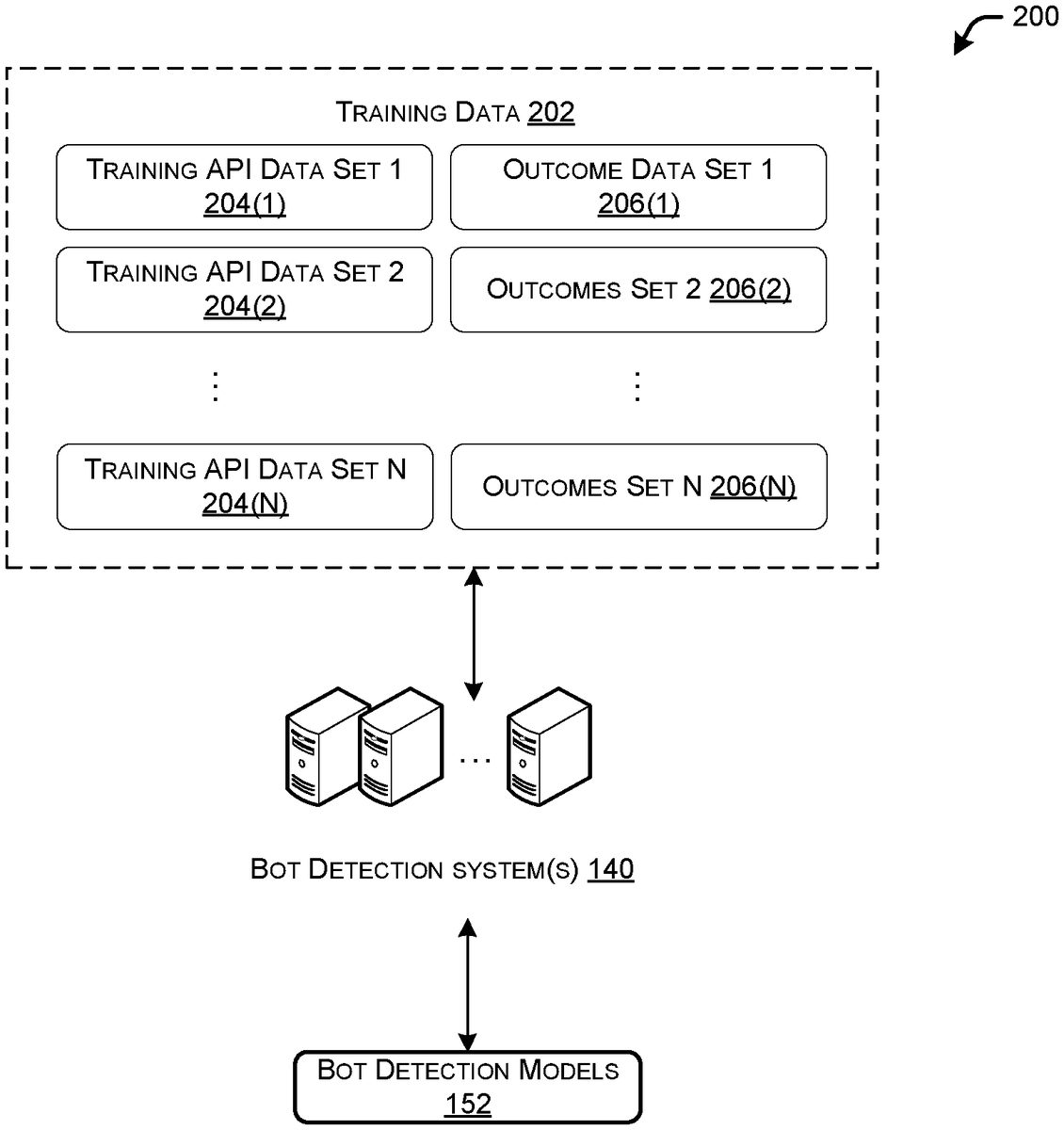
FIG.2illustrates an example environment200where the bot detection system140ofFIG.1uses training data202to generate bot detection models152, in accordance with example embodiments of the disclosure. The bot detection system(s)140, in some cases, may be configured to generate the bot detection models152used to generate the support assessment outputs160. In other cases, a different entity may generate the bot detection models152using the mechanisms described herein and those bot detection models152may be provided to and used by the bot detection systems140.
To generate bot detection models152, the various models may be trained using the training data202as received by and/or generated by the bot detection system(s)140. The training data202may include one or more training API data sets204(1),204(2), . . . ,204(N), hereinafter referred to, individually or in plurality, as training data set204or training data sets204. The training data202may further include outcome data sets206(1),206(2), . . . ,206(N), hereinafter referred to outcome set206or outcome sets206. Each of the API training data sets204may correspond to a respective outcome data set206. The outcome data set206may indicate whether the corresponding API training data set204was generated by a bot. Thus, the training data202provides a multiple API training data sets204along with an indication of whether those API training data sets206were a result of bot-based game play. The training data202may be associated with any suitable API and/or combination of APIs of an online game hosted by the online gaming system110.
The training data202may be gathered in any suitable manner, such as by deploying training data collection bots. These training data collection bots may be deployed within the bot detection system(s)140to monitor known cheating player accounts that utilize bots for the purposes of generating the training data202. Bot usage in accounts may be detected, for example, by tripwire-type mechanisms, where a particular player account using a bot is exposed by accessing an API parameter that it is not supposed to access and/or by not accessing an API parameter that it is supposed to access. Tripwires, in some cases, may be set by making changes to the APIs120, such as changes to the API data structures and/or data vectors. In other cases, tripwires may be set by pushing updates to software running on client devices104to change the API parameter structure when making API calls via the APIs120to the online gaming system110. As a result, bot-driven interactions may access portions of the API that are not to be accessed or not access portions of the API that are to be accessed.
The bot detection models152may be any suitable model, such as any variety of machine learning and/or artificial intelligence models. For example, bot detection models152may include a decision tree model, a gaussian tree model, a Bernoulli model, and a random forest model. In other examples, the bot detection models152may include any type and/or number of models and/or combinations of models. Other models that may be used as bot detection models may include, for example, linear regression models, neural network models, Bayesian network models, any variety of heuristics (e.g., genetic algorithms, swarm algorithms, etc.), combinations thereof, or the like.
These bot detection systems140may be configured to train the bot detection models152, as described herein. This training may be supervised, unsupervised, or partially supervised (e.g., semi-supervised). This training may include fitting the outcome data sets206of the training data202to API metadata derived from the training API data sets204of the training data202. In example embodiments, the bot detection systems140may wait to train the bot detection models152until a sufficient amount of the training data202is available. It should be appreciated that more accurate and robust bot detection models152may be generated by using a larger corpus of training data202.
Once the bot detection models152are generated using the training data202, the bot detection models may be tested. This testing, in some cases, may be performed on a portion of the training data202or other training data202that had not been used to train the bot detection models152. The performance of the individual bot detection models152in correctly determining the use of bots using API data with known outcomes may be used to weigh the combination of the bot detection models152, when deployed, in making a final determination of whether a player account is using a bot. In some cases, errors in bot detection models152may not be equally considered when determining how to combine the outputs of the individual bot detection models152. For example, the combination of the bot detection models152may be weighted in a manner to prevent false positives even if there is a greater likelihood of false negatives.
As a non-limiting example, there may be four bot detection models used for bot detection in a particular online game: a decision tree model, a gaussian tree model, a Bernoulli model, and a random forest model. These models may be generated by training using training data. The models may then be tested against additional API data to determine their performance. It may be found that the random forest model performs the best, followed by the decision tree model, then the Bernoulli model, and finally the gaussian tree model. In this case, the output of the random forest model may be weighted at 40%, the decision tree model at 30%, the Bernoulli model at 20%, and the gaussian tree model at 10%. This is an example weighting, and in some cases the weights selected for the bot detection models may be proportional to their relative performance in bot detection, false negatives, and/or false positives. Additionally, in cases where the bot detection systems140detect bots in different online games, the weights of various bot detection models in making a final determination of whether a bot is being used may be different from one online game to another.
FIG.3illustrates a flow diagram of an example method300by which bot usage may be detected and enforcement may be implemented, in accordance with example embodiments of the disclosure. The method300may be performed by the bot detection system(s)140, individually or in cooperation with one or more other elements of the environment100.
At block302, API data associated with a player account may be received. This API data130may be received from the online gaming system110and/or the API log datastore142. The API data130to perform method300, in some cases, may be available after a period of time. For example, if API data130over a month is needed for the player profile, then that API data130may be collected over a month before the subsequent processes of method300can be performed. The API data130may be received from the online gaming system110by any suitable communicative connection, such as the Internet, wide area network (WAN), local area network (LAN), combinations thereof, or the like.
At block304, API metadata associated with the player account may be generated. The API metadata150may be generated by processing the received API data130associated with the player account. As described herein, in some cases, the API metadata150may include a tally or count of the number of API calls made to a particular API of a game over a particular period of time. For example, a number of API calls made to a particular API over a one week period may be determined as an API count metadata for the particular API for the player account. Similar to the API call count metadata, the API metadata150may additionally include a mean number of API calls over constituent segments of the time period (e.g., one day segments of the one week time period). Other constituents of the API metadata150may include, for example a standard deviation of API calls over constituent segments of the time period. In this way, the API metadata150may include any suitable number of descriptive metadata of the underlying API data130for any suitable APIs120and any suitable time periods for the player account.
At block306, the API metadata may be applied to the bot detection models. Each of the bot detection models152may provide an indication of whether the API metadata150indicate whether the player account is using a bot. At block308, it may be determined if the player account is using a bot. This determination may be made based at least in part on the outputs of the bot detection models152. In the case of a plurality of bot detection models152, the outputs of the bot detection models152may be combined to make an overall determination of whether the player account is using a bot during online game play on the online gaming systems110.
At block308, if it is determined that a bot is not being used with the player account, then the method300may return to block302to continue monitoring the API data associated with the player account. In some cases, player accounts may be checked for bot use on a continuous basis. In other cases, the player accounts may be checked for cheating on a defined periodic basis. If at block308it is determined, based at least in part on the outputs of the bot detection models, that the player account is using a bot during online game play, then the method may proceed to block308, where an enforcement parameter may be determined for the player account. The enforcement parameter may be a code that is associated with an enforcement action, which may include, but is not limited to, slowing down (e.g., adding latency) the player account vis-à-vis other players, preventing the player account from accessing one or more functions of the online game, disallow certain moves or actions by the player account, or other online gameplay impairments of the like. This enforcement action may be determined and encoded as the enforcement parameter. In some cases, the enforcement action may be progressive if a player account is found to continue to cheat. For example, a first action when a player account is found to be cheating may be to slow down the account for a certain period of time. If the player account is caught cheating again, then the enforcement action may be escalated to prolonged slowed down times periods.
At block310, the enforcement parameter may be sent to the online gaming system. This enforcement parameter may be sent in association with an identity of the player account (e.g., player account login). Sending this enforcement parameter to the online gaming system110may cause the implementation of the enforcement action corresponding to the enforcement parameter by the online gaming system110on the player account.
At block312, the bot use associated with the player account may be documented. The cheating documentation158may include a variety of information, such as an identifier of a cheating player102(e.g., player account identifier/login, real world player name, real world player email address, etc.), a timestamp when cheating was detected, API data130or portions thereof of the player102, API metadata150or portions thereof of the player102, bot detection model outcomes, bot determination154, enforcement parameters156associated with the player account, and/or other notes associated with the player account. The cheating documentation158may be used, in some cases, to memorialize why a particular player account is impaired with enforcement actions. In some other cases, the cheating documentation158may be used to support any enforcement actions that are challenged by the corresponding player102. In some cases, the cheating documentation158may be stored in a database, such as in the API log datastore142.
It should be noted that some of the operations of method300may be performed out of the order presented, with additional elements, and/or without some elements. Some of the operations of method300may further take place substantially concurrently and, therefore, may conclude in an order different from the order of operations shown above.
FIG.4illustrates a flow diagram of an example method for providing application program interface (API) metadata associated with a user account for bot detection, in accordance with example embodiments of the disclosure. The method400may be performed by the bot detection system(s)140, individually or in cooperation with one or more other elements of the environment100. The method400may be an example process for the operations of block304of method300ofFIG.3.
At block402, API data associated with a player account may be received from an online gaming system. In this case, the API data130may be game play data that is received via API calls by the client device104. The API data130, as received may be used to generate metadata, such as the number of API calls made via a particular API120, the average number API calls made over segments of a time period, and/or the standard deviation of API calls made over the segments of the time period. In some cases, the API data130may be temporarily stored in the API log datastore142and retrieved when need by the bot detection system140to perform the processes of method400.
At block404, for a particular API, a particular time period may be identified over which API metadata is to be determined. In some cases, API metadata150may be determined over multiple different time periods and one of those time periods may be selected. For example, if API metadata150is to be determined over a day, a week and a month, the time period of a day may be selected first to generate API metadata150according to the processes of method400. Similarly, there may be multiple APIs120for which API metadata150is to be generated and one of those APIs may be selected to start the API metadata generation processes.
At block406, API call counts during the during the particular time period may be determined based at least in part on the API data associated with the particular API and the particular time period. For example, if the particular time period is one day, the number of API calls made to the particular API120may be determined over the previous day. The API calls made in any particular time period may be determined by using timestamps that may be part of the API data130, as received from the online gaming system110and/or received from the API log datastore142.
At block408, an average of API calls over portions of the particular time period may be determined based at least in part on the API call counts during the portions of the particular time period. In other words, the particular time period may be analyzed by non-overlapping portions thereof. The API call counts for the particular API during each of the portions of the particular time period may be determined and averaged together to determine the API calls over the particular time period. For example, if the particular time period is a day and the portions of the day are the 24 hours of the day, then the average over the 24 hours may be determined. In some cases, the total API call counts may be divided by the total number of portions of the particular time period to determine the average of API calls over the portions of the particular time period.
At block410, a standard deviation of API calls over the portions of the particular time period may be determined based at least in part on the API call counts during the portions of the particular time period. In other words, the particular time period may be analyzed by non-overlapping portions thereof. The API call counts for the particular API during each of the portions of the particular time period may be determined and a standard deviation of the API calls over the portions of the particular time period may be determined. For example, if the particular time period is a week and the portions of the week are the seven days of the week, then the number of API calls over each of the seven days may be determined and then the standard deviation over the seven days may be calculated.
At block412, it may be determined if there are additional time periods over which API metadata is to be generated for the particular API. If there are any additional time periods for which API metadata is to be generated for the particular API for this player profile, then the method400may return to block404to repeat the processes of blocks406,408, and410over a different time period and/or portions thereof.
If, on the other hand, there are no additional time periods over which API metadata is to be generated for the particular API for this player profile, then the method400may continue to block414, where it may be determined whether there are any additional APIs associated with the API data. In other words, it may be determined if there are additional APIs120for which API metadata150is to be generated for this player profile. If it is determined that there are additional APIs120for which API metadata is to be generated, then the method400may return to block404, where the processes of blocks406,408,410, and412are to be repeated for the next API120.
If on the other hand, if it is determined that there are no additional APIs120for which API metadata is to be determined, then at block416, API metadata over one or more time frames and/or one or more APIs may be provided for the player account. This API metadata150may applied to one or more bot detection models152to make a determination of whether the player account is using a bot to cheat on the online game.
It should be noted that some of the operations of method400may be performed out of the order presented, with additional elements, and/or without some elements. Some of the operations of method400may further take place substantially concurrently and, therefore, may conclude in an order different from the order of operations shown above. For example, in some cases, one or more of the total API call count, average of the API calls, and/or standard deviation of the API calls may not be included in the API metadata150. There may also be other statistical descriptors of the API data130that may be included in the API metadata150that may be determined by processes similar to the ones described herein.
FIG.5illustrates a flow diagram of an example method500to generate and deploy a bot detection model152, in accordance with example embodiments of the disclosure. The method500may be performed by the bot detection system(s)140, individually or in cooperation with one or more other elements of the environment100. In alternative embodiments, the bot detection models152may be generated on separate systems and then deployed on the bot detection system140.
At block502, a set of training data including training API data sets and corresponding outcomes may be received. As discussed herein the training data202may be received by deploying bots in dummy player accounts to harvest or by collecting the training data202from player accounts where it is known whether the player account is using a bot or not. Known usage of bots may be detected by deploying tripwires or otherwise by deploying decoy API parameters and/or changing API parameters that are to accessed on one or more APIs120of the online gaming system110.
At block504, one or more training metadata may be generated based at least in part on the training API data sets. The API metadata150may be generated using the processes of method400ofFIG.4. There may be any suitable number of elements in the API metadata150of each of the training API data sets204. For example, if there are four different time periods over which training API metadata is to be generated for four different APIs120with three elements per time period, there may be 48 elements for the training API metadata for each training API data set204.
At block506, the training API metadata and the corresponding outcomes to may be applied to train one or more machine learning models. These machine learning models may be any suitable type of machine learning model, such as decision tree models, gaussian tree models, Bernoulli models, random forest models, linear regression models, neural network models, Bayesian network models, any variety of heuristics (e.g., genetic algorithms, swarm algorithms, etc.), combinations thereof, or the like. The training process may be any suitable process, such as a supervised, unsupervised, and/or partially supervised training. The training process, at block508, may result in the generation of the bot detection models based at least in part on the training API metadata and corresponding outcomes. At block510, the bot detection models may be deployed at the bot detection system110to detect bots used during online game play.
It should be noted that some of the operations of method500may be performed out of the order presented, with additional elements, and/or without some elements. Some of the operations of method500may further take place substantially concurrently and, therefore, may conclude in an order different from the order of operations shown above.
FIG.6illustrates a diagram600of an example set of API data for a player account602, API metadata for the player account620, and bot detection and documentation procedures using the API metadata620for the player account, in accordance with example embodiments of the disclosure.
API data602for a player account may be received by the bot detection system140from the online gaming system110. This API data602may include API data for four different APIs of an online game: search API data604associated with a search API, bid API data606associated with a bid API, sell API data608associated with a sell API, and trade API data610associated with a trade API. These APIs may be associated, for example, with a soccer online game. A player102may be able to create a soccer team to compete with other players online, as hosted by the online gaming system110. The API data602may be game play data that is received via API calls by the client device104. The API data602, as received may be used to generate metadata, such as the number of API calls made via a particular API120, the average number API calls made over segments of a time period, and/or the standard deviation of API calls made over the segments of the time period.
A client device104of a player102may make an API call (e.g., access the API) to the search API if the player102wishes to search for digital content (e.g., team players, vehicles, weapons, outfits, and other virtual in-game assets of the like) that he or she wishes to add to his or her team. Similarly, the client device104may make an API call to the bid API if the player102wishes to bid on a soccer player, and/or make an API call to the sell API is the player102wishes to sell one of his or her soccer players, and/or make an API call to the trade API if the player102wishes to trade one of his or her soccer players. As discussed herein, a bot provides an unfair advantage in making these types of transactions and therefore, the overall game experience can be made fair and equal for other players if cheaters are identified and impaired during their use of bots.
The API data for the player account602may be used to determine API metadata for the player account620, as discussed herein. The API metadata620may include API call counts over one hour622for each of the APIs, API call average over one hour by minute segments624for each of the APIs, API call standard deviation over one hour by minute segments626for each of the APIs, API call counts over one day628for each of the APIs, API call average over one day by one hour segments630for each of the APIs, and API call standard deviation over one day by one hour segments632for each of the APIs. In this example, there are 24 different elements in the API metadata for the player account620.
The API metadata for the player account620, after generation by the bot detection system140, may be applied to the bot detection models640. In this example, there are four different bot detection models: a decision tree model, a gaussian tree model, a Bernoulli model, and a random forest model. Each of the bot detection models640may generate an output that gives an indication of whether the API metadata for the player account620indicates that the player account used a bot during online game play. Some of the outputs (e.g., for the Bernoulli model) may be a binary output (e.g., indicating that either a bot was or was not used), while other outputs (e.g., for the gaussian tree model) may be a probabilistic output (e.g., indicating a probability or likelihood that a bot was used). The outputs of the bot detection models640may be combined in a weighted manner and used to determine whether a bot was used by the player account. In this example, it may be determined that a bot was detected650.
In response to detecting the bot650, enforcement parameters660may be generated. In this example, the enforcement parameters may correspond to not allowing the player account to access the trade market and also to slow down search functions for the player account. In this way, the advantages gained by the player account using a bot can be negated through the enforcement action that penalizes them for bot use, which aids in rebalancing the game experience for players who do not engage in cheating through bot use. The enforcement parameters660may be sent by the bot detection system140to the online gaming system110to cause the enforcement actions to be enforced by the online gaming system110.
The bot detection system140may further generate documentation670related to finding an incidence of cheating associated with the player account. The documentation670may include a variety of information, such as an identifier of the cheating player102(e.g., player account identifier, real world player name, real world player email address, etc.), a timestamp when the player's bot detection was identified, API data602or portions thereof of the player102, API metadata620or portions thereof of the player102, bot detection model outcomes, bot detection650, enforcement parameters660associated with the player account, and/or other notes associated with the player account. The documentation158may be used, in some cases, to memorialize why a particular player account is impaired with enforcement actions. In some other cases, the documentation158may be used to support any enforcement actions that are challenged by the corresponding player102.
FIG.7illustrates a block diagram of example bot detection system(s)140that may bot detection for online games, in accordance with example embodiments of the disclosure. The bot detection system(s)140may include one or more processor(s)700, one or more input/output (I/O) interface(s)702, one or more communication interface(s)704, one or more storage interface(s)706, and computer-readable media710.
In some implementations, the processors(s)700may include a central processing unit (CPU), a graphics processing unit (GPU), both CPU and GPU, a microprocessor, a digital signal processor or other processing units or components known in the art. Alternatively, or in addition, the functionally described herein can be performed, at least in part, by one or more hardware logic components. For example, and without limitation, illustrative types of hardware logic components that may be used include field-programmable gate arrays (FPGAs), application-specific integrated circuits (ASICs), application-specific standard products (ASSPs), system-on-a-chip system(s) (SOCs), complex programmable logic devices (CPLDs), etc. Additionally, each of the processor(s)700may possess its own local memory, which also may store program modules, program data, and/or one or more operating system(s). The one or more processor(s)700may include one or more cores.
The one or more input/output (I/O) interface(s)702may enable the bot detection system(s)140to detect interaction with a user and/or other system(s), such as one or more game system(s)110. The I/O interface(s)702may include a combination of hardware, software, and/or firmware and may include software drivers for enabling the operation of any variety of I/O device(s) integrated on the bot detection system(s)140or with which the bot detection system(s)140interacts, such as displays, microphones, speakers, cameras, switches, and any other variety of sensors, or the like.
The network interface(s)704may enable the bot detection system(s)140to communicate via the one or more network(s). The communications interface(s)704may include a combination of hardware, software, and/or firmware and may include software drivers for enabling any variety of protocol-based communications, and any variety of wireline and/or wireless ports/antennas. For example, the network interface(s)704may comprise one or more of a cellular radio, a wireless (e.g., IEEE 802.1x-based) interface, a Bluetooth® interface, and the like. In some embodiments, the network interface(s)704may include radio frequency (RF) circuitry that allows the bot detection system(s)140to transition between various standards. The network interface(s)704may further enable the bot detection system(s)140to communicate over circuit-switch domains and/or packet-switch domains.
The storage interface(s)706may enable the processor(s)700to interface and exchange data with the computer-readable medium710, as well as any storage device(s) external to the bot detection system(s)140, such as the API log datastore142.
The computer-readable media710may include volatile and/or nonvolatile memory, removable and non-removable media implemented in any method or technology for storage of information, such as computer-readable instructions, data structures, program modules, or other data. Such memory includes, but is not limited to, RAM, ROM, EEPROM, flash memory or other memory technology, CD-ROM, digital versatile discs (DVD) or other optical storage, magnetic cassettes, magnetic tape, magnetic disk storage or other magnetic storage devices, RAID storage system(s), or any other medium which can be used to store the desired information and which can be accessed by a computing device. The computer-readable media710may be implemented as computer-readable storage media (CRSM), which may be any available physical media accessible by the processor(s)700to execute instructions stored on the memory710. In one basic implementation, CRSM may include random access memory (RAM) and Flash memory. In other implementations, CRSM may include, but is not limited to, read-only memory (ROM), electrically erasable programmable read-only memory (EEPROM), or any other tangible medium which can be used to store the desired information and which can be accessed by the processor(s)700. The computer-readable media710may have an operating system (OS) and/or a variety of suitable applications stored thereon. The OS, when executed by the processor(s)700may enable management of hardware and/or software resources of the bot detection system(s)140.
Several functional blocks having instruction, data stores, and so forth may be stored within the computer-readable media710and configured to execute on the processor(s)700. The computer readable media710may have stored thereon a bot detection model generator712, an API data handler714, an API metadata generator716, bot detector718, an enforcement parameter generator720, and a document generator722. It will be appreciated that each of the functional blocks712,714,716,718,720,722, may have instructions stored thereon that when executed by the processor(s)700may enable various functions pertaining to the operations of the bot detection system(s)140.
The instructions stored in the bot detection model generator712, when executed by the processor(s)700, may configure the bot detection system(s)140to train one or more bot detection models152. These bot detection models may be of any suitable type, such as a decision tree model, a gaussian tree model, a Bernoulli model, a random forest model, linear regression models, neural network models, Bayesian network models, any variety of heuristics (e.g., genetic algorithms, swarm algorithms, etc.), combinations thereof, or the like. The bot detection system(s)140may receive training data and use the training data to generate the bot detection models152.
The instructions stored in the API data handler714, when executed by the processor(s)700, may configure the bot detection system(s)140to receive and handle API data130. The bot detection system140may store some of the API data130in a database, such as the API log datastore142for use later, such as to generate API metadata150.
The instructions stored in the API metadata generator716, when executed by the processor(s)700, may configure the bot detection system(s)140to use the API data130, as received from the online gaming system110and/or the API log datastore142to generate API metadata150, as disclosed herein. API metadata generation may entail determining the number of API calls may by a player account to one or more APIs120over various periods of time.
The instructions stored in the bot detector718, when executed by the processor(s)700, may configure the bot detection system(s)140to apply the API metadata150to the one or more bot detection models152to make a determination of whether the corresponding player account has engaged in cheating by using a bot during online game play.
The instructions stored in the enforcement parameter generator720, when executed by the processor(s)700, may configure the bot detection system(s)140to determine one or more enforcement parameters related to enforcement action to take against player accounts using bots. These enforcement parameters may be sent to the online gaming system110for implementation.
The instructions stored in the document generator722, when executed by the processor(s)700, may configure the bot detection system(s)140to generate cheating documentation158. The cheating documentation158may include any variety of evidence used to make an assessment that a player account has engaged in cheating by using a bot.
The illustrated aspects of the claimed subject matter may also be practiced in distributed computing environments where certain tasks are performed by remote processing devices that are linked through a communications network. In a distributed computing environment, program modules can be located in both local and remote memory storage devices.
Although the subject matter has been described in language specific to structural features and/or methodological acts, it is to be understood that the subject matter defined in the appended claims is not necessarily limited to the specific features or acts described. Rather, the specific features and acts are disclosed as illustrative forms of implementing the claims.
The disclosure is described above with reference to block and flow diagrams of system(s), methods, apparatuses, and/or computer program products according to example embodiments of the disclosure. It will be understood that one or more blocks of the block diagrams and flow diagrams, and combinations of blocks in the block diagrams and flow diagrams, respectively, can be implemented by computer-executable program instructions. Likewise, some blocks of the block diagrams and flow diagrams may not necessarily need to be performed in the order presented, or may not necessarily need to be performed at all, according to some embodiments of the disclosure.
Computer-executable program instructions may be loaded onto a general purpose computer, a special-purpose computer, a processor, or other programmable data processing apparatus to produce a particular machine, such that the instructions that execute on the computer, processor, or other programmable data processing apparatus for implementing one or more functions specified in the flowchart block or blocks. These computer program instructions may also be stored in a computer-readable memory that can direct a computer or other programmable data processing apparatus to function in a particular manner, such that the instructions stored in the computer-readable memory produce an article of manufacture including instruction that implement one or more functions specified in the flow diagram block or blocks. As an example, embodiments of the disclosure may provide for a computer program product, comprising a computer usable medium having a computer readable program code or program instructions embodied therein, said computer readable program code adapted to be executed to implement one or more functions specified in the flow diagram block or blocks. The computer program instructions may also be loaded onto a computer or other programmable data processing apparatus to cause a series of operational elements or steps to be performed on the computer or other programmable apparatus to produce a computer-implemented process such that the instructions that execute on the computer or other programmable apparatus provide elements or steps for implementing the functions specified in the flow diagram block or blocks.
It will be appreciated that each of the memories and data storage devices described herein can store data and information for subsequent retrieval. The memories and databases can be in communication with each other and/or other databases, such as a centralized database, or other types of data storage devices. When needed, data or information stored in a memory or database may be transmitted to a centralized database capable of receiving data, information, or data records from more than one database or other data storage devices. In other embodiments, the databases shown can be integrated or distributed into any number of databases or other data storage devices.
Many modifications and other embodiments of the disclosure set forth herein will be apparent having the benefit of the teachings presented in the foregoing descriptions and the associated drawings. Therefore, it is to be understood that the disclosure is not to be limited to the specific embodiments disclosed and that modifications and other embodiments are intended to be included within the scope of the appended claims. Although specific terms are employed herein, they are used in a generic and descriptive sense only and not for purposes of limitation.
Claims
- A system, comprising: one or more processors;and one or more computer-readable media storing computer-executable instructions that, when executed by the one or more processors, cause the one or more processors to: determine game play data associated with a player account;determine, based at least in part on the game play data, a number of application programming interface (API) calls made to a first API on behalf of the player account during a time period;determine, based at least in part on the number of API calls and one or more bot detection models, that the player account is using a bot during online game play;and store an indication of the player account using the bot during the online game play associated with the player account.
- The system of claim 1, wherein the game play data comprises API data associated with the player account.
- The system of claim 2, wherein the computer-executable instructions further cause the one or more processors to: determine, based at least in part on the API data, API metadata associated with the player account, wherein to determine that the player account is using a bot during online game play is based at least in part on the API metadata.
- The system of claim 1, wherein the computer-executable instructions further cause the one or more processors to: cause, based at least in part on determining that the player account is using the bot during online game play, an enforcement action for the player account.
- The system of claim 4, wherein the computer-executable instructions further cause the one or more processors to: generate a document indicating that the enforcement action has been applied to the player account.
- The system of claim 4, wherein to cause the enforcement action for the player account, the computer-executable instructions further cause the one or more processors to: determine the enforcement action to apply to the player account;determine an enforcement parameter corresponding to the enforcement action to apply to the player account;and send, to an online gaming system, the enforcement parameter.
- The system of claim 4, wherein the enforcement action comprises slowing down online game play by the player account.
- The system of claim 1, wherein the computer-executable instructions further cause the one or more processors to: receiving training data including one or more training data sets and one or more outcome data sets;and training, based at least in part on the training data, the one or more bot detection models.
- A method, comprising: receiving, from an online gaming system, game play data associated with a player account;determining, based at least in part on the game play data, a number of application programming interface (API) calls made to a first API on behalf of the player account during a time period;determining, based at least in part on the the number of API calls and one or more bot detection models, that the player account is using a bot during online game play;and storing an indication of the player account using the bot during the online game play associated with the player account.
- The method of claim 9, further comprising: causing, based at least in part on determining that the player account is using the bot during online game play, an enforcement action for the player account.
- The method of claim 10, wherein causing an enforcement action for the player account further comprises: determining, based at least in part on determining that the player account is using the bot during online game play, an enforcement action for the player account;determining an enforcement parameter corresponding to the enforcement action;and sending, to the online gaming system, the enforcement parameter to cause the enforcement action to be implemented for the player account.
- The method of claim 9, wherein the game play data comprises API data associated with the player account.
- The method of claim 12, further comprising: determining, based at least in part on the API data, a total number of API calls to at least one API during at least one time period, wherein determining that the player account is using the bot during the online game play is based at least in part on the total number of API calls to the at least one API during the at least one time period.
- The method of claim 9, further comprising: receiving, from the online gaming system, second game play data associated with a second player account;determining, based at least in part on the second game play data and the one or more bot detection models, that the second player account is not using any bots during online game play;and allowing, based at least in part on determining that the second player account is not using any bots during online game play, the second player to continue online game play.
- The method of claim 9, wherein determining that the player account is using the bot during online game play further comprises combining outputs of the bot detection models according to weights associated with individual ones of the bot detection models.
- A method, comprising: receiving training data including one or more training data sets and one or more outcome data sets associated with bot usage during online game play;training, based at least in part on the training data, one or more bot detection models;determining game play data associated with a player account;determining, based at least in part on the game play data, a number of application programming interface (API) calls made to a first API on behalf of the player account during a time period;determining, based at least in part on the number of API calls and the one or more bot detection models, that the player account is using a bot during online game play;and recording an indication of the bot usage during the online game play associated with the player account.
- The method of claim 16, further comprising: causing, based at least in part on determining that the player account is using the bot during online game play, an enforcement action for the player account.
- The method of claim 17, further comprising: generating a document indicating that the enforcement action has been applied to the player account.
- The method of claim 17, further comprising: determining the enforcement action to apply to the player account;determining an enforcement parameter corresponding to the enforcement action to apply to the player account;and sending, to an online gaming system, the enforcement parameter.
- The method of claim 16, wherein determining that the player account is using the bot during online game play further comprises combining outputs of the bot detection models according to weights associated with individual ones of the bot detection models.
Disclaimer: Data collected from the USPTO and may be malformed, incomplete, and/or otherwise inaccurate.