U.S. Pat. No. 11,559,746
FEEDBACK ORIENTED GAMEPLAY SESSIONS IN VIDEO GAMES
AssigneeELECTRONIC ARTS INC.
Issue DateAugust 13, 2021
Illustrative Figure
Abstract
Systems and methods are described herein for monitoring a gameplay session for violations of a policy and creating a remediation gameplay session through which remediation can be provided to players or player accounts that violate gameplay policies. The systems and methods can create a remediation gameplay session based in part on the game state data of the gameplay session during which the violation occurs.
Description
DETAILED DESCRIPTION System Overview The systems and methods described herein provide for feedback oriented gameplay sessions in video games. Feedback oriented gameplay sessions are a type of gameplay session in a video game that include or convey, for example, constructive feedback through one or more objectives. Feedback oriented gameplay sessions can include: (i) remediation sessions that promote and maintain fair play environments in video games and (ii) advisory sessions that provide interactive strategic analysis of a gameplay session; among other types of feedback oriented gameplay sessions of the like. To remediate misconduct committed during a gameplay session of a video game, access to a remediation session, or remediation gameplay session, (e.g., a type of gameplay session) can be provided to players. The remediation gameplay session provides remedial strategies as feedback by way of a remediation objective that addresses one or more instances of misconduct, conflict, or other issues of the like, among players of a gameplay session. The remediation objective can provide remedial strategies that are in accordance with, or correspond to, a policy of a video game that is utilized to maintain fair play environments in gameplay sessions. The remediation gameplay session can provide remedial objectives to players that (i) assess the impact the misconduct had during a gameplay session of a video game, and/or (ii) simulate an alternative gameplay scenario without misconduct. The remediation gameplay session of a video game can be created by way of a model or service, or by a player of the video game. For strategic analysis of gameplay performance in a gameplay session of a video game, access to an advisory session, or advisory gameplay session, (e.g., a type of gameplay session) can be provided to players. An advisory gameplay session of a video game provides gameplay strategies to players by way of ...
DETAILED DESCRIPTION
System Overview
The systems and methods described herein provide for feedback oriented gameplay sessions in video games. Feedback oriented gameplay sessions are a type of gameplay session in a video game that include or convey, for example, constructive feedback through one or more objectives. Feedback oriented gameplay sessions can include: (i) remediation sessions that promote and maintain fair play environments in video games and (ii) advisory sessions that provide interactive strategic analysis of a gameplay session; among other types of feedback oriented gameplay sessions of the like.
To remediate misconduct committed during a gameplay session of a video game, access to a remediation session, or remediation gameplay session, (e.g., a type of gameplay session) can be provided to players. The remediation gameplay session provides remedial strategies as feedback by way of a remediation objective that addresses one or more instances of misconduct, conflict, or other issues of the like, among players of a gameplay session. The remediation objective can provide remedial strategies that are in accordance with, or correspond to, a policy of a video game that is utilized to maintain fair play environments in gameplay sessions. The remediation gameplay session can provide remedial objectives to players that (i) assess the impact the misconduct had during a gameplay session of a video game, and/or (ii) simulate an alternative gameplay scenario without misconduct. The remediation gameplay session of a video game can be created by way of a model or service, or by a player of the video game.
For strategic analysis of gameplay performance in a gameplay session of a video game, access to an advisory session, or advisory gameplay session, (e.g., a type of gameplay session) can be provided to players. An advisory gameplay session of a video game provides gameplay strategies to players by way of an advisory objective that promotes performance improvements for players. The advisory objective can provide advisory objectives to players that (i) assess the gameplay performance of a player during a gameplay session of a video game, and/or (ii) simulate an alternative gameplay scenario with an improved gameplay performance outcome. The advisory gameplay session of a video game can be created by way of a model or service, or by players of the video game.
Other types of feedback oriented gameplay sessions (in short as “feedback gameplay session(s)” or “feedback session(s)”) may also be created and provided to players, such as for providing constructive feedback with respect to mediation, conflict resolution, cheating, content creation, community engagement, community outreach, and other game related aspects of the like. Feedback gameplay sessions may be created by one or more models, gameplay services, or gameplay systems of a video game.
Feedback gameplay sessions of a video game, including remediation gameplay sessions and advisory gameplay sessions, can be based in part on a game state, such as a game state of an existing or previously played gameplay session of a video game. Alternatively, feedback gameplay sessions may also be created based in part on new game states from newly created gameplay sessions.
To simplify, but not limit, the disclosure, advisory gameplay sessions and remediation gameplay sessions illustrate the proceeding embodiments of feedback gameplay sessions in a video game.
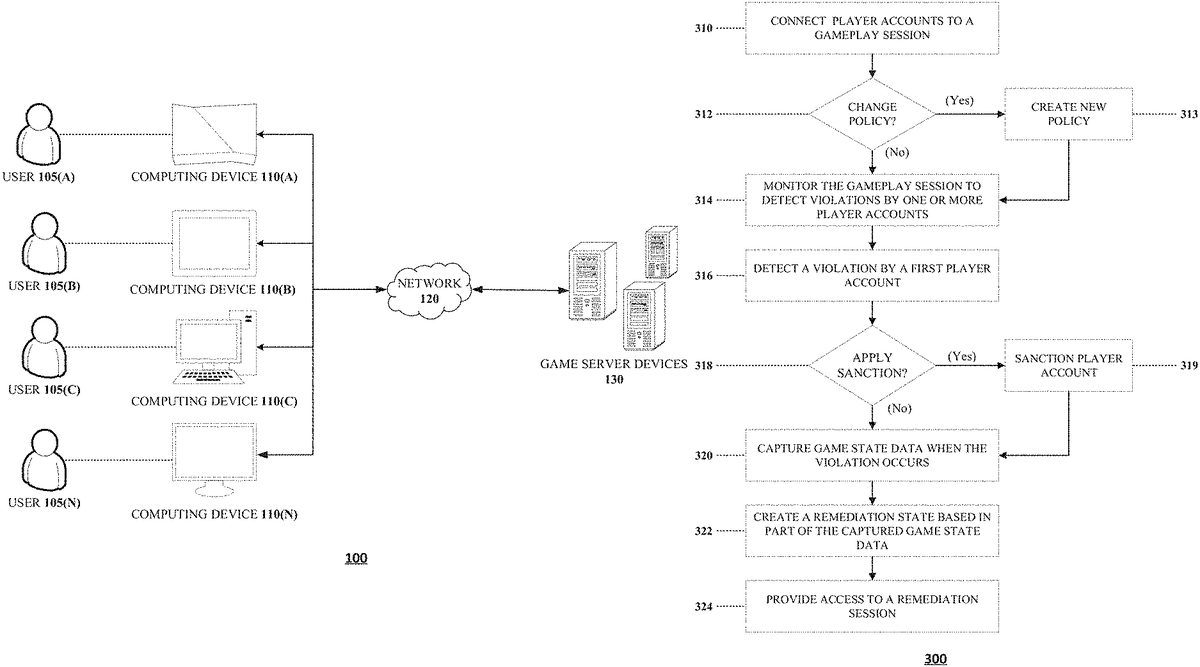
FIG.1illustrates an example embodiment of a system overview100of a hardware environment for playing video games. The system overview100is an environment including users105(A),105(B),105(C), and105(D) (collectively referred to herein as “105” or “users105”) of respective computing devices110(A),110(B),110(C), and110(D) (collectively referred to herein as “110or “computing devices110”) that are cumulatively coupled to game server devices130over a network120for playing a video game. It should be understood that as described in the present disclosure, a “user” on or of a computing device playing a video game refers to or is synonymous with a “player” of the video game.
Users105are players of video games on computing devices110. In some embodiments, there is a one-to-one correspondence between the users105and the computing devices110. In some embodiments, there is an N to one or one to N (wherein “N” is an arbitrary real value) correspondence between the users105and the computing devices110.
Computing devices110are exemplary hardware devices capable of playing or executing a video game. As illustrated in the exemplary embodiment ofFIG.1, computing device110(A) is a video game console for playing a video game; computing device110(B) is a mobile device for playing a video game; computing device110(C) is a personal computer for playing a video game; and computing device110(D) is a display device for playing a video game. In some embodiments, computing devices110have dedicated hardware components that can run a video game locally. In some embodiments, computing devices110are of similar devices. In some embodiments, computing devices110can run video games through a cloud gaming service.
In some embodiments, computing devices110are connected to a gameplay session of a video game by way of being communicatively coupled to a game server device130over a network120. Network120communicatively couples computing devices110and game server devices130. In some embodiments, a network120can be any method of connectivity or communication between devices known in the arts, such as, but not limited to, a direct wired connection, Near Field Communication (NFC), Local Area Network (LAN), an internet connection, or other communication methods of the like.
Game server devices130provide the backend infrastructure of services for a video game. In some embodiments, game server devices130provide services for video games such as, but not limited to: game platform services, matchmaking, authentication, player account services, fraud detection, policy management, remediation, strategic advising, game state management, datastores, and other video game services of the like.
Gameplay Environment
FIG.2illustrates an example embodiment of a gameplay session environment200. Gameplay session environment200is a software environment that includes player accounts205(A) to205(N) (collectively referred to as “205”) that are associated with game clients210(collectively referred to as “210”), and game platform230. In some embodiments, game clients210are communicatively coupled to game platform230and gameplay services220.
Player Account
Player accounts205are accounts of players associated with game client210and/or game platform230. In some embodiments, player accounts205comprise data provided by players, such as a username, for identifying the player in gameplay sessions of video games associated with game platform230, such as game client210. A game client210and/or game platform230can require users (such as users105fromFIG.1) to use a player account205to access one or more features of game client210, such as social gaming features including multiplayer gameplay sessions or player to player communications, in some embodiments. Respectively, data, such as gameplay actions or communications actions, from gameplay sessions of game client210can be associated with player accounts205in some embodiments.
Game Client
Game clients210are software applications of a video game, which can be played through a computing device, such as computing devices110ofFIG.1.
In some embodiments, game clients210are of the same video game and elements211,212,213,214,215, and216of game client210(A) apply through game client210(N). Game clients210may include variations among one another in some embodiments: such as including different software instructions, components, or data for supporting different platforms or performance settings. For example, game client210(A) and210(N) can be of the same video game wherein210(A) includes variations for support on a video game console (such as computing device110(A) inFIG.1), while game client210(N) includes variations for support on a mobile device (such as computing device110(B) inFIG.1). However, since210(A) and210(N) are of the same video game, both can connect to gameplay session211to play together by being communicatively coupled to gameplay services220.
Gameplay Session
Gameplay session211is an instance of a virtual environment of a video game. For example, gameplay session211can be a multiplayer match of a video game. In some embodiments, gameplay session211is shared among game clients210to connect player accounts205to gameplay session211.
A gameplay session211may include player characters in some embodiments. Player characters of gameplay session211can refer to player controllable character models used to facilitate or perform gameplay or other in-game actions. In some embodiments, a player account205of a game client210can control one or more player characters in a gameplay session211.
A gameplay session211may include player objects in some embodiments. Player objects of gameplay session211can refer to player controllable objects, or models, used to facilitate or enable gameplay or other in-game actions. Player objects may be, for example, vehicles, vessels, aircraft, ships, tiles, cards, dice, pawns, and other in-game items of the like known to those of skill in the art. In some embodiments, a player account205of a game client210can control one or more player objects in a gameplay session211, including, in some instances, by controlling player characters.
In some embodiments, the player characters and player objects controlled (and/or manipulated) by a player account205during gameplay session211can be associated to player account205. For simplicity, player characters and player objects are collectively referred to herein as player characters in some embodiments.
Gameplay session211comprises game state data212. Game state data212can refer to data representing one or more states, in whole or in part, of the gameplay session211. Game state data212may be stored as one or more complementary and/or duplicate files that can be captured and stored locally or remotely on a game server.
In some embodiments, game state data212of a gameplay session211can include information about, but not limited to: (i) connected player accounts205and game clients210, (ii) player characters associated with player accounts205, (iii) gameplay actions of player characters, (iv) communication actions associated with player accounts, (v) the status and position of virtual objects and gameplay objectives, (vi) interactions among player characters, and (vii) information about gameplay services220, among other types of information known to those of skill in the art.
In some embodiments, game state data212is one or more data files including text-based information that includes a variety of properties, conditions, statuses, and locations, for instance. An example of game state data212and/or a data file with text-based information can be: {TIME=X, PLAYER ACCOUNT=205(A), PLAYER CHARACTER=CHARACTER A, HEALTH=100, ARMOR=0, POSITION=1.0, 2.0, 3.0, WEAPON=NONE, WEAPON ATTACHMENTS=NONE, TEXT CHAT=“HELLO”, VOICE CHAT=NULL, CURRENT ACTION=EMOTE A, ORIENTATION=NORTH, VELOCITY=1M/S }.
In some embodiments, game state data212is a collection of one or more data or log files corresponding to gameplay session211. For example, game state data212can be a collective, in part or in whole, of a number of data or communication logs produced and/or facilitated among one or more game clients210and game server220that correspond to gameplay session211.
In some embodiments, game state data212is periodically or continuously updated over the course of the gameplay session211. The gameplay actions of player characters and the communication actions by a player account205can produce updates or changes to game state data212.
For instance, game state data212can be updated or changed when the following example gameplay actions of a player character occur: completing an objective or portion thereof; moving from one position of a level to another; eliminating, damaging, or aiding another player character; invoking player character animations (e.g., emotes or crouching); invoking player character voice lines; or directing a ping. In some embodiments, the game state data212is updated to include data representative of the gameplay action.
As another example, game state data212can be updated or changed when the following example communication actions of a player account occur: communicating text in chat channel of the gameplay session211, communicating sound in a voice channel of the gameplay session211, and communicating an image to the gameplay session. In some embodiments, the game state data212is updated to include data representative of the conveyed communication.
The game state data212of a gameplay session211can be captured (e.g., saved). In some embodiments, game clients210and/or gameplay services220are configured to capture game state data212of a gameplay session211periodically, continuously, or at or based on the occurrence of some event or trigger. The capture of game state data212may be for a predetermined or dynamically determined duration or instance in time, and/or for a duration or instance of time relative to (e.g., prior to, during, after) an event or trigger.
The capturing of game state data212allows game clients210to reproduce gameplay session211, or any portion thereof. In some embodiments, gameplay session211can be reproduced by way of game client components (e.g., game engine213, gameplay systems217, game assets218, and engine extensions219) utilizing one or more captures of game state data212.
In some embodiments, a new game state data based in part on the captures of game state data212can be created by gameplay services220or game client210to produce a new gameplay session. In some embodiments, one or more players205connected to gameplay session211may create a new game state data based in part on the captures of game state data212. New game state data for a remediation session can be referred to as remediation state data or remediation game state data. New game state data for an advisory session can be referred to as advisory state data or advisory game state data. As such, a new game state data can be distributed to players (i.e., player accounts205) to produce (e.g., run the virtual instance thereof) a new gameplay session on game client210by way of game client components.
As described in further detail below, the new gameplay session, the new game state data of which can be based in part on captures of game state data during a gameplay session, can be a feedback gameplay session, such as a remediation gameplay session and/or an advisory gameplay session.
Game Client Components
Game client components (e.g., game engine213, gameplay systems217, game assets218, and engine extensions219) are portions or subparts of, corresponding to and/or associated with game client210that provide the underlying frameworks and software that support and facilitate features of the video game.
In some embodiments, a game engine213is an underlying software framework that runs a video game. Game engine213includes, among other things, renderer, simulator, and stream layer. A renderer is a graphics framework that manages the production of graphics. As used herein in some embodiments, a simulator refers to a framework that manages simulation aspects corresponding to physics and other corresponding mechanics used in part for animations and/or interactions of gameplay objects, entities, characters, lighting, gases, and other game assets or effects of the like. A stream layer is a software layer that allows a renderer and simulator to run independently of each other by providing a common execution stream for graphics and animations to be produced at runtime. In some embodiments a game engine includes an audio engine that synchronizes audio playback with the common execution of a stream layer, or with the simulator directly.
In some embodiments, gameplay systems215are used in conjunction with a game engine213to facilitate and manage gameplay logic and other features of a game client210. For example, gameplay systems215can be used to manage settings and preferences, and facilitate social features, communications, and gameplay aspects (e.g., control inputs, events, triggers, NPCs, and other functions of the like) of a video game.
Gameplay systems215can also include a game state editing system that creates or enables creation of new game state data based in part on captures of game state data from one or more gameplay sessions. The new game state data created by a game state editing system can be utilized by game client210to produce a new gameplay session. The new gameplay session produced can be a feedback gameplay session of the video game, such as a remediation gameplay session or advisory gameplay session.
In some embodiments, a game state editing system produces new game state data based in part on captures of game state data212, based on or by evaluating the gameplay actions and/or communication actions or corresponding to one or more players205that participated (e.g., played) in gameplay session211. The evaluation includes a categorization of gameplay actions and/or communication actions by one or more players to determine a gameplay objective to incorporate into the new game state data.
The type of evaluation performed by the game state editing system can be based in part on the type of feedback gameplay session that is sought or configured to be generated, including for example a remediation gameplay session or an advisory gameplay session. The gameplay objective that is to be incorporated in the new game state data corresponds to the type of feedback gameplay session.
For example, when creating new game state data to produce a remediation gameplay session, the game state editing system can be configured to categorize misconduct among one or more players205in the gameplay session211from game state data212. The categorization of misconduct can be based in part on a variety of data or criteria including one or more of, but not limited to: game state data of historical gameplay sessions containing misconduct, a policy corresponding to gameplay session211that includes or identifies gameplay actions and/or communications constituting misconduct (or violation of the policy), and player reports of misconduct corresponding to gameplay session211or other historical gameplay sessions where similar gameplay actions, communication actions, or other related in-game events occurred.
The categorization of misconduct can then be utilized by the game state editing system to determine an objective that remediates the misconduct. The objective may include an assessment of the misconduct that identifies the impact the misconduct had on gameplay session211and/or on one or more players205. The objective may also require or request interactivity from a player, such that the interactivity demonstrates and/or conveys (i) the impact of the misconduct (e.g., on another player) and/or (ii) an alternative result of the gameplay session.
Similarly, in example of creating new game state data to produce an advisory gameplay session, the game state editing system can be configured to make evaluations of gameplay performance among one or more players205in gameplay session211from game state data212. The evaluations of gameplay performance can be based in part on the gameplay actions, telemetry, statistics, and other metrics known to those of skill in the art corresponding to one or more players205. The evaluations of gameplay performance may also consider skill ratings corresponding to one or more players205. The criteria or data from which gameplay performance is evaluated (or categorized) from can be based in part on historical game state data from previous gameplay sessions where other players approached the same or similar gameplay situation in a more efficient or effective manner. The criteria can also be based in part on data from an ideal gameplay session simulated by game client210, where automated character agents complete the same or a similar gameplay situation efficiently and/effectively. Such simulations may be simulated in response to an evaluation of gameplay performance, where no suitable criteria are available for reference (such as among a database corresponding to gameplay services220).
In such examples, the evaluation itself can be a comparison of the data corresponding to the gameplay performance of a player205and that of one or more other players (e.g., from a previous or simulated gameplay session). Based in part on the evaluation, a gameplay objective can be determined. The objective may include an assessment of the gameplay performance that benefited and/or detriment one or more gameplay objectives corresponding to gameplay session211. The objective may also require or request interactivity from a player, such that the interactivity demonstrates gameplay methods, techniques, or strategies for improvement.
In some embodiments, the game state editing system can be configured to (e.g., as an automated or semi-automated process) produce new game state data in the gameplay environment such as the aforementioned examples.
In some embodiments, game client210may provide players205with access to the game state editing system to enable players205to create partial or complete new game state data based in part on game state data212on their own accord. In some embodiments, this user-created new game state data can be combined and/or used in conjunction with computer-generated new game state data.
The game state editing system may be an interactive editor that enables players205, e.g., through a functional interface, to produce new game state data to create an advisory gameplay session by modifying game state data212. Such modifications to game state data212can include instructions for (i) introducing or removing gameplay events or triggers, (ii) substituting, removing, or adding player characters, such as with automated character agents, (iii) modifying the positions of one or more gameplay objects or player characters, (iv) creating tips, suggestions, notifications, and other markup or identification features that appear as notifications or overlays during runtime of a respective new gameplay session, (v) modifying, removing, or adding gameplay objectives, (vi) modifying, removing, or adding parameters that affect simulation or rendering; and (vii) providing access to other modifiable gameplay features or parameters of the like.
The new game state data produced from the game state editing system can be saved locally to game client210or to game server220. New game state data can be distributed to all or some game clients210, or to one or more players205in particular: such as through peer to peer communication or by way of gameplay services220. In turn, access to the new game state data enables one or more game clients210to locally produce a new gameplay session based in part on the new game state data.
In some embodiments, a game state editing system can create an advisory gameplay session with an advisory objective, based in part on game state data212. The game state editing system can provide players with functionality similar to traditional game replay systems, such as fast forward, pause, reverse, zooming, and camera or perspective change, to see the entirety of gameplay (including communication actions) occur in detail. The game state editing system can provide players with functionality or inputs to markup and/or provide commentary—in the form of video, audio, text, and other elements, effects, or overlays of the like—on the gameplay actions corresponding to one or more player characters of the original gameplay session211.
The game state editing system can output or produce advisory game state data, a game state based in part on game state data212. As such, a player205can create an assessment as an advisory objective based in part on the markups and commentary from player205. Therefore, the advisory gameplay session produced by player205can, in essence, coach other players with gameplay strategies illustrated by player205.
In some embodiments, a game state editing system can create an advisory gameplay session with an advisory objective, based in part on game state data212, through automation, in whole or in part (e.g., with some player or user input, as aforementioned). The automation can be based in part on a machine learning system that identifies areas or aspects in gameplay performance of one or more players that can be improved upon for a higher likelihood of success. The training or reference data used for automating the game state editing system can be based in part on game state data from gameplay sessions including one or more highly skilled players or automated character agents. The automation can identify instances in the game state data that differ from that of the training data corresponding to a similar gameplay situation(s), such as, for example, the positions of one or more player characters, one or more statuses of one or more player characters, the distance between player characters on the same player team, the time spent advancing one or more gameplay objectives of the gameplay session, among other gameplay data.
For example, where a player has low health at some instance of gameplay session of a first person shooter video game, the system can identify that point in the game state data and generate new state data that includes a generated commentary or overlay advising the player to seek or regenerate health, take cover, and/or retreat. Other, non-limiting, examples of strategic feedback providing in advisory state data for an advisory session include demonstrations and/or illustrations of alternative outcomes in a gameplay scenario, commentary corresponding to an opponent's strategy including one or more visualizations, tips for improving tactics or strategies at one or more instances in a gameplay session, among other feedback of the like.
In some embodiments, the game state editing system generates or creates video or other content of the like that one or more players can engage and/or interact with to receive strategic feedback.
In some embodiments, a game engine213and/or gameplay systems215references game assets216to produce a gameplay session211. Game assets216are digital assets that compose the virtual interactive environments of a game client210, such as menus and gameplay sessions, which include: game objects, textures, terrain maps, geometry scripts, animation files, audio files, character models, video files, font libraries, visual effects, and other digital assets of video games of the like.
In some embodiments, engine extensions214are used in conjunction with a game engine213. Engine extensions214are software components that can support the game engine213and gameplay systems215. For example, engine extensions can include SDKs, APIs, shims, DLLs that provide a variety of functionality such as providing additional graphics, audio, or communication support, establishing, and maintaining service connections, performing authorizations, providing anti-cheat and anti-fraud detection, among other things.
In some embodiments, accessing captures of game state data212enables the game client components of a game client210to reproduce (e.g., instantiate) one or more states of gameplay session211, such that it can be replayed, in whole or in part. In further embodiments, accessing new game state data based in part on the captures of game state data212enables the game client components of a game client210to instantiate a state of a new gameplay session based in part of gameplay session211, such that gameplay session211can be replayed with one or more alterations or modifications (e.g., for remediation purposes).
Gameplay Services
Gameplay services220are backend services of a video game. In some embodiments, gameplay services220are provided by game server devices130s130ofFIG.1. In some embodiments, gameplay services220include, but are not limited to, a policy manager221, a game state manager222, a remediation service223, a datastore226, and game platform services230(A).
Game clients210and game platform230can communicate with gameplay services220over a network, such as network120illustrated inFIG.1. In some embodiments, game services220establish and maintain connections for gameplay session211among game clients210and player accounts205to facilitate a multiplayer gameplay for gameplay session211.
Game platform services230(A) is a service to game platform230. In some embodiments, game platform230is a software client that utilizes game platform services230(A).
Policies
Policy manager221is a service that creates and manages fair play policies (also referred to herein as “policy” or “policies”) and monitors for the compliance thereof within a video game; such as within gameplay session211.
A policy is a set of rules used, in part or in whole, to detect, determine, identify, and/or categorize misconduct in a video game. The rules of the policy can be based in part on standards of conduct set by developers of a video game, historical incidents of misconduct, and player misconduct reports, among other things.
In some embodiments, a policy can include gameplay actions, communication actions, and other game related actions of the like that do, and/or do not, constitute misconduct. For purposes of this disclosure, the occurrence of misconduct by one or more players of a video game, as defined (directly or indirectly) by a policy, is known as a violation of a policy (or “violation” in short).
A policy can include a number of actions constituting misconduct, including, but not limited to: performing repetitive gameplay actions; performing repetitive communication actions; conveying and/or directing abusive communications; creating, distributing, and/or displaying abusive user generated content; gameplay inaction; gameplay actions that hinder a player's respective player team in a team based gameplay session of a video game; gameplay actions that are modified, controlled, directed, or assisted by software (i.e., cheating software), receiving player metrics, statistics, telemetry, and other data relating to the game state or gameplay session from software (i.e., cheating software); receiving player metrics, statistics, telemetry, and other data relating to the game state or gameplay session from other players or spectators of a gameplay session (i.e., collusion or “stream sniping”).
In some embodiments, policy manager221can create and/or manage one or more policies for the video game of game client210. In some embodiments, policy manager221can create and/or manage one or more policies for each gameplay session of the video game, such as gameplay session211.
In further embodiments, the policy manager221creates one or more policies based in part on the player accounts connected to a gameplay session. To illustrate, one or more preferences of a player account can indicate whether certain gameplay actions or communication actions in gameplay session211are appropriate or within certain appropriateness boundaries as defined by that respective player. When game services220is establishing gameplay session211among game clients210, the policy manager221can create a policy that conforms to the preferences of the player accounts205. For example, if all but one player account205in gameplay session211finds cursing appropriate, policy manager221can establish a policy for gameplay session211that makes cursing over a voice channel misconduct. In some embodiments a policy applying to gameplay session211is presented to player accounts205upon connecting for gameplay.
In some embodiments, the policy manager221can create policies through a machine learning model. In such embodiments, the model can utilize rule-based machine learning (RBML) methods to train a network that receives, as input, one or more parameters from player account preferences or historical data, among other things. Based on this data, the policy manager can employ its ML (machine learning) capabilities to traverse through rules, or groups of rules, in the network, to arrive at or create a set of one or more rules to incorporate into a policy for a gameplay session, such as gameplay session211.
In some embodiments, the policy manager221can create policies through a deterministic logic system. A deterministic logic system can determine which rules to apply based directly in part on player accounts preferences, among other things, such that, for example, preference A leads to the selection of rule A for the policy. In some embodiments, the policy manager221can use different methods to create, define or select different rules within a single policy. For example, a policy can include a rule created using ML, another can be input directly into the system by another system or person, and yet another rule can be created using deterministic logic.
In some embodiments, the policy manager221can consider other data or characteristics of gameplay aspects and/or configurations when selecting one or more rules for a policy. For example, if a player account205initiating gameplay session211does so with a “mature” rating, the policy manager221may create a rule set that no longer classifies one or more types of conduct as misconduct. In further embodiments, the policy manager221may be configured with a single policy to apply to all gameplay sessions of a video game, such as game client210.
Policies created by policy manager221can be saved, for example, to the datastore226of gameplay services220. In other embodiments, a policy, or a reference to a policy, can be saved within the game state data212of gameplay session211.
In some embodiment, policy manager221can monitor gameplay session211indirectly through instructions provided to game client210. The policy manager221can provide game client210instructions to invoke one or more components of either gameplay systems215or extensions214that enable game client210to locally monitor gameplay session211for a violation of a policy. The instructions provided by policy manager221can include the policy, and rules thereof, for a component of game client210to detect a violation of the policy.
The instructions can further provide instructions for game client210to capture game state data212, in whole or in part, when the violation occurs and/or at least one time proximate to (and/or including) when the violation occurred, or for the duration of the gameplay session. When capturing game state data212, game client210can store the capture locally on the storage of a respective computing device and/or send the capture to datastore226of gameplay services220.
In some embodiments, policy manager221can monitor gameplay session211directly through the game state manager222of gameplay services220. The policy manager221includes instructions for monitoring the game state data processed by game state manager222to detect a violation of the policy.
A game state manager222is a service that manages and/or facilitates the game state data of a gameplay session. In some embodiments, game state manager222is authoritative, such that it determines what the current state of gameplay session211is and provides updates of game state data212to game clients210. In some embodiments, game state manager222is passive, such that the current state of gameplay session211is determined by one or more of the game clients210.
The detection of a violation, by the policy manager221and/or the game client210, can be performed by a model, or a deterministic logic system, with training data (or sample or reference data) corresponding to or indicative of prior occurrences of misconduct. As described in further detail below, this training data enables a system to distinguish (or reduce the complexities of distinguishing) misconduct from (1) other incidental, accidental, or unintentional gameplay or communication actions by players of a video game, and/or (2) actions of unskilled players who do not know how or are unable to play a game well, or players who have difficulty playing a video game for a number of reasons, among other quasi-quantifiable gameplay data. In some embodiments, training data can be supplemented with, derived from, or based in part on, misconduct reported by players. It should be understood that, as used with reference to at least the interactive reporting system, “misconduct” can refer to an actual occurrence of misconduct, or a potential, alleged or suspected occurrence of misconduct. In some embodiments, misconduct can be reported using an interactive reporting system. An interactive reporting system refers to a virtual interactive environment within game client210that enables a player to go back into a gameplay session (e.g., as a replay including video, audio and/or text) to review and indicate one or more occurrences of misconduct (e.g., violation of a policy). This can be achieved through the game client210and/or game server220, which can be configured to capture the game state of a gameplay session, in whole or in part, and thereby enable players to review the gameplay session with or through the interactive reporting system.
The interactive reporting system can provide players with functionality similar and/or supplemental to traditional game replay systems, such as fast forward, pause, reverse, zooming, and camera or perspective change, to see the entirety of gameplay (including communication actions) in detail. Additionally, an interactive reporting system can provide players with functionality to indicate or markup gameplay actions or communication actions corresponding to one or more players—for instance, denoting specifically where, how, what, and when misconduct or potential misconduct occurred. The indication of misconduct can also include labeling or a short description of the misconduct, provided by players. Such an interactive reporting system can be a system among the gameplay systems215.
In this way, a player (e.g., player205) can replay gameplay session211through the interactive reporting system using a capture of game state212. Player205can then indicate a specific occurrence of misconduct in gameplay session211, such as abusive communication, gameplay inaction, cheating, or other misconduct known to those of skill in the art. For example, the player205can indicate that another player is “throwing” (a colloquial idiom among video game communities denoting intentional inaction or action that results in an intentional failure to complete a gameplay objective of a gameplay session) in gameplay session211. Player205can explain (e.g., label or provide a description) how they believe the other player was “throwing” (or “threw”) the match by detailing what gameplay actions and/or communication actions correspond to or evidence the act of “throwing.” It should be understood that an indication of misconduct can correspond to one or more frames, gameplay actions, communication actions, or player characters of the replay of gameplay session211.
The detailed indication provided by a player in the interactive reporting system can provide additional context and supplement gameplay data (e.g., game state data) from gameplay sessions which can be used to identify types of misconduct that are harder to detect, such as “throwing.” In some instances, a system using training data only may lack enough context to make an adequate or accurate determination of whether certain actions constitute misconduct. This can occur, for example, when an inexperienced player lacks sufficient gameplay experience to make and carry out effective gameplay strategies during gameplay (such as a player who is unfamiliar with the controls of the video game), the abilities of playable characters or non-playable characters (NPCs) in a video game, the layout of a particular map, and the like is likely to play in a manner that is or could be detrimental to the completion of a gameplay objective of a gameplay session. Without further context—e.g., provided through the interactive reporting system—this type of conduct could be misinterpreted or flagged as an occurrence of misconduct such as “throwing.”
For example, if the player205indicates or reports that another player stated “JUST GONNA THROW, LOL” in the text chat after intentionally repeating emote actions directly in front of the enemy player team in order to be easily eliminated, that information provides context relevant to the act or determination of throwing. The system could therefore distinguish between instances in which a player accidentally performed an emote action in front of an enemy and was unintentionally eliminated thereafter, and when a player intentionally performs an emote action and does not realize the enemy player team could see them, incidentally, making themselves vulnerable. As another example, a player with a disability may not play a video game in the same way as other players, which may lead to misinterpretation of misconduct. Therefore, factors including a player's overall engagement with the video game, hardware associated with assisting an impairment, the enablement of accessibility settings, and/or player account information, among other things, may be used to supplement the analysis of the detection system to determine if whether certain conduct from one or more particular players should not be considered misconduct.
Such reports made by players in the interactive reporting system can be used to create or supplement the training data or reference data to use when monitoring gameplay sessions to detect violations of a policy. For example, the reports by players and data from the game state of a respective gameplay session can be used in part for the following: training or reference data for a violation or misconduct detection system based in part on machine learning and/or deterministic logic, or a database of misconduct in gameplay sessions, among other things.
A system to detect misconduct, or violations of a policy, within game client210or policy manager221, may be based in part on machine learning or deterministic logic (e.g., a deterministic algorithm). A machine learning implementation can be trained and configured to analyze data and create a result based in part on inference. A deterministic logic implementation can be configured to process data to achieve a predefined or expected output. One skilled in the art would recognize that either aforementioned implementation can be configured to produce similar results.
In some embodiments, the violation detection system within game client210or policy manager221can receive data including player reports and game state data corresponding to the player report as training or reference data. When evaluating or processing the game state data of a gameplay session, the violation detection system can make a determination or inference based in part on that training or reference data. For example, in a machine learning implementation, the training data (e.g., player reports and game state data corresponding to the player report) provides the system with a more contextual understanding of gameplay, such that the system can better or more accurately detect when misconduct occurs, based in part on when players have indicated that it has occurred in similar situations. As such, the prior reports by players can constitute a foundation or basis for detecting similar misconduct in future or proceeding gameplay sessions.
The detections by a violation detection system within game client210or policy manager221can be based in part on comparisons between a given game state of a gameplay session and the training or reference data (e.g., from players' reports) and game state data corresponding to those reports. When the game state data of a gameplay session corresponds to one or more prior instances of misconduct among the training or reference data, the game state data can be flagged, marked, or otherwise indicated as including misconduct or being in violation of one or more policies corresponding to the gameplay session.
In some embodiments, the violation detected may also be identified, defined, or otherwise categorized (e.g., by the violation detection system within game client210or policy manager221) as being of one or more types of violations. The categorization of the violation provided may be based in part on the categorization of the misconduct in the training or reference data that was used to detect the violation. For example, training data can include one or more player reports for hate speech and corresponding game state data. The game state data, or the player report, can include a text chat log that includes the language identified as hate speech. As such, the game state of another gameplay session that is determined to correspond to that type of violation can also be categorized as hate speech.
In some embodiments, further or more detailed categorizations, or sub categorizations, of the violations can be determined. For example, the training data can be identified as a particular type of hate speech based in part on data from player reports or contextual analysis. Such embodiments can provide categorizations that identify one or more particular players, individuals, or groups of individuals as targeted victims or subjects of the hate speech. This in turn can provide for more accurate detections and categorizations of misconduct, which can also be used in part for the creation of a remediation gameplay session as explained in further detail below.
In some embodiments, when a violation is detected (e.g., by either policy manager221or game client210), the policy manager221can sanction a player account. In some embodiments, a policy manager221can make a determination whether to sanction a player account and a determination of the extent of the sanction, based in part on the severity of the violation (such as the type of misconduct that occurred) and/or a history of violations associated with the player account, among other factors.
In some embodiments, a sanction includes an imposed condition which, when completed, can remove the sanction from the player account. For example, a sanction on player accounts may prevent the player account from joining one or more types of gameplay sessions for a duration of time; and upon the completion of the duration of time, the player account may be allowed to proceed to access those one more gameplay sessions again.
In some embodiments, policy manager221communicates information about the violation, including: the player account(s) associated with the violation, the type of violation(s) that occurred, and/or the locations of the respective capture(s) of game state data212within datastore226, to remediation service223.
Remediation Service
A remediation service223is a service that can create remediation game state data based in part on the communicated (i.e., detected) violations and captured game state data212. That is, the remediation game state data can be a new set of game state data, based on or including all or portions of the game state data, for other purposes such as remediation. Remediation game state data includes a remediation objective through which a violation detected in the game state data212of gameplay session211can be remediated.
In some embodiments, a remediation objective can include (or be based on or associated with) an assessment that evaluates and communicates the impact the violation had (or is presumed to have had) on other players of the gameplay session, and on the outcome of the gameplay of that session. An assessment may be presented in the form of an interactive guide that navigates through specific instances of the game with one or more notifications, a video with one or more notifications, or a set of images from gameplay with one or more notifications, in some embodiments.
In some embodiments, a remediation objective is an alternative gameplay scenario that enables the violating player account to review and reflect on the misconduct through gameplay, or other interactions. In some embodiments, the player can experience or be exposed to the impact of the violation from another perspective. For example, in a remediation gameplay session, a player may play as the player character of the player account they directed misconduct towards. Alternatively, in a remediation gameplay session, a player may play as a player character who was not associated with the misconduct.
An alternative gameplay scenario can be achieved as a remediation objective by reproducing and/or recreating all or portions of the gameplay session. An alternative gameplay scenario can include the ability to play alongside one or more player characters from the gameplay session. In some embodiments, the remediation objective includes both an assessment and alternative gameplay scenario.
In some embodiments, remediation service223can determine which type of remediation objective should be included in a remediation gameplay session, such as through a deterministic logic system. The remediation service223can evaluate information of the detected violation and/or the player account that committed the violation against a set of criteria, or factors, for the selection of a remediation objective. The factors or criteria may include, for example, the history of violations committed by the player account, the type of violation identified, the amount and context of misconduct reports submitted against the player account for violation, among other things. For example, if the violation was minor, but has been a recurring violation committed by the player account, then the system can determine that the violation sufficiently meets the criteria for providing an assessment of the violation.
In some embodiments, the remediation service223can create remediation game state data by way of a machine learning model. A machine learning model, such as recurrent neural network model, can process information (e.g., text data) from the captures of game state data212and corresponding detections of violations. The processing of the model can occur in relation to (e.g., weighted against) information about the violation provided by the policy manager221, misconduct reports, and/or the remediation objective determined.
As a result of the processing, the model can produce new information (e.g., text data) to create remediation game state data. In some embodiments, remediation game state data includes at least one or more portions of one or more captures of game state data212and new information (e.g., text data) produced by or based on a machine learning model. Additionally, the model can determine which portions of the gameplay session are relevant to the violation, such that only particular instances within the gameplay session are incorporated as part of a remediation session.
For example, the model can determine that player account205(N) was not actively participating in gameplay session211, which potentially led player account205(A) to commit a violation, e.g., over text chat, directed at player205(N). Based on this, the model can create new data (e.g., text data) corresponding to a remediation objective to incorporate into remediation game state data. The new text data that can indicate when and how a remediation objective is to occur or be implemented in the remediation gameplay session. For example, for an assessment of the violation included in the remediation objective, the new data can provide context for when and what to display or communicate as a notification (e.g., “NOTIFICATION {“REMEDIAL TEXT”, TIME, DURATION, LOCATION, SIZE}”).
As another example, where the remediation objective is a gameplay scenario, the model can also determine which player accounts and/or player characters are relevant to the violation and/or which player accounts are necessary or optimal to provide the adequate or desired remediation. In some instances, the player characters that are relevant to the violation and/or needed to provide the remediation can be a subset of the total number of player characters in the gameplay session where the violation occurred. In such cases, only that subset of player characters could be included as part of the remediation session.
The subset of players determined can be identified as new text data that the model provides, such as, for example “PLAYER SUBSET {PLAYER ACCOUNT205(A)=PLAYER CHARACTER A, PLAYER ACCOUNT205(B)=PLAYER CHARACTER B, PLAYER ACCOUNT205(N)=PLAYER CHARACTER N}. In some embodiments, the system and/or model can determine that one or more of the players in the gameplay session can be substituted by one or more automated character agents incorporated into the remediation session; such that gameplay within the remediation session can be driven or directed automatically by the character agents without the need to connect one or more player accounts to those player characters.
In some embodiments, remediation game state data is a combination of captures from game state data212and new data appended to the captures as discussed above in further detail. The remediation game state data can replace or substitute the captures of game state data212. In some embodiments, remediation game state data is a modification of the captures of game state data212. Remediation game state data can be created locally on game client210by way of instructions containing the new data (e.g., remediation objective) that is used in conjunction with the original captures of game state data212, such that the captures of game state data212can be reproduced on game client210but modified based on the instructions containing the new data.
In some embodiments, remediation game state data can be configured with instructions perform one or more of the following changes, modifications, or alterations at one or more times, or instances, of a remediation objective to emphasize the impact of the misconduct: increasing or decreasing the FOV, changing the color scheme (e.g., full color to monochrome) of the rendering (i.e., the displayed frames), shrinking the size of the current player character, blurring the rendering, reducing the lighting (i.e., luminosity) of the rendered scene of the remediation session, disabling one or more gameplay actions for the player character, increasing or decreasing one or more audio tracks on one or more audio channels, playing additional audio tracks, increasing the game difficulty, enlarging the size of the current game level (i.e., the map or virtual interactive environment of the gameplay session), among other things.
In some embodiments, the remediation service223saves remediation game state data in datastore226. In some embodiments, remediation service223provides the player account(s) associated with the violation with the remediation game state data to provide access to the remediation game session.
To illustrate an embodiment of a process for creating a remediation session, a policy, from policy manager221, applies to gameplay session211and provides that “throwing” is a violation. Thereafter the policy manager221or game client210may detect that a player character associated with player account205(A) is determined to be “throwing” in the gameplay session211—in violation of the policy. The policy manager221instructs the game state manager222or game client210to capture game state data212at the time the “throwing” violation occurs and at least one time proximate to it. The policy manager221provides the remediation service223with information corresponding to the violation detected, and the captured game state data212(or a reference thereto). The remediation service223can then create a remediation game state data based in part on the captures of game state data212and the violation detected. Thereafter, the remediation service223can provide player account205(A) with access to the remediation game state data to produce a remediation session, by way of the game client components (213,214,215, and216)
Remediation Session
FIG.3illustrates an example embodiment of a process for creating remediation sessions300.
Creation Process
At step310, a number of player characters associated with player accounts are connected to a gameplay session: for example, player accounts205(A) to205(N) and gameplay session211inFIG.2.
At step312, a determination is made as to whether a policy for the gameplay session needs to be established, or to change or be changed. This can be determined by the policy manager221as described above with reference toFIG.2. If so (Yes), at step313, a new policy is established or created, for instance to conform to or account for the preferences of the connected player accounts. Alternatively, if it is determined at step312that the policy does not need to be changed (No), an existing policy that has already been established or created can be applied to the gameplay session.
In turn, at step314, the system monitors the gameplay sessions to detect violations of the policy by one or more player characters associated with player accounts. As described above with reference toFIG.2, such monitoring can be performed by the policy manager221. At step316, violation(s) of the policy by one or more player characters associated with player accounts are detected. This can be done by the policy manager221, e.g., as described above with reference toFIG.2.
At step318, a determination of whether to apply a sanction to a player account is made, such as by the policy manager221as described above with reference toFIG.2. If it is determined at step318that a sanction is to be applied (Yes), the sanctioning of one or more player accounts in violation of the policy is performed at step319. In some embodiments, where more than one player account is involved in a sanction, the policy manager221can provide individualized sanctions to each player account. On the other hand, if it is determined that a sanction is not to be applied at step318(No), or after player accounts are sanctioned at step319, game state data is in turn captured at step320.
That is, at step320, the system can capture game state data when the violation occurs—similar to the captures of game state data212described forFIG.2.
In turn, at step322, the system creates a remediation game state based in part on one or more captures of game state data, such as by remediation service223as described inFIG.2. In some embodiments, a unique remediation game state is created for each of the one or more player accounts associated with the violation.
At step324, the system provides access to a remediation session to one or more player accounts, such as those associated with the violation. This can be done, for example, by the remediation service223as described inFIG.2.
Accessing the Remediation Session
FIG.4illustrates an example embodiment for a remediation session environment400. In some embodiments, player account405is similar to player accounts205described inFIG.2; game client410and game client components413,414,415,416are similar to the game clients210and game client components213,214,215, and216described inFIG.2; gameplay services420is similar to gameplay services220described inFIG.2; and game platform430is similar to game platform230described inFIG.2.
In some embodiments, gameplay services420can provide player account405access to remediation session411through game client410by providing remediation game state data412to game client410. Providing game client410with remediation game state data412can enable game client410to present a notification indicating that remediation411is now accessible.
In some embodiments, game engine413, extensions414, gameplay systems415, and game assets416can read remediation game state data412to produce remediation session411on game client410.
In some embodiments, remediation game state data412may include data for the use of one or more automated character agents in remediation session411. An automated character agent can be, in some embodiments, the logic that drives, directs, or controls a player character (e.g., a playable or player controlled character model) in a gameplay session of a video game. Additionally, an automated character agent can include, in some embodiments, a separate, distinct, and/or unique character model that is configured differently than a player controlled character model. For example, an automated character agent including a character model may be configured to perform actions that are not traditionally be included in the configuration of a player controlled character model, such as, a ray casting system and image capture system for determining position and future gameplay actions, among other things. In some embodiments, an automated character agent not including a character model can be configured to provide a new configuration to a player controllable character model such that it can perform the aforementioned actions, among other things.
In some embodiments, character agent system415(A) is a subcomponent of gameplay systems415configured to provide and/or direct one or more automated character agents in remediation session411. In some embodiments, character agent system415(A) can be a service among gameplay services420that is configured to provide and/or direct one or more automated character agents in remediation session411.
An automated character agent may be a machine learning agent trained in gameplay. In some embodiments, the gameplay actions of automated characters agents can be modeled on particular players. For example, where players opt into contributing their gameplay data to train an automated character agent, the corresponding automated character agent trained from their control inputs and gameplay data to reflect the player account's gameplay style, such as by way of the systems and methods disclosed in U.S. Pat. No. 10,940,393 and U.S. Pat. No. 10,839,215 which are incorporated by reference in their entirety. As such, in some instances, where player accounts elect to contribute their gameplay data for training, a particular character agent that is representative of their gameplay style can be used. As another example, automated character agents can be based in part on one or more people represented in the game as a player character, such as by way of the systems and methods disclosed in U.S. Pat. No. 10,713,543, which is incorporated by reference in its entirety.
Alternatively, an automated character agent may comprise traditional “artificial intelligence” for controlling a player character, as one skilled in the art would recognize.
In some embodiments, the character agent system415(A) includes character agents configured to drive or direct the alternative gameplay scenario of remediation session411. For example, remediation game state data412includes an alternative gameplay scenario as a remediation objective in which the gameplay session results in a win rather than a previous loss. The character agent system415(A) can provide automated character agents configured to best achieve a “win” from any given state (e.g., game state data) of a gameplay session, such that the character agents themselves can drive gameplay towards a win from any particular game state that remediation game state data412is based on. In some embodiments, the automated character agents may also be configured to conform to a stand of conduct, or gameplay style, that best promotes a remedial gameplay strategy provided in the remediation game state data412.
In some embodiments, remediation game state data412may include one or more notifications that provide remedial gameplay strategies at one or more times during the remediation session411which can be read by, or passed to, notification system415(B). In some embodiments, notification system415(B) is a subcomponent of gameplay systems415configured to display notifications provided within remediation game state data412.
The game client410can include gameplay session211and game state data212. The remediation session411can occur during gameplay session211, such that remediation session411is a sub session of gameplay session211.
In some embodiments, game client410is separate and distinct from game client210, such that a remediation session can occur externally from the original game client in which the violation occurred and was detected on.
In some embodiments, gameplay systems415can be configured to remove a sanction on player account405upon completion of the remediation objective of remediation session411.
Remediation Objective
FIG.5illustrates an example embodiment of a process500for providing a remediation session. In some embodiments, process500represents game client410running remediation session411from remediation game state data412associated with player account405. As described herein, the remediation game state data412is based at least in part on game state data212from gameplay session211.
As illustrated in the example embodiment ofFIG.5, remediation can include an assessment process (e.g., steps510and512) and/or execution of an alternative gameplay scenario (e.g., steps520,522and524). It should be understood that, in some embodiments, remediation can include both an assessment and an alternative gameplay scenario.
At step510, the remediation session411performs an assessment of the violation as a remediation objective. In some embodiments, an assessment of the violation is an interactive guide that evaluates or assesses the impact, or the effect, the violation had over the course of gameplay session211, including the impact or effect on other player accounts connected to gameplay session211. For example, an assessment can evaluate one or more captures of game state data212of gameplay session211in which a violation had a negative impact or effect on the gameplay objective or the gameplay actions of one or more player characters associated with one or more player accounts.
At step512, the assessment provides remedial gameplay strategies to improve upon or eliminate the situations causing or leading to the violation in gameplay session211. In some embodiments, the remedial gameplay strategies are tips presented to player account405on game client410—e.g., through user interface notifications, such as a text box, that displays during the remediation session411. The remedial gameplay strategies can include, for example, methods for avoiding and/or improving upon misconduct.
At step520, the remediation session411initializes an alternative gameplay scenario. In some embodiments, an alternative gameplay scenario is an altered re-creation of the gameplay session211. For instance, the gameplay session211can be altered by creating remediation game state data412(e.g., based on or based off of the game state data212) that includes a virtual interactive environment that enables player account405to experience the captured violation (e.g., as captured in the game state data212from which the remediation game state data412is derived). The virtual interactive environment enabled by the remediation game state data412can enable the player account405, for example, to experience the violation from the same perspective (e.g., from the perspective of the same player character with which the player account405was associated with in gameplay session211) or from a different perspective (e.g., from the perspective of a virtual player character different than the one the player account405was associated with during the session).
For example, upon accessing remediation session411, player account405may, as part of the remediation objective, play as or view the gameplay from the player character associated with a different player account that was the subject (or victim) of misconduct in the original gameplay session211. As such, player account405may participate in the remediation session411in the place of the other player character while experiencing the misconduct that they (player405) committed in the original gameplay session211. This enables the player associated with player account405to experience first-hand how their misconduct affected another player and/or the impact it had on the outcome of gameplay session211. In some embodiments, remediation session411can provide player405some control of or interactivity with the other player character they are currently using or viewing from in the remediation session.
At step522, the remediation session substitutes players characters with automated character agents where necessary to facilitate the alternative gameplay scenario.
At step524, the remediation session facilitates or enables gameplay for the alternative gameplay scenario. In some embodiments, the alternative gameplay scenario of gameplay session411associates player account405with the player character associated with the player account that was victimized, offended or the like in, during or as a result of a violation in the gameplay session211. In this way, the player account405(and thereby its user) can be exposed to and/or understand the experience of the victimized or offended player or player account. In some embodiments, the alternative gameplay scenario of remediation session411associates player account405as spectator to demonstrate an alternative outcome driven by the automated character agents.
In some embodiments, steps520,522and524, occur concurrently and/or independently of steps510,512, and514, such that the remediation session411includes both remediation objectives from steps510and520occur. In some embodiments, only one remediation objective from steps510or520is included in remediation session411and occurs.
At step530, completion of the remediation objective is verified. In some embodiments, verification in step530is done by game client410. In some embodiments, verification in step530is done by gameplay services420(e.g., by a remediation service).
At step532, a check is performed to determine whether the associated player account (405) received a sanction in response to the violation. If so (Yes), the system can remove the sanction on the player account405at step534. In some embodiments, the sanction is removed by game client410. In some embodiments, the sanction is removed by gameplay service420. In turn, or if it was determined at step532that the player account had not been sanctioned (No), the remediation session411is ended at step536.
Computing Device
FIG.6illustrates an example embodiment of the resources within a computing device10. In some embodiments, some or all of the computing devices110ofFIG.1are similar to computing device10, as known to those of skill in the art.
Other variations of the computing device10may be substituted for the examples explicitly presented herein, such as removing or adding components to the computing device10. The computing device10may include a video game console, a smart phone, a tablet, a personal computer, a laptop, a smart television, a server, and the like.
As shown, the computing device10includes a processing unit20that interacts with other components of the computing device10and external components. A media reader22is included that communicates with computer readable media12. The media reader22may be an optical disc reader capable of reading optical discs, such as DVDs or BDs, or any other type of reader that can receive and read data from computer readable media12. One or more of the computing devices may be used to implement one or more of the systems disclosed herein.
Computing device10may include a graphics processor24. In some embodiments, the graphics processor24is integrated into the processing unit20, such that the graphics processor24may share Random Access Memory (RAM) with the processing unit20. Alternatively, or in addition, the computing device10may include a discrete graphics processor24that is separate from the processing unit20. In some such cases, the graphics processor24may have separate
RAM from the processing unit20. Computing device10might be a video game console device, a general-purpose laptop or desktop computer, a smart phone, a tablet, a server, or other suitable system.
Computing device10also includes various components for enabling input/output, such as an I/O32, a user I/O34, a display I/O36, and a network I/O38. I/O32interacts with storage element40and, through a device42, removable storage media44in order to provide storage for computing device10. Processing unit20can communicate through I/O32to store data. In addition to storage40and removable storage media44, computing device10is also shown including ROM (Read-Only Memory)46and RAM48. RAM48may be used for data that is accessed frequently during execution of software.
User I/O34is used to send and receive commands between processing unit20and user devices, such as keyboards or game controllers. In some embodiments, the user I/O can include a touchscreen. The touchscreen can be a capacitive touchscreen, a resistive touchscreen, or other type of touchscreen technology that is configured to receive user input through tactile inputs from the user. Display I/O36provides input/output functions that are used to display images. Network I/O38is used for input/output functions for a network. Network I/O38may be used during execution, such as when a client is connecting to a server over a network.
Display output signals produced by display I/O36comprising signals for displaying visual content produced by computing device10on a display device, such as graphics, GUIs, video, and/or other visual content. Computing device10may comprise one or more integrated displays configured to receive display output signals produced by display I/O36. According to some embodiments, display output signals produced by display I/O36may also be output to one or more display devices external to computing device10, such a display16.
The computing device10can also include other features, such as a clock50, flash memory52, and other components. An audio/video player56might also be used to play a video sequence, such as a movie. It should be understood that other components may be provided in computing device10and that a person skilled in the art will appreciate other variations of computing device10.
Program code can be stored in ROM46, RAM48, or storage40(which might comprise hard disk, other magnetic storage, optical storage, other non-volatile storage or a combination or variation of these). Part of the program code can be stored in ROM that is programmable (ROM, PROM, EPROM, EEPROM, and so forth), part of the program code can be stored in storage40, and/or on removable media such as media12(which can be a CD-ROM, cartridge, memory chip or the like, or obtained over a network or other electronic channel as needed). In general, program code can be found embodied in a tangible non-transitory signal-bearing medium.
Random access memory (RAM)48(and possibly other storage) is usable to store variables and other processor data as needed. RAM is used and holds data that is generated during the execution of an application and portions thereof might also be reserved for frame buffers, application state information, and/or other data needed or usable for interpreting user input and generating display outputs. Generally, RAM48is volatile storage and data stored within RAM48may be lost when the computing device10is turned off or loses power.
As computing device10reads media12and provides an application, information may be read from media12and stored in a memory device, such as RAM48. Additionally, data from storage40, ROM46, servers accessed via a network (not shown), or removable storage media46may be read and loaded into RAM48. Although data is described as being found in RAM48, it will be understood that data does not have to be stored in RAM48and may be stored in other memory accessible to processing unit20or distributed among several media, such as media12and storage40.
Some portions of the detailed descriptions above are presented in terms of symbolic representations of operations on data bits within a computer memory. These algorithmic descriptions and representations are the means used by those skilled in the data processing arts to most effectively convey the substance of their work to others skilled in the art. An algorithm is here, and generally, conceived to be a self-consistent sequence of steps leading to a desired result. The steps are those requiring physical manipulations of physical quantities. Usually, though not necessarily, these quantities take the form of electrical or magnetic signals capable of being stored, transferred, combined, compared, and otherwise manipulated. It has proven convenient at times, principally for reasons of common usage, to refer to these signals as bits, values, elements, symbols, characters, terms, numbers, or the like.
The disclosed subject matter also relates to an apparatus for performing the operations herein. This apparatus may be specially constructed for the required purposes, or it may comprise a general-purpose computer selectively activated or reconfigured by a computer program stored in the computer. Such a computer program may be stored in a computer readable storage medium, such as, but not limited to, any type of disk including optical disks, CD-ROMs, and magnetic-optical disks, read-only memories (ROMs), random access memories (RAMs), EPROMs, EEPROMs, magnetic or optical cards, or any type of media suitable for storing electronic instructions, each coupled to a computer system bus.
The disclosed subject matter may be provided as a computer program product, or software, that may include a machine-readable medium having stored thereon instructions, which may be used to program a computer system (or other electronic devices) to perform a process according to the disclosed subject matter. A machine-readable medium includes any mechanism for storing or transmitting information in a form readable by a machine (e.g., a computer). For example, a machine-readable (e.g., computer-readable) medium includes a machine (e.g., a computer) readable storage medium (e.g., read only memory (“ROM”), random access memory (“RAM”), magnetic disk storage media, optical storage media, flash memory devices, etc.).
It should be understood that the original applicant herein determines which technologies to use and/or productize based on their usefulness and relevance in a constantly evolving field, and what is best for it and its players and users. Accordingly, it may be the case that the systems and methods described herein have not yet been and/or will not later be used and/or productized by the original applicant. It should also be understood that implementation and use, if any, by the original applicant, of the systems and methods described herein are performed in accordance with its privacy policies. These policies are intended to respect and prioritize player privacy, and to meet or exceed government and legal requirements of respective jurisdictions. To the extent that such an implementation or use of these systems and methods enables or requires processing of user personal information, such processing is performed (i) as outlined in the privacy policies; (ii) pursuant to a valid legal mechanism, including but not limited to providing adequate notice or where required, obtaining the consent of the respective user; and (iii) in accordance with the player or user's privacy settings or preferences. It should also be understood that the original applicant intends that the systems and methods described herein, if implemented or used by other entities, be in compliance with privacy policies and practices that are consistent with its objective to respect players and user privacy.
Certain example embodiments are described above to provide an overall understanding of the principles of the structure, function, manufacture and use of the devices, systems, and methods described herein. One or more examples of these embodiments are illustrated in the accompanying drawings. Those skilled in the art will understand that the descriptions herein and the accompanying drawings are intended to be illustrative, and not restrictive. Many other implementations will be apparent to those of skill in the art based upon the above description. Such modifications and variations are intended to be included within the scope of the present disclosure. The scope of the present disclosure should, therefore, be considered with reference to the claims, along with the full scope of equivalents to which such claims are entitled. The features illustrated or described in connection with one exemplary embodiment may be combined with the features of other embodiments. In some instances, well-known structures and devices are shown in block diagram form, rather than in detail, in order to avoid obscuring the disclosed subject matter.
Claims
- A system comprising: one or more processors;and a computer-readable storage medium including machine-readable instructions that, when executed by the one or more processors, cause the one or more processors to: connect a plurality of player characters to a gameplay session of a video game, wherein the gameplay session comprises game state data;establish a policy, the policy comprising violations of interactivity among the plurality of player characters in the gameplay session, wherein a player account is associated with one or more player characters among the plurality of player characters;monitor interactivity among the plurality of player characters in the gameplay session to detect violations of the policy by one or more of the plurality of player characters;detect a violation by a first player character, wherein the first player character is associated with a first player account;capture game state data of the gameplay session at a time when the violation occurs and at least one time proximate to when the violation occurs;create remediation state data based in part on the captured game state data;provide, to the first player account, access to a remediation session, wherein the remediation session is a secondary gameplay session of the video game based in part on the remediation state data;and determine completion of the remediation session by the first player account.
- The system of claim 1, wherein the creating the remediation state data includes: categorizing the violation by the first player character;determining a remediation objective in response to the categorization, wherein the remediation objective is a gameplay objective that remediates the violation;and providing instructions to: (i) incorporate one or more automated character agents configured to direct gameplay actions of player characters over the course of the remediation session;and (ii) incorporate the remediation objective.
- The system of claim 2, wherein the determining the remediation objective occurs further in response to determining prior violations associated with the first player account.
- The system of claim 3, wherein to provide access to a remediation session enables the first player account to initialize the remediation session as a secondary gameplay session of the video game, wherein the initialization references the remediation state data to: (i) substitute a plurality of player characters with automated character agents;and (ii) initialize the remediation objective, the remediation objective including at least one of: (a) an assessment of the violation caused by the player character associated with the player account;and (b) participation in an alternative gameplay scenario based in part on gameplay events in the gameplay session.
- The system of claim 4, wherein the alternative gameplay scenario is driven by the automated character agents, the automated character agents configured to optimally control player characters in the completion of the remediation objective.
- The system of claim 5, wherein the first player account is sanctioned in response to the detection of the violation, causing a sanction to be associated with the first player account.
- The system of claim 6, wherein completion of the remediation session by the first player account removes the sanction on the player account.
- A computer implemented method system to remediate violations of interactivity in video games by: connecting a plurality of player characters to a gameplay session of a video game, wherein the gameplay session comprises game state data;establishing a policy, the policy comprising violations of interactivity among the plurality of player characters in the gameplay session, wherein a player account is associated with one or more player characters among the plurality of player characters;monitoring interactivity among the plurality of player characters in the gameplay session to detect violations of the policy by one or more of the plurality of player characters;detecting a violation by a first player character, wherein the first player character is associated with a first player account;capturing game state data of the gameplay session at a time when the violation occurs and at least one time proximate to when the violation occurs;creating remediation state data based in part on the captured game state data;providing, to the first player account, access to a remediation session, wherein the remediation session is a secondary gameplay session of the video game based in part on the remediation state data;and determining completion of the remediation session by the first player account.
- The method of claim 8, wherein the creating the remediation state data includes: categorizing the violation by the first player character;determining a remediation objective in response to the categorization, wherein the remediation objective is a gameplay objective that remediates the violation;and providing instructions to: (i) incorporate one or more automated character agents configured to direct gameplay actions of player characters over the course of the remediation session;and (ii) incorporate the remediation objective.
- The method of claim 9, wherein the determining the remediation objective occurs further in response to determining prior violations associated with the first player account.
- The method of claim 10, wherein to provide access to a remediation session enables the first player account to initialize the remediation session as a secondary gameplay session of the video game, wherein the initialization references the remediation state data to: (i) substitute a plurality of player characters with automated character agents;and (ii) initialize the remediation objective, the remediation objective including at least one of: (a) an assessment of the violation caused by the player character associated with the player account;and (b) participation in an alternative gameplay scenario based in part on gameplay events in the gameplay session.
- The method of claim 11, wherein the alternative gameplay scenario is driven by the automated character agents, the automated character agents configured to optimally control player characters in the completion of the remediation objective.
- The method of claim 12, wherein the first player account is sanctioned in response to the detection of the violation, causing a sanction to be associated with the first player account.
- The method of claim 13, wherein completion of the remediation session by the first player account removes the sanction on the player account.
- A non-transitory computer readable medium comprising machine-readable instructions to remediate violations of interactivity in video games by: connecting a plurality of player characters to a gameplay session of a video game, wherein the gameplay session comprises game state data;establishing a policy, the policy comprising violations of interactivity among the plurality of player characters in the gameplay session, wherein a player account is associated with one or more player characters among the plurality of player characters;monitoring interactivity among the plurality of player characters in the gameplay session to detect violations of the policy by one or more of the plurality of player characters;detecting a violation by a first player character, wherein the first player character is associated with a first player account;capturing game state data of the gameplay session at a time when the violation occurs and at least one time proximate to when the violation occurs;creating remediation state data based in part on the captured game state data;providing, to the first player account, access to a remediation session, wherein the remediation session is a secondary gameplay session of the video game based in part on the remediation state data;and determining completion of the remediation session by the first player account.
- The non-transitory computer readable medium of claim 15, wherein the creating the remediation state data includes: categorizing the violation by the first player character;determining a remediation objective in response to the categorization, wherein the remediation objective is a gameplay objective that remediates the violation;and providing instructions to: (i) incorporate one or more automated character agents configured to direct gameplay actions of player characters over the course of the remediation session;and (ii) incorporate the remediation objective.
- The non-transitory computer readable medium of claim 16, wherein the determining the remediation objective occurs further in response to determining prior violations associated with the first player account.
- The non-transitory computer readable medium of claim 17, wherein to provide access to a remediation session enables the first player account to initialize the remediation session as a secondary gameplay session of the video game, wherein the initialization references the remediation state data to: (i) substitute a plurality of player characters with automated character agents;and (ii) initialize the remediation objective, the remediation objective including at least one of: (a) an assessment of the violation caused by the player character associated with the player account;and (b) participation in an alternative gameplay scenario based in part on gameplay events in the gameplay session.
- The non-transitory computer readable medium of claim 18, wherein the alternative gameplay scenario is driven by the automated character agents, the automated character agents configured to optimally control player characters in the completion of the remediation objective.
- The non-transitory computer readable medium of claim 19, wherein the secondary gameplay session is accessed in a second video game.
Disclaimer: Data collected from the USPTO and may be malformed, incomplete, and/or otherwise inaccurate.