U.S. Pat. No. 11,161,042
VIDEO GAME FOR CHANGING MODEL BASED ON ADJACENCY CONDITION
AssigneeSQUARE ENIX CO., LTD.
Issue DateMarch 18, 2020
Illustrative Figure
Abstract
A system for changing appearance of a character composed of a plurality of models judges whether a model can be changed or not on the basis of whether an adjacency condition is satisfied or not. Whether the adjacency condition is satisfied or not is judged on the basis of a shape of a judgement target and a shape of a model adjacent to a change target. The system may refer to a type of a shape set to each model to judge whether the adjacency condition is satisfied or not. The system may also refer to a type regarding a portion adjacent to another model set to each model for the judgement. Moreover, the system may adjust a shape of an adjacent model on the basis of information that is set to the model.
Description
DESCRIPTION OF THE EMBODIMENTS Hereinafter, examples of embodiments according to the present invention will be described with reference to the drawings. In this regard, various kinds of elements in an example of each embodiment, which will be described below, can appropriately be combined with each other in a range where contradiction or the like did not occur. Further, explanation of the content that will be described as an example of an embodiment may be omitted in another embodiment. Further, the content of operations and/or processing with no relationship to characteristic portions of each embodiment may be omitted. Moreover, various kinds of processing that constitute various kinds of processing flows (will be described below) may be carried out in random order in a range where contradiction or the like did not occur in the content of the processing. First Embodiment FIG. 1is a block diagram illustrating an example of a configuration of a system100according to one embodiment of the present invention. As illustrated inFIG. 1, the system100includes a server10, and user terminals20, and201to20N respectively used by users of the system100(“N” is an arbitrary integer. Hereinafter, they are simply referred to as “terminals20, and201to20N”). In this regard, the configuration of the system100is not limited to this configuration. The system100may be configured so that a plurality of users uses a single terminal, or may be configured so as to include a plurality of servers. Each of the server10and the plurality of terminals20and201to20N is connected to a communication network30such as the Internet. In this regard, although it is not illustrated in the drawings, the plurality of terminals20and201to20N is connected to the communication network30by carrying out data communication with base stations managed by a telecommunication carrier by means of a radio communication line. The system100includes the server10and the plurality of terminals20, and201to20N, thereby executing various ...
DESCRIPTION OF THE EMBODIMENTS
Hereinafter, examples of embodiments according to the present invention will be described with reference to the drawings. In this regard, various kinds of elements in an example of each embodiment, which will be described below, can appropriately be combined with each other in a range where contradiction or the like did not occur. Further, explanation of the content that will be described as an example of an embodiment may be omitted in another embodiment. Further, the content of operations and/or processing with no relationship to characteristic portions of each embodiment may be omitted. Moreover, various kinds of processing that constitute various kinds of processing flows (will be described below) may be carried out in random order in a range where contradiction or the like did not occur in the content of the processing.
First Embodiment
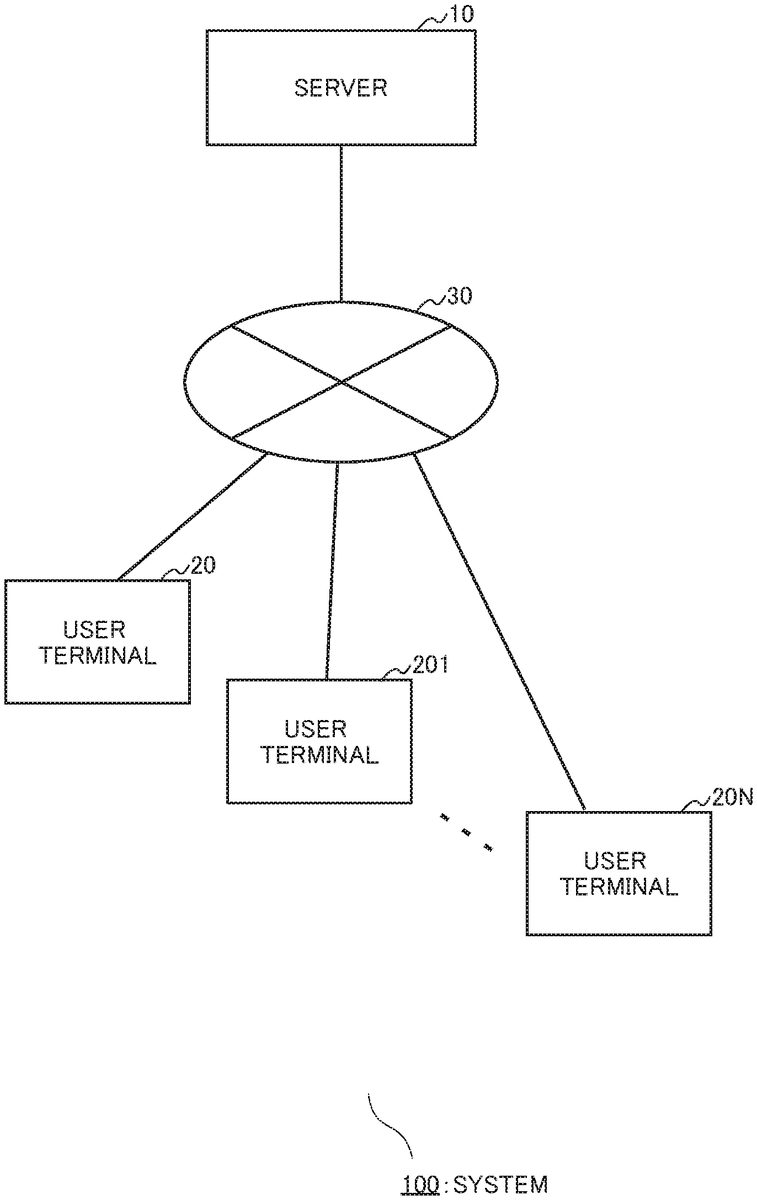
FIG. 1is a block diagram illustrating an example of a configuration of a system100according to one embodiment of the present invention. As illustrated inFIG. 1, the system100includes a server10, and user terminals20, and201to20N respectively used by users of the system100(“N” is an arbitrary integer. Hereinafter, they are simply referred to as “terminals20, and201to20N”). In this regard, the configuration of the system100is not limited to this configuration. The system100may be configured so that a plurality of users uses a single terminal, or may be configured so as to include a plurality of servers.
Each of the server10and the plurality of terminals20and201to20N is connected to a communication network30such as the Internet. In this regard, although it is not illustrated in the drawings, the plurality of terminals20and201to20N is connected to the communication network30by carrying out data communication with base stations managed by a telecommunication carrier by means of a radio communication line.
The system100includes the server10and the plurality of terminals20, and201to20N, thereby executing various kinds of processes to change appearance of a character composed of a plurality of models.
Here, the model means one constituting a character that appears in a video game. It is suitable that the model can be set to each portion of one character (for example, an arm, a foot, or a body). As an example of the model, there is one that can be set to each predetermined classification. The predetermined classification is not limited to biological border. For example, an object obtained by combining a torso and arms may be set to one classification, and hands may be set to another classification. Further, the character means a person or an animal that appears in the video game. The character is not limited particularly so long as it is a so-called object. It is preferable that appearance can be changed for each site. As an example of the character, there is a so-called avatar. In this regard, each model may be configured so that the user can possess each model as one item.
The server10is managed by an administrator of the system100, and has various kinds of functions to provide information regarding the various kinds of processes to each of the plurality of terminals20,201to20N. In the present embodiment, the server10is constructed by an information processing apparatus, such as a WWW server, and includes a storage medium for storing various kinds of information. In this regard, the server10is provided with a general configuration for carrying out the various kinds of processes, such as a control section, as a computer. However, its explanation herein is omitted. Further, in the system100, it is preferable that the server10manages various kinds of information from a point of view to reduce a processing load on each of the plurality of terminals20,201to20N. However, a storage region may be provided in a state that the server10can access the storage region. For example, the server10may be configured so as to be provided with a dedicated storage region outside the server10.
FIG. 2is a block diagram illustrating a configuration of a server10A that is an example of the configuration of the server10. As illustrated inFIG. 2, the server10A at least includes a specifying unit11(which corresponds to one example of a specifying function), a judging unit12(which corresponds to one example of a judging function), and a determining unit13(which corresponds to one example of a determining function).
The specifying unit11has a function to execute a process for specifying at least one model as a judgement target. Here, the judgement target means a model that becomes a target of predetermined judgement among models that appear in the video game. A configuration for specifying a judgement target is not limited particularly. However, it is preferable that one that satisfies a predetermined condition to become a judgement target is set to the judgement target. As an example of such a configuration, there is a configuration in which a model selected by the user is set to a judgement target.
The judging unit12has a function to execute a process for judging, in a case where a model of a portion corresponding to the judgement target among a plurality of models constituting a character (hereinafter, referred to as a “change target”) is changed into the judgement target, whether a predetermined adjacency condition is satisfied or not on the basis of a shape of the judgement target and a shape of a model adjacent to the change target. Here, the portion corresponding to the judgement target means a portion that has a site attribute the same as a site attribute of the judgement target or becomes a substitute for the site attribute of the judgement target. Further, the site attribute means an attribute indicating which site of a model the portion is, for example, an arm, a leg, or a hand. For example, in a case where the judgement target is a model indicating an arm, the “model of the portion corresponding to the judgement target among the plurality of models constituting the character” becomes a model indicating an arm among the models constituting the character, or a model of a site that becomes a substitute for the arm. Further, a case where the change target is changed into the judgement target means that a model or models, which is/are a part of models that currently constitutes a character is changed into another model. As an example of the case where the change target is changed into the judgement target, there is a case where a hand model MDL1is changed into a hand model MDL2. Further, the adjacency condition is a condition for preventing a state where a plurality of models collides with each other (so-called interference) from occurring. The content of the adjacency condition is not limited particularly. However, it is suitable that the adjacency condition relates a shape of the model (for example, a size, a length, a form, a design or the like). As an example of the adjacency condition, there is a condition that a shape A can adjoin to another shape A. As another example of the adjacency condition, there is a condition that a shape B can adjoin to a shape A and another shape B. In this regard, the adjacency condition may be configured by a plurality of necessary conditions or requirements. Further, the word “adjoin” means a relationship of two models, which has an adjoining positional relationship, among plural kinds of models that constitute one character. Namely, in the present embodiment, even a case where two models actually have no contact with each other may be included in a state of the word “adjoin”. As an example of a situation that two models adjoin to each other, there is a situation that two models are directly coupled to each other. As another example of the situation that two models adjoin to each other, there is a situation that two models are indirectly coupled to each other via any other object (for example, an arm of the character).
The determining unit13has a function to execute a process for determining whether the change target can be changed into the judgement target or not on the basis of a judgement result. How to utilize the determination by the determining unit13is not limited particularly. The determination by the determining unit13is utilized for a process to cause the user to be not able to select an unchangeable model, a process to inform the user of whether the model can be changed or not, and a process to change the model, for example.
Each of the plurality of terminals20, and201to20N is managed by the user (or a player) who plays the video game, and is configured by a communication terminal, such as a cellular phone terminal, a PDA (Personal Digital Assistants), or a mobile game device, by which the user can play a network delivery type video game, for example. In this regard, a configuration of the terminal that the system100can include is not limited to the examples described above. It may be a configuration in which the user can recognize the video game. As other examples of the configuration of the terminal, there are a so-called wearable divide such as a smartwatch, and a combination of the wearable divide and the communication terminal.
Further, each of the plurality of terminals20, and201to20N is connected to the communication network30, and includes hardware (for example, a display device for displaying a game screen, an audio output device and the like) and software for executing the video game by communicating with the server10. In this regard, each of the plurality of terminals20, and201to20N may be configured so as to be capable of directly communicating with each other without the server10. Further, each of the plurality of terminals20, and201to20N outputs an image of the video game to its own display device on the basis of information transmitted from the server10(for example, information regarding a game image).
Next, an operation of the system100according to the present embodiment will be described.
FIG. 3is a flowchart illustrating an example of game related processing executed by the system100. Hereinafter, a case where the server10A and the terminal20execute transmission and reception of information regarding the video game will be described as an example. In this regard, the game related processing according to the present embodiment is executed in a case where a change request for changing a model of a hand of a character is received from a user.
In the game related processing, the server10A first specifies a judgement target (Step S11). In the present embodiment, the server10A specifies a hand model MDL1designated by the user as a judgement target.
When the judgement target is specified, the server10A judges whether an adjacency condition is satisfied or not (Step S12). In the present embodiment, in a case where a hand model MDL2of a current character is changed into a hand model MDL1, the server10A judges whether the adjacency condition is satisfied or not on the basis of a shape of the hand model MDL1and a shape of a model adjacent to the hand model MDL2.
The server10A determines whether a change target can be changed into the judgement target or not on the basis of a judgement result (Step S13). In the present embodiment, in a case where the judgement result indicates that the adjacency condition is satisfied, the server10A determines that the hand model MDL2can be changed into the hand model MDL1. On the other hand, in the present embodiment, in a case where the judgement result indicates that the adjacency condition is not satisfied, the server10A determines that the hand model MDL2cannot be changed into the hand model MDL1. Moreover, the server10A transmits information regarding the determination to the terminal20.
FIG. 4is a flowchart illustrating an example of an operation of the server10A side in the game related processing. Here, an operation of the server10A in the system100will be described again.
In the game related processing, the server10A first specifies a judgement target (Step S101); judges whether an adjacency condition is satisfied or not (Step S102); determines whether a change target can be changed into the judgement target or not (Step S103), and terminates the processing herein.
FIG. 5is a flowchart illustrating an example of an operation of the terminal20in a case where the terminal20executes the game related processing. Hereinafter, the case where the terminal20executes the game related processing by a single body will be described as an example. In this regard, the terminal20is configured to include similar functions to the configuration of the server10A. For this reason, its description is omitted from a point of view to avoid repeated explanation.
In the game related processing, the terminal20first specifies a judgement target (Step S201); judges whether an adjacency condition is satisfied or not (Step S202); determines whether a change target can be changed into the judgement target or not (Step S203); and terminates the processing herein.
As explained above, as one side of the first embodiment, the system100for controlling progress of the video game is configured so as to at least include the specifying unit11, the judging unit12, and the determining unit13. Thus, the specifying unit11specifies at least one model as the judgement target; in a case where the change target is changed into the judgement target, the judging unit12judges whether the predetermined adjacency condition is satisfied or not on the basis of the shape of the judgement target and the shape of the model adjacent to the change target; and the determining unit13determines whether the change target can be changed into the judgement target on the basis of the judgement result. Therefore, it is possible to change appearance of a character without impairing the appearance of the character by a configuration with a smaller processing load.
In particular, the system100judges whether the adjacency condition is satisfied or not on the basis of the mutual shapes of the adjacent models. Namely, in a case where the mutual shapes of the adjacent models satisfy the adjacency condition in the system100, it is possible to change one model into the other model that satisfies the adjacency condition. By configuring the system100in this manner, it is possible to change appearance of a character without impairing the appearance of the character by a configuration with a smaller processing load compared with a case where judgement of whether the models collide with each other (that is, collision judgement of the models) is executed.
Second Embodiment
FIG. 6is a block diagram illustrating a configuration of a server10B, which is an example of the server10. In the present embodiment, the server10B at least includes a specifying unit11, a judging unit12B (which corresponds to one example of a judging function), and a determining unit13.
The judging unit12B has a function to execute a process for referring to a type of a shape that is set to each of models to judge whether a predetermined adjacency condition is satisfied or not. Here, a configuration for setting the type of the shape to each of the models is not limited particularly. However, it is suitable that information regarding the models is stored so as to contain the type of the shape thereof when the information is to be stored. Further, as an example of the configuration to refer to the type of the shape thereof for judgement, there is a configuration in which judgement is made on the basis of a type of a judgement target, a type of a shape of a model adjacent to a change target, and information defining types that are allowed to adjoin thereto. In this regard, the server10B may be configured so that various kinds of information are stored in a predetermined storage region.
FIG. 7is a flowchart illustrating an example of game related processing executed by the system100. Hereinafter, an operation of the server10B side will be described as an example. In this regard, explanation for a case where the terminal20(that is, a terminal20that includes similar functions to the configuration of the server10B) executes the game related processing by a single body, and portions that have already been explained are omitted from a point of view to avoid repeated explanation.
When a judgement target is specified, the server10B refers to a type of a shape that is set to each model to judge whether a predetermined adjacency condition is satisfied or not (Step S2-11). In the present embodiment, in a case where a hand model MDL2is changed into a hand model MDL1, the server10B judges whether the adjacency condition is satisfied or not on the basis of a type of a shape of the hand model MDL1, a type of a shape of a model adjacent to the hand model MDL2, and information defining types that are allowed to adjoin thereto.
As explained above, as one side of the second embodiment, the system100is configured so as to at least include the specifying unit11, the judging unit12B, and the determining unit13. Thus, the judging unit12B refers to the type of the shape that is set to each of the models to judge whether the predetermined adjacency condition is satisfied or not. Therefore, it is possible to change appearance of a character without impairing the appearance of the character by a configuration with a smaller processing load.
Namely, each model has the type of the shape, whereby compared with a case where collision judgement is executed, it is possible to make a processing load smaller in a case where appearance of a character is changed without impairing the appearance of the character even in a video game in which models with various shapes are adopted. In other words, the system100can realize diversity of the models with a smaller processing load than that in a conventional technique in the video game in which appearance of a character is changed without impairing the appearance of the character. Further, in a case where a new model is added thereto, it is possible to deal with it without rewriting information on conventional models. Therefore, the system100can improve the degree of freedom in design of the model with a smaller processing load than that in the conventional technique.
Third Embodiment
FIG. 8is a block diagram illustrating a configuration of a server10C, which is an example of the server10. In the present embodiment, the server10C at least includes a specifying unit11, a judging unit12C (which corresponds to one example of a judging function), and a determining unit13.
The judging unit12C has a function to execute a process for referring to a type regarding a portion adjacent to another model that is set to each of models (hereinafter, referred to as an “adjacent portion type”) to judge whether a predetermined adjacency condition is satisfied or not. Here, a configuration for setting the adjacent portion type to each of the models is not limited particularly. However, it is suitable that information regarding the models is stored so as to contain the adjacent portion type when the information is to be stored. Further, as an example of the configuration to refer to the adjacent portion type for judgement, there is a configuration in which judgement is made on the basis of an adjacent portion type of a judgement target, an adjacent portion type of a model adjacent to a change target, and information defining adjacent portion types that are allowed to adjoin thereto. In this regard, the server10C may be configured so that various kinds of information are stored in a predetermined storage region.
FIG. 9is a flowchart illustrating an example of game related processing executed by the system100. Hereinafter, an operation of the server10C side will be described as an example. In this regard, explanation for a case where the terminal20(that is, the terminal20that includes similar functions to the configuration of the server10C) executes the game related processing by a single body, and portions that have already been explained are omitted from a point of view to avoid repeated explanation.
When the judgement target is specified, the server10C refers to an adjacent portion type that is set to each of models to judge whether a predetermined adjacency condition is satisfied or not (Step S2-11). In the present embodiment, in a case where a hand model MDL2is changed into a hand model MDL1, the server10C judges whether the adjacency condition is satisfied or not on the basis of the adjacent portion type of the hand model MDL1, the adjacent portion type of a model adjacent to the hand model MDL2, and information defining adjacent portion types that are allowed to adjoin thereto.
As explained above, as one side of the third embodiment, the system100is configured so as to at least include the specifying unit11, the judging unit12C, and the determining unit13. Thus, the judging unit12C refers to the adjacent portion type that is set to each of the models to judge whether the predetermined adjacency condition is satisfied or not. Therefore, it is possible to change appearance of a character without impairing the appearance of the character by a configuration with a smaller processing load.
Namely, each model has the adjacent portion type, whereby compared with a case where collision judgement is executed, it is possible to make a processing load smaller in a case where appearance of a character is changed without impairing the appearance of the character even in a video game in which models with various shapes are adopted. The system100can realize diversity of the models with a smaller processing load than that in a conventional technique in the video game in which appearance of a character is changed without impairing the appearance of the character. Further, in a case where a new model is added thereto, it is possible to deal with it without rewriting information on conventional models. Therefore, the system100can improve the degree of freedom in design of the model with a smaller processing load than that in the conventional technique.
Fourth Embodiment
FIG. 10is a block diagram illustrating a configuration of a server10D, which is an example of the server10. In the present embodiment, the server10D at least includes a specifying unit11, a judging unit12, a determining unit13, and an adjusting unit15(which corresponds to one example of an adjusting function).
The adjusting unit15has a function to execute a process for adjusting a shape of an adjacent model on the basis of information that is set to a model. The phrase “adjusting a shape of an adjacent model” means that a shape of at least a part of an adjacent model is changed so that models do not interfere with each other. A configuration to adjust a shape of a model is not limited particularly. However, it is suitable to refer to a taper value that is set to at least one of adjacent models, and change a shape of one model that becomes an adjustment target. As an example of such a configuration, there is a configuration in which a shape of a joint portion of a model, positioned at a central side of a character, among adjacent models is gradually tapered toward a terminal portion. Further, as another example of the configuration to adjust the shape of the model, there is a configuration in which a shape of one model or shapes of mutual models is/are adjusted so that predetermined reference positions of the models (that is, a reference position for adjustment) are matched with each other. In this regard, a configuration for setting a taper value to at least one of adjacent models is not limited particularly. As an example of such a configuration, there is a configuration in which a character is configured by one body model, two hand models, and two foot models, and taper values are set to the respective hand models and the respective foot models.
FIG. 11is a flowchart illustrating an example of adjustment processing executed by the system100. Hereinafter, an operation of the server10D side will be described as an example. In this regard, explanation for a case where the terminal20(that is, a terminal20that includes similar functions to the configuration of the server10D) executes the adjustment processing by a single body, and portions that have already been explained are omitted from a point of view to avoid repeated explanation. In this regard, in the present embodiment, a case where a change of a hand model is executed will be described as an example.
In the adjustment processing, the server10D first adjusts a shape of adjacent models on the basis of information that is set to a model (Step S4-11), and terminates the processing herein. In the present embodiment, the server10D gradually tapers a shape of a joint portion of a body model (that is, a portion that is connected to each of hand models and foot models) toward a terminal portion thereof on the basis of information that is set to each of two hand models and two foot models.
As explained above, as one side of the fourth embodiment, the system100is configured so as to at least include the specifying unit11, the judging unit12, the determining unit13, and the adjusting unit15. Thus, the adjusting unit15adjusts the shape of the adjacent model on the basis of the information that is set to the model. Therefore, it is possible to change appearance of a character without impairing the appearance of the character by a configuration with a smaller processing load.
Namely, the system100is configured so as to adjust a model, for which it is judged that the model can be changed, on the basis of the information that is set to the model while allowing the model to interfere with another adjacent model, thereby realizing a change in appearance of a character without impairing appearance thereof. In other words, upon providing a system by which appearance of a character is not impaired, the system100uses information that is set to the model without narrowing down models for each of which an adjacency condition is satisfied (that is, without enlarging restrictions in design of the model), thereby allowing a flexible response. Therefore, the system100can change appearance of a character without impairing the appearance of the character by a configuration with a smaller processing load, and variegate a combination of models.
Fifth Embodiment
In the present embodiment, a system100can change appearance of a character (for example, an avatar) composed of a plurality of models. An owner of the character is allowed to combine various models, thereby enjoying customizing of the character.
FIG. 12is an explanatory drawing for explaining a concept of models that constitute a character. As illustrated inFIG. 12, a character1000is composed of five kinds of models that include a face model1010, a hair model1020, a body model1030, hand models1040, and foot models1050. Here, up to which site the body model1030contains is defined in advance. Specifically, arm (up to a wrist), a chest, a belly, a neck, and a leg (up to an ankle) are sites that constitute the body model1030. On the other hand, with respect to each of the hand model1040and the foot model1050, there are plural types of constituent sites. In the hand model1040, there are constituent sites thereof such as one having a range from fingers of a hand to an arm, and one having a range from fingers of a hand to an elbow. Further, similarly, with respect to the foot model1050, there are constituent sites of the foot model1050such as one having a range from toes to an ankle, and one having a range from toes to a knee.
In this regard,FIG. 12illustrates a character in a nude state. Namely, clothes, items and the like are not reflected to the character, and a model constituting the character becomes a model indicating a nature state of the character. However, the model according to the present embodiment includes a model to which clothes or items are reflected, such as a body model in which a body wears clothes, for example.
In the present embodiment, in particular, it is judged whether the body model can be combined with the hand model or not, or whether the body model can be combined with the foot model or not. There are two conditions to be used for judgement. One condition is a condition regarding a design of a body model and a length of a model to be connected to the body model (hereinafter, referred to as a “first adjacency condition”). The other condition is a condition regarding a size of both of the models at a connecting part between the body model and the model to be connected to the body model (hereinafter, referred to as a “second adjacency condition”). When the first adjacency condition and the second adjacency condition are satisfied, a change of the model is allowed.
FIG. 13is a concept view illustrating a concept of a combination between a hand model and a body model. As illustrated in a left side ofFIG. 13, the hand model1040is classified into plural stages in view of a length thereof. In the present embodiment, the hand model1040is classified into a short model1041, a middle model1042, and a long model1043. As illustrated in a right side ofFIG. 13, the body model1030containing up to a wrist is combined with the hand model1040with a classified length. Here, they are not necessarily able to be combined with each other as illustrated in a right side ofFIG. 13. As described above, it is required that the first adjacency condition is satisfied.
FIG. 14is an explanatory drawing for explaining an example of a storage state of information that indicates the first adjacency condition. A correspondence relationship for each item is defined in the form of a matrix. Combinations in the matrix to each of which a o-mark (circle) is applied indicate that the first adjacency condition is satisfied. Namely, specifically, the matrix means that a body model that can match with a long model (L matching body) can match with any of a short model (S hand model), a middle model (M hand model), and a long model (L hand model). On the other hand, combinations in the matrix to each of which a x-mark is applied indicate that the first adjacency condition is not satisfied. Namely, specifically, the matrix means that a body model that can match with a short model (S matching body) does not match with each of a middle model (M hand model) and a long model (L hand model).
FIG. 15is a concept view illustrating a concept of a connecting part between a body model and a hand model. As illustrated in an upper column ofFIG. 15, a body model and a hand model respectively include models for a large size (1035and1045) and models for a small size (1037and1047). The size mentioned herein means a size of a connecting part, and corresponds to an adjacent portion type. As illustrated in a lower column ofFIG. 15, the models with the same size may be connected, and models with different sizes from each other may be combined. Here, they are not necessarily able to be combined with each other as illustrated in the lower column ofFIG. 15. As described above, it is required that the second adjacency condition is satisfied.
FIG. 16is an explanatory drawing for explaining an example of a storage state of information that indicates the second adjacency condition. A correspondence relationship for each item is defined in the form of a matrix. Combinations in the matrix to each of which a o-mark (circle) is applied indicate that the second adjacency condition is satisfied. Namely, specifically, the matrix means that in a case where a body model is a small size (S arm body), a size of a hand model can match with either a small size (S size hand) or a large size (L size hand). On the other hand, combinations in the matrix to each of which a x-mark is applied indicate that the second adjacency condition is not satisfied. Namely, specifically, the matrix means that in a case where the body model is a large size (L arm body), the size of the hand model does not match with the hand model with the large size (L size hand).
As described above, the first adjacency condition and the second adjacency condition have been described with respect toFIG. 12,FIG. 13,FIG. 14,FIG. 15, andFIG. 16by using the relationship between the hand model and the body model as an example. Next, information regarding each of the models will be described. In the present embodiment, information to be associated is different depending upon a site. With respect to the body model, at least information indicating which length of a model the body model can match and information indicating a size of a connecting part are associated with each other. By associating these kinds of information with each other, it is possible to judge whether the first adjacency condition is satisfied or not and whether the second adjacency condition is satisfied or not. Further, with respect to the hand model, at least information regarding a type of a length and information indicating a size of a connecting part are associated with each other. By associating these kinds of information with each other, it is possible to judge whether the first adjacency condition is satisfied or not and whether the second adjacency condition is satisfied or not.
In this regard, a relationship between a foot model and a body model is similar to the relationship between the hand model and the body model. Therefore, explanation thereof is omitted herein.
Next, a configuration of the system100will be described.
The system100includes a server10Z and user terminals20, and201to20N (“N” is an arbitrary integer. Hereinafter, they are simply referred to as “terminals20, and201to20N”). In this regard, a configuration of the system100is not limited to this, and the system100may be configured so that a plurality of users uses a single terminal.
The server10Z has various kinds of functions to cause the video game to proceed. For example, the server10Z has a function to process various kinds of information regarding each character in the virtual space. Further, the server10Z has various kinds of functions to provide each of the plurality of terminals20, and201to20N with information for displaying a game image. Further, the server10Z has various kinds of functions to communicate with an external apparatus such as the terminals20, and201to20N via a communication network30. In the present embodiment, the server10Z is constructed by an information processing apparatus such as a WWW server, and includes a storage medium for storing the various kinds of information. In this regard, the server10Z may be configured so as to be provided with a storage region in a state that the server10Z can access the storage region. For example, the system100may be configured so as to be provided with the storage region outside the system100.
FIG. 17is a block diagram illustrating a configuration of the server10Z that is an example of the server10. In the present embodiment, the server10Z at least includes a specifying unit11Z (which corresponds to one example of a specifying function), a judging unit12Z (which corresponds to one example of a judging function), a determining unit13Z (which corresponds to one example of a determining function), and an adjusting unit15Z (which corresponds to one example of an adjusting function).
The specifying unit11Z has a function to execute a process for specifying at least one model as a judgement target. In the present embodiment, it is configured so that a model that is to be changed by a change request from a user is set to the judgement target.
The judging unit12Z has a function to execute a process for judging whether a judgement target and a model adjacent to a change target satisfy an adjacency condition or not. The adjacency condition includes a first adjacency condition and a second adjacency condition. Namely, the judging unit12Z judges whether a relationship between the judgement target and the model adjacent to the change target is a relationship that both the first adjacency condition and the second adjacency condition are satisfied or not. Here, it is suitable that the adjacency condition is not a condition defining that interference between models is not allowed, but is a condition defining that a certain range of interference is allowed. Further, it is suitable that the certain range of interference is such a degree that it can be adjusted by a process by the adjusting unit15Z (will be described later).
The determining unit13has a function to execute a process for determining whether the change target can be changed into the judgement target or not on the basis of a judgement result. In the present embodiment, the determining unit13also has a function to execute a process for changing the models in a case where it is determined that the change target can be changed into the judgement target. On the other hand, the determining unit13also has a function to execute a process for prohibiting selection of a model in a case where it is determined that the change target cannot be changed into the judgement target.
The adjusting unit15Z has a function to execute a process for adjusting a shape of an adjacent model on the basis of information that is set to the model. In the present embodiment, the adjusting unit15Z refers to a taper value that is set to a hand model or a foot model to gradually taper a portion of a body model adjacent to the other model (or a connecting part) toward a terminal portion thereof so as to prevent mismatching with a body portion with a continuous surface from occurring. Namely, in a case where the hand model is adjacent to the body model, an arm portion in the body model becomes thinner. Vertex color or the like is used for a definition of whether it is the terminal portion or not. Further, in the present embodiment, a definition regarding whether it is thick or thin is dealt by a positive or negative offset in a direction of a vertex normal. Further, the adjusting unit15Z according to the present embodiment executes vertex processing on a GPU by using a shader. In this regard, the taper value that is set to the model may be set to zero. In this case, a result subjected to the adjustment also becomes the same result as that not subjected to the adjustment.
Each of the plurality of terminals20, and201to20N is managed by the user (or a player) who plays the video game, and is configured by a communication terminal, such as a cellular phone terminal, a PDA (Personal Digital Assistants), or a mobile game device, by which the user can play a network delivery type video game, for example. In this regard, a configuration of the terminal that the system100can include is not limited to the examples described above. It may be a configuration in which the user can recognize the video game. As other examples of the configuration of the terminal, there are a so-called wearable divide such as a smartwatch, and a combination of the wearable divide and the communication terminal.
Further, each of the plurality of terminals20, and201to20N is connected to the communication network30, and includes hardware (for example, a display device for displaying a game screen, an audio output device and the like) and software for executing the video game by communicating with the server10Z. In this regard, each of the plurality of terminals20, and201to20N may be configured so as to be capable of directly communicating with each other without the server10Z. Further, each of the plurality of terminals20, and201to20N outputs an image of the video game to its own display device on the basis of information transmitted from the server10Z (for example, information regarding a game image).
Next, an operation of the system100according to the present embodiment will be described.
FIG. 18is a flowchart illustrating an example of game related processing executed by the system100. Hereinafter, an operation of the server10Z will be described as an example. In this regard, explanation for a case where a terminal20(that is, a terminal20that includes similar functions to the configuration of the server10Z) executes the game related processing by a single body, and portions that have already been explained are omitted from a point of view to avoid repeated explanation. The game related processing according to the present embodiment is executed in a case where information regarding a change request is received from the terminal20that received a change request for a hand model from the user.
In the game related processing, the server10Z first specifies a judgement target (Step S5-11). In the present embodiment, the server10Z specifies a hand model MDL1designated by the user as the judgement target.
Subsequently, the server10Z judges whether a first adjacency condition is satisfied or not (Step S5-12). In the present embodiment, the server10Z judges whether the first adjacency condition is satisfied or not on the basis of a length of the hand model MDL1, a length with which a body model MDL9can match, and information indicating the first adjacency condition.
In a case where it is judged that the first adjacency condition is not satisfied (“N” at Step S5-12), the server10Z determines that the hand model cannot be changed (Step S5-13). Subsequently, when it is determined that the hand model cannot be changed, the server10Z executes various kinds of processes based on determination that the hand model cannot be changed (Step S5-14), and terminates the processing herein. In the present embodiment, the server10Z transmits image information to the terminal20. The image information is used to cause the terminal20to display information indicating that the hand model cannot be changed.
On the other hand, in a case where it is judged that the first adjacency condition is satisfied (“Y” at Step S5-12), the server10Z judges whether a second adjacency condition is satisfied or not (Step S5-15). In the present embodiment, the server10Z judges whether the second adjacency condition is satisfied or not on the basis of a size of a connecting part of the hand model MDL1, a size of a connecting part of the body model MDL9to the hand model MDL1, and information indicating the second adjacency condition.
In a case where it is judged that the second adjacency condition is not satisfied (“N” at Step S5-15), the server10Z determines that the hand model cannot be changed (Step S5-13). On the other hand, in a case where it is judged that the second adjacency condition is satisfied (“Y” at Step S5-15), the server10Z determines that the hand model can be changed (Step S5-16).
Subsequently, when it is determined that the hand model can be changed, the server10Z adjusts the model (Step S5-17). In the present embodiment, the server10Z refers to a taper value that is set to the hand model MDL1, and gradually tapers the connecting part of the body model MDL9to be connected to the hand model MDL1toward a terminal portion thereof.
When the model is adjusted, the server10Z changes the model into the adjusted model (Step S5-18), and terminates the processing herein. In the present embodiment, the server10Z changes a site of a hand of the model of a character into the hand model MDL1to update character information, and reflects a tapering result of the body model MDL9to the character information. Further, in the present embodiment, the server10Z transmits the information thus updated and reflected to the terminal20. In this regard, in the present embodiment, timing to execute the adjustment is timing after it is determined that that the hand model can be changed. However, this timing is not limited to such a configuration. For example, the system100may be configured so as to execute the adjustment when data to be displayed as a game image are generated. Namely, the system100may be configured so as to execute adjustment processing separately.
As explained above, as one side of the fifth embodiment, the system100for controlling progress of the video game is configured so as to at least include the specifying unit11Z, the judging unit12Z, and the determining unit13Z. Thus, the specifying unit11Z specifies at least one model as the judgement target; in a case where the change target is changed into the judgement target, the judging unit12Z judges whether the predetermined adjacency condition is satisfied or not on the basis of the shape of the judgement target and the shape of the model adjacent to the change target; and the determining unit13Z determines whether the change target can be changed into the judgement target or not on the basis of the judgement result. Therefore, it is possible to change appearance of a character without impairing the appearance of the character by a configuration with a smaller processing load.
In particular, the system100judges whether the adjacency condition is satisfied or not on the basis of the mutual shapes of the adjacent models. Namely, in a case where the mutual shapes of the adjacent models satisfy the adjacency condition in the system100, it is possible to change one model into the other model that satisfies the adjacency condition. By configuring the system100in this manner, it is possible to change appearance of a character without impairing the appearance of the character by a configuration with a smaller processing load compared with a case where judgement of whether the models collide with each other (that is, collision judgement of the models) is executed.
Further, as one side of the fifth embodiment, the system100is configured so as to at least include the specifying unit11Z, the judging unit12Z, and the determining unit13Z. Thus, the judging unit12Z refers to the type of the shape that is set to each of the models to judge whether the predetermined adjacency condition is satisfied or not. Therefore, it is possible to change appearance of a character without impairing the appearance of the character by a configuration with a smaller processing load.
Namely, each model has the type of the shape, whereby compared with a case where collision judgement is executed, it is possible to make a processing load smaller in a case where appearance of a character is changed without impairing the appearance of the character even in a video game in which models with various shapes are adopted. In other words, the system100can realize diversity of the models with a smaller processing load than that in a conventional technique in the video game in which appearance of a character is changed without impairing the appearance of the character. Further, in a case where a new model is added thereto, it is possible to deal with it without rewriting information on conventional models. Therefore, the system100can improve the degree of freedom in design of the model with a smaller processing load than that in the conventional technique.
Further, as one side of the fifth embodiment, the system100is configured so as to at least include the specifying unit11Z, the judging unit12Z, and the determining unit13Z. Thus, the judging unit12Z refers to the adjacent portion type that is set to each of the models to judge whether the predetermined adjacency condition is satisfied or not. Therefore, it is possible to change appearance of a character without impairing the appearance of the character by a configuration with a smaller processing load.
Namely, each model has the adjacent portion type, whereby compared with a case where collision judgement is executed, it is possible to make a processing load smaller in a case where appearance of a character is changed without impairing the appearance of the character even in a video game in which models with various shapes are adopted. The system100can realize diversity of the models with a smaller processing load than that in a conventional technique in the video game in which appearance of a character is changed without impairing the appearance of the character. Further, in a case where a new model is added thereto, it is possible to deal with it without rewriting information on conventional models. Therefore, the system100can improve the degree of freedom in design of the model with a smaller processing load than that in the conventional technique.
Further, as one side of the fifth embodiment, the system100is configured so as to at least include the specifying unit11Z, the judging unit12Z, the determining unit13Z, and the adjusting unit15Z. Thus, the adjusting unit15Z adjusts the shape of the adjacent model on the basis of the information that is set to the model. Therefore, it is possible to change appearance of a character without impairing the appearance of the character by a configuration with a smaller processing load.
Namely, the system100is configured so as to adjust a model, for which it is judged that the model can be changed, on the basis of the information that is set to the model while allowing the model to interfere with another adjacent model, thereby realizing a change in appearance of a character without impairing appearance thereof. In other words, upon providing a system by which appearance of a character is not impaired, the system100uses information that is set to the model without narrowing down models for each of which an adjacency condition is satisfied (that is, without enlarging restrictions in design of the model), thereby allowing a flexible response. Therefore, the system100can change appearance of a character without impairing the appearance of the character by a configuration with a smaller processing load, and variegate a combination of models.
In this regard, although it has not been mentioned particularly in the embodiments described above, the system100may be configured so as to refer to information in which a type of a changeable model is associated with each model and execute various kinds of judgement. Further, as another example, the system100may be configured so as to refer to information in which a shape of a model is classified for each model, information defining combinations that are allowed to adjoin thereto, and shapes of a changing side and a changed side, and judge whether the change is allowed or not. Further, a basis of the shape of the model means that it is based on appearance of the model. As an example of the configuration on the basis of the shape, there is a configuration on the basis of any one or more element of a form, a length, and a size.
In this regard, although it has not been mentioned particularly in the embodiments described above, the system100is configured so as to execute the adjustment even in a case where a taper value that is set to a model is zero. However, this is not limited to such a configuration. For example, the system100may be configured so as to judge whether the taper value is more than zero or not and execute the adjustment only in a case where the taper value is more than zero.
In this regard, although it has not been mentioned particularly in the embodiments described above, the system100is configured so as to adjust a change portion in the present embodiment. However, the system100may be configured to adjust models so as to reflect the taper values of all of the models when the character information is to be updated.
As explained above, each of the embodiments of the present application solves one or two or more shortages. In this regard, the effects by each of the embodiments are non-limiting effects or one example of the non-limiting effects.
In this regard, in each of the embodiments described above, each of the plurality of user terminals20,201to20N and the server10carries out the various kinds of processing described above in accordance with various kinds of control programs (for example, a program) stored in the storage device with which the corresponding terminal or server is provided. A control unit (not illustrated in the drawings particularly) may be configured so as to have functions to execute processes that are respectively to be executed by the units11Z to13Z and15Z.
Further, the configuration of the system100is not limited to the configuration that has been explained as an example of each of the embodiments described above. For example, the system100may be configured so that the server10carries out a part or all of the processes that have been explained as the processes carried out by the user terminal. Alternatively, the system100may be configured so that any of the plurality of user terminals20,201to20N (for example, the user terminal20) carries out a part or all of the processes that have been explained as the processes carried out by the server10. Further, the system100may be configured so that a part or all of the storing sections included in the server10is included in any of the plurality of user terminals20,201to20N. Namely, the system100may be configured so that a part or all of the functions of any one of the user terminal20and the server10according to the system100is included in the other.
APPENDIX
The explanation of the embodiments described above has been described so that the following inventions can be at least realized by a person having a normal skill in the art to which the present invention belongs.
(1)
A program for causing a user terminal to realize functions to change appearance of a character composed of a plurality of models,
wherein the functions include:
a specifying function configured to specify at least one model as a judgement target;
a judging function configured to judge, in a case where a model of a portion corresponding to the judgement target among a plurality of models (hereinafter, referred to as a “change target”) is changed into the judgement target, whether a predetermined adjacency condition is satisfied or not on a basis of a shape of the judgement target and a shape of a model adjacent to the change target, the plurality of models constituting the character; and
a determining function configured to determine whether the change target can be changed into the judgement target or not on a basis of a judgement result by the judging function.
(2)
The program according to (1),
wherein the judging function includes a function configured to refer to a type of a shape that is set to each of the models to judge whether the predetermined adjacency condition is satisfied or not.
(3)
The program according to (1) or (2),
wherein the judging function includes a function configured to refer to a type of a portion adjacent to another model that is set to each of the models to judge whether the predetermined adjacency condition is satisfied or not.
(4)
The program according to any one of (1) to (3),
wherein the functions further include:
an adjusting function configured to adjust a shape of an adjacent model on a basis of information that is set to the model.
(5)
The program according to any one of (1) to (4),
wherein the judging function includes a function configured to refer to a storage region to judge whether the predetermined adjacency condition is satisfied or not, model information being stored in the storage region, the model information containing a size of each of the models.
(6)
The program according to any one of (1) to (5),
wherein the judging function includes a function configured to refer to a storage region to judge whether the predetermined adjacency condition is satisfied or not, model information regarding a body model containing up to a forearm and model information regarding a hand model containing at least a model whose part overlaps a portion contained in the body model being stored in the storage region.
(7)
The program according to any one of (1) to (6),
wherein the judging function includes a function configured to refer to a storage region to judge whether the predetermined adjacency condition is satisfied or not, model information regarding a body model containing up to an ankle and model information regarding a foot model containing at least a model whose part overlaps a portion contained in the body model being stored in the storage region.
(8)
A program for causing a server to realize at least one function of the functions that the program described in any one of (1) to (7) causes the user terminal to realize, the server being capable of communicating with the user terminal.
(9)
A user terminal into which the program described in any one of (1) to (8) is installed.
(10)
A system for changing appearance of a character composed of a plurality of models, the system comprising:
a specifying unit configured to specify at least one model as a judgement target;
a judging unit configured to judge, in a case where a model of a portion corresponding to the judgement target among a plurality of models (hereinafter, referred to as a “change target”) is changed into the judgement target, whether a predetermined adjacency condition is satisfied or not on a basis of a shape of the judgement target and a shape of a model adjacent to the change target, the plurality of models constituting the character; and
a determining unit configured to determine whether the change target can be changed into the judgement target or not on a basis of a judgement result by the judging unit.
(11)
The system according to (10),
wherein the server includes the specifying unit, the judging unit, and the determining unit, and
wherein the user terminal includes:
a display unit configured to output a game image to a display screen of a display device on a basis of image information for displaying the game image, the image information being transmitted from the server, the game image indicating progress of a video game.
(12)
A program for causing a server to realize functions to change appearance of a character composed of a plurality of models,
wherein the functions include:
a specifying function configured to specify at least one model as a judgement target;
a judging function configured to judge, in a case where a model of a portion corresponding to the judgement target among a plurality of models (hereinafter, referred to as a “change target”) is changed into the judgement target, whether a predetermined adjacency condition is satisfied or not on a basis of a shape of the judgement target and a shape of a model adjacent to the change target, the plurality of models constituting the character; and
a determining function configured to determine whether the change target can be changed into the judgement target or not on a basis of a judgement result by the judging function, and
wherein the program causes a user terminal to realize an outputting function configured to output a game image to a display screen of a display device on a basis of information, the game image indicating progress of a video game transmitted from the server, the information being used for displaying the game image.
(13)
A program for causing a server to realize functions to change appearance of a character composed of a plurality of models,
wherein the functions include:
a specifying function configured to specify at least one model as a judgement target;
a judging function configured to judge, in a case where a model of a portion corresponding to the judgement target among a plurality of models (hereinafter, referred to as a “change target”) is changed into the judgement target, whether a predetermined adjacency condition is satisfied or not on a basis of a shape of the judgement target and a shape of a model adjacent to the change target, the plurality of models constituting the character; and
a determining function configured to determine whether the change target can be changed into the judgement target or not on a basis of a judgement result by the judging function.
(14)
A method of changing appearance of a character composed of a plurality of models, the method comprising:
a specifying process of specifying at least one model as a judgement target;
a judging process of judging, in a case where a model of a portion corresponding to the judgement target among a plurality of models (hereinafter, referred to as a “change target”) is changed into the judgement target, whether a predetermined adjacency condition is satisfied or not on a basis of a shape of the judgement target and a shape of a model adjacent to the change target, the plurality of models constituting the character; and
a determining process of determining whether the change target can be changed into the judgement target or not on a basis of a judgement result by the judging process.
(15)
A method of changing appearance of a character composed of a plurality of models by a system, the system comprising a communication network, a server, and a user terminal, the method comprising:
a specifying process of specifying at least one model as a judgement target;
a judging process of judging, in a case where a model of a portion corresponding to the judgement target among a plurality of models (hereinafter, referred to as a “change target”) is changed into the judgement target, whether a predetermined adjacency condition is satisfied or not on a basis of a shape of the judgement target and a shape of a model adjacent to the change target, the plurality of models constituting the character; and
a determining process of determining whether the change target can be changed into the judgement target or not on a basis of a judgement result by the judging process.
INDUSTRIAL APPLICABILITY
According to one of the embodiments of the present invention, it is useful for a video game in which appearance of a character composed of a plurality of models is changed.
EXPLANATION OF REFERENCE NUMERALS
10server11specifying unit12judging unit13determining unit15adjusting unit20,201to20N user terminal30communication network100system
Claims
- A non-transitory computer-readable media including a program for causing a user terminal to perform operations to change an appearance of a character, the character being composed of character models selected from among a plurality of available models, the operations comprising: specifying at least one of the plurality of available models as a judgement target;judging, in a case where a first model of the character models corresponding to the judgement target is to be changed into the judgement target, whether a predetermined adjacency condition is satisfied or not on a basis of a shape of the judgement target and a shape of a second model of the character models adjacent to first model;and determining whether the first model can be changed into the judgement target or not on a basis of a judgement result by the judging.
- The non-transitory computer-readable media including the program according to claim 1 , wherein the judging is configured to refer to a type of the shape that is set to the second model of the character models to judge whether the predetermined adjacency condition is satisfied or not.
- The non-transitory computer-readable media including the program according to claim 1 , wherein the judging is configured to refer to a type of a portion adjacent to a third model that is set to the second model of the character models to judge whether the predetermined adjacency condition is satisfied or not.
- The non-transitory computer-readable media including the program according to claim 1 , the operations further comprising: adjusting a shape of an adjacent model of the character models on a basis of information that is set to the first model.
- A system for changing an appearance of a character, the character being composed of character models selected from among a plurality of available models, the system comprising: a processor;and a memory including a program that, when executed by the processor, causes the processor to perform operations, the operations including: specifying at least one of the plurality of available models as a judgement target;judging, in a case where a first model of the character models corresponding to the judgement target is to be changed into the judgement target, whether a predetermined adjacency condition is satisfied or not on a basis of a shape of the judgement target and a shape of a second model of the character models adjacent to the first model;and determining whether the first model can be changed into the judgement target or not on a basis of a judgement result by the processor.
- A non-transitory computer-readable media including a program for causing a server to perform operations to change an appearance of a character, the character being composed of character models selected from among a plurality of available models, the operations comprising: specifying at least one of the plurality of available models as a judgement target;judging, in a case where a first model of the character models corresponding to the judgement target is to be changed into the judgement target, whether a predetermined adjacency condition is satisfied or not on a basis of a shape of the judgement target and a shape of a second model of the character models adjacent to the first model;and determining whether the first model can be changed into the judgement target or not on a basis of a judgement result by the judging.
Disclaimer: Data collected from the USPTO and may be malformed, incomplete, and/or otherwise inaccurate.