U.S. Pat. No. 10,987,574
HEAD MOUNTED DISPLAY
AssigneeSony Interactive Entertainment Inc.
Issue DateJanuary 7, 2020
U.S. Patent No. 10,987,574: Head mounted display
Issued April 27, 2021, to Sony Interactive Ent. Inc.
Filed: January 7, 2020 (claiming priority to June 9, 2013)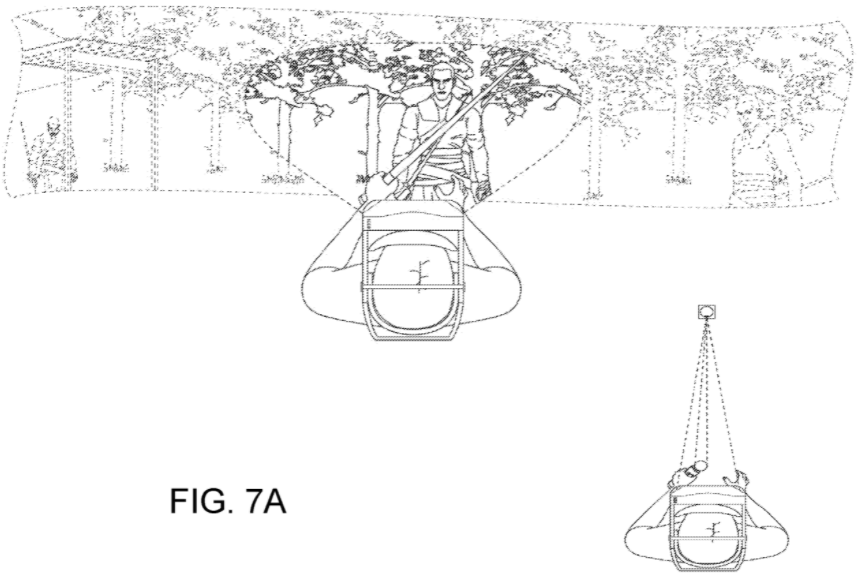
Overview:
U.S. Patent No. 10,987,574 (the ‘574 patent) relates to a head mounted display (HMD) that uses a depth camera to track and render a user’s hand in virtual reality. The ‘574 patent details an HMD with a depth camera in the HMD’s housing. The camera is oriented to capture depth data of an area in front of the housing and the HMD has a processor which uses that data to identify movement of real objects and render the objects (and the objects’ movement) in virtual reality. The real object is the hand of the HMD user and the hand’s virtual counterpart is displayed from a perspective in front of the user. The virtual hand is displayed as a continuation of at least part of the arm of the user, to convey depth to the user as the user extends their arm into virtual reality. The ‘574 patent could be used to make virtual reality experiences more immersive by representing more movements that the user is making with their real body in the virtual world.
Abstract:
A head mounted display (HMD) is provided. In one example configuration, the HMD has housing and a view port. The view port has a screen for rendering a virtual reality scene. The HMD has a communications device for exchanging data over a network. The HMD has a depth camera integrated in the housing and oriented to capture depth data of an environment in front of the housing. A processor is provided and is configured to use the depth data captured by the depth camera to identify real objects in the environment. A real object is rendered into the virtual reality scene. The real object is tracked such that movements of the real object are shown as movements in the virtual reality scene. The real object captured by the depth camera in the environment is a hand of a user wearing the HMD. The hand of the user is rendered as a virtual hand, and movements of the virtual hand are displayed in the screen of the viewport from a perspective that is in front of the user.
Illustrative Claim:
- A head mounted display (HMD), comprising, a housing; a view port of the housing, the view port having a screen for rendering a virtual reality scene; a communications device for exchanging data over a network; a depth camera integrated in the housing and oriented to capture depth data of an environment in front of the housing; and a processor is configured to use the depth data captured by the depth camera to identify real objects in the environment, wherein a real object is rendered into the virtual reality scene, the real object being tracked such that movements of the real object are shown as movements in the virtual reality scene; wherein the real object captured by the depth camera in the environment is a hand of a user wearing the HMD, and said hand of the user is rendered as a virtual hand, and movements of the virtual hand are displayed in the screen of the viewport from a perspective that is in front of the user, wherein at least part of an arm of the user extended into the virtual reality scene in front of the user provides for the virtual hand to appear depth-wise as a continuation of the arm to the virtual hand.
Illustrative Figure
Abstract
A head mounted display (HMD) is provided. In one example configuration, the HMD has housing and a view port. The view port has a screen for rendering a virtual reality scene. The HMD has a communications device for exchanging data over a network. The HMD has a depth camera integrated in the housing and oriented to capture depth data of an environment in front of the housing. A processor is provided and is configured to use the depth data captured by the depth camera to identify real objects in the environment. A real object is rendered into the virtual reality scene. The real object is tracked such that movements of the real object are shown as movements in the virtual reality scene. The real object captured by the depth camera in the environment is a hand of a user wearing the HMD. The hand of the user is rendered as a virtual hand, and movements of the virtual hand are displayed in the screen of the viewport from a perspective that is in front of the user.
Description
DETAILED DESCRIPTION FIG. 1illustrates a system for interactive gameplay of a video game, in accordance with an embodiment of the invention. Although examples are provided herein with reference to video games and games, the embodiments can also be used in different environments and tools. Such environments can include business tool environments, presentations tools, conference call systems, virtual visit programs, virtual project collaboration, sharing of information and social interactions, social networking, social data mining, communication, etc. In a video game example, a user100is shown wearing a head-mounted display (HMD)102. The HMD102is worn in a manner similar to glasses, goggles, or a helmet, and is configured to display a video game or other content to the user100. The HMD102provides a very immersive experience to the user by virtue of its provision of display mechanisms in close proximity to the user's eyes. Thus, the HMD102can provide display regions to each of the user's eyes which occupy large portions or even the entirety of the field of view of the user. In one embodiment, the HMD102can be connected to a computer106. The connection to computer106can be wired or wireless. The computer106can be any general or special purpose computer known in the art, including but not limited to, a gaming console, personal computer, laptop, tablet computer, mobile device, cellular phone, tablet, thin client, set-top box, media streaming device, etc. In one embodiment, the computer106can be configured to execute a video game, and output the video and audio from the video game for rendering by the HMD102. The user100may operate a controller104to provide input for the video game. Additionally, a camera108can be configured to capture image of the interactive environment in which the user100is located. These captured images can be analyzed to determine the location and movements of the user100, the HMD102, and the controller104. In ...
DETAILED DESCRIPTION
FIG. 1illustrates a system for interactive gameplay of a video game, in accordance with an embodiment of the invention. Although examples are provided herein with reference to video games and games, the embodiments can also be used in different environments and tools. Such environments can include business tool environments, presentations tools, conference call systems, virtual visit programs, virtual project collaboration, sharing of information and social interactions, social networking, social data mining, communication, etc.
In a video game example, a user100is shown wearing a head-mounted display (HMD)102. The HMD102is worn in a manner similar to glasses, goggles, or a helmet, and is configured to display a video game or other content to the user100. The HMD102provides a very immersive experience to the user by virtue of its provision of display mechanisms in close proximity to the user's eyes. Thus, the HMD102can provide display regions to each of the user's eyes which occupy large portions or even the entirety of the field of view of the user.
In one embodiment, the HMD102can be connected to a computer106. The connection to computer106can be wired or wireless. The computer106can be any general or special purpose computer known in the art, including but not limited to, a gaming console, personal computer, laptop, tablet computer, mobile device, cellular phone, tablet, thin client, set-top box, media streaming device, etc. In one embodiment, the computer106can be configured to execute a video game, and output the video and audio from the video game for rendering by the HMD102.
The user100may operate a controller104to provide input for the video game. Additionally, a camera108can be configured to capture image of the interactive environment in which the user100is located. These captured images can be analyzed to determine the location and movements of the user100, the HMD102, and the controller104. In one embodiment, the controller104includes a light which can be tracked to determine its location and orientation. Additionally, as described in further detail below, the HMD102may include one or more lights which can be tracked to determine the location and orientation of the HMD102. The lights are considered illumination objects.
In one embodiment, an illumination object is one that can emit light or glow to provide a visible difference when viewed by a human eye and/or viewed by a camera or image detecting device, or detector, or receiver. In one embodiment, the illumination object can emit light that is human visible and in others not human visible. The illumination object may, in one embodiment, emit infrared (IR) light via IR emitters. In one example, the illumination object may be one or more light emitting diodes (LEDs). Each diode may emit white light, or a colored light of various shades. In some embodiments, the illumination objects may be placed under a surface that is at least partially transparent. The surface may be a cover, such that the cover may glow or appear in one or more colors.
In some embodiments, the illumination objects are integrated into the body or housing of the HMD, are placed under light or transparent plastic on the HMD, are exposed on the surface of the HMD, are placed under color shields/materials that illuminate in particular colors, and/or are arranged in specific shapes to improve detectability, improve tracking (e.g., to identify tilt, roll, yaw, and depth). In various examples, the HMD may include various illumination objects at various locations, such that the HMD can be tracked from the front, the sides and the back. In one embodiment, the illumination object may be added to the headband of the HMD, such illumination objects can be attached to the sides of the head band at various locations, which may increase tracking when the user is moving, turning, turning in circles, etc.
In one embodiment, illumination logic may be integrated into the HMD. The HMD may include one or more circuits for activating the illumination objects. In simple configurations, the illumination logic may be defined by wires that connect to the illumination objects to a circuit, a switch, a trigger, a chip, a controller, a CPU (central processing unit), DSP (digital signal processor), an ASIC (application specific integrated circuit), and/or firmware and/or software. The illumination object can thus control when one or all of the illumination objects turn on, stay on, flicker, turn on/off with a code, turn a color, turn specific colors to differentiate multiple HMD players of a game, etc. In some embodiments, the circuit of the HMD can include logic for receiving and processing image data.
The image data received, e.g., from a computer or game console, may be received by the HMD and processed. The processing of the data can include rendering the image data onto a viewing module. The viewing module may include a screen, which renders the images for viewing via the HMD. In some embodiments, the screen of the HMD may be defined a two separate screens, e.g., one for each eye. In another embodiment, the screen may be a single screen, whereby each eye is allowed to focus on the screen using optics.
The camera108can include one or more microphones to capture sound from the interactive environment. Sound captured by a microphone array may be processed to identify the location of a sound source. Sound from an identified location can be selectively utilized or processed to the exclusion of other sounds not from the identified location. Furthermore, the camera108can be defined to include multiple image capture devices (e.g. stereoscopic pair of cameras), an IR camera, a depth camera, and combinations thereof.
In another embodiment, the computer106functions as a thin client in communication over a network with a cloud gaming provider112. The cloud gaming provider112maintains and executes the video game being played by the user102. The computer106transmits inputs from the HMD102, the controller104and the camera108, to the cloud gaming provider, which processes the inputs to affect the game state of the executing video game. The output from the executing video game, such as video data, audio data, and haptic feedback data, is transmitted to the computer106. The computer106may further process the data before transmission or may directly transmit the data to the relevant devices. For example, video and audio streams are provided to the HMD102, whereas a vibration feedback command is provided to the controller104.
In one embodiment, the HMD102, controller104, and camera108, may themselves be networked devices that connect to the network110to communicate with the cloud gaming provider112. For example, the computer106may be a local network device, such as a router, that does not otherwise perform video game processing, but facilitates passage network traffic. The connections to the network by the HMD102, controller104, and camera108may be wired or wireless.
FIG. 2illustrates a head-mounted display (HMD), in accordance with an embodiment of the invention. As shown, the HMD102includes a plurality of lights200A-H. Each of these lights may be configured to have specific shapes, and can be configured to have the same or different colors. The lights may also be oriented and defined on the HMD in particular patterns to improve tracking. The lights200A,200B,200C, and200D are arranged on the front surface of the HMD102. The lights200E and200F are arranged on a side surface of the HMD102. And the lights200G and200H are arranged at corners of the HMD102, so as to span the front surface and a side surface of the HMD102. It will be appreciated that the lights can be identified in captured images of an interactive environment in which a user uses the HMD102. Based on identification and tracking of the lights, the location and orientation of the HMD102in the interactive environment can be determined. It will further be appreciated that some of the lights may or may not be visible depending upon the particular orientation of the HMD102relative to an image capture device. Also, different portions of lights (e.g. lights200G and200H) may be exposed for image capture depending upon the orientation of the HMD102relative to the image capture device.
In one embodiment, the lights can be configured to indicate a current status of the HMD to others in the vicinity. For example, some or all of the lights may be configured to have a certain color arrangement, intensity arrangement, be configured to blink, have a certain on/off configuration, or other arrangement indicating a current status of the HMD102. By way of example, the lights can be configured to display different configurations during active gameplay of a video game (generally gameplay occurring during an active timeline or within a scene of the game) versus other non-active gameplay aspects of a video game, such as navigating menu interfaces or configuring game settings (during which the game timeline or scene may be inactive or paused). The lights might also be configured to indicate relative intensity levels of gameplay. For example, the intensity of lights, or a rate of blinking, may increase when the intensity of gameplay increases. In this manner, a person external to the user may view the lights on the HMD102and understand that the user is actively engaged in intense gameplay, and may not wish to be disturbed at that moment.
The HMD102may additionally include one or more microphones. In the illustrated embodiment, the HMD102includes microphones204A and204B defined on the front surface of the HMD102, and microphone204C defined on a side surface of the HMD102. By utilizing an array of microphones, sound from each of the microphones can be processed to determine the location of the sound's source. This information can be utilized in various ways, including exclusion of unwanted sound sources, association of a sound source with a visual identification, etc.
The HMD102may also include one or more image capture devices. In the illustrated embodiment, the HMD102is shown to include image captured devices202A and202B. By utilizing a stereoscopic pair of image capture devices, three-dimensional (3D) images and video of the environment can be captured from the perspective of the HMD102. Such video can be presented to the user to provide the user with a “video see-through” ability while wearing the HMD102. That is, though the user cannot see through the HMD102in a strict sense, the video captured by the image capture devices202A and202B can nonetheless provide a functional equivalent of being able to see the environment external to the HMD102as if looking through the HMD102. Such video can be augmented with virtual elements to provide an augmented reality experience, or may be combined or blended with virtual elements in other ways. Though in the illustrated embodiment, two cameras are shown on the front surface of the HMD102, it will be appreciated that there may be any number of externally facing cameras installed on the HMD102, oriented in any direction. For example, in another embodiment, there may be cameras mounted on the sides of the HMD102to provide additional panoramic image capture of the environment.
FIG. 3conceptually illustrates the function of the HMD102in conjunction with an executing video game, in accordance with an embodiment of the invention. The executing video game is defined by a game engine320which receives inputs to update a game state of the video game. The game state of the video game can be defined, at least in part, by values of various parameters of the video game which define various aspects of the current gameplay, such as the presence and location of objects, the conditions of a virtual environment, the triggering of events, user profiles, view perspectives, etc.
In the illustrated embodiment, the game engine receives, by way of example, controller input314, audio input316and motion input318. The controller input314may be defined from the operation of a gaming controller separate from the HMD102, such as controller104. By way of example, controller input314may include directional inputs, button presses, trigger activation, movements, or other kinds of inputs processed from the operation of a gaming controller. The audio input316can be processed from a microphone302of the HMD102, or from a microphone included in the image capture device108. The motion input218can be processed from a motion sensor300included in the HMD102, or from image capture device108as it captures images of the HMD102. The game engine320receives inputs which are processed according to the configuration of the game engine to update the game state of the video game. The game engine320outputs game state data to various rendering modules which process the game state data to define content which will be presented to the user.
In the illustrated embodiment, a video rendering module322is defined to render a video stream for presentation on the HMD102. The video stream may be presented by a display/projector mechanism310, and viewed through optics308by the eye306of the user. An audio rendering module304is configured to render an audio stream for listening by the user. In one embodiment, the audio stream is output through a speaker304associated with the HMD102. It should be appreciated that speaker304may take the form of an open air speaker, headphones, or any other kind of speaker capable of presenting audio.
In one embodiment, a gaze tracking camera312is included in the HMD102to enable tracking of the gaze of the user. The gaze tracking camera captures images of the user's eyes, which are analyzed to determine the gaze direction of the user. In one embodiment, information about the gaze direction of the user can be utilized to affect the video rendering. For example, if a user's eyes are determined to be looking a specific direction, then the video rendering for that direction can be prioritized or emphasized, such as by providing greater detail or faster updates in the region where the user is looking.
Additionally, a tactile feedback module326is configured to provide signals to tactile feedback hardware included in either the HMD102or another device operated by the user, such as a controller104. The tactile feedback may take the form of various kinds of tactile sensations, such as vibration feedback, temperature feedback, pressure feedback, etc.
FIG. 4Aillustrates a three-dimensional view into an interactive space, that shows scenes of videogame play by a user, in accordance with one embodiment. In this example, the user is wearing a head mounted display (HMD) and is holding a controller, as shown inFIG. 4B. In one embodiment, the user is being monitored by a camera, that is directed toward the user as shown inFIG. 4B. The camera can be a mono camera or a stereo camera that can identify depth. The camera can identify the controller and the head mounted display during gameplay. The identification of the controller and the head mounted display will identify a spatial position of each. The spatial position of each can be tracked to identify movements of the controller and the head mounted display independently. The tracking can include identifying the positions and changes in position rates and changes of position, etc. using the images captured by the camera. In another embodiment, the controller and the HMD will each includes circuitry, including inertial sensors that can communicate data back to a base station computer. The data containing inertial sensor data (and other date) can be processed to identify the positions, changes in positions, rates of change of position, and other 6 axes type data elements.
Accordingly, it should be understood that some embodiments will include a camera while other embodiments will not include a camera. In the embodiment where a camera is used, the user is detected to be facing forward when playing the game, as shown inFIG. 4A. As the user holds the controller, as shown inFIG. 4B, the user's hands may appear to extend into a three-dimensional scene rendered in the screen of the HMD. In one embodiment, the viewpoint into the scenes of the interactive content generated by the executing game, will change. The change, in one embodiment is driven by the position or view provided by the users head movements, when wearing the head mounted display.
To illustrate the viewpoint into the interactive space, the area that the user views is shown within the dashed lines that outline a 3D volume. Interactive scene data that is not viewable, since the users not viewing that particular region or direction, is shown in dashed lines in the figures. In operation, the content in dashed lines is not rendered until the user views in that particular location or direction. However, to provide clarity regarding the ability of the user to view specific portions of the interactive scene in the screen of the head mounted display, the dashed lines have been provided.
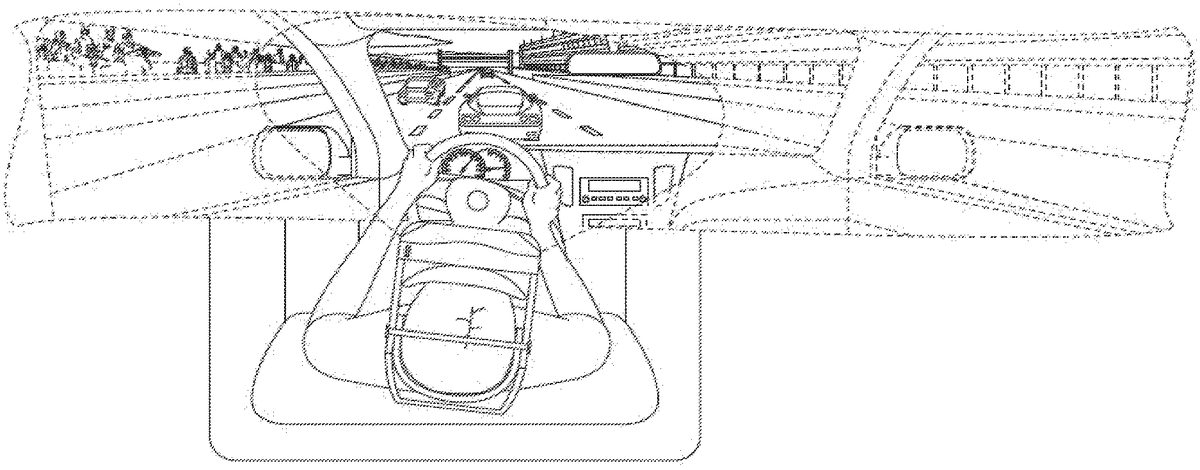
In one embodiment, the position of the user's hands when holding the controller can be detected and can be shown to enter the screen of the HMD as if the user was extending his hand into the interactive scene. This is illustrated inFIG. 4A, where the user is holding a steering wheel in a videogame depicting a race car scene. It should be noted that the drawings of the HMD are only illustrative of an R&D type HMD, and a commercial embodiment may be produced in a more ergonomic and finished product manner.
The HMD can provide the user with a view into the interactive scene. The controller held by the user, as shown inFIG. 4Billustrates that the user can be playing a game where motions, positions, button inputs, etc., are tracked and correlated to the input provided to the game executed on a computer system. As described below, the computer system may be a game console, a standalone computer, a tablet, a smart phone, a web-based computer, a cloud server, or any other system capable of processing instructions. In yet another embodiment, the controller and or the HMD can communicate directly with a network. The network and then communicate with a cloud system for executing instructions.
FIG. 5Aillustrates an embodiment where the user has turned his head to the left, exposing additional viewpoints into the interactive scene.FIG. 5Billustrates the position of the real world user turning his head to the left, which triggered the rendering of a different three-dimensional scene in front of the user, as viewed from the screen of the head mounted display. In addition,FIG. 5Billustrates the user turning the controller to the left. The turn to the left can be gradual or abrupt, and can be detected using inertial sensors of the controller, where such data is transferred to a computing device for processing. In another embodiment, the movement of the controller can be monitored by the camera that detects a different spatial position. The different spatial position can be monitored by identifying the position or orientation, or position and orientation of the controller as viewed by the camera.
As shown inFIG. 5A, the user's movement of the controller to the left represented inFIG. 5B, will cause the user to turn the steering wheel to the left in the virtual scene. Thus, the user's actions with the controller can be represented in the virtual scene, as seen from the screen of the head mounted display. At the same time, the viewpoint into the virtual scene, as shown inFIG. 5Awill also change, based on the detected position and orientation of the head mounted display. Detecting the position of the head mounted display can be by way of identifying lights, markers, infrared lighting, or combinations thereof.
In other embodiments, identification of the spatial position of the head mounted display can be by way of tracking inertial sensors in the head mounted display. In still other embodiments, a camera can track the position of the head without detecting sensors, but by simply detecting the position of the head using three-dimensional depth mapping. Accordingly, both motions of the controller and motions of the head mounted display can be tracked, and the independent motion positions, changes in positions, changes in movement rates, and other input type movements can be tracked and correlated to one another. The correlation can be by way of a mapping algorithm that tracks the motions of the controller and head mounted display, and the resulting view in the head mounted display screen can change according to the motions and movements of the head mounted display and the interactive feedback provided by the controller held by the user.
Accordingly, the mapping between the actions of the user's head and the actions with the controller are shown by referencing the movements of the actual real world user inFIG. 5B, and the viewpoint into the scene shown inFIG. 5A. As noted above, the user, in one embodiment is able to reach in to the interactive scene as perceived by the user. That is, the user is provided a viewing sensory that the user has actually reached into the scene and is holding an actual steering wheel. To the user, when the user views his or her hands, virtual hands holding the steering wheel are rendered. Movements of his or her hands will then be substantially mapped and correlated to the movements of the virtual hands in the scene. In one embodiment, the virtual hands can be augmented reality or virtual reality. One augmented reality view can be one where an image of the user's actual hands are slightly augmented in the view provided by the head mounted display screen.
Although hands are described as being able to reach into the scene, any body part that can be viewed via the HMD can also be rendered in the scene to provide the appearance that the user is actually present in the 3D scene. Additionally, the user can hold other controllers or wear clothing that can be tracked to provide the ability to blend into the scene, so as to blur the real and virtual world outlines. In still other embodiments, the user can wear clothes or gloves that are provided with tactile feedback, so that actions in the virtual scene are translated to the real world. If the user reaches into a virtual scene, the user can shake the hand of a virtual character, and the grasp of the hand can be simulated using tactile feedback to the glove.
FIGS. 6A and 6Billustrates an example where the user has turned his head to the right and also turn the controller to the right. InFIG. 6A, the user's virtual hands appeared to turn the steering wheel of the race car to the right. The images seen into the three-dimensional space, as provided in the screen of the head mounted display, show the changes made as a result of the user turning the controller to the right. At the same time, the user has turned his head slightly to the right, which is a typical natural movement made in real life when turning a steering wheel to the right. This real world movement will therefore convey the same movement in the virtual environment illustrated in the head mounted display screen.
FIG. 6Ashows the steering wheel turned to the right and the viewpoint into the virtual scene shifted to the right. As noted above, the dashed lines outside of the viewpoint into the three-dimensional space are provided to simply provide an illustration that additional virtual environments exist beyond that which the user is currently viewing. The extensions beyond the regions where the user is currently viewing, in one embodiment, is a natural extensions of the current virtual viewpoint. That is, if the user is viewing straightforward in a race car, the user turning his head to the left can actually view out the left side window of the race car. If a spectator (or object) is standing to the left of the race car in the stands, that spectator may come into view when the user has turned his head to the left, when driving by in the race car.
FIGS. 7A and 7Billustrate another embodiment, where the controller is a different type of controller. The type of controller shown is a MOVE™ controller, which is made by Sony Computer Entertainment Inc. This controller has a handle and a spherical object that lights up for tracking. The controller also includes an inertial sensor and other buttons for communicating information back to a base computer. In one embodiment, the camera can track the controller in 6 axes (e.g., X,Y,Z; pitch; roll; yaw). The camera can also be simultaneously tracking the head mounted display. In another embodiment, the head mounted display can be tracked using other tracking functions. The other tracking functions can include using inertial sensors, infrared camera lighting, sound, data input by buttons or motions, etc.
In the embodiment shown inFIGS. 7A and 7B, the user is moving the controller inFIG. 7B, which is represented as a sword inFIG. 7A. The user is interacting with characters or subjects of a game where movements of the controller are tracked to the movements of the virtual character participating in the game. The position of the controller and the position of the head mounted display (and associated motion), are tracked so as to provide a viewpoint into the virtual scene. In this example, to the user playing the game using the head mounted display, the user holding the controller will appears as a virtual object (e.g., sword) in the virtual game. As shown, however, the user's arm appears and feels as if the user is extending into the 3D space, which is right in front of the user. Movements of the controller are mapped and correlated to the movements of the virtual object in the game.
InFIGS. 8A and 8B, the users shown to have moved his head to the left while maintaining the controller in the same position. The user's movement of the head exposes a new viewpoint into the scene as generated by the game being executed. Movement of the users head to the left will expose that new viewpoint showing additional interactive scene elements in the game, as if the game elements were real-world three-dimensional elements.
FIGS. 9A and 9Bagain show the user moving his head to the right and the controller slightly to the right. This will expose a new view into the interactive scene as shown in the screen of the head mounted display. In one embodiment, the mapping of the user's actions with the controller assist in driving the interactivity of the gameplay while coordinating the viewpoint into the scene using the positional information of the head mounted display.
FIG. 10illustrates an example of a real-world player sitting holding a controller on his couch and wearing a head mounted display.
FIG. 11illustrates the player standing up playing a game, where movements of the player's head and controller are tracked and conveyed in changes in the view point into the scene of the interactive three-dimensional environment.
In one embodiment, the controller can include one or more lights that are viewable by the camera. The lights can be provided in a shape so as to enable the camera to detect and orientation of the controller. The lights can be in the shape of a horizontal light bar, or as a plurality of lights. The lights can also be provided with various colors, which are identifiable by the camera. The colors can provide information regarding the player number, or can identify the controller in various environmental conditions.
The environmental conditions can include, for example, the lighting of the room in which the user is playing the game. In another embodiment, the conditions can include determining the background colors in the space where the player is playing. Based on the background colors, and appropriate color can be selected for the colors of the controller lights. For instance, if the background colors primarily red, a color other than red will be selected for the controller to provide better detectability or identification for improved tracking. In still another embodiment, the color can be selected from a predefined list of colors, where the selected color is one that passes a threshold of distinctiveness when compared to the background. In still another embodiment, the color select the controller can be one that is least (or close to the least) represented in the background scene. The selection of the colors for the controller can be adjusted from time to time, during calibration, during gameplay, during specific scenes in a game, during specific action sequences in a game, for communicating with other users in a multiplayer game environment, or at the control of the user by selecting buttons, or at the control of the computing device based on predefined algorithms, situations, rules, or combinations of rules and situations.
With reference toFIG. 12, a diagram illustrating components of a head-mounted display102is shown, in accordance with an embodiment of the invention. The head-mounted display102includes a processor1300for executing program instructions. A memory1302is provided for storage purposes, and may include both volatile and non-volatile memory. A display1304is included which provides a visual interface that a user may view. A battery1306is provided as a power source for the head-mounted display102. A motion detection module1308may include any of various kinds of motion sensitive hardware, such as a magnetometer1310, an accelerometer1312, and a gyroscope1314.
An accelerometer is a device for measuring acceleration and gravity induced reaction forces. Single and multiple axis models are available to detect magnitude and direction of the acceleration in different directions. The accelerometer is used to sense inclination, vibration, and shock. In one embodiment, three accelerometers1312are used to provide the direction of gravity, which gives an absolute reference for two angles (world-space pitch and world-space roll).
A magnetometer measures the strength and direction of the magnetic field in the vicinity of the head-mounted display. In one embodiment, three magnetometers1310are used within the head-mounted display, ensuring an absolute reference for the world-space yaw angle. In one embodiment, the magnetometer is designed to span the earth magnetic field, which is ±80 microtesla. Magnetometers are affected by metal, and provide a yaw measurement that is monotonic with actual yaw. The magnetic field may be warped due to metal in the environment, which causes a warp in the yaw measurement. If necessary, this warp can be calibrated using information from other sensors such as the gyroscope or the camera. In one embodiment, accelerometer1312is used together with magnetometer1310to obtain the inclination and azimuth of the head-mounted display102.
A gyroscope is a device for measuring or maintaining orientation, based on the principles of angular momentum. In one embodiment, three gyroscopes1314provide information about movement across the respective axis (x, y and z) based on inertial sensing. The gyroscopes help in detecting fast rotations. However, the gyroscopes can drift overtime without the existence of an absolute reference. This requires resetting the gyroscopes periodically, which can be done using other available information, such as positional/orientation determination based on visual tracking of an object, accelerometer, magnetometer, etc.
A camera1316is provided for capturing images and image streams of a real environment. More than one camera may be included in the head-mounted display102, including a camera that is rear-facing (directed away from a user when the user is viewing the display of the head-mounted display102), and a camera that is front-facing (directed towards the user when the user is viewing the display of the head-mounted display102). Additionally, a depth camera1318may be included in the head-mounted display102for sensing depth information of objects in a real environment.
The head-mounted display102includes speakers1320for providing audio output. Also, a microphone1322may be included for capturing audio from the real environment, including sounds from the ambient environment, speech made by the user, etc. The head-mounted display102includes tactile feedback module1324for providing tactile feedback to the user. In one embodiment, the tactile feedback module1324is capable of causing movement and/or vibration of the head-mounted display102so as to provide tactile feedback to the user.
LEDs1326are provided as visual indicators of statuses of the head-mounted display102. For example, an LED may indicate battery level, power on, etc. A card reader1328is provided to enable the head-mounted display102to read and write information to and from a memory card. A USB interface1330is included as one example of an interface for enabling connection of peripheral devices, or connection to other devices, such as other portable devices, computers, etc. In various embodiments of the head-mounted display102, any of various kinds of interfaces may be included to enable greater connectivity of the head-mounted display102.
A WiFi module1332is included for enabling connection to the Internet via wireless networking technologies. Also, the head-mounted display102includes a Bluetooth module1334for enabling wireless connection to other devices. A communications link1336may also be included for connection to other devices. In one embodiment, the communications link1336utilizes infrared transmission for wireless communication. In other embodiments, the communications link1336may utilize any of various wireless or wired transmission protocols for communication with other devices.
Input buttons/sensors1338are included to provide an input interface for the user. Any of various kinds of input interfaces may be included, such as buttons, touchpad, joystick, trackball, etc. An ultra-sonic communication module1340may be included in head-mounted display102for facilitating communication with other devices via ultra-sonic technologies.
Bio-sensors1342are included to enable detection of physiological data from a user. In one embodiment, the bio-sensors1342include one or more dry electrodes for detecting bio-electric signals of the user through the user's skin.
The foregoing components of head-mounted display102have been described as merely exemplary components that may be included in head-mounted display102. In various embodiments of the invention, the head-mounted display102may or may not include some of the various aforementioned components. Embodiments of the head-mounted display102may additionally include other components not presently described, but known in the art, for purposes of facilitating aspects of the present invention as herein described.
It will be appreciated by those skilled in the art that in various embodiments of the invention, the aforementioned handheld device may be utilized in conjunction with an interactive application displayed on a display to provide various interactive functions. The exemplary embodiments described herein are provided by way of example only, and not by way of limitation.
FIG. 13is a block diagram of a Game System1400, according to various embodiments of the invention. Game System1400is configured to provide a video stream to one or more Clients1410via a Network1415. Game System1400typically includes a Video Server System1420and an optional game server1425. Video Server System1420is configured to provide the video stream to the one or more Clients1410with a minimal quality of service. For example, Video Server System1420may receive a game command that changes the state of or a point of view within a video game, and provide Clients1410with an updated video stream reflecting this change in state with minimal lag time. The Video Server System1420may be configured to provide the video stream in a wide variety of alternative video formats, including formats yet to be defined. Further, the video stream may include video frames configured for presentation to a user at a wide variety of frame rates. Typical frame rates are 30 frames per second, 60 frames per second, and 1420 frames per second. Although higher or lower frame rates are included in alternative embodiments of the invention.
Clients1410, referred to herein individually as1410A.,1410B., etc., may include head mounted displays, terminals, personal computers, game consoles, tablet computers, telephones, set top boxes, kiosks, wireless devices, digital pads, stand-alone devices, handheld game playing devices, and/or the like. Typically, Clients1410are configured to receive encoded video streams, decode the video streams, and present the resulting video to a user, e.g., a player of a game. The processes of receiving encoded video streams and/or decoding the video streams typically includes storing individual video frames in a receive buffer of the client. The video streams may be presented to the user on a display integral to Client1410or on a separate device such as a monitor or television. Clients1410are optionally configured to support more than one game player. For example, a game console may be configured to support two, three, four or more simultaneous players. Each of these players may receive a separate video stream, or a single video stream may include regions of a frame generated specifically for each player, e.g., generated based on each player's point of view. Clients1410are optionally geographically dispersed. The number of clients included in Game System1400may vary widely from one or two to thousands, tens of thousands, or more. As used herein, the term “game player” is used to refer to a person that plays a game and the term “game playing device” is used to refer to a device used to play a game. In some embodiments, the game playing device may refer to a plurality of computing devices that cooperate to deliver a game experience to the user. For example, a game console and an HMD may cooperate with the video server system1420to deliver a game viewed through the HMD. In one embodiment, the game console receives the video stream from the video server system1420, and the game console forwards the video stream, or updates to the video stream, to the HMD for rendering.
Clients1410are configured to receive video streams via Network1415. Network1415may be any type of communication network including, a telephone network, the Internet, wireless networks, powerline networks, local area networks, wide area networks, private networks, and/or the like. In typical embodiments, the video streams are communicated via standard protocols, such as TCP/IP or UDP/IP. Alternatively, the video streams are communicated via proprietary standards.
A typical example of Clients1410is a personal computer comprising a processor, non-volatile memory, a display, decoding logic, network communication capabilities, and input devices. The decoding logic may include hardware, firmware, and/or software stored on a computer readable medium. Systems for decoding (and encoding) video streams are well known in the art and vary depending on the particular encoding scheme used.
Clients1410may, but are not required to, further include systems configured for modifying received video. For example, a client may be configured to perform further rendering, to overlay one video image on another video image, to crop a video image, and/or the like. For example, Clients1410may be configured to receive various types of video frames, such as I-frames, P-frames and B-frames, and to process these frames into images for display to a user. In some embodiments, a member of Clients1410is configured to perform further rendering, shading, conversion to 3-D, or like operations on the video stream. A member of Clients1410is optionally configured to receive more than one audio or video stream. Input devices of Clients1410may include, for example, a one-hand game controller, a two-hand game controller, a gesture recognition system, a gaze recognition system, a voice recognition system, a keyboard, a joystick, a pointing device, a force feedback device, a motion and/or location sensing device, a mouse, a touch screen, a neural interface, a camera, input devices yet to be developed, and/or the like.
The video stream (and optionally audio stream) received by Clients1410is generated and provided by Video Server System1420. As is described further elsewhere herein, this video stream includes video frames (and the audio stream includes audio frames). The video frames are configured (e.g., they include pixel information in an appropriate data structure) to contribute meaningfully to the images displayed to the user. As used herein, the term “video frames” is used to refer to frames including predominantly information that is configured to contribute to, e.g. to effect, the images shown to the user. Most of the teachings herein with regard to “video frames” can also be applied to “audio frames.”
Clients1410are typically configured to receive inputs from a user. These inputs may include game commands configured to change the state of the video game or otherwise affect game play. The game commands can be received using input devices and/or may be automatically generated by computing instructions executing on Clients1410. The received game commands are communicated from Clients1410via Network1415to Video Server System1420and/or Game Server1425. For example, in some embodiments, the game commands are communicated to Game Server1425via Video Server System1420. In some embodiments, separate copies of the game commands are communicated from Clients1410to Game Server1425and Video Server System1420. The communication of game commands is optionally dependent on the identity of the command Game commands are optionally communicated from Client1410A through a different route or communication channel that that used to provide audio or video streams to Client1410A.
Game Server1425is optionally operated by a different entity than Video Server System1420. For example, Game Server1425may be operated by the publisher of a multiplayer game. In this example, Video Server System1420is optionally viewed as a client by Game Server1425and optionally configured to appear from the point of view of Game Server1425to be a prior art client executing a prior art game engine. Communication between Video Server System1420and Game Server1425optionally occurs via Network1415. As such, Game Server1425can be a prior art multiplayer game server that sends game state information to multiple clients, one of which is game server system1420. Video Server System1420may be configured to communicate with multiple instances of Game Server1425at the same time. For example, Video Server System1420can be configured to provide a plurality of different video games to different users. Each of these different video games may be supported by a different Game Server1425and/or published by different entities. In some embodiments, several geographically distributed instances of Video Server System1420are configured to provide game video to a plurality of different users. Each of these instances of Video Server System1420may be in communication with the same instance of Game Server1425. Communication between Video Server System1420and one or more Game Server1425optionally occurs via a dedicated communication channel. For example, Video Server System1420may be connected to Game Server1425via a high bandwidth channel that is dedicated to communication between these two systems.
Video Server System1420comprises at least a Video Source1430, an I/O Device1445, a Processor1450, and non-transitory Storage1455. Video Server System1420may include one computing device or be distributed among a plurality of computing devices. These computing devices are optionally connected via a communications system such as a local area network.
Video Source1430is configured to provide a video stream, e.g., streaming video or a series of video frames that form a moving picture. In some embodiments, Video Source1430includes a video game engine and rendering logic. The video game engine is configured to receive game commands from a player and to maintain a copy of the state of the video game based on the received commands. This game state includes the position of objects in a game environment, as well as typically a point of view. The game state may also include properties, images, colors and/or textures of objects.
The game state is typically maintained based on game rules, as well as game commands such as move, turn, attack, set focus to, interact, use, and/or the like. Part of the game engine is optionally disposed within Game Server1425. Game Server1425may maintain a copy of the state of the game based on game commands received from multiple players using geographically disperse clients. In these cases, the game state is provided by Game Server1425to Video Source1430, wherein a copy of the game state is stored and rendering is performed. Game Server1425may receive game commands directly from Clients1410via Network1415, and/or may receive game commands via Video Server System1420.
Video Source1430typically includes rendering logic, e.g., hardware, firmware, and/or software stored on a computer readable medium such as Storage1455. This rendering logic is configured to create video frames of the video stream based on the game state. All or part of the rendering logic is optionally disposed within a graphics processing unit (GPU). Rendering logic typically includes processing stages configured for determining the three-dimensional spatial relationships between objects and/or for applying appropriate textures, etc., based on the game state and viewpoint. The rendering logic produces raw video that is then usually encoded prior to communication to Clients1410. For example, the raw video may be encoded according to an Adobe Flash® standard, .wav, H.264, H.263, On2, VP6, VC-1, WMA, Huffyuv, Lagarith, MPG-x. Xvid. FFmpeg, ×264, VP6-8, realvideo, mp3, or the like. The encoding process produces a video stream that is optionally packaged for delivery to a decoder on a remote device. The video stream is characterized by a frame size and a frame rate. Typical frame sizes include 800×600, 1280×720 (e.g., 720p), 1024×768, although any other frame sizes may be used. The frame rate is the number of video frames per second. A video stream may include different types of video frames. For example, the H.264 standard includes a “P” frame and a “I” frame. I-frames include information to refresh all macro blocks/pixels on a display device, while P-frames include information to refresh a subset thereof. P-frames are typically smaller in data size than are I-frames. As used herein the term “frame size” is meant to refer to a number of pixels within a frame. The term “frame data size” is used to refer to a number of bytes required to store the frame.
In alternative embodiments Video Source1430includes a video recording device such as a camera. This camera may be used to generate delayed or live video that can be included in the video stream of a computer game. The resulting video stream, optionally includes both rendered images and images recorded using a still or video camera. Video Source1430may also include storage devices configured to store previously recorded video to be included in a video stream. Video Source1430may also include motion or positioning sensing devices configured to detect motion or position of an object, e.g., person, and logic configured to determine a game state or produce video-based on the detected motion and/or position.
Video Source1430is optionally configured to provide overlays configured to be placed on other video. For example, these overlays may include a command interface, log in instructions, messages to a game player, images of other game players, video feeds of other game players (e.g., webcam video). In embodiments of Client1410A including a touch screen interface or a gaze detection interface, the overlay may include a virtual keyboard, joystick, touch pad, and/or the like. In one example of an overlay a player's voice is overlaid on an audio stream. Video Source1430optionally further includes one or more audio sources.
In embodiments wherein Video Server System1420is configured to maintain the game state based on input from more than one player, each player may have a different point of view comprising a position and direction of view. Video Source1430is optionally configured to provide a separate video stream for each player based on their point of view. Further, Video Source1430may be configured to provide a different frame size, frame data size, and/or encoding to each of Client1410. Video Source1430is optionally configured to provide 3-D video.
I/O Device1445is configured for Video Server System1420to send and/or receive information such as video, commands, requests for information, a game state, gaze information, device motion, device location, user motion, client identities, player identities, game commands, security information, audio, and/or the like. I/O Device1445typically includes communication hardware such as a network card or modem. I/O Device1445is configured to communicate with Game Server1425, Network1415, and/or Clients1410.
Processor1450is configured to execute logic, e.g. software, included within the various components of Video Server System1420discussed herein. For example, Processor1450may be programmed with software instructions in order to perform the functions of Video Source1430, Game Server1425, and/or a Client Qualifier1460. Video Server System1420optionally includes more than one instance of Processor1450. Processor1450may also be programmed with software instructions in order to execute commands received by Video Server System1420, or to coordinate the operation of the various elements of Game System1400discussed herein. Processor1450may include one or more hardware device. Processor1450is an electronic processor.
Storage1455includes non-transitory analog and/or digital storage devices. For example, Storage1455may include an analog storage device configured to store video frames. Storage1455may include a computer readable digital storage, e.g. a hard drive, an optical drive, or solid state storage. Storage1415is configured (e.g. by way of an appropriate data structure or file system) to store video frames, artificial frames, a video stream including both video frames and artificial frames, audio frame, an audio stream, and/or the like. Storage1455is optionally distributed among a plurality of devices. In some embodiments, Storage1455is configured to store the software components of Video Source1430discussed elsewhere herein. These components may be stored in a format ready to be provisioned when needed.
Video Server System1420optionally further comprises Client Qualifier1460. Client Qualifier1460is configured for remotely determining the capabilities of a client, such as Clients1410A or1410B. These capabilities can include both the capabilities of Client1410A itself as well as the capabilities of one or more communication channels between Client1410A and Video Server System1420. For example, Client Qualifier1460may be configured to test a communication channel through Network1415.
Client Qualifier1460can determine (e.g., discover) the capabilities of Client1410A manually or automatically. Manual determination includes communicating with a user of Client1410A and asking the user to provide capabilities. For example, in some embodiments, Client Qualifier1460is configured to display images, text, and/or the like within a browser of Client1410A. In one embodiment, Client1410A is an HMD that includes a browser. In another embodiment, client1410A is a game console having a browser, which may be displayed on the HMD. The displayed objects request that the user enter information such as operating system, processor, video decoder type, type of network connection, display resolution, etc. of Client1410A. The information entered by the user is communicated back to Client Qualifier1460.
Automatic determination may occur, for example, by execution of an agent on Client1410A and/or by sending test video to Client1410A. The agent may comprise computing instructions, such as java script, embedded in a web page or installed as an add-on. The agent is optionally provided by Client Qualifier1460. In various embodiments, the agent can find out processing power of Client1410A, decoding and display capabilities of Client1410A, lag time reliability and bandwidth of communication channels between Client1410A and Video Server System1420, a display type of Client1410A, firewalls present on Client1410A, hardware of Client1410A, software executing on Client1410A, registry entries within Client1410A, and/or the like.
Client Qualifier1460includes hardware, firmware, and/or software stored on a computer readable medium. Client Qualifier1460is optionally disposed on a computing device separate from one or more other elements of Video Server System1420. For example, in some embodiments, Client Qualifier1460is configured to determine the characteristics of communication channels between Clients1410and more than one instance of Video Server System1420. In these embodiments the information discovered by Client Qualifier can be used to determine which instance of Video Server System1420is best suited for delivery of streaming video to one of Clients1410.
It should be understood that the various embodiments defined herein may be combined or assembled into specific implementations using the various features disclosed herein. Thus, the examples provided are just some possible examples, without limitation to the various implementations that are possible by combining the various elements to define many more implementations. In some examples, some implementations may include fewer elements, without departing from the spirit of the disclosed or equivalent implementations.
Embodiments of the present invention may be practiced with various computer system configurations including hand-held devices, microprocessor systems, microprocessor-based or programmable consumer electronics, minicomputers, mainframe computers and the like. The invention can also be practiced in distributed computing environments where tasks are performed by remote processing devices that are linked through a wire-based or wireless network.
With the above embodiments in mind, it should be understood that the invention can employ various computer-implemented operations involving data stored in computer systems. These operations are those requiring physical manipulation of physical quantities. Any of the operations described herein that form part of the invention are useful machine operations. The invention also relates to a device or an apparatus for performing these operations. The apparatus can be specially constructed for the required purpose, or the apparatus can be a general-purpose computer selectively activated or configured by a computer program stored in the computer. In particular, various general-purpose machines can be used with computer programs written in accordance with the teachings herein, or it may be more convenient to construct a more specialized apparatus to perform the required operations.
The invention can also be embodied as computer readable code on a computer readable medium. The computer readable medium is any data storage device that can store data, which can be thereafter be read by a computer system. Examples of the computer readable medium include hard drives, network attached storage (NAS), read-only memory, random-access memory, CD-ROMs, CD-Rs, CD-RWs, magnetic tapes and other optical and non-optical data storage devices. The computer readable medium can include computer readable tangible medium distributed over a network-coupled computer system so that the computer readable code is stored and executed in a distributed fashion.
Although the method operations were described in a specific order, it should be understood that other housekeeping operations may be performed in between operations, or operations may be adjusted so that they occur at slightly different times, or may be distributed in a system which allows the occurrence of the processing operations at various intervals associated with the processing, as long as the processing of the overlay operations are performed in the desired way.
Although the foregoing invention has been described in some detail for purposes of clarity of understanding, it will be apparent that certain changes and modifications can be practiced within the scope of the appended claims. Accordingly, the present embodiments are to be considered as illustrative and not restrictive, and the invention is not to be limited to the details given herein, but may be modified within the scope and equivalents of the appended claims.
Claims
- A head mounted display (HMD), comprising, a housing;a view port of the housing, the view port having a screen for rendering a virtual reality scene;a communications device for exchanging data over a network;a depth camera integrated in the housing and oriented to capture depth data of an environment in front of the housing;and a processor is configured to use the depth data captured by the depth camera to identify real objects in the environment, wherein a real object is rendered into the virtual reality scene, the real object being tracked such that movements of the real object are shown as movements in the virtual reality scene;wherein the real object captured by the depth camera in the environment is a hand of a user wearing the HMD, and said hand of the user is rendered as a virtual hand, and movements of the virtual hand are displayed in the screen of the viewport from a perspective that is in front of the user, wherein at least part of an arm of the user extended into the virtual reality scene in front of the user provides for the virtual hand to appear depth-wise as a continuation of the arm to the virtual hand.
- The HMD of claim 1 , further comprising, using the depth camera to further capture depth data for said at least part of an arm of the user that extends to the virtual hand, wherein said at least part of the arm is rendered in the virtual reality scene and parallels movement of the arm of the user.
- The HMD of claim 1 , wherein the virtual hand is rendered in the virtual reality scene along with a virtual reality object that is allowed to interact with the virtual reality hand based on movements of the hand of the user in the environment in front of the housing.
- The HMD of claim 1 , wherein the depth camera is configured to capture a second hand of the user, the second hand of the user being rendered into the virtual reality scene as a second virtual hand.
- The HMD of claim 1 , wherein the processor executes data for input data, image data, audio data, or combinations of two or more thereof.
- The HMD of claim 1 , wherein audio data is provided to the HMD as associated with content of the virtual reality scene.
- The HMD of claim 6 , wherein the content includes game data, video data, internet navigation data, interactive data, combinations of game data and internet data, social media data, or combinations thereof.
- A head mounted display (HMD), comprising, a housing;a view port of the housing, the view port having a screen for rendering a virtual reality scene;a communications device for exchanging data over a network;a depth camera coupled to the housing and oriented to capture depth data of an environment in front of the housing;an inertial sensor integrated in the HMD, the inertial sensor produces inertial data in response to detected movement of the HMD when worn by the user;and a processor is configured to use the depth data captured by the depth camera to identify real objects in the environment, wherein a real object is rendered into the virtual reality scene, the real object being tracked such that movements of the real object are shown as movements in the virtual reality scene;wherein the real object captured by the depth camera in the environment is a hand of a user wearing the HMD, and said hand of the user is rendered as a virtual hand, and movements of the virtual hand are displayed in the screen of the viewport from a perspective that is in front of the user, wherein at least part of an arm of the user extended into the virtual reality scene in front of the user provides for the virtual hand to appear depth-wise as a continuation of the arm to the virtual hand.
- The HMD of claim 8 , further comprising, using the depth camera to further capture depth data for said at least part of an arm of the user that extends to the virtual hand, wherein said at least part of the arm is rendered in the virtual reality scene and parallels movement of the arm of the user.
- The HMD of claim 8 , wherein the virtual hand is rendered in the virtual reality scene along with a virtual reality object that is allowed to interact with the virtual reality hand based on movements of the hand of the user in the environment in front of the housing.
- The HMD of claim 8 , wherein the depth camera is configured to capture a second hand of the user, the second hand of the user being rendered into the virtual reality scene as a second virtual hand.
- The HMD of claim 8 , wherein the processor executes data for input data, image data, audio data, inertial data, or combinations of two or more thereof.
- The HMD of claim 12 , wherein audio data is provided to the HMD as associated with content of the virtual reality scene.
- The HMD of claim 13 , wherein the content includes game data, video data, internet navigation data, interactive data, combinations of game data and internet data, social media data, or combinations thereof.
Disclaimer: Data collected from the USPTO and may be malformed, incomplete, and/or otherwise inaccurate.