U.S. Pat. No. 10,702,767
INTEGRATED MULTI ENVIRONMENT INTERACTIVE BATTLE GAME
AssigneeHasbro, Inc.
Issue DateDecember 12, 2018
U.S. Patent No. 10,702,767: Integrated multi environment interactive battle game
U.S. Patent No. 10,702,767: Integrated multi environment interactive battle game
Issued July 7, 2020, to Hasbro Inc.
Filed: December 12, 2018 (claiming priority to December 14, 2017)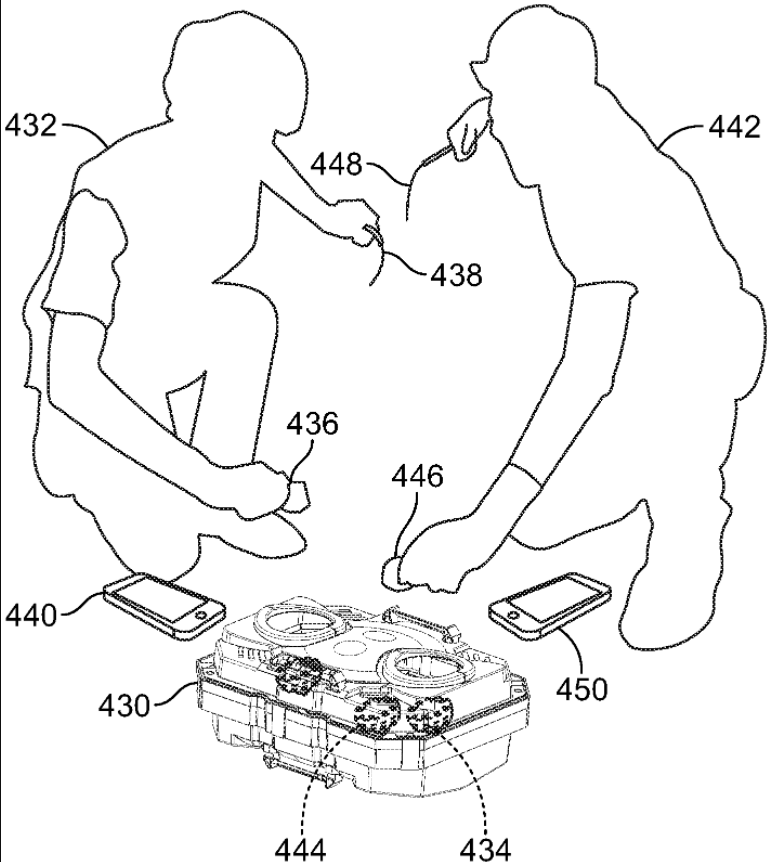
Overview:
U.S. Patent No. 10,702,767 (the ‘767 patent) relates to a battle arena for spinning battle tops. The ‘767 patent details a battle arena game with two lids and two matching bases, one lid with two launch openings for two players to insert spinning battle tops, and the other with four launch openings for four players.
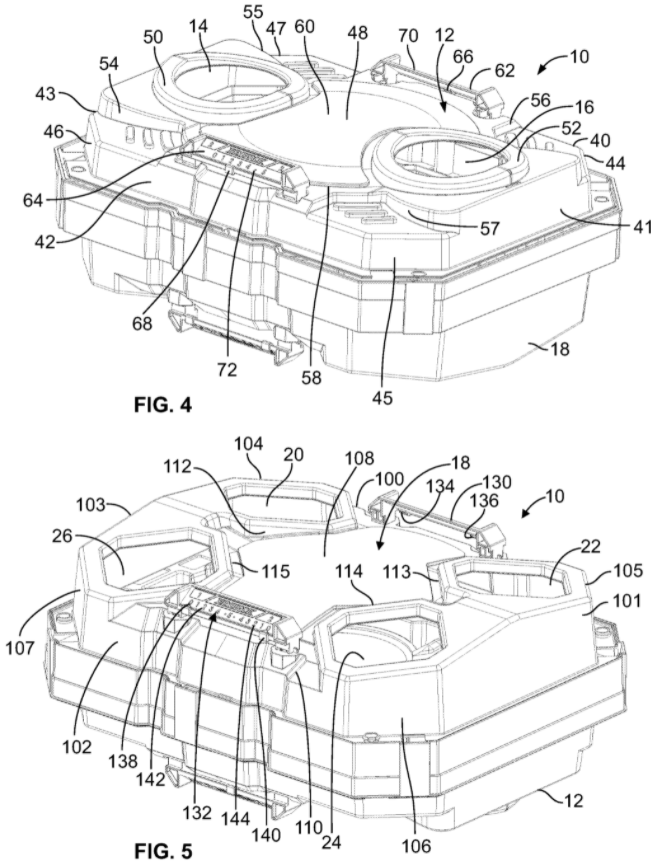
The lids have slanted slide regions connecting to the launch openings, which the battle tops slide down to enter a battling surface. The base is the battling surface which includes a circular wall around it to prevent tops from reentering the slide area. The ‘767 patent could include one or more electronic sensors which detect and monitor the spinning tops in the arena and communicate the top activity to a personal electronic device of a user, like a cellphone. This could provide users information through a game-specific app.
The ‘767 patent may be familiar as a Beyblade product. Beyblade has continually moved towards app integration with their physical toys. More generally, toy companies seem to be combining physical toys with elements of digital gaming more and more, blurring the lines between physical toys and video games. Some examples of this trend include: LEGO’s recent patent for a game console that detects a physical toy, Skylanders, or Nintendo’s amiibos.
Abstract:
Gaming systems and methods for a battling game which may use two or four physical toy tops and a stadium-shaped toy game board arena for physical game play interactions between game players. The battling 2-in-1 stadium battle dome allows a number of users to play on one side and then flip over to play on the other, encouraging 2 and 4 player battles. The stadium is shaped like a dome, enclosed on both sides, and there are two different sides to play on, overall creating four different play surfaces. The toy has double sided suspended play surfaces for corresponding game play with various surfaces of the different sides.
Illustrative Claim:
- A battle arena game apparatus, comprising: a first lid having two launch openings to enable two players to each insert a spinning battle top through a corresponding launch opening of the first lid; a second lid having four launch openings to enable four players to each insert a spinning battle top through a corresponding launch opening of the second lid; a first base having a battling surface to enable spinning battle tops inserted through the two launch openings of the first lid to engage each other in combat; and a second base for mounting the first and second lids and having a support surface and a battling surface, the support surface for mounting the first base, and the battling surface to enable spinning battle tops inserted through the four launch openings in the second lid to engage each other in combat.
Illustrative Figure
Abstract
Gaming systems and methods for a battling game which may use two or four physical toy tops and a stadium-shaped toy game board arena for physical game play interactions between game players. The battling 2-in-1 stadium battle dome allows a number of users to play on one side and then flip over to play on the other, encouraging 2 and 4 player battles. The stadium is shaped like a dome, enclosed on both sides, and there are two different sides to play on, overall creating four different play surfaces. The toy has double sided suspended play surfaces for corresponding game play with various surfaces of the different sides.
Description
DESCRIPTION OF THE EMBODIMENTS The following description is provided to enable those skilled in the art to make and use the described embodiments set forth in the best mode contemplated for carrying out the invention. Various modifications, equivalents, variations, and alternatives, however, will remain readily apparent to those skilled in the art. Any and all such modifications, variations, equivalents, and alternatives are intended to fall within the spirit and scope of the present invention. FIGS. 1 and 1Ashow views of a physical toy top. The physical toy top may be constructed from any material suitable for the top to withstand colliding with another top of the same or similar material spinning at a high rate. The physical top410embodies a particular spirit, or character, identified by the spirit/character symbol412. The described embodiment allows for one to any number of spirit/character symbols412as long as each spirit/character symbol412is represented by a virtual spirit/character in the videogame app. The crown of the physical top414is the part of the spinning physical top410that collides with other spinning physical tops410. Although the physical design of the crown of the physical top414shown is randomly and irregularly notched, any design suitable for fair competition between spinning tops may be used. The described embodiment has several designs and colors for the crown of the physical top414and provides for greater excitement and unpredictability in battles because of the greater number of possible collisions scenarios. Additionally, the part of the toy featuring the spirit/character symbol412may be separate and detachable from the part of the toy featuring the crown of the physical top414, which may be detachable from the remainder of the physical top410. Thus, the physical tops410in the described embodiments are extremely customizable. Not shown inFIG. 1A, the physical top410has a BLE module or other wireless that may communicate a unique alphanumeric ...
DESCRIPTION OF THE EMBODIMENTS
The following description is provided to enable those skilled in the art to make and use the described embodiments set forth in the best mode contemplated for carrying out the invention. Various modifications, equivalents, variations, and alternatives, however, will remain readily apparent to those skilled in the art. Any and all such modifications, variations, equivalents, and alternatives are intended to fall within the spirit and scope of the present invention.
FIGS. 1 and 1Ashow views of a physical toy top. The physical toy top may be constructed from any material suitable for the top to withstand colliding with another top of the same or similar material spinning at a high rate. The physical top410embodies a particular spirit, or character, identified by the spirit/character symbol412. The described embodiment allows for one to any number of spirit/character symbols412as long as each spirit/character symbol412is represented by a virtual spirit/character in the videogame app. The crown of the physical top414is the part of the spinning physical top410that collides with other spinning physical tops410. Although the physical design of the crown of the physical top414shown is randomly and irregularly notched, any design suitable for fair competition between spinning tops may be used. The described embodiment has several designs and colors for the crown of the physical top414and provides for greater excitement and unpredictability in battles because of the greater number of possible collisions scenarios. Additionally, the part of the toy featuring the spirit/character symbol412may be separate and detachable from the part of the toy featuring the crown of the physical top414, which may be detachable from the remainder of the physical top410. Thus, the physical tops410in the described embodiments are extremely customizable.
Not shown inFIG. 1A, the physical top410has a BLE module or other wireless that may communicate a unique alphanumeric identification number to a BLE equipped electronic device. Thus, even if the two different physical tops410have the same spirit/character symbol412and the same crown of the physical top414, each will be uniquely identifiable to a videogame application running on an BLE equipped electronic device. Other protocols besides BLE may be used.
FIG. 1Bshows an exploded view of the physical toy top shown inFIG. 1A. The crown nut416in the described embodiment is shown as a standard nut, which may be made of plastic, metal or any suitably durable material, although any design capable of attaching to a crown of the physical top414defined with reference toFIG. 1Amay be used. The crown nut416contains the spirit/character symbol412described inFIG. 1Aon its topside. The crown of the physical top414fromFIG. 1Ais shown as a two-piece design, although other designs may be used. The crown of the physical top414is composed of a crown battle shield418and a crown support420that attach to each other.FIG. 1Ashows a configuration where a crown support post416on the crown support420fits snugly into a crown battle shield hole on the crown battle shield418, although other configurations are possible. In the described embodiment, the physical top410may be customized by swapping one crown nut416with another and one crown battle shield418with another without dismantling the remainder of the physical top410for customization.
Also in the described embodiment, the crown nut416, the crown battle shield418and the crown support420fit together to form a single piece, which are fully customizable and may appear in various forms. As shown further inFIG. 1B, the crown of the physical top414attaches to a point424with a BLE module422sandwiched between the crown of the physical top414and the point424. Thus, the crown nut416, the crown of the physical top414, the BLE module22, and the point24snap together to form the physical top410. In the described embodiment, the BLE module422may be activated by a centrifugal switch so that spinning may be detected. In some games involving battle between tops, some tops will break apart after colliding with another top. A “broken” top may be considered out of the competition, and, thus, should not produce a BLE signal. Therefore, in the described embodiment, the BLE module422may additionally, or alternatively, be activated by an assembly contact switch that provides a closed circuit and a BLE signal when a physical top414is fully assembled and that provides an open circuit and no BLE signal when the physical top414has broken apart. Other activation means may be used.
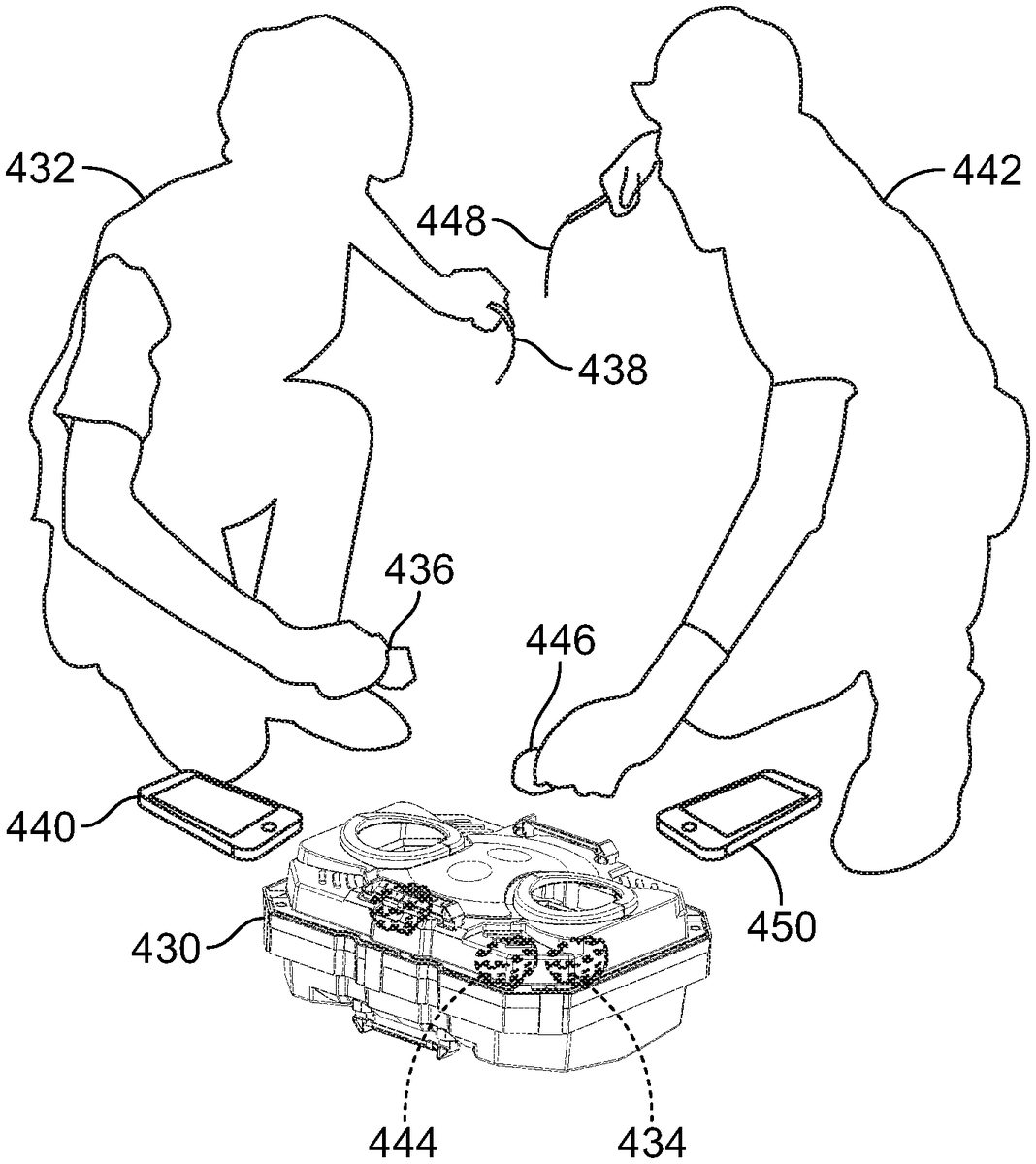
FIGS. 2 and 2Ashow perspective views of players, each with battling top devices, playing a battling game which may use two or four physical toy tops and a stadium-shaped game board arena. In the described embodiments, a battle using a multiplicity of physical toy tops occurs in a stadium-shaped game board430.FIG. 2Ashows that the first player432has spun one battling physical top434, which is spinning in the stadium-shaped game board430. The first player432is also shown holding a wound physical top436, which has been wound using the ripcord438so that the wound physical top436is gyrating and will spin when placed on a the surface of the stadium-shaped game board430. The first player's electronic device440sits in close proximity to the first player432so that the first player432may see and hear the videogame app running on the first player's electronic device440.
Likewise,FIG. 2Ashows that the second player442has spun one battling physical top444, which is spinning in the stadium-shaped game board430. The second player442is also shown holding a wound physical top446, which has been wound using the ripcord448so that the wound physical top446is gyrating and will spin when placed on a the surface of the stadium-shaped game board430. The second player's electronic device450sits in close proximity to the second player442so that the second player442may see and hear the videogame app running on the second player's electronic device450. The stadium-shaped game board430may be further identified, uniquely identifiable, or redeemable either through digital connectivity, with a slip sheet insert, or using a communicated or printed code.
In scenarios like that inFIG. 2A, the battling physical top434, the battling physical top444, the wound physical top436, the wound physical top446, the stadium-shaped game board430, the first player's electronic device440and the second player's electronic device450are all BLE equipped and are capable of recognizing each other, which may be subject to activation by registration in some described embodiments. Other protocols may be used. For example, the first player432has purchased the battling physical top434and the wound physical top436and registered them to an account associated with the first player432and a videogame app running on the first player's electronic device440. Similarly, the second player442has purchased the battling physical top444and the wound physical top446and registered them to an account associated with the second player442and a videogame app running on the second player's electronic device450.
In this example, because each BLE equipped physical top has a unique alphanumeric identification number that it communicates to each player's BLE equipped electronic devices, the videogame application on each player's electronic device may sense which battling physical tops belong to the player whose account is associated with that player's electronic device and which battling physical tops belong to the opposing player. Thus, the videogame application for a particular player may keep track of the opponents' identities against whom that particular player has battled. Each videogame application may further offer a user input interface to allow each player to enter who won each battle.
In some embodiments, as noted above, the BLE module in a physical top may be activated by a centrifugal switch so that spinning may be detected and/or an assembly contact switch so that a fully assembled top may be detected. In these embodiments, the videogame application on each player's electronic device may be programmed to know that a particular physical top has stopped spinning because the videogame application is no longer receiving the physical top's unique alphanumeric identification number because of rotation or because the physical top has broken apart. In these embodiments, the videogame application may automatically calculate who has won by the last top spinning, as well as calculate battle standings and related statistics. For purposes of the described embodiment, a physical top that has broken apart is no longer spinning.
It should be noted thatFIG. 2Afeatures physical tops that begin gyrating internally when energy is transferred to the top from a player pulling a ripcord. This configuration allows the player to hold a top that is gyrating internally and to place the top onto a surface so the top will spin without the top losing much energy. While this form of a physical top may be desirable in many embodiments, the described manner of spinning the top is not meant to be limiting, and other means of spinning the physical tops are possible, and means other than receiving BLE from spinning may be used, such as means using an assembly contact switch as described above.
FIG. 2Bshows a transparent plan view from the side of a stadium-shaped game board. In this particular embodiment, the battle arena is an BLE equipped stadium game board452with an BLE reader antenna454proximate the BLE equipped stadium game board452such that the BLE reader antenna454will detect a spinning top within the BLE equipped stadium game board452. The stadium electronics456inputs signals from the BLE reader antenna454and receives the unique alphanumeric identifier only for tops within the BLE equipped stadium game board452. In tops where a centrifugal switch enables an BLE read only for spinning tops, the stadium electronics456will start detecting spinning tops when placed within the BLE equipped stadium game board452and stop detecting a top when the top stops spinning within the BLE equipped stadium game board452or exits while spinning. In tops where an assembly contact switch enables a BLE read only for assembled tops, the stadium electronics456will start detecting assembled tops when placed within the BLE equipped stadium game board452and stop detecting a top when the top stops breaks apart within the BLE equipped stadium game board452or exits while spinning.
The stadium electronics456communicates in real time with a videogame app on an electronic device458by sending the unique alphanumeric identifiers of the tops spinning within the BLE equipped stadium game board452to the videogame app through a wired connection460plugged into the headphone jack462of the electronic device458. Although this connection is shown as wired, wireless connections may also be used. This way, from real time data, the videogame app can determine the order in which the spinning tops stop and thus determine a winner and the finishing positions of all the competitors. For example, inFIG. 2B, the first player top464and the second player top466may be placed onto the stadium battling or game surface468, where each top will spin and emit its unique alphanumeric identifier and continue to emit the identifier while spinning. Meanwhile, the data from the spinning tops will go through the stadium electronics sensor devices456to the personal electronic device458which is capable of detecting and monitoring the spinning tops on the battling or game surfaces, and communicating the spinning top activity to the videogame app on the personal electronic device of the user458and track the battle until all tops have stopped spinning. Alternatively to the wired connection shown inFIG. 2B, the electronic sensor devices456are capable of wirelessly communicating the spinning top activity to a personal electronic device of the user. Then, the videogame app will be able to determine the entire outcome of the battle, including the winner and the order in which the tops stopped. Additionally, the videogame app may manage statistics for all players and offer rewards to redeem either in the real world or in the virtual world. The statistics kept may also be transferred to the Cloud for storage, management, including rewards, and use across a network.
FIG. 2Cshows physical toy top recognition on the electronic device when a player returns from playing a physical battle and goes to play a virtual battle. Once the players have finished the physical battle in the real world, they may return to battle in the virtual world by performing the tapping process described above. That is, each player may take his or her registered physical top470, with the videogame app running on the electronic device472, and tap the top on the video screen474of the electronic device472. Because the player has registered the physical top470, the videogame app recognizes the unique alphanumeric identification and displays a top recognition notice475and a recognized top image476, which is shown as an image of the registered physical top470inFIG. 2C. At this point, the player has successfully transferred the Spirit back to the virtual environment. The player is also prompted with a virtual battle inquiry478asking the player if he or she wishes to battle in the virtual world. The player may select the virtual battle accept button480to play or the virtual battle decline button482not to play.
FIG. 3shows how a player may register a physical top on more than one of the player's electronic devices in the integrated multi-environment game. In the described embodiments, a player who has a registered physical top470may use the registered physical top470on any capable electronic device that the player owns. As shown inFIG. 3, an integrated system may consist of a registered physical top470, a first registered electronic device484, and a second registered electronic device486.
Referring now toFIGS. 4-6, there is illustrated an embodiment of the present invention in the form of a battle tower, stadium or battle game arena apparatus10that provides multiple surfaces for spinning battle tops to engage each other in combat. Battle tops of the type that may be used with the battle arena apparatus10are disclosed and expressly incorporated herein by reference for an “Integrated Multi Environment Interactive Battle Game” published on Feb. 4, 2016, US Patent Application Publication 2016/0030848, to Lema et al. The following Patent Application for a “Multi Sourced Point Accumulation Interactive Game” also filed on Feb. 4, 2016, US Patent Application No. 2016/0035178 to Judkins, et al. is also expressly incorporated herein by reference.
The battle game arena apparatus10is made very compact and lightweight for shipping and yet easy to assemble and use. The battle arena10is also reversible or may be flipped such that when placed in one orientation the battle arena is arranged for up to two players, as shown inFIG. 4, and when turned upside down to another orientation the battle arena is arranged for up to four players, as shown inFIG. 5. The battle arena10is formed of a rugged transparent plastic having a length of about seventeen and a half inches, a width of about fourteen inches and a height dimension of about seven and a half inches when assembled. However, before assembly and during shipment, the battle arena10may be less than about three and a half inches high, less than half of the assembled height and hence much more efficient for shipping. The battle arena has connectors/couplings and openings/couplings that allow for a nesting configuration that may easily be transformed to a game ready configuration.
The battle arena apparatus10includes as its main components a first lid12, as seen inFIG. 4, having two opposing main openings or launch openings14,16, and a second lid18, as seen inFIG. 5, having four main openings or launch openings20,22,24,26. The two launch openings of the first lid, enable two, or up to two players, to each insert a spinning battle top through a corresponding launch opening of the first lid. Similarly, the four launch openings of the second lid, enable up to four players to each insert a spinning battle top through a corresponding launch opening of the second lid.
The battle arena game apparatus10also includes a first base30, as seen inFIG. 6, having a battling or game playing surface32, to enable spinning battle tops inserted through the two launch openings of the first lid to engage each other in combat. A second base36, also includes a battling or game playing surface38to enable spinning battle tops inserted through the four launch openings in the second lid to engage each other in combat. The battling or game playing surface38of the second base is positioned juxtaposed to the second lid18. The second base36also includes a support surface210for mounting the first base30, with the first base being mounted juxtaposed to the first lid12. Both of the battling or game playing surfaces32,38give the appearance of being suspended between the lids12,18when the arena is in play mode. The second base36mounts the first and second lids, with the second base including a first side and a second side and a clam shell coupling mounting the first lid to the first side of the second base and a clam shell coupling mounting the second lid to the second side of the second base. The lids12,18and bases30,36are easily assembled by attaching each of the lids12,18and the first base30to the second base36, as will be described in greater detail below.
The first lid12is formed of transparent plastic with the two large launch openings14,16to enable two players to each insert or drop a spinning battle top through a respective opening as indicated inFIG. 2A, such that a battle is able to occur on the game surface32of the first base30. Each of the main openings14,16may have a diameter of about four inches. The first lid12,FIGS. 4, 6 and 7, has a generally upside down pan-shaped configuration with four sidewalls40,41,42,43, four beveled corners44,45,46,47, and a top surface48. The top surface includes a raised ring50,52positioned around a corresponding opening14,16. The top surface48also includes strengthening levels54,55,56,57,58near the corners44,45,46,47and around a center region60. A handle62,64is connected along each side of the lid and a pointer66,68is attached to each of the handles. The handles62,64make handling of the battle arena10convenient, function as supports when the first lid12is at the bottom of the battle arena as shown inFIG. 5, and serve as scoreboards70,72for the two players.
The first lid12also includes a peripheral flange74,FIG. 7, with a clam shell coupling having four round connector openings75,76,77,78and two rectangular connector openings79,80for receiving a mating clam shell coupling including projecting generally round and rectangular finger and hook clip connectors formed with and on the second base36. The peripheral flange74also includes six oversize rectangular openings81,82,83,84,85,86for accommodating the second base36during shipment and prior to assembly of the battle arena10. Two hexagon shaped openings88,90are provided for attachment of the handle62and two hexagon shaped openings92,94are provided for attachment of the handle64. When the first lid12is oriented in one mode, it may be attached to the second base36. However when the first lid is pivoted 180° the connectors are accommodated by the oversize openings and attachment of the first lid to the second base is avoided.
The second lid18,FIGS. 5, 6 and 8, with the four large launch openings20,22,24,26enables up to four players to each insert or drop a spinning battle top through a respective opening so that combat of up to four tops is able to be played on the battling or game playing surface38,FIG. 11, of the second base36. Each of the main openings20,22,24,26may be generally square shaped with beveled corners and have a dimension of about three and three-quarters inches across. The second lid18, similar to the first lid12, has a generally upside down pan-shaped configuration with four sidewalls100,101,102,103, four beveled corners104,105,106,107, and a top surface108with a border110. The second lid18also includes partial borders112,113,114,115around corresponding main openings20,22,24,26for strengthening the second lid. Two handles130,132are connected along each side of the second lid18and two pointers134,136and138,140are attached to each of the handles. The handles130,132make handling the battle arena10convenient, provide a support when the second lid18is lowermost as shown inFIG. 4, and serve as scoreboards, with two scoreboards142,144on each handle as illustrated on the handle132inFIG. 5.
The second lid18also includes a peripheral flange150,FIG. 8, with a clam shell coupling having four round openings152,153,154,155and two rectangular openings156,157for receiving corresponding clam shell coupling of round and clip connectors extending from the second base36. The flange150also includes six oversize rectangular openings160,161,162,163,164,165for accommodating the connectors of the second base36during shipment and prior to assembly. Like the first lid, the second lid includes hexagon shaped openings for attaching the handles.
In the alternative, the first and second lids12,18may be transparent only around the centers of the top surfaces48,108to allow the battle tops to be viewed by the players from above. The lids may have decals on their sidewalls and portions of their top surfaces. Also in the alternative, the main openings may be larger or smaller as a function of the sizes of battle tops being used.
The first base30,FIGS. 6 and 9, is mounted to the second base36to work with the first lid12. As shown inFIG. 6, the base30is located beneath the first lid when the arena is assembled. The first base30is relatively narrow and includes the centrally located battling surface32flanked by a pair of opposed slanted slide regions170,172. The slide regions are mounted juxtaposed the two launch openings of the first lid, with slide region170located beneath the launch openings14and the slide region172located beneath the launch opening16when the arena is assembled. The slide regions170and172are slanted toward the battling surface of the first base for directing spinning tops from the launch openings14and16to the battling surface32. The angle of the slide regions from a horizontal reference may be about 5°.
The battling surface32is circular and includes a circular wall174at least partially forming a raised perimeter around the battling surface. The battling surface has a diameter of about five and a quarter inches, and the circular wall174has a height of about one-eighth of an inch. The battle arena, in combination with one or more spinning toy tops, each top having a tip suitable for gliding down the slide regions from the launch openings to battle at the battling surface, and are prevented by the circular wall from reentering the slide regions from the battling surface to create a one way flow of the one or more tops from the openings to the battling surface to maximize collisions between actively spinning tops at the battling surface.
The battle tops may engage each other in combat by colliding with each other on the battling surface32until only one top remains spinning and thus is the winner. The battle of the tops may be viewed through the top and sides of the first lid12and may appear to be suspended when the battle arena is transparent. Short walls176,178may also border the slide regions170,172. The first base30also includes six flange tabs180,181,182,183,184,185having six rectangular openings186,187,188,189,190,191for receiving clip connectors mounted on the second base36and two guide tabs192,194,FIG. 6, may depend from the first base30. The first and second lids12,18and the first base30may be formed of any suitable plastic.
The second base36,FIGS. 6, 10 and 11, mounts the first base30and attaches to the first and second lids12,18to form the assembled arena shown inFIGS. 4 and 5. The second base36may be formed of a more rigid plastic than the lids and the first base, and includes two long sides200,202and two short sides204,206that may have the same dimensions as the first and second lids. Between the sides200,202,204,206extends a game surface212, and a support surface210facing and acting with the first lid12with the game surface212facing and acting with the second lid18.
The support surface210, as seen inFIG. 10, includes two U-shaped interior walls216,218for supporting the first base30and a central panel219(the opposite side of the battling surface38) for supporting the battling surface32of the first base30. The support surface210includes six upstanding finger and hook or clip connectors220,221,222,223,224,225for being received in corresponding openings186,187,188,189,190,191in the first base30that attach the first base30to the second base36.
To either side of the central panel219are two large trapezoidal openings230,232and around the edges of the second base is a clam shell coupling including six tabs234,235,236,237,238,239for supporting six upstanding connectors, four round connectors242,243,244,245to be received in corresponding clam shell coupling including openings75,76,77,78of the first lid12and two clip connectors246,247for receipt by corresponding openings79,80in the first lid12, for coupling the first lid to the first side of the second base. Two upstanding tabs250,252,FIG. 6, are mounted adjacent the connectors220,223respectively.
The game surface212, as seen inFIG. 11, of the second base36includes two pairs of opposed slanted slide regions flanking the battling surface38of the second base and mounted juxtaposed the four launch openings of the second lid. The two pairs of opposed slanted slide regions includes four slanted slide regions260,261,262,263, located beneath a corresponding one of the four main openings20,22,24,26of the second lid18when the arena is assembled. The four slide regions260,261,262,263are slanted toward a battling surface for directing spinning tops from the launch openings to a battling surface. The angle of each of the slide regions from a horizontal reference may be about 5°. The four slide regions function to direct battle tops dropped through the four openings20,22,24,26to slide downward to the battling surface38.
The battling surface38is circular and includes a circular wall266at least partially forming a raised perimeter around the battling surface. The short circular wall266may have a height of about one-eighth of an inch and the battle surface38may have a diameter of about a five and a quarter inches. Up to four battle tops may engage each other in combat on the battle surface38and the winner of the combat is the last top still spinning. The circular wall at least partially forming a raised perimeter around each of the battling surfaces prevents spinning tops from exiting the battling surfaces to maximize the frequency of collisions between actively spinning tops for enhanced game play and fun for the user.
In summary, the battle arena game apparatus includes multiple launch openings and slide regions for guiding spinning toy battle tops to flow one way from the launch openings toward the battling surfaces for engaging the tops in combat. The arena, in combination with one or more spinning toy tops, each top having a tip suitable for gliding down the slide regions from the launch openings to battle at the battling surfaces, and prevented by the circular wall from reentering the slide regions from the battling surfaces to create a one way flow of the one or more tops from the openings to the battling surfaces to maximize collisions between actively spinning tops at the battling surfaces.
Alternatively, the battle arena game apparatus can be described as a clam shell battle arena game apparatus10enabling two and four player orientations and including a first clam shell housing12having two launch openings14&16to enable up to two players to each insert a spinning battle top through a corresponding launch opening of the first clam shell housing. A second clam shell housing18having four launch openings20,22,24,26, enable up to four players to each insert a spinning battle top through a corresponding launch opening of the second clam shell housing, and a base unit36having a first side210and a second side212, couples to the first clam shell housing at the first side and the second clam shell housing at the second side. A first battling surface32at the first side of the base unit enables spinning battle tops inserted through the two launch openings of the first clam shell opening to engage each other in combat, and a second battling surface38at the second side of the base unit enables spinning battle tops inserted through the launch openings in the second clam shell housing to engage each other in combat.
As seen inFIGS. 4 & 5, the base unit36containing first and second battling surfaces32and36, respectively, is sandwiched between first and second clam shell housings,12&18, respectively. The first and second battling surfaces32&38, further include a circular wall at least partially forming a raised perimeter around each of the battling surfaces. A pair of opposed slanted slide regions170&172flank the first battling surface32and are mounted juxtaposed the two launch openings of the first clam shell housing when the arena is sandwiched together. Likewise, two pairs of opposed slanted slide regions, (260&262) & (261&263) flank the second battling surface38are mounted juxtaposed the four launch openings of the second clam shell housing when the arena is sandwiched together.
The slide regions are all slanted toward a battling surface for directing spinning tops from the launch openings to a battling surface. The clam shell battle arena, in combination with one or more spinning toy tops, each top having a tip suitable for gliding down the slide regions from the launch openings to battle at the battling surfaces, and prevented by the circular wall from reentering the slide regions from the battling surfaces to create a one way flow of the one or more tops from the openings to the battling surfaces to maximize collisions between actively spinning tops at the battling surfaces. Additionally, includes is one or more electronic sensor devices capable of detecting and monitoring spinning tops on the battling surfaces and wirelessly communicating the spinning top activity to a personal electronic device of a us
The game surface/second side212of the second base36also includes a peripheral rim270including the clam shell coupling having six connectors, four generally round connectors272,273,274,275that are received by the corresponding clam shell coupling including openings152,153,154,155in the second lid18. Two clip type connectors276,277are for receipt in corresponding openings156,157. Peripheral rectangular openings280,281,282,283,284,285may be used to facilitate shipping.
The rectangular openings81,82,83,84,85,86,FIG. 7, in the first lid12and the rectangular openings160,161,162,163,164,165,166,FIG. 8, in the second lid18are provided for ease of packaging. The rectangular openings are placed to allow the lids12,18and the bases30,36to be nested but not yet attached.
In operation of the battle arena apparatus10, the apparatus is nested for shipment and must be unpacked and easily assembled by a user. The first base30is snapped into place on the game surface210of the second base36, the pointers66,68are attached to corresponding handles62,64, and the handles62,64are then connected to the first lid12. The pointers134,136,140,142are attached to the corresponding handles130,132and the handles130,132are connected to the second lid18. The first lid12may then be attached to the connectors242,243,244,245,246,247,248on the periphery tabs of the second base36and the second lid18may be attached to the connectors272,273,274,275,276,277of the second base36. After assembly, the battle arena apparatus is ready for play. When there are two players, the battle arena10is oriented (as shown inFIG. 4) with the first lid12facing the players, and the second lid18is resting on a table, floor or other convenient support surface. When there are up to four players, the battle arena10is flipped or turned upside down so that the second lid18is facing the players (as shown inFIG. 5) and the first lid12is lowermost and resting on the support surface.
In use of the battle arena10, each player may assemble his/her battle top, where each top may have its own characteristics, and each player may use a ripcord to cause the top to spin. The top is placed over one of the main openings in the first or second lids12,18that has been assigned to that player and the spinning top is dropped onto the main opening. The winner of a battle may then move his/her pointer on a corresponding handle to keep score.
A variation of the inventive battle arena apparatus is shown inFIGS. 12-14, where a battle arena apparatus350is illustrated. The battle arena apparatus includes a first lid352with two main openings354,356for receiving spinning battle tops from two players and a second lid360having four main openings362,364,366,368for receiving spinning battle tops from up to four players. Located beneath the first lid352, when the first lid352is facing the players, is a first base370having a battle surface372, and located beneath the second lid360, when the second lid360is facing the players, is a second base374having a battle surface376. Each of the main openings of the first and second lids352,360, such as the main opening356in the first lid352and the main opening368in the second lid360, are bordered by walls, such as the wall380bordering the main opening356and the wall382bordering the main opening368. The bordering walls380,282function to direct spinning tops into a corresponding main opening and act as stands for supporting the battle arena apparatus350on a support surface when the walls are lowermost when the game is to be played. The lids and bases may have the same types of connectors and openings to receive the connectors as the battle arena apparatus10. Operation of battle arena apparatus350is the same as operation of the battle arena apparatus10, as is assembly of the battle arena apparatus350.
The battle arena apparatus disclosed in detail above have great play value, are fun to use and easy to operate. The apparatus are compact for shipping and yet easily assembled. The resulting assembled apparatus are robust and rugged, and may be produced at reasonable cost.
The present invention also includes a method300,FIG. 15, for making a game battle arena apparatus including the steps of forming a first lid having two main openings302to enable up to two players to each insert a spinning battle top through a corresponding opening in the first lid, forming a second lid having four main openings304to enable up to four players to each insert a spinning battle top through a corresponding opening in the second lid, forming a first base being mountable to a second base306, the first base having a game surface to enable spinning battle tops inserted through the first lid to engage each other in combat, and forming the second base for mounting the first base and for mounting the first and second lids308, the second base having a game surface to enable multiple spinning battle tops inserted through the second lid to engage each other in combat.
The method for making a battle arena game apparatus further includes the step of forming a pair of opposed slanted slide regions flanking the game surface of the first base and mounted juxtaposed the two main openings of the first lid, and forming two pairs of opposed slanted slide regions flanking the game surface of the second base and mounted juxtaposed the four main openings of the second lid. The method further includes the step of combining with one or more spinning toy tops, each top having a tip suitable for gliding down the slide regions from the main openings to battle at the game surfaces, creating a one way flow of the one or more tops from the openings to the game surfaces to maximize collisions between actively spinning tops at the game surfaces. The method also includes the step of forming at least two play modes, having a first play mode accommodating up to two players when the battle arena game apparatus is placed in one orientation and a second play mode accommodating up to four players when placed in another orientation.
From the foregoing, it can be seen that the present inventions provide a unique battle arena game apparatus which accommodates two players when placed in one orientation and four players after being flipped to another orientation. The arena includes multiple launch openings and slide regions for guiding spinning toy battle tops to flow one way from the launch openings toward the battling surfaces for engaging the tops in combat. The circular wall at least partially forming a raised perimeter around each of the battling surfaces prevents spinning top from exiting the battling surfaces to maximize the frequency of collisions between actively spinning tops for enhanced game play and fun for the user. While particular embodiments and variations of the present invention have been shown and described in great detail, it will be obvious to those skilled in the art that changes and modifications may be made without departing from the invention in its broader aspects. Therefore, the aim is to cover all such changes and modifications as fall within the true spirit and scope of the invention. The matters set forth in the foregoing description and accompanying drawings are offered by way of illustrations only and not as limitations.
Claims
- A battle arena game apparatus, comprising: a first lid having two launch openings to enable two players to each insert a spinning battle top through a corresponding launch opening of the first lid;a second lid having four launch openings to enable four players to each insert a spinning battle top through a corresponding launch opening of the second lid;a first base having a battling surface to enable spinning battle tops inserted through the two launch openings of the first lid to engage each other in combat;and a second base for mounting the first and second lids and having a support surface and a battling surface, the support surface for mounting the first base, and the battling surface to enable spinning battle tops inserted through the four launch openings in the second lid to engage each other in combat.
- The battle arena game apparatus according to claim 1 , wherein the second base further comprises a first side and a second side, and a clam shell coupling mounting the first lid to the first side of the second base and a clam shell coupling mounting the second lid to second side of the second base.
- The battle arena game apparatus according to claim 2 , wherein the battling surfaces of each of the first and second bases further comprise a circular wall at least partially forming a raised perimeter around each of the battling surfaces.
- The battle arena game apparatus according to claim 3 , further comprising a pair of opposed slanted slide regions flanking the battling surface of the first base and mounted juxtaposed the two launch openings of the first lid.
- The battle arena game apparatus according to claim 4 , further comprising two pairs of opposed slanted slide regions flanking the battling surface of the second base and mounted juxtaposed the four launch openings of the second lid.
- The battle arena game apparatus according to claim 5 , wherein each of the slide regions are slanted toward a battling surface for directing spinning tops from the launch openings to a battling surface.
- The battle arena game apparatus according to claim 6 , in combination with one or more spinning toy tops, each top having a tip suitable for gliding down the slide regions from the launch openings to battle at the battling surfaces, and prevented by the circular wall from reentering the slide regions from the battling surfaces to create a one way flow of the one or more tops from the openings to the battling surfaces to maximize collisions between actively spinning tops at the battling surfaces.
- The battle arena game apparatus according to claim 7 , further comprising one or more electronic sensor devices capable of detecting and monitoring spinning tops on the battling surfaces and wirelessly communicating the spinning top activity to a personal electronic device of a user.
- A clam shell battle arena game apparatus enabling two and four player Orientations, comprising: a first clam shell housing having two launch openings to enable up to two players to each insert a spinning battle top through a corresponding launch opening of the first clam shell housing;a second clam shell housing having four launch openings to enable up to four players to each insert a spinning battle top through a corresponding launch opening of the second clam shell housing;a base unit having a first side and a second side, coupling to the first clam shell housing at the first side and coupling to the second clam shell housing at the second side;a first battling surface at the first side of the base unit to enable spinning battle tops inserted through the two launch openings of the first clam shell opening to engage each other in combat;and a second battling surface at the second side of the base unit to enable spinning battle tops inserted through the launch openings in the second clam shell housing to engage each other in combat.
- The clam shell battle arena game apparatus according to claim 9 , wherein the first and second battling surfaces, further comprise a circular wall at least partially forming a raised perimeter around each of the battling surfaces.
- The clam shell battle arena game apparatus according to claim 10 , further comprising a pair of opposed slanted slide regions flanking the first battling surface and mounted juxtaposed the two launch openings of the first clam shell housing.
- The clam shell battle arena game apparatus according to claim 11 , further comprising two pairs of opposed slanted slide regions flanking the second battling surface and mounted juxtaposed the four launch openings of the second clam shell housing.
- The clam shell battle arena game apparatus according to claim 12 , wherein each of the slide regions are slanted toward a battling surface for directing spinning tops from the launch openings to a battling surface.
- The clam shell battle arena game apparatus according to claim 13 , in combination with one or more spinning toy tops, each top having a tip suitable for gliding down the slide regions from the launch openings to battle at the battling surfaces, and prevented by the circular wall from reentering the slide regions from the battling surfaces to create a one way flow of the one or more tops from the openings to the battling surfaces to maximize collisions between actively spinning tops at the battling surfaces.
- The clam shell battle arena game apparatus according to claim 14 , further comprising one or more electronic sensor devices capable of detecting and monitoring spinning tops on the battling surfaces and wirelessly communicating the spinning top activity to a personal electronic device of a user.
- A method for making a battle arena game apparatus, comprising the steps of: forming a first lid having two main openings to enable up to two players to each insert a spinning battle top through a corresponding opening in the first lid;forming a second lid having four main openings to enable up to four players to each insert a spinning battle top through a corresponding opening in the second lid;forming a first base being mountable to a second base, the first base having a game surface to enable spinning battle tops inserted through the first lid to engage each other in combat;and forming the second base for mounting the first base and for mounting the first and second lids, the second base having a game surface to enable multiple spinning battle tops inserted through the second lid to engage each other in combat.
- The method for making a battle arena game apparatus according to claim 16 , further comprising the step of forming a pair of opposed slanted slide regions flanking the game surface of the first base and mounted juxtaposed the two main openings of the first lid.
- The method for making a battle arena game apparatus according to claim 17 , further comprising the step of forming two pairs of opposed slanted slide regions flanking the game surface of the second base and mounted juxtaposed the four main openings of the second lid.
- The method for making a battle arena game apparatus according to claim 18 , further comprising the step of combining with one or more spinning toy tops, each top having a tip suitable for gliding down the slide regions from the main openings to battle at the game surfaces, creating a one way flow of the one or more tops from the openings to the game surfaces to maximize collisions between actively spinning tops at the game surfaces.
- The method for making a battle arena game apparatus according to claim 19 , further comprising the step of forming at least two play modes, having a first play mode accommodating up to two players when the battle arena game apparatus is placed in one orientation and a second play mode accommodating up to four players when placed in another orientation.
Disclaimer: Data collected from the USPTO and may be malformed, incomplete, and/or otherwise inaccurate.